Banner promoting anonymous crime reporting with a phone and contact number 1 800 TIPS (8477), featuring the Crime Stoppers logo and a QR code for submitting tips.

← Back

Your message to the BLOGMASTER was sent

Submitted Kemar Stuart, NNP Leader, Author Alternate Views Barbados Economic Road to Republic 

The Barbados economy reported 2.5 growth which can be described as non-performative or artificially inflated growth as the majority of our sectors underperformed with the exception of a few which recorded minor increases in overall financial contribution to the country. Alarmingly the central bank is reporting a 134% increase in the use of monetary easing or in simple terms printing money to fuel growth. The Central Bank of Barbados financed government operations to the tune of $623 Million in June 2025 up from $270 M  for the entire year of  2024. This is very concerning. 

This $623 Million is the highest recorded level of CBB financial support of government operations since the financial year 2017-2018 recorded at $1.6 Billion when Chris Sinckler was Minister of Finance. 

To break down the GDP performance by sector, Tourism recorded a surplus of 33.2 M , construction 14.3 M and business & other services 67.7 M. These are supposedly being used as leaders in growth measurements.

Tourism arrivals continue to be overstated as the 472K figure recorded for cruise passengers was led by 34.8% increase in-transit cruise arrivals. The overall number of actual cruise calls declined by 21 which shows that less cruise ships are using Barbados as a call port. Air to sea transfers inflated visitor arrivals to 395 K visitors. Despite these record tourist arrival numbers the revenue collected was overall minor 33.2 Million

The government is depending on future price increases as the continued attempts to fuel organic growth are failing. As taxation is charged as a percentage of prices with the society. Any increase in prices will benefit government tax revenue without them having to work hard to drive investment led growth. Price increases are the easiest and laziest way for the government to keep afloat financially.


Discover more from Barbados Underground

Subscribe to get the latest posts sent to your email.

63 responses to “NNP charges artificial economic growth”


  1. We had 2.5% growth but prices are forecast to increase.

    Barbados likely to feel fallout from rising inflation

    Inflation has increased in the United States (US) and Central Bank Governor Dr Kevin Greenidge believes that based on Barbados’ fixed exchange rate and its reliance on the US market, this could negatively impact prices in the coming months.

    In the Central Bank’s half-year economic review, released on Friday, Greenidge said inflation declined to 0.5 per cent “as international price pressures eased”.

    However, last week, the US Bureau of Labour Statistics reported that inflation increased to 2.7 per cent as American consumers faced higher prices linked the tariffs the Donald Trump administration has imposed on trading partners.

    “Because of our fixed exchange rate, . . . we are tied to the US inflation. We import about 75 to 80 per cent [of inflation] but with a lag, our research and analysis suggests a four-month lag, or so,” Greenidge said when asked if Barbados’ prices were likely to feel any fallout from this US inflation increase.

    “So, those prices will eventually feed back through as we import materials and we import energy. So, that is why we expect a pick-up in inflation towards the end of this year, . . . and if you go from 0.5 to two [per cent], that’s a significant pick-up in six months. So, we do expect to see that, and we built it into our projection.”

    Greenidge reminded that inflation was a general increase in prices, which meant that inflation at 0.5 per cent did not mean that prices in Barbados were not rising.

    “To be honest, yes, prices remain high, they have been high for a while and I think our goal is to mitigate increases going forward, to keep them at a minimum,” he explained.

    “And then make smart choices, like investing in renewable energy, . . . and also doing what we can at our own household level, [with solar] panels, and so on, to mitigate the effects of that [inflation].

    “Any dynamics that feed into inflation abroad will eventually find its way into Barbados. Similarly, if oil prices and commodity prices move up or down, those feed into inflation. We remain quite vulnerable and exposed to inflation dynamics abroad.”

    In the review, Greenidge said “prices moderated across several categories, including alcoholic beverages and tobacco, furnishings and household equipment, and housing and utilities. Transport costs also declined in line with lower international oil prices”.

    Inflation is expected to remain low and stable, he said, noting that “after decelerating sharply and registering only minimal price increases in the first half of 2025, domestic inflation is projected to rise gradually, with the 12-month moving average inflation rate anticipated to stabilise between 1.7 and 3.5 per cent”. (SC)

    Source: Nation


  2. What does the statement mean because there is mention of enhanced governance infrastructure. Does it mean many of them have been able to make their financials current?

    SOEs on right path

    By Shawn Cumberbatch shawncumberbatch@nationnews.com

    Government is still providing millions of dollars in assistance to state-owned enterprises (SOEs) but the successful implementation of SOE reform means that these state agencies are relying less on the public purse.

    Several well-known SOEs have also reduced the amount of money they owe creditors for the provision of goods and services from $288.3 million to $48.9 million over the last seven fiscal years.

    Report

    This information comes in a Central Bank of Barbados analysis titled Delivering Fiscal Consolidation: A Credible And Sustained Effort, which examines Government’s fiscal performance since 2018.

    As Government exits about seven years of International Monetary Fund (IMF) oversight, the Central Bank is advising that Barbados must stay committed to economic and fiscal reform.

    The monetary authority said continued improvements in SOEs and prioritising investment “will be critical to safeguarding fiscal sustainability and building long-term resilience”.

    In the new analysis published as part of the Central Bank’s half-year economic report shared by Governor Dr Kevin Greenidge on Friday, the institution’s team concluded that “Barbados’ fiscal consolidation is not a story of austerity. It reflects deliberate, credible and sustained reform”.

    “Anchored in clear targets, externally validated through IMF reviews, and executed with discipline, it stands as one of the most successful fiscal adjustment efforts in the region,” the report stated.

    In the half-year report under the heading Transfers And Subsidies, the Central Bank said there was $121.6 million in grants to public institutions in the first quarter of its 2025/2026 fiscal year, down from $144.2 million in the same April to June period last year. SOEs were also paid $19.1 million in subsidies between April and June this year compared with $5.8 million in the same time last year.

    Based on information from the Ministry of Finance, the Central Bank said in its analysis that Government made millions of dollars in savings on transfers to SOEs between the fiscal years 2018/2019 and 2024/2025.

    This included well over $80 million in transfer savings related to the Barbados Tourism Marketing Inc. (BTMI), about $40 million each related to the Sanitation Service Authority (SSA) and Barbados Agricultural Management Company, and more than $20 million related to the Transport Board.

    Millions of dollars in savings on transfers were also noted in relation to the Queen Elizabeth Hospital (QEH), University of the West Indies, Barbados Tourism Product Inc., Barbados Investment and Development Corporation, Caves of Barbados Limited, Barbados Conference Services Limited, Kensington Oval Management Inc., Barbados Cane Industry Corporation, Rural Development Commission and the Child Care Board.

    Reduction

    The information reported from the Ministry of Finance also states that while SOE trade payables totalled $48.9 million at the end of the 2024/2025 fiscal year, this was a reduction when compared to the $288.3 million owed to creditors in the 2018/2019.

    The Central Bank’s fiscal consolidation analysis noted that “before 2018, SOEs imposed a significant burden on public finances, with limited oversight and growing arrears”.

    “By fiscal year 2018/19, transfers to SOEs (excluding subsidies to the Transport Board) stood at 7.2 per cent of GDP. Additionally, SOE arrears expanded significantly, reaching seven per cent of GDP by the onset of the BERT programme,” it said.

    “As part of the reforms, the number and functions of SOEs were rationalised, several entities were restructured or dissolved, fees were introduced to help finance operational costs at institutions such as the QEH, the SSA and the BTMI.

    “Oversight was enhanced through new legislation and a strengthened monitoring framework. Although progress has been made, SOEs continue to pose medium-term fiscal risks.”

    Source: Nation


  3. US$500m loan ‘makes sense’

    Government has been criticised for borrowing US$500 million at a higher interest rate to repay cheaper debt, but Central Bank Governor Dr Kevin Greenidge says the recent transaction “makes sense”.

    Barbados returned to the international capital market on June 26, when Government issued a US$500 million bond, priced at eight per cent and purchased by foreign investors.

    A Central Bank analysis, Re-Entering The Capital Markets: Strengthening Fiscal Flexibility Through Strategic Refinancing, noting that the transaction “formed part of a broader liability management strategy aimed at retiring the 2029 Eurobond”.

    “That bond was issued in 2019 following the restructuring and carried a 6.5 per cent coupon with a ten-year maturity and five-year grace period,” it said.

    The analysis said the new bond featured terms similar to the 2029 instrument, including a ten-year maturity, with a five-year grace period on principal and five years of amortisation.

    The proceeds were used to retire approximately 83.5 per cent of the outstanding 2029 Eurobond, representing US$340 million in principal payments.

    An additional US$108 million was allocated to prepay a portion of the Government’s obligations to the International Monetary Fund, which reduced the country’s use of IMF resources to below 424 per cent of quota and lowered associated surcharges.

    The remaining US$50 million will be retained as a fiscal buffer to respond to future external shocks.

    During his half-year press conference on Friday, Greenidge was asked about criticism that Barbados was borrowing money at a higher interest rate to repay debt which had a lower coupon payment.

    “There are many factors that go into a decision to undertake a debt liability management like that, and the interest is only factor,” he said.

    “In this case, Government . . . exchanged an instrument [of] 6.5 per cent for [one at] eight [per cent, that’s a 1.5 per cent gap, allowing Government to save about US$300 million in terms of payments.

    “Put that US$300 million into growing the economy, into infrastructure development, into growing capacity, and we are projecting three per cent growth.

    “In the interim, while you have the five-year grace period, you have built out the economy, the economy is much larger than it was before, you have built earning capacity, when time comes around the [additional] 1.5 per cent [interest] that you have to pay you have already earned that over many times, and you have built capacity going forward that you can pay that [debt] comfortably.

    “So, from that perspective, it makes sense. There are a number of other issues in terms of building back market confidence, in terms of exchange in instrument and building in pandemic clauses in it to give you buffers.”

    “So, it’s just not about the [interest] rate, you have got to look at the time [and] value of money. Even with the five-year grace period, inflation is going to eat out the value of what you have to pay.

    If [today] I pay US$500 million on a bond in five years and I pay US$500 million those two US$500 million are not equal, inflation has reduced the value of each of those. So, the time dynamics too, is very important.” (SC)

    Source: Nation


  4. Listen to the ideologues. They need to make it make sense for the ordinary man in the street who all they see if restricted carry capacity in almost all areas of the economy.

    Central Bank Governor supports full freedom of movement

    Central Bank Governor Dr Kevin Greenidge is all for full freedom of movement from October 1, arguing that it will benefit the economy.

    “Bodies do work,” said Greenidge when asked about the issue on Friday during his half-year press conference at the Frank Collymore Hall.

    It was announced following the recent 49th Regular Meeting of CARICOM Heads of Government in Montego Bay, Jamaica, that “to advance the goal of free movement of all Community nationals, Heads of Government, in accordance with the provisions of the Protocol on Enhanced Cooperation, authorised Barbados, Belize, Dominica and St Vincent and the Grenadines, the participating member states, to, among themselves, grant their nationals the right to enter, leave and re-enter, move freely, reside, work and remain indefinitely in the receiving Member State without the need for a work or residency permit”.

    “Their nationals will also be able to access emergency and primary health care, and public primary and secondary education, within the means of the receiving member state.

    “The participating member states have agreed that the required legislative, security and administrative measures to support the free movement of their nationals will be undertaken and that free movement among them will commence on 1, October 2025.”

    Greenidge saw benefits from this, including in relation to sectors such as construction and the country’s overall economic growth.

    “Economics 101 tells us that many factors to [achieving] economic growth is capital and labour and we have already shown that in a very small country like Barbados, our labour force is quite small compared to other persons. If you look at Singapore compared to Barbados,they have at least three million [people] or so, and bodies do work,” he said.

    “And so with an unemployment rate at the lowest level it can be, 6.3 per cent, there could only be positive benefits from an influx of labour, because we have enough work opportunities.

    “If you want to grow the economy beyond where it is now and beyond our three per cent trajectory, labour is going to be very important. There are two components to labour, the number of persons, and there is the quality of that labour, which is the training, which we would say in economics is the productivity of that labour.”

    He said beyond increased labour productivity in Barbados, including through the use of technology, there would be a need for other labour in areas such as construction.

    The Governor, therefore, saw positive benefits from Barbados’ participation in CARICOM’s full freedom of movement effort. (SC)

    Source: Nation


  5. Remember 2 figures here $623 million and $270 million. These are the 2 main figures that summarise the direction we are heading in.

    For the entire year of 2024 the central bank supported government spending to the tune of $270 million. SO FAR THIS YEAR the Central Bank has supported the state spending to the tune of $628 million. A record “propping up” in simple terms, bettered only by Sinkyuh. So my question is with us doing so well and a minister say that we collected a record amount in taxes, why the hell we had to borrow $ 628 million from the central bank for the first 6 months of this year?

    I keep telling wunna left out the fluff and study the facts. Politicians could say anthing, but tek dat with a pinch of salt and focus on the data ONLY.


  6. @John A

    Why is it a surprise? Didn’t we know from the estimates that the government will have to rely on borrowing to finance its operations? The governor of the central bank was fairly glib about it, we have high liquidity and a monetary system that can within the borrowing. This is what we have become in recent years. This is the legacy we are happy to nurture.


  7. @ David Yes as usual we will run the economy again based on borrowing. Thing is though based on ” A record year for tourism” accompanied by ” record tax receipts,” why did we need to borrow $628M in the first 6 months of this year? Remeber now for the 2nd part of the year tourism receipts will be lower than the first half and the tax take is also lower in the second half of the year.

    Will we end the year with borrowing from the central bank exceeding well over 1 billion dollars for 2025 alone ? When will we start ro reign in goverment spending and improve their collection system, so that we can put the brakes on this runaway train?

  8. NorthernObserver Avatar
    NorthernObserver

    “In this case, Government . . . exchanged an instrument [of] 6.5 per cent for [one at] eight [per cent, that’s a 1.5 per cent gap, allowing Government to save about US$300 million in terms of payments.”

    The WTF of all WTF statements.
    Interpret and explain for 10 Marks.

    “Based on information from the Ministry of Finance, the Central Bank said” note the source. Not from the audited financials of the SOEs, but the MoF. Also note the time period “transfers to SOEs between the fiscal years 2018/2019 and 2024/2025.” In other words, since the BLP was elected.

    “This included well over $80 million in transfer savings related to the Barbados Tourism Marketing Inc. (BTMI), about $40 million each related to the Sanitation Service Authority (SSA) and Barbados Agricultural Management Company, and more than $20 million related to the Transport Board.”

    We (the Barbadian public) know very little because these entities do not Report. BUT, we do know, the BAMC spun off its sugar portfolio and associated revenues/expenses, to two companies, BESCO and ABC, for the intended sale to Co-Op Energy. The sale never closed. The GoB retained ownership, but the operations were no longer under the BAMC, but separate companies. So how much did these companies lose or make? They don’t report either so we don’t know. But we got $40 million in “transfer savings”.

    Lemme explain yuh. I have 2, 30+ year old children living at home. But neither pays me a cent, they behave poorly, so I kick them out. My monthly home expenses were $10,000, but after their departure, they dropped to $7000. I am saving $3000/month? $36,000/year if I want it to sound bigger. Over a 5 year period, hundreds of thousands!!!. But, I didn’t tell you, they are unable to support themselves, so I provide them each $1200/month, but it’s not a gift, but a loan to be repaid. And the money comes from a company I own, so it goes on the company’s books, not my personal account. So what are my actual savings? Anyhow I telling anyone who will listen, I saving thousands. And assuming the interest free loans are repaid, I am saving $600/month, which is $7200/yr, which is thousands. I en lying. I’m just hoping their loving mother, doesn’t pay them to cut the grass, cause she’s telling me I’m too old, and we need to get someone to care for the yard. Even worse, she may hire a consultant to advise on yard care going forward!! And I just now got a bill, from someone I don’t know, for $10,000 for legal fees related to arranging the loans. I can’t recall hiring anyone? She says she did. Murdah. I feel kicking dem out is costing me more. Steupse. I saving thousands, and I’m sticking to that. I gone.


  9. @ NO

    It is clear the gag order has been imposed on the BAMC deal. Very unfortunate and as far as the blogmaster is concerned more of the same.


  10. LOL @ Northern
    Yours is a SIMPLIFIED explanation of how business is being done in Brassbados. Thanks!

    ANYONE who tells Bushie that they took the decision to borrow money at a HIGHER interest rate -in order to pay off an EXISTING loan at a LOWER rate, should stand by for a brass bowl cussing….

    Unless of course they ALSO explained that the existing loan is overdue, and we have NO INCOME to service THAT debt …. so we are FORCED to borrow at the best rate that we can get – to make the due payments.

    in UDDER words, Bajans are refusing to buy the damn BOSS shiite ..UNTILL outstanding reports are presented… as advised by our BU financial consultant.

    How are CBB financial professionals able to LOWER themselves to promote such flawed political messages is beyond logic….

    What a place!


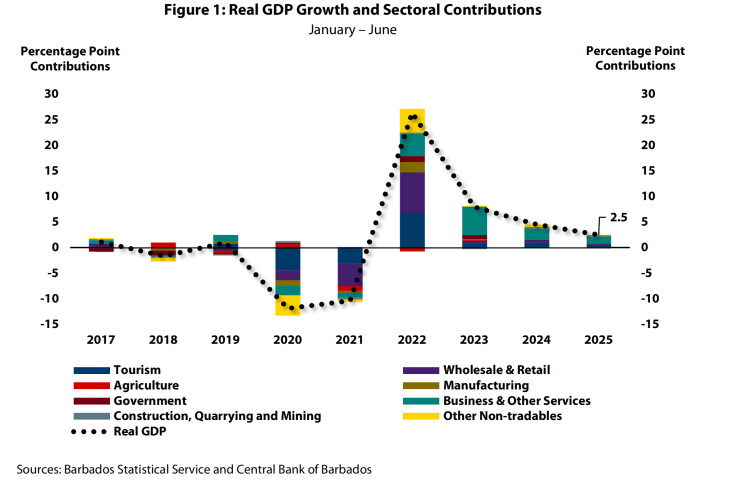
  11. Bar chart illustrating Real GDP growth and sectoral contributions in Barbados from January to June for the years 2017 to 2025, highlighting contributions from Tourism, Agriculture, Government, Construction, Mining, Wholesale & Retail, Manufacturing, and other sectors.

    It is interesting to discuss the real GDP growth areas in the economy to make sense of it. Discuss for 50 points.

  12. NorthernObserver Avatar
    NorthernObserver

    @David
    It maybe self imposed silence vs a gag order.
    The rumour which was flying around, was “Co-op Energy couldn’t come up with the money”. I asked ” they have no audited financials”, to which I get ” they have internal accounts”. I ask, which financial entity will release (loan) millions without audited financials? Silence. Now comes the crux. “It was offered to us”, a member, not Board member, of BSIL. So I ask ” why didn’t you buy it?”. Reply, ‘I was told the energy component did add up, as the grid is closed to new players for now’.
    So I ask, ‘ever thought it didn’t add up to Co-op either under the circumstances’? Silence again.
    So it’s get complicated without intimate details of “the deal”. Were they escape clauses, beyond the obvious audited financials?
    And if you wish to enter the conspiracy land, was Co-op merely a pawn to get the two Newco’s to move liability off an SOEs books. None report, so we don’t know.
    Further, and this a chat with another person, I ask about the deal to sell sugar below cost to some UK based distributor. “Dat done. It only began just before the 2018 election”. So that didn’t contribute, if true, to losses in 15-16-17. Again, no reports, so it’s all speculation, even that the UK sales deal is no longer.
    Keep us blind, and anybody with any sight, will be King. We like it so. Gimme a rum, lemme enjoy the breeze. The grands coming over soon 😀

  13. NorthernObserver Avatar
    NorthernObserver

    @Bushie
    You may have inferred that, but it said “allowing Government to save about US$300 million in terms of payments.”
    What are payments? To whom and for what?
    The obvious conundrum of rate differential caught your eye, but it was described not as 1.5% more(?), but a 1.5% gap, which “led to savings”.
    You feel he talking bout St.Lawrence Gap? Dey got on a sale down dey?
    And because bullshit baffles brains, we get a long story about the future value of money and inflation. You ever hear them tell you when they borrow over a longer term, when they pay back the dollars used will be costlier, based on the same future value principle.
    But wait, you en see hummuch dey win St.James Norf by? Tings good. #wegotthis
    Only hoping David don’t start up pun dat Eddykayshun thing again.


  14. “I ask, which financial entity will release (loan) millions without audited financials?…”
    ~~~~~~~~~~~~~~~~~~~
    …and your friend did NOT know the answer…?

    The Barbados Government!
    Via Cabinet, the responsible ministers and the LEGALLY accountable Permanent Secretaries.
    Routine stuff!!

    But then, that is just mock money from the bottomless treasury of brassbados.
    Apparently the credit unions are a bit more businesslike.

    What a place nuh!!


  15. @NO

    The dots seem to connect based on the angle you posited.


  16. Economist welcomes growth but flags risk from new borrowing
    By Shamar Blunt
    Economist Dr Antonio Alleyne is cautiously optimistic about Barbados’ latest economic performance, highlighting both encouraging signs and underlying vulnerabilities in the economy.
    His comments follow the Central Bank of Barbados’ latest economic review, which reported 2.5 per cent economic growth for the first half of 2025, driven by robust performances in tourism, construction, and business services.
    Central Bank Governor Dr Kevin Greenidge also noted a projected full-year growth of 2.7 per cent and an expected medium-term average of three per cent, supported by diversification in tourism, infrastructure development, and digital transformation.
    Tourism remained a strong pillar, with long-stay arrivals up by 3.3 per cent. The report also revealed a record $3.9 billion in international reserves—equal to 37.4 weeks of import cover– alongside a slowing inflation rate of 0.5 per cent and a declining unemployment rate, now at 6.3 per cent.
    Dr Alleyne acknowledged the economic progress: “At the surface level, it would appear that Barbados continues to recover,” he told Barbados TODAY. “We’ve had growth in tourism, the overall economy has grown . . . reserves are holding strong for months now, so that’s a good thing.”
    He praised the government’s achievement of a 3.5 per cent primary surplus, calling it “commendable, particularly in the challenging times that we have”. However, he warned that deeper issues could undercut the sustainability of these gains.
    While the unemployment rate has dropped, Dr Alleyne pointed out that productivity levels remain worryingly low, particularly in light of the government’s plans to diversify the economy.
    “We’re not being productive . . . . Whether it is the private sector or the government, somebody needs to lead it and find a way to encourage individuals to be more productive in the workplace,” he said.
    The lecturer at the Cave Hill Campus of the University of the West Indies also raised concerns about the country’s continued heavy reliance on traditional tourism markets.
    He questioned the sustainability of Barbados’ heavy reliance on markets such as the United States, Canada and the United Kingdom, noting the ongoing challenges in the UK and anticipating rising inflation and other costs in the US economy.
    He suggested that these factors could contribute to a decline in tourism arrivals.
    Dr Alleyne also noted that if the island’s growing crime situation is left unchecked, it could reduce the gains recorded in the tourism sector.
    The economist explained, “The Central Bank needs to ask itself, ‘how does this affect the tourism product [going forward]?’ Because if you think about it, the crime rate is a deterrent for tourists. So if you don’t get that under control, then that could also play a role in our growth potential, because we know for a fact that tourism is a significant contributor to the GDP.”
    Dr Alleyne stressed that his main concern is the government’s decision some months ago to borrow US$500 million (BDS$1 billion), a move intended to refinance existing debt and unlock hundreds of millions of dollars for social programmes. The government has said the measure would strengthen economic resilience and safeguard essential public services.
    “You’re borrowing money to pay debt,” he said. “That to me internally underlines and tells me that there are financial concerns that we need to worry about, because we are saying, more or less, that we are unable to pay our immediate debt.” shamarblunt@barbadostoday.bb

    Source: BT


  17. Nothing is FUNNIER than this shiite they call ‘economics’. (What ever the Hell um is…)

    It seems that anyone who can string some words together, and who can create a simple graph or chart …can take ANY set of information, however nebulous, and present any conclusion that their political sponsors require of them….especially to brass bowls.

    This thing called ‘economic growth’ is a classic.
    Every damn year we are hearing about this positive rate of growth.
    GROWTH OF WHAT?
    …de GDP!!

    What is the GDP?
    They add up all the economic activity (largely by ‘guesstimation’ – since our actual audited financials are nonexistent) and tell us that it is GOOD when this increases.

    BUT WAIT!!!
    Every damn week prices are going up..
    The SAME shiite cost us MUCH more today, than last month… making most of wunna poorer and poorer…

    So are we being told that getting POORER and POORER represents ‘National Economic progress’…?

    As a simple bushman, can someone at the damn Central Bank tell us the INDEX that measures how well (or badly) the most vulnerable among us is doing….?
    …and how THAT index has increased over the damn years.

    Everyone with eyes KNOWS that the profits from tourism, real estate, banking, utilities, retail and insurance make their merry way OVERSEAS to the owners. the ONLY resident GROWTH is in prices and frustration.
    …and everyone with ears hears that Humphrey’s ever growing welfare budget is covering less and less of the carnage every damn year – even in collusion with Mr. Saffry ‘Homeless’.

    The governor should really restrict his shiite ‘talks’ to the clueless BBs that they feature during his video ‘explanations’ on CBC…


  18. @ Bush Tea

    I going brek this down in simple shop keeper terms without the slide of hand and lot of fluff and big talk.

    RESERVES. The amount of money i got in the Sodabix can hide behind the sheep pen. Can full as ass, so I bragging bout my reserves high, but God Blyma I owe the drinks truck, the biscuit man, the Bico man and a few others, so when I pay them the Sodabix tin nearly empty ( net reserves.) You will notice no politican or governor don’t talk bout net reserves? No please dem like me and bragging bout how full the can is.

    GDP. How much business the one door shop do for the period. This includes all the brek up biscuits I sell at cost and the cornbeef sale I had, where i ain’t make no money on it, cause the expiry date was coming and i had was to offload it. Sales, sorry my GDP if you please did look good though, but the profit get it tail lick in. Next other ting the drinks truck prices went up by 5%, I just pass on the increase so as not to push up the prices too much though. This help carry up my GDP too but due to inflation, my old ass only make the same pun each drink as before the price increase.

    RECORD ARRIVALS. So last month i decide to hold a soca bram at the one door shop the last Friday in the month. I did not charge no admission cause i figure the visitors, sorry customers, would of spend nuff on drinks and I would of benefit from all these people at the shop. Would you believe those cheap bitches come and block up my place and at the end, all i mek at the bar was $30 more than the Friday before. I did vexx as ass here!

    Back to serious talk now with a few questions. Is GDP as currently applied a true reflection on our economy?

    Seeing that GDP contains an inflation factor should we seek an alternative form of quantification of our net economic activity?

    Should we stop focusing on arrivals and instead focus on spend from said arrivals? If this is done then any duplication in arrivals, like transfers and the inclusion of crews in these numbers would become irrelevant.

    Should we stop talking about gross reserves which include nuff borrowed money and instead speak to net reserves only?

    Have we reached a point in our economic life where we need to make some serious changes to how the Central Bank Report is put together and presented?

    Just asking a few questions but not expecting no answers of course.


  19. LOL @ that lotta central bank shiiteflyer

    As Bushie said, any BB who can get Excel to produce a graph; who passed O’level english , and who have minimum personal scruples …can come up with this jobby in Barbados. A place where the pinnacle of university ‘research’ is reciting old cricket scores on VOB every damn day…on “today in cricket history”.

    1 – The shiite about ‘growth’ has already been debunked as a myth designed to mislead the gullible (including gullible politicians) That is MOSTLY measuring inflation and associated POVERTY.

    2 – “Unemployment” has been REDEFINED to mean people not ACTIVELY seeking work.
    So if you have a mock degree from the Hill in ‘economics’, but cannot find a clerk job working for Massy or Digicel for the last two years, you are NO LONGER UNEMPLOYED unless you keep asking and asking them – like you are a Parro.
    Shiite!!
    The levels of youth frustration are such that Bushie is surprised that we don’t now have ZERO unemployment.

    3 – The Debt to GDP ratio is just another invented distraction. The GDP is just a rough guess in the absence of audited balances, and the debt appears to be an unknown variable with multiple random inputs and outputs, some of which give us no HOPE.

    4- ‘inflation’ is meaningless – UNLESS we are referring to a SPECIFIC collection of items,
    it is obvious that the review can be compiled to produce ANY DESIRED average result.
    But in the supermarkets, it is Hell!!

    5 – John A dealt with the so called ‘International Reserves’, …where we borrowed other peoples’ funds, and REFUSE to settle current outstanding debts (such as Tax Refunds,) in order to maintain this phantom Forex account.

    LOL
    This is like @CuhDear Bajan borrowing money from the ZR conductors on her route – to put in her Credit Union account, – and then telling us how well she is doing , while keeping the different ZR men at bay… UNTIL one catch her in a gap, that is…

    What a place!

  20. NorthernObserver Avatar
    NorthernObserver

    We’ll all ah yuh brighter than me.
    My money was kept in a mustard tot, no labels, so whenever a child showed up in any shop bearing the mustard tot, they all knew which part dem was frum.
    The goodly DrA above says
    “You’re borrowing money to pay debt,” he said. “That to me internally underlines and tells me that there are financial concerns that we need to worry about”
    But you see he has a PhD in Econ, if had paid attention in (or taken) undergrad Finance 102, he would understand the semi Ponzi scheme of International Finance called Debt Refinancing.
    But nevertheless his simple observation bears merit.
    And if he combines it with another Bajan idiom, bout kicking a tin tot down de road, he’ll get closer to reality. You see I know bout tin tots.
    The big hurdle remains unlocking local liquidity. And it seems even WhiteHoax hasn’t figured that out for them. Debt swaps, success fees, $US denominated Bonds, but not how to get Bajans to buy GoB Debt.
    Bajans en as stupid as some may think. They may not understand deeply, but they know when something smells like shit, it looks like shit, and the flies seem to enjoying it, then it is probably shit.


  21. Strong numbers, social blind spots

    BARBADOS’ LATEST ECONOMIC REVIEW, released by the Central Bank for the first half of 2025, tells a story of cautious optimism wrapped in the language of macroeconomic competence.

    The headline indicators offer plenty for the government to celebrate: economic growth registered at 2.5 per cent, unemployment dropped to 6.3 per cent and inflation hovered at a very manageable 0.5 per cent. These numbers suggest that the Barbadian economy has not only withstood global uncertainty but has, in fact, gained traction.

    Tourism continues to pulse vigorously. Arrivals from the United States, which surged by nearly 10 per cent, helped lift total long-stay visitor numbers by 3.3 per cent.

    Cruise tourism added even more sparkle to the numbers with a staggering 34.8 per cent spike in arrivals. Hotel occupancy and revenue per available room both rose. The construction sector is abuzz with activity.

    Barbados’ fiscal performance also paints a disciplined picture.

    Government revenues rose on the back of higher corporate taxes, some of which reflect one-off asset liquidations and new prepayment schedules.

    Meanwhile, spending was contained sufficiently to deliver both fiscal and primary surpluses. Debtto- Gross Domestic Product, long a point of concern, declined to 102 per cent, extending a trend that has its roots in the post-2018 restructuring programme.

    Yet, scratch beneath the surface and the picture becomes more nuanced. Much of the current stability rides on a delicate balancing act.

    The report is light on discussion of the downside risks. While it briefly mentions external shocks such as oil price volatility or geopolitical instability, it does not model or present clear alternative scenarios in which tourism receipts decline or global financial conditions tighten abruptly. These are not abstract possibilities.

    The report takes a victory lap on inflation but says little about the deeper vulnerabilities that lie beneath the benign headline number. Food inflation, fuel prices and shipping costs are all heavily influenced by international markets, and while these moderated in the first half of the year, the report does not indicate whether domestic price levels are resilient to future commodity price swings. The assumption seems to be that current trends will continue, an outlook that is overly sanguine.

    The Central Bank’s analytical frameworks remain grounded in conventional macroeconomic reporting, remaining descriptive rather than predictive. Growth is parsed by sector and fiscal balances are compared year-over-year. The report does not venture into more dynamic modelling – no use of stress-testing, no Monte Carlo simulations, no probabilistic forecasting. The absence of counterfactuals is an oversight given the structural fragility of the country. What would happen to Barbados’ growth trajectory if there were a US recession or a disruptive hurricane season? If revenue collections underperform due to fewer one-off corporate tax events or if expenditure pressures increase, can the government still meet its fiscal and debt reduction targets? How resilient is the financial sector if there is a sudden deterioration in credit quality?

    The policy recommendations are mostly implicit, resting on an assumption of continuity.

    The Central Bank celebrates its accumulation of $3.9 billion in international reserves – a record level – but stops short of indicating how this war chest might be deployed in a crisis. Nor does it suggest mechanisms to evaluate the effectiveness of existing policies. The assumption appears to be that more of the same will suffice. This may reassure markets, but it leaves the public without a roadmap should conditions change.

    There are also equity blind spots. The report gives no attention to the distributional impact of macroeconomic gains. Who is benefitting from growth? What segments of the labour force are still underemployed or facing stagnant wages? How have the fiscal surpluses translated into social spending that reaches the most vulnerable?

    These critical questions go unanswered.

    An area that deserves more scrutiny is the recent bond issuance to refinance the 2029 Eurobond. The new ten-year bond, priced at eight per cent, will indeed ease near-term cash flow pressures, but at a cost.

    The report frames this as a strategic refinancing decision and while the inclusion of a disaster clause is prudent, there is little discussion of the long-term debt servicing implications or the potential crowding out of fiscal space should global interest rates rise further.

    Ultimately, the Central Bank’s report achieves what it likely set out to do: instil confidence, attract investors and demonstrate macroeconomic stewardship. But it does so at the expense of deeper analytical transparency. It would benefit from a thorough interrogation of its assumptions, clearer articulation of risk scenarios and greater attention to social equity. If economic policy is to be inclusive, then economic reporting must be too. Until then, the quarterly economic reviews remain compelling, but frustratingly incomplete.

    Professor Troy Lorde is an economist and Dean of the Faculty of Social Sciences at the University of the West Indies, Cave Hill Campus. Email troy. lorde@cavehill.uwi.edu

    Source: Nation


  22. $57.5m drop in exports

    by SHAWN CUMBERBATCH shawncumberbatch@nationnews.com

    BARBADOS’ EXPORTS fell by $57.5 million in the first half of the year, an outcome that is causing Central Bank Governor Dr Kevin Greenidge concern.

    The 7.2 per cent between January and June resulted from lower fuel re-exports and weaker domestic shipments of food and beverages, particularly rum, lard, and margarine, amid softer international demand.

    This is what Greenidge reported on Friday during a press conference at Frank Collymore Hall to review of Barbados’ half-year economic performance.

    The country’s merchandise exports totalled $796.5 million in the first half of last year, but fell to $739 million in the same period this year.

    On the other hand, imports increased, ended June at $2.12 billion, up from $2.03 billion in the same period last year.

    “Any decline will cause you concern,” the Governor responded when asked about the fall in exports.

    He said while it was too early to say that United States tariffs had impacted Barbados’ merchandise sales overseas, “there may be a bit going on there”.

    Consumers may think twice

    “When we talk to the industry, what we are being told is that it reflects a weakening demand for some of those products. I think it’s too early to tell, from my perspective, whether that is tariff impacted, . . . but my hunch would be there may be a bit going on there,” he said.

    “For example, rum, we know we have a highly quality, specialised product in terms of rum, but a ten per cent tariff means increase in the cost of bottles, increase in the cost of labels, increase in the actual cork.

    “But it also means that those persons in, say, New York or different areas who will consume a high quality product, at the margins may think twice when they have to pay ten [to] 15 per cent [more], but I think it’s too early to say. I think we should monitor and look at what’s going on there.”

    Greenidge said that increased intra-regional trade, particularly in the context of the CARICOM Single Market and Economy, was an important way for Barbados to boost its exports, while reducing the cost of imports.

    “I think that is absolutely where we should be looking. In our last economic report . . . when we first started to see this unravelling of tariffs and this continued global struggle intensified, one of our policy recommendations in terms of that, and also where we see things heading, is that we got to look more inter regional [trade],” he said.

    “And I think more at the last Heads of Government CARICOM meeting you saw that playing out in all kinds of directions. I think that will help us now to be able to keep costs down and also to insulate ourselves a bit. So absolutely, home drums beat first, regional drums should beat also.”

    Driven by higher demand

    Greenidge said in the Central Bank’s half-year economic review that “the merchandise trade deficit widened during the first half of 2025 as imports rose and exports declined”. “The deficit expanded by $146.3 million compared to the same period in 2024. Imports increased by 4.4 per cent, driven by higher demand for food and beverages, hybrid and electric vehicles, and crane machinery used to upgrade the Bridgetown Port,” he said.

    The Barbados Statistical Service’s (BSS) monthly trade bulletin for June also shared information on the decline in exports between January and June.

    For example, while in the first six months of 2024 rum exports were $46.6 million, they declined to $31.9 million in the same period this year. In that same time, margarine and shortening exports fell from $13.9 million to $10.3 million, exports of metal containers fell from $8.4 million to $7 million, and exports of pigments, paints and varnishes decline from $1.74 million to $1.68 million.

    On the other hand, in the same six months between 2024 and 2025there was an increase in exports for medicaments and pharmaceuticals (from $15 million to $15.3 million) disinfectants, insecticides etc (from $9.7 million to $10.5 million), paper, paper products and articles of paper (from $4.3 million to $4.9 million).

    Source: Nation


  23. $1.2b in revenue from taxes taxes

    Stories by SHAWN CUMBERBATCH shawncumberbatch@nationnews.com

    GOVERNMENT EARNED about $1.2 billion from taxes in the first three months of its new financial year as this revenue category towered over the $40.5 million from non-tax revenue and grants in the same period.

    This is according to the latest information from the Ministry of Finance as shared in the Central Bank of Barbados’ half-year economic report.

    It stated that Government’s total revenue reached an estimated $1.23 billion between April and June, the first three months of the 2025/2026 fiscal year. This was an increase over the $1.11 billion in the same period last year.

    Of this amount, $1.19 billion was from tax revenue this year versus $1.05 billion last year. All information to follow relates to April to June of fiscal year 2025/2026 compared with the same three months of fiscal year 2024/2025.

    Direct taxes led the way with $707.4 billion this year, mainly from corporation tax $416 million ($291.3 million in 2024/2025), personal income tax $155.4 million ($144.8 million in 2024/2025), and property tax $101.3 million ($116.5 million in 2024/2025).

    Revenue from indirect taxes was $491.9 million this year, up from $468.1 million in 2024/2025. Most was from value added tax (VAT) $293 million ($273.9 million in 2024/2025). Other taxes included million the cent import duties $66.3 million ($64.4 million in 2024/2025), and excises $57.3 million ($58.7 million in 2024/2025).

    Other taxes contributed $71.2 million this year ($67.1 million in 2024-2025), including $18.6 million from fuel tax ($19.2 million in 2024/2025), and $14.1 million from the room rate/shared accommodation levy $14.1 million ($13.3 million 2024/2025).

    Non-tax revenue and grants in the period was $40.5 million this year versus $66.2 million in the same time last financial year. This included $27.2 million from the two per cent foreign exchange fee ($26.8 million in 2024-2025).

    Reporting on Government’s fiscal performance in the January to June report on Friday, Central Bank Governor Dr Kevin Greenidge gave some context to the revenue performance.

    “Higher corporate tax collections led the increase in total revenue during the first quarter of fiscal year 2025/26. Corporation tax receipts rose by $125.3 million, thanks to the asset dissolution of a large corporate group, stronger profitability, and larger payments under the new prepayment schedule,” he said.

    “Personal income tax collections increased by $10.6 million to $155.4 million, while property tax revenue fell by $15.3 million due to a shift in the early payment discount period. Indirect tax receipts also increased, supported by growth in domestic activity and imports.

    “Net VAT collections rose by Greenidge collections year tax to discount million from accommodation time $19.1 million, because of expansion in the accommodation and food sectors and higher import volumes. Import duties grew by $1.9 million, while net excise revenues marginally declined by $1.4 million, as revenue from fossil fuel vehicles continued to fall,” Greenidge stated.

    The Governor confirmed that non-tax revenue and grants totalled fell by $25.7 million in the period, attributing this to a normalising of investment income “following the one-off declaration of a dividend by Government in fiscal year 2024/25”.

    On the expenditure side, Ministry of Finance data reported by the Central Bank showed that recurrent expenditure in the first quarter of the 2025/2026 fiscal year was $759.6 million, up from $718.5 million in the same period in 2024/2025.

    This included transfers and subsidies $254.2 million ($252.1 million in 2024/2025), wages and salaries $221.4 million ($215.2 million in 2024/2025), interest payments $158 million ($167.1 million in rose asset group, prepayment 2024/2025), and goods and services $126 million ($84.1 million in 2024/2025).

    Greenidge stated: “Interest payments decreased in the first quarter of fiscal 2025/26, largely due to savings from the debt-for-climate swap. Domestic interest costs declined by $12.9 million, as a result of savings from the debt-for-climate swap, which facilitated the settlement of some domestic debt.

    “External interest payments increased by $3.8 million, resulting from the early settlement of the 2029 Eurobond. Recurrent expenditure rose across most categories despite a reduction in grants to public institutions.

    “Grants declined by $22.6 million, but higher subsidies to the Transport Board and larger pension payments more than offset the reduction.

    Spending on goods & services increased by $41.9 million, due to higher payments for rent, utilities, operating costs, and professional services.”

    He added: “Wages and salaries grew by $6.2 million, reaching $221.4 million at the end of the quarter. Capital spending expanded as Government advanced several major infrastructure projects.

    “Capital expenditure rose by $57.9 million in the first quarter of fiscal year 2025/26, as work continued work on the new geriatric hospital, the payment for new garbage trucks, and the construction of two senior citizens’ villages.”

    Government’s overall fiscal performance between April and June was such that it “recorded both overall and primary surpluses, . . .the result of strong corporation tax receipts”, said Greenidge.

    Overall, he stated, “Tax revenue increased by $146.7 million, reflecting winding up activities, larger prepayments, and higher profitability among corporate taxpayers. Broader economic expansion also boosted revenue across most tax categories.

    “Expenditure focused on wages and salaries, goods and services, pensions, and capital projects. The overall fiscal surplus stood at $372.9 million, or 2.4 per cent of GDP, compared to $349.5 million in the same quarter of fiscal year 2024/25.

    “The primary surplus reached $530.9 million, or 3.5 per cent of GDP, slightly higher than the $516.6 million a year earlier.”

    Greenidge said in the Central Bank’s outlook for the rest of this year that Government’s finances were “on a path of further strengthening”.

    “The Government’s fiscal stance continues to prioritise the balance between supporting growth and ensuring debt sustainability,” he said.

    “Building on a solid first quarter of the fiscal year 2025/26, which featured healthy revenue collections and a strong primary surplus, government remains committed to meeting annual fiscal targets through enhanced revenue and careful spending.

    “Ongoing tax administration reforms and the adoption of new global tax standards are expected to improve collections, providing upside potential for government revenues. These efforts create space for continued investment in critical infrastructure and climate resilience initiatives, even as fiscal discipline is maintained.”

    He added that “sustained economic growth and prudent budget management are set to keep the public debt on a downward trajectory, with the debt-to-GDP ratio projected to decline steadily toward the 60 per cent benchmark by fiscal year 2035/36”.

    “Favourable global financial conditions, including the prospect of lower international interest rates, could further ease debt servicing costs, reinforcing the positive debt dynamics,” Greenidge stated in the forecast.

    “Overall, the fiscal and debt outlook is one of gradual improvement, marked by continued surpluses, moderating debt levels, and increased resilience to future shocks.”

    Source: Nation


  24. $248.6m increase increase in borrowing

    BUSINESSES AND HOUSEHOLDS borrowed $248.6 million from financial institutions in the first half of the year. Central Bank of Barbados Governor Dr Kevin Greenidge has attributed the increase in credit to “favourable economic conditions and accommodative lending policies”.

    He gave this update on Friday while presenting the bank’s half-year economic review during a press conference at the Frank Collymore Hall.

    The overall assessment was that “the financial sector remained stable over the first half of 2025”.

    “Credit expanded moderately, with increased lending to both businesses and households. At the same time, credit quality improved, on the strength of a substantial decline in household non-performing loans. Banks and finance companies remained highly liquid, profitable, and well capitalised,” he said.

    Getting into specifics, Greenidge said that “private sector credit increased by 2.9 per cent compared to December financing strengthened”.

    “Business credit ($146.7 million), led hotels & restaurants, he elaborated.

    “Household credit ($101.9 million), driven residential mortgages. for both housing and contributed to the during the period.”

    He also noted that improved during the “The non-performing across both banks reflecting stronger household credit performance,” “Finance companies of 2.1 percentage points, December 2024, as demand for strengthened”. credit rose by 5.7 per cent led by increased borrowing from restaurants, and the real estate sector,” credit also grew by 1.8 per cent driven by rising demand for mortgages. Strong bank lending and business investment overall expansion in credit period.” that “overall credit quality the first half of 2025”. performing loan (NPL) ratio declined and finance companies, stronger economic activity and healthier performance,” said Greenidge. companies registered a decrease points, bringing the NPL ratio to 7.6 per cent, while banks recorded a more moderate decline of 0.6 percentage points to 3.5 per cent. Substantial improvements in household credit quality contributed significantly to the overall decline.”

    The Governor said too that deposit-taking institutions (DTIs) “remained profitable and well capitalised”.

    “DTIs recorded higher interest income due to increased credit activity, but higher non-interest expenses offset those gains,” he reported.

    “The return on average assets for banks and finance companies remained relatively unchanged from December 2024, amounting to 1.1 per cent for both financial sub-sectors. Capital positions remained strong across institutions.

    The capital adequacy ratio of banks declined by 1.8 percentage points to 19.4 per cent, while that of finance companies rose by 1.2 percentage points to 20.7 per cent, relative to December 2024.”

    Source: Nation

  25. NorthernObserver Avatar
    NorthernObserver

    following the one-off declaration of a dividend by Government in fiscal year 2024/25”.

    Is this the pre-election money paid to all Barbadians, I forget what they called it. Is it taxable?


  26. @NO

    Solidarity Allowance, it was announced it was exempt from being taxable.


  27. @David Some people, including many on this blog seek sometimes to overcomplicated macroeconomics even though it can be an already complex thing with a number of parts. To break it down, the economy has three main agents. Households (workers and savers), Businesses and Government. These three agents participate in the real sector (goods and services) and the financial sector. they also participate in domestic activity and external activity.

    Most economic data in Barbados is complied by the Barbados Statistical Service, with financial sector data being collected by the Central Bank as regulator.
    In spite of the protests from many critics, the government’s fiscal and debt position has improved substantially since 2018 even after a pandemic in which GDP contracted by almost 14%. This improvement is across all metrics; primary balance (which excludes interest payments), fiscal balance (which includes interest payments), debt-to-GDP ratio and debt service as a percent of revenue.

    Recall that it was runaway spending at State owned enterprises that cause a lot of the fiscal problems under the previous government. That is why we had such large fiscal deficits. The transfers to State owned enterprises have been contained, which has helped to contain the growth in current spending.

    The government has now shifted to capital spending instead of current spending. Scotland District road rehabilitation, accelerated mill and pave, this years’ focused roads programme, new geriatric hospital, new garbage trucks, infrastructural improvements at the port. What we have seen is higher primary surpluses and an increase in capital spending. This is good management of the public finances and I would support any reforms to further consolidate this position.

    On the household side inflation had kicked everyone globally since the end of the covid pandemic. If you have any doubts, check the change price of fast-food across the world. Fast-food used to be considered cheap, now its becoming a luxury. Articles like this has become common in the U.S financial press. https://www.cbsnews.com/news/fast-food-prices-us-lendingtree/
    These pressures will be felt in a country that imports 80% of it’s food.
    The growth in the Barbados economy in the last few years has led to a record low unemployment rate of 6.3%, so much so that some labour shortages have started to show up in construction and some other sectors. These jobs are being filled by Jamaicans, Colombians and Mexcians. The current record low unemployment is why the sizable minimum wage increase may not be a problem for large and medium sized businesses as most had already stated paying above $10.50 before the increase. Smaller businesses (one door shops) may find it more difficult. https://barbadostoday.bb/2025/07/29/small-companies-fear-rising-costs-as-result-of-minimum-wage-hike/

    Non-performing loan ratios at commercial banks are near all time lows after a spike during covid, and households are taking out mortgages (not only car loans) and higher rates.

    On the business end, domestic business investment in Barbados needs to be much higher than where its has been. This is one of the only ways the country can diversify it’s economy. There has been an uptick in foreign investment in the last 12 months. However this investment will flow to where foreign investors are familiar. hotels, condominiums and some renewable energy. To diversify the economy, domestic capital will have to take the lead. An area of opportunity is digitization and incorporating robotics in manufacturing and agriculture.

  28. NorthernObserver Avatar
    NorthernObserver

    @wargeneral
    Or should I call you Ryan?
    When one reads all the responses from many, not BU bloggers, there is a common thread. They seek to explain or comment on specifics from CBB report, and scattered throughout are their personal ‘feelings’, coming from life experience.
    One common comment, is we have been “saving” all this money, whether it is in transfers to SOEs, Debt swaps, etc, we have mountains of borrowed money, and yet, we are still borrowing bigly. In fact, we are even printing more.
    Under the last government, people didn’t know at the time, they were redirecting millions in public employees NIS contributions to fund government, or they were not paying their bills and had billions due in accounts payable at almost every conceivable level, or even the full extent of NIS Bond purchases (they still don’t).But they knew “something en right”.
    As one former PM noted, ‘how we get back here?’
    What many are saying today is “something isn’t right”, it doesn’t make sense.
    And the deep rooted fear, which has enough precedent it doesn’t need to be deep, is we aren’t being told the full story.
    The most damning evidence is the continued, and increased, failure to provide Annual Reports, from many of these same entities which are producing “millions in savings”.
    Even the Auditor General says he’s reviewed NIS Reports to 2015, but the public hasn’t seen one since 2008? Why?
    Minister Jordan does not wish to share all the good news? Ok so those are older reports.
    What about since 2018 for all those other SOEs?
    Natta from TB, QEH, BTMI, BMAC, BTI and the list goes on.
    We already know Barbados was offering BOSS Bonds at 4%. That rate is not commensurate with risk. Don’t touch them. And bingo, they have to offer the International investors DOUBLE that? Were the local investors being abused? (and fyi global rates have come down since BOSS were issued, not gone up)
    So without factual evidence, largely because so many public bodies do not Report as required by law, I must conclude, extreme caution and skepticism.
    Comply with the laws of Barbados, and one will be able to draw a more factually based conclusion.


  29. @NO I know where you’re going with this. I’m not Ryan so don’t call me that. I’m j7ust a Barbadian who is interested in Capital markets. That interest has led me to be thorough reader of global financial and economic publications.

    Secondly, I don’t think that anyone can argue with the need to have up to date Audited financial statements.


  30. Mr lazy gloom and doom

    Real gdp is 2.5%. If you need the number to crunch – appendix 1 ( I told you this before)

    Estimate tourist spend – appendix 2
    U have already stated there is no exact formula to calculate tourist spend and the cb don’t capture all the spend because there is a lot in the informal economy

    Short memory!


  31. NO

    Boy it seems like the only way you going to to see them reports is if you become the next AG. Apply 🙈

  32. NorthernObserver Avatar
    NorthernObserver

    @wargeneral
    The only place I’m going, is observing you locate several policy positives, and few offsetting issues.
    This administration has been significantly improved in their forecasts to actual. At least their current version of it. You may have read the Auditor Generals report, and the significant changes made to immediate prior year numbers, without explanation.
    So if I spent say $5M as per the prior report, but spent $6m this year, that’s $1M more? Unless the actual for prior year changes to $7M, in which I now “saved” $1M.
    Hence, my difficulty in accepting numbers without additional diligence. Which is darn near impossible to locate.


  33. @wargeneral

    The only metric the blogmaster feels to use is to examine where the growth in the economy is mainly coming. In appears to be from tourism and services (including financial services)?

  34. NorthernObserver Avatar
    NorthernObserver

    @john2
    I have no CA/CPA designation, and don’t support either party. So no hope. Nor interest.
    But I can constantly pressure certain groups not to invest in Barbados. And Bajans don’t like strife. So in the same way they won’t challenge Gov’t, they tend to avoid strife elsewhere too. Especially if you can direct to alternate investments.
    If you can’t get through what should be the easy way (it’s the law), you can try an alternate route.
    But truthfully, I doubt many of those Audited Reports will ever be released. Too much to keep hidden. And since they’ve been successful for this long, no need to change. If it doesn’t affect them at the polling booth, why change?
    It’s the same logic why DI, nor the ICBL execs, were prosecuted locally. A guilty verdict, would shut down much of the economic side activity. What is sometimes referred to as “knowing people” in order to get things done, would become a much riskier endeavor.


  35. @NorthernObserver

    I wholeheartedly agree with your contributions.

    Unfortunately, rather than seek the analysis of neutral economists to explain economic data for the average Barbadian, the media prefers to print certain ‘talking points’ from the Central Bank Reports, and the opinions thereof from the usual political biased economists, who would apply the ‘political spin’ accordingly.

    I noticed one of the issues BU seems to be focused on is GDP, which, I’m sure you are aware, is basically a measure of the total market value of goods and services produced within a country in a given year.

    I read CBG Greenidge expressed concern about the decreasing level of exports. Using the expenditure method to calculate GDP, Consumption + Investment + Government Spending + Net Exports (X – M).

    We’re essentially importing more than exporting.

    Without boring the forum by going into too many details, obviously, any reduction in net exports (ceteris paribus) reduces aggregate demand, may reduce real GDP in the short run, and affect economic growth.
    Also, there is an inverse relationship between the exchange rate and net exports.

    What is your opinion?


  36. Obviously the reason why no INTELLIGENT persons will stand up and represent the official government position, is that their positions have no basis in LOGIC, TRUTH or even common sense.

    The place has become a mafia…
    Plain and simple.
    …and
    Mafiosa DO NOT provide performance reports – except to the inner circle of top bosses.
    Mafiosa DO NOT pursue lawbreakers within the ranks – unless they upset the Don, in which case they are resigned, reposted overseas, outed from the party …oops mob, or sent to the back bench.

    But the BB victims are not much better themselves… and mostly SUPPORT, admire and envy them.

    Expecting saintly behaviors from known mafia players is not a hopeful exercise… UNLESS the victims awake and DEMAND changes.


  37. So after reading all the great increases in income in practically everything as outlined by the governor and others, my concerns still remain unanswered.

    Why with all these bonanzas in state revenue was it necessary to borrow $628 million in the first 6 months of 2025? Especially when in the full year of 2024 the government only borrowed $270 million. Remember in 2024 practically all of the states earnings by category, were lower in 2024 than 2025 for the same periods. That make sense to wunna?

    Secondly based on such great increases in cashflows from practically all income streams in 2025 as confirmed by governor, why would one borrow via a paper offering, $500 milion now at 8% to pay off current loans that are at substantially lower rates? Why not take some of these surplus incomes as confirmed by the governor not me, and pay off some of the loans at the lower rates that may soon be coming due? Why with these income figures do you even need to offer new paper at 8%? I mean according to the Governor we got reserves coming through we tail, so its not like we need now to prop up the reserves by paying lenders 8% for more USD. It appears we are on tract to borrow nearly 4 times the amount in 2025 from the COB on a prorated basis, as compared with 2024 ( $628m over 6 months 2025 vs $270M over 12 months 2024.)

    You see all the lotto words and lengthy attempts at discussing the situation, answers any of my concerns as outlined above. The decisions taken by our divine leaders are not therefore supported by the report. Actually the decisions are direclty in opposition to the claimed status of the economy as outlined in the Governor’s report.

    Wunna dont find that strange? Anyhow I will wait for the year end report from the Governor for 2025 in full, before I say I tell wunna so.

  38. NorthernObserver Avatar
    NorthernObserver

    @Artax
    Your observation is sound IMO, yet with all the variables, something like an inflationary increase could offset your scenario.
    We live in a chaotic world. The joke is, after all the existing trading patterns are turned upside down by politicians and their brain trust, the real players still have to buy into them?
    And you already know they are scrambling under multiple scenarios.
    I don’t want to pull a Trump, and be alarmist, yet the Canadian PM has agreed to many expenses, without accompanying revenue. Topics we haven’t heard in years, are making the rounds. The tax treaties with Barbados and 22 other nations? Especially when one of the bigger issues, is removing barriers between provinces? Why isn’t a low tax jurisdiction within Canada? Or again along a Trumpian line, this time with the issues brewing over Canadian snow birds and Florida, of Canada forging formal ties with a specific southern destination.
    There are scenarios where Barbados may benefit, both via increased tourism and decreased import cost. Or the opposite.
    So many variables. So many options.


  39. Thorne: Govt misleading public

    THE ECONOMY is not doing well despite the talk about the debt to gross domestic product (GDP) ratio.

    Leader of the Opposition Ralph Thorne told the House of Assembly during debate on the Tourism Levy (Amendment) Bill 2025 yesterday that the economic terms being used by those in Government did not mean growth.

    He said while Government was imposing taxes on Airbnb guests, Barbadians should be made aware that the country was on the precipice of disaster as the ruling Barbados Labour Party failed to protect the majority.

    Economy not well

    Thorne added that Government’s efforts to find more effective ways of catching people who were escaping the tax net was not surprising since it needed to collect more taxes because the economy was not doing well as revenue was down and so was production.

    Exports, according to the Central Bank, fell this year by 57.5 per cent but, said Thorne, the Government was saying the economy was growing and buoyant.

    “But here is how this Government continues to mislead the people of Barbados as to economic performance. This Government has cleverly taken the minds of the people of this country into a state in which the success of this country is now to be determined by something called debt to GDP ratio. The Government has convinced itself and is now trying to convince the people of this country that the measure of a country’s economic success is contained in something called debt to GDP ratio.

    “So that if you have a debt to GDP ratio that is falling, the economy is doing better. The performance of this economy is proving that that is not so. Here is a Government boasting every week about healthy debt to GDP ratio – which we questioned – and yet, the Governor of the Central Bank comes and says that exports are down. I wouldn’t say both cannot be true. It proves that debt to GDP ratio is not a proper assessment of a country’s economic performance,” Thorne said.

    That macro analysis, he said, bore little relationship to the internal workings of employment, productivity and access to jobs, among others, and that showed it was not working.

    Thorne described it as “shameful” that the Government would continue to boast about record reserves when even the man sitting on the sidewalk knew that the reserves came from borrowed money.

    Exports down

    “Here is a Government admitting through its Central Bank that exports are down. It means income is down and yet, it boasts about reserves. The reserves are borrowed monies, so I don’t know why they don’t stop boasting about that,” Thorne said.

    That exports were down and the Government continued to increase the tax burden on the people were evidence that the economy is not buoyant, the Opposition Leader said.

    Thorne also said while the amendment was touted as making things more efficient, last week there was a day when the Customs Department did not collect any revenue because the system of the greatest contributor to revenue was down.

    In addition, he said the sugar industry was in trouble because the Government did not know what to do. (AC)


    Source: Nation


  40. WTH!

    African bank to fund hotel

    by SHAWN CUMBERBATCH in Grenada

    shawncumberbatch@nationnews.com

    THE AFRICA EXPORT-IMPORT BANK (Afreximbank) has committed to lend US$61.25 million in funding for the construction of a 12-storey 150-room Homewood Suites by Hilton Hotel property in Bridgetown.

    This was announced on Monday evening during the fourth AfriCaribbean Trade and Investment Forum ( ACTIF2025) at the Radisson Conference Centre in St George’s, Grenada.

    A head of terms agreement, otherwise known as a letter of intent, was signed in this regard by Okechukwu Ihejirika, acting chief operating officer, Afreximbank Caribbean Office, which is based in Barbados, and Keith Downer, managing director, Speedbird House.

    “Afreximbank is pleased to sign a head of terms agreement with Speedbird House Limited for a term loan facility of up to US$61.25 million to finance the construction of a 12-storey, 150-room Homewood Suites by Hilton Hotel in Bridgetown, Barbados,” information from Afreximbank stated.

    “The two-tranche facility structure is part of Afreximbank’s strategy of facilitating the growth of the tourism sectors in member states of the bank under its Construction and Tourism-Linked Relay Financing Facility.”

    This deal was one of five worth a total of US$290 mllion that were signed on the first day of ACTIF2025, which the Afreximbank said showcased its “deepening investment in tradeenabling infrastructure and economic development across the Caribbean”.

    Among the signings was a US$50 million heads of terms agreement with the Government of St Kitts and Nevis for an Education Construction and Rehabilitation Climate-Linked Facility, and a US$40 million public-private partnership with Gemini Integrated Commodities Trading Company Ltd. to develop a modern commercial port in St Kitts.

    Officials also signed agreements for two “landmark transactions” in The Bahamas. These were a US$100 million Receivables Discounting Facility for the Bahamas Striping Group of Companies to rehabilitate over 200 miles of road infrastructure, and a US$40 million facility with Cat Island Infrastructure Company Ltd. for critical roadworks.

    Source: Nation

  41. NorthernObserver Avatar
    NorthernObserver

    So is the Hotel to be at Speedbird House, which has been listed for sale for some time.
    That is down in the same area as Pierhead, without beach frontage, across from the inner harbour of the Careenage. Mr Downer had been associated with Venti Global.


  42. “Today, the Bank of Canada maintained its key interest rate at 2.75 per cent — the same level it’s been since March — citing the continued lack of clarity around tariffs and the outcome of Canada-U.S. trade talks.”


  43. They should have read the memo by now, the focus will always be on tourism and International Business because there is the strong position held that it moves the needle more based on establishment economic metrics.

    FARMERS FED UP with thieves raiding their fields and livestock have been warned not to commit a crime to stop a crime. The caution has came Acting Superintendent of the Barbados Police Service Anthony Warner during a forum on praedial larceny hosted by the Barbados Agricultural Society (BAS) yesterday at Kensington Oval. He stressed while farmers can exercise powers of arrest under the Criminal Law (Arrestable Offences) Act, they should not endeavour to use lethal force against trespassers on their property. “Every situation will not be the same, and I am not going to tell you how to deal with a situation, but don’t commit a crime to stop a crime because then you too, will be the subject of an investigation,” Warner said. He was responding to outcries from some of the farmers about the use of force against thieves who, mostly in the dead of night, run or drive off with the fruits of their labour. “If there is no threat [to your life], there’s no need for you to go and shoot anybody. I can’t tell you what circumstance will present itself for you to employ the use of a licensed [firearm] if you have one, but do not use it arbitrarily; that will bring you in conflict with the law also. “The circumstances that existed will determine your action and when the court comes to decide, the assessment will be made on what a reasonable person would do in the circumstances,” the lawman added. Warner made the point during his presentation on the 2022 Protection of Agricultural Products Act which introduced tougher penalties for those found guilty of stealing farm produce, with fines reaching up to $100 000 or five years in prison. The legislation also placed responsibility on farmers, vendors and purchasers to have receipts in transactions involving the sale of agricultural products. This proof of purchase, Warner said, could hasten investigations and track ownership. Some farmers complained that without enforcement and meaningful action, all this would amount to a waste of time. General manager of Armag Farms Richard Armstrong, said receipts for proof of purchase were more likely to be crumpled into a ball and thrown in the trash by buyers. Armstong was critical of the police’s attitude to the plight of farmers, mentioning occasions when his reports were not followed through. He said the last time he reported crop theft at the District ‘C’ Police Station, he was left waiting for an hour and a half before being approached for a handwritten statement. “We no longer report praedial larceny, so the majority of figures shown in Barbados for praedial larceny are a joke because the majority of it doesn’t get reported, and why report it? “The police see this praedial larceny, crop theft, whatever you want to call it, as a humbug. That is my opinion from my experiences for 42 years and I am not changing my mind until we see drastic differences,” he said. “We’re talking about implementing this but who is going to enforce it? They will say they don’t have enough resources. They can spend $30 million on the sugar industry but people in here trying to grow food can’t get one red cent spend to stop this problem. It’s sad,” he said, as other farmers nodded in agreement. Chief executive officer of the BAS James Paul, urged farmers to speak up on the thefts and demand swifter action from the authorities. “There are farmers right now who are not planting because their produce is going to be stolen and they have no recourse. You can’t go to the courts or anywhere and get any justice. “We have a situation where thieves blatantly steal in this country and walk out and laugh at the victim and say, ‘I’m back here in the streets’ . . . . Something has to be done,” he declared. Paul called on the farming community to support each other and present a united front in addressing the situation. (JRN)

    Source: Nation


  44. Praedial larceny could shut down Armag Farms
    After years of enduring crippling heat, drought, and pests, one of Barbados’ leading farmers says he is now on the brink of calling it quits— not because of the usual challenges, but because praedial larceny is proving to be the final straw.
    Speaking at a high-level forum at Kensington Oval on Thursday, owner of Armag Farms Limited, Richard Armstrong warned that repeated thefts have taken a heavier toll than any storm or disease, and if the situation doesn’t change, he’ll be forced to send his employees home and pack up business.
    The forum, a joint initiative of Barbados Agricultural Society (BAS), Inter-American Institute for Cooperation on Agriculture (IICA) and the Food and Agriculture Organisation (FAO), brought together various stakeholders including the Ministry of Agriculture, the police, security firms and farmers.
    “I’ve never thought of closing down. Not through bugs, not through bad weather,” Armstrong said from the back of the room, his voice heavy with frustration. “But the stealing is getting to me and I think I’m one incident away from wrapping it all up.”
    His gut-wrenching testimony was met with nods across the room, as farmers and sector leaders confirmed what many already knew: praedial larceny has become an existential threat to the country’s food producers.
    For months, farmers have raised alarm bells over escalating theft, reporting everything from crops stripped days before harvest to livestock and equipment vanishing overnight.
    Despite countless complaints, many say enforcement has been slow, penalties too soft, and support lacking.
    CEO of the BAS James Paul told the forum that the sector was in real danger of collapse if urgent action was not taken.
    “We’re sending the wrong message to our farmers. We cannot keep coming with the same old recipes. If we don’t act now, there won’t be farmers left to protect,” he warned stakeholders.
    “If we don’t do something, and something serious, we’re going to lose agriculture altogether.”
    Paul demanded that the government do more to support the industry.
    His fellow farmers were not spared from the whip of his words either as he called on them to “stop accepting excuses”, speak out, unite in their advocacy, and hold policymakers accountable.
    Addressing the forum, Acting Superintendent of Police Anthony Warner said the newly enacted Protection of Agricultural Products Act, passed in 2022 and gazetted in 2024, could be a game changer but only if it’s backed with real enforcement and buy-in from every player in the supply chain.
    “The law now demands that anyone found with commercial quantities of produce must show proof of ownership whether a receipt, delivery note, or bill of lading, or face the courts,” Warner shared.
    “Before, we couldn’t touch them. Now, either you share your receipt, prove you plant or face the law court.”
    The legislation gives police clearer authority to pursue not only thieves, but also the people who knowingly buy stolen produce, the “receivers” who keep the black market alive.
    Warner however, stressed that the police cannot do this alone.
    Acting Chief Agricultural Officer Michael James, who also addressed the forum, noted that enforcement has always been a challenge, and that this crisis must be treated as a societal problem and not just a legal one.
    “We need to go back to basics: if it’s not yours, don’t take it,” he said.
    “Farmers need to team up, install cameras, notify the police ahead of harvesting. We need to take this seriously.”
    He noted that there exist rebates and incentives for farmers to invest in security systems and encouraged them to register with the ministry to take advantage of the support systems.
    The call for shared action was echoed by IICA’s Barbados Representative Allister Glean, who said everyone, from producers to consumers, has a part to play.
    “It’s not just about the government,” Glean said. “Farmers must provide receipts. Buyers must request them. Consumers must ask questions. The judiciary must impose penalties. Even insurance companies need to come to the table and offer coverage for praedial larceny.”
    The officials noted that other forums will be held to bring stakeholders together as they work in tandem to address the scourge of praedial larceny and other issues affecting the industry. (SM)

    Source: Nation


  45. @ David

    Could you identify at least three (3) policies that any political administration, whether BLP, DLP, or NNP, could implement to prevent praedial larceny?

The blogmaster invites you to join the discussion.

Trending

Discover more from Barbados Underground

Subscribe now to keep reading and get access to the full archive.

Continue reading