Banner promoting anonymous crime reporting with a phone and contact number 1 800 TIPS (8477), featuring the Crime Stoppers logo and a QR code for submitting tips.

← Back

Your message to the BLOGMASTER was sent

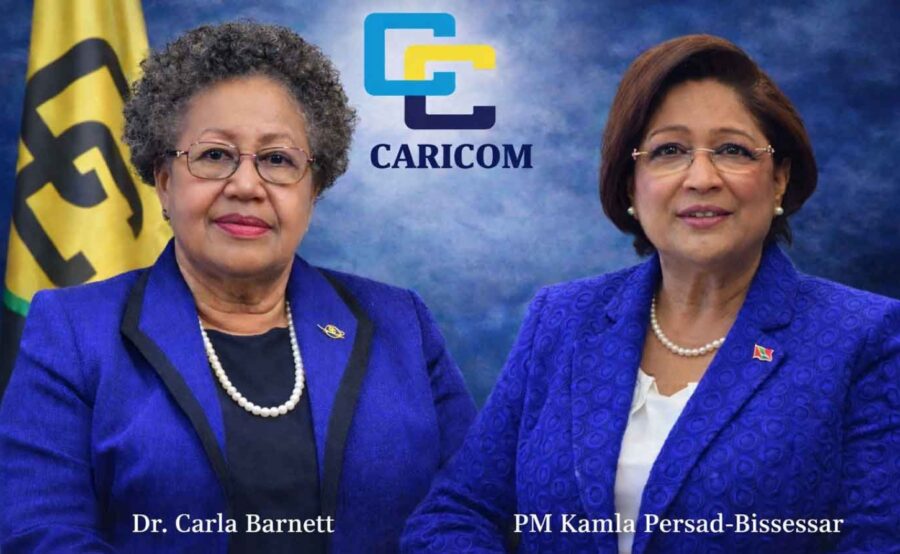
How many Barbadians are cued to the fact Trinidad, or should we say Prime Minister Kamla Persad-Bissessar, has vehemently opposed the reappointment of Secretary General of CARICOM Carla Bennett?

As the story goes: the reappointment of CARICOM Secretary General Dr. Carla Barnett stems from a dispute over whether the February 2026 decision to extend her term followed the rules of the Revised Treaty of Chaguaramas (RTOC). At that meeting of the Heads of Government of CARICOM (HOGs) in St. Kitts and Nevis in 2022, the HOGs announced that Barnett had been unanimously reappointed. A few months later, Trinidad and Tobago’s Prime Minister Kamla Persad‑Bissessar publicly rejected the legitimacy of that decision, arguing that the process was procedurally flawed. She claimed that the required formal vote never occurred, that key ministers were excluded, and that decisions were circulated informally rather than through established treaty mechanisms.

Fast forward to the just concluded 51st HOGs held in St. Lucia where the dispute of Bennett’s appointment was addressed. St. Lucia’s Prime Minister Philip Pierre, who is the current rotating Chairman of CARICOM updated that the issue will be deflected to the Caribbean Court of Appeal (CCJ) to secure an advisory opinion. Pierre’s view is that CARICOM’s credibility required clarity on whether the reappointment complied with the RTOC.

It is an open secret that Persad-Bissessar has an ongoing concern with Bennet going back to 2022. At that time she claimed Bennett failed to respond to a diplomatic concern about a Trinidad national raised by Trinidad. Although Persad- Bissessar did not mention details about the national, it is know that there continues to be tension related to the ‘abduction’ of a Trinidadian businessman in Barbados with the support of the Barbados Police Force (BPF). Some speculate if this is why former Attorney General Dale Marshall had to demit office prematurely, a request from Trinidad made in a smoked filled backroom..

It is embarrassing that a few islands making up CARICOM would have to refer a simple matter of a routine reappointment of the Secretary General to the CCJ. These are HOGs charged by regional citizens to manage complex affairs of states, When the HOGs can become so publicly divided over a basic procedural matter, it suggests there is an institutional fault line. How are CARICOM citizens expected to be confident to deal with Haiti’s failed state concerns, food and energy insecurity, equitably sharing regional resources, regional crime that has been declared a public health crisis and always there is the mother of all challenges, external geopolitical issues.

The ongoing dispute erodes trust, reinforcing public perception that CARICOM is slow, divided, distracted and INCOMPETENT. That it is an institution mired in insularity and small mindedness. Most critically, it highlights that if routine governance tasks become contentious, then future decisions risk a similar ending, threatening CARICOM’s capacity to act collectively on threats to the region when cohesion would be most needed.

The blogmaster has always opined that our small islands, now more than ever, need to commit to a framework that promotes practical cooperation. However, as we have seen with the abduction of Maduro and the meek reaction by CARICOM HOGs, we have a long way to go to represent a One Caribbean policy on the issues.


Discover more from Barbados Underground

Subscribe to get the latest posts sent to your email.

4 responses to “CARICOM’s Leadership Crisis: The Persad-Bissessar Carla Barnett Controversy”


  1. Caricom: no half measures

    AS THE CHAIRMANSHIP OF CARICOM moves to the Prime Minister of St Lucia, Philip J. Pierre, it does so in a moment where the most open and direct threats to secede are being made by certain sections of Caribbean leadership.

    These threats should not be brushed aside as a temporary descent into anti-diplomacy on the part of a loose-tongued generation of Caribbean leadership, but should be understood as part of broader global structural shifts of which the “rethinking” of CARICOM is only a small part.

    The collapse of the post-World War II order, and the United States’ intent on reshaping its role in the Western Hemisphere even while it strategically withdraws from “global leadership”, are at the centre of these anti-CARICOM noises. Put bluntly, had there been no “Trumpism”, there would have been no Kamla Persaud-Bissessar quarrel with CARICOM.

    Given the seriousness of the moment, the current CARICOM phase being ushered in by the St Lucia deliberations should be treated as an extraordinary moment demanding extraordinary responses.

    Good opportunity

    While the positive energy which has pervaded the assumption of Pierre represents a good opportunity to “reset CARICOM”, as argued recently by veteran journalist Julian Rogers, it would be a mistake to assume that the way forward for CARICOM is the pursuit of “small deeds” minus bold aspirations.

    However, despite the potentially ground-shifting nature of the current moment, there appears to be two dominant responses from the main actors in CARICOM.

    First, there is a pretence at “nothing to see here” normalcy. Those in this tendency exhibit strong doses of “false consciousness”, since their actions do not match reality.

    The second approach is from those claiming to be “pragmatic”. They insist that CARICOM should pursue a “minimal programme”, since the situation is too delicate for any big gestures.

    They take comfort in completing elusive basic tasks like “regional travel”. They see themselves as “saving CARICOM” by “working on the issues that have been ignored”. This seems to be the dominant narrative being prepared for what is likely to be the main feature of the St Lucia chairmanship.

    However, none of these approaches fully addresses the deep structural issues that have brought us to the current moment. The way forward for CARICOM is for the emergence of an uncompromising, radical, committed core willing to articulate and organise for a deeper programme of integration never experienced in the region. It requires the presence of a vanguard organisation committed to the pursuit of a federal sovereign state as its sole purpose.

    The Caribbean people need a new sovereign political arrangement beyond the limited, singlestate independence inherited at Independence. This cannot be achieved by the familiar “small technical detail”, bureaucratic approach. A new sovereign nation state of the West Indian people arising out of the dust of the currently collapsing world order is the only solution.

    Tennyson Joseph is associate professor of political science at North Carolina Central University. Email tjoe2008@live.com

    Source: Nation


  2. Kamla ‘committed’ to grouping

    TRINIDAD AND TOBAGO remains committed to CARICOM, says Prime Minister Kamla Persad-Bissessar.

    She was addressing a question from a journalist on her thoughts after previously describing the Caribbean Community as “an unreliable partner”, during the closing media conference of the 51st Regular Meeting of CARICOM Heads of Government in Castries, St Lucia, yesterday.

    “My position from the start remains to now and that position has been whilst I would have levered some concerns about the operations of CARICOM, I have always said Trinidad and Tobago remains committed to CARICOM. We have unwavering support to CARICOM for us to work together to better the region and, of course, all our citizens,” she said.

    Persad-Bissessar said during the meeting, held under the chairmanship of St Lucia’s Prime Minister Philip J. Pierre, and with the cooperation of other Heads, they ironed out some of the concerns she had.

    “So my position has not changed. I remain committed to CARICOM. We will have issues from day to day; from time to time in a family you have issues. We have issues of concern and . . . my position is that we must raise them. We must not put our heads down in the sand like ostriches. We raise them when they are and try to find resolutions.”

    She said that after ironing out those issues, it would be “better as we go forward”. (SAT)

    Source: Nation


  3. Moves to cap cost of living

    INDIVIDUAL CARICOM NATIONS have put measures in place to fight the rising cost of living in their respective countries, but say they are powerless over the cost of fossil fuels which drive all aspects of the economy.

    That was one of the key points emerging from discussions held at the 51st Regular Meeting of CARICOM Heads of Government which ended in Castries, St Lucia, yesterday.

    However, Prime Minister of St Kitts & Nevis Dr Terrance Drew said while there was no energy crisis in the region, there was an energy-harnessing issue.

    “On the issue of the cost of living, it seems like the Caribbean is just on this wave, up and down, up and down. There’s a war, we’re down, up, down; a hurricane, we’re up, down. We suffer these shocks mainly because a lot of what we consume, we import,” he said during a media conference at the close of the meeting.

    “We have wind, we have solar, we have geothermal, and we have wave, and we have started to invest heavily in these. There’s nothing that can really stabilise our economy or transform our economy or deal with this constant up and down, like stabilising our energy sources and our energy situation.”

    Petroleum products

    Drew said that at a meeting of the Organisation of Eastern Caribbean States, a chart showed billions were being spent on petroleum products.

    “Cutting into that with renewable energy can really help from our perspective to transform the Caribbean, to transform the region and help us to get on a sustainable path of really managing the cost of living of all of our people here in the region. So that is one of our proposals that we are putting forward.”

    He said St Kitts had also put to tender a plan to build a 50-megawatt facility and they would share via under-sea cable with other countries around, like Antigua and Barbuda, to help reduce the cost of energy.

    Barbados’ Prime Minister Mia Amor Mottley said CARICOM was about to enter discussions with Trinidad and Tobago about the use of one of its ferries that can ply the Southern Caribbean as a “proof of concept” on how inter-island trade can lower the cost of living. Trinidad has long used ferries for trade and travel with its sister island Tobago.

    Mutual recognition

    “I’ve undertaken the responsibility of working with colleagues to be able to get the treaty arrangements for mutual recognition of licences, insurance, so that vehicles, cargo vehicles can literally go on and come off where possible. This is a work in progress,” Mottley said.

    She added that said while it would be a first in the Southern and Eastern Caribbean, it would also reveal the infrastructural arrangements that needed to be put in place at the various ports.

    “So I give you the assurance that we are singularly focused on being able to reduce the cost of intra-island cargo which, in addition to the other measures that we have taken to increase disposable income of our citizens, but also to reduce the cost of freight, the cost of gas and the cost of electricity, all of which, when combined, can be completely inflationary, is what we’re doing together.”

    Mottley said the region was also looking at the application of the Common External Tariff. It was put in place to protect regional production, but remained on some items even as production ended over the decades. Some countries have asked for different arrangements so it can be removed, and thereby lower the cost of goods.

    Prime Minister of Trinidad and Tobago Kamla Persad-Bissessar also outlined three key medical services available in her country which she said could be accessed at a fraction of the cost elsewhere. These include a National Prosthetic Centre – set up with assistance from the government of India.

    She said prices in the United States ranged from US$3 000 to US$120 000, depending on “the mobility of what you want that artificial limb to do”.

    Persad-Bissessar said the twinisland republic also had many medical graduates in various fields, adding they have shared with CARICOM members and are willing to work with them to provide fully trained doctors, mostly trained at the University of the West Indies.

    The third service is a children’s hospital, which she said had affordable prices, and these ventures would also help them earn foreign exchange. (SAT)

    Source: Nation

    Source: Nation


  4. What a collection of hapless jokers….!!!

The blogmaster invites you to join the discussion.

Trending

Discover more from Barbados Underground

Subscribe now to keep reading and get access to the full archive.

Continue reading