



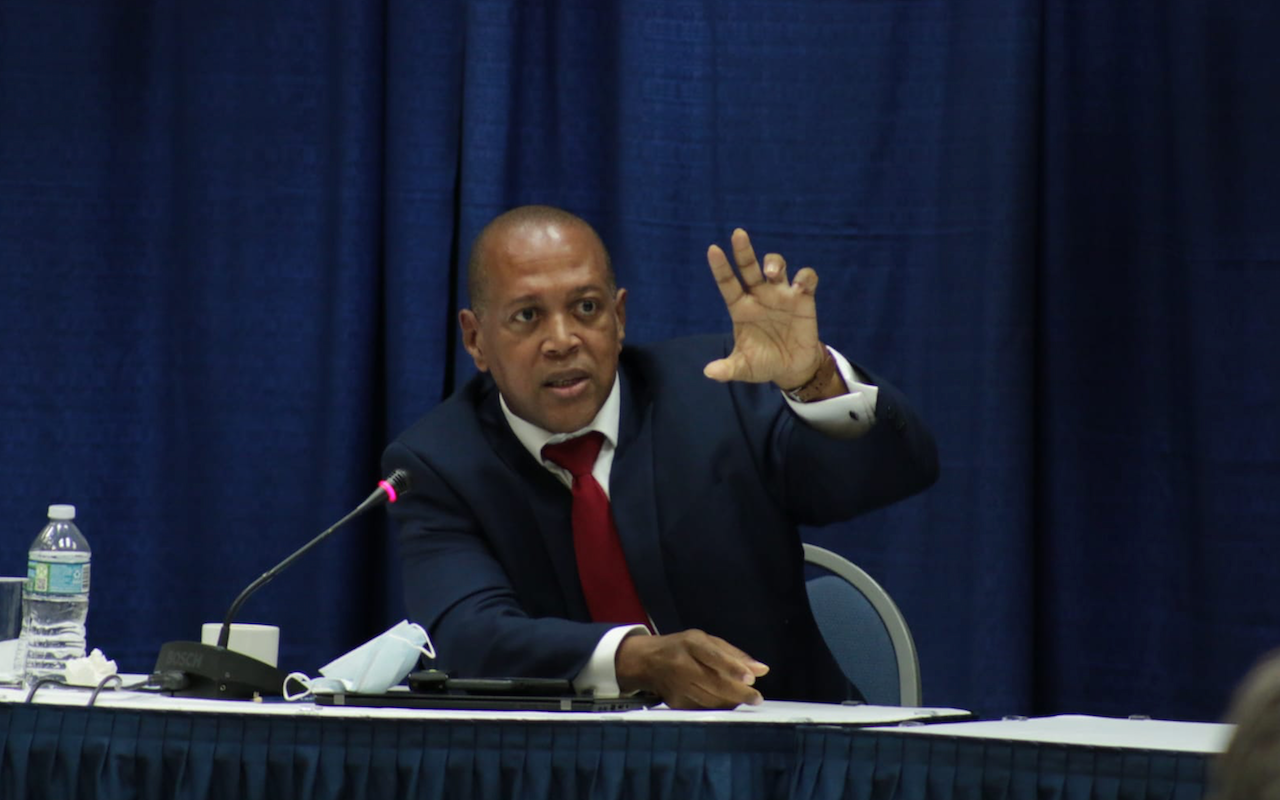
Governor Dr. Kevin Greenidge delivers the Central Bank of Barbados’ review of Barbados’ economic performance in the first quarter of 2025.
The review provides an update on key economic indicators, including economic growth, the debt-to-GDP ratio, inflation, the unemployment rate, and the level of international reserves, as well as information about Government’s performance in fiscal year 2024/25 (April 2024 to March 2025).
Governor Greenidge also gives his outlook for the economy in 2025 and takes questions from the media and members of the public.
- CBB Review of the Economy – January to March 2025
- Media Presentation – Review of the Economy Janaury-March 2025
– Source: Central Bank of Barbados
Q1 Economic Review – Growth!
Discover more from Barbados Underground
Subscribe to get the latest posts sent to your email.
17 responses to “Q1 Economic Review – Growth!”
-
2.6% growth
First quarter driven by tourism, services and building
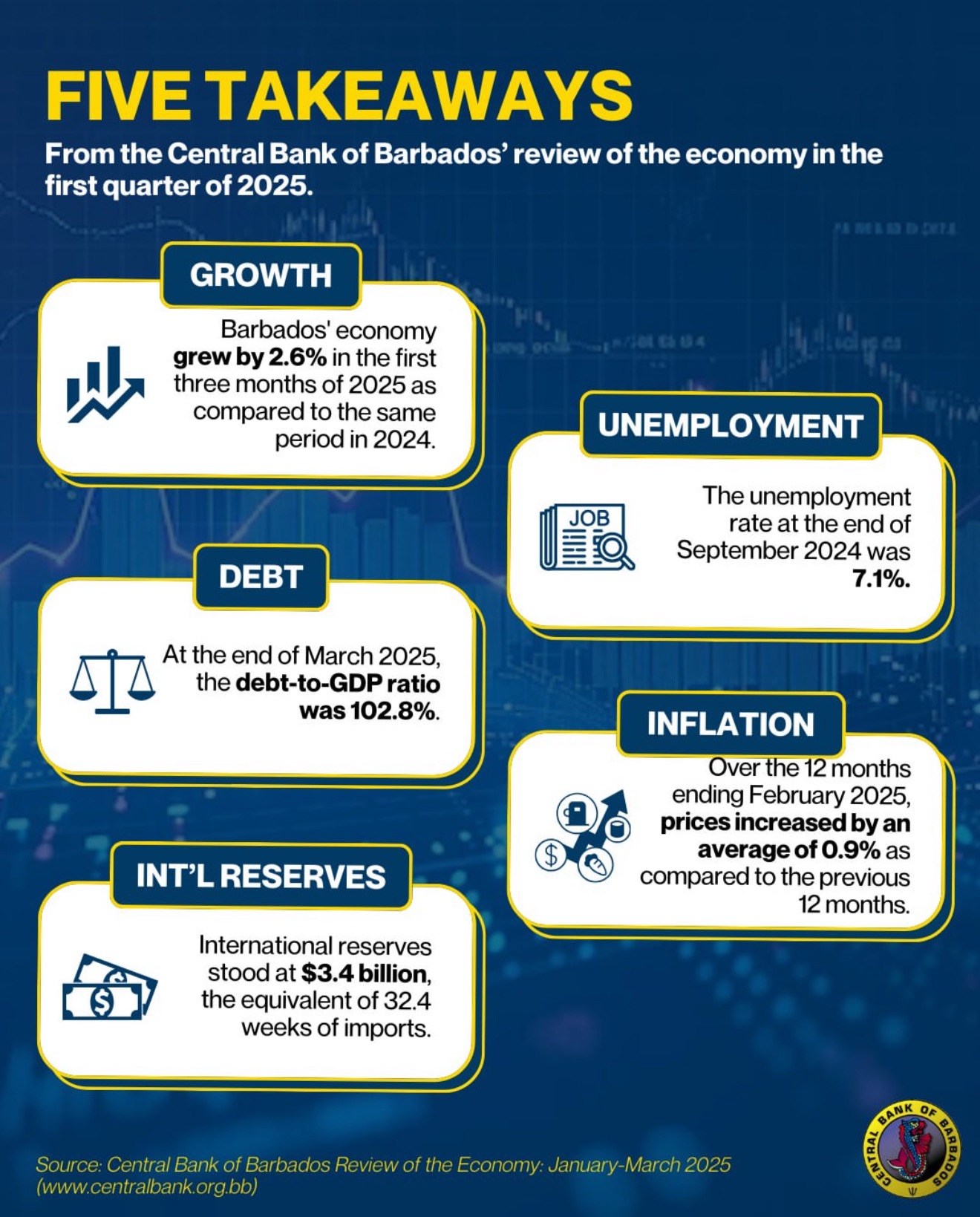
BARBADOS’ ECONOMY GREW by 2.6 per cent in the first quarter, fuelled by strong performances in tourism, business services and construction, according to Central Bank Governor Dr Kevin Greenidge.
However, weaker global conditions and ongoing trade tensions, including United States (US) tariffs, are threatening to derail 2025’s prospects.
The Central Bank has, therefore, lowered this year’s growth forecast from three per cent to 2.7 per cent. Greenidge said he believed this was “very realistic”, but acknowledged there was “great risk” to the projections.
The governor was speaking yesterday during his first quarter press conference at the Courtney Blackman Grande Salle, Tom Adams Financial centre, The City, as US authorities reported that country’s economy contracted by 0.3 per cent, the first decline since 2022.
Greenidge spoke firstly about the economic growth between January and March, noting that the 2.6 per cent real economic growth in the period was “actually slightly above our expectation for the first quarter”.
He attributed this mainly to the strong performance in cruise tourism, highlighted by an overall 385 468 in-transit passengers. This was a 37.1 per cent increase, the highest level on record for a first quarter.
“The traded sector registered growth of four per cent, supported by strong cruise and long-stay visitor arrivals, while agricultural output declined because of adverse weather.
“The non-traded sector expanded by 2.4 per cent, reflecting continued investment by both private and public sectors,” Greenidge reported.
On tourism, the country’s main breadwinner, he said that long-stay arrivals increased by 2.4 per cent, “with the US market recording a 13 per cent increase”. European visitor arrivals climbed by 13.9 per cent, aided by targeted marketing efforts, while arrivals from Canada and CARICOM had modest growth of 1.4 and 2.9 per cent, respectively. Lower seating capacity from the United Kingdom contributed to a 7.2 per cent decline in arrivals from that market.
Among the sectors that do not earn foreign exchange, construction rose by 6.4 per cent, supported by strong private and public sector investment in projects; business and other services grew by 3.4 per cent, driven by higher demand for legal, travel, recreational and financial services; and wholesale and retail trade expanded by 1.7 per cent, reflecting increased consumer demand for food, beverages, household appliances and motor vehicle parts.
The Central Bank is awaiting labour market data from the Barbados Statistical Service, but Greenidge said activity “eased during the first quarter” based on a 6.9 per cent reduction in jobless claims in January and February as reported by the National Insurance and Social Security Service.
Barbados’ economic performance this year hinges on global factors, including the performance of the island’s main trading partner, the US.
“Rising trade tensions – particularly broadbased tariffs and job losses in the US – threaten to dampen consumer demand, with potential spillovers for Barbados through reduced tourism, exports and remittances. Given the country’s reliance on US travellers and imports, these risks remain material,” the Governor said in giving the bank’s revised outlook for the year.
Revised downward
He called the economy’s first quarter contraction “not good” but said the International Monetary Fund’s projections included global growth and an expanded US economy, though the forecasts for both were revised downward.
“The fact that the tariffs have been paused, . . . our main direction for which this will affect us is through tourism and so far we are not seeing any fall-off in forward bookings, . . . and the market is doing very well,” Greenidge said.
“So when we do our analysis, we believe that a slight slowing . . . from the three per cent to 2.7 [per cent] . . . is not optimistic, it’s actually very realistic.”
He based this on several factors, including the expectation that “event-driven demand from Crop Over and international sporting events is likely to sustain long-stay arrivals, while increased airlift and seven additional cruise calls should bolster overall activity”.
“However, economic uncertainty in key source markets, particularly the US, may dampen tourism spending. The sector will continue to play a central role in foreign exchange earnings and broader economic performance.”
Greenidge said the Central Bank was prepared to adjust its growth projections “if we see tariffs come back on, if we see the US economy continue to wobble even further”.
“Why do we feel confident? Prior to all of this, we put our house in order, so to speak. Many countries still have not done that,” he observed.
“So the point is, once we stick to what we are doing and we continue doing investment, that growth is absolutely attainable and very realistic, but we continue to monitor very closely.” (SC)
Source: Nation
-
Wow, where are the haters of government’s success managing the economy? The only worry spot is running a Hugh annual budget deficit!
-
International Monetary Fund’s projections included global growth and an expanded US economy, though the forecasts for both were revised downward.
——–
The issue with this, on current trajectory the US is headed for a significant economic decline. When other political factors are added, one may expect US external tourism, to be reduced to a fraction of current, as a result on internal turmoil, caused by the Good and Great Leader going after federal courts, independent press and so on.
It seems that most people do not yet understand how grave the issue is. This surprises me.
Count on zero forex from US visitors from the summer and with limited shipments of goods out of US to Caribbean.
Caribbean governments should be stockpiling what they can now and putting alternate supply chains in force with speed.
This will be a long, hot summer.
-
Trump 2.0 policies mean an era of great uncertainty for doing business in the world. Forecasts by economists is fickle in the normal.
We are currently navigating a time of global transformation where traditional alliances and partnerships have to be dismantled to mitigate against what is currently unfolding and by extension layer resilience in the global model to mitigate against future recurrence.
-
David Avatar
David
May 2, 2025 at 6:40 am
Rate ThisWow, where are the haters of government’s success managing the economy? The only worry spot is running a Hugh annual budget deficit!
…
What you call success others call voodoo economics gift wrapped in smoke and mirrors
Also govt speaks about growth ..if that’s so how much revenue did govt generate from growth to show proof that there is tangible success sufficient and enough to lower vat and other taxes
Govt right out of this celebration threw a 1dollar and 50cents increases to hard working employees an increase which amounts to zero effect when compared to high cost of living in Barbados -
US TARIFF BLOW
Central Bank expects between $88m and $157m fallout
By Shawn Cumberbatch
shawncumberbatch@nationnews.com
Barbados could be impacted by an economic fallout of between $88.9 million and $157.6 million caused by a hike in tariffs by the United States.
That is the estimate of Central Bank of Barbados experts who assessed the gross domestic product (GDP) impact of the import tax measures announced by US President Donald Trump.
This follows a year in which Barbados imports from the US reached a record $1.6 billion while exports to that market were $161.1 million.
They have concluded that the US government’s imposition of a ten per cent baseline tariff on all imports last month “introduces meaningful downside risks to Barbados’ economy”.
Exports and tourism
An analysis prepared by the Central Bank’s Research and Economic Analysis Department found direct and indirect impacts for Barbados’ exports and the tourism sector.
Their baseline calculation was an estimated GDP loss of $88.9 million, assuming there is a 7.5 per cent drop in tourism from the US and a $15.6 million export loss. The severe scenario found an export and tourism loss of $157.6 million based on a 15 per cent drop in US tourists and a $17.8 million export loss.
“As a small, open economy deeply integrated with the US through trade and tourism, Barbados faces pressures on exports, inflation and fiscal performance,” the Central Bank analysis states.
“Merchandise exports are likely to register a moderate decline. Export earnings could decline by $15.6 to $17.8 million, particularly in sectors like rum, jewellery and niche manufacturing. This translates into real GDP losses of $23.4 to $26.7 million, after applying conservative multipliers.
“The shock is concentrated in high-value categories with price-sensitive demand and significant exposure to global competition.”
The department also flagged the tourism sector’s vulnerability to the directs, but said that any fallout would not be due directly to the tariffs, but from “second-round effects, including a potential slowdown in the US economy, the knockon impact of US tariffs on other global trade partners if the pre-90-day pause levels are returned to, and rising global uncertainty”.
“These forces may dampen discretionary travel, reduce US household spending and weaken airline connectivity. A 7.5 to 15 per cent decline in US travel spending – driven by these broader macroeconomic pressures – could result in real GDP losses of 1.04 to 2.07 per cent,” the analysis warned.
“This underscores the urgency of further diversifying Barbados’ tourism source markets and strengthening resilience across the sector.”
The Central Bank team said these possible outcomes meant that “Barbados’ economic safety buffers will be vital”.
“While Barbados’ foreign reserves and fiscal buffers remain strong, the fixed exchange rate limits monetary policy responses. Fiscal policy may face stress from rising subsidies and falling value added tax collections linked to tourism and trade,” the experts said.
“More must be done to ensure resilience. This external shock underscores the urgency of export diversification, logistics resilience and deeper CARICOM integration, especially in food security and regional market access.
“Barbados’ response will determine whether this episode becomes a moment of vulnerability or a catalyst for structural transformation.”
The Central Bank report also examined Barbados merchandise trade structure, which it described as “structurally imbalanced, with high dependence on a few partners”.
“As a small, open economy with limited natural resources and a modest manufacturing base, Barbados relies heavily on imports for domestic consumption and production,” it said.
“While merchandise exports generate foreign exchange and growth, the trade account has remained persistently in deficit.”
The existence of this deficit is confirmed in the Central Bank’s first quarter economic review that was presented by Governor Dr Kevin Greenidge on Wednesday.
“Higher imports and lower exports of goods widened the merchandise trade deficit. The deficit expanded by $143 million compared to the first quarter of 2024,” he said.
Largest increase
“Imports increased by 13.3 per cent, driven by higher demand for machinery, food and beverages, and hybrid and electric vehicles, marking the largest first-quarter import increase – outside the pandemic period – since 2011.
“Total exports declined by 2.6 per cent, as re-exports fell by 6.1 per cent, largely due to reduced fuel shipments. Domestic exports also declined by 2.2 per cent, reflecting lower sales of food and beverage products.”
The Central Bank research noted that the US remained Barbados’ number one trading partner for goods between 2002 and 2024, followed by Trinidad and Tobago, and the United Kingdom.
“The US is Barbados’ largest import source, supplying nearly 88.5 per cent of US-sourced goods from domestic production and 11.5 per cent through re-exports. Key imports include food, machinery, and fuel,” the Central Bank team reported.
“In 2024, imports from the US reached a record $1.6 billion. This heavy concentration leaves Barbados vulnerable to US tariff changes. While the recent ten per cent baseline tariff may not hit all categories equally, finding cost-effective alternative suppliers in the short term may prove challenging.”
The US remains Barbados’ largest export destination, particularly for rum, jewellery and sweet biscuits, the Central Bank noted.
Source: Nation
-
Unsure I fall into the hater category, certainly unimpressed by the level of accountability and transparency with regard to entities like the NIS, TB, QEH, CBL etc etc
Yet, overall once tourism continues to tick along well, and the significant added Corporate tax revenue, this eases the noose around the GoBs neck. What will happen with Global Minimum tax rates in the months ahead is unknown. I ‘believe’ local corporate rates increased again in ’25, the numbers in this current report reflect ’24 rates.
Exactly where the money to fund deficits will come from, remains an unknown.
I haven’t a clue the effect of current global trading transformation on tourism in Barbados. -
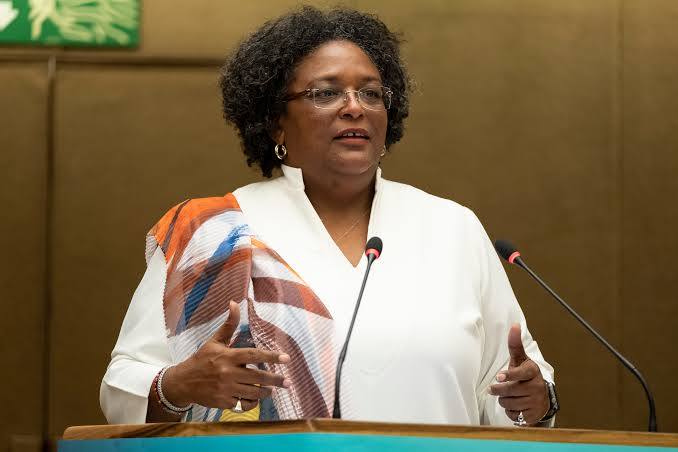
PM MIA.
-
Barbados to exit IMF programme after 7 years
Barbados is about to exit nearly seven years of International Monetary Fund (IMF) arrangements, but Prime Minister and Minister of Finance Mia Amor Mottley has made it clear that with “outside seriously overcast”, Government will have the institution on speed dial in case of an emergency.
IMF team leader for Barbados, Michael Perks, yesterday reported that following a week of talks with the authorities, his team reached staff level agreement with Barbados on the fifth and final reviews under the Extended Fund Facility (EFF) and the Resilience and Sustainability Facility (RSF).
Board approval
This means that once the IMF’s executive board approves the review as expected around the middle of next month, Barbados can immediately draw down the remaining US$19 million under the EFF and about US$38 million under the RSF.
The Prime Minister, who was joined by Perks, senior Government officials and members of the IMF team at a press conference at Ilaro Court yesterday, said the imminent conclusion of the second successive IMF programme “brings us to the end of the heavy lifting”.
However, after thanking Barbadians for the sacrifices they made during seven years of economic reform under the IMF’s watch, Mottley told the media: “As we have gotten out of COVID, whether we like it or not, the third major crisis is now facing us, which is the crisis that is caused by the external economic environment.”
She noted that while Barbados had more than seven months of foreign reserves, as compared to three weeks when her administration was elected in May 2018, “anyone who has been watching what has been taking place globally this year will appreciate that outside is . . . seriously overcast.
“And similarly, as we bring this process to an end, we have determined that we will keep our relationship open with the Fund.
We will discuss with the Social Partnership what that relationship should be. It is at this stage likely to be what I call speed dial standby, what they call precautionary standby,” she announced. Mottley said this meant that “if at some point in the next three months or six months or nine months, the overcast conditions change into showers or floods or high winds, that instead of having to go through a lengthy process to get help, you literally press speed dial, one button, and everything is there.
Standby deal
“One of the benefits of the . . . precautionary standby arrangement is that it still allows us to retain access to technical assistance, structured policy dialogue and, if necessary, . . . emergency resources,” she explained.
“The disadvantage of it is that you have to pay it back in a shorter period of time if we actually have to draw down money for financing purposes. We haven’t used our entire quota with the Fund, but I think that we would like to walk on our own.”
The Prime Minister said that over the life of the two IMF arrangements, which supported two homegrown Barbados Economic Recovery and Transformation (BERT) programmes, with a third BERT plan to come, Government was able to “fix the fundamentals”.
These included growing the economy and exceeding fiscal targets, which resulted in “upgrade after upgrade” from international credit rating agencies, she said.
“Barbadians should feel proud today that in spite of everything else that has happened, that we stand here taller, stronger and more confident than we did seven years ago. It could not have happened without the cooperation of Bajans, and that is why the Solidarity Allowance is the least that we can do,” Mottley said.
“Because when we started this journey, two weeks after we took office, we went to the people of this country and we said, ‘Help me share the burden.
Because if you share the burden, a time is going to come when we will share the bounty’.”
She added: “I feel happy, proud and humbled because many a country would not have allowed a government to walk this road and to make the difficult decisions.
Sacrifices
“And I pray that Bajans will reflect on it and not take things for granted, because sacrifices were made by many for us to reach this point and today, we stand stronger on so many other fronts than almost two-thirds of the countries of the world.
That was not where we were in May of 2018.”
Perks said Government “delivered their broad objectives of the IMF arrangements, macroeconomic stability had been further reinforced through a sustained increase in primary fiscal surpluses and continued decline in public debt, alongside improvements in the external position and initial steps to enhance the monetary policy framework and strengthen financial safety nets”.
He added: “At the same time, structural reforms have been implemented to boost fiscal sustainability, enhance growth and competitiveness and build resilience. The authorities are on track to complete all five reviews on time.
“They have met all the EFF quantitative targets at every review.
They’ve completed all 21 structural benchmarks with only a few subject to short delays. And finally, they have met all ten RSF reform measures . . . .
This is no small feat.”
(SC)
Source: Nation
-
“They’ve completed all 21 structural benchmarks with only a few subject to short delays. And finally, they have met all ten RSF reform measures . . . .”
~~~~~~~~~~~~~
What the Hellis a “reform measure”!!
What a lotta shiite talk..!!!Exactly WHAT are these ‘targets’ that we have so impressively met…?
IN PLAIN ENGLISH please…OK we ‘reduced the debt’ a bit, ….mainly by WRITING OFF $1 BILLION DOLLARS of poor peoples NIS pension funds – meaning that there will be a LOTTA poor BBs scrunting and begging – going forward…
We have had VERY LITTLE financial reporting, VERY poor Auditing and transparency, and ZERO progress with Integrity legislation. So we have very LITTLE INDEPENDENT proof of our actual financial position.
The IMF people seem to be either daft or complicit in the lack of transparency – since NONE OF THE STIPULATIONS that they set up front have been completed….
-CBC was to be divested
-BAMC was to be divested
-Transport Board was to be transformed
-Government business was to be streamlined
-Other SOEs were to be rationalized..Which of these have been ‘completed’..???
The only shiite that we know for sure is that the NIS $ billion is GONE…
…Millions are gone with the HOPE misadventure
…Millions with the STEAL houses out of China
…Million spent on the countless consultants, whose roles presumably have been to bamboozle the IMF jokers who come down for some sun…Meanwhile,
No water
No sewerage system
No renewable energy
No dependable transport system
No end to potholes
No education structure
No judicial system
No end to crime
No hope for our youth…just the lotta long talk, and talk, and talk….
Sorry, ..Bushie is allergic to BS….
-
The SOEs are a mess, reform was promised.
Pension both private and public is a mess, reform was promised.
Comprehensive digitalisation was promised, it remains far from complete.
-
Mottley: Progress with SOE reform
GOVERNMENT HAS UNDERTAKEN most of the planned reform of stateowned enterprises (SOEs), with the establishment of the Mass Transit Authority one of the initiatives still to be completed.
Prime Minister Mia Amor Mottley gave this update while saying she envisaged the need for continued strengthening of SOEs.
“Rural and Urban [Development Commissions] . . . transitioned into one. The big one that is waiting to finish now is . . . taking the Transport Board and evolving it into a Mass Transit Authority, where Government gets out of the ownership of buses and allows the drivers and the current people who own buses in this country to be able to operate the system,” she said at Ilaro Court last Thursday after meeting with the International Monetary Fund staff delegation for Barbados.
Privately run
“The reality is that two-thirds of the system, almost, is already privately run. So in spite of the fact that we’ve bought the electric buses, Government will provide the financing to those persons, and the option will go first to the drivers and employers of the Transport Board.
Making headway
“But that is subject to the discussions with the Barbados Workers’ Union and others. I don’t want to get into it, but we are way advanced in that process now with the . . . Mass Transit Authority,” she added.
Mottley also said that efficiency gains at the Barbados Water Authority and the Queen Elizabeth Hospital “are coming”.
“So in essence, most of the SOE reform has taken place. I still feel that there is need for some continuous strengthening . . . so we will always have a keen eye for the things that we must continue to do, and that is what [the Barbados Economic Recovery and Transformation programme] 3.0 is about, and continuing to propel how . . . we sustain growth.” (SC)
Source: Nation
-
Wild Coot is fighting a losing battle, so too the BCEN.
A challenge for our Central Bank
I AM NOT HAPPY to see our Central Banker and his deputy appear aesthetic that the deposits of the commercial banks in the Central Bank are at $16 billion. That would be something to be happy about if other aspects of the Barbados economy were in good order.
Surely the Central Bank is aware that the commercial banks are paying one per cent or less for deposits in the bank. Surely the Central Bank is aware that the commercial banks have declared huge profits. Surely the Central Bank is aware that there is a distort rise in the commercial banks’ profitability of income from commissions.
Surely the Central Bank knows that there are long lines and waits in commercial banks because of slow service and slow cashier attention. Even so some banks are now reducing their branch exposure on the grounds that banking can be done at home or from ATMs.
An imbalance and appreciation must be staring the Government’s representatives in the face. With an ageing population in Barbados, banks are requiring customers over the age of 80 to provide a younger person to countersign to loans unless loans are cash secured. How can the cut-off age for competency be set at age 80 and who sets it for everybody when some people are doltish in their 60s?
Housing needs
Of course the joy is not reflected in a big increase from lending. Surely the urgent call by people for housing accommodation and Government’s efforts to meet the call does not impel the banks as one of their duties is to make a connection between the huge deposits in a match for the housing needs of the country.
Do not the huge deposits enable the banks to comfortably enjoy their profitability from comfortably trading? They do not have to incur the risks or expense from lending.
Who are better in policing the housing loans than the banks with their daily policing of the comings and goings of borrowers? We have seen how Government, in an effort to police, have made a mess of housing provision as efforts are made.
Even so, I blame Government also as Government holds oversight of the Central Bank. When we see the paltry efforts lately of the Ministry of Housing trying to enter providing housing, the not ascertaining ownership of land, not screening prospective builders’ capabilities or applicants’ capability; even managerial responsibility to oversee and of course the waste of money from taxpayers.
Of course we can say that we have millions of dollars in the banks. This is as loud a boast as we can say that we have a large treasure of foreign exchange without saying how much is the net amount that we can spend on the provision of food and medicine.
Save, rather than invest
This is a loud boast that we can make without saying what efforts are made for people to invest in the needs of the country such as providing food requirements and the utilisation of land.
The Central Bank oversees the performance of the commercial banks. Even though there may be a propensity for Barbadians to save, rather than invest, it cannot allow the commercial banks to take advantage of this. This is what is happening in the present scenario.
Even the credit unions are under the same pressures as they are obligated to place their deposits in the commercial banks. So while the commercial banks may argue that increasing the deposit rate will cause the mortgage rate to rise, it is incumbent on the banks to find their profitability in this milieu.
Maybe the banks are taking advantage of the fact that there is no real indigenous bank in Barbados where an indigenous bank may not be subject to dictates of oversees shareholders with little regard for the local environment.
Maybe the Central Bank is unaware of the tremendous flexibility of the commercial banks in their adjustment to profit making, but ignorance of this is no excuse for inertia.
Harry Russell is a banker. Email quijote70@gmail.com
-
Credit unions ‘becoming like banks’
ASHTON TURNEY, a former president of the Barbados Co-operative Credit Union League Ltd, the umbrella body for local credit unions, is concerned that some of these cooperatives are increasingly operating like banks.
He view is that “there appears to be a growing practice of treating members’ applications for assistance in the same light banking agencies adopt”.
“Banks are in the business of making money at all costs, while credit unions are in the business of helping members to achieve their dreams,” he said.
“It goes without saying that to survive credit unions need to make a profit and the membership is aware of that need and express the appreciation of that reality every annual general meeting.”
Turney has served as a director and vice-president of the Caribbean Confederation of Credit Unions, asserted that credit unions’ hiring practices “no longer considers connections with unions or credit unions, so that employees can boast of not being members of neither a union or credit union”.
“Our lending policies have moved closer to the terms and conditions of the banks and other lending agencies and our services. A 2019 paper entitled Credit Unions, Cooperatives, Sustainability And Accountability In A Time Of Change: A Case Study Of Credit Unions In Cyprus . . . argued that credit unions . . . departed from adherence to the founding principles,” he noted.
“They are run by the employees for the benefit of the credit union (performance) rather than by the membership for the community (mutual well-being).”
He added that the authors “wanted to know if credit unions had adhered to the principles and the membership maintained a guiding influence, would they have remained independent, through the financial crisis is a matter for conjecture.
“What is far more certain is that credit unions, do not offer the utopian alternative that many had alluded to post the 2008 crisis. Co-operatives, their underpinning rationale and guiding principles, were, as noted previously, proposed as an alternative means of delivering financial services.”
Continuous message
Turney argued that “commitment to the cooperative spirit seems to have disappeared and credit union members must find ways to restore it and if it is not then it must be a continuous message”.
He illustrated the importance of credit unions to their members, pointing out that “credit unions continue to provide workers with opportunities, and without their presence that would remain only a dream”.
“Not that financial benefits are all that individuals and families need but often the availability of adequate financial assurances can make life less strenuous and open to enjoyment of other benefits,” Turney observed.
“Credit unions have become critical to the advancements of the working class to the point that some of them have now moved into decision making positions and appear to be without knowing it heading in a direction that undermines the philosophy that gives life to the movement.
“The brother and sister terminology within the movement, particular in the context of solidarity and community, is rooted in the cooperative movement’s historical emphasis on collective action and mutual support.
“These terms were often used to evoke a sense of shared identity and purpose among members, emphasising the idea of people helping each other.” (SC)
Source: Nation
-
Saving grace
PM again defends decision to enter IMF programme in 2018
PRIME MINISTER MIA AMOR MOTTLEY has again mounted a defence of her administration’s decision to enter an International Monetary Fund (IMF) programme in 2018, declaring that it was a necessary step to rescue Barbados from economic collapse.
But with the IMF agreement due to end next month, she reiterated that while the country must now “walk alone”, the international institution remains on standby if needed.
Speaking at a Barbados Labour Party (BLP) meeting on Saturday night in Sion Hill, St James, in support of candidate Chad Blackman for the May 21 by-election, Mottley reminded constituents that the Government took office at a time when the country was on the brink of insolvency.
“When we started, we had just over $300 million in reserves, and we had a debt payment to make in two weeks that would have brought us down to $100 million,” she said. “If your feet break, your hands break and your throat almost gone, you’re going to go to the doctor. And that’s what we did – we went and got the help we needed so we could stand tall and strong again.”
The Prime Minister dismissed suggestions that Barbados had blindly followed the IMF’s lead, stressing that her administration came to the decision openly and after widespread consultation, including with the Social Partnership.
“I will never forget the meeting. I asked everybody, ‘Who in here want to save the Barbados dollar?’ Every hand went up – unions, private sector, civil servants,” she recalled. “I said write down the top three ways to do that and 80 per cent of what they wrote came to fruition.”
She pointed to achievements under the IMF-backed Barbados Economic Recovery and Transformation (BERT) programme, such as a five per cent salary increase for public servants, acquisition of new buses and garbage trucks, and construction of a new Accident & Emergency (A& E) Department at the Queen Elizabeth Hospital (QEH). These, she stressed, laid the groundwork for a stronger, more resilient country.
“If we didn’t have that A& E when COVID hit, we would’ve been in crisis,” she said. “We moved fast. Within hours of deciding to use Harrison’s Point, the Ministry of Transport and Works was cleaning up the site. In four weeks, we had more ICU beds than QEH had in over 50 years.”
While acknowledging that Barbados must now transition into economic self-reliance, Mottley said the IMF was still a critical part of the country’s toolbox.
“We can get help on speed dial. But come the end of June, there will be no more IMF programme in this country – and we have come out stronger, safer.”
Mottley rejected those that accused her Government of over-borrowing under the programme. She provided a snapshot of the national debt trajectory, noting that the public debt in 2018 was close to $18 billion, including arrears.
“They talk about the debt, but they don’t tell you the full story. Even after all the borrowing during COVID, it’s down to $15 billion. Fifteen is still less than 18.”
She also took a swipe at the Opposition, accusing them of lacking vision and misrepresenting Barbados’ economic reality.
The Prime Minister said Barbados’ success going forward will depend on national unity, planning and courage.
“Now is the time for Barbados to put on its big people pants and shirts. Just like when your children leave home and have to make it on their own, so must we. But we’re ready.”
(CLM)
Source: Nation



The blogmaster invites you to join the discussion.