Banner promoting anonymous crime reporting with a phone and contact number 1 800 TIPS (8477), featuring the Crime Stoppers logo and a QR code for submitting tips.

← Back

Your message to the BLOGMASTER was sent

106 responses to “The Thomas Sankara Philosophy: Revolution, Betrayal, Learnings”

  1. pieceuhderockyeahright Avatar
    pieceuhderockyeahright

    Again, very true AC.

    It must have rankled Mitterrand to no end to sit and listen to the uppity Sankara as he spoke of Peter Botha at 40:33 in that documentary.

    Note to viewers who understand the isokinetics of the colonialists and neo-colonialists, the seminal “Judas Moment” that whites effect around blacks at 41:19 the touch of betrayal, the “I have with this light touch marked you for death” moment that Sankara would learn that France would not forgive him for his “jeunesse”

    Mitterrand et al did not hesitate to eradicate the thorn in their side shortly after with their resident Judas Blaise Campaore “flesh of his flesh and blood of his blood”.

    I have to get my insulin checked to see if there is truth serum of some type of hallucinogenic mixed with it because, of late, I find myself agreeing with AC notwithstanding that it is AC#2


  2. AC 1@ac

    LOL!


  3. Good to hear what s happening in Birkino Faso making the VoB news Stetson Babb, what is missing is the history and background, the real story. Majority of Bajans are clueless.


  4. Congratulations to Comrade Harsch for this welcomed addition to the arsenal of works that will assist working people from one end of the globe to the other as we collectively decipher a very complex world. I am sure this book will be of great value to those who grapple with the unfolding class struggle in Africa and the Middle-East, and will open the eyes of many as to why Thomas Sankara, Maurice Bishop, Malcolm X and Carlos Fonseca are not the same as the Baathist remnants, Hamas and Hezbollah.

    Ernest Harsch interviewed by Jim Lance
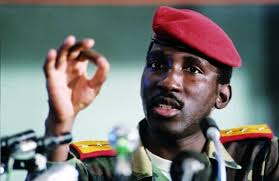
    October 10, 2014 — New Books in African Studies –Thomas Sankara, often called the African Che Guevara, was president of Burkina Faso, one of the poorest countries in Africa, until his assassination during a military coup that brought down his government. Although his time in office was relatively short, Sankara left an indelible mark on his country’s history and development.
    As Ernest Harsch explains in his engaging biography, Thomas Sankara: An African Revolutionary (Ohio University Press, 2014), Sankara’s influence extends beyond Burkina Faso. Sankara was a moral force and an ardent spokesperson for African dignity and struggle against neocolonial forces and Western economic domination.
    Harsch traces Sankara’s life from his student days to his recruitment into the military, his early political awakening, and his increasing dismay with his country’s extreme poverty and political corruption. Sankara and his colleagues initiated economic and social policies that shifted Burkina Faso away from dependence on foreign aid and toward a greater use of the country’s own resources to build schools, health clinics and public works. Although Sankara’s sweeping vision and practical reforms won him admirers both within and without Burkina Faso, a combination of domestic opposition and factions within his own government and the army led to his assassination in 1987.
    Harsch has written the first English-language book that relates the story of Sankara’s life and achievements. Based on extensive firsthand research in Burkina Faso as well as interviews with Sankara himself, this brief biography will give this neglected hero of the African revolution the attention he deserves.


  5. Pambazuka News — The life and work of Thomas Sankara can be taken as a reminder of both the power and potential for human agency to enact transformation. I would like to situate my ideas within the geopolitical context of the popular uprisings that continue to take place around the world as people organise against neoliberal policies of advanced capitalism and their resultant gross inequalities in wealth, health and education.

    In 1987, Blaise Compaoré overthrew Sankara and took over the presidency. 27 years later, Sankara’s ghost may be coming back to return the favour.
    Thirty years ago, on August 4, 1984, the former French colony of the Upper Volta was re-baptised as “Burkina Faso” amidst a revolutionary process that proved to be one of the most inspiring, yet ultimately tragic, episodes of modern African history.
    In 1983, the young Captain Thomas Sankara had come to power in a popularly supported coup d’état and − with broad support from leftist political parties, students, women and peasants − initiated a range of ambitious projects, including the country’s name change, that aimed to make the country more self-reliant and free of corruption. Sankara also sought to decentralise and democratise power in order to facilitate more participatory forms of governance, though elections for national offices were never attempted.

    Accompanying the intensifying neoliberal crises — manifested through the financial crisis, food security crisis, and struggles over land reform and landed property — is an ever expanding militarisation. The US military now has more bases and more personnel stations in more countries than ever in its history. The US Africa Command is one component of the US military’s current phase of expansion, including millions of dollars of military equipment, arms and training in African nations.

    Their ideas, courage and sacrifice for the freedom and dignity of their people have made these martyrs larger than life. Thomas Isidore Sankara is one in a long lineage of African sons and daughters whose ideas and actions have left an indelible mark on the history of their continent. That is why 21 years after his death, Sankara continues to guide those who are struggling to end the domination of their continent and the enslavement of its peoples.

    Thomas Sankara was killed in the belief that it could extinguish the example he set for African youth and progressive forces across the continent. They could not have been more wrong. One week before his assassination on October 15, 1987, in a speech marking the 20th anniversary of the assassination of Ernesto Che'' Guevara, Thomas Sankara declared:Ideas cannot be killed, ideas never die.’’ Indeed, the history of humanity is replete with martyrs and heroes whose ideas and actions have survived the passage time to inspire future generations.”The revolution and women’s liberation go together. We do not talk of women’s emancipation as an act of charity or out of a surge of human compassion. It is a basic necessity for the revolution to triumph.” — Thomas Sankara


  6. yes his dreams and ideas would go on forever .however one cannot overlooked that a man of such greatness was unable to bring his people along to the finish line an undeniable marks of human rights violations against his people was written in his final chapter

The blogmaster invites you to join the discussion.

Trending

Discover more from Barbados Underground

Subscribe now to keep reading and get access to the full archive.

Continue reading