
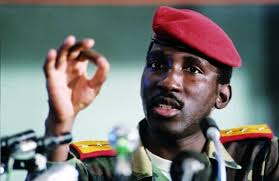


Submitted by Kammie Holder
“While revolutionaries as individuals can be murdered, you cannot kill ideas.” — Thomas Sankara
I first became aware of Thomas Isidore Noël Sankara, some 18 years ago. He is affectionately known as “The Upright Man,” remains one of Africa’s most inspiring and uncompromising leaders. Born in 1949 in Upper Volta, now Burkina Faso, he embodied integrity, courage, and an unshakable faith in the potential of his people. When he rose to power in 1983 at just 33 years old, he declared, “We must dare to invent the future.” Sankara’s revolution was not one of rhetoric but of substance — a call to reclaim dignity, independence, and self-reliance from the grip of imperialism. He understood that Africa could never rise by bending its knees to foreign masters, and his short-lived presidency became a blueprint for what true leadership could look like.
“He who feeds you, controls you.” — Thomas Sankara
Central to Sankara’s vision was food sovereignty — a conviction that a free people must first be able to feed themselves. He challenged dependency on imported food, declaring that Burkina Faso must “produce what we consume and consume what we produce.” Through nationwide agricultural reforms, irrigation projects, and incentives for local farmers, the country saw unprecedented growth in food production. Within four years, Burkina Faso became nearly self-sufficient in grain. Sankara’s policies remind us that sovereignty begins at the soil, and that no IMF or World Bank loan can feed a hungry nation. His stance against global financial institutions was not isolationism — it was protection of dignity. He refused aid that came with strings, understanding that “debt is a cleverly managed reconquest of Africa.”
“You cannot carry out fundamental change without a certain amount of madness.” — Thomas Sankara
Sankara’s so-called madness was, in truth, vision. He saw possibilities where others saw only poverty. From environmental renewal to public health, he led with urgency and imagination. Under his leadership, ten million trees were planted across Burkina Faso to combat desertification — a green revolution long before climate change became a global concern. He also launched one of Africa’s most ambitious vaccination drives, immunizing 2.5 million children against measles, meningitis, and yellow fever in just weeks. His message was clear: development must serve the people, not statistics. He lived simply, rode a bicycle, cut his salary, and sold the fleet of Mercedes-Benz cars that symbolized government privilege. He embodied sacrifice — “We must live simply so that others may simply live.”
“The revolution and women’s liberation go together.” — Thomas Sankara
Perhaps most profoundly, Sankara was decades ahead of his time in advancing women’s rights. He banned forced marriages, promoted girls’ education, criminalized female genital mutilation, and encouraged women to work in all sectors of government. “There is no true social revolution without the liberation of women,” he declared. Sankara challenged men to share domestic responsibilities and appointed women to positions of authority, not as a gesture, but as a principle of equality. In a patriarchal world, he redefined leadership — one that valued inclusion, dignity, and justice. His words remain a torch for every modern leader who seeks to build a society rooted in respect and equity.
“Comrades, there is no true revolution without transparency and accountability.” — Thomas Sankara
Sankara’s government was built on accountability and anti-corruption. He lived in the same modest conditions as his people and demanded integrity from every public official. Corruption, he said, was “the termite that eats away at the foundations of nations.” He required all ministers to declare their assets and refused foreign luxury. His simplicity was his armor. Sankara’s example is one that Caribbean leaders, including Mia Mottley and CARICOM, can draw upon today. In an age of rising public distrust and opaque governance, the region must embrace open government — where policies are transparent, resources are traceable, and leaders are answerable. Sankara’s life reminds us that development divorced from accountability is merely deception in disguise.
“We must choose either champagne for a few or safe drinking water for all.” — Thomas Sankara
Burkina Faso under Sankara was not rich in money, but it was rich in purpose. He taught his people pride, the strength of unity, and the beauty of simplicity. His humility contrasted sharply with the extravagance of many postcolonial elites. Mia Mottley’s global leadership on climate change, debt justice, and sustainable development resonates with Sankara’s ideals. But his lesson to CARICOM is clear — progress must be people-centered, not donor-driven. The Caribbean, too, must reject dependency on the IMF and World Bank when their conditions compromise national sovereignty. Sankara’s voice still whispers through the winds of history: “A soldier without political or ideological training is a potential criminal.” The same applies to leaders without moral training — they are potential betrayers of their people’s trust.
“Our revolution is not a public relations campaign. It is for the happiness of our people.” — Thomas Sankara
Sankara’s downfall came from betrayal — a tragedy etched into the story of Africa itself. His closest ally, Blaise Compaoré, turned against him in a coup on October 15, 1987, aided by foreign interests who feared Sankara’s growing influence. The French, whose neocolonial grip he denounced, saw in him a threat to the status quo. He was gunned down alongside twelve comrades, but his spirit remained unbroken. His assassination proved that truth is dangerous, but it also immortalized his ideals. Sankara’s life teaches that naïveté in trust is the curse of the righteous — yet it is also the mark of those who believe more in the goodness of humanity than in its greed.
“Even if you kill me, thousands will rise to take my place.” — Thomas Sankara
And indeed, he was right. Across Africa, the Caribbean, and the global south, Sankara’s fire still burns — in every movement for justice, every call for transparency, and every leader who dares to speak truth to power. His message to CARICOM and to the world is not just political, but moral: that integrity is not a strategy, it is a duty; that leadership is not privilege, it is service. As Mia Mottley and her Caribbean counterparts steer their nations through economic storms and climate crises, they can draw strength from The Upright Man — the one who chose truth over comfort, equality over privilege, and nation over self. Sankara’s revolution was short-lived, but its echo remains eternal.
“We must dare to invent the future.” — Thomas Sankara
Thomas Sankara lived and died for that dream — a future where every African, every Caribbean citizen, and every oppressed person could stand tall, independent, and proud. His enemies may have silenced his voice, but not his vision. Today, the world still needs his courage — to confront corruption, defy imperialism, and lead with honesty. Sankara did not die in vain; he lives in every heart that still believes that integrity is revolutionary




The blogmaster invites you to join and add value to the discussion.