Banner promoting anonymous crime reporting with a phone and contact number 1 800 TIPS (8477), featuring the Crime Stoppers logo and a QR code for submitting tips.

← Back

Your message to the BLOGMASTER was sent

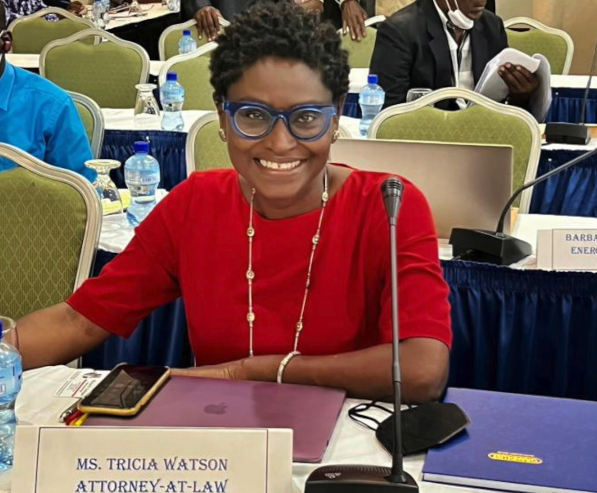
The following articles were written by Tricia Watson, a respected social commentator, particularly on energy-related issues. The Blogmaster extends sincere thanks to her for granting permission to share her writings in this space. Special thanks are also extended to Peter Thompson for his assistance in facilitating this arrangement – Blogmaster

So who is paying for Barbados’ energy transition? Electricity ratepayers are!

Dear Bajans,

Pull out your light bill. Now ask yourself a simple question: who decided what is on it, and did anybody ask you?

The Saturday Sun Editorial of October 10 says Barbados is on the horns of a dilemma: households squeezed by the “skyrocketing” cost of living, employers wary of wage rises, and electricity costs climbing again.

The Editorial, interestingly, anticipates that Barbados Light & Power (BLPC) will be granted a rate increase when it asks for one in the next six months, and pleads, plaintively, that the increase be reasonable. But what is “reasonable”? And who decides?

Under the law, “reasonable” is a finding based on tested evidence. It is not a feeling or an assumption. In the 2021 rate case, BLPC argued that it deserved an increase because it had gone more than a decade without one.

It used inflation-related arguments to suggest that a $48 million annual increase would simply restore what it had lost. The Fair Trading Commission (FTC), without testing the BLPC’s evidence, ordered an “interim rate” increase, amounting to $29 million per year. We have been paying that unsubstantiated increase for 49 months and we continue to pay.

In its 2018 manifesto, the then Opposition Barbados Labour Party (BLP) promised to “by 2030, transition Barbados to the first 100% green and carbon neutral island state in the world . . .” . As is the case with manifesto promises, the BLP did not explicitly state how it intended to finance the transition, and who would foot the multibillion-dollar bill.

Energy transition

So who is paying for Barbados’ energy transition? Electricity ratepayers are! Every household, shop, church and small business will pay through their monthly bills. Businesses and Government will also pass electricity costs on through the prices of goods and services.

The estimated $4 billion to $5 billion needed to move from roughly 15 per cent renewable electricity to 100 per cent will be collected through base rates, riders and the fuel clause. And remember what is being funded: the existing fossil-fuel plant AND the new, expensive renewable investments, on the same bill.

In principle, I do not oppose the transition. I oppose one that leaves the people paying for it in the dark. This is not just a technical project; it is a political and social one, turning on four questions: who pays, who decides, who benefits and who carries the risk.

• Diagnose the delay honestly

Government and its allies say regulatory delay, meaning particularly FTC rate proceedings, is holding up projects that support national policy, and they blame rate-case intervenors.

As a participant in these rate proceedings, I agree that a rate case that drags on helps nobody, least of all consumers. But delay has many parents: incomplete applications, evidence redacted as “confidential”, late filings by the utility, unanswered questions and, more recently, ministers stepping into the process. Consumers are the only parties not contributing to the delay.

Consider the Renewstable hydrogen project tariff application. With Cabinet’s approval, the Minister of Energy announced that tariffs would be decided by September 15. It is now November, no ruling has been issued, and intervenors in the Renewstable rate case that remains open before the FTC have not been told anything by either the minister or the FTC.

How can citizens be the bottleneck in a process in which nothing is happening? They are not.

Public rate hearings

The practice of public utility commissions holding public rate hearings to regulate rates charged by utilities has been around for over 125 years in this hemisphere. In Barbados, public rate hearings forcing our utilities to prove that they deserve the rates they ask for have been the norm since the 1950s.

In the last full rate case, intervenors tested the evidence, and the FTC reduced the return requested by Barbados Light & Power from 8.79 to 7.47 per cent, ordered compensation for overcollection, and ruled that $100 million taken from the Self Insurance Fund had been unlawfully withdrawn and paid to the shareholder and should be returned to ratepayers. That is scrutiny producing results for consumers – not intervenors causing needless delay.

When a rate case concludes swiftly and approves costs that have not been tested by a rigorous process that includes examination by knowledgeable interested citizens, that is not necessarily efficiency. The phrase “trust us” is not a reliable regulatory system, and “nimbleness” is not a measure of regulatory effectiveness.

That October 10 Saturday Sun Editorial added, in a frighteningly casual manner, that getting a “reasonable” result out of the FTC is dependent “on the articulation of advocates like Tricia Watson” who participate in rate hearings.

This should worry us greatly. A system that leans on a few citizens who turn up, without being paid, without being treated fairly and who are not listened to by the FTC or the Government, is not protection for the consumer. That is a system that requires consumers to rely on hope, luck, or divine intervention for their interests to be represented.

Fairness to electricity consumers must not hinge on who has the time, money and intestinal fortitude to show up and to keep showing up.

• Read the law, not the press release The Government now proposes a ministerial process under Sections 37(4) and (5) of the Utility Regulation Act, which lets a minister exempt specified matters from the Act where he is satisfied the public interest requires it. The Government rhetoric assures us that this ministerial process will not displace intervenors, arguing that the public may still be invited to present their concerns. But an invitation is not the same as a right to participate.

Let me remind you that the Act lets a minister EXEMPT a power producer from scrutiny – it does not empower the minister to step in and set rates in the FTC’s place.

When electricity companies, like the Light & Power, like Renewstable, are exempted from complying with the law that exists to protect electricity consumers, who decides what you will pay, and by what method? What is certain is that in such a case, rates will not be set by the independent regulator, public participation is not guaranteed, and the rates will be decided behind closed doors.

Your only role in such a “system” will be to meekly pay the bill regardless of the amount.


Discover more from Barbados Underground

Subscribe to get the latest posts sent to your email.

3 responses to “Who decides what’s on your bill?”


  1. Fast and fair transition: Five proposals

    The following is the second and final part of a submission by Tricia Watson, former senator, attorney, public policy and energy justice advocate. Part 1 was carried in yesterday’s SUNDAY SUN.

    THE EDITORIAL in the SATURDAY SUN of October 10, lists stronger energy regulation among the answers. Agreed. Here is what that should mean.

    1. A clock for everybody. Fair Trading Commission (FTC) rules, which have the force of law since 2003, set deadlines for the utility and Independent Power Producers to file complete applications and answer intervenors’ questions. Enforce the rules instead of blaming intervenors at every opportunity.

    2. Fund the case, not an office. The utility has lawyers, engineers, economists, accountants, and other consultants, and recovers the cost of a rate case from its customers. We can expect large power producers who come to the FTC for rate approvals to have similar resources and to recover their costs from us.

    The FTC recovers its costs from us too. Approved intervenors have no such assurance. The Government has shown that it is not willing to adequately resource either a government-appointed, or a government-funded, independent “consumer voice”.

    One solution is to let each intervenor apply to the FTC for reasonable expert costs and compensation for the time that the intervenor spends participating in the rate case, with interim payments at set stages. The money could come from a small levy on the electricity licensees.

    Household bills

    3. Show the public the transition bill. Before each application for rate approval is heard, the FTC must publish its effect on household bills, public finances and inflation. We have Renewstable as an applicant before the FTC and at no point has that applicant been ordered to state the price that we will have to pay for its electricity.

    Renewstable’s own highly contested application documents, which they asked the FTC not to make substantial parts public to the very Barbadians who would have to pay the rates being requested, suggest that a Renewstable kilowatt hour of electricity will cost Barbadians twice what we currently pay for the averagekilowatt hour of electricity. The public must not automatically be forced to pay for expensive electricity because of flawed government policy.

    4. Consult early, give reasons, keep the route to appeal decisions open. Licensing and tariff-setting must be open to the public before decisions are made. That is the current law for tariff-setting. The FTC is supposed to consult. But far too often it does not meet the accepted legal standard for consultation.

    Two years ago, our Government removed the public’s right to participate in considering licence applications for large renewable energy projects and utility licences. Now, citizens may learn that a licence has been signed only after the fact – if we learn about it at all.

    There must also be a real route to appeal decisions made by the FTC and the minister that approves electricity licences. We have, at present, multiple orders issued by the FTC that have been appealed, and interlocutory applications filed with the FTC, that have gone unanswered.

    The form of appeal is to ask the FTC to make a decision about whether its own decision was right or wrong, and the FTC’s approach is to allow the people who made the decision in the first place to review their own decision.

    Crippling costs

    The FTC gave a decision in April this year allowing Barbados Light & Power to charge higher rates through the fuel clause adjustment to cover rental of temporary generation equipment, but the FTC has never given reasons for its decision.

    Without reasons, an appeal becomes very difficult. The route for appealing decisions by the minister responsible for energy is murky since a clear process has never been laid out. And citizens face crippling cost orders if, in good faith, they challenge the FTC’s orders in our High Court.

    5. Let Bajans own a piece. Implement and incentivise community solar, co-operatives and shared batteries, with routes to ownership for renters and low-income households. And let us talk seriously about who controls our national grid. We cannot proclaim that we are pursuing electricity sovereignty and never consider who owns the electricity system.

    To Government and Parliament: Mission Barbados promises “active, involved citizens” by 2030. You cannot cultivate active citizens by sidelining or attacking the citizens who turn up. And changes of the magnitude of Barbados’ energy transition belong before an independent regulator, not under a ministerial exemption.

    To the regulator: Independence is your asset. Enforce deadlines, publish documents and make public hearings the norm, as the law requires. Of the matters the FTC has handled since the 2021 Rate Review Application, only one has been conducted in public.

    Demand scrutiny

    To employers and the private sector: Electricity is part of your cost of doing business. Every untested cost in rates lands on your margins or your customers (who will do everything in their power to pay their electricity bill because they need electricity to survive). You have as much reason as any householder to demand scrutiny.

    To lenders and investors: Investor confidence must not become a euphemism for consumer surrender. Shortcuts breed mistrust, and they damage the country’s name as a place that respects the rule of law.

    To every householder: Everyone is being asked to share the burden of hard times. When it comes to electricity, the light bill is where we find out whether that is true. A young Barbadian who is 20 today will still be living with the policy and regulatory choices at 50.

    Proposed amendments for our republic constitution include economic rights for citizens – I support that idea. Citizen economic rights must guarantee a right for citizens to participate in rate-setting and licensing proceedings for essential services like electricity, representing consumers and the public interest.

    As we mark 60 years of Independence on November 30, remember that a people who won the right to govern themselves did not do so for 300 000 of us to be told, while the electricity price is being set and the profits pie is divvied up, to wait outside. This is about our money, our power and our say.

    Stay vigilant!


  2. Professor Troy Lorde’s weekly column touches on the importance of energy cost in the local economy as it relates particularly to battery storage and a proposed investment by Minister Symmonds.

    The missing transmission mechanism

    Economic transformation cannot be judged by how much additional income is generated while remaining indifferent to who receives it.

    MY LAST TWO COLUMNS raised questions about the effectiveness of our economic model. But there is a more fundamental issue that neither fully addressed.

    Even when the economy grows, who captures the income generated and how much of it ultimately reaches Barbadian households? The question is not simply whether Barbados is producing more, but whether the arrangements governing our economy allow ordinary Barbadians to share meaningfully in what is produced.

    Recent remarks by Minister Kerrie Symmonds have inadvertently opened this discussion. He argued that Barbadians had historically received only the “crumbs” from agriculture and tourism, while relatively few captured the substantial returns.

    The Barbados Hotel and Tourism Association (BHTA) objected, citing tourism’s contribution to Gross Domestic Product (GDP), employment, entrepreneurship and other industries. But the BHTA’s defence answers a completely different question. Demonstrating that tourism contributes substantially to national production does not establish how the income it generates is distributed.

    Fundamental weakness

    The disagreement exposes a fundamental weakness in our economic debate. We repeatedly invoke tourism’s contribution to GDP as though the size of an industry establishes the breadth of its benefits. GDP does not distinguish between income accruing to workers, domestic owners, foreign investors and Government. Nor does it establish how much ultimately reaches households. The minister’s language may have been provocative, but the underlying distributional question cannot be answered by repeating tourism’s economic importance.

    The same problem arises with productivity. The Governor of the Central Bank called for improvements in productivity, but higher productivity does not automatically produce higher wages. Businesses can retain the gains as profits, distribute them to shareholders, increase wages or reduce prices.

    Which occurs depends on bargaining power, competition and institutional arrangements. Barbados has a longstanding Social Partnership, yet an explicit mechanism linking productivity improvements to workers’ real earnings remains non-existent. Wage adjustments to compensate for inflation are not the same as workers receiving a share of additional income generated through greater productivity.

    Minister Symmonds’ proposed $200 million battery-storage investment offers an opportunity to confront the ownership question. Allowing Barbadians to purchase units in energy infrastructure could broaden participation in investment returns. But access to an investment product is not equivalent to broadening ownership across society. Households struggling to meet essential expenditure cannot divert income into financial assets. Those already possessing savings will capture most of the opportunity. If the intention is to change who benefits from productive investment, Government must explain how participation will extend beyond households already capable of investing.

    There is a further contradiction.

    Barbadians may become investors in energy infrastructure while continuing to pay electricity bills determined

    through regulatory arrangements. The ongoing proceedings involving Barbados Light & Power and the Fair Trading Commission illustrate the importance of those arrangements. The court has permitted discussions between the utility and regulator while preserving judicial oversight and an opportunity for intervenors to comment.

    Beyond the procedural dispute lies a fundamental economic question: how are the costs and returns of electricity provision divided between investors and consumers? An investment that generates attractive returns for investors while leaving electricity unnecessarily expensive for everyone else is a very different achievement from one that broadens ownership and reduces costs throughout the economy.

    Household prosperity

    This is where the transmission mechanism becomes particularly important. Household prosperity depends not only on the income people receive but also on how much of it they retain after paying for necessities. Electricity, housing, transportation and food costs determine whether wage increases become meaningful improvements in purchasing power. The Central Bank reported lower inflation of 1.5 per cent. But lower inflation does not reverse previous price increases. Nor does it tell us whether domestic distribution costs, market structures and regulatory decisions are preventing households from benefiting fully from improvements in economic performance.

    There is an even more unsettling possibility. We assume that economic growth finances household consumption, but households can also sustain economic activity by borrowing more, saving less or working additional hours. The Central Bank reports growth in domestic services and distribution, but this does not establish whether expenditure is supported by rising real incomes or household financial adjustments. This is a hypothesis requiring evidence from household income, credit, savings and debtservicing data. Nevertheless, it raises a question that should trouble policymakers: Are households benefiting from the growth being reported, or are their financial sacrifices helping to sustain it?

    Economic transformation cannot be judged by how much additional income is generated while remaining indifferent to who receives it.

    Until we confront the ownership structures, wage arrangements and pricing decisions that determine who captures the gains, the size of the Barbadian economy could change without fundamentally changing who benefits from it.

    Professor Troy Lorde is an economist and Dean of the Faculty of Social Sciences at the University of the West Indies, Cave Hill Campus. Email troy.lorde@cavehill.uwi.edu


  3. Maybe BARP with its 23 thousand strong membership needs a more impactful and tactical call to action.

    We know that despite strident calls to the powers that be AND a docile Barbadian consumer, many of these calls from the figureheads like BARP merely check a box. No disrespect intended to President Marilyn Rice-Bowen. She needs to get the membership active to mirror what happens at the BARP Fete.

    he advocacy needs to be escalated. This government for example has not issue with enacting self serving legislation is QuickTime but the current lacuna in the legislation excluding regulation of mobile by the telcos has gone unattended by successive governments.

    BARP slams utility price hikes

    THE BARBADOS ASSOCIATION OF RETIRED PERSONS (BARP) HAS expressed strong concern and opposition to the recently implemented increases in utility costs by the Barbados Light & Power Company (BLPC) and FLOW, warning that the additional financial burden would place further pressure on retirees and other consumers living on fixed incomes.

    The increases, affecting electricity bills and FLOW’s broadband and bundled services, combined, represent an additional expense of approximately $32 or more per month for many consumers.

    Against the backdrop of an already challenging cost-of-living environment, BARP is particularly concerned about the implications for Barbadian seniors, many of whom have limited capacity to absorb further increases in their monthly expenses.

    BARP president Marilyn Rice-Bowen said the increases highlighted the growing financial vulnerability of pensioners, whose incomes had not kept pace with the rising cost of living.

    “The majority of pensions in Barbados are not indexed. This means they do not benefit from automatic cost of living adjustments and remain fixed at the same dollar value throughout retirement. When the cost of essential services increases, pensioners have little room to manoeuvre. They are often forced to make difficult choices, cutting back on other necessities, including food and health care, to meet their monthly obligations,” she said.

    Compromise well-being

    Rice-Bowen said seniors should not have to compromise their well-being and quality of life simply to maintain access to essential services. She called for greater consideration of the financial circumstances of retirees and the introduction of practical measures to cushion the impact of rising utility costs.

    While maintaining its concern about the increases, BARP is formally inviting BLPC and FLOW to meet with the association to discuss targeted relief measures for customers who are seniors.

    Rice-Bowen said BARP was seeking engagement with both companies to explore practical solutions, including concessions, discounted senior packages, waivers or other forms of assistance that would make these essential services more affordable for retirees.

    “We believe there is an opportunity for these companies to demonstrate a commitment to the well-being of Barbadian seniors by working with us to develop measures that recognise the particular financial challenges faced by pensioners. In addition to raising concerns, we want to dialogue and are proposing solutions,” she added.

    “We would welcome the opportunity to sit with both companies and explore what can be done to provide

    real relief to seniors.”

    Targeted assistance

    She pointed to the Barbados Water Authority’s (BWA) Garbage and Sewage Contribution (GSC) Levy relief programme as an example of how targeted assistance can be designed to benefit seniors. The programme provides for a reduction or complete waiver of the levy for eligible people aged 65 and over.

    Under the programme, applicants must be at least 65 years old, reside at the property for which relief is being sought and have a separate water meter. Applications must be submitted to the GSC Relief Board at the BWA.

    “We recognise that this is not an issue affecting retirees alone. Within BARP’s nearly 23 000-member base there are many persons between the ages of 40 and 65, who are also feeling the effects of rising costs. However, many in this age group remain economically active and have opportunities to earn an income. For those who are retired, particularly pensioners dependent on fixed incomes, it is difficult to absorb additional expenses.”

    The BARP president also emphasised that access to broadband and Internet services had become vital in modern society.

    “Internet access is no longer a convenience. It is required for communication, conducting business, accessing information and most Government services, and maintaining social connections. Seniors must not be left behind because the cost of staying connected has become prohibitive,” she insisted.

    Rice-Bowen also called on Government to give greater consideration to the financial realities of an ageing population when developing social and economic policies.

    She noted that Barbadian seniors would represent a considerable proportion of the country’s population, making it necessary for national policies and corporate practices to take account of their particular needs and circumstances.

    BARP maintains that access to essential utilities should remain affordable. The association looks forward to engaging with BLPC and FLOW, as well as Government, in pursuit of practical solutions that will help protect the well-being and quality of life of seniors. (PR/SC)

    Source: Nation

The blogmaster invites you to join the discussion.

Trending