
Banner promoting anonymous crime reporting with a phone and contact number 1 800 TIPS (8477), featuring the Crime Stoppers logo and a QR code for submitting tips.

← Back

Your message to the BLOGMASTER was sent

Submitted by Terence Blackett
There has never been better slaves, never worst masters – Tacitus
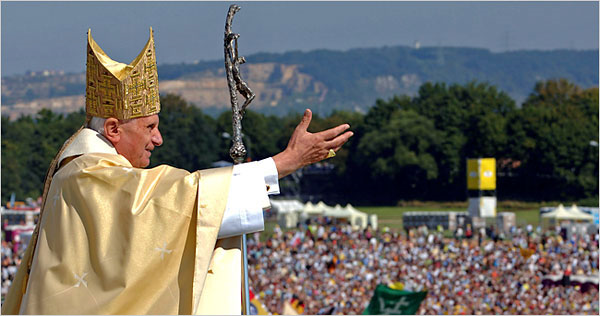
The Pope

For the past [212] years, the deadly socio-political and religious wound inflicted on the Papacy by Napoleon Bonaparte’s General Jean Baptiste Berthier on the 20 February 1798 has now healed to the point where this institution will once again usurp her authority as she did during the 1260 years of the Dark Ages (538 AD -1798).

The entire world still pays obeisance to this earthly religious government. Its power is greater than that of kings. Its might has been wielded for over 3000 years, shape-shifting throughout past ages taking on diverse Satanic forms while masking and masquerading as a “godlike” entity. Time and again it has resurrected itself. In the past, (just like today), it is “the ‘Beast’ that sits on many waters” –

Aptly called “The Fourth Reich” it seeks to bring world powers under its allegiance – culminating in enforced religious “laws” where all the inhabitants of earth will be obliged to adhere to – regardless of geography, religion, ethnic group, class or creed.

Social historians and anthropologists agree that most definitional interpretations of “Reich” is “German State” – but the conceptual place from which this notion originates does not infer a relation to what is today the country of Germany, but rather an ancient allusion to the Germanic Lands occupied by the Goths, Ostrogoths, Franks, Heruli, Bavarians, Alamans, Saxons and other barbarian people. The “Reich” is then best described as a crossbreed between a State and a confederation based on religious grounds – except for the latter, (not being unlike the EU of today).

In “The First Reich” was seen as the evolution of The Holy Roman Empire after the fall of the once mighty political empire called Rome. Within Europe, these geographical and political enclaves was to become a continuity of the once mighty Roman Empire that started in the lands ruled by Charlemagne (Charles the Great) who was crowned Emperor by Pope Leo III in Rome on Christmas Day 800 AD, a date which is normally seen as the founding of the Empire, but sometimes the year of 962 AD is also used, which was when Otto I (Otto the Great) was crowned.

“The Second Reich” is also based on counting the Holy Roman Empire as the first German Empire (just as Nazi ideology insisted that Nazi Germany was “The Third Reich”). “The Second Reich”, ruled by the Hohenzollern dynasty, in the areas known as Prussia and Brandenburg, from 1871 to 1919, fell with the ending of World War I. During this “Reich” the “Iron Chancellor” Otto Von Bismarck united Germany, and set the roots for World War I. “The Second Reich” saw the unification of Germany following the Franco-Prussian War (1870 – 1871) and the crowning of Wilhelm I as German Emperor at the Palace of Versailles, with Otto von Bismarck as the first Reichskanzler, to the abdication of Wilhelm II in 1919 following the German defeat in the First World War. Then entered a period known as the Weimar Republic, from 1919 to 1933 (called sometimes the pre-3rd Reich). Social historians agree that this weakened Republic was the catalyst for the creation of what was to become “The Third Reich”.

The Third Reich” (from 1933 to 1945), called Nazi Germany came under the control of Adolf Hitler. The term “Third Reich” was most likely taken from the book “Das Dritte Reich” published by Arthur Möller van den Bruck (1876-1925) in 1923. He called it the “Third Reich” because he thought that under his leadership Germany could reunite the old Holy Roman Empire, bringing Germany back to its glorious days. This “Reich” was terminated with the fall of Germany at the end of World War II.

There is a very interesting question here because most theorists cannot agree why Hitler started World War II and what his objective was?

Of course his delusion… “The Third Reich” was an anglification of the German expression “Das Dritte Reich“, and is used as a synonym for Nazi Germany. The term was introduced by Nazi propaganda, which counted the Holy Roman Empire as the “First Reich”, the 1871 German Empire the “Second”, and its own regime as the “Third”. This was done in order to suggest a return to alleged former German glory after the perceived failure of the 1919 Weimar Republic, but this was not seen as the “Third Reich”, but rather as an Interim “Reich”.

The Third Reich” was sometimes also referred to as the “Thousand Year Reich” as in the case of the Holy Roman Empire (ref: The Dark Ages). The Nazi Party under Adolf Hitler used the terms “Third Reich” and “Thousand Year Reich” to connect the allegedly glorious past to its supposedly glorious future.

By 1932, influential bankers, industrialists, landowners and politicians conspired to put Hitler into power because of the political and economic weakness of the Weimar Republic. Hitler’s ideological views were suspect but there was an inherent belief that he could restore the Republic back to its former glory and prosperity sanctioned by the will and might of the Catholic Church.

Today, global trends suggest that what is emerging in Catholic Europe is nothing more than “The Fourth Reich” – an assimilation of “dark forces” at work to bring mankind into the long conspired One-World government under the magnetism of a powerful political/religious leader.

Let us be under no illusion, these powers that are at work – existing for just one purpose and that is – global domination.

EU integration has been one such move in the major global paradigmatic synergy in the fulfillment of this process. The forces of globalization are a major catalyst in this process in bringing about world union while removing the barriers to trade liberalization, currency formulations, political unification and finally religious ecumenism.

The work of The World Bank, The International Monetary Fund, The United Nations, The World Council of Churches and other global conglomerates are all working feverishly to ratify global change in favour of the working of these subliminal, shadowy forces which are now at work in our world.

The Vatican is preparing Pope Benedict XVI for his first formal visit to the United Kingdom as a “head of state”. There are many who question the logic of why a religious leader, by definition, who do not have any significance or relevance to the majority of British people who are secularists and are frankly void of religious affiliation. But this visit is political in nature, so those arguments are quashed because his sole intention is to first meet with Queen Elizabeth II (to heal an ancient wound), then Archbishop Dr. Rowan Williams (to bring back this lost daughter back into the fold) and finally the new PM – David Cameron (who has no problem spending £12 million of British taxpayers money on a Papal visit while public servants lose jobs from austerity measures – to simply hear that Britain must make a firm EU commitment and adopt the maxims of the Church).

For Pope Benedict, the issue to be raised in September is the sacredness of “SUNDAY” as a legislated day of worship ratified by the State as an ACT* of Parliament under the pretext of the – “WRITTEN DECLARATION pursuant to Rule 116 of the Rules of Procedure by Anna Záborská, Martin Kastler, Jean Louis Cottigny, Patrizia Toia and Konrad Szymański on ‘the protection of a work-free Sunday’ as an essential pillar of the European Social Model and a part of the European cultural heritage…”

As stated – The European Parliament having regard to Article 137 of the TEU and to Rule 116 of its Rules of Procedure dictates: –

  1. Whereas a work-free Sunday is an essential pillar of the European Social Model and a part of the European cultural heritage;
  2. Whereas a EUROFOUND survey shows that the likelihood of sickness and absenteeism in establishments that work on Saturdays and Sundays is 1.3 times greater compared with establishments that do not require staff to work at the weekend;
  3. Whereas, according to EU law, Sunday is the weekly rest day for children and adolescents;
  4. Whereas the European institutions, bodies and agencies have not worked on Sundays
    since their creation and do not intend to do so in the future, despite the diversity of
    religious, cultural and ethnic backgrounds of EU officials and decision-makers;
  5. Calls on the Member States and the EU institutions to protect Sunday, as a weekly rest
    day, in forthcoming national and EU working-time legislation in order to enhance the
    protection of workers’ health and the reconciliation of work and family life;
  6. Instructs its President to forward this declaration, together with the names of the
    signatories, to the Council, the Commission and the parliamentary committees for social
    affairs of the national parliaments.

If the European Union succeeds in legislating a specific day – (Sunday) as a “day of rest” – it will be tantamount to the enforcement of a lifestyle change on all peoples within its Diaspora including all Member States as well as the religious “Right” in America (who is also pushing this agenda in Congress) where we will be forced to follow a “state-sanctioned religion” – Catholicism and its enforcement of Sunday worship will be the “Mark” of a powerful Vatican-allied European superpower institution given the wings of globalization to be adopted by every nation, kindred, tongue and people.

The Catholic Church claims that “Sunday” is the “mark of its authority”, and that the other churches of Christendom acknowledge the church’s authority by Sunday observance (Cardinal Gibbons and the Douay Catechism, p. 59).

The Secretariat of COMECE* – the Commission of the Bishops’ Conferences of the European Community – made up of (Bishops delegated by the Catholic Bishops’ Conferences of the European Union and has a permanent Secretariat in Brussels), the Protestant Church in Germany (EKD) and the Church of Englandwelcome the initiative of several Members of the European Parliament, to ask the House to decide on a Written Declaration “on the protection of a work-free Sunday as an essential pillar of the European Social Model and as part of the European cultural heritage”.

Such a declaration would constitute an important commitment to a “Social Europe” knowing that it is important to find the majority necessary for this cross-party resolution, which has been launched by five parliamentarians – from the political groups of EPP, PSE, ALDE and UEN on 2 February 2009.

For most of us who are religious liberty watchers; freedom of conscience advocates; and the amalgamation of church & state denouncers and deniers – we see the writing on the wall and the moves being made by the Vatican to break down the last vestige of religious dissension in Europe by toppling Britain and very soon – America.

The Queen – who is the Head of the Church of England – along with Dr. Williams et al will be given a final papal edict to heal the century’s old division between the two faiths. This [478] year old rift is being healed right before our very eyes as we await the outcome of this historic papal visit.

This historical rift began in 1532. King Henry V III wanted Pope Clement V II to annul his marriage to Catherine of Aragon so that he could marry Anne Boleyn. When Clement refused, Henry retaliated by declaring himself the Supreme Head of the Church of England and with this authority persuaded other church leaders to back his call for the annulment of his marriage so he could marry Anne.

Anne became pregnant with Princess Elizabeth who was born in December 1532. Henry married Anne (though not divorced from Catherine until May 23rd 1533). Anne was the 2nd of Henry’s 6 wives who he later accused of adultery and had her beheaded on May 19th 1536 (although some social historians agree that Jane Seymour – his 3rd wife was the actual cause of Anne’s death).

Pope Paul III excommunicated King Henry for his rebellious and adulterous ways though he remained a faithful Catholic during his reign – the Church of England still mirrored the theology and practices of the Catholic Church with the only noticeable difference that the Pope lived in Rome and the head of the Church of England lived in London.

When Henry died, his son Edward VI came to power and he tried to win the approval of the Protestants by implementing some reforms which included the creation of a Common Prayer Book in 1552. Henry quickly died and was succeeded by Mary I (also known as bloody Mary) as he had no heir. She reversed the reforms of her brother and brought the Church of England back to pure Catholicism. Many were burned at the stake as a result of refusal to embrace the edits of the new Queen.

Mary like her brother died without an heir and so her half-sister Elizabeth came to the throne and is credited with the establishment of the Anglican Church (1558) as we know it today. Her negotiation skills resulted in the church being 80% Catholic and 20% Protestant.

However, a grassroots movement within the church arose (called “rabble” – uneducated) – conservative radicals who wanted a complete break from the Catholic Church. This group given the derogatory name “Puritans” wanted (a) complete separation from the Vatican; (b) the abandonment of Catholic ritual; and (c) complete devotion to perfection and piety. To the ordinary layperson, the Puritan Movement seemed obsessed with anti-Catholic sentiment and a relentless quest for purity and perfection.

King James I succeeded Elizabeth in 1603 and he did not like the Puritans at all. To his credit however, James believed that the common people should be able to read the Bible in English and as the Supreme Head of the Church of England permitted the Bible to be translated. The first version appeared in 1611.

James died and was succeeded by his son Charles I and he too detested the Puritans and wanted the church to return to its Catholic roots and rituals. So he married a Catholic woman – creating outrage amongst the Puritans, escalating tensions and they in turn, repudiated the doctrine of “The Divine Right of Kings” (a political/religious doctrine of absolutism) – resulting in deadly persecution and the exodus of the Puritans to escape death.

Hence the birth of the colonies of New England on the shores of what was to become America and subsequently the United States of America (a land richly occupied by native peoples which a potent cultural heritage).

So the Puritans arrived on the shores of America with a strong resentment against Catholics, a rigid devotion to purity and perfection and an eagerness for freedom to worship God according to the dictates of their conscience.

The Puritans established Sunday Laws in their colonies (what we know in America today as (“BLUE LAWS” because of the blue paper they were written on). Obedience to the law was paramount. The laws did vary from colony to colony but the result was the same. Church attendance on the “Lord’s Day” was mandatory. Puritans could not work in the fields, make a bed, cook, sew or even kiss their own child on Sunday. All business activity (e.g. discussing business, buying or selling) and various forms of casual pleasures were rigorously outlawed.

The law enacted by Lord De La Warr, the 1st governor of Virginia, in 1610 stated:

“Every man and women shall repair in the morning to the divine service and sermons preached upon the Sabbath day, and in the afternoon to the divine service, and catechizing upon pain for the first fault to lose their provision and the allowance for the whole week following and also be whipped; for the second, to lose the said allowance and also be whipped; and for the third to suffer death.” (C. Gary Hullquist 2004, Emphasis supplied).

The Puritans had escaped to religious freedom – to be the first to enact and enforce similar laws limiting that said freedom for which they sought, hungered and died for.

Will we be facing a similar law of unintended consequences? Will the wall of separation between church and state be finally bulldozed to expose centuries of unheeded warnings? Will Sunday worship become a test of faith; an issue of political and civil disobedience and furthermore, a choice between the commandments of God or the dictates of men?

What we have learnt from history is that those who refuse to learn the lessons of the past are doomed to make the same mistakes in the future.

May God help us!

“There has never been better slaves, never worst masters” – Tacitus


Discover more from Barbados Underground

Subscribe to get the latest posts sent to your email.

188 responses to “THE FOURTH REICH: Masking The EU “Working Time Directive” – A Pretext To Enforce Global Catholic Religious Observance As the Ancient Issue Of “Sunday Sacredness” Takes Center Stage”


  1. ALL of this Roman Catholic diatribe that’s being quoted, HAS not bearing whatsoever on the TRUE ‘Body of Christ, HIS Church, througout the world.

    When the Pope speaks about Sunday worship and the ‘Mass’ it HAS no relationship whatsoever to those TRUE sactified believers OUTSIDE of the Whore and Mother of Harlots, as the ‘Sacrifice of the Mass’ within Roman Catholicism, IS blatant Witchcraft, and has NO connection to the Lord’s Supper in the other churches, who ABIDE in His Word.

    When true sanctified believers gather on the First day of the week, Sunday, thus is NOT some legalistic, imposed sanction, NO, not at all, it is in the FREEDOM of liberty that we do this, and there is NO penalty or SIN if one does NOT worship on Sunday, unlike Adventist, who FEAR, if they do not worship on the Sabbath.

    Bringing in ALL of this Vatican diatribe, is just another redherring, to distract from the real substance of this debate, won’t work, TB, can’t work, TB!! Get to the meat of the TRUTH, can you do this?

    Jesus NEVER taught anywhere in the NT, that the Sabbath was obligatory observance for His Church.

    Logical implication, straightfoward common sense, reasonable deduction, explicitely implied SILENCE from Jesus Christ, and Paul, on the Sabbath, coherently, cogently, by credible warrants FACTS, *SILENCE* on the very issue, says, IT IS NOT required for the New Testament Church. Period!!!


  2. SUNDAY SACREDNESS (cont’d)

    PART 2

    JESUS AND THE ORIGIN OF SUNDAY

    A popular view defended recently by several scholars is that Christ paved the way for the abandonment of the Sabbath and the adoption of Sunday keeping instead, by His messianic claims and His provocative method of Sabbath keeping, which caused considerable controversy with the religious leaders of His day.

    A noteworthy example of this view is the symposium From Sabbath to the Lord’s Day (1982), produced by seven British/American scholars and sponsored by the Tyndale Fellowship for Biblical Research in Cambridge, England.

    This symposium is generally regarded as the most scholarly defence of Sunday-keeping in our time. The authors maintain that Christ transcended the Sabbath law by His messianic claims. He acted against the prevailing Sabbath traditions in order to provide His followers with the freedom to reinterpret the Sabbath and to choose a new day of worship, better suited to express their new Christian faith.

    The fundamental problem with this view is that it grossly misinterpret the intent of Christ’s controversial Sabbath activities and teachings, which were clearly designed, not to nullify, but to clarify the divine intent of the Fourth Commandment. Christ acted deliberately against prevailing misconceptions of the Sabbath, not to terminate its observance, but to restore the day to God’s intended purpose.

    It should be noted that whenever accused of Sabbath breaking, Christ refuted such charge of Sabbath breaking by appealing to the Scriptures: “Have you not read . . .” (Matt 12:3-5). Christ never conceded to have broken the Sabbath commandment. On the contrary He defended Himself and His disciples from the charge of Sabbath breaking by appealing to the Scriptures.

    The intent of Christ’s provocative Sabbath teachings and activities was not to pave the way for the abandonment of the Sabbath and adoption of Sunday keeping, but rather to show the true meaning and function of the Sabbath, namely, a day “to do good” (Matt 12:8), “to save life” (Mark 3:4), to loose people from physical and spiritual bonds (Luke 13:16), and to show “mercy” rather than religiosity (Matt 12:7).

    By showing these vital functions of the Sabbath, Christ proved that “The Sabbath was made for man, not man for the Sabbath” (Mark 2:27). Our Lord’s choice of words in this text is significant. The verb “made – ginomai” alludes to the original “making” of the Sabbath and the word “man – anthropos” suggests its human function.

    Thus to establish the human and universal value of the Sabbath, Christ reverts to its very origin, right after the creation of man.

    Why?

    Because for the Lord the law of the beginning stands supreme.

    This memorable affirmation alone suffices to refute the claim that Christ paved the way for the abandonment of the Sabbath and adoption of Sunday, because He established the permanent validity of he Sabbath by appealing to its original creation when God determined its intended function for the well-being of mankind.

    The Sabbath and the Savior in Luke

    To appreciate more fully the relationship between the Savior and the Sabbath, it is necessary to study the Sabbath material found in all the Gospels and in Hebrews. Since this is not possible within the limited scope of this chapter, we will briefly focus only on the Sabbath in Luke and in Hebrews. The complete study is found in chapter 4 “The Savior and the Sabbath” of my book The Sabbath Under Crossfire.

    Luke opens his account of Christ’s ministry by describing Him as as an habitual observer of the Sabbath: “On the Sabbath day he went into the synagogue as was his custom” (Luke 4:16;NIV).

    Apparently Luke intended to set Christ before his readers as a model of Sabbath-keeping, because he speaks of Christ’s customary Sabbath-keeping in the immediate context of His upbringing in Nazareth (“where he had been brought up” – v. 16). This suggests that the allusion is especially to the custom of Sabbath observance during Christ’s youth.

    The word “Sabbath” occurs in Luke’s Gospel 21 times and 8 times in Acts.22.

    That is approximately twice as often as in any of the other three Gospels. This surely suggests that Luke attaches significance to the Sabbath. In fact, Luke not only begins but also closes the account of Christ’s earthly ministry on a Sabbath by mentioning that His entombment took place on “the day of Preparation and the Sabbath was beginning” (Luke 23:54).

    A number of scholars recognize in this text Luke’s concern to show that the Christian community observed the Sabbath.

    Lastly, Luke expands his brief account of Christ’s burial by stating emphatically that the women “rested on the sabbath in obedience to the commandment” (Luke 23:56b – NIV).

    Why does Luke present not only Christ but also His followers as habitual Sabbath-keepers?

    The answer is that Luke intended to set before his readers Christ as “a model of reverence for the Sabbath.”

    Such a model discredits Benedict XVI’s claim that “Sunday was not chosen by the Christian community but by the Apostles, and indeed by Christ himself.”

    The Sabbath in Hebrews

    The discussion of the Sabbath in Hebrews is crucial to our study because it shows the understanding and experience of the Sabbath by the New Testament church. The relationship between the Sabbath and the Savior is established by the author of Hebrews by linking together Genesis 2:2 with Psalm 95:7,11.

    By means of these two texts the writer of Hebrews explains that the Sabbath rest offered at creation (Heb 4:4) was not exhausted when the Israelites under Joshua found a resting place in Canaan, since God offered again His rest “long afterwards” through David (Heb 4:7; cf. Ps 95:7).

    Consequently, God’s promised Sabbath rest still awaited a fuller realization which has dawned with the coming of Christ (Heb 4:9).

    It is by believing in Jesus Christ that God’s people can at last experience (“enter”—Heb 4:3,10,11) the “good news” of God’s rest promised on the “seventh day” of creation (Heb 4:4).

    Obsolete or Remaining?

    Does Hebrews teach that the Sabbath, like the temple and its services, lived out its function with the coming of Christ?

    Or did the Sabbath acquire fresh meaning and function with His coming?

    Let us now look at what Hebrews has to say on this point.

    There is no question that the author clearly teaches that Christ’s coming has brought about a decisive discontinuity with the sacrificial system of the Old Covenant.

    In chapters 7 to 10, the writer of Hebrews explains at great length how Christ’s atoning sacrifice and subsequent heavenly ministry have replaced completely the typological (“copy and shadow” – Heb 8 :5) function of the levitical priesthood and its Temple.

    These services Christ “abolished” (Heb 10:9). Thus they are “obsolete” and “ready to vanish away” (Heb 8:13).

    But, does the writer of Hebrews place the Sabbath in the same category, viewing it as one of the “obsolete” Old Covenant institutions?

    This is indeed the conclusion drawn by people like Benedict XVI, who are eager to trace the origin of Sunday to Christ Himself, but a careful study of the passage proves otherwise.

    The “sabbatismos—Sabbath rest” is explicitly and emphatically presented, not as being “obsolete” like the Temple and its services, but as being a divine benefit that still “remains” (Heb 4:9). The verb “remains – apoleipetai” is a present passive tense which literally translated means “has been left behind.”

    Thus, literally translated, Hebrews 4:9 reads as follows: “So then a Sabbath-keeping has been left behind for the people of God.”

    Professor Andrew Lincoln, one of the contributors to the scholarly symposium From Sabbath to the Lord’s Day, has established that the term “sabbatismos” was used both by pagans and Christians as a technical term for Sabbath-keeping.

    Examples can be found in the writings of Plutarch, Justin, Epiphanius, the Apostolic Constitutions, and the Martyrdom of Peter and Paul.

    Lincoln found that in each of the above instances “the term denotes the observance or celebration of the Sabbath.

    This usage corresponds to the Septuagint usage of the cognate verb “sabbatizo” (cf. Ex 16:23; Lev 23:32; 26:34f.; 2 Chron. 36:21) which also has reference to Sabbath observance. Thus the writer to the Hebrews is saying that since the time of Joshua an observance of Sabbath rest has been outstanding.”

    The fact that according to Hebrews 4:9, the observance of Sabbath “remains” for believers in Christ, compellingly discredit Benedict XVI’s claim that the first Christians showed their belonging to Christ by celebrating Sunday.

    The Meaning of the Sabbath Rest

    Is the author of Hebrews merely encouraging his readers to interrupt their secular activities on the Sabbath?

    Considering the concern of the writer to counteract the tendency of his readers to adopt Jewish liturgical customs as a means to gain access to God, he could hardly have emphasized solely the physical “cessation” aspect of Sabbath-keeping.

    This aspect yields only a negative idea of rest, one which would only serve to encourage existing Judaizing tendencies. Obviously then, the author attributes a deeper meaning to the resting on the Sabbath.

    This deeper meaning can be seen in the antithesis the author makes between those who failed to enter into God’s rest because of “unbelief – “apeitheias” (4:6,11) – that is, faithlessness which results in disobedience – and those who enter it by “faith – “pistei” (4:2, 3), that is, faithfulness that results in obedience.

    The act of resting on the Sabbath for the author of Hebrews is not merely a routine ritual (cf. “sacrifice”—Matt 12:7), but rather a faith-response to God. Such a response entails not the hardening of one’s heart (4:7) but the making of oneself available to “hear his voice” (4:7).

    It means experiencing God’s salvation rest not by works but by faith, not by doing but by being saved through faith (4:2, 3,11).

    On the Sabbath, as John Calvin aptly expresses it, believers are “to cease from their work to allow God to work in them.”

    This expanded interpretation of Sabbath-keeping in the light of the Christ event, negates any attempt to make Sunday the continuation of the Sabbath, thus inheriting the sacredness of the Sabbath.


  3. SUNDAY SACREDNESS (cont’d)

    PART 3

    THE RESURRECTION AND THE ORIGIN OF SUNDAY

    The most popular argument used to defend the apostolic origin of Sunday, is Christ’s Resurrection and Appearances on the first day of the week. In view of its popularity and importance, careful consideration must be given to this argument.

    In his Pastoral Letter Dies Domini – The Lord’s Day, John Paul II affirms that the earliest Christians “made the first day after the Sabbath a festive day, for that was the day on which the Lord rose from the dead.”

    He argues that though Sunday is rooted in the creative and redemptive meaning of the Sabbath, the day finds its full expression in the Resurrection of Christ. “Although the Lord’s Day is rooted in the very work of creation and even more in the mystery of the Biblical [Sabbath] ‘rest’ of God, it is nonetheless to the Resurrection of Christ that we must look in order to understand fully the Lord’s Day.”

    Vital Importance Attributed to Resurrection

    Numerous scholars argue that the Resurrection and Appearance of Christ on the first day of the week constitute the fundamental biblical justification for the origin of Sunday worship.

    Since John Paul II offers a concise summary of this argument, I will respond primarily to his comments.

    In his Pastoral Letter John Paul II writes: “According to the common witness of the Gospels, the Resurrection of Jesus Christ from the dead took place on ‘the first day after the Sabbath’ (Mark 16:2,9; Luke 24:1; John 20:1).

    On the same day, the Risen Lord appeared to the two disciples of Emmaus (cf. Luke 24:13-35) and to the eleven Apostles gathered together (cf. Luke 24:36; John 20:19).

    A week later, as the Gospel of John recounts (cf. John 20:26), the disciples were gathered together once again when Jesus appeared to them and made Himself known to Thomas by showing him the signs of His Passion.

    The day of Pentecost – the first day of the eighth week after the Jewish Passover (cf. Acts 2:1), when the promise made by Jesus to the Apostles after the Resurrection was fulfilled by the outpouring of the Holy Spirit (cf. Luke 24:49; Acts 1:4-5) – also fell on a Sunday.

    This was the day of the first proclamation and the first baptisms: Peter announced to the assembled crowd that Christ was risen and ‘those who received his word were baptized’ (Acts 2:41).

    This was the epiphany of the Church, revealed as the people into which are gathered in unity, beyond all their differences, the scattered children of God.”

    Numerous Catholic and Protestant scholars concur with John Paul in attributing to Christ’s Resurrection and appearances on the first day of the week the fundamental reason for the choice of Sunday by the Apostolic church.

    In his doctoral dissertation on the origin of Sunday, Corrado Mosna, a Jesuit student at the Pontifical Gregorian University who worked under Vincenzo Monachino, S. J. (the same professor who monitored my dissertation), concludes: “Therefore we can conclude with certainty that the event of the Resurrection has determined the choice of Sunday as the day of worship of the first Christian community.”

    The same view is expressed by Cardinal Jean Daniélou: “The Lord’s Day is a purely Christian institution; its origin is to be found solely on the fact of the Resurrection of Christ on the day after the Sabbath.”

    In a similar vein, Paul Jewett, a Protestant scholar, writes: “What, it might be asked, specifically motivated the primitive Jewish church to settle upon Sunday as a regular time of assembly?

    As we have observed before, it must have had something to do with the Resurrection which, according to the uniform witness of the Gospels, occurred on the first day of the week.”

    In spite of its popularity, the alleged role of the Resurrection in the adoption of Sunday observance lacks both biblical and historical support.

    A careful study of all the references to the Resurrection reveals the incomparable importance of the event, but it does not provide any indication regarding a special day to commemorate it.

    Harold Riesenfeld notes, “In the accounts of the Resurrection in the Gospels, there are no sayings which direct that the great event of Christ’s Resurrection should be commemorated on the particular day of the week on which it occurred.”

    Therefore, “to say that Sunday was ob-served because Jesus rose on that day,” as S. V. McCasland cogently states, “is really a petitio principii [begging the question], for such a celebration might just as well be monthly or annually and still be an observance of that particular day.

    Let me briefly mention seven major reasons which discredit the alleged role of Christ’s Resurrection in the adoption of Sunday observance.

    (1 ) No Command of Christ or of the Apostles

    There is no commandment of Christ or of the apostles regarding a weekly-Sunday or annual Easter-Sunday celebration of Christ’s resurrection.

    We have commands in the New Testament regarding baptism (Matt 28:19-20), the Lord’s Supper (Mark 14:24-25; 1 Cor.11:23-26) and foot-washing (John 13:14-15), but we find no commands or even suggestions to commemorate Christ’s Resurrection on a weekly Sunday or annual Easter-Sunday.

    (2) Christ Made no Attempt to Establish a Memorial of His Resurrection

    Had Jesus wanted to memorialize the day of His Resurrection, the ideal time to institute such a memorial would have been the actual day of His Resurrection.

    Important divine institutions like the Sabbath, baptism, Lord’s Supper, all trace their origin to a divine act which marked their beginning.

    But on the day of His Resurrection Christ performed no act to institute a memorial of His Resurrection. He did not tell the women and the disciples: “Come apart and celebrate My Resurrection?” Instead He told the women “Go and tell my brethren to go to Galilee” (Matt 28:10) and to the disciples “Go . . . make disciples . . . baptizing them” (Matt 28:19).

    None of the utterances of the risen Savior reveal an intent to memorialize His resurrection by making Sunday the new day of rest and worship.

    The silence of the New Testament on this matter is very important since most of its books were written many years after Christ’s death and Resurrection.

    If by the latter half of the first century Sunday had come to be viewed as the memorial of the Resurrection which fulfilled the creation/redemption functions of the Old Testament Sabbath, as the Pope claims, we would expect to find in the New Testament some allusions to the religious meaning and observance of the weekly Sunday and/or annual Easter-Sunday.

    The total absence of any such allusions indicates that such developments occurred in the post-apostolic period as a result of an interplay of political, social, and religious factors, which I have examined at length in my dissertation From Sabbath to Sunday.

    (3) There is no Easter-Sunday in the New Testament

    The Pope’s claim that the celebration of Christ’s Resurrection on a weekly Sunday and annual Easter-Sunday “evolved from the early years after the Lord’s Resurrection” is negated by the absence of Easter-Sunday in the New Testament.

    It is a known fact that for at least a century after Jesus’ death, Passover was observed not on Easter-Sunday, as a celebration of the Resurrection, but on the date of Nisan 14 (irrespective of the day of the week) as a celebration of the sufferings, atoning sacrifice, and Resurrection of Christ.

    The repudiation of the biblical reckoning of Passover and the adoption of Easter-Sunday instead, is a post-apostolic development which is attributed, as Joachim Jeremias puts it, “to the inclination to break away from Judaism”39 and to avoid, as J. B. Lightfoot explains, “even the semblance of Judaism.”

    The introduction and promotion of Easter-Sunday by the Church of Rome in the second century caused the well-known Passover (Quartodeciman) controversy which eventually led Bishop Victor of Rome to excommunicate the Asian Christians (about A.D.191) for refusing to adopt Easter-Sunday.

    Indications such as these suffice to show that Christ’s Resurrection was not celebrated on a weekly Sunday and annual Easter-Sunday from the inception of Christianity.

    The social, political, and religious factors that contributed to the change from Sabbath to Sunday and Passover to Easter-Sunday are discussed at length in my dissertation From Sabbath to Sunday.

    (4) Sunday is Never Called “Day of the Resurrection”

    Sunday is never called in the New Testament as “Day of the Resurrection.” It is consistently called “First day of the week.” The references to Sunday as day of the resurrection first appear in the early part of the fourth century.42 By that time Sunday had become associated with the resurrection and consequently was referred to as “Day of the Resurrection.”

    But this development occurred several centuries after the beginning of Christianity.

    (5) The Lord’s Supper was not Celebrated on Sunday in Honor of the Resurrection

    In his dissertation on Sunday: The History of the Day of Rest and Worship in the Earliest Centuries of the Christian Church, Willy Rordorf argues that Sunday became the Lord’s Day because that was the day in which the Lord’s Supper was celebrated.

    This view is accepted by many, but it lacks biblical and historical support.

    Historically we know that Christians could not celebrate the Lord’s Supper on a regular basis on Sunday evening, because such gatherings were prohibited by the Roman hetariae law – a law that outlawed all types of communal fellowship meals held in the evening.

    The Roman government was afraid that such evening gatherings could become an occasion for political plotting.

    To avoid the search of the Roman police, Christian changed the time and place of the Lord’s Supper celebration. Eventually, they moved the service from the evening to the morning.

    This explains why Paul is very specific on the manner of celebrating the Lord’s Supper, but he is indefinite on the question of the time of the assembly. Note that four times he repeats the same phrase: “When you come together” (1 Cor 11:18, 20, 33, 34). The phrase implies indefinite time, most likely because there was no set day for the celebration of the Lord’s Supper

    (6) The Lord’s Supper Commemorates Christ’s Sacrifice, not His Resurrection

    Many Christians today view their Lord’s Supper as the core of Sunday worship in honor of Christ’s resurrection. But, as we have seen, in the Apostolic Church the Lord’s Supper was not celebrated on Sunday, and was not connected with the Resurrection.

    Paul, for instance, who claims to transmit what “he received from the Lord” (1Cor.11:23), explicitly states that the rite commemorated not Christ’s resurrection, but His sacrifice and Second Coming (“You proclaim the Lord’s death till he comes” (1Cor.11:26).

    (7) The Resurrection is not the Dominant Reason for Sunday-keeping in Earliest Documents

    The earliest explicit references to Sunday-keeping are found in the writings of Barnabas (about 135 A.D.) and Justin Martyr (about 150 A.D.).

    Both writers do mention the resurrection as a basis for Sunday observance but only as the second of two reasons, important but not predominant.

    Barnabas’ first theological motivation for Sunday-keeping is eschatological, namely, that Sunday as “the eight day” represents “the beginning of another world.”

    Justin’s first reason for the Christians’ Sunday assembly is the inauguration of creation: “because it is the first day on which God, transforming the darkness and prime matter, created the world.”

    The seven reasons given above suffice to discredit the claim that Christ’s resurrection on the first day of the week caused the abandonment of the Sabbath and the adoption of Sunday.

    The truth is that initially the resurrection was celebrated existentially rather than liturgically, that is, by a victorious Christian living rather than by a special day of worship.


  4. I CHALLENGE TB, OR ANY OTHER SABBATARIAN TO PROVE FROM ONE SINGLE VERSE IN THE *NEW TESTAMENT* EITHER BY JESUS, PAUL, OR ANY OTHER NT WRITERS, THAT THE ‘SABBATH’ IS REQUIRED OBSERVANCE FOR THE NT CHURCH!

    And, by referening to the Gospel, that Jesus kept the Sabbath, and other OT rites, WAS TO *FULFILL* THE LAW, completely FULFILL His Father’s Law. so this WON’T WORK either, SHOW where in the New Testament, that Sabbath observance is TAUGHT as a doctrinal imperative.


  5. In light of this conversation it may be instructive for some to look at what SDAs around the world were studying from the Bible last week:

    Video:
    http://bit.ly/bm8rk7

    Script:
    http://bit.ly/cBgr9o

    Audio:
    http://bit.ly/bGfENg

    http://bit.ly/cXEVIh

    http://bit.ly/cuUUxH

    http://bit.ly/cKuH1x

    http://bit.ly/a5LRCF

    http://bit.ly/9OVR3Z

    http://bit.ly/dguRlP


  6. Zoe

    Why do you waste your time with this dishonest man? He is devoid of logic and understanding.

    Those of us who have read the Bible know that

    1- THE SABBATH WAS PART OF THE LAW GIVEN TO THE JEWS.

    The Law and the Sabbath was NOT given to either GENTILES or the CHURCH.

    2. As you have correctly said there is NOT ONE SINGLE VERSE IN THE *NEW TESTAMENT* THAT SAYS THAT THE ‘SABBATH’ IS REQUIRED OBSERVANCE FOR THE NT CHURCH!

    Question Where, when how did this Sabbath worship enter Christendom


  7. Before you can keep the Sabbath as a good Jew dont you have to get circumcised? Are you circumcised Terrence?
    Did they remove the foreskin of your brain?


  8. ISN’T IS LAUGHABLE THAT SO-CALLED GROWN MEN WITH A PAIR OF ELEPHANT-TYPE TESTICLES HAVE TO HIDE BEHIND PSEUDONYMS, ALIASES & THE CLOAK OF ANONYMITY???

    WHAT A JOKE!!!


  9. Not really. The size of our testicles does not affect our ability to reason, and has nothing to do with the topic at hand.

    Some of the best books and poems were written by men and women with nomme de plumes, pseudonyms aliases, and under the cloak of anonymity.

    My question is where can I get some pigeons, turtle doves etc to offer as an evening sacrifice under the law this coming Saturday. Where will I find a laver etc .


  10. Gentlemen, let’s all try to keep the debate more Christ-like and, in the immortal words of the hymn-writer, “the lower lights … burning.” “Send a gleam across the wave! Eager eyes are watching, longing, for the lights, along the shore.”

    Two more videos (longer) addressing the topic “Jew and Gentile” which was the subject of study and discussion among SDAs worldwide last week:

    Pastor Doug Bachelor
    Sacremento Central SDA Church
    Sacremento, CA

    http://bit.ly/b9meHS

    Dr. Derek Morris
    Forest Lake SDA Church
    Apopka (near Orlando), FL

    http://bit.ly/d8Pyee

    Enjoy!


  11. Why then Mr. Zoe and anonymous,don’t you first answer TB and prove him right or wrong, before coming with a challenge of your own. After all, he did challenge you first.


  12. Anonymous
    It seems that either you can not read or you do not understand what has been said.
    The exegeses by Zoe and myself on Collossians 2:16-17 ought to be quite clear. How will they answer that.

    How come they only harp on one commandment in all the laws or commandments given to Moses. If the commandment concerning worship on the Sabbath is still to be practice, tell us from the Bible- not from SDA dogma- are SDA’s not keeping the rest of the law.

    To whom was the law given?

    What does John 1:17 mean when it says THE LAW was given by MOSES BUT GRACE AND TRUTH CAME BY JESUS CHRIST?

    Zoe has challenged him to show where in the NT Jesus has directed us to keep the Sabbath.

    Did not Jesus supercede MOSES?


  13. IF I am not mistaken Christians are to obey the ten commandments as well as Jews. So to say that christians are exempt fr omthe 4th commandment is false. However since it was a bone of contention for the gentiles it was not required for them to do so., BUT the law itself is there for all to follow!


  14. Could you quote the relevant scriptures to support the gush of goo you have just spewed on the forum?
    Where does the Bible say that Christians are to obey the ten commandments as well as Jews. Please cite the NT verse.

    Do you really understand the nonsense you are saying?

    I quote ” since it was a bone of contention for the gentiles it was not required for them to do so., BUT the law itself is there for all to follow!”

    Holy Cow! what gobbyledegook.


  15. @Annonymous

    Were these Laws only for they Jews ?If So why are they taught in christian chuirches FOOL! GP


  16. As for guidance who else to look to for guidance and Jesus kept the sabbath. A perfect example, GP go figure!


  17. What does the Bible say? Not what is taught in Christian churches. TB done tell you that the teaching in Christian churches was brought in by the RC church.
    Does the Bible teach that the law is to be kept by the church or Christians or gentiles? These are relevant questions that must be answered. .


  18. @GP(ANNONYMOUS)

    Drop the annonymous crap your dialogue and phrasing out You as GP.First of all in addition to the Ten Commandments they are many other Laws which The Jewish people Kept and the Gentiles did not have to keep such Laws. THe main point of contention here is Whether bthe 4th commandment i.e being one of the ten commandments should be kept. I say YES!
    The relevancy of your question becomes only relevant to you since you and other theologist have interpreted the word using to GRACE through Christ death on the cross and ressurection. as permission to worship on Sunday. The 4th commandment instructions are to Rest and Keep it Holy. Don’t you think that if Jesus wanted people not to Keep the Sabbath he would have said so? he never shy away from things of such importance. I do not refer to vatican for what I think?


  19. Obedience to the Commandments of Christ, as given in the New testament.

    Faith is not only a passive attitude of trust in the person and words of the Covenant, it also involves ACTIVE obedience to the terms of the covenant (James 2: 17-26; Hebrews 11: 7,8). Jesus Himself said:

    “If ye LOVE Me, keep My commandments” (John 14: 15; 15: 10).

    The Seventh-day Adventists and other sabbatarians, ignorantly believe and say, that Jesus meant by “…keep My commandments” to be referring to the Ten Commandments, and naturally, according to the SDA false hemerneutics, the Sabbath. This is not so, as Jesus in His teaching of the New Covenant, laid down many conditions. This is illustrated by how often He attached the word “if” to His covenantal promises (John 15: 1-10; 7:37; Mark 11:22-26; Matthew 5, 6, 7). Through the New Covenant Jesus “the author of eternal life to them that obey Him” (Hebrews 5: 8,9).

    Though the believer of the New Covenant is NOT under the law of Moses, he is under the law of Christ (I Cor. 9:20,21). The Old Covenant required “Legal” obedience to its commandments, but the New Covenant requires “Loving” obedience to the commandments of Jesus (John 14: 15; I john 3: 22-24). The Old Covenant gave an external standard and required strict and full obedience to it before mercy was given. The New Covenant IMPARTS an INTERNAL standard as well as the grace to be able to keep it ( I Cor 3, Hebrews 8: 6-13, Jeremiah 31: 31-34).

    Jesus GAVE numerous commandments, some of which are listed here:

    1. The FIRST commandment to love God (Matthew 22:
    37, 38).

    2. The second commandment to love our neighbour
    (Matthew 22: 39, 40; John 13:34).

    3. The commandment of witness ( Matt. 5: 13-16)

    4. The commandment of righteousness (Matt. 5: 17-20)

    5. The commandment of reconciliation ( Matt. 5:21-26).

    6. The commandment concerning adultry and divorce
    (Matt. 5:27-32; 19: 1-9).

    7. The commandment concerning oaths (Matt. 5: 33-
    37).

    8. The commandment concering retaliation (Matt. 5: 38-
    42).

    9. The commandment concerning enemies (Matt. 5: 43-
    47)

    10. The commandment concerning perfection (Matt. 5:
    48).

    11. The commandment concerning alms ( Matt. 6: 1-4)

    12. The commandment concerning parayer (Matt. 6:5-
    13).

    13. The commandment concerning forgiveness (Matt.
    6: 14,15).

    14. The commandment concerning fasting (Matt. 6: 16-
    18).

    15. The commandment concerning values (Matt. 6: 19-
    34).

    16. The commandment concering criticism (Matt. 7: 1-
    5).

    17. The commandment concering request (Matt. 7:7-
    11).

    18. The commandment concering consideration (Matt:
    7:12).

    19. The commandment concering self-discipline ( Matt:
    7: 13,14).

    20. The commandment concerning character and
    ministry (Matt. 7: 15-21).

    21. The commandment concering obedience (Matt: 7:
    24-27).

    22. The commandment concerning communion (Matt:
    26: 26-29).

    23. The commandment concering water baptism (Matt:
    28: 19,20).

    24. The commandment concering the Gospel (Mark:16
    15-18; Acts 1:8).

    25. The commandment concerning the Holy Spirit (Luke
    24:49; Acts 1: 4,5).

    There are many other ‘commandments’ that Jesus gave. Jesus’ *Commandments* are ALL summarized as I have already given earlier today in the word “LOVE” (Matthew 22:37-40; I John 5:3; II John 6, Romans 13: 8-10), NOT the LAW, or the observance and keeping of the Sabbath.

    While salvation is by grace through faith, the New Covenant believer who LOVES Jesus will keep His Commandments, some of which have been given above, AND, these are kept through the IMPERATIVE of *LOVE* and can only be truly demonstrated by the indwelling presence and power of the Holy Spirit, in, by, and through the believers life; NOT the Mosaic Law, or the strict observance of the Sabbath,

    This IS precisely WHY, the *SEAL* of the New Covenant believer IN Christ Jesus, IS ‘The HOLY SPIRIT, “You were MARKED in HIM with a SEAL, the promised HOLY SPIRIT” (Eph. 1:13) and NOT the Sabbath day, as erroneously taught by E.G. White, and falsely continued to be taught by the SDA right up until today.

    The sign or ‘Seal’ of the Mosaic Covenant WAS the weekly Sabbath day. It is DISTINCTLY spoken of as a ‘sign’ betwen God and the natiion of Israel (Exodus 31: 12-17; Ezekiel 20: 10-26: Leviticus 19:30; Nehemiah 9:14; Leviticus 23: 3). It WAS NEVER given to the Gentiles OR the Church.

    God NEVER transfers the SEAL of one covenant into another covenant; this is WHAT the Seventh-day Adventists have DONE, it is UTTERLY unscriptural to do this, it is BAD theology to say the least.


  20. The Covenant for the Ministry: The New Covenant.

    Hear the Apostle Paul, as he was Inspired by the Holy Spirit.

    “And such trust have we through Christ to god-ward.”

    “Not that we are sufficient of ouselves to think any thing as ourselves; but our sufficiency is of God.”

    Who have MADE us able ministers of the New Testament; NOT of the LETTER (Law) but of the spirit: for the LETTER (Law) killeth, but the spirit giveth LIFE.”

    “But if the MINISTRATION of DEATH, written and ENGRAVEN (Where?) in STONES (refers to the LAW and particularly to the Ten Commandments Deut. 9:10) was glorious, so that the children of Israel could not steadfastly behold the face of Moses for the glory of his countenance, which glory WAS TO BE DONE AWAY. How shall not the MINISTRATION of the spirit be RATHER GLORIOUS?’ (2 Corinthians 3: 4-8) emphasis added.

    Here, Paul is specifically referring to the ‘Ten Commandments” that was “…the MINISTRATION of DEATH…which WAS to be DONE AWAY.” (vs 7a, b).

    “Of DEATH” (tou thanatou) Subjective genitive, marked by DEATH in its outcome (cf. I Cor. 15:56; Gal 3:10). The LETTER KILLS.

    ‘Was PASSING AWAY” (katargoumenen) Late verb, to RENDER of NO EFFECT, and oresent passive participle here as in I Cor. 2:6.

    Hear Paul, as he contiunes:

    “For if THAT which is DONE AWAY was glorious, MUCH MORE that which remaineth is GLORIOUS.” (v. 11).

    Exegesis of verse 11.

    “Passeth away” (katargoumenon). In the process of disappearing BEFORE the Glorious Gospel of Christ. “Remaineth” (menon). The NEW ministry is PERMANENT.

    “Now the LORD is that Spirit: and where the Spirit of the Lord IS, there is LIBERTY.” (v. 17).

    This IS, Divinely Inspired NEW TESTAMENT Scripture,
    where Paul is contrasting the Mosaic Law, and specifically the Ten Commandments, which were glorious, BUT, “…which is done AWAY…Literally,
    passeth away..” Because the ministration of the Spirit of the Gospel of Christ is LIBERTY from the bondage of the Law, refered to as “…the ministration of DEATH, written and engraven on STONES (Deut 9:10).

    Could anyone want IT plainer than this here written in the New Testament?

    As the late Dr. Walter Martin, once wrote concering Adventism and the Sabbath:

    “The Christian stand under ‘the PERFECT law of LIBERTY, (in Christ) which enables him to ‘FULFILL’ the righteousness of ‘the Law’ by the imperative of LOVE.”

    TB, further up the thread, accuses (us) of “…who continue to laud this fallacious idea of Sunday sacredness.”

    You intellectually dishonest man, no where in my post do I present this FALACIOUS LIE of yours, I have been systematically and coherently giving the Scriptural FACTS, point by point, soundly REFUTING the entire Sabbatarian HERESY of Seventh-day Adventism, which you simply cannot defend, NO YOUR PLACE!


  21. SUNDAY SACREDNESS (cont’d)

    PART 4

    FIRST DAY RELIGIOUS MEETINGS AND THE ORIGIN OF SUNDAY

    To support the claim that Sunday is a biblical institution that was observed by the Apostolic church, appeal is commonly made to the following three Bible texts: (1) 1 Corinthians 16:2, (2) Acts 20:7-12, and (3) Revelation 1:10. These passages are examined at great length in my dissertation.47 In this context I limit myself to a few basic observations.

    1 Corinthians 16:2: Christian Sunday Gatherings?

    The first-day fund-raising plan recommended by Paul in 1 Corinthians 16:1-3 is commonly cited to prove that Christians came together for worship on Sunday during apostolic times.

    For example, John Paul II affirms that “ever since Apostolic times, the Sunday gathering has in fact been for Christians a moment of fraternal sharing with the poor. ‘On the first day of the week, each of you is to put aside and save whatever extra you earn’ (1 Cor. 16:2), says Saint Paul in referring to the collection organized for the poor churches of Judea.

    John Paul II sees in the first-day fund-raising plan recommended by Paul in this text a clear indication that the Christian Church gathered for worship on that day. This view is shared by numerous Catholic and Protestant scholars.49 For example, in his dissertation Corrado Mosna argues that since Paul designates the “offering” in 2 Corinthians 9 :12 as “service–leiturgia,” the collection [of 1 Corinthians 16:2] must have been linked with the Sunday worship service of the Christian assembly.”

    The various attempts to extrapolate from Paul’s fund-raising plan a regular pattern of Sunday observance reveal inventiveness and originality, but they rest on construed arguments and not on the actual information the text provides. Observe, first of all, that there is nothing in the text to suggests public assemblies inasmuch as the setting aside of funds was to be done “by himself–par’heauto.”

    The phrase suggests that the collection was to be done individually and in private.
    If the Christian community was worshiping together on Sunday, it appears paradoxical that Paul should recommend laying aside at home one’s gift. Why should Christians deposit their offering at home on Sunday if on such a day they were gathering for worship? Should not the money have been brought to the Sunday service?

    Purpose of the Fund-raising Plan

    The purpose of the first-day fund-raising plan is clearly stated by the Apostle: “So that contributions need not be made when I come” (1 Cor. 16:2). The plan then is proposed not to enhance Sunday worship by the offering of gifts, but to ensure a substantial and efficient collection upon his arrival. Four characteristics can be identified in the plan. The offering was to be laid aside periodically (“on the first day of every week” – v. 2), personally (“each of you” – v. 2), privately (“by himself in store” – v. 2), and proportionately (“as he may prosper” – v. 2).

    To the same community on another occasion, Paul thought it necessary to send brethren to “arrange in advance for the gift . . . promised, so that it may be ready not as an exaction but as a willing gift” (2 Cor. 9:5). The Apostle desired to avoid embarrassing both to the givers and to the collectors when finding that they “were not ready” (2 Cor. 9:4) for the offering. To avoid such problems in this instance, he recommends both a time—the first day of the week—and a place – one’s home.

    Paul’s mention of the first day could be motivated more by practical than theological reasons. To wait until the end of the week or of the month to set aside one’s contributions or savings is contrary to sound budgetary practices, since by then one finds empty pockets and empty hands.

    On the other hand, if, on the first day of the week before planning any expenditures, believers set aside what they plan to give, the remaining funds will be so distributed as to meet all the basic necessities. The text, therefore, proposes a valuable weekly plan to ensure a substantial and orderly contribution on behalf of the poor brethren of Jerusalem—to extract more meaning from the text would distort it.

    Acts 20:7-11: First-Day Troas Meeting

    Fundamental importance is attributed to Acts 20:7-11 in as much as it contains the only explicit New Testament reference to a Christian gathering conducted “on the first day of the week . . . to break bread” (Acts 20:7). John Paul II assumes that the meeting was a customary Sunday assembly “upon which the faithful of Troas were gathered ‘for the breaking of the bread [that is, the Eucharistic celebration].’”

    Numerous scholars share the Pope’s view. F. F. Bruce, for example, affirms that this statement “is the earliest unambiguous evidence we have for the Christian practice of gathering together for worship on that day.” Paul Jewett similarly declares that “here is the earliest clear witness to Christian assembly for purposes of worship on the first day of the week.”

    Statements like these could be multiplied.

    These categorical conclusions rest mostly on the assumption that verse 7 represents “a fixed formula” which describes the habitual time (“On the first day of the week”) and the nature (“to break bread”) of the primitive Christian worship. Since, however, the meeting occurred in the evening and “the breaking of the bread” took place after midnight (vv. 7, 11) and Paul left the believers at dawn, we need to ask: Was the time and nature of the Troas’ gathering ordinary or extraordinary, occasioned perhaps by the departure of the Apostle?

    Special Farewell Gathering.

    The context clearly indicates that it was a special farewell gathering occasioned by the departure of Paul, and not a regular Sunday-worship custom. The meeting began on the evening of the first day, which, according to Jewish reckoning, was our Saturday night, and continued until early Sunday morning when Paul departed. Being a night meeting occasioned by the departure of the Apostle at dawn, it is hardly reflective of regular Sunday-keeping.

    Paul would have observed with the believers only the night of Sunday and traveled during the day time. This was not allowed on the Sabbath and would not have set the best example of Sunday-keeping either. The passage suggests, as noted by F. J. Foakes-Jackson, that “Paul and his friends could not, as good Jews, start on a journey on a Sabbath; they did so as soon after it as was possible (verse 12) at dawn on the ‘first day’ – the Sabbath having ended at sunset.”

    The Breaking of the Bread.

    The expression “to break bread – klasai arton” deserves closer attention. What does it actually mean in the context of the passage? Does it mean that the Christians came together for a fellowship meal or to celebrate the Lord’s Supper? It should be noted that the breaking of bread was simply a customary and necessary part of the preparation for eating together.

    The act of breaking in pieces a loaf of bread by the host marked the opening action of a meal. In most European cultures, the same function is fulfilled by the host wishing “Buon appetito—Good Appetite” to the guest. This ritual gives permission to all to begin eating.

    In the post-apostolic literature, the expression “breaking of bread” is used as a technical designation for the Lord’s Supper. But this is not the common meaning or usage in the New Testament.

    In fact, the verb “to break – klao” followed by the noun “bread – artos” occurs fifteen times in the New Testament. Nine times it refers to Christ’s act of breaking bread when feeding the multitude, when partaking of the Last Supper, and when eating with His disciples after His Resurrection (Matt 14:19; 15:36; 26:26; Mark 8:6; 9:19; 14:22; Luke 22:19; 24:30; 24:35); twice it describes Paul’s commencing and partaking of a meal (Acts 20:11; 27:35); twice it describes the actual breaking of the bread of the Lord’s Supper (1 Cor. 10:16; 11:24); and twice it is used as a general reference to the disciples’ or believers’ “breaking bread” together (Acts 2:46; 20:7).

    In none of these instances is the Lord’s Supper explicitly or technically designated as “the breaking of bread.” Furthermore, the breaking of bread was followed by a meal “having eaten – geusamenos” (v. 11).

    The same verb is used by Luke in three other instances with the explicit meaning of satisfying hunger (Acts 10:10; 23:14; Luke 14:24). Undoubtedly, Paul was hungry after his prolonged speech and needed some food before he could continue his exhortation and start his journey.

    However, if Paul partook of the Lord’s Supper together with a regular meal, he would have acted contrary to his recent instruction to the Corinthians to whom he strongly recommended satisfying their hunger by eating at home before gathering to celebrate the Lord’s Supper (1 Cor. 11:2, 22, 34).

    The New Testament, as noted earlier, does not offer any indication regarding a fixed day for the celebration of the Lord’s Supper. While Paul recommends to the Corinthian believers a specific day on which to privately set aside their offerings, concerning the celebration of the Lord’s Supper he repeatedly says in the same epistle and to the same people, “When you come together” (1 Cor. 11:18, 20, 33, 34), implying indeterminate times and days.

    The simplest way to explain the passage is that Luke mentions the day of the meeting not because it was Sunday, but most likely because (1) Paul was “ready to depart” (Acts 20:7), (2) the extraordinary miracle of Eutychus occurred that night, and (3) the time reference provides an additional, significant, chronological reference to describe the unfolding of Paul’s journey.
    Revelation 1:10: “The Lord’s Day”

    The third crucial New Testament passage used to defend the apostolic origin of Sunday observance is found in the book of Revelation. John, exiled on the “island of Patmos on account of the word of God and the testimony of Jesus” (Rev 1 :9), writes: “I was in the Spirit on the Lord’s day – en te kuriake hemera” (Rev 1:10).

    John Paul II claims that this text “gives evidence of the practice of calling the first day of the week ‘the Lord’s Day’ (Rev 1:10). This would now be a characteristic distinguishing Christians from the world around them. . . . And when Christians spoke of the ‘Lord’s Day,’ they did so giving to this term the full sense of the Easter proclamation: ‘Jesus Christ is Lord’ (Phil 2:11; cf. Acts 2:36; 1 Cor.12:3).”

    The implication of the Pope’s statement is that New Testament Christians not only called Sunday “The Lord’s Day,” but also expressed through such designation their faith in their Risen Savior. Numerous scholars share the same view. For example, Corrado Mosna emphatically writes: “By the phrase ‘Lord’s Day’ (Rev 1:10), John wishes to indicate specifically the day in which the community celebrates together the Eucharistic liturgy.”56 The phrase “Eucharistic liturgy” is used by Catholics to describe the Lord’s Supper celebration in honor of the Risen Lord.

    A detailed analysis of this text would take us beyond the limited scope of this chapter. In my dissertation From Sabbath to Sunday I devoted twenty pages (pp. 111 to 131) to an examination of this verse. For the purpose of this chapter, I submit only two basic observations.

    First, the equation of Sunday with the expression “Lord’s day” is not based on internal evidences of the book of Revelation or of the rest of the New Testament, but on three second-century patristic testimonies, namely, Didache 14:1, Ignatius’ Epistle to the Magnesians 9:1, and the apocryphal The Gospel of Peter 35; Of the three, however, only in the Gospel of Peter, written toward the end of the second century, is Sunday unmistakably designated by the technical term “Lord’s – kuriake.”

    In two different verses it reads: “Now in the night in which the Lord’s day (He kuriake) dawned . . . there rang out a loud voice in heaven” (v. 35); “Early in the morning of the Lord’s day (tes kuriakes) Mary Magdalene . . . came to the sepulcher” (v. 50, 51).

    It is noteworthy that while in the genuine Gospels, Mary Magdalene and the other women went to the sepulcher “early on the first day of the week” (Mark 16:2; cf. Matt 28:1; Luke 24:1; John 20:1), in the apocryphal Gospel of Peter it says that they went “early in the morning of the Lord’s day.”

    The use of the new designation “Lord’s Day” instead of “first day of the week” clearly indicates that by the end of the second century Christians referred to Sunday as “the Lord’s Day.”

    The latter usage, however, cannot be legitimately read back into Revelation 1:10. A major reason is that if Sunday had already received the new appellation “Lord’s day” by the end of the first century, when both the Gospel of John and the book of Revelation were written, we would expect this new name for Sunday to be used consistently in both works, especially since they were apparently produced by the same author at approximately the same time and in the same geographical area.

    If the new designation “Lord’s day” already existed by the end of the first century, and expressed the meaning and nature of Christian Sunday worship, John would not have had reasons to use the Jewish phrase “first day of the week” in his Gospel. Therefore, the fact that the expression “Lord’s day” occurs in John’s apocalyptic book but not in his Gospel—where the first day is explicitly mentioned in conjunction with the Resurrection (John 20:1) and the appearances of Jesus (John 20:19, 26)—suggests that the “Lord’s day” of Revelation 1:10 can hardly refer to Sunday.

    No Easter Sunday Observance in Asia Minor

    A second important consideration that discredits the Pope’s claim that Sunday was called “Lord’s Day” in the “sense of the Easter proclamation” is the fact that the book of Revelation is addressed to the seven churches of Asia Minor who did not observe Easter-Sunday.

    Instead, they observed Passover by the biblical date of Nisan 14.

    Polycrates, Bishop of the province of Asia Minor, convened a council of the church leaders of Asia Minor (about A. D. 191) to discuss the summon received from Bishop Victor of Rome to adopt Easter-Sunday. The unanimous decision of the Asian bishops was to reject Easter-Sunday and to retain the Biblical dating of Passover.

    In the light of these facts, it would be paradoxical if the Apostle John, who, according to Polycrates, kept Passover by the fixed date of Nisan 14 and who wrote to Christians in Asia Minor who like him did not observe Easter-Sunday, would have used the phrase “Lord’s Day” to express his Easter faith in the Risen Lord.

    Cardinal Jean Daniélou, a respected Catholic scholar, timidly acknowledges this fact when he writes: “In the Apocalypse (1:10), when Easter takes place on the 14 Nisan, the word [Lord’s Day] does not perhaps mean Sunday.”

    The only day that John knew as the “Lord’s Day” by the end of the first century when he wrote the book of Revelation, is the Sabbath. This is the only day of which Christ proclaims Himself to be “Lord–kupios.” “For the Son of man is lord of the Sabbath” (Matt 12:8).

    Eschatological Day of the Lord

    The immediate context that precedes and follows Revelation 1:10 contains unmistakable references to the eschatological day of the Lord. This suggests the possibility that the “Lord’s Day” on which John was transported in vision could have been a Sabbath day in which he saw the great day of Christ’s coming.

    What greater vision could have given courage to the aged Apostle in exile for his witness to Christ! Moreover, the Sabbath is closely linked eschatologically to the Second Advent. The meeting of the invisible Lord in time on the weekly Sabbath is a prelude to the meeting of the visible Lord in space on the final day of His coming.

    Summing up, the attempts to find biblical support for Sunday worship in the New Testament references to the Resurrection (Mark 16:2, 9; Luke 24:1; John 20:1), the first-day farewell night meeting at Troas (Acts 20:7-11), the first-day private deposit plan mentioned by Paul in 1 Corinthians 16:1-3, and the reference to the “Lord’s Day” in Revelation 1:10, must be viewed as well meaning, but devoid of biblical support.


  22. GENTLEMEN I APPRECIATE THE SCHOLARLY NATURE OF THIS EXERCISE – (and for the record) I DO NOT INTEND TO STRIVE OR CONTEND WITH ANYONE OVER MUNDANE, IRRELEVANT PERSONAL ISSUES…

    I am not being paid to do this!!!

    If DAVID* will show me the money – then “YES” by all means…

    As the GOOD BOOK says – “every servant is worthy of his hire”…

    So personally attacking someone in cyberspace that you don’t know from a hole in the wall is frankly “PATHETIC”, childish and utterly moronic…

    If grown men and women cannot come to the table in “LOVE” – then why are we here?


  23. Was it not you that was talking about elephant testicles? LOL

    WHO IS STRIVING AND CONTENDING WITH ANYONE OVER MUNDANE, IRRELEVANT PERSONAL ISSUES… BUT YOU

    We go church on Sundays, and other days of the week. YOu seem to have a problem with that.

    And after your long stupid palaver THE EU WILL STILL REST AND WORSHIP ON SUNDAYS LOL


  24. SUNDAY SACREDNESS

    PART 5

    JERUSALEM AND THE ORIGIN OF SUNDAY

    Closely related to the alleged role of the Resurrection, is the popular view that the Jerusalem Church pioneered the abandonment of the Sabbath and adoption of Sunday. I devoted chapter 5 “Jerusalem and the Origin of Sunday” of my dissertation From Sabbath to Sunday to a close analysis of this view. My investigation shows that this popular view rests on three major faulty assumptions.

    Sunday Began in Jerusalem because Christ Arose There

    The first faulty assumption is that Jerusalem must be the birthplace of Sunday keeping, because that is the place where Jesus arose on the first day of the week. It is alleged that immediately after Christ’s resurrection, the Apostles “no longer felt at home in the Jewish Sabbath service.” and consequently they proceeded to honor Christ’s Resurrection in a distinctive Christian day, Sunday, and in a Christian place, the Church.

    This assumption lacks biblical and historical support, because in the Apostolic Church the Resurrection was seen as an existential reality experienced by living victoriously by the power of the Risen Savior, and not a liturgical practice associated with Sunday worship.

    We noted earlier that nothing in the New Testament prescribes or even suggests the commemoration of Jesus’ resurrection on Sunday. The very name “Day of the Resurrection” does not appear in Christian literature until early in the fourth century.

    If the primitive Jerusalem Church had pioneered and promoted Sunday keeping because they no longer felt at home with Jewish Sabbath keeping, we would expect to find in such a church an immediate break away from Jewish religious traditions and services.

    But the opposite is the case.

    Both the book of Acts as well as several Judeo-Christian documents clearly reveal that the ethnic composition and the theological orientation of the Jerusalem Church were profoundly Jewish. Luke’s characterization of the Jerusalem Church as “zealous for the law” (Acts 21:20), is an accurate description which hardly allows for the abandonment of a chief precept of the law, namely, the Sabbath.

    Only the Jerusalem Church had the Authority to Change the Sabbath to Sunday

    The second faulty assumption is that only the Jerusalem Church, which was the Mother Church of Christendom, commanded sufficient authority and respect to persuade all the Christian churches scattered through the Roman empire to change their weekly day of worship from Sabbath to Sunday. Less influential churches could have never accomplished this change.

    The problem with this assumption is the failure to recognize that he Jerusalem Church did have the authority, but not the desire to change the Sabbath to Sunday, simply because it was composed almost exclusively of Jewish Christians who were zealous in the observance of the law in general and of the Sabbath in particular.

    Attachment to the Law. The attachment of the Jerusalem Church to the Mosaic Law is reflected in some of the decisions of the first Jerusalem Council held about 49-50 A.D. (See Acts 15). The exemption from circumcision is there granted only “to brethen who are of the Gentiles” (Acts 15:23). No concession is made for Jewish-Christians, who must continue to circumcise their children.

    Moreover, of the four provisions made applicable by the Jerusalem Council to Gentiles, one is moral (abstention from “unchastity”) but three are ceremonial (even Gentile Christians are ordered to abstain “from contact with idols and from [eating] what has been strangled and from [eating] blood” (Acts 15:20). This concern of the Jerusalem Council for ritual defilement and Jewish food laws reflects its continued attachment to Jewish ceremonial law and its commands. It would be unthinkable that this Church at this early time would change the Sabbath to Sunday.

    James’ statement at the Jerusalem Council in support of his proposal to exempt Gentiles from circumcision but not from Mosaic laws in general, is also significant: “For generations past Moses has had spokesmen in every city; he is read every Sabbath in the synagogues” (Acts 15:21). Most interpreters recognize that both in his proposal and in its justification, James reaffirms the binding nature of the Mosaic Law which was customarily taught every Sabbath in the synagogue.

    Paul’s Last Visit to Jerusalem. Further insight is provided by Paul’s last visit to Jerusalem. The Apostle was informed by James and the elders that thousand of converted Jews were “all zealous for the Law” (Acts 21:20). The same leaders then pressured Paul to prove to the people that he also “lived in observance of the law” (Acts 21-24), by undergoing a rite of purification at the Temple. In the light of this deep commitment to the observance of the Law, it is hardly conceivable that the Jerusalem Church would have abrogated one of its chief precepts–Sabbath keeping–and pioneered Sunday worship instead.

    Paul Learned Sunday Observance from Apostolic Leaders

    The third assumption is that Paul learned about Sunday observance from the apostolic leaders of the Jerusalem church and taught it to his Gentile converts. The reason given for this assumption is that Paul could hardly have pioneered the abandonment of the Sabbath and adoption of Sunday, without stirring up the opposition of the Jewish brethren.

    The absence of any echo of controversy is taken to mean that Paul accepted Sunday observance as taught him by the Jewish brethren, and promoted this practice among the Gentile churches which he established.

    In his book on The Lord’s Day, Paul Jewett affirms, for example, “If Paul had introduced Sunday worship among the Gentiles, it seems likely that Jewish opposition would have accused his temerity in setting aside the law of the Sabbath, as was the case with reference to the rite of circumcision (Acts 21:21).”60 The absence of such opposition is interpreted by Jewett and others as indicating that Paul accepted and promoted Sunday observance as taught him by the Jewish brethren.

    This assumption is correct in maintaining that Paul could not have pioneered Sunday observance without stirring up the opposition of the Jewish brethren, but it is incorrect in assuming that the Jewish Brethren taught Paul Sunday observance.

    The truth is that Jewish Christians were deeply committed to the observance of the law in general and of the Sabbath in particular. The absence of any controversy between Paul and the Jewish brethren rather indicates that the Sabbath never became an issue in the Apostolic Church because it was faithfully observed by all Christians.

    On the basis of the above considerations, we conclude that the Jerusalem Church could hardly have changed the Sabbath to Sunday, because of all the Christian Churches, it was both ethnically and theologically the closest and most loyal to Jewish religious traditions.


  25. Following on from my post yesterday evening, “The Covenant for Ministry: The New Covenant’ where Paul in 2 Corinthians 3, 7, in referring to the Law, particularly The Ten Commandments, says:

    “But if the MINISTRATION of DEATH, written and engraven in STONES, (The Ten Commandments) …which IS DONE AWAY, (Lit. PASSETH AWAY) the END of that which IS ABOLISHED” (vs.7, 11a, 13b) and Paul then contrast the New Covenant Ministry in Christ, to be “…MUCH MORE which remaineth IS GLORIOUS” (v. 11. b).

    Because, “NOW the Lord is that Spirit: and where the Spirit of the Lord IS, there IS LIBERTY.” (v.17).

    The LIBERTY that the New Testament Church, and its sanctified believers experience IN Christ, sets them free from the legal bondage of the Old Covenant, and its strict commandment keeping requirements, AND the Sabbath CANNOT be excluded from the Ten Commandments, plus, it WAS the Sign and Seal of the Mosaic Covenant, FOR Israel, the Jews, NOT for the Gentiles OR the NT Church.

    I’ll now continue with this the “New Covenant Documents and Signs” by Ex-Seventh-day Adventist, Dale Ratzlaff, in his book, “Sabbath in CRISIS”

    “First, we found the New Testament defines the Sinaitic Covenant just the way the Old Testament did: the Ten Commandments and the other laws which were an application and interpretation of the ten principles. The New Testament specifically mentions “the tables of the covenant” (Hebrews 9: 1-4), “Letters ENGRAVED on STONES,” as referring to the “first” or “old” covenant.”

    “Second, we saw that the old covenant, while being a revealation of truth, WAS very incomplete and fragmentary. The new covenant revelation of Jesus, on the other hand, IS a “better” revelation because, unlike the laws of the old covenant, Jesus IS the RADIANCE of God’s glory, and He IS the exact representation of God’s nature (Heb. 1: 1,2). This we concluded that if the two covenants were to come into conflict, the New Covenant would always take precedence over the old.”

    Jesus, The New Covenant.

    “Jesus is the New Covenant. He IS the Elect of God. As we read in Isaiah 42: 6, a prophecy of the coming Messiah, “I WILL APPOINT YOU [Messiah] as a Covenant to the people as a light to the nations” “I will keep You and give You for a covenant of the people” ( Isa. 49: 8). “For on Him [Jesus] the Father, even God, has set His SEAL” (Jn. 6:27).

    “But NOW He has obtained a more EXCELLENT ministry, by as much as HE is also the mediator of a BETTER COVENANT, which has been enacted on BETTER PROMISES” (Heb. 8:6) emphasis added.

    “The old covenant partners were God and the “sons of Israel,” The new covenant partners are the Father and Jesus Christ, Is the ONE who gave perfect obedience. We enter into that covenant by faith in Him. Over and over again we hear Jesus saying.”

    “My food is to do the will of Him who sent Me, and to accomplish His work…I do not seek My own will, but the will of Him who sent Me…I have kept My Father’s commandments (Jn. 4:34; 5:30; 15:10).

    ” On that Friday afternoon when our Covenant Keeper was dying on the fross for our sin, His last words were, “IT IS FINISHED” (Jn. 19:30). Just before these triumphant words, we read these insightful remarks by the Gospel writer, “Jesus knowing that ALL THINGS had already been accomplished…” (Jn. 19;28).

    NOTE” “It is FINISHED” the last words spoken by Jesus before He died, are rendered from the Greek word “Tetelestai’ a word used in commercial transactions, and stamped across a bill, meaning, ‘PAID IN FULL.’

    What exactly WAS IT, that Jesus PAID IN FULL?, ‘It IS FINISHED.” It is only when we grasp and understand the old covenant, and its laws, and the Ten Commandments in particular, that NO ONE has EVER being able to keep them totally, completely, NEVER could, impossible for anyone, BUT Jesus, and He DID all of it, completely FULFILLING the Law in its entireity, this is why He said, ‘IT IS FINISHED.” (Jn. 19:30).

    This WAS necssary for Him to accomplished, otherwise, NONE of us could be forgiven our sins, and receive the Gift of Eternal Life.

    But, the most profound thing, is, that Jesus KEPT the Law, the Ten Commandments, FIRST, which NONE of us could EVER do, thereby satisfying one side of the Father’s just requirement, in our stead, on our behalf. Then, He also PAID the PRICE for our having broken ALL of His commandments, which WAS DEATH, again on our behalf, in our place, as we ALL deserve to be in Hell! Which He DID, thereby, absolutely FULFILLING the Just requirement of His Father.

    If, the SDA would just grasp this, which is why the New Covenant, as ‘…a more EXCELLENT ministry, by as much as He is ALSO the mediator of a BETTER COVENANT, which has been enacted on BETTER PROMISES” (Heb. 8:6), THEN, maybe, the SDA would begin to see and understand, why, as Paul emphasizes, “For if that which is DONE AWAY, (passeth away) was gloriouis, much MORE that (The New Covenant, in CHRIST) which remaineth IS GLORIOUS…Now the Lord is that Spirit: AND where the Spirit of the Lord IS, there is LIBERTY.” (2 Cor. 3: 11, 17).

    This IS precisely WHY, there IS NO New Testament, New Covenant requirement at ALL, for observing and keeping the Sabbath, as “It IS FINISHED” Paid in FULL, by the Lord Jesus Christ, PERIOD.


  26. The Old Covenant The New Covenant
    Written with ink Written with the Spirit
    On tablets of stone On tablets of the heart
    Not of the letter But of the Spirit
    Ministry of Death The Spirit gives Life
    Ministry of condemnation Ministry of righteousness
    Came with glory Abounds in Glory
    Now has no glory Glory remains.

    What a contrast!?

    Law vs Grace.


  27. SUNDAY SACREDNESS

    PART 6

    ROME AND THE ORIGIN OF SUNDAY

    The birthplace of Sunday observance must be sought in an influential Gentile Church, with no significant Jewish roots. In the course of my investigation I found cumulative evidences pointing to the Church of Rome as the most likely birthplace of Sunday observance. There we find the social, religious and political conditions which permitted and encouraged the abandonment of Sabbath-keeping and the adoption of Sunday worship instead.

    For the sake of brevity and clarity I will mention only seven major indications pointing to the church of Rome as the birthplace of Sunday observance.

    (1) Predominance of Gentile Converts.

    In the first place, the Church of Rome was composed predominantly of Gentile converts. Paul in his Epistle to the Roman Church explicitly affirms: “I am speaking to you Gentiles” (Romans 11:13). This means that while the Jerusalem Church was made up almost exclusively of Jewish Christians who were deeply committed to their religious traditions, like Sabbath keeping, the Church of Rome consisted mostly of Gentile converts who were influenced by such pagan practices as Sun Worship with its Sun Day.

    (2) Early Differentiation from the Jews

    The predominant Gentile membership apparently contributed to an early Christian differentiation from the Jews in Rome. This is indicated by the fact that in A.D. 64, Nero blamed the Christians for the burning of Rome, though the Jewish district of Trastevere had not been touched by the fire.
    This fact suggests that by A. D. 64 Christians in Rome were no longer perceived to be a Jewish sect by the Roman authorities, but a different religious movement. Most likely the reason is that by that time Christians in Rome no longer participated in the worship service of the synagogue, as they still did in Palestine.

    (3) The Preeminence of the Bishop of Rome

    A third important consideration is the “preeminent authority” exercised by the Bishop of Rome after the destruction of Jerusalem in A. D. 70. Being the Bishop of the capital city of the Roman empire, the Bishop of Rome took over the leadership of the Christian communities at large. His leadership is acknowledged, for example, by Ignatius, Polycarp, Ireneaus, all of whom lived in the second century.

    Tangible proofs of the leadership of the Bishop of Rome are his leadership role of the Bishop of Rome in pioneering and promoting the change from Sabbath feasting to Sabbath fasting, as well as the change from Passover to Easter Sunday. He was the only one who commanded sufficient authority to influence the majority of Christians to adopt new religious observances, such as weekly Sunday and annual Easter Sunday

    (4) Repressive Anti-Jewish Measures

    To appreciate why the Bishop of Rome would pioneer the abandonment of the Sabbath and the adoption of Sunday, it is important to consider a fourth important factor, namely, the fiscal, military, political and religious repressive measures imposed by the Romans upon the Jews, beginning with the First Jewish Revolt against Rome in A. D. 66 and culminating with the Second Jewish Revolt in A. D. 135. These measures, which were introduced by the Roman government to punish the Jews on account of their violent uprisings in various places of the Empire, were especially felt in the city of Rome, which had a large Jewish population.

    Fiscally, the Jews were subjected to a discriminatory tax (the fiscus judaicus) which was introduced by Vespasian and increased first by Domitian ( A.D. 81-96) and later by Hadrian. This meant that the Jews had to pay a penalty tax simply for being Jews. Militarily, Vespasian and Titus crushed the First Jewish Revolt (A. D. 66-70) and Hadrian, the Second Jewish Revolt (A.D. 132-135). Religiously, Vespasian (69-79 A.D.) abolished the Sanhedrin and the office of the High Priest.64 These repressive measures against the Jews were intensely felt in Rome, which had a large Jewish population.

    (5) Anti-Jewish Propaganda

    A fifth significant factor is the anti-Jewish propaganda by a host of Roman authors who began reviling the Jews racially and culturally, deriding especially Sabbath-keeping and circumcision as examples of Judaism’s degrading superstitions. These authors especially derided Sabbath-keeping as an example of Jewish laziness. Contemptuous anti-Jewish literary comments can be found in the writings of Seneca (d. A.D. 65 ), Persius (A.D. 34-62), Petronius (ca. A.D. 66), Quintillian (ca. A.D. 35-100), Martial (ca. A.D. 40-104), Plutarch (ca. A.D. 46-119), Juvenal ( A. D. 125) and Tacitus (ca. A.D. 55-120), all of whom lived in Rome most of their professional lives.

    With Seneca (ca. 4 B.C.- A.D. 65) a new wave of literary anti-Semitism surged in the sixties, undoubtedly reflecting the new mood of the time against the Jews. This fervent stoic railed against the customs of this “accursed race – sceleratissime gentis,” and especially their Sabbath-keeping: “By introducing one day of rest in every seven, they lose in idleness almost a seventh of their life, and by failing to act in times of urgency they often suffer loss.”

    (6) Hadrian’s Anti-Sabbath Legislation

    The sixth and most decisive factor which influenced the change of the day of worship from Sabbath to Sunday, is the anti-Jewish and anti-Sabbath legislation promulgated by the Emperor Hadrian in A. D. 135.

    This repressive anti-Jewish legislation was promulgated by Hadrian after three years of bloody fighting (A. D. 132-135) to crush the Jewish revolt, known as the Barkokeba revolt. His Roman legions suffered many casualties.

    When the Emperor finally captured Jerusalem, he decided to deal with the Jewish problem in a radical way. He slaughtered thousands of Jews, and took thousand of them as slaves to Rome. He made Jerusalem into a Roman colony, calling it Aelia Capitolina. He forbade Jews and Jewish Christians from ever entering the city. More important still for our investigation, Hadrian outlawed the practice of the Jewish religion in general and of Sabbath-keeping in particular throughout the empire.

    At this critical time, for the sake of expediency many Christians followed the lead of the Bishop of Rome in changing the time and manner of observance of two institutions associated with Judaism, namely the Sabbath and Passover. The Sabbath was changed to Sunday and Passover to Easter Sunday in order to avoid even the semblance of Judaism.

    (7) Christian Theology of Contempt for the Jews

    To understand what contributed to these historical changes, we need to mention a seventh important factor, namely, the development of a Christian theology of contempt for the Jews. This is what happened. When the Jewish religion in general and the Sabbath in particular were outlawed by Roman government and derided by Roman writers, a whole body of Adversus Judaeos (“Against all Jews”) Christian literature began to appear.

    Following the lead of Roman writers, Christians authors developed a “Christian” theology of separation from and contempt toward the Jews. Characteristic Jewish customs such as circumcision and Sabbath-keeping were proclaimed to be signs of Jewish depravity.

    The condemnation of Sabbath-keeping as a sign of Jewish wickedness, contributed to the abandonment of the Sabbath and the adoption of Sunday observance, in order to clarify to the Roman authorities the Christian separation from Judaism and identification with Roman paganism.

    Measures Taken by the Church of Rome

    To appreciate how the Church of Rome went about to wean Christians away from Sabbath-keeping and to encourage Sunday worship instead, we shall mention briefly the theological, social and liturgical measures taken by the Church of Rome.

    Theological Measures

    Theologically, the Sabbath was reduced from a creational institution established by God for mankind, to a Mosaic institution given exclusively to the Jews as a trademark of their depravity. Justin Martyr writing from Rome by the middle of the second century, argues in his Dialogue with Trypho, that the observance of the Sabbath was a temporary Mosaic ordinance which God imposed exclusively on the Jews as “a mark to single them out for punishment they so well deserve for their infidelities.”

    It is hard to comprehend how a church leaders like Justin, who became a martyr for the Christian faith, could reject the biblical meaning of the Sabbath as a sign of covenant commitment to God (Ex 31:16,17; Ez 20:12,20), and reduce it instead to a sign of Jewish depravity. What is even harder to accept is the absence of scholarly condemnations for such absurd and embarrassing theology of contempt for the Jews—a theology which blatantly misinterprets biblical institutions like the Sabbath, in order to give biblical sanction to the political and social repression of the Jews.
    The sad lesson of history is that the need to be politically correct by supporting popular immoral policies such as the extermination of Jews, Moslems and heretics, or the perpetration of slavery, has caused some church leaders and theologians to become biblically incorrect. They fabricated unbiblical theologies which would sanction popular immoral practices. It is impossible to estimate the damage done by these theologies of expediency to our society and Christianity at large.

    Social Measures

    Socially, the negative reinterpretation of the Sabbath as a sign of Jewish wickedness led the Church of Rome to transform Sabbath observance from a day of feasting and joy into a day of fasting and sadness. The purpose of the Sabbath fast was not to enhance the spiritual observance of the Sabbath. Rather, as emphatically stated in the papal decretal of Pope Sylvester (A. D. 314-335), the Sabbath fasting was designed to show “contempt for the Jews” (exacratione Judaeorum) and for their Sabbath “feasting” (destructione ciborum).

    The sadness and hunger resulting from the fast would enable Christians to avoid “appearing to observe the Sabbath with the Jews” and would encourage them to enter more eagerly and joyfully into the observance of Sunday.

    Liturgical Measures

    Liturgically, the Bishop of Rome decreed that no religious assemblies and Eucharistic celebrations were to be held on Saturday. For example, Pope Innocent I ( A. D. 402-417) declared that “as the tradition of the Church maintains, in these two days [Friday and Saturday] one should not absolutely celebrate the sacraments.”

    Two contemporary church historians, Socrates and Sozomen, confirm Innocent I’s decretal. For example, Sozomen (about A. D. 440) tells us that while “the people of Constantinople, and almost everywhere, assemble together on the Sabbath, as well as on the first day of the week, such custom is never observed at Rome and Alexandria.”

    Summing up, the historical evidences mentioned above indicate that the Church of Rome used theological, social, and liturgical measures to empty the Sabbath of any religious significance, and to promote Sunday observance instead. .


  28. As Ratzlaff points out, yet again, the contrast between the Old and New Covenant.

    Old Covenant: Showbread: detailed recipe, how to arrage it, what kind of plate to use, when to put it out, etc. (Lev. 24:5,60.

    New Covenant: Communion bread: NO recipe, NO directiions other than “when He had given thanks, He broke it and said, “This is My body, which is for you; do this in remembrance of Me’!’ (I Cor. 11: 24,25).

    Old Covenant: When to worship: Sabbaths, new moons, fixed festivals, etc., (Lev. 23).

    New Covenant: When to worship: not forsaking the assembling of yourselves together (Heb. 10:25). Continually offer up yourselves a sacrifice of praise (Heb. 13:15)

    Old Covenant: Where to worship: tabernacle (temple in Jerusalem) (Jn. 4:20).

    New Covenant: Where to worship: Where two or three are gathered together (Mt. 18:20).

    Old Covenant: How to worship: as prescribed by the law.

    New Covenant: How to worship: In Spirit and in Truth (Jn. 4:24).

    Old Covenant: What to bring: One male goat and two male lambs (Lev. 23:19).

    New Covenant: What to bring: Present your bodies a living and holy sacrifice (Rom. 12:1)

    Hebrews.

    “The book of Hebrews was written to converted Jews who had been members of the old covenant community. The contextual teaching of this book deals with the very point of our study: how Christians are to relate to Old Covenant law. Therefore, we should ACCEPT the following statements as having the ‘highest teaching authority.’ After the writer of Hebrews has SHOWN the three fundamental aspects of the New Covenant (Heb. 8: 6-12) he adds:

    “When He said, ‘A new covenant,’ He said He made the FIRST *OBSOLETE*. But whatever is becoming OBSOLETE and growing old is ready to DISAPPEAR” (Heb. 8:13) emphasis added.

    “A literal translation from the Greek would be, “In saying ‘new’ he made old the FIRST: but that which grows old and aged is near DISAPPEARING.” With the coming of the new covenant the ‘first’ covenant grows old and aged and IS near disappearing. The New Testament defines the old covenant as the Ten Commandments and other laws in the book of Moses. But we can be sure that is what the author here has in mind.”

    The verse next verse makes it clear.

    “Now even the first covenant had regulations of divine worship [Greek word is service] ” (Heb. 9:1).

    “It is unquestionably CLEAR that the Sabbath was one of those regulations of divine worship or service (Lev. 23). Following this reference the author of Hebrews lists other aspects of the “first covenant” then in verse 4 he lists “the tables of the covenant.” Let me clarify by reviewing what is said here. First, our author calls the Sinaitic Covenant the ‘first covenant’ (called old in other places). Then he says it had regulationa for divine worship. He goes on to list the things included in this ‘first covenant.’ Including the tables of ‘the covenant’ – a CLEAR reference to the Ten commandments. These are FACTS of Scripture in their contextual setting. Thus the ‘tables of the covenant,’ which INCLUDE the SABBATH commandment, and the ‘laws’ for divine worship,’ which INCLUDE the SABBATH, are OLD and ready to DISAPPEAR.”

    ‘In Hebrews 9: 4-10 the author continues to describe aspects of old covenant worship and then in verse 10 states that these were “IMPOSED UNTIL a time of reformation,” What IS that “time of reformation”? The next verse tells us, “But when Christ appeared” (Heb. 9:11). emphasis added.

    ‘..He TAKES AWAY the FIRST in order to ESTABLISH the SECOND. By this will we have been sanctified through the offering of the body of Jesus Christ ONCE for ALL” (Heb. 10: 9,10).

    “From our previous study we remember that the Ten Commandments were the “words of the Sinaitic Covenant.” Hebrews 8:8, quoting from Jeremiah 31: 32, states that the New Covenant is ‘NOT LIKE” the one God made with Israel when they came out of Egypt. In other words, the New Covenant, IS NOT like the Ten Commandments.” (Sabbath in CRISIS, pp. 190, 192, 193) emphasis added.

    How anyone, reading these discourses from Paul in 2 Corinthians 3, that I quoted from earlier, and now here in the book of Hebrews, written primarily to JEWISH converts, ALL of this, IS Divinely Inspired Scripture, and NOT see that Almighty God in His Word, from the New Testament, HAS dealt with the Old Covenant, unmistakably rendering it ‘Obsolete’ ‘Passeth Away’ etc, and NOT see that the Sabbath WAS part of what is “…DONE AWAY..” that was for the Jewish people under the Sinaitic Covenant, which IS NOT in any way connected to the New Covenant, and hence, NOT required for NT believers!


  29. NOTE CAREFULLY, Observers, who might be not sure what or who to believe in coming to a reasonable, balanced, coherent conclusion on what has been submiitted thus far:

    Bacchiocchi, has been quoted from extensively in his diatribe to defend Sabbath observance, constantly meadering through the halls of the Roman Empire, dealing with almost everything BUT, what saith the LORD, from His Divinely Inspired Text, New Testament documents, on the Sabbath and the Old Covenant, which according to NT Scripture, HAS been, ‘Done AWAY…PASSETH AWAY…made OBSOLETE…’ BUT, Bacchiocchi, DOES NOT go there, he is more comfortable, as a Sabbatarian defendent, telling about Jewish revolts, etc, etc, than dealing with Scripture, the Word of God, IN the New Testament.

    One will note carefully, that in my submission, I’m quoting from an Ex-Seventh-day Adventis, WHO is relying exclusively ON the Word of God, especially New Testaments documents, in exposing the heresy and false doctrine of Adventism, which is the only honest, Scriptural way and method to use and apply in this subject matter.

    Also, it is imperative to understand that I am NOT interested in defending any so-called ‘Sunday Sacredness’, as that IS NOT the issue, as no specific day in mentioned in the NT for strict adherence to worship, it IS the Sabbath observance as imposed by the SDA on Christians, as the ‘Seal’ of God for His end time church, supposedly the SDA., that IS THE ISSUE. Bacchiocchi and those of his ilk, are just using this REDHERRING of some Sunday Sacredness, to DISTRACT from the REAL issue, which IS, ‘Is Sabbath observance ascribed anywhere in the NT, as a doctrinal teaching, as ALL of the other important Doctrines of the NT Church, ARE dealt with in detail, the resolute ANSWER IS NO!


  30. @ Bush Tea // July 11, 2010 at 10:05 PM

    You said:- ” First you folks will need to UNLEARN all of your fancy research and exegesis and open yourselves to the ONLY POSSIBLE teacher of the truth…..in order to see the whole elephant.”
    ………………………………………………………………………………………
    Hi BT,
    I hope all is well. How yuh know so good that I here on the side checking out all that the Doc and Zoe rehashing here again? I dun warn all dem so, including the Dic, that dem bes watch duh self if dem want tuh end up on de right side of the “great divide”. 🙂
    Anyhow, I don’t mind if you or anyone else could show me a pic of “the whole elephant” instead of letting me see only a “part of the body”. 🙂 I dun tell allyuh dat I ain’t nuh scholar. I only went school in August (on the playground!) and I is be willin tuh learn from de brite sparks. 🙂


  31. SUNDAY SACREDNESS

    PART 7

    SUN WORSHIP AND THE ORIGIN OF SUNDAY

    The social, political, and religious conditions mentioned above, explain why the Sabbath was changed to Sunday, but, they do not explain why Sunday rather than another day, such as Friday (the day of Christ’s passion) was chosen.

    Sun Worship and Sunday

    The influence of sun worship with its “Sun-day” provides the most plausible explanation. The cult of Sol Invictus–the Invincible Sun–as shown by Gaston H. Halsberghe in his dissertation, became “dominant in Rome and in other parts of the Empire from the early part of the second century A.D.”72

    The Invincible Sun-god became the chief god of the Roman Pantheon and was worshipped especially on the Dies Solis, that is, “the Day of the Sun,” known in our calendar as “Sunday.”
    Indirect Evidences

    There are indirect and direct evidences on the influence of Sun-worship on the origin of Sunday. Indirectly, people who had worshipped the Sun-god in their pagan days, brought with them into the church various pagan practices. The existence of the problem is evidenced by the frequent rebukes by Church leaders to those Christians who venerated the Sun-god, especially on the Day of the Sun.

    The sun is often used as a symbol to represent Christ.74 The earliest pictorial representation of Christ (dated about A. D. 240), which was discovered under the confession of St. Peter’s Basilica excavated during a 1953-1957, is a mosaic that portrays Christ as the Sun God riding the quadriga sun-chariot.

    Sunrise also became the orientation for prayer and for Christian churches. The dies natalis solis Invicti, the birthday of the Invincible Sun, which the Romans celebrated on December 25, was adopted by the Christians to celebrate Christ’s birth.

    Direct Evidence

    A more direct indication is provided by the use of the sun symbology to justify the actual observance of Sunday. The motifs of light and of the sun are frequently invoked by the Church Fathers to develop a theological justification for Sunday worship. God’s creation of light on the first day and the resurrection of the Sun of Justice which occurred on the same day coincided with the day of the sun.

    For example, in his Commentary on Psalm 91, Eusebius (263-339) writes: “The Logos has transferred by the New Alliance the celebration of the Sabbath to the rising of the light. He has given us a type of the true rest in the saving day of the Lord, the first day of light. … In this day of light, first day and true day of the sun, when we gather after the interval of six days, we celebrate the holy and spiritual Sabbaths . . . All things whatsoever that were prescribed for the Sabbath, we have transferred them to the Lord’s day, as being more authoritative and more highly regarded and first in rank, and more honorable than the Jewish Sabbath. In fact, it is on this day of the creation of the world that God said: ‘Let there be light and there was light.’ It is also on this day that the Sun of Justice has risen for our souls.”

    This statement from Eusebius, Bishop of Caesarea and regarded as the father of church history, is significant for two reasons. First, because it places the responsibility for the change from the Sabbath to Sunday upon the church: “All things whatsoever that were prescribed for the Sabbath, we have transferred them to the Lord’s day. Second, because it appeals to the creation of the light on the first day of the week to justify the observance of Sunday observance.

    On a similar vein Jerome (342-420), the translator of the Latin Vulgate, explains: “If it is called the day of the sun by the pagans, we most willingly acknowledge it as such, since it is on this day that the light of the world appeared and on this day the Sun of Justice has risen.”78

    Conclusion

    The conclusion of this investigation conducted over a period of five years at the Pontifical Gregorian University in Rome is as follows: The change from Sabbath to Sunday came about, not by the authority of Christ or the Apostles, but as a result of an interplay of social, political, pagan, and religious factors.

    Anti-Judaism influenced the abandonment the observance of the Sabbath at a time when the Jewish religion in general and Sabbath-keeping in particular were outlawed in the Roman Empire. Sun-worship influenced the adoption of Sunday observance to show differentiations from the Jews and identification with the customs and cycles of the Roman Empire.

    The change from Sabbath to Sunday was not simply one of names or numbers, but of authority, meaning and experience. It was a change from a divinely established Holy Day to enable believers to experience more freely and more fully the awareness of divine presence and peace in our lives, into an ecclesiastical Feast Day which has become an occasion to seek for personal pleasure and profit.

    This historical change has greatly affected the quality of Christian living of countless people who throughout the centuries have been deprived of the physical, moral and spiritual renewal the Sabbath is designed to provide. The change has also contributed to the alarming decline in church attendance which is threatening the survival of mainline churches is numerous Western countries.

    At a time when concerted efforts are made by popes, church leaders, and scholars, to promote Sunday sacredness on the basis of its alleged apostolic origin, it is imperative to help Christians understand that Sunday observance is a post-apostolic development that lacks biblical authority, meaning and experience.

    As we live today in a tension-filled, rushing, and restless culture, our lives cry out for the release, renewal and realignment that await God’s people on His Holy Sabbath Day.

    Sabbath observance in this cosmic age can well be for modern Christians the fitting expression of a cosmic faith, a faith which embraces and unites creation, redemption and final restoration; the past, the present and the future; man, nature and God; this world and the world to come; a faith that recognizes God’s dominion over the whole creation and over human life by consecrating to Him a portion of time; a faith that fulfills the believer’s true destiny in time and eternity; a faith that would treat the Lord’s day as God’s holy day rather than as a holiday.


  32. The Law and Sabbath Keeping.

    We have already seen clearly, from Paul in 2 Corinthians 3, and from the book of Hebrews, that the Law, particularly the Ten Commandments of the Sinaitic Covenant, have been “…DONE AWAY…PASSETH AWAY…become OBSOLETE”, in so far as any STRICT requirement of Sabbath day observance is concerned, emphatically replaced by the teachings of JESUS, whose imperative of ‘fulfliing’ the Law and the Ten Commandment ARE *LOVE* for God, and LOVE for your neighbour as yourself, which IS a continuous activity in ones heart, expressed DAILY, seven days a week, NOT in any Sabbath day observance, NOR in any so-called Sunday Sacredness, as the New Testament, New Covenant enacted by Jesus, through the power of the indwelling Holy Spirit, IN the believers heart and DAILY life, is the entire focus of the New Testament writers.

    Galatians.

    Here we find ANOTHER stingling polemic from Paul, to the Galatians who were been confused by the Judaizing teachers, and who wanted to bring these young coverts to Christ, ‘Under the law” (Gal 4:21)

    Hear Paul from the Word of God.

    “I marvel that you are so soon REMOVED from Him that called you into the grace of Christ unto ANOTHER Gospel.” Gal 1: 6) emphasis added throughout.

    Just what is this ANOTHER Gospel that Paul refers to?

    Well, the Judaizers were attempting to pervert the pure Gospel of Christ to these young Galatian Christians, by imposing on them, the Old Testament rite of circumcision, in order to be saved, just like the Sabbatarians imposing Sabbath observance in order to receive the ‘lie’ of E.G. White and the SDA which they claim is the ‘Seal’ of God, contrary to the very Word of God, which states that ‘The Holy Spirit IS our Seal, NOT the Sabbath.

    Paul is righteously angered, and he says to the Galatians:

    “But through we, or an angel from heaven, PREACH ANY other Gospel unto you THAN THAT which we have preached unto you, ler him be ACCURSED.” (v. 8)

    Paul again repeats his anathema:

    “As we said before, so say I now again, If ANY MAN preach any other Gospel (A false gospel) unto you than that you have received LET HIM BE ACCURSED” (v. 9).

    As Ex- Adventist Ratzlaff correctly points out.

    “The context deal expressly with the same subject matter. Therefore, it, too, has the highest teaching authority. In Galatians 3:17 Paul states that the Law ‘came FOUR HUNDRED AND THIRTY YEARS” *AFTER* the promise to Abraham. Thus, Paul agrees with the old covenant record that THIS covenant “was NOT MADE with the fathers” (Deut 5:3). In answer to “Why the Law?” Paul says, “It was ADDED because of transgression…UNTIL the seed should come to WHOM the promise had been made” ( Gal. 3:19). Verse 16 defines the “seed” as Christ.

    “But before faith came, we were KEPT in custody UNDER THE LAW, being SHUT UP to the faith which was later to be REVEALED. Therefore, the LAW has become our tutor to LEAD US to Christ, that we may be justified by FAITH. But now faith is come, we are NO LONGER under the tutor (Law)” Gal. 3:22)

    As Ratzlaff so correctly asserts:

    “Here, in contextual teaching, Paul calls the Law our tutor, then says we are NO LONGER under a tutor. In other words he is saying that ‘the old covenant law NO longer has any authority over the life of a Christian.’ but can we be sure this IS what Paul really means? Yes. Note carefully his powerful allegory.”

    “Tell me, you who want to be UNDER THE LAW, do you NOT listen to the law? for it is written that Abraham had two sons, one by the bondwoman and one by the FREE woman. But the son of the bondwoman was born according to the flesh, and the son by the FREE woman through the PROMISE. This contains an allegory: for these women are TWO COVENANTS, one proceeding from Mount Sinai bearing children WHO ARE to be slaves; she is Hagar. Now this Hagar is Mount Sinai in Arabia, and corresponds to the present Jerusalem, for she IS IN slavery with her children. BUT the Jerusalem above IS FREE: she is OUR mother..And you brethren, like Isaac, are children of PROMISE. But as at that time he who is born according to the flesh persecuted him who was born according to the Spirit, so it is now also. But what does the Scripture say? Cast out the bondwoman and her son, for the son of the bondwoman SHALL NOT be an heir with the son of the FREE woman. So then, brethren, we ARE NOT children of a bondwoman, but of the FREE woman.” (Gal. 4:21-31)

    The following chart will help us understand this passage:

    Old Covenant = Hagar = Bondwoman – New Covenant Sarah = Free woman.

    Old covenant: Sinai-Jerusalem

    New Covenant: The Jerusalem above.

    Old Covenant: Son of a bondwoman.

    New Covenant: Son of a free woman.

    Old Covenant: Born of flesh.

    New Covenant: Born of Promise.

    Old Covenant: In slavery.

    New Covenant: In FREEDOM

    Old Covenant: Persecuting

    New Covenant: Persecuted.

    Old Covenant: (Like Ismael)

    New Covenant: Like Isaac.

    Old Covenant: Born according to flesh.

    New Covenant: Born according to Spirit.

    Conclusions: (Gal. 4: 30,31)

    1. “Cast out the bondwoman,” = Cast OUT the old
    covenant.

    2. Cast out “her son,” = Cast out those who perform the
    old covenant.

    3. “For the son of the bondwoman shall NOT be an heir
    with the son of the FREE woman,” = The terms of the
    covenants are mutually EXCLUSIVE.

    4. “We are NOT children of a bondwoman,” = We are
    NOT under the old covenant.

    5. We are children “of the FREE woman,” = We are
    under the New Covenant.

    Again, Ratzlaff, so correctly states:

    “Here, in clear contextual teaching over several chapters, Paul states in THEE SPECIFIC ways that Christians ARE NOT under the authority of the Old Covenant. (1) The Law was given 430 years AFTER Abram and was in effect UNTIL the coming of Christ. (2) With the coming of Christ we are NO LONGER under the Law. (3) Christians are to “cast ot” the old covenant and those who promote its being kept.” (Sabbath in CRISIS, pp. 193, 194, 195) emphasis added.

    But, we ain’t finish yet as Paul states in verse 18,

    “For IF the *INHERITANCE* be of the LAW, it is no longer of PROMISE: but God gave it to Abraham by PROMISE.” (Gal. 3:18).

    This verse is POTENT with deep theological meaning, what exactly does Paul mean, by the words ‘Inheritance’ and ‘PROMISE.’

    First, the PROMISE that God gave to Abraham, and IS applicable to ALL, henceforth, who LIKE Abraham, trusted, believed God, NOT by works, or rituals, or any other Old Covenant Law or commandment keeping, BUT, by FAITH would ultimately RECEIVE their INHERITANCE, where?

    ‘Inheritance’ is from the Greek word, “Kleronomia” and means what is STORED UP in heaven for those who are ‘Saved’ justified, BY grace through FAITH, NOT Law or Sabbath commandment keeping and observance, as taught by SDA, ; and HEIR, Gk, ‘Kleros’. The LAW in the context of the discourse in which this verse is found in Galatians 3: 18, means the entire Mosaic economy, of which the Ten Commandments is its foundation, with the fourth commandment, the Sabbath-day, as its seal for the Jews, Israel. Now, the PROMISE that God gave Abraham which CAME 430 years BEFORE the Ten Commandments where given on Mt. Sinai, is THAT whosoever believes and trust God, as Abraham DID, will be Justified, Saved, APART from the Law and any other Sabbath keeping old covenant ritual.

    Therefore, Paul argues, that the *Inheritance* which is the Gift of Eternal Life, which starts with ‘Justification’ continues on with ‘Sanctification’ CANNOT be in ANYWAY, attained, sustained, or retained, by ANYTHING to do with the LAW, that is, legalistic observance of any particular DAY, for the PROMISE which guarentees the INHERITANCE, is solely by grace through through FAITH, from beginning to consummation, PERIOD!!!

  33. Georgie Porgie Avatar

    Top class teaching Zoe


  34. @Zoe

    In your “proof-texting” you may also want to consider: Romans 3:31 (King James Version)

    “Do we then make void the law through faith? God forbid: yea, we establish the law.”

    @TB

    SHABBAT SHALOM!


  35. @ USC

    Thanks for bringing new light into the discussion. Citing romans is an excellent reference. Your input is welcomed.


  36. So then dumby, we should be keeping the whole law.
    Let’s worship on Saturdays. Let’s bring our turtle doves and pigeons and perfect lambs, and lets slay our bullocks on the altar. Let us set the shape goats free.

    Let’s redeem our brothers in debt. Shall I go on.
    TELL US CLEARLY WHAT LAWS WE MUST KEEP BESIDES OBSERVING THE SABBATH After all James did teach that if we offend in ONE POINT WE ARE GUILTY OF ALL!

    Help me man. Ya got me confused!.


  37. ac
    Can you explain the text in Romans to me. He got me confused here chile.

  38. Straight talk Avatar

    Is there any wonder mankind can’t get along “loving thy neighbour” when persons believing in the same “prince of peace” bash themselves around the head to prove who is the true believer, and what specific day they choose to worship their chosen way of life.

    And yet they have the temerity to knock the Shia and Shi’ite for their own differing interpretations of their version of holy writ.

    Sane people realise that religion is a paganism at the heart of all the present conflicts, perpetuating hatred, elitism, slavery and dominance of the oppressed.

    Controversially , why not say we class all, and i mean all, religious extremism in the same way as the totally nebulous Al Qaeda?

    An indefinable enemy of division and fear of the unknown, that only our betters can properly defend us.

    Sounds Biblical enough to frighten most of us, even though it costs our freedoms, as well as an arm and a leg, to keep the system operating efficiently enough to protect us from the evils without, and still we buy into it while cascading into poverty and hunger.

    Stupsee. Double Stupsee.


  39. Romans 3:31, must NOT be taken out of the context, of the entire chapter, doing this, is “poof-texting” .

    Romans Chapter 3: 1-8. He did NOT believe the promises of God.

    “What advantage then hath the Jew? or what profit is there in circumcision.” (v.1)

    “What advantage then hath the Jew?” (ti oun to perisson tou Ioudaiou?). Literally, “What then is the overplus of the Jews? What does the Jew have over and above the Gentiles? It is a pertinent question after the stinging indictment of the Jew in chapter 2.”

    The Condemnation of All Men. 3: 9-20.

    “What then? are we better than they? NO, in no wise: for we have before proved both Jews and Gentiles, that they are ALL under SIN” (v.9).

    “Now we know that what things soever the law saith, it saith to THEM who are UNDER the law, that every mouth may be stopped, and ALL the world may become guilty before God.”

    “Therefore, by the DEEDS of the LAW there shall NO flesh (mankind) be justified in His sight, for by the law is the knowledge of sin.: (v.20).

    “Because” (dioti, again, dia, hoti). “By the WORKS of the law ( ex ergon nomou). “Out of the works of law.” Mosaic law and any law as the source of being set right with God. Paul quotes Pss. 43:2 as he did in Gal. 2:16 to PROVE his point. “The knowledge of sin” (epignosis harmartias). The effect of the law universally IS rebellion to it (I Cor. 15:56). Paul has shown this carefully in Gal. 3: 19-22. Cf. Heb. 10:3). Paul has now proven the guilt of both Gentile and Jew.

    RIGHTEOUSNESS IMPUTED: JUSTIFICATION, SALVATION, 3:21-31.

    “But NOW the righteousness of God WITHOUT the LAW is manifested, being witnessed by the law and the prophets.” (v.21).

    Exegesis:

    “But now APART from the law ( nuni de choris nomos). he now ( nuni, emphatic logical transition) proceeds carefully in verses 21 to 31 the ‘nature’ of God-kind of righteousness which stands MANIFESTED (didaiosune theou pephanerotai, perfect indicative of ‘phaneroo’, to make manifest), the NECESSITY of which he has shown in 1:18 to 3:20. This kind of RIGHTEOUSNESS is “APART FROM THE LAW” of any kind, and ALL of grace (chariti) as Paul will show in verse 24. But it is not a new discovery on the part of Paul, but “witnessed by the law and the prophets.” (marturomene, present passive participle, hupo tou nomou kai ton propheton) made plain continuously by God Himself.”

    “Even the righteousness of God, which is by (Sabbath keeping? NO!) which is by FAITH of Jesus Christ unto ALL and upon ALL that BELIEVE: for there IS no difference.”

    “Even” (de) Not adversative here. It defines here. “Through FAITH in Jesus Christ (dia pisteos [Iesou] Christou). Intermediate agency (dia) is FAITH and objective genitive, “IN Jesus Christ,’ not subjective “of Jesus Christ.” The objective nature of FAITH in Christ is shown in Gal. 2:16 by the addition ‘eis Christon Iesoun episteuamen (WE believed in Christ, (Not Law and Sabbath keeping!) “unto ALL them that believe” (eis pantas tous pistuontas) IN JESUS.”

    “Being justified FREELY by His grace through the redemption that IS in Christ Jesus.” (v.24)

    “Being Justified: (dikaioumenon). Present passive particple of ‘dikaioo, TO SET RIGHT, (not by Sabbath keeping!) repeated action in each case, each being SET RIGHT. “Freely” (dorean). As in Gal. 2:21. “By His grace (tei auton chariti). Instrumental case of this WONDERFUL word ‘charis’ which so richly expresses Paul’s idea of Salvation as God’s FREE GIFT, Apart from ANY works righteousness, therefore, NO Sabbath observance is required.

    “Where is boasting then? It is EXCLUDED, By what law? of works? Nay, but by the law of FAITH.” (v. 27)

    “It is EXCLUDED” ( exekleisthe) First aorist (effective) passive indicative. “It is completely SHUT OUT.” Glorying is on man’s part, as Sabbatarians and others who like to ‘boast’ that they are keeping the commandments of the LAW, instead of living OUT the numerous ‘commandments’ as given by Jesus in the NT, which can, and are ONLY fulfilled through the IMPERATIVE of DAILY love for God and ones neighbour, NOT Sabbath observance!

    Now, we come to verse 31, which can ONLY be properly understood and correctly interpreted, when we take the other KEY verses that Paul has stressed, as shown.

    “Do we then make void the law through faith? God forbid: yea, we ESTABLISH the Law>”

    “Nay, we establish the law: (alla nomon histanomen). Present indicative active of late verb ‘histano’ from ‘histemi. This Paul hinted at in verse 21.”Now the righteousness of God WITHOUT THE LAW is manifested, being witnessed by the law and the prophets” Now Paul will show in chapter 4 how Abraham IS an examople of FAITH, not LAW, or Sabbath observance, and in his life illustrates the very point just made. This is why Jesus taught and amplified the principle of LOVE, not Sabbath keeping, now wondefully expounded by Paul here in Romans, and by doing this through Christ, as our Saviour and Lord, indwelt by the power of the Holy Spirit, “…we establish the law.” As being FULFILLED.

    Exegesis taken from “Word Pictures in The New Testament, Vol. IV, pp. 341- 349) emphasis added.


  40. Jesus: THE LAW’S FULFILLMENT.

    Matthew 5: 17-19

    “Think not that I have come to abolish the Law or the Prophets, I did not come to abolish, but to FULFILL. For truly I say to you, until heaven and earth pass away, not the smallest letter or stroke shall pass away from the Law *UNTIL* ALL is accomplished.. Whoever then annuls one of the least of these commandments, and so teaches others, shall be called least in the kingdom of heaven, but whoever keeps and teaches them, he shall be great in the kingdom of heaven.” (Matt. 5: 17-19).

    As Ratzlaff, Ex-Seventh-day Adventist says:

    “Matthew 5:17-19 has been a very important text to sabbath keepers and others who want to support the continuing nature of the Ten Commandments. This verse deserve our careful study.” (Sabbath in CRISIS’ p. 219)

    Before going into the thorough study that Ratzlaff has done on this text and others, where the words Law and FULFILL are used in the Gospel and other NT text, let us have a clear understanding of the Greek word used by the Holy Spirit, as He inspired the writers of the NT.

    Gk 4137. Pleroo, contracted [plero, fut. ‘pleroso, from ‘pleres’ (4134), Full, to make full, fill. Trans. By implication, to fil out, COMPLETE, make PERFECT, accomplish an end, (Matt; 5:17, Hohn 3:29; 15: 11; 16:24; 17: 13; 2 Cor. 10:6; I John 1:4; 2 John 1:12; Rev. 3:2. Of persons (Col 4:12) (The Complete Word Study Dictionary, New Testament, Spiros Zodhiates, Th.D., p. 1177,).

    As Ratzlaff points out:

    “The meaning of this text hinges on the meaning of two words: Law and FULFILL. does “Law” refer to the Ten Commandments? Or, does “Law” refer to the whole old covenant? Does “fulfill” mean to “do, and keep on doing” or does it mean “do” in the sense that when it is once done, it is ACCOMPLISHED and NO longer needs to be done again? Two widely differing interpretations have been given to these verses.”

    “The first goes something like this: “by this statement Jesus unmistakably teaches that the Ten Commandments are to continue and will not come to an end. This means that Christians must live in harmony with the Ten Commandment law, which includes Sabbath observance, for not even the smallest letter or stroke is to be removed from this law, those who teach that the law is abolished are clearly going against the will of Christ.”

    “The second interpretation says that “Jesus clearly teaches that the whole law (including all that is written in the Torah) is to remain in force “Until all is FULFILLED.’ By His life, death and resurrection Jesus FULFILLED ALL the old covenant law (and prophecies) so this law is no longer binding on Christians.”

    The “Law” in Matthew.

    “The following quotations contain all the usages of this word ‘law’ in the book of Matthew.”

    “Therefore, however you want people to treat you, so treat them, for this is the Law and the Prophets” (Matt. 7:12).

    “As used in this verse “Law” refers to the WHOLE Torah (books of Moses) for it is associated with prophets. Thus, we have represented here two or three divisions of the Old Testament Scriptures which were divided into Law, Prophets, and Psalms. Without doubt the Ten Commandments are included in this law, but we cannot limit ‘law’ used here to the Ten Commandments.”

    “For all the prophets and the Law prophesied until John” (Matt. 11:13).

    “In this verse the “Law” refers to the whole Torah for there is no prophecy given in the Ten Commandments.”

    “Or have you not read in the Law, that on the Sabbath, the priests in the temple break the Sabbath, and are innocent” (Matt. 12:5).

    “The portion of the “Law” referred to here is not the Ten Commandments but Lev. 24:5-9, which gives the duties of the priests.”

    “Woe to you, Scribes and Pharisses, hypocrites!. For you tithe mint and dill and cummin, and have neglected the weightier provision of the law: justice and mercy and faithfulness; but these are the things you should have done without neglecting the others” (Mt. 23:23).

    “Again, “law” as used here is more than the Ten Commandments.”

    “These are ALL the passages in the book of Matthew which use “Law,” other than the use of this term in Matthew 5: 17-19. therefore, unless there are strong contextual reasons for interpreting “Law” as the Ten Commandments in Matthew 5: 17-19, we must understand “Law” as referring to the Torah, the books of Moses, because in EVERY OTHER use of the word “Law” in the book of Matthew it never once refers to the Ten Commandments alone, but ALWAYS to the WHOLE law, or to portions of the law other than the Ten Commandments.”

    “When we look at the context of Matthew 5: 17-19 we immediately recognize Jesus uses “Law” with the “Prophets.” “Think not that I have come to abolish the Law or the Prophets…” Even the context here leans heavily in favor of understanding “Law” to be the Torah. we must therefore, conclude that the “Law” Jesus has reference to IS the ENTIRE old covenant law, which INCLUDED the Ten Commandments.”

    “Fulfill” in the book of Matthew.

    “Below are listed ALL the passages where Matthew uses the word “fulfill.” In each passage seek to determine what Matthew means when he uses this word. Does he use “fulfill” to apply to an event which was done ONCE and needs never to be done again, or does he use “fulfill” in the idea of “do and keep on doing.”?

    “Now all this took place that what was spoken by the Lord through the prophets might be *FULFILLED* saying, ‘Behold, the virgin shall be with child, and shall bear a Son and they shall call His name immanuel,” which translated means, ‘God with us” (Mt. 1:22,23).

    “Here ‘FULFILLED” is used in connection with the virgin birth of Jesus, and event which was done only ONCE.” FULFILLED!

    “And [Joseph] with Jesus was there until the death of Herod; and that what was spoken by the Lord through the prophet might be *FULFILLED*, saying, “Out of Egypt did I call My Son” (Mt. 2:15).

    “Jesus was called out of Egypt only ONCE.” FULFILLED!

    “Then that which was spoken through Jeremiah the prophet was *FULFILLED* saying, “A voice was heard in Ramnah, weeping and great mourning. Rachel weeping for her children” (Mt. 2:17).

    “This prophecy was FULFILLED once by the events connected with the birth of Jesus.” FULFILLED!

    “And [Joseph with Jesus] came and resided in a city called Nazareth; that what was spoken through the prophets might be *FULFILLED*, ‘He shall be called a Nazarene” (Mt. 2:23).

    “There was no ongoing fulfillment of this prophect, it was done ONCE.” FULFILLED!

    “Then Jesus answring said to him, ‘Permit it at this time; for in this way it is fitting for us to *FULFILL* all righteousness.” Then he permitted Him” (Mt. 3: 15).

    “The context is the baptism of Jesus by John. This done ONCE with no ongoing fulfillment.” FULFILLED!

    “This was to *FULFILL* what was spoken through Isaiah the prophert, saying, ‘The land of Zebulun and the land of Naphtali, by the way of the sea, beyond the Jordan, Galilee of the Gentiles – The people who were sitting in darkness saw a great light, and to those who wrre sitting in the land and shadow of death, upon them a light dawned” (Mt. 4: 14-18).

    “Jesus, by coming to the area named in this prophecy FULFILLED this Old Testament prophecy.” FULFILLED!

    “Again you have heard that the ancients were told, ‘You shall not make false vows, but shall *FULFILL* your vows to the Lord” (Mt. 5:33).

    ‘In context, Jesus quotes from the old covenant and then says, “But I SAY unto you…” showing His authority OVER the covenant law,”

    “In order that what was spoken through Isaiah the prophet might be *FULFILLED* saying, ‘He Himself took our infirmities, and carried our deseases” (Mt. 8:17).

    “There is NO further fulfillment by Christians in this verse as Christ is the only sin-bearer and He did this only ONCE.” FULFILLED!

    “In order that what was spoken through Isaiah the prophet, might be *FULFILLED* saying, ‘Behold, My Servant whom I have chosen; My Beloved in whom My soul is well pleased; I will put My Spirit upon Him and He shall proclaim justice to the Gentiles. He will not quarrel, nor cry out; nor will anyone hear His voice in the streets. A battered reed He will not break off, and a smoldering wick He will not put out, until He leads justice to victory. And to His name the Gentiles will hope” (Mt. 12: 17-21).

    “Christ FULFILLED this prophecy ONCE” FULFILLED!

    “And in this case the prophecy of Isaish is being *FULFILLED* which says, ‘You will keep on seeing, but will not perceive, for the heart of this people has become dull” (Mt. 13: 14, 15).

    “The people of Jesus’ day FULFILLED this prophect by their rejection of Jesus.” FULFILLED!

    ‘Now this took place that what was spoken through the prophet might be *FULFILLED* saying, ‘Say to the daughter of Zion, Behold your King is coming to you, gentle, and mounted upon a donkey, even upon a colt, the foal of a beast of burden” (Mt. 21: 4,5).

    “Christ and Christ ALONE FULFILLED this prophecy ONCE” FULFILLED!

    “But ALL this has taken place that the Scriptures of the prophets may be *FULFILLED*. Then all the disciples left Him and fled” (Mt. 26: 56).

    “The disciples FULFILLED this prophecy ONCE. There is no ongoing fulfillment.” FULFILLED!

    “And that which was spoken through Jeremiah the prophet was *FULFILLED* saying, ‘And they took the thirty pieces of silver, the price of the one whose price hsd been set by the sons of Israel; and they gave them for the Potter’s Field, as the Lord directed me” (Mt. 27: 9,10).

    “In the book of Matthew every time – with one possible exception (Mt. 5:33) – the word “FULFILL” is used, it IS employed in connection with the LIFE OF JESUS, or the events connected with it. In EVERY instance it was ONE EVENT which “FULFILLED* the prophecy. In EVERY instance Christians ARE NOT to participate in any ongoing fulfillment.”

    “For these reasons we must interpret the word “FULFILL” in Matthew 5: 17-19 as referring to something that Jesus would do in connectiion with His work as the Messiah. Christians should NOT read into this passage any ongoing fulfillment in which they participate.”

    ‘In John we read:”

    “After this, Jesus, knowing that ALL THINGS had ALREADY been *ACCOMPLISHED*, in order that Scripture might be *FULFILLED*, said, “I thirst.’ (Jn. 28: 30).

    “This verse is extremely important to a correct understanding of Matthew 5: 17-19. Here we find that Jesus had ALREADY accomplished ALL but one of the prophecies regarding the life and death of the Messiah. One thing, however, still remained to be FULFILLED, so Jesus said, “I thirst.”

    “When we let Scripture be our interpreter, the meaning of this passage becomes evident. Notice how it fits perfectly into the context. In the book of Matthew we find this passage coming soon after Jesus gives His “blessings” on the mount. It comes just before the six times He says, “You have heard…BUT I SAY unto you.” In the context it is evident that Jesus is taking authority to Himself greater than that of the old covenant Law. He was completely doing AWAY with the binding nature of the old covenant. This He will do but not before He COMPLETELY FULFILLS the prophecies, types and shadows which pointed forward to HIS WORK as Messiah and Savior of the world which are recorded in the law. Therefore, the law must continue UNTIL He has ACCOMPLISHED everything. This happened, according to John, at the death of JESUS.” (Ibid., pp. 219-225) emphasis added.

    It is so clearly evident, that Jesus ACCOMPLISHED all that was required in the Law, including the Ten Commandments, THAT He totally and completely *FULFILLED* ALL, thus now, as He taught in the NT, that it IS Only through the wonderful imperative of LOVE, that all of the Ten Commandments are FULLY obeyed and FULFILLED. Amen and Amen!


  41. Entering God’s REST, The REST that Remains (Hebrews 4:1-13)

    “Therefore, let us fear lest, while a PROMISE remains of ENTERING His REST, any one of you should seem to have come short of it. For indeed we have had GOOD NEWS preached to us (The Gospel) just as they also; but the word THEY hear did NOT profit them, because it was not united by FAITH in those who heard. For we who have BELIEVER have ENTERED THAT *REST*, just as He has said, ‘As I swore in My wrath, they shall NOT enter My REST,” although His works were finished from the foundation of the world. for He has thus said somewhere concerning the seventh day, ‘And God rested on the seventh day from all His works”; and again in this passage, ‘They shall NOT ENTER My Rest,’ Since therefore it remains for some to ENTER IT, and those who formerly had GOOD NEWS preached to them FAILED to ENTER because of disobedience, He again fixes a certain day, “TODAY,” saying through David after so long a time just as has been said before, ‘Today if you hear His voice, do NOT harden your hearts.’ For if Joshua had given them rest, He would not speak of another day after that. There remains therefore a Sabbath rest for the people of God. For the one who has ENTERED . For the one who has ENTERED His rest has himself also rested from his works, as God did from His. Let us therefore be diligent to ENTER that REST, lest anyone fall through following the same example of disobedience. For the Word of God is LIVING and ACTIVE and sharper than any two-edged sword, and piercing as far as the division of soul and spirit, of both joints and marrow, and able to JUDGE the thoughts and intentions of the heart. And there is NO creature hidden from His sight but ALL things are OPEN and laid bare to the eyes of Him with whom we have to do.” (Hebrews 4: 1-13) emphasis added.

    Seventh-day Adventist et al, would like to TWIST and convolute what is here in Hebrews, as referring to the Seventh day Sabbath, this is not so.

    As Ratzlff, Ex-Seventh-day Adventist so correctly states:

    “We now come to the GOOD NEWS of this study on the Sabbath: the ‘REST’ that remains for the believer. There is real gold, so to speak, in these two chapters of Hebrews. Hebrews was writtewn to Jewish Christians who had undergone some persecution and who would be faced with more in the future. It WAS INTENDED to show the superiority of Christianity over Judaism. Or, to put it in other words, these chapters show how much better the New Covenant IS than the old.” (Sabbath in CRISIS, p. 235,) emphasis added throughout.

    “In the third and fourth chapters of Hebrews the writer shows how Jesus is greater than Moses. He demonstrates this by showing that Moses, as a servant, DID NOT give his household (Israel) “God’s REST.” Then he proves that Christ as a faithful Son over His household (the church), DOES GIVE ‘God’s REST.” It is important to note that the author of Hebrews is drawing upon Psalm 95 for his support. Follow closely as he works out this truth.”

    “Now Moses was faithful in all His house [Israel] as a servant (Heb 3:5) Christ was faithful as a Son over His house [the church] whose house we are, If we hold fast our confidence and the boast of our hope until the end” (Heb. 3:6).

    “Israel, the household of Moses, lost faith because the people hardened their hearts (heb. 3:8) Here we know that our author is referring to the experience recorded in Exodus 17: 7 where Israel put the Lord to the test. We know this because the author of Hebrews quotes Psalm 95, which in turn mentions ‘Meribath and Massah’ by name. Because of unbelief demonstrated at Meribath and Massah, Israel was left to wander in the wilderness for forty years (Heb. 3:9). “As I swore in My wrath, they shall NOT enter My rest.” (Heb. 3:11) (Ibid., p.236).

    Waite a minute, did Israel not have the Sabbath day, rest? Did God not through Moses, GIVE them, the Sabbath day rest? Yet, we hear Almighty God SAY to them, “As I swore in My wrath, they SHALL NOT ENTER My REST.” (Heb. 3:11).

    Interestingly, the writer of Hebrews, WARNS the Christian Jews, “But take care, brethren, lest there should ne in ANY ONE of YOU an evil, unbelieving heart,…”Today” lest any one of you be hardened by the deceitfulness of sin. For we have become PARTAKERS OF CHRIST, if we hold fast the beginning of OUR ASSURANCE firm to the end.” (Heb. 3: 12-14) An to WHOM did He swear that they should NOT enter His REST…” (Heb. 3: 18,19).

    In spite of keeping the Sabbath day, Israel nevertheless, lost faith on the very borders of the promise land.

    As Ratzlaff shows:

    “They did NOT enter God’s rest because of unbelief. Emphasis is placed on ‘today’ as the day of decision. “Today’ is an extended period of time: “as long as it is called today.”

    “Therefore, let us fear lest, while a PROMISE REMAINS of ENTERING His REST, any one of you should seem to have come short of it” (Heb. 4:1).

    It should be evident, so far, that the “Rest’ spoken of here, IS much MORE than just Sabbath-day keeping and observance, as the Jews kept the Sabbath day, YET, they failed utterly in being able to ENTER God’s true REST, that He had for them, are the SDA et al ALSO failing to ENTER in the TRUE Rest of God, which is NOT in a DAY, but in the Person of The Lord Jesus Christ!

    Ratzlaff continues:

    “The author clearly states that there REMAINS A PROMISE of ENTERING GOD’S REST. Notice carefully in the next few verses HOW one ENTERS God’s REST.”

    “For indeed we have had GOOD NEWS preached to us, just as they also; but the word they heard DID NOT profit them, because it was NOT united by faith in those who heard. For we who have BELIEVED ENTER THAT REST; just as He has said, ‘As I swore in My wrath, they shall NOT enter My rest…” (Heb. 4: 2,3).

    “Here we find three more facts which need to be underlined in our thinking. (1) The REST of God has to DO with the ‘GOODNEWS.’ (2) We ENTER the rest of God by BELIEVING. (3) This ‘rest’ is in some way related to the FINISHED work of creation.” (Ibid., p. 237).

    Are these not the very people, the Jews who God gave the seventh-day Sabbath?

    “First, our author states that the Israelites who rebelled and lost faith DID NOT enter God’s rest (Heb. 3:11). But these were the very people to whom God gave the seventh-day Sabbath. These people were present at the giving of the Ten Commandments at Sinai. It was these very people who participated in the wilderness tabernacle services. Without question, we KNOW that they were given the seventh-day Sabbath rest at Sinai. But notice that Hebrews states these Sabbath-keeping Israelites DID NOT enter “God’s rest.” Here we see that our author is definitely referring to a type of ‘REST’ other than the seventh-day Sabbath rest of Sinai.”

    Exactly so, and this IS the point that the Seventh-day Adventist and other sabbatarians DON’T GET, as the Israelites rudely found out, so too will the SDA et al find out, THAT the true REST of God, is not in a DAY, but in the GOOD NEWS of Jesus Christ, it IS in His Person as Lord and Saviour, NOT in any Sabbath-day keeping and observance.

    As Ratzlaff summarizes:

    1. The church is encouraged not to lose faith.

    2. The Israelites who were alive in the experience recorded in Exodus DID NOT ENTER into the ‘rest’ of God’ but they did RECEIVE and KEEP the seventh-day Sabbath of Sinai.

    3. Israel DID NOT enter ‘rest’ because of unbelief.

    4. The author places much stress on “today” as the day of decision.

    5. “Today” is an ongoing period of time: ‘as long as it is called today.’

    6. The ‘rest of God’ is associated with the “GOOD NEWS” ( of the Gospel of Jesus Christ).

    7. We enter the ‘rest of God’ by believing (In the GOOD NEWS of Christ).

    True REST for our souls, CANNOT be found in Sabbath-day keeping, as emphatically revealed here in Hebrews and other New Testament documents, but ONLY in the Person of Christ, as we “BELIEVE” in His GOOD NEWS, and KNOW Him as our personal Saviour and Lord, and this HE Gives seven DAYS a week, as we obey His Commandments, not the Commandments of the Old Covenant, BUT, the Commandments of JESUS CHRIST, so numerously given by Him in the NT, which IS always, and only lived out, through the IMPERATIVE of *LOVE* seven days a week, NOT in any Sabbath-day observance.


  42. Alden Thompson Response to Dale Ratzlaff

    “Ironically, just when former Adventists are jettisoning the Sabbath, an increasing number of thoughtful Christians are casting longing eyes at the idea of Sabbath and writing some very good things about Sabbath (e.g., Marva Dawn, Eugene Peterson) …”

    Read more: http://www.ministrymagazine.org/archive/2004/February/response-to-dale-ratzlaff.html


  43. Sabbath-Keeping May Prolong Your Life:


  44. The Meaning of Rest.

    “The English ‘rest’ and the Greek word (katapausis) that it translates here have similar meanings. The basic idea is that of ceasing from work, or any kind of action. You stop doing what you are doing, action, labor, or exertion is over. Applied to God’s rest, it mean no more self-effort as far as salvation is concerned. It means the end of trying to please God by feeble, flesly works. God’s perfect rest is rest free in grace.”

    “Rest also means freedom from whatever worries or disturbs you. Some people cannot rest mentally and emotionally because they are so hassled. Rest does not mean freedom from all nusiances and hassles; it means freedom from being so easily bothered by them. It means to be inwardly quiet, composed, peaceful. To ENTER God’s rest meant to be at peace with God, to possess that perfect peace He gives. It means to be free from guilt and even unnecessary feelings of guilt. It means freedom from worry about sin, because sin is forgiven. God’s rest is the end of legalistic works and the experience of peace IN the TOTAL forgiveness of God.”

    “Rest can mean to lie down, be settled, fixed, secure. There is no more shifting about in frustration from one thing to another, no more running in circles. In god’s rest we are forver ESTABLISHED in Christ. We are freed from running from philosophy to philosophy, from religion to religion, from life-style to life-style. We are freed from being tossed about by every doctrinal wind, every idea or fad, that blows us away. In Christ, we are ESTABLISHED, rooted, grounded, unmoveable. This IS the Christians REST.”

    “Rest involves remaining confident, keeping trust. In other words, to REST in something or someone means to maintain our confidence in it or HIM. To ENTER God’s rest, therefore, means to enjoy the perfect, unshakeable confidence of salvation in our Lord. We have no more reason to fear. We have ABSOLUTE trust and confidence in God’s power and care.”

    “Rest also means to lean ON. To ENTER into God’s rest means that for the remainder of our lives and for all eternity we can lean on God. We can be sure that He will NEVER fail to support us. In the new relationship with God, we can depend on HIM for everything and in everything – for support, for health, for strength, for all we need. It is a relationship in which we are confident and secure that we have committed our life to God and that He holds it in perfect, eternal love. It is a relationship that involves being settled and fixed. No more floating around. We know whom we have believed and we stand in Him.”

    “The rest spoken of in Hebrews 3 and 4 includes ALL of these meanings. It is FULL, BLESSED, SWEET, SATISFYING, PEACEFUL. It is what God offers every person in Christ. It is rest pictured and illustrated in Canaan rest that Israel NEVER understood, and NEVER entered into, because of unbelief. And just as Israel NEVER entered Canaan rest because of unbelief, so soul after soul since that time, and even before, has MISSED God’s salvation REST because of unbelief.”

    “Two other dimensions of spiritual rest will not be found in a dictionary – the Kingdom rest of the Millennium and the eternal rest of heaven. These are the ultimate expressions of the new relationshio to God in Christ, the relationship that takes care of us in this life, in the Kingdom, and in heaven FOREVER.”

    “Hebrews 4: 1-13 takes us more deeply into this truth by teaching four things about God’s rest: its AVAILABILITY, its ELEMENTS, its NATURE, and its URGENCY.” (The MacArthur New Testament Commentary, Hebrews, By Dr. John F. MacArthur, pp. 96, 97) emphasis added.

    This rest, that Almighty God offers all people, IS to be found only in His Son, the Lord Jesus Christ, and HE offers it to those who believe, trust, in HIM, EVERY SINGLE DAY OF THE WEEK, no special day is required to experience this REST, PEACE, JOY and LOVE of our Saviour and Lord, Jesus Christ.


  45. Resting in CHRIST, daily, is the only sure way, as He said:


  46. “Come unto Me, all ye that labour and are heavy laden, an I WILL GIVE YOU REST. Take My yoke upon you and learn of Me, for I am meek and lowly in heart: and you shall find REST unto your souls. For My yoke is easy and My burden is light.” (Matt. 11: 28-30) emphasis added.

    This great invitation by Jesus, extended to ALL, is threefold: (1) to come and receive salvation; (2) to learn in discipleship; and (3) to serve in yoke with the Lord. The yoke involves instruction under discipline. Yet, in contrast to the teaching of the scribes, Jesus yoke is easy. Through the ages, these verses have been among the most treasured and loved in the NT.


  47. Practical Theology 101-1


  48. Practical Theology 101-2


  49. The Availability of Rest.

    “Therefore, let us fear lest while the PROMISE remains of ENTERING His rest, any one of you should seem to have come short of it” (Heb. 4:1)

    “Therefore refers, of course, to Israel,s unbelief and consequennt failure to enter God’s Canaan rest. As illustrated by her experience, not trusting in God is something to be feared. Jesus warned, “Do not fear those who kill the body, but are unable to kill the soul, but rather fear Him who is able to destroy both soul and body in Hell” (Matt. 10:28) Only God has the power to commit a person (soul) to hell. If He is not believed, he is thye only One, the only One, to be feared.” (The MacArthur New Testament Commentary Hebrews, p. 98).

    The Seventh-day Adventist et al, do not believe in Hell and eternal punishment in the Lake of Fire for those who have chosen to reject God’s universal offer of forgiveness, in Jesus Christ. The SDA believe in soul-sleep, or conditional immortality; and its necessary corollary, annihilation; this doctrine is a terrible perversion of the truth of God’s Word. This subject matter is a very detailed one, suffice to say, that the Greek word rendered ‘destroy’ does NOT mean annihilation, or cessation of conscious existence, but, rather, the destruction of the ‘function’ for which we were created in the first place, is ‘destroyed’ in conscious everlasting misery, as a result of willfully rejecting God’s love, mercy and forgiveness in Christ. The choice is ours, where we spend eternity, Everlasting Life, or Everlasting Torment.

    Back to MacArthur.

    “But to be lost and face eternal separation from God, (which is what the Greek word Thanatos means, NOT annihilation) is cause for the most extreme fear. Few, however, who are lost feel such fear. Even many who have heard the gospel and recognize its truth do not have this fear. So the writer urges them, pleads with them, to be afraid of what they are doing and of what they are facing.”

    “As long as A PROMISE REMAINS, there is opportunity to be saved and to ENTER God’s REST. Otherwise appeal for belief would be a mockery. There is still time. God still holds the door open. When Israel was in the wilderness, (even though they kept the Sabbath) those who refused to believe were NOT allowed to enter the Promised Land (of God’s rest).”

    “Even though they killed the Prince of life, the very Son of God, they (Israel) are still children of the *UNCONDITIONAL* Covenant God made with Abraham. So the writer of Hebrews could say to them, “a promise remains of entering His rest.” rest is still available. What marvelous grace? A more accurate translation of the last part of Hebrews 4:1 is, ‘lest you think you have come too late to enter into the rest of God.” In other words, some Jews were in danger of talking themselves out of trusting in Christ because they thought it was too late. Perhaps they believed their people forfeited the opportunity to receive the Messiah and be saved. But they had no reason for such dispair, because a promise still remained. But they did have reason to be afraid – not because they had lost the opportunity for salvation, but because they could lose it if they continued to put off accepting Christ as their personal Savior.”

    “AS long as a person has opportunity to decide, he can decide. A person is never too far gone for God to deal with him. As long as his heart is sensitive to what the Spirit of God is saying, as long as he can hear God’s call, he has time to be saved. God’s REST is still available. Only God knows how long that is for each person.” (Ibid., pp.98,99)

The blogmaster invites you to join the discussion.

Trending

Discover more from Barbados Underground

Subscribe now to keep reading and get access to the full archive.

Continue reading