
Banner promoting anonymous crime reporting with a phone and contact number 1 800 TIPS (8477), featuring the Crime Stoppers logo and a QR code for submitting tips.

โ† Back

Your message to the BLOGMASTER was sent

Submitted by Terence Blackett
There has never been better slaves, never worst masters – Tacitus
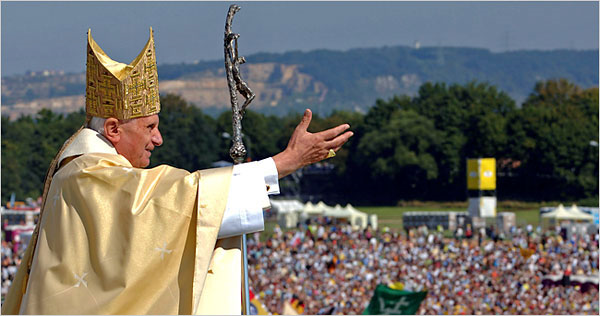
The Pope

For the past [212] years, the deadly socio-political and religious wound inflicted on the Papacy by Napoleon Bonaparteโ€™s General Jean Baptiste Berthier on the 20 February 1798 has now healed to the point where this institution will once again usurp her authority as she did during the 1260 years of the Dark Ages (538 AD -1798).

The entire world still pays obeisance to this earthly religious government. Its power is greater than that of kings. Its might has been wielded for over 3000 years, shape-shifting throughout past ages taking on diverse Satanic forms while masking and masquerading as a โ€œgodlikeโ€ entity. Time and again it has resurrected itself. In the past, (just like today), it is โ€œthe โ€˜Beastโ€™ that sits on many watersโ€ โ€“

Aptly called โ€œThe Fourth Reichโ€ it seeks to bring world powers under its allegiance – culminating in enforced religious โ€œlawsโ€ where all the inhabitants of earth will be obliged to adhere to โ€“ regardless of geography, religion, ethnic group, class or creed.

Social historians and anthropologists agree that most definitional interpretations of โ€œReichโ€ is “German State” – but the conceptual place from which this notion originates does not infer a relation to what is today the country of Germany, but rather an ancient allusion to the Germanic Lands occupied by the Goths, Ostrogoths, Franks, Heruli, Bavarians, Alamans, Saxons and other barbarian people. The โ€œReichโ€ is then best described as a crossbreed between a State and a confederation based on religious grounds โ€“ except for the latter, (not being unlike the EU of today).

In โ€œThe First Reichโ€ was seen as the evolution of The Holy Roman Empire after the fall of the once mighty political empire called Rome. Within Europe, these geographical and political enclaves was to become a continuity of the once mighty Roman Empire that started in the lands ruled by Charlemagne (Charles the Great) who was crowned Emperor by Pope Leo III in Rome on Christmas Day 800 AD, a date which is normally seen as the founding of the Empire, but sometimes the year of 962 AD is also used, which was when Otto I (Otto the Great) was crowned.

“The Second Reich” is also based on counting the Holy Roman Empire as the first German Empire (just as Nazi ideology insisted that Nazi Germany was โ€œThe Third Reichโ€). โ€œThe Second Reichโ€, ruled by the Hohenzollern dynasty, in the areas known as Prussia and Brandenburg, from 1871 to 1919, fell with the ending of World War I. During this โ€œReichโ€ the “Iron Chancellor” Otto Von Bismarck united Germany, and set the roots for World War I. โ€œThe Second Reichโ€ saw the unification of Germany following the Franco-Prussian War (1870 – 1871) and the crowning of Wilhelm I as German Emperor at the Palace of Versailles, with Otto von Bismarck as the first โ€œReichskanzlerโ€, to the abdication of Wilhelm II in 1919 following the German defeat in the First World War. Then entered a period known as the Weimar Republic, from 1919 to 1933 (called sometimes the pre-3rd Reich). Social historians agree that this weakened Republic was the catalyst for the creation of what was to become โ€œThe Third Reichโ€.

โ€œThe Third Reichโ€ (from 1933 to 1945), called Nazi Germany came under the control of Adolf Hitler. The term โ€œThird Reichโ€ was most likely taken from the book “Das Dritte Reich” published by Arthur Mรถller van den Bruck (1876-1925) in 1923. He called it the โ€œThird Reichโ€ because he thought that under his leadership Germany could reunite the old Holy Roman Empire, bringing Germany back to its glorious days. This โ€œReichโ€ was terminated with the fall of Germany at the end of World War II.

There is a very interesting question here because most theorists cannot agree why Hitler started World War II and what his objective was?

Of course his delusion… โ€œThe Third Reichโ€ was an anglification of the German expression “Das Dritte Reich“, and is used as a synonym for Nazi Germany. The term was introduced by Nazi propaganda, which counted the Holy Roman Empire as the โ€œFirst Reichโ€, the 1871 German Empire the โ€œSecondโ€, and its own regime as the โ€œThirdโ€. This was done in order to suggest a return to alleged former German glory after the perceived failure of the 1919 Weimar Republic, but this was not seen as the โ€œThird Reichโ€, but rather as an Interim โ€œReichโ€.

โ€œThe Third Reichโ€ was sometimes also referred to as the “Thousand Year Reich” as in the case of the Holy Roman Empire (ref: The Dark Ages). The Nazi Party under Adolf Hitler used the terms “Third Reich” and “Thousand Year Reich” to connect the allegedly glorious past to its supposedly glorious future.

By 1932, influential bankers, industrialists, landowners and politicians conspired to put Hitler into power because of the political and economic weakness of the Weimar Republic. Hitlerโ€™s ideological views were suspect but there was an inherent belief that he could restore the Republic back to its former glory and prosperity sanctioned by the will and might of the Catholic Church.

Today, global trends suggest that what is emerging in Catholic Europe is nothing more than โ€œThe Fourth Reichโ€ – an assimilation of โ€œdark forcesโ€ at work to bring mankind into the long conspired One-World government under the magnetism of a powerful political/religious leader.

Let us be under no illusion, these powers that are at work – existing for just one purpose and that is โ€“ global domination.

EU integration has been one such move in the major global paradigmatic synergy in the fulfillment of this process. The forces of globalization are a major catalyst in this process in bringing about world union while removing the barriers to trade liberalization, currency formulations, political unification and finally religious ecumenism.

The work of The World Bank, The International Monetary Fund, The United Nations, The World Council of Churches and other global conglomerates are all working feverishly to ratify global change in favour of the working of these subliminal, shadowy forces which are now at work in our world.

The Vatican is preparing Pope Benedict XVI for his first formal visit to the United Kingdom as a โ€œhead of stateโ€. There are many who question the logic of why a religious leader, by definition, who do not have any significance or relevance to the majority of British people who are secularists and are frankly void of religious affiliation. But this visit is political in nature, so those arguments are quashed because his sole intention is to first meet with Queen Elizabeth II (to heal an ancient wound), then Archbishop Dr. Rowan Williams (to bring back this lost daughter back into the fold) and finally the new PM โ€“ David Cameron (who has no problem spending ยฃ12 million of British taxpayers money on a Papal visit while public servants lose jobs from austerity measures โ€“ to simply hear that Britain must make a firm EU commitment and adopt the maxims of the Church).

For Pope Benedict, the issue to be raised in September is the sacredness of โ€œSUNDAYโ€ as a legislated day of worship ratified by the State as an ACT* of Parliament under the pretext of the โ€“ โ€œWRITTEN DECLARATION pursuant to Rule 116 of the Rules of Procedure by Anna Zรกborskรก, Martin Kastler, Jean Louis Cottigny, Patrizia Toia and Konrad Szymaล„ski on โ€˜the protection of a work-free Sundayโ€™ as an essential pillar of the European Social Model and a part of the European cultural heritageโ€ฆโ€

As stated – The European Parliament having regard to Article 137 of the TEU and to Rule 116 of its Rules of Procedure dictates: –

  1. Whereas a work-free Sunday is an essential pillar of the European Social Model and a part of the European cultural heritage;
  2. Whereas a EUROFOUND survey shows that the likelihood of sickness and absenteeism in establishments that work on Saturdays and Sundays is 1.3 times greater compared with establishments that do not require staff to work at the weekend;
  3. Whereas, according to EU law, Sunday is the weekly rest day for children and adolescents;
  4. Whereas the European institutions, bodies and agencies have not worked on Sundays
    since their creation and do not intend to do so in the future, despite the diversity of
    religious, cultural and ethnic backgrounds of EU officials and decision-makers;
  5. Calls on the Member States and the EU institutions to protect Sunday, as a weekly rest
    day, in forthcoming national and EU working-time legislation in order to enhance the
    protection of workers’ health and the reconciliation of work and family life;
  6. Instructs its President to forward this declaration, together with the names of the
    signatories, to the Council, the Commission and the parliamentary committees for social
    affairs of the national parliaments.

If the European Union succeeds in legislating a specific day – (Sunday) as a โ€œday of restโ€ โ€“ it will be tantamount to the enforcement of a lifestyle change on all peoples within its Diaspora including all Member States as well as the religious โ€œRightโ€ in America (who is also pushing this agenda in Congress) where we will be forced to follow a โ€œstate-sanctioned religionโ€ โ€“ Catholicism and its enforcement of Sunday worship will be the โ€œMarkโ€ of a powerful Vatican-allied European superpower institution given the wings of globalization to be adopted by every nation, kindred, tongue and people.

The Catholic Church claims that โ€œSundayโ€ is the โ€œmark of its authorityโ€, and that the other churches of Christendom acknowledge the church’s authority by Sunday observance (Cardinal Gibbons and the Douay Catechism, p. 59).

The Secretariat of COMECE* – the Commission of the Bishops’ Conferences of the European Community – made up of (Bishops delegated by the Catholic Bishops’ Conferences of the European Union and has a permanent Secretariat in Brussels), the Protestant Church in Germany (EKD) and the Church of Englandwelcome the initiative of several Members of the European Parliament, to ask the House to decide on a Written Declaration โ€œon the protection of a work-free Sunday as an essential pillar of the European Social Model and as part of the European cultural heritageโ€.

Such a declaration would constitute an important commitment to a โ€œSocial Europeโ€ knowing that it is important to find the majority necessary for this cross-party resolution, which has been launched by five parliamentarians โ€“ from the political groups of EPP, PSE, ALDE and UEN โ€“ on 2 February 2009.

For most of us who are religious liberty watchers; freedom of conscience advocates; and the amalgamation of church & state denouncers and deniers โ€“ we see the writing on the wall and the moves being made by the Vatican to break down the last vestige of religious dissension in Europe by toppling Britain and very soon – America.

The Queen โ€“ who is the Head of the Church of England – along with Dr. Williams et al will be given a final papal edict to heal the centuryโ€™s old division between the two faiths. This [478] year old rift is being healed right before our very eyes as we await the outcome of this historic papal visit.

This historical rift began in 1532. King Henry V III wanted Pope Clement V II to annul his marriage to Catherine of Aragon so that he could marry Anne Boleyn. When Clement refused, Henry retaliated by declaring himself the Supreme Head of the Church of England and with this authority persuaded other church leaders to back his call for the annulment of his marriage so he could marry Anne.

Anne became pregnant with Princess Elizabeth who was born in December 1532. Henry married Anne (though not divorced from Catherine until May 23rd 1533). Anne was the 2nd of Henryโ€™s 6 wives who he later accused of adultery and had her beheaded on May 19th 1536 (although some social historians agree that Jane Seymour – his 3rd wife was the actual cause of Anneโ€™s death).

Pope Paul III excommunicated King Henry for his rebellious and adulterous ways though he remained a faithful Catholic during his reign โ€“ the Church of England still mirrored the theology and practices of the Catholic Church with the only noticeable difference that the Pope lived in Rome and the head of the Church of England lived in London.

When Henry died, his son Edward VI came to power and he tried to win the approval of the Protestants by implementing some reforms which included the creation of a Common Prayer Book in 1552. Henry quickly died and was succeeded by Mary I (also known as bloody Mary) as he had no heir. She reversed the reforms of her brother and brought the Church of England back to pure Catholicism. Many were burned at the stake as a result of refusal to embrace the edits of the new Queen.

Mary like her brother died without an heir and so her half-sister Elizabeth came to the throne and is credited with the establishment of the Anglican Church (1558) as we know it today. Her negotiation skills resulted in the church being 80% Catholic and 20% Protestant.

However, a grassroots movement within the church arose (called โ€œrabbleโ€ – uneducated) โ€“ conservative radicals who wanted a complete break from the Catholic Church. This group given the derogatory name โ€œPuritansโ€ wanted (a) complete separation from the Vatican; (b) the abandonment of Catholic ritual; and (c) complete devotion to perfection and piety. To the ordinary layperson, the Puritan Movement seemed obsessed with anti-Catholic sentiment and a relentless quest for purity and perfection.

King James I succeeded Elizabeth in 1603 and he did not like the Puritans at all. To his credit however, James believed that the common people should be able to read the Bible in English and as the Supreme Head of the Church of England permitted the Bible to be translated. The first version appeared in 1611.

James died and was succeeded by his son Charles I and he too detested the Puritans and wanted the church to return to its Catholic roots and rituals. So he married a Catholic woman – creating outrage amongst the Puritans, escalating tensions and they in turn, repudiated the doctrine of โ€œThe Divine Right of Kingsโ€ (a political/religious doctrine of absolutism) โ€“ resulting in deadly persecution and the exodus of the Puritans to escape death.

Hence the birth of the colonies of New England on the shores of what was to become America and subsequently the United States of America (a land richly occupied by native peoples which a potent cultural heritage).

So the Puritans arrived on the shores of America with a strong resentment against Catholics, a rigid devotion to purity and perfection and an eagerness for freedom to worship God according to the dictates of their conscience.

The Puritans established Sunday Laws in their colonies (what we know in America today as (โ€œBLUE LAWSโ€ because of the blue paper they were written on). Obedience to the law was paramount. The laws did vary from colony to colony but the result was the same. Church attendance on the โ€œLordโ€™s Dayโ€ was mandatory. Puritans could not work in the fields, make a bed, cook, sew or even kiss their own child on Sunday. All business activity (e.g. discussing business, buying or selling) and various forms of casual pleasures were rigorously outlawed.

The law enacted by Lord De La Warr, the 1st governor of Virginia, in 1610 stated:

โ€œEvery man and women shall repair in the morning to the divine service and sermons preached upon the Sabbath day, and in the afternoon to the divine service, and catechizing upon pain for the first fault to lose their provision and the allowance for the whole week following and also be whipped; for the second, to lose the said allowance and also be whipped; and for the third to suffer death.โ€ (C. Gary Hullquist 2004, Emphasis supplied).

The Puritans had escaped to religious freedom – to be the first to enact and enforce similar laws limiting that said freedom for which they sought, hungered and died for.

Will we be facing a similar law of unintended consequences? Will the wall of separation between church and state be finally bulldozed to expose centuries of unheeded warnings? Will Sunday worship become a test of faith; an issue of political and civil disobedience and furthermore, a choice between the commandments of God or the dictates of men?

What we have learnt from history is that those who refuse to learn the lessons of the past are doomed to make the same mistakes in the future.

May God help us!

โ€œThere has never been better slaves, never worst mastersโ€ โ€“ Tacitus


Discover more from Barbados Underground

Subscribe to get the latest posts sent to your email.

188 responses to “THE FOURTH REICH: Masking The EU “Working Time Directive” – A Pretext To Enforce Global Catholic Religious Observance As the Ancient Issue Of “Sunday Sacredness” Takes Center Stage”


  1. The Sabbath & Creation (cont’d)

    OBJECTIONS TO THE CREATION SABBATH

    Four major objections are used to negate the creation origin of the Sabbath are the following:

    1) No command to keep the Sabbath is given in Genesis.

    2) No example of Sabbath-keeping is recorded in Genesis.

    3) No mention is made of the word โ€œSabbathโ€ in Genesis.

    4) No formula of โ€œand there was evening and morningโ€ is used for the seventh day.

    (1) No Command to Keep the Sabbath Is Given in Genesis

    The first argument used to negate the creation origin of the Sabbath is the absence of an explicit command to observe the seventh day in Genesis 2:2-3. The Worldwide Church of God formulates this argument by means of six rhetorical statements: โ€œThere are several things that Genesis does not tell us:

    1) It does not say that humans rested.

    2) It does not say that humans were told to follow Godโ€™s example.

    3) It does not say that humans were told to rest.

    4) It does not say that God taught Adam and Eve on the Sabbath.

    5) It does not say that God created the Sabbath.

    6) It does not say that humans kept the Sabbath.

    Dale Ratzlaff uses the same argument, saying, โ€œThere is no command for mankind to rest in the Genesis account.โ€ โ€œNothing is expressly mentioned regarding man in the seventh-day-creation rest.โ€ For him, this fact indicates that the Sabbath is not a creation ordinance binding upon humanity, but a temporary institution introduced by Moses for Israel alone.

    Reasons for โ€œNo Commandโ€

    There are several possible reasons for the absence of an explicit command to keep the Sabbath in Genesis 2:2-3.

    First of all, we must remember that Genesis is not a book of commands but of origins. None of the Ten Commandments are ever mentioned in Genesis, yet we know that their principles were known because we are told, for example, โ€œAbraham obeyed my voice and kept my charge, my commandments, my statutes, and my lawsโ€ (Gen 26:5).

    It is evident Abraham knew Godโ€™s commandments and laws, though no reference is made to them in the book of Genesis. The reason is that Genesis is a book of beginnings; it tells us how we get from the creation of this planet to the creation of Godโ€™s people in the book of Exodus.

    Another possible reason for the absence of a command to keep the Sabbath in Genesis is the cosmological function of the seventh day in the creation story. The divine act of resting on the seventh day is designed to tell us how God felt about His creation. It was โ€œvery good,โ€ and to dramatize this fact, twice we are told that โ€œHe restedโ€ (Gen 2:2-3)โ€”that is, โ€œHe stopped.โ€ No finishing touches were to improve His perfect creation.

    In the Near Eastern creation myths, the divine rest (technically called otiositas), which usually imยญplies the establishment of a secure world order, generally is achieved either by eliminating noisy, disturbing gods or by creatยญing human beings.

    For example, in the Babylonian creation epic Enuma Elish, the god Marduk says, โ€œVerily, savage-man I will create. He shall be charged with the service of the gods, that they might be at ease!โ€

    In the creation Sabbath, however, the divine rest is secured not by subordinating or destroying competitors, nor by exploiting the labor of mankind, but by the completion of a perfect creation. God rested on the seventh day, not to conclude His work of creation, but rather because His work was โ€œfinished . . . doneโ€ (Gen 2 :2-3).

    As stated by Niels-Erik Andreasen, โ€œIt is not the rest (cessation from work) which concludes creation, but it is the concluded creation which occasions both rest and the Sabbath.โ€

    The Function of Godโ€™s Rest

    Any responsible artisan works on a product until it is brought it up to the ideal; then the work stops. In an infinitely higher sense, God, having completed the creaยญtion of this world with all its creatures, desisted from creating on the seventh day. This is essentially the meaning of the Hebrew verb sabat which is twice translated โ€œrested.โ€ Its more accurate rendering is โ€œto stop, to desist, to cease from doing.โ€

    To express the idea of rest from physical exhaustion, the Hebrew employs a different verb, namely nuah, which is also generally translated in English โ€œto rest.โ€ The latter, in fact, occurs in Exodus 20:11 where Godโ€™s pattern of work-rest in creation is given as the basis for the commandment to work six days and to rest on the seventh.

    In Genesis 2, however, the verb sabat is used because the function of Godโ€™s rest is different. It fulfills a cosmological rather than an anthropological function. It explains to us not why people should rest but rather how God felt about His creation: He regarded it as comยญplete and perfect; and to acknowledge it, He stopped.

    This function of Godโ€™s rest has been recognized by numerยญous scholars.

    Karl Barth, for example, remarks: โ€œWe read in Genesis 2:2 that on the seventh day God, the Creator, completed His work by โ€˜resting.โ€™ This simply means that He did not go on with the work of creation as such. He set both Himself and His creation a limit. He was content to be the Creator of this particular creationโ€”to glory, as the Creator, in this particular work. He had no occasion to proceed to further creations. He needed no further creations. And He had found what he created very goodโ€™ (Gen. 1:31).โ€ โ€œWhen creation ended with man, having found its climax and meaning in the actualization of man, God rested on the seventh day from all the work that He had done. It was to this that He looked in the recognition that everything was very good and therefore did not need to be extended or supplemented.โ€

    Dietrich Bonhoeffer similarly explains that โ€œin the Bible โ€˜restโ€™ really means more than โ€˜having a rest.โ€™ It means rest after the work is accomplished, it means completion, it means the perfection and peace in which the world rests.โ€ We might say that by confronting His creation with His cessation-rest, God proclaimed the Good News that there was no need to put addiยญtional finishing touches on what He had created, since He regarded all of it โ€œvery goodโ€ (Gen. 1:31). Godโ€™s cessation from doing expresses His desire for being with His creation, for giving to His creaยญtures not only things but Himself.

    An Example Rather Than a Command

    The fact that the Sabbath is established in the creation story by a divine example rather than by a divine commandment could also reflect what God intended the Sabbath to be in a sinless worldโ€”namely, not an alienating imposition but a free response to a gracious Creator. By freely choosing to make themselves available for their Creator on the Sabbath, human beings were to experience physical, mental, and spiritual renewal and enrichment. Since these needs have not been eliminated but heightened by the Fall, the moral, universal, and perpetual functions of the Sabbath precept were repeated later in the form of a commandment.

    What is it that makes any divine precept moral and universal? Do we not regard a law moral when it reflects Godโ€™s nature? Could God have given any stronger revelation of the moral nature of the Sabbath than by making it a rule of His divine conduct? Is a principle established by divine example less binding than one enunciated by a divine command? Do not actions speak louder than words?

    The argument that the Sabbath originated at Sinai makes Moses guilty of distorting truth or, at least, the victim of gross misunderstanding. He would have traced the Sabbath back to creation in the Sabbath commandment, when in reality it was his own new creation. Such a charge, if true, would cast serious doubts on the integrity and/or reliability of anything else Moses or anyone else wrote in the Bible.


  2. The Sabbath & Creation (cont’d)

    (2) No Example of Sabbathkeeping Is Recorded in Genesis

    The oldest and perhaps the strongest argument against the creation origin of the Sabbath is the absence of an explicit reference to Sabbath-keeping after Genesis 2 for the whole patriarchal period up to Exodus 16.

    For example, in his doctoral dissertation on โ€œSabbatic Theology,โ€ Roger Congdon writes: โ€œThere is absolutely no mention of the Sabbath before the Lord said to Moses, โ€˜Behold, I will rain bread from heaven for you . . . On the sixth day, when they prepare what they bring in, it will be twice as much as they gather dailyโ€™ (Ex 16:4-5). These words indicate that the event was bound to the Decalogue of Sinai. . . . The first mention of the Sabbath in the Bible and the first chronological use of the word in all history is in Exodus 16:23.โ€

    In a similar vein, the Worldwide Church of God affirms that Genesis โ€œdoes not say that humans kept the Sabbath.โ€

    Not Observed?

    The absence of explicit references to Sabbath-keeping between Genesis 2 and Exodus 16 does not necessarily mean that the principle of Sabbath-keeping was unknown. The apparent silence could mean that between Adam and Moses, the Sabbath, though known, was not observed. The non-observance of the feast of the Booths between Joshua and Nehemiah, a period of almost a thousand years, would provide a parallel situation (Neh 8:17).

    Taken for Granted

    A more plausible explanation is that the custom of Sabbath-keeping is not mentioned simply because it is taken for granted. A number of reasons support this explanation.

    First, we have a similar example of silence regarding the Sabbath between the books of Deuteronomy and 2 Kings. Such silence can hardly be interpreted as non-observance of the Sabbath since, when the first incidental reference occurs in 2 Kings 4:23, it describes the custom of visiting a prophet on the Sabbath.

    Second, Genesis does not contain laws like Exodus but is rather, a brief sketch of origins. Since no mention is made of any other commandment, silence regarding the Sabbath is not exceptional.

    Third, throughout the book of Genesis and the early chapters of Exodus one finds circumstantial evidences for the use of the seven-day week which would imply the existence of the Sabbath as well. The period of seven days is mentioned four times in the account of the Flood (Gen 7:4, 10; 8:10,12).

    Apparently, the โ€œweekโ€ also is used in a technical way to describe the duration of the nuptial festivities of Jacob (Gen 29:27) as well as the duration of mourning at his death (Gen 50:10).

    A similar period was observed by the friends of Job to express their condolences to the patriarch (Job 2:13). Probably all the mentioned ceremonials were terminated by the arrival of the Sabbath.

    Lastly, the Sabbath is presented in Exodus 16 and 20 as an already existing institution. The instructions for gathering a double portion of manna on the sixth day presuppose a knowledge of the significance of the Sabbath: โ€œOn the sixth day, when they prepare what they bring in, it will be twice as much as they gather dailyโ€ (Ex 16:5). The omission of any explanation for gathering a double portion on the sixth day would be inexplicable if the Israelites had no previous knowledge of the Sabbath.

    Similarly, in Exodus 20, the Sabbath is presupposed as something already familiar. The commandment does not say โ€œKnow the Sabbath dayโ€ but โ€œRemember the Sabbath dayโ€ (Ex 20:8), thus implying that it was already known. Furthermore, the commandment, by presenting the Sabbath as rooted in creation (Ex 20:11), hardly allows a late Exodus introduction of the festival.

    To speculate on how the patriarchs kept the Sabbath would be a fruitless endeavor since it would rest more on imagination than on available information. Considering, however, that the essence of Sabbath-keeping is not a place to go to fulfill rituals, but a set time to be with God, ourselves, and others, it is entirely possible that the patriarchs spent the Sabbath holy hours within their households, engaged in some of the acts of worship described in Genesis such as prayer (Gen 12:8; 26:25), sacrifice (Gen 12:8; 13:18; 26:25; 33:20), and teaching (Gen 18:19).


  3. The Sabbath & Creation (cont’d)

    (3) No Mention Is Made of the Word โ€œSabbathโ€ in Genesis

    The absence of the term โ€œSabbathโ€ in Genesis 2:2-3 is seen by some as an indication that the Sabbath as an institution did not originate at creation but later at the time of Moses. For example, Robert Morey emphatically states: โ€œBut isnโ€™t the Sabbath creation ordinance found in Genesis 2:1-3? No, the word โ€˜Sabbathโ€™ does not appear in the text.โ€

    Harold Dressler makes a similar statement: โ€œGenesis 2 does not mention the word โ€˜Sabbath.โ€™ It speaks about the โ€˜seventh day.โ€™ Unless the reader equates โ€˜seventh dayโ€™ and โ€˜Sabbath,โ€™ there is no reference to the Sabbath here.โ€

    In a similar vein, Dale Ratzlaff writes: โ€œThere is no mention of the word โ€˜Sabbathโ€™ in the Genesis account; nothing is said about man resting; in fact, man is not even mentioned in connection with this seventh-day-creation rest.โ€

    Verbal Form

    It is true that the name โ€œSabbathโ€ does not occur in the passage, but the cognate verbal form shabat (to cease, to stop, to rest) is used and the latter, as noted by Ugo Cassuto, โ€œcontains an allusion to the name โ€˜the Sabbath day.โ€™โ€

    Moreover, as Cassuto sagaciously remarks, the use of the name seventh day rather than Sabbath may well reflect the writerโ€™s concern to underline the perpetual order of the day, independent and free from any association with astrological โ€œsabbathsโ€ of the heathen nations.

    Perpetual Order

    It is a known fact that the term shabbatu, which is strikingly similar to the Hebrew word for Sabbath (shabbat), occurs in the documents of ancient Mesopotamia.

    The term apparently designated the fifteenth day of the month, that is, the day of the full moon. By designating the day by number rather than by name, Genesis seems to emphasize that Godโ€™s Sabbath day is not like that of heathen nations, connected with the phases of the moon. Rather, it shall be the seventh day in perpetual order, independent from any association with the cycles of heavenly bodies.

    By pointing to a perpetual order, the seventh day strengthens the cosmological message of the creation storyโ€”precisely that God is both Creator and constant controller of this cosmos. In Exodus, however, where the seventh day is given in the context of the Genesis, not of this cosmos, but of the nation of Israel, the day is explicitly designated โ€œsabbath,โ€ apparently to express its new historical and soteriological function.

    (4) No Formula of โ€œand there was evening and morningโ€ Is Used for the Seventh day

    The omission in the creation account of the formula โ€œand there was evening and morningโ€ in connection with the seventh day indicates to some that the Sabbath is not a literal 24-hour day like the preceding six days, but a symbolic time representing eternal rest.

    For example, Dale Ratzlaff writes: โ€œThe Genesis account does not mention an end to Godโ€™s seventh-day rest. Rather it is presented as an ongoing state by the omission of the formula โ€˜and there was evening and morning, a seventh day.โ€™โ€

    He interprets the absence of this formula as indicating that โ€œthe conditions and characteristics of that first seventh day were designed by God to continue and would have continued had it not been for the sin of Adam and Eve.โ€

    Eternal Rest

    Both Rabbis and Christian writers have interpreted the absence of any reference to โ€œthe evening and morningโ€ in connection with the seventh day of creation as representing the future, eternal rest of the redeemed.

    Augustine offers a most fitting example of this interpretation in the last page of his Confessions, where he offers this exquisite prayer: โ€œO Lord God, grant Thy peace unto us . . . the peace of rest, the peace of the Sabbath which has no evening. For all this most beautiful order of things, โ€˜very goodโ€™ . . . is to pass away, for in them there was morning and evening. But the seventh day is without any evening, nor hath it any setting, because Thou hast sanctified it to an everlasting continuance; . . . that we also after our works . . . may repose in Thee also in the Sabbath of eternal life.โ€

    This spiritual, eschatological interpretation of the creation Sabbath has some merits because the vision of the peace, rest, and prosperity of the first Sabbath inspired the prophetic vision of the peace, delight, and prosperity of the world-to-come. This interpretation is also found in Hebrews 4 where believers are urged to strive to enter into the Sabbath rest that remains for the people of God (Heb 4:9, 11).

    Literal Day

    The symbolic interpretation of creationโ€™s seventh day which has no evening does not negate its literal 24-hour duration for at least four reasons:

    First, the seventh day is enumerated like the preceding six days. Note that in the Bible whenever โ€œdayโ€“yomโ€ is accompanied by a number it always means a day of 24 hours.

    Second, the Decalogue itself clearly states that God, having worked six days, rested on the seventh day of creation week (Ex 20:11). If the first six days were ordinary earthly days, we must understand the seventh in the same way.

    Third, every passage which mentions creationโ€™s seventh day as the basis of the earthly Sabbath regards it as an ordinary day (Ex 20:11; 31:17; cf. Mark 2:27; Heb 4:4).

    Last, the commandment to keep the Sabbath as a memorial day of the creation-Sabbath (Ex 20:11) implies a literal original 24-hour Sabbath. God could hardly command His creatures to work six days and rest on the seventh after His own example if the seventh day were not a literal day.

    The omission of the formula โ€œand there was evening and morning, a seventh dayโ€ may be due to the fact that the seventh day is not followed by other creation days. The formula serves to separate each of the first days of creation from the following ones. The seventh day, being the last day of creation, did not need to be separated because there was no โ€œeighth dayโ€ to follow. By marking the termination of the creation week, the seventh day did not need to be defined in terms of its termination because there were no further creation days.

    Another suggestion is the possibility that the Sabbath was blessed with extraordinary light. For example, referring to the Messianic age, Zechariah remarks that โ€œthere shall be continuous day . . . not day and not night, for at evening time there shall be lightโ€ (Zech 14:7). Here we have a probable allusion to the seventh day of creation which in Genesis has no mention of โ€œevening and morning.โ€ Such a detail was interpreted by the rabbis as signifying that the Sabbath was especially blessed by supernatural, continuous light.

    To this we return in chapter 4.


  4. The Sabbath & Creation (cont’d)

    THE CREATION WEEK IS A HUMAN WEEK

    A fundamental problem with the preceding objections against the creation origin of the Sabbath is their failure to realize that the creation week is a human week, established by God for regulating our human life. God did not need six days to create our solar system.

    He could have spoken it into existence in a second, since His creation was accomplished by the spoken word (Ps. 33:6). But He chose to establish a human week of seven days and to use it Himself in order to give a divine perspective to our six days of work and to our seventh day of rest.

    This means that as we work during the six days and rest on the seventh day, we are doing in a small scale what God has done on a much larger scale. Godโ€™s willingness to enter into the limitations of human time at creation in order to enable us to identify with Him is a marvelous revelation of His willingness to enter into human flesh at the incarnation in order to become Emmanuel, God with us.

    On each of the first six days of creation God did something that had lasting results for the human family. We would expect the same to be true for the seventh day.

    Roy Gane notes: โ€œGod set up cyclical time even before man was created (Gen 1:3-5, 14-18). According to Genesis 1:14, God made heavenly luminaries, chiefly the sun and the moon (Gen 1:16), to mark earthly time as โ€˜signs,โ€™ โ€˜seasons.โ€™ i. e., appointed times, days, and years. So when Genesis 2:3 says that God blessed and hallowed the seventh day, this blessing and consecration could be on-going in a cyclical sense, applying to each subsequent seventh day. In fact, the seventh-day Sabbath provides a plausible explanation for the origin of the week, which is not defined by the movement of heavenly bodies.โ€

    Creation Sabbath and Weekly Sabbath

    The emphatic threefold repetition of โ€œthe seventh dayโ€ with its four divine acts (โ€œfinished,โ€ โ€œrested,โ€ โ€œblessed,โ€ and โ€œhallowedโ€โ€”Gen 2:2-3) at the conclusion of creation indicates that just as man is the crown of creation, so the seventh day, the Sabbath, is the final goal of creation. Thus, the creation Sabbath tells us not only how God felt about His creation, but also what He planned for His creatures.

    G. H. Watermann makes this point saying: โ€œIt seems clear, therefore, that the divine origin and institution of the Sabbath took place at the beginning of human history. At that time God not only provided a divine example for keeping the seventh day as a day of rest, but also blessed and set apart the seventh day for the benefit of man.โ€

    As God created the world in six days and rested on the seventh day at the completion of His creation, so human beings are to accomplish their work and purpose in this creation during the six working days of the week and to follow the example of the Creator by resting on the seventh day. Sabbath-keepers can find satisfaction and fulfillment in their work and rest, because the Sabbath reassures them that they are doing on a small scale what God has done and is doing on an infinitely larger scale.

    Earlier we noted that God โ€œrestedโ€ on the seventh day to express His satisfaction over his complete and perfect creation. This idea is conveyed by the verb shabat used in Genesis 2:2-3 which means to โ€œcease or stop working.โ€ We must not ignore, however, that in Exodus 31:17 the creation rest of God is interpreted as a model for human rest. Israel is called to keep the Sabbath because โ€œin six days the Lord made the heaven and the earth, and on the seventh day he rested and was refreshedโ€ (Ex 31:17). The Hebrew verb used here is nephesh, which describes God as being โ€œrefreshedโ€ as a result of His rest on the seventh day of creation.

    It is evident God did not need to rest from fatigue because โ€œHe does not faint or grow wearyโ€ (Is 40:28), yet the Bible speaks of God in human terms (anthropomorphically) as being โ€œrefreshedโ€ on the Sabbath in order to set the pattern for the human Sabbath rest. This is not the only example in the Bible where God does something to set an example for His creatures to follow.

    Jesus asked John the Baptist to baptize him, not because He needed to be cleansed from sin (Rom 6:1-5), but to set an example for His followers (Matt 3:13-14). Both baptism and the Lordโ€™s Supper trace their origin to a divine act and example that established them. In the same way Scripture traces the origin of the Sabbath to Godโ€™s act of resting, blessing, and sanctifying the seventh day.

    This is the fundamental problem with Sunday observance. No divine act established the day as a memorial of the resurrection. None of the words uttered by Christ on the day of His resurrection suggest that He intended to make the day a memorial of His resurrection.

    The Blessing of the Seventh Day

    The blessing and hallowing of the seventh day at creation further reveals that God intended the Sabbath to have on-going benefits for the human family. It would make no sense for God to bless and sanctify a unit of holy time for Himself. The blessings of God are outgoing, benefiting His creatures. They represent not wishful thinking but assurance of fruitfulness, prosperity, and abundant life.

    For example, God blessed the first couple saying, โ€œBe fruitful and multiplyโ€ (Gen 1:28; cf. 9:1; 49:22-26). Similarly, we read in the Aaronic beneยญdiction: โ€œThe Lord bless you and keep youโ€ (Num 6:24). The blessing of God results, then, in the preservation and assurance of abundant life. This meaning is expressed explicitly by the Psalmist when he writes: โ€œThe Lord has commanded the blessing, life for evermoreโ€ (Ps 133:3). Applied to the Sabbath, this means that God made this day a channel through which human life can receive His beneficial and vitalizing power.

    It must be said that the meaning of both the blessing and sanctification of the Sabbath is not spelled out in Genesis 2:3. This is puzzling because in most instances Godโ€™s benediction is accompanied by an explanation of its content. For example, โ€œGod blessed them [animals], saying, โ€˜Be fruitful and multiply and fill the water in the seas, and let the birds multiply on the earthโ€ (Gen. 1:22). Similarly, God said to Abraham regarding his wife, Sarah, โ€œI will bless her, and she shall be a mother of nations; kings of peoples shall come from herโ€ (Gen. 17:16; cf. 9:1; 17:20). Yet with regard to the blessing of the Sabbath, nothing is said as to what such a blessing entails.

    The mystery of the blessedness and sanctity of the Sabbath begins to be unveiled in Exodus with the establishment of Israel as Godโ€™s covenant people. The day becomes now linked not only to a finished creation but to the new nation which God has miraculously brought into existence: โ€œSee! The Lord has given you the Sabbathโ€ (Ex. 16:29).

    From being cosmological, a symbol of a perfect world, the Sabbath has now become a soteriological-historical symbol of Godโ€™s redemptive plan for His people. Thus the Sabbath becomes now more intimately conยญnected with the ups and downs of the life of Godโ€™s people.

    The manna story offers a starting point to understand the nature of the original blessing of the Sabbath. Notice first certain parallelisms between the creation and the manna narrative. Both are divine acts accomยญplished according to the seven-day structure. Both testify to the perfection of Godโ€™s activities: the daily creation was โ€œgoodโ€ and the daily portion of the manna was satisfying (Ex 16:18).

    ln both instances, the creative activity ceases on the Sabbath: creation is โ€œfinishedโ€ (Gen 2:2) and the manna ceased to fall (Ex 16:25). In both cases Godโ€™s blessings are bestowed upon the Sabbathโ€”by proclamation at creation (Gen 2:3) and by preservation in the manna (Ex 16:24).

    In the context of the aridity of the desert and of the murmuring of the people caused by their inability to secure food, the miracle of the preservaยญtion of the manna throughout Sabbath stands as a most conยญspicuous revelation of the nature of the Sabbath blessings, namely, Godโ€™s reassuring gift of physical nourishment and life. In order to receive the blessings of the Sabbath, believers need to consecrate the day to God by altering their behavior, as in the manna experience.

    As John Skinner puts it: โ€œThe Sabbath is a constant source of well-being to the man who recognizes its true nature and purpose.โ€


  5. The Sabbath & Creation (cont’d)

    The Sanctification of the Sabbath

    Genesis 2:3 also affirms that the Creator โ€œhallowedโ€ (RV, RSV) the seventh day, โ€œmade it holyโ€ (NEB, NAB), โ€œdeclared it holyโ€ (NKJV), or โ€œsanctifiedโ€ (NASB). Both here and in the Sabbath commandment we are told that God made the Sabbath holy. How did God make the seventh day holy? Since the day is not a material substance but a unit of time, it cannot be made holy by applying a holy substance such as anointing oil (Lev 8:10-12). The meaning of the holiness of the Sabbath must be found in its relation to the people who are affected by its observance.

    Dale Ratzlaff argues that God did not sanctify the seventh day as such for human beings to observe, but the โ€œconditions of that day were sanctified and blessed.โ€

    By โ€œthe conditions,โ€ Ratzlaff means the condition that existed on โ€œthe first day after creation was completed.โ€

    In other words, the sanctification of the seventh day refers primarily to the โ€œconditionsโ€ of โ€œfellowship and communionโ€ that existed on creationโ€™s seventh day rather than to God setting aside the seventh day for humanity to experience in a special way His sanctifying presence.

    The problem with this interpretation is that nowhere does the Bible suggest that the sanctification of the seventh day at creation refers to the sanctification of the conditions that existed โ€œthe first day after creation was completed.โ€ God did not sanctify โ€œconditionsโ€ but the seventh day itself.

    The Meaning of Sanctification

    The basic meaning of the Hebrew idea of โ€œholy – qodeshโ€ is โ€œset apart,โ€ โ€œseparated.โ€ Applied to the Sabbath, the divine sanctification of the day consists in Godโ€™s setting apart the seventh day from the rest of the six days.

    It must be emphasized that God did the setting apart, not man. The holiness of the Sabbath stems not from those who keep it, but from the act of God.

    Believers experience the holiness of the Sabbath by altering their behavior on that day. They stop their work to allow God to enrich their lives with His sanctifying presence.

    John Skinner perceptively points out that the Sabbath โ€œis not an institution which exists or ceases with its observance by man; the divine rest is a fact as much as the divine working, and so the sanctity of the day is a fact whether man secures the benefit or not.โ€

    The verbal form (Piel) of the Hebrew verb โ€œto sanctify – yeqaddesh,โ€ as H. C. Leupold explains, has both a causative and a declarative sense. This means that God declared the seventh day holy and caused it to be a means of holiness for humanity.

    It is noteworthy that the word โ€œholyโ€ is used for the first time in the Bible with reference not to an object such as an altar, a tabernacle, or a person, but with regard to time, the seventh day (Gen 2:3).

    The meaning of the sanctification of the Sabbath becomes clearer with the unfolding of the history of salvation. In Exodus, for example, the holiness of the Sabbath is elucidated by means of its explicit association with the manifestation of Godโ€™s glorious presence.

    From Mount Sinai, which was made holy by the glorious presence of God, the Sabbath is explicitly proclaimed to be Godโ€™s holy day: โ€œRemember the Sabbath day, to keep it holyโ€ (Ex. 20:8). The commandment, it should be noted, not only opens with the invitation to remember and keep holy the Sabbath (cf. Deut 5:15), but also closes by reiterating that its holiness is grounded in Godโ€™s sanctification of the day at creation (Ex 20:11). In Hebrew, the identical verb is used in both instances.

    An Experience of Godโ€™s Presence

    The experience of Godโ€™s glorious presence on Mount Sinai served to educate the Israelites to acknowledge the holiness of God manifested in time (the Sabbath) and later in a place of worship (the Tabernacle).

    The motif of Godโ€™s glory is found in all of these (Sinai, Sabbath, and Tabernacle) and ties them together.

    The Israelites were instructed to prepare themselves for the encounter with Godโ€™s holy presence (Ex 19:10, 11), when the Lord would โ€œcome down upon Mount Sinai in the sight of all the peopleโ€ (Ex 19:11). The preparation included personal cleansing (Ex 19:10, 14) and the setting of a boundary around the mountain (Ex. 19:12, 23) which was to be invested with Godโ€™s glory.

    The nexus with the holiness of the Sabbath can hardly be missed. Indeed, personal preparation and the setting of a boundary between common and holy time are the basic ingredients necessary for the sanctification of the Sabbath.

    Can one enter into the experience of Godโ€™s holy presence on the Sabbath without making necessary preparation?

    Or is it possible to honor Godโ€™s presence on His holy seventh day without setting a boundary in time that fences off personal profits and pleasures?

    The meaning of the holiness of God is further clarified at Sinai by the invitation God extended to Moses โ€œon the seventh dayโ€ to enter into the cloud and thus experience the intimacy of His presence. โ€œThen Moses went up on the mountain, and the cloud covered the mountain. The glory of the Lord settled on Mount Sinai, and the cloud covered it six days; and on the seventh day he called to Moses out of the midst of the cloud. Now the appearance of the glory of the Lord was like a devouring fire on the top of the mountain in the sight of the people. And Moses entered the cloud, and went up on the mountainโ€ (Ex 24:15-18).

    Godโ€™s invitation to Moses to enter on the seventh day into His glorious presence unveils the cryptic meaning of Godโ€™s sanctification of the Sabbath at creation. The holiness of the Sabbath is now explained to be not a magic quality infused by God into this day, but rather His mysterious and majestic presence manifested on and through the Sabbath in the lives of His people.

    This meaning of the holiness of the Sabbath is brought out more forcefully a few chapters later when, at the end of the revelation of the tabernacle, God says to the people of Israel, โ€œYou shall keep my Sabbaths, for this is a sign between me and you throughout your generations, that you may know that I, the Lord, sanctify youโ€ (Ex 31:13).

    The sanctity of the Sabbath is now clearly equated with the sanctifying presence of God with His people. The mystery of the sanctification of the creation-Sabbath is now unveiled. It consists precisely of Godโ€™s commitment to manifest His presence in the lives of His people.

    For six days God filled this planet with good things and living beings, but on the seventh He filled it with His presence. As the symbol and assurance of Godโ€™s sanctifying presence in this world and in human lives, the Sabbath represents a most sublime and permanent expression of Godโ€™s loving care.

    The Permanence of the Sabbath

    In the creation account, we learn that God set up the ideal order of relationship that should govern human life. He instituted the Sabbath, marriage, and work – three institutions which embody principles which were later formulated in the Ten Commandments.

    When Adam and Even disobeyed God by eating of the forbidden fruit (Gen 3:6), their marriage and work suffered as a result of the curse of sin. But the Sabbath did not. โ€œThe Sabbath is not affected by any curse resulting from the Fall. Unlike the other two Creation institutions, the Sabbath remains a little piece of Paradise. As such, its value is enhanced by the deterioration around it. Now that work is exhausting, ceasing from labor on the Sabbath provides needed rest.

    More importantly, now that human beings are cut off from direct access to God, they need a reminder of His lordship [and fellowship] even more than they did before the Fall.โ€

    The Fall did not eliminate the order that God established at creation to govern human life and relationship. Marriage and labor have remained, though they became more difficult. In the same way, the Sabbath has remained, though its observance is often made more difficult by working schedules that infringe on the Sabbath and by many personal tasks that clamor for use of the Sabbath time.

    In the light of the foregoing considerations, we conclude that God, by resting, blessing, and sanctifying the seventh day, created a day that would delineate the on-going weekly cycle for human beings, and invites them to fellowship with Him in a special way on the Sabbath day. God created the natural world by speaking, then man by moulding him out of dust and vivifying him with His life-giving Spirit, and the Sabbath by โ€œsabbatizingโ€ Himself.

    By instituting the Sabbath at creation along with the basic components of human life such as marriage and labor, long before Israel existed, God made the day a permanent institution for the human family (Mark 2:27). The fact that later the Sabbath became one of the Ten Commandments does not negate its universality, but rather supports it, since the other nine commandments are universal principles binding upon the whole human family, not Israel alone.

    Conclusion

    Our examination of the objections to the creation origin of the Sabbath has shown the arguments to be based on gratuitous assumptions. The consistent and unanimยญous testimony of Scripture is that Sabbath is rooted in the creation event and marks the inauguration of human history. This means that Sabbath-keeping is not a temporary Jewish ceremonial law, but a creation ordinance for the benefit of humanity.

    It also means, as so well stated by Elizabeth E. Platt, that โ€œwe have our roots in the Sabbath; we belong in it from Genesis on into Eternity in Godโ€™s plan.โ€


  6. Then we wonder why there is so much wars based on reLIEgion, one look at this and many threads on BU should explain it all.


  7. @ DAVID

    Some bedtime reading ‘ole chap….

    http://www.vaticanassassins.org/

  8. Georgie Porgie Avatar

    One wonders if TB wanted to do a discourse on the Sabbath why didnt he start of from the beginning, instead of wasting time with his opening salvo.

    Of course Zoe was on to him from the beginning.

    After all this diatribe filled with lies about the RC’s changing the Sabbath this false teacher can not get around two simple Scripture verses in the NT, and the historical fact that for almost 300 years before the advent of the RC church (out of which even the SDA’s descended) THE EARLY CHURCH GATHERED ON THE FIRST DAY OF THE WEEK .

    It is also note worthy that the early church even in this period of transition did not follow Jewish rituals.

    Acts 2:42 clearly states that they continued stadfastly in the apostles doctrine and felloship and in the breaking of bread and in prayers.

    Note they continued in the APOSTLES DOCTRINE i.e teachings of Jesus recieved from the apostles who had spent three years with him.

    It is noteworthy that the SDA’s harp on the SABBATH. Serious Christians put the emphasis where the Bible puts it—–ON CHRIST.

    Techie it is good to see that you are alive. Note that wars are really caused because of the evil of men’s hearts

    The origin of wars is not religion. James 4:1 clearly teaches the reason for war. It is LUST!

    From whence come wars and fightings among you? come they not hence, even of your lusts that war in your members?

    The cause of war like the cause of all sin is LUST!

    Read about it in 1 John 2:16 where we have a classification of the three categories of sin as exhibited first by our fore parents in Genesis.

    For all that is in the world, the lust of the flesh, and the lust of the eyes, and the pride of life, is not of the Father, but is of the world.

  9. Georgie Porgie Avatar

    Annonymous wrote, and it is sound doctrine that can not be refuted

    CHRIST IS THE ANSWER TO RITUAL

    LET NO MAN THEREFORE JUDGE YOU IN MEAT, OR IN DRINK, OR IN RESPECT OF AN HOLYDAY, OR OF THE NEW MOON, OR OF THE SABBATH DAYS:
    Which are a shadow of things to come; but the body is of Christ [Col. 2:16โ€“17].

    There can be no clearer teaching from the NT for believewrs in the Church Age.

    LET NO MAN JUDGE YOU
    IN MEAT,
    OR IN DRINK,
    OR IN RESPECT OF AN HOLYDAY,
    OR OF THE NEW MOON,
    OR OF THE SABBATH DAYS:

    The Holy Spirit of God certainly knew that the SDA’s would be around in the early 1800’s
    He was way ahead of the game Wasnt he?

    Ask your SDA friends what happened before 1800?
    Were there any Christians from AD 33 until then?

  10. Georgie Porgie Avatar

    Modern Seventh Day Adventism traces its origins back to the early 1800’s to Mr. William Miller (1782-1849) of Low Hampton, New York. Mr. Miller had converted from deism to Christianity in 1816 and became a Baptist. He was an avid reader, dedicated to God’s word, and sought to reconcile apparent biblical difficulties raised by deists. He relied heavily on the Cruden’s Concordance in his studies and developed a focus on the imminent return of Jesus. He began preaching at the age of 50.

    The time was right. America was hot with discussions on the return of Christ. As a result, many thousands (called Millerites) accepted his idea that Jesus would return in the year covering 1843-1844. He had arrived at this date based upon a study of Daniel 8:14 which says, “And he said to me, “For 2,300 evenings and mornings; then the holy place will be properly restored.” He interpreted the 2300 evenings and mornings to be years and counted forward from 457 BC when the commandment to rebuild Jerusalem was given (Dan. 9:24-25).1 When his initial predictions failed, he adjusted his findings to conclude that Jesus would return on March 21, 1844 and then later on October 22, 1844. After these too failed, Miller quit promoting his ideas on Jesus’ return and the “Millerites” broke up.

    On the morning following the “Great Disappointment” of October 22, 1844, a Mr. Hiram Edson claimed to have seen a vision. He said that he saw Jesus standing at the altar of heaven and concluded that Miller had been right about the time, but wrong about the place. In other words, Jesus’ return was not to earth, but a move into the heavenly sanctuary as is referenced in Heb. 8:1-2.

    Mr. Joseph Bates (1792-1872), a retired sea captain and a convert to “Millerism” then began to promote the idea of Jesus moving into the heavenly sanctuary. He published a pamphlet which greatly influenced James (1821-1881) and Ellen White (1827-1915). It is these three who were the driving force behind the SDA movement.

    Numerous reports state that Ellen G. White (1827-1915) saw visions from an early age. Such was the case shortly after the Great Disappointment. Mrs. White claimed to see in a vision of a narrow path where an angel was guiding Adventists. Subsequent visions resulted in interpretations of the three angels in Rev. 14:6-11 as being 1843-1844 as the hour of God’s judgment; the fall of Babylon signified by Adventists leaving various churches, and admonitions against Sunday worship.

    1849 – First paper, the Present Truth, was printed in Middletown, Conn.
    1850 – First issue of the Second Advent Review and Sabbath Herald, printed in
    Paris, Maine.
    1860 – Name of Seventh-day Adventist adopted by the church.
    1863 – First General Conference and formation of the SDA church on May 21, 1863.
    1871 – First college opened which became Andrews University.
    1871 – J. N. Andrews sent to Switzerland as a missionary.
    1885 – Missionary work begun in Australia.
    1915 – Ellen G. White dies on July 16, at St. Helena, CA.
    1941 – Opening of Theological Seminary at Takoma Park.
    1942 – Voice of Prophecy radio show begins broadcasting coast to coast.
    1950 – Faith for Today TV show begins.
    1955 – SDA membership hits 1 million.
    1986 – SDA membership hits 5 million.2
    Today, the SDA church is very evangelical with mission efforts world wide, numerous publications, and many educational facilities. It claims over 8 million members world wide and is growing rapidly with its educational, TV, Radio, and publication based outreaches.3

    1. Martin, Walter, Kingdom of the Cults, Minneapolis: Bethany House Publishers, 1977.
    2. Mayer, F.E., Religious Bodies in America, 4th ed., St. Louis: Concordia Publishing House, 1961, p. 439.
    3. Jordan, Anne Devereaux, The Seventh Day Adventists: A History, New York: Hippocrene Books, 1988.

    IF YOU START OF WRONG OR WEIRD IN YOUR TEACHING YOU MUST EXPECT TO CONTINUE HOW?


  11. @Georgie Porgie

    >>”IF YOU START OF WRONG OR WEIRD IN YOUR TEACHING YOU MUST EXPECT TO CONTINUE HOW?”

    Hmmm, maybe that why Anglicans and other “mainstream” denominations are now marrying and ordaining homosexuals.


  12. Exactly Terrence.! Exactly!

    But where do you think that they learned the bulling from? The RC’s.

    And guess what they got bulling SDA’s too. All that happen is that they have not started to come to the fore yet LOL Ah lie?


  13. Terence Blackett is just like his late friend and mentor, Samuele Bacchiocchi, both of whom are legalistic, sterile intellectuals, laced in Seventh-day Adventism and paralized orthodoxy.

    Bacchiocchi, whom TB loves to quote, meanders through the halls of the Old Testament, wondering, speculating, guessing, adding to, and taking away from, the Word of God, which Almighty God seriously warned us NEVER to do, in order to justify SDA’s erroneous contentions, re the Sabbath.

    TB through Bacchiocchi, clearly suggest that the Israelites had to have KNOWN about the Sabbath, prior to Mount Sinai, in other words, that this was not the first time the Jews heard or knew about the Sabbath.

    Let us hear from God’s Word, not Bacchiocchie or TB.

    The Seal of The Mosaic Covenent! To whom was it specifically given and made with?

    “And the Lord spoke unto Moses saying, Speak thou also unto THE CHILDREN OF ISRAEL, saying, My Sabbaths Ye (Israel) shall keep: for it is a sign between (Who?) Me and YOU (Israel) throughout your generations.” (Exodux 31:13) emphasis added.

    Again in verse 16 we read:

    “Wherefore THE CHILDREN OF ISRAEL shall keep the Sabbaths, to observe the Sabbath throughout THEIR generations, for a perpetual covenant.” (Exodus 31:16) emphasis added.

    “It is A SIGN between (Who?) Me (God) and (Who?) THE CHILDREN OF ISRAEL.” (v.17) emphasis added.

    In Ezekiel 20 verse 12, we hear again from God.

    “More over also, I gave them (Israel) my Sabbaths, to be a sign between (Who?) Me (God) and (Who?) THEM, (Israel) that they (Israel) might know that I AM the Lord that sanctfy them (Israel).” emphasis added.

    Again in Nehemiah 9 verses 13 and 14, we read:

    “Thou (God) camest down also upon Mount Sanai, and spake with THEM (Israel) from heaven, and gavest THEM (Israel) right judgments, and true laws, good statutes and commandments.”

    Now, listen carefully to verse 14, as this soundly refutes the SDA contention that the Jews already KNEW about the Sabbath, hear Almighty God, not Bacchiocchi, TB, or any other sabbatarians.

    “And madest KNOWN UNTO THEM (Israel) Thy HOLY Sabbath” emphasis added.

    IF, as the SDA contend, that Israel, the Jews already knew about the Sabbath, why would Almighty God say in Nehemiah 9:14, “And madest KNOWN UNTO THEM (Israel) Thy Holy Sabbath”

    Let us not forget, the vehement anguish that TB wrote on the Israel thread most recently, decrying THEM with utter contempt, dismissing all that was posted by me from God’s Word and GP, emphatically showing that God has NOT cast away His people (Israel), as the Apostle Paul so aptly states, “God forbid…God hath NOT cast away His People (Israel) which He foreknew) Rom. 11: vs 1,2).

    The antecedent error of “Sabbatarianism” is the false belief that Isarael (the Jews) from the Old Testament, has no future, and that the “Church” is now “Spiritual Israel” receiving the promises made to them in the Abrahamic Covenant.

    Regading those, like the Adventists, who confuse ‘Israel’ with the ‘Church” Dr. Seiss says:

    “There is NO VICE or device of sacred hermeneutics which so beclouds the Scriptures and so unsettles the faith of men, as this attempt to read Church for Israel and Christian people for Jewish Tribes.”

    Again, we see the trickery used by TB, and Bacchiocchie in suggesting that when the Lord gave the Ten Commandments through Moses to Israel, and said:

    “Remember the Sabbath day, to keep it holy.” (Exodus 20: 8) that by using the word ‘remember’ implies that they already knew about the Sabbath; which has already been shown to be wrong, because God, “…madest KNOWN unto them Thy Holy Sabbath” (Neh. 9:14)

    And, by now saying to THEM, “Remember the Sabbath day…” in this specific historic context, is NOT used as the Adventist would like to believe, that they already knew about the Sabbath day, BUT, rather as the Hebrew word “Zakar” means, ‘think (about) meditate (upon) pay attention (to), as there are three groups of meaning to this word. 1) for completely inward mental acts such as “remembering” or “paying attention to,” 2) for such mental acts accompanied by appropriate external acts, and 3) for forms of audible speaking with such meanings as “recite” or “invoke.”

    Therefore, the “Remember the Sabbath Day, to keep it holy.” (Exo. 20:8) is NOT used in the context of something they already knew from the past, BUT, a most recent revelation given to them by God, for the first time, confirmed by Nehemiah 9:14, where and when God, “…madesr KNOWN UNTO THEM (Israel) Thy Holy Sabbath.”

    True Worship! Where and When?

    John 4: 20-24.

    Sabbatarians, Seventh-day Adventists, and others of their ilk, insist that the seventh day, the Sabbath, is the only right and correct day to worship God, that all others who acknowledge and honour God on “Sunday” are esstentially partaking in the mark of the beast, still to be instituted by some Blue law as the age draws to its close.

    A most pertinent and extremely relevant discourse that gives incisive insight into ‘where’ and ‘when’ God requirews and accepts TRUE worship in the New Covenant dispensation, as opposed to the Old Testament Mosaic Law, is found in Jesus’ encounter with the Samaritan woman at the well.

    Let us read, hear and see what Jesus had to say about true worship, where and when this would be acceptable to God.

    The Samaritan woman says to Jesus:

    “Our fathers worshipped on this mountain, and you Jews say that in Jerusalem is the place one ought to worship” (v.20).

    This mountain, refers to Mt. Gerizim, on which the Samaritans built a temple as a rival place of worship, whereas, the Jews worshipped in the Jerusalem Temple, on the Sabbath day, and the Samaritans were not welcomed there. So here we have two different places of worship clearly identified. Yes, the Jews correctly worshipped in Jerusalem, in the temple, on the Sabbath day, as was required by the Old Testament Law, but this was about to CHANGE with the coming of Messiah, the Lord Jesus Christ.

    Let us hear Him, in response to the Samaritan woman:

    “Jesus said to her, ‘Woman, believe Me, the hour is coming when you will neither on this mountain, NOR in Jerusalem (in the Temple, Sabbath day) worship the Father.” (v. 21)

    What exactly was Jesus saying here, that “the HOUR IS COMING when (any form of worship, be it false, as at Mt. Gerizim, or even as ordained in the Old Testament, in Jerusalem, in the Temple, on the Sabbath day, for the Jews) it WILL NOT be what is required by Almighty God, WHY, WHY, must this be changed?

    Let us hear from A.T. Robertson, eminent Greek scholar on verse 21.

    “Believe Me” (pisteue moi). Correct text, Present active imperative, (unique phrase in place of the common amen, amen (verily, verily). “The hour cometh” (erchetai hora). “There is coming an hour.” The same idiom occurs also in John 4:34; 5:25, 28; 16:2, 25, 32. ‘Neither in this mountain NOR in Jerusalem” (oute en toi orei toutoi oute en Ierosolumois). The worship of God will be emancipated from bondage (and) place (e.g., Temple, Synagogue, Sabbath day) Both Jews and Samaritans are wrong as to the ‘necessity’ (dei). “These ancient revalries will disappear when the spirituality of true religion is fully realized.” Jesus told this sinful woman one of the greatest truths.” (Word Pictures in the New Testament, Vol V, pp. 65,66) emphasis added.

    In other words, Jesus is about to, and already starting a total Change of dispensation which is about to come over the Church.

    “The Samaritans are wrong, not only as to ‘place’, but the whole ‘grounds’ and ‘nature’ of their worship, while in all these respects the truth lies with the Jews. As God is ‘Spirit’ so He both invites and demands a spiritual worship, and already all is in preparation, for a ‘spiritual economy’ more in harmony with the true nature of acceptable service than the ceremonial worship by consecrated persons (priests) place (Temple, Synagogue) and TIMES (Sabbath days) which God for a time has seen meet to keep up TILL the FULNESS of time should come. “Neither in this mountain, nor yet at Jerusalem” (The Temple, Synagogue, nor the Sabbath day, Why Not? Because) ‘hour cometh, and NOW IS” – evidently meaning her to understand that this new economy was in some sense being set up while He was talking to her, a sense which would in a few minutes so far appear, when He told her plainly he was the Christ.” (Commentary on the Whole Bible, Jamieson, Fausset and Brown, pp. 1033, 34) emphasis added.

    This is confirmed throughout the New Testament letters and epistles, for nowhere in any of these divinely inspired writings, do we find any of Jesus’ apostles making any mention of any specific or particular day of whorship, Why NOT?

    Because, as Jesus said to the Samariytan woman:

    “But the hour is coming, and NOW IS, when the true worshiper WILL worshio the Father, in Spirit and TRUTH; for such the Father is seeking such to worship Him.” (vs 23,23).

    Christians shall worship God, not in the ceremonial observances, (Sabbath observance included) of the Mosaic institution, BUT, wherever and whenever, SEVEN days a week.

    Sabbath keepers just cannot get around these teachings of Jesus and Paul, which are emphatic, that the New Testament Church, is NOT REQUIRED to keep the Sabbath Day.

    I personally, numerous times and places, on every day of the week, HAD, the most glorious, uplifting, enlightening WORSHIP with other sanctified believers, over and over AGAIN, refreshed, touched, and reinvigorated BY the presence of the Holy Spirit, beyond words of description, and it WAS NOT on any Sabbath day, though that was also one of the days, BUT, because, Almighty God requires His people, the Church, to WORSHIP HIM, in Spirit and TRUTH, and this does NOT require it to be done on any Sabbath day!

    As rest, refreshment, and being touched by the Lord Jesus Christ, is IN *HIM* not a given day!


  14. Do You Recognize These Adages? Or rather verbosities.
    1.All articles that coruscate with resplendence are not truly auriferous.
    2.Sorting on the part of mendicants must be interdicted.
    3.Male cadavers are incapable of rendering any testimony.
    4.Neophite’s serendipity.
    5.A revolving lithic conglomerate accumulates no congeries of small, green, biophytic plant.
    7.Members of an avian species of identical plumage tend to congregate.
    8.Pulchritude possesses solely cutaneous profundity.
    9.Freedom from incrustations of crime is contiguous to rectitude.
    10.It is fruitless to become lachrymose of precipitately departed lacteal fluid.
    12.Eschew the implement of correction and vitiate the scion.
    13.The stylus is more potent than the rapier.
    14.It is fruitless to attempt to indoctrinate a superannuated canine with innovative maneuvers.
    15.Surveillance should precede saltation.
    16.Scintillate, scintillate, asteroid minim. (not a proverb) or scintillate.scintillate O diminutive asteroid
    17.The person presenting the ultimate cachinnation possesses thereby the optimal cachinnation.
    18.Exclusive dedication to necessitous chores without interludes of hedonistic diversion renders John a
    hebetudinous fellow.
    19.Individuals who make their abodes in vitreous edifices would be advised to refrain from catapulting petrious projectiles.
    20.Where there are visible vapors having their provenance in ignited carbonaceous materials, there is conflagration.

    ANSWERS
    ANS: 1 All that Glitters is not Gold.
    ANS: 2 Beggars cannot be choosers.
    ANS: 3 Dead men tell no tales.
    ANS:4 Beginner’s luck
    ANS:5 A Rolling Stone gathers no Moss.
    ANS:7 Birds of a feather flock together.
    ANS:8 Beauty is only skin-deep.
    ANS:9 Cleanliness is next to Godliness.
    ANS:10 Don’t cry over Spilt Milk.
    ANS:12 Spare the Rod and Spoil the Child.
    ANS:13 The Pen is Mightier than the Sword.
    ANS:14 You cant teach an Old Dog new Tricks.
    ANS:15 Look before you leap.
    ANS:16 Twinkle twinkle little star
    ANS:17 One who laughs the last, laughs the best.
    ANS:18 All work and No Play makes Jack (?) a Dull boy.
    ANS:19 Those who livein Glass Houses should cast no stones.
    ANS:20 Where there is smoke, there will be fire.

    TO THESE I WILL ADD โ€ฆโ€ฆThe essence of citrous liquidity ,reposes on the abode.
    That is to say The lemonade is on the house.
    __________________________________________________Things to Ponder

    If you mixed vodka with orange juice and milk of magnesia, would you get a Philip’s Screwdriver?
    Why do we say something is out of whack? What is a whack?
    Do infants enjoy infancy as much as adults enjoy adultery?
    If a pig loses its voice, is it disgruntled?
    Why do women wear evening gowns to nightclubs? Shouldn’t they be wearing night gowns?
    If love is blind, why is lingerie so popular?
    When someone asks you, “A penny for your thoughts,” and you put your two cents in, what happens to the other penny?
    Why is the man who invests all your money called a broker?
    Why do croutons come in airtight packages? It’s just stale bread tobegin with.
    When cheese gets it’s picture taken, what does it say?
    Why is a person who plays the piano called a pianist, but a person who drives a race car not called a racist?
    Why are a wise man and a wise guy opposites?
    Why do overlook and oversee mean opposite things?
    If horrific means to make horrible, does terrific mean to make terrible?
    Why isn’t 11 pronounced onety one?
    “I am ” is reportedly the shortest sentence in the English language. Could it be that “I do ” is the longest sentence?
    If lawyers are disbarred and clergymen defrocked, doesn’t it follow that electricians can be delighted, musicians denoted, cowboys deranged, models deposed, tree surgeons debarked and dry cleaners depressed?
    Do Roman paramedics refer to IV’s as “4’s”?
    Why is it that if someone tells you that there are 1 billion stars in the universe you will believe them, but if they tell you a wall has wet paint you will have to touch it to be sure?
    If you take an Oriental person and spin him around several times, does he become disoriented?
    If people from Poland are called “Poles,” why aren’t people from Holland called “Holes?”
    ____


  15. Bishop to Member: You must be a 7th Day Adventist now cuz I see you at church everyday but Sunday….


  16. It is amazing how the Christian right is so adamant in trying to refute the Fourth Commandment. Even though it is clearly stated “REmember to observe and keep it holy. meaning the sabbath. but then again only them have the hitzbuth to argue with their God.


  17. Throughout your life time on what day have you worshipped?
    Throughout the life of the Church prior to the coming of the adventists on what day has the chuch worshipped?
    Do you understand anything at all that has been said above?
    Who is arguing with God?
    Do you understand what the scriptures teach concerning Law & Grace?


  18. @Anonymous

    What part of the 4th Commandment has a double meaning! Isn’t it clearly stated to Observe and keep the Sabbath Day Holy. What about that is so hard to understand. Clearly people like you would pick and choose and interpert the bible as you see fit.
    What does People Worshhiping on the first day have to do with the SABBATH.If people choose to worship on the first day of the week so be it. However that does not Change the intent of the 4th. commandment.


  19. Anonymous would condemn the holy sabbath of God’s chosen people then?

    Such pomposity and elitism from the few who have devoted their whole lives to their mendacious path to a perverted superiority over their fellow “illeterate” brothers.
    ” No man ever believes that the Bible means what it says: He is always convinced that it says what he means.” Nice one,, George Bernard Shaw

  20. Simple enough Avatar

    ac is a REAL DC!


  21. The unholy of holys is that most christians are taught that observingsunday is not breaking the 4th commandment which in itself is a bold face lie, If Jesus did observe the sabbath and even his disciples who are we to say different, You all could keep interpreting all you want and quoting all you want , but to try to turn what is obvious in writing to another way of thinking by “Grace vs. Law “.is acinine.Jesus never try to change the sabbath.


  22. @SIMPLE ENOUGH

    AND SO ARE YOU!


  23. @ AC

    In due season, (in the not very distant future) – we are all going to have to choose sides…

    As it was in the days of NOE* – so it’s gonna’ be when the Son of God appears…

    Many who have never stood for NOTHING* in their whole lives – will easily fall for anything at that time…

    Many of us who have learnt the spurious bent of compromise for so long – that to accept the “MARK” in lieu of death will be a no-brainer…

    If war in HEAVEN* was about worship…

    If the allegiance of our 1st parents was about worship…

    If throughout SCRIPTURE* – the issue has been about worship…

    If Yeshua was confronted during HIS* greatest earthly human trial pertained to worship…

    What is it about – “THOSE WHO KEEP THE COMMANDMENTS* OF GOD & HAVE THE FAITH OF JESUS, so difficult to understand – given that the final test for all humanity will be about whom we will choose to worship…

    FEAR GOD – GIVE GLORY TO HIM FOR THE HOUR OF HIS JUDGMENT HAS COME!!!


  24. @ USC Student

    Thank you so much for that BEAUTIFUL video…

    I am home-sick for one of my Church homes (CEDARS OF LEBANON SDA CHURCH) Chesapeake, VA….

    I am reminded of just how special God’s people are… (all of us – even those who still walk in darkness because they refuse to allow in the light of truth – blinded by their theology refusing to honor the LAW OF GOD*)

    Yet the Prayer of Jesus in John 17 goes unanswered – “That we (all) be ONE* as HE* & THE FATHER* are ONE*…


  25. All about Worship In Heaven ( This will of course ONLY BE ON SATURDAYS)

    Revelation chapter 5

    Revelation
    Chapter 5
    1. And I saw in the right hand of him that sat on the throne a book written within and on the backside, sealed with seven seals.

    2. And I saw a strong angel proclaiming with a loud voice, Who is worthy to open the book, and to loose the seals thereof? 3. And no man in heaven, nor in earth, neither under the earth, was able to open the book, neither to look thereon.

    4. And I wept much, because no man was found worthy to open and to read the book, neither to look thereon.

    5. And one of the elders saith unto me, Weep not: behold, the Lion of the tribe of Juda, the Root of David, hath prevailed to open the book, and to loose the seven seals thereof.

    6. And I beheld, and, lo, in the midst of the throne and of the four beasts, and in the midst of the elders, stood a Lamb as it had been slain, having seven horns and seven eyes, which are the seven Spirits of God sent forth into all the earth.

    7. And he came and took the book out of the right hand of him that sat upon the throne.

    8. And when he had taken the book, the four beasts and four and twenty elders fell down before the Lamb, having every one of them harps, and golden vials full of odours, which are the prayers of saints.

    9. And they sung a new song, saying, Thou art worthy to take the book, and to open the seals thereof: for thou wast slain, and hast redeemed us to God by thy blood out of every kindred, and tongue, and people, and nation; 10. And hast made us unto our God kings and priests: and we shall reign on the earth.

    11. And I beheld, and I heard the voice of many angels round about the throne and the beasts and the elders: and the number of them was ten thousand times ten thousand, and thousands of thousands; 12. Saying with a loud voice, Worthy is the Lamb that was slain to receive power, and riches, and wisdom, and strength, and honour, and glory, and blessing.

    13. And every creature which is in heaven, and on the earth, and under the earth, and such as are in the sea, and all that are in them, heard I saying, Blessing, and honour, and glory, and power, be unto him that sitteth upon the throne, and unto the Lamb for ever and ever.

    14. And the four beasts said, Amen. And the four and twenty elders fell down and worshipped him that liveth for ever and ever.


  26. A religious war gine on hay?…wait boah…cockroach ain got nuh right in fowl cock fight. I gone.


  27. For those who believe the workings of the VATICAN is a JOKE – Here’s the JESUIT OATH!!!

    “When a Jesuit of the minor rank is to be elevated to command, he is conducted into the Chapel of the Convent of the Order, where there are only three others present, the principal or Superior standing in front of the altar.

    On either side stands a monk, one of whom holds a banner of yellow and white, which are the Papal colors, and the other a black banner with a dagger and red cross above a skull and crossbones, with the word INRI, and below them the words IUSTUM, NECAR, REGES, IMPIOUS.

    The meaning of which is:

    It is just to exterminate or annihilate impious or heretical Kings, Governments, or Rulers.

    Upon the floor is a red cross at which the postulant or candidate kneels.

    The Superior hands him a small black crucifix, which he takes in his left hand and presses to his heart, and the Superior at the same time presents to him a dagger, which he grasps by the blade and holds the point against his heart, the Superior still holding it by the hilt, and thus addresses the postulant:”

    Superior: My son, heretofore you have been taught to act the dissembler: among Roman Catholics to be a Roman Catholic, and to be a spy even among your own brethren; to believe no man, to trust no man.

    Among the Reformers, to be a reformer; among the Huguenots, to be a Huguenot; among the Calvinists, to be a Calvinist; among other Protestants, generally to be a Protestant, and obtaining their confidence, to seek even to preach from their pulpits, and to denounce with all the vehemence in your nature our Holy Religion and the Pope; and even to descend so low as to become a Jew among Jews, that you might be enabled to gather together all information for the benefit of your Order as a faithful soldier of the Pope.

    You have been taught to insidiously plant the seeds of jealousy and hatred between communities, provinces, states that were at peace, and incite them to deeds of blood, involving them in war with each other, and to create revolutions and civil wars in countries that were independent and prosperous, cultivating the arts and the sciences and enjoying the blessings of peace.

    To take sides with the combatants and to act secretly with your brother Jesuit, who might be engaged on the other side, but openly opposed to that with which you might be connected, only that the Church might be the gainer in the end, in the conditions fixed in the treaties for peace and that the end justifies the means.

    You have been taught your duty as a spy, to gather all statistics, facts and information in your power from every source; to ingratiate yourself into the confidence of the family circle of Protestants and heretics of every class and character, as well as that of the merchant, the banker, the lawyer, among the schools and universities, in parliaments and legislatures, and the judiciaries and councils of state, and to ‘be all things to all men,’ for the Pope’ sake, whose servants we are unto death.

    You have received all your instructions heretofore as a novice, a neophyte, and have served as co-coadjutor, confessor and priest, but you have not yet been invested with all that is necessary to command in the Army of Loyola in the service of the Pope.

    You must serve the proper time as the instrument and executioner as directed by your superiors; for none can command here who has not consecrate his labors with the blood of the heretic; for ‘without the shedding of blood no man can be saved.’

    Therefore, to fit yourself for your work and make your own salvation sure, you will, in addition to your former oath of obedience to your order and allegiance to the the Pope, repeat after me – (cont’d)…


  28. The Extreme Oath Of The Jesuits

    “I, ________ now, in the presence of Almighty God, the Blessed Virgin Mary, the blessed Michael the Archangel, the blessed St. John the Baptist, the holy Apostles St. Peter and St. Paul and all the saints and sacred hosts of heaven, and to you, my ghostly father, the Superior General of the Society of Jesus, founded by St. Ignatius Loyola in the Pontificate of Paul the Third, and continued to the present, do by the womb of the virgin, the matrix of God, and the rod of Jesus Christ, declare and swear, that the holiness the Pope is Christ’s Vicegerent and is the true and only head of the Catholic or Universal Church throughout the earth; and that by virtue of the keys of binding and loosing, given to his Holiness by my Savior, Jesus Christ, he hath power to depose heretical kings, princes, states, commonwealths and governments, all being illegal without his sacred confirmation and that they may safely be destroyed.

    Therefore, to the utmost of my power I shall and will defend this doctrine of his Holiness’ right and custom against all usurpers of the heretical or Protestant authority whatever, especially the Lutheran of German, Holland, Denmark, Sweden, Norway, and the now pretended authority and churches of England and Scotland, and branches of the same now established in Ireland and on the Continent of America and elsewhere; and all adherents in regard that they be usurped and heretical, opposing the sacred Mother Church of Rome.

    I do now renounce and disown any allegiance as due to any heretical king, prince or state named Protestants or Liberals, or obedience to any of the laws, magistrates or officers.

    I do further declare that the doctrine of the churches of England and Scotland, of the Calvinists, Huguenots and others of the name Protestants or Liberals to be damnable and they themselves damned who will not forsake the same.

    I do further declare, that I will help, assist, and advise all or any of his Holiness’ agents in any place wherever I shall be, in Switzerland, Germany, Holland, Denmark, Sweden, Norway, England, Ireland or America, or in any other Kingdom or territory I shall come to, and do my uttermost to extirpate the heretical Protestants of Liberals’ doctrines and to destroy all their pretended powers, regal or otherwise.

    I do further promise and declare, that notwithstanding I am dispensed with, to assume my religion heretical, for the propaganda of the Mother Church’s interest, to keep secret and private all her agents’ counsels from time to time, as they may entrust me and not to divulge, directly or indirectly, by word, writing or circumstance whatever; but to execute all that shall be proposed, given in charge or discovered unto me, by you, my ghostly father, or any of this sacred covenant.

    I do further promise and declare, that I will have no opinion or will of my own, or any mental reservation whatever, even as a corpse or cadaver (perinde ac cadaver), but will unhesitatingly obey each and every command that I may receive from my superiors in the Militia of the Pope and of Jesus Christ.

    That I may go to any part of the world withersoever I may be sent, to the frozen regions of the North, the burning sands of the desert of Africa, or the jungles of India, to the centers of civilization of Europe, or to the wild haunts of the barbarous savages of America, without murmuring or repining, and will be submissive in all things whatsoever communicated to me.

    I furthermore promise and declare that I will, when opportunity present, make and wage relentless war, secretly or openly, against all heretics, Protestants and Liberals, as I am directed to do, to extirpate and exterminate them from the face of the whole earth; and that I will spare neither age, sex or condition; and that I will hang, waste, boil, flay, strangle and bury alive these infamous heretics, rip up the stomachs and wombs of their women and crush their infants’ heads against the walls, in order to annihilate forever their execrable race.

    That when the same cannot be done openly, I will secretly use the poisoned cup, the strangulating cord, the steel of the poniard or the leaden bullet, regardless of the honor, rank, dignity, or authority of the person or persons, whatever may be their condition in life, either public or private, as I at any time may be directed so to do by any agent of the Pope or Superior of the Brotherhood of the Holy Faith, of the Society of Jesus.

    In confirmation of which, I hereby dedicate my life, my soul and all my corporal powers, and with this dagger which I now receive, I will subscribe my name written in my own blood, in testimony thereof; and should I prove false or weaken in my determination, may my brethren and fellow soldiers of the Militia of the Pope cut off my hands and my feet, and my throat from ear to ear, my belly opened and sulfur burned therein, with all the punishment that can be inflicted upon me on earth and my soul be tortured by demons in an eternal hell forever!

    All of which, I, ____________, do swear by the Blessed Trinity and blessed Sacraments, which I am now to receive, to perform and on my part to keep inviolable; and do call all the heavenly and glorious host of heaven to witness the blessed Sacrament of the Eucharist, and witness the same further with my name written and with the point of this dagger dipped in my own blood and sealed in the face of this holy covenant.” (He receives the wafer from the Superior and writes his name with the point of his dagger dipped in his own blood taken from over his heart.)

    Superior: “You will now rise to your feet and I will instruct you in the Catechism necessary to make yourself known to any member of the Society of Jesus belonging to this rank.

    In the first place, you, as a Brother Jesuit, will with another mutually make the ordinary sign of the cross as any ordinary Roman Catholic would; then one cross his wrists, the palms of his hands open, and the other in answer crosses his feet, one above the other; the first points with forefinger of the right hand to the center of the palm of the left, the other with the forefinger of the left hand points to the center of the palm of the right; the first then with his right hand makes a circle around his head, touching it; the other then with the forefinger of his left hand touches the left side of his body just below his heart; the first then with his right hand draws it across the throat of the other, and the latter then with a dagger down the stomach and abdomen of the first.

    The first then says Iustum; and the other answers Necar; the first Reges. The other answers Impious.” (The meaning of which has already been explained.) “The first will then present a small piece of paper folded in a peculiar manner, four times, which the other will cut longitudinally and on opening the name Jesu will be found written upon the head and arms of a cross three times. You will then give and receive with him the following questions and answers:

    Question—-From whither do you come?

    Answer—-The Holy faith.

    Q.—-Whom do you serve?

    A.—-The Holy Father at Rome, the Pope, and the roman Catholic Church Universal throughout the world.

    Q.—-Who commands you?

    A.—-The Successor of St, Ignatius Loyola, the founder of the Society of Jesus or the Soldiers of Jesus Christ.

    Q.—-Who received you?

    A.—-A venerable man in white hair.

    Q.—-How?

    A.—-With a naked dagger, I kneeling upon the cross beneath the banners of

    the Pope and of our sacred order.

    Q.—-Did you take an oath?

    A.—-I did, to destroy heretics and their governments and rulers, and to spare neither age, sex nor condition. To be as a corpse without any opinion or will of my own, but to implicitly obey my Superiors in all things without hesitation of murmuring.

    Q.—-Will you do that?

    A.—-I will.

    Q.—-How do you travel?

    A.—-In the bark of Peter the fisherman.

    Q.—-Whither do you travel?

    A.—-To the four quarters of the globe.

    Q.—-For what purpose?

    A.—-To obey the orders of my general and Superiors and execute the will of the Pope and faithfully fulfill the conditions of my oaths.

    Q.—-Go ye, then, into all the world and take possession of all lands in the name of the Pope. He, who will not accept him as the Vicar of Jesus and his Vicegerent on earth, let him be accursed and exterminated.”


  29. CHECK OUT THE OATH OF A CATHOLIC PRIEST as compared to that of a JESUIT***

    The Oath of a Catholic Priest

    I do declare from my heart, without mental reservation that the Pope is Christ’s vicar-general and is the true and only head of the Universal Church throughout the world, and that by virtue of the Keys of binding and loosing given to his Holiness by Jesus Christ, he has power to depose heretical kings, princes, states, commonwealths and governments, all being illegal without his sacred Confirmation, and that they may safely be destroyed.

    Therefore, to the utmost of my power, I will defend this doctrine and his Holiness, rights and customs against all usurpers of the Protestant authority whatsoever, especially against the now pretended authority of the Church of England and all adherents, in regard that they may be usurped and heretical, opposing the Sacred Mother, the Church of Rome.

    I do renounce and disown any allegiance as due to any Protestant king, prince, or state, or obedience to any of their inferior officers.

    I do further declare the doctrine of the Church of England, of the Calvinist, Huguenots, and other Protestants, to be damnable and those to be damned who will not forsake the same.

    I do further declare that I will help, assist, and advise, all or any of his Holiness’ agents, in any place wherever I shall be, and to do my utmost to extirpate the Protestant doctrine and to destroy all their pretended power, regal or otherwise.

    I do further promise and declare that, notwithstanding, I may be permitted by dispensation to assume any heretical religion for the propagation of the Mother Church’s interest, to keep secret and private all her agents’ counsels as they entrust to me, and not to divulge, directly or indirectly, by word, writing, or circumstances whatsoever, but to execute all which shall be proposed given in charge, discovered unto me by you my most Reverend Lord and Bishop.

    (cf. Carlos Didier, Subterranean Rome, p.349 – 351)


  30. A man is driving down a deserted stretch of highway
    when he notices a sign out of the corner of his eye….
    It reads:

    SISTERS OF ST. FRANCIS
    HOUSE OF PROSTITUTION
    10 MILES

    He thinks this is a figment of his imagination and
    drives on without second thought….

    Soon he sees another sign which reads:

    SISTERS OF ST. FRANCIS
    HOUSE OF PROSTITUTION
    5 MILES

    Suddenly he begins to realize that these signs are
    for real and drives past a third sign saying:

    SISTERS OF ST. FRANCIS
    HOUSE OF PROSTITUTION
    NEXT RIGHT

    His curiosity gets the best of him and he pulls into
    the drive… On the far side of the parking lot is a
    stone building with a small sign next to the door reading:

    SISTERS OF ST. FRANCIS

    He climbs the steps and rings the! Bell . The
    door is answered by a nun in a long black
    habit who asks, ‘What may we do for you my son?’

    He answers, ‘I saw your signs along the highway
    and was interested in possibly doing business…..’

    ‘Very well my son. Please follow me.’ He is led
    through many winding passages and is soon quite
    disoriented. The nun stops at a closed door and tells
    the man, ‘Please knock on this door.’

    He does so and another nun in a long habit, holding
    a tin cup answers the door… This nun instructs, ‘Please
    place $100 in the cup then go through the large
    wooden door at the end of the hallway.’

    He puts $100 in the cup, eagerly trots down the hall
    and slips through the door pulling it shut behind him.

    The door locks, and he finds himself back in the
    parking lot facing another sign:

    GO IN PEACE.
    YOU HAVE JUST BEEN SCREWED BY THE
    SISTERS OF ST.FRANCIS.
    SERVES YOU RIGHT, YOU SINNER

    You will be simiarly screwed by Terrence and his diabolical diversionary diatribe


  31. My next-door neighbors, two cute young lesbians, asked me what I would like for my birthday.

    I was quite surprised when they gave me a Rolex! Very nice of them, but I’m pretty sure they misunderstood me when I said,

    ‘I wanna watch!’


  32. Let us hear from Ex-seventh-day Adventist, Dale Ratzlaff, M.Div., was a fourth generation Seventh-day Adventist, was educated in SDA church schools from first grade through seminary. He taught Bible at a SDA high school for seven years and pastored two SDA churches.

    I will be quoting from Ratlazff’s thoroughly researched and extremely well presented book, “Sabbath in CRISIS” chapter 10, ‘The Sabbath in Acts.’

    “This chapter will examine ALL the Sabbath incidents in the book of Acts to discover what, IF anything, is taught regarding the Sabbath and what can be learned by the Sabbath *behavior* of the early believers. It is important to LOOK carefully at each Sabbath episode.” (p.139)

    Acts 13: 13-52

    “But going on from Perga, they arrived at Pisidian Antioch, and on the Sabbath day they went into the synagogue and sat down. And after the reading of the Law and the Prophets the synagogue officials sent to them, saying, ‘Brethren, if you have any word of exhortation for the people, say it,” And Paul stood up, and motioning with his hand said…” (Acts 13: 14-10).

    “At this point Paul begins a sermon which continues through verse 14. It becomes immediately EVIDENT that Paul’s subject matter is NOT the Sabbath, but the GOOD NEWS of Christ. Paul does, however, make an incidental reference to the Sabbath.”

    “For those who live in Jerusalem, and their rulers, recognizing neither HIM nor the utterances of the prophets which are read every Sabbath, fulfilled these by condemning HIM” (Acts 13:27).

    At the conclusion of Paul exhortation Luke records:

    “And as Paul and Barnabas were going out, the people KEPT begging that these THINGS might be spoken to them the next Sabbath. Now when the meeting of the synagogue had broken up, many Jews and God-fearing proselytes followed Paul and Barnabas, who, speaking to them, were urging them continue in the grace of God. And the next Sabbath nearly the WHOLE CITY assembled to hear the Word of God. But when the Jews saw the crowds, they were FILLED with jealously and began CONTRADICTING the THINGS spoken by Paul, and were BLASPHEMING. And Paul and Barnabas spole out BOLDLY and said, ‘It was necessary that the Word of God should be spoken to YOU first; since you repudate IT, and judge yourselves unworthy of eternal life.” (Acts 23: 42-46).

    As Ratzlaff points out:

    “At this word the Gentiles rejoiced (Acts 13:48), and the Gospel spread through the whole region (Acts 13: 49). The (Sabbath keeping) Jews instigated a persecution against Paul and Barbabas, and DROVE them out of their district.” (acts 13:50). (Ibid., p. 140).

    Is this what Paul and Barnabas got, ‘persecution’ for keeping the Sabbath? Clearly, Paul USED the Sabbath day, in the synagogue, as an OPPORTUNITY to PREACH the Gospel of Christ to the Jews FIRST, as will be evidently seen, as Ratzlaff systematically and coherently presents the FACTS.

    “This event was early in Paul’s ministry (Acts 13:50). These Sabbath meetings were held in a Jewish synagogue, for the benedit of a Jewish congregation, they were NOT meetings of Christian believers.” (Ibid., p. 140).

    This is precisely WHY Paul went there, no to keep the Sabbath, as his custom was, before his conversion, BUT, to USE the Sabbath as a specific occasion to PREACH the Gospel of Christ, FIRST, to the Jews, and the only place sanctioned by Roman Law, that was safe for Paul to do this, WAS in the Jewish synagogue, AND, on the Sabbath day, AND, here begins the PERSECUTION against Paul and Barnabas, in earnest!

    Summary of Acts 13: 13-52

    1. Nothing is TAUGHT regarding the seventh-day Sabbath.

    2. These two Sabbath meetings were held in a Jewish synagogue.

    3. Paul and Barnabas went to this synagogue to PREACH the Gospel of Christ because they felt the Jews should hear it FIRST.

    4. The only mention of the Sabbath in Pauls sermom is in the connection with the Jews at Jerusalem who REJECTED the very Christ whom they read about in the Prophets each Sabbath.

    Acts 16: 11-40

    Paul and his companions came to Philippi, where they stayed for some days.

    “And in the Sabbath day we went outside the gate to a river side, where we were supposing that there was a place of prayer; and we sat down and began speaking to the women who had assembled. And a certain woman named Lydia, from the city of Thyatira, a seller of purple fabrics, a worshipper of God, was listening; and the Lord opened her heart to respond to the things spoken by Paul. And when she and her household had been baptized, she urged us, saying, “If you have jidged me to be faithful to the Lord, come into my house and stay” (Acts 16:12_.

    Summary of Acts 16: 11-40

    1. Nothing is taught regarding the Sabbath

    2. On the Sabbath day Paul and his companions sought out a gathering of Jewish proselytes (God worshippers) who met for prayer by a river side.

    3. Paul’s message was the Gospel of Christ, not the Sabbath day.

    4. Paul preached the Gospel to the Jailer and baptized his whole household, not a word about the Sabbath.

    Acts 17: 1-9

    “Now when they had traveled through Amphipolis and Apollonia, they came to Thessalonica, where there was a synagogue of the Jews. And according to Paul’s custom, he went to them, and for three Sabbaths REASONED with them, from the Scriptures, explaining and giving evidence that the Christ had to suffer and rise again from the dead, and saying, “This Jesus whom I am proclaiming to YOU is the Christ” (Acts 17: 1-3).

    “A few of the Jews, a “great multitude of God-fearing Greeks and a number of the leading women” accepted the Gospel. The Jews created such DISTURBANCE that Paul and his companions had to leave town.” (Ibid., p.141)

    Summary of Acts 17: 1-9

    1. Nothing is taught regarding the Sabbath.

    2. The message of Paul WAS the Gospel of Jesus.

    3. It was Paul’s custom to go to the Jewish synagogue on the Sabbath, and FROM Scriptures SEEK to persuade those present that Jesus was the Christ.

    4. Paul “reasoned” with the Jews here for three Sabbaths.

    Acts 18: 1-11

    In this section we find Paul coming to the city of Corinth.

    “And he was REASONING in the synagogue every Sabbath and TRYING to persuade Jews and Greeks” (Acts 18:4).

    Soon, however, the Sabbath keeping Jews began to resist his efforts.

    Listen carefully to what next happens.

    “And when they RESISTED and BLASPHEMED, he took out his garments and said to them, “Your BLOOD be upon your own heads, I am clean; from NOW ON I shall go to the GENTILES.” And he departed fromn there and went to the house of a certain man named Titus Justus, a worshipper of God, whose house was next to the synagogue. And Crispus, the leader of the synagogue, believed in the Lord with all his household, and many of the Corinthians when they heard were believing and being baptrized.” (Acts 18: 6-8).

    In Acts 19 we have a similar account of Paul’s ministry both in and out of the synagogue.

    “And he entered the synagogue and CONTINUED speaking out BOLDLY for three months, REASONING and PERSUADING them about the kingdom of God. But when some wrre becoming hardened and disobedient, speaking EVIL of the Way before the multitude, he WITHDRRW from them and took away the disciples, reasoning daily in the school of Tyrannus” (Acts 19: 8,9).

    Summary of Acts 18: 1-11

    1. Nothing is taught regarding the Sabbath.

    2. Paul’s message WAS to convince those present that JESUS was the Christ, not the Sabbath.

    3. We know that Paul was “reasoning in the synagogue every Sabbath,” BUT, the FACT that he was forced to leave the synagogue, apparently quite early in his stay in Corinth, shows that this “synagogue” practice, did not obviously continue for the full year and a half.

    “Acts 15: 21 mentions the Sabbath in connection with the Jerusalem Council. The context of this verse is the final decision of the Council, which stated that the Gentiles DID NOT have to keep the Law of Moses, rather they were onky required to:”

    “…abstain from things contaminated by idols and from fornication and from what was strangled and from blood” (Acts 15:20).

    Chapter Summary

    1. In ALL the Sabbath meetings recorded in the Book of Acts, NOT ONCE is the Sabbath the point of disussion. NOTHING is taught regarding the Sabbath.

    2. In EVERY Sabbath incident recorded in the Book of Acts, Paul is SEEKING to persuade the JEWS, and others, that JESUS is the CHRIST. The Subject of the teaching is ALWAYS the Gospel, NOT the Sabbath.

    3. Every Sabbath incident recorded in the Book of Acts is in connection with a JEWISH meeting. All but one are in a JEWISH synagogue, the one exception being the synagogue. Here again, it WAS a meeting place for “God-worshippers” – a name used to describe converts to Judaism.

    4. When going to a new city it was Paul’s custom, or method of approach, to FIRST go to the Jewish synagogue and “reason with them from the Scriptures.” He would do this every Sabbath UNTIL the Jews THREW him out, usually only two or three weeks, then he would DIRECT his ministry to the Gentiles.

    5. It is the Jewish synagogues where Moses is read every Sabbath.

    The mere FACT that in the Book of Acts, TROUBLE and REJECTION is what Paul received each and EVERY time he went into the Jewish synagogue, confirms that Paul did NOT go there to observe the Sabbath, BUt, to preach the Gospel of Christ, and he WAS rejected, hence he then went to the Gentiles.

    But, if you listen to the SDA church on Acts and Paul, ALL you EVER hear them say, is Paul as his ‘custom was, went to the synagogue on the Sabbath…” they NEVER deal with the reason as clearly stated in Acts, and the FACT that he was thrown OUT, rejected, and PERSECUTED, for trying to ‘reason’ and ‘persuade’ the JEWS, that CHRIST, and His Gospel, NOT the SABBATH, is the ONLY Way into the kingdom of God.

    This IS from the Word of God, in the Book of Acts, NOT the biased, convoluted nonsense of SDA sabbatarians!

  33. Georgie Porgie Avatar

    Your discussion of Paul in the Acts is in the top drawer.

    It is noteworthy that Paul spent three week ends teaching in Thessalonica, but perusal of 1 Thessalonians which alludes to the many doctrines that he taught there, the sabbath is not mentioned once.

    It is noteworthy that the sabbath is not discussed in the epistles of Jude James or Peter either

    As leaders of the early church NONE of these men harped on the Sabbath, nor does Wesly Luther Zwingli Calvin etc Nor will you find a section on the sabbath in any Text of Systematic Theology.

    Jesus particularly taught that the sabbath was made for man. And Jesus broke the sabbath and incurred the wrath of the Jewish leadership as is clearly the case as recorded in John 5.

    Jesus dulfilled the law by PAYING THE PRICE OF SIN THAT WAS REQUIRED BY THE LAW) of which the sabbath is a minor part.) In fact it seems from Mark 7 that Jesus put greater emphasis on honoring father and mother.

    His brother James the leader of the early church taught that to ne guilty of any part of the law is to be guilty of all.

    Any way I must go now. I have to offer a TRESASS OFFERING AND A SIN OFFERING so I am going to buy some animals to take to the temple. LOL

    But I cant find where the SDA’s offer these offerings to FULFIL THE LAW. LOL


  34. Now you have concluded that the sabbath is a minor part of the Law of God. Are you trying to be funny or what? This one relly have you sht…..ng in your pants. The
    sabbath is the sabbath. THere is no way of gertting around it .
    Jesus did Fulfill the law but there wereLaws of which the Rabbi used to keep their people in submission and Jesus dealt with them openly which did annoyed many , But as for the Sabbath he did kept it even unto death and his ressurection.


  35. There is so much contradictions amongst so-called well-meaning Christian folks….

    They are quick to represent FALSE JEWS* but dishonor their practice of the SABBATH* while defending them as GOD’s so-called people…

    What a pathetic irony!!!


  36. THE CHALLENGE GOES OUT ON THE INTERNET TODAY –

    I AM WILLING TO PLACE & PAY A SERIOUS FINANCIAL WAGER TO ANYONE WHO CAN SHOW ME A SINGLE LINE OF BIBLICAL SCRIPTURE WHERE GOD, OR HIS CHRIST OR THE BLESSED HOLY SPIRIT CHANGED THE SABBATH FROM SATURDAY TO SUNDAY….

    I AM NOT A GAMBLING MAN – BUT I AM ALMOST SURE THAT NO ONE WILL TAKE UP THE CHALLENGE….


  37. Enough of this diatribe..it is getting u guys no where..here’s some reality.
    http://www.sott.net/articles/show/211951-Connecting-the-Dots-Gulf-Blood-for-Oil-Iran-Besieged-Secret-Spy-Games


  38. LOOK AT ALL THESE NOTABLE CHURCH LEADERS FROM EVERY MAJOR CHURCH BODY PAYING HOMAGE TO THE POPE – THIS IS SCARY STUFF FOLKS!!!


  39. HERE IN EUROPE WE HAVE A BUNCH OF BLIND SHEEP FOLLOWING POLITICIANS & RELIGIOUS LEADERS OVER THE SIDE OF A CLIFF… SUNDAY LAWS ARE ALREADY UPON US…


  40. What Did Jesus Say About ‘The Law’ and Sabbath Observance?

    Let us HEAR from The ‘WORD’ of God HIMSELF, the Second Person of the Eternal Godhead, none other than THE LORD of LORDS, and THE KING OF KINGS.

    Did Jesus have anything to say, by way of instruction, teaching, regarding keeping the Sabbath? Keeping the ‘Ten Commandments’ and, if so, how do He express it?

    Did The Lord Jesus Christ, summarize the ‘Ten Commandments’ ‘The Law’ bearing in mind always, that HE never made any DISTINCTION between Ceremonial and Moral Law, for when HE said ‘The Law’ it ENCOMPASSED ‘ALL the Law and the Prophets.”

    The function of the Law, including the Ten Commandments in the Old Testament, IS clearly contrasted in the New Testament with the ‘PRINCIPLE’ or the ‘Spirit of LOVE’ as this IS the very ESSENCE of the New Testament dispensation of Grace, that IS, the IMPERATIVE of LOVE, NOT ‘LAW.’

    Let us see how Jesus answered the probing Pharisaical lawyer, in Matthew 22: 34-40.

    Hear HIM, the WORD of God, Himself, as it was HE who gave the Law in the FIRST place, therefore, HE is the only ONE, who can correctly, interpret, OR, even change it.

    “But when the pharisees had heard that HE had put the Sadducees to silence, they gathered together.”

    “Then one of them, which is a lawyer, asked Him a question, tempting Him, saying,’

    “Master, which is THE GREAT COMMANDMENT IN THE LAW?”

    Do you HEAR the question asked JESUS, the Word of God?

    “Master, which is THE GREAT COMMANDMENT IN THE LAW?

    All you Sabbatarians, and others of their ilk, listen very carefully and NOTE Jesus’ response to this most serious, profound, and relevant question; let’s read on:

    “Jesus SAID unto him, ‘Thou shalt love the Lord Thy God with all thy heart, and with all thy soul, and with all thy mind.”

    ‘THIS, is the FIRST and GREAT COMMANDMENT.”

    “And, the second is LIKE UNTO IT, thou shalt LOVE thy neighbour as thyself.”

    NOTE: The Lord Jesus Christ, the WORD of God, was the FIRST person to combine these TWO text from Deuternomy 6:5, “And thou shalt love the Lord thy God with all thine heart, and with all thy soul, and with all thy might,” and Leviticus 19:18, “Thou shalt not avenge, nor bear any grudge against the children of thy people, but thou shalt love thy neightbour as thyseld: I am the LORD.”

    Sabbatarians, HOW are these TWO Commandments that Jesus, the WORD of God gave in response to the question asked, carried OUT? What DAY of the WEEK, are we to adhere to these TWO COMMANDMENTS? Which DAY, are we to”…LOVE God with all thine heart…? And which DAY, are we to “…LOVE thy neighbour as theyself…”

    Is IT the Sabbath day, or the FIRST day of the week, or maybe one of the other days? Or could it BE ALL Seven days of the ENTIRE week?

    Let us HEAR, clearly, emphatically, conclusively, what the Lord Jesus Christ, the WORD of God, SAID, in summarizing the LAW, including the TEN COMMANDMENTS, and the Prophets.

    “On these TWO COMMANDMENTS HAND (How much of the LAW? 99%, NO! NO!NO!) ALL THE LAW and the PROPHETS.” (Matt. 24: 34-40). emphasis added.

    Does one have to be a linguist or grammarian, or scholar to UNDERSTAND what JESUS CHRIST, the WORD of God SAID? No, certainly not!

    What exactly WAS Jesus saying here? He was expressly stating, THAT the IMPERATIVE of LOVE, for Almighty God, and LOVE for one’s neighbour, IS paramount, carried OUT, from ones Heart, through the indwelling presence and power of the Holy Spirit, DAILY, every DAY of the WEEK, is the fulfilling of the *LAW* which INCLUDES, ALL the *Ten Commandments* AND the Prophets, PERIOD!!!

    Jesus Christ, the WORD of God, DID NOT, say one word, about the Sabbath, NOT a single WORD about Sabbath observance; because the fourth commandment, and ALL the other NINE commandments, *HANG* “On these TWO COMMANDMENTS, and the Prophets” Which are carried out, HONOURED, by Loving God with all your heart, DAILY, and loving one’s neighbour DAILY, as the New Tesatament principle, the very imperative of LOVE, is here taught by the WORD of God, Himself, the Lord Jesus Christ, NO MENTION, whatsoever of the Sabbath day.

    What does the Apostle Paul, the most gifted and anointed Apostle of them all, himself, a strict, ‘LAW Adiding’ Law keeping Pharisee, prior to his conversion on the road to Damascus, have to say, when he wrote Divinely Inspired Scripture, on this very same matter, in Romans 13: 8-10.

    “Owe no man anything, but to LOVE one another: For he that LOVETH another hath FULFILLED THE LAW.” (v. 8)

    How do we KNOW that just like Jesus, Paul IS referring to the ‘Ten Commandments’ when he says, ‘The Law’? Let us read on and SEE!

    “For this, ‘Thou shalt not commit adultry, Thou shalt not kill, Thou shalt not steal, Thou shalt not bear false witness, Thou shalt not covet; (v. 9a)

    NOTE CAREFULLY: That Paul in identifying FIVE of the Ten Commandments, at NO TIME, does he mention the ‘Sabbath’ BUT, simply alludes to the other FIVE Commandments, by saying:

    “AND, if there be any OTHER COMMANDMENTS, (the other five) it IS briefly comprehended ( understood, summarized) in THIS SAYING, namely, ‘Thou shalt LOVE thy neighbour as thyself,” (v. 9b)

    Now, for God sake, DO YOU THINK, that Jesus, the WORD of God, and Paul, would deal with such vitally important matters, such as how DOES ONE KEEP, and FULFILL, ‘The Law’ specifically, ‘The Ten Commandments’ and NOT at ANY time identify and point OUT the Sabbath, the fourth commandment, if this were necessary for the New Testament Church, to observe; but RATHER, both Jesus and Paul make absolutely NO MENTION of it AT ALL!

    The above IS resolutely and emphatically reaffirmed by what I posted yesterday from the Book of Acts, NO teaching whatsoever on the Sabbath by Paul, NOR a WORD about the Sabbath, as GP alluded to in any of the other NT books, NONE what so ever, PERIOD.

    Jesus, the WORD of God, expressly made CLEAR, He did NOT say a word regarding Sabbath observance, NOR did Paul, or any of the other NT writers.

    Later, I will give a clear distinction from the NT Greek, showing that ‘Nomos’ Law, and ‘Entole’ Commandment(s) are used in very distinct ways, which the SDA are BLINDED to, in their zeal to push Sabbath observance down people’s throat, contrary to the expressed WORDS of Jesus, the WORD of God incarnate, and the Apostle whom God used to pen two thirds of New Testament Scrpture.


  41. THERE IS STILL NO BIBLICAL EVIDENCE OR ANSWER TO THE ABOVE-POSED QUESTION….

    I PATIENTLY AWAIT A PIECE OF SCRIPTURE – NO MATTER HOW SMALL STATING A CHANGE OF THE SABBATH…

    SURELY, THAT’S NOT DIFFICULT FOR ALL THE LEARNED SCRIBES, PHARISEES & SADDUCEES WHO CONTINUE TO LAUD THIS FALLACIOUS IDEA OF SUNDAY SACREDNESS…


  42. Well, it seems that a challenge has gone out to Zoe, GP et al.

    Can we please see the evidence!!


  43. SUNDAY SACREDNESS – by S. BACCHIOCHI

    A most popular belief shared in common by Catholics and Protestants is Sunday sacredness. In both religious traditions Sunday is regarded as the “Lord’s Day,” established by Christ and the Apostles to commemorate Christ’s resurrection.

    The traditional view of Sunday sacredness is being challenged today by the alarming decline in Sunday observance, In Italy, where I come from, it is estimated that only 5% of Catholics attend Mass regularly on Sunday. About 95% of Catholics go to church three times in their lives: when they are hatched, matched, and dispatched.

    The situation is essentially the same in most Western countries where church attendance runs below the 10% of the Christian population. The strikingly low church attendance is seen by church leaders as a threat to the survivals not only of their churches but also of Christianity itself. After all the essence of Christianity is a relationship with God and if Christians ignore the Lord on the day which they view as the Lordโ€™s Day, chances are that they will ignore the Lord every day of the week.

    President Abraham Lincoln eloquently expressed the vital function of the Sabbath for the survival of Christianity in a speech delivered on November 13, 1862. There he emphasized : โ€œAs we keep or break the Sabbath day, we nobly save or meanly loose the last and the best hope by which mankind arises.โ€1 Obviously, for Abraham Lincoln, the Sabbath meant Sunday. But this does not detract from the fact that one of Americanโ€™s outstanding presidents recognized in the principle of Sabbathkeeping the best hope to renew and elevate human beings.

    Keenly aware of the implications of the crisis of Sunday observance for the future of Christianity, church leaders and scholars are re-examining the history and theology of Sunday in an effort to promote more effectively Sunday sacredness.

    Popesโ€™ Passionate Pleas for a Revival of Sunday Observance

    In their homilies and official pronouncements, both Pope John Paul II and Benedict XVI, have made passionate pleas for a revival of Sunday observance. For example, on May 31, 1998, Pope John Paul II promulgated a lengthy Pastoral Letter, Dies Dominiโ€“The Lord’s Day, where he addresses the crisis of Sunday observance. He laments that the โ€œstrikingly lowโ€ attendance to the Sunday Mass indicates that โ€œfaith is weakโ€ and โ€œdiminishing.โ€

    He predicts that if this trend is not reversed it can threaten the future of the Catholic Church in the third millennium. He states: โ€œThe Lordโ€™s Day has structured the history of the Church through two thousand years: how could we think that it will not continue to shape the future?โ€

    Benedict XVI has expressed the same concern in his homilies and pastoral letters. For example, on the occasion of the 43rd anniversary of the promulgation of the Second Vatican Council constitution on the sacred liturgy, called โ€œSacrosanctum Concilium,โ€

    Benedict XVI wrote a pastoral letter to Cardinal Francis Arinze, Prefect of the Congregation for Divine Worship and the Discipline of the Sacraments. He said: โ€œFor the first Christians, participation in the Sunday celebrations was the natural expression of their belonging to Christ, of communion with his Mystical Body, in the joyful expectation of his glorious return. This belonging was expressed heroically in what happened to the martyrs of Abitene, who faced death exclaiming, โ€˜Sine dominico non possumus,โ€™ without gathering together on Sunday to celebrate the Eucharist, we cannot live.โ€

    The Pope continues saying: โ€œHow much more necessary it is today to reaffirm the sacredness of the Lordโ€™s Day and the need to take part in Sunday Mass! The cultural context in which we live, often marked by religious indifference and secularism that blot out the horizon of the transcendent, must not let us forget that the People of God, born from โ€˜Christโ€™s Passover-Sunday,โ€™ should return to it as to an inexhaustible source, in order to understand better and better the features of their own identity and the reasons for their existence.โ€

    Sunday Sacredness Derives from its Apostolic Origin

    The present โ€œreligious indifference and secularism,โ€ manifested in the alarming neglect of Sunday observance, has convinced Benedict XVI that it is imperative โ€œto reaffirm the sacredness of the Lordโ€™s Day,โ€ by returning to its โ€œinexhaustible sourceโ€ to be found in its โ€œbiblicalโ€ origin.

    Benedict XVI states this belief with amazing clarity later on in the same pastoral letter to Cardinal Francis Arinze, saying: โ€œSunday was not chosen by the Christian community but by the Apostles, and indeed by Christ himself, who on that day, โ€œthe first day of the week,โ€ rose and appeared to the disciples (cf. Mt 28:1; Mk 16: 9; Lk 24:1; Jn 20:1,19; Acts 20:7; I Cor 16: 2), and appeared to them again โ€œeight days laterโ€ (Jn 20:26).โ€

    Did Christ establish Sunday by resurrecting on that Day?

    This important question will be examined below in part 3 of this chapter.

    John Paul II expresses the same conviction in his Pastoral Letter Dies Domini – The Lordโ€™s Day, that the solution to the crisis of Sunday observance must be found in recovering of the โ€œbiblicalโ€ foundations of Sunday observance in order to keep the day holy.

    He wrote that today it is โ€œmore necessary than ever to recover the deep doctrinal foundations underlying the Churchโ€™s precept, so that the abiding value of Sunday in the Christian life will be clear to all the faithful.โ€

    The doctrinal foundations of Sunday observance are sought in its alleged โ€œbiblicalโ€ origin. This belief has led a host of Catholic and Protestant scholars in recent years to re-examine the origin of Sunday, in the hope of proving its biblical origin, authority and experience.

    A major question addressed in recent doctoral dissertations, books, and articles, is the relationship between the Sabbath and Sunday.

    Simply stated the question is – did Sunday begin as the continuation of the Sabbath, thus inheriting the sacredness of the Sabbath?

    Or, did Sunday begin as a new institution, radically different from the Sabbath, established by the church to celebrate Christโ€™s resurrection by means of the Lordโ€™s Supper celebration?

    To find an answer to this and other related questions, I spent five years at the Pontifical University in Rome, investigating for my doctoral dissertation how the change came about from Sabbath to Sunday in early Christianity.

    The findings of my investigation are presented in my book FROM SABBATH TO SUNDAY*: A Historical Investigation of the Rise of Sunday Observance in Early Christianity, published in 1977 by the Pontifical Gregorian University Press.

    This chapter represents a brief summary of the highlights of my dissertation.


  44. SUNDAY SACREDNESS (cont’d)

    The seven parts of this chapter are:
    1) The Theological Connection between Sabbath and Sunday
    2) Jesus and the Origin of Sunday
    3) The Resurrection and the Origin of Sunday
    4) First Day Gatherings and the Origin of Sunday
    5) The Jerusalem Church and the Origin of Sunday
    6) The Church of Rome and the Origin of Sunday
    7) Sun worship and the Origin of Sunday


  45. Commandments of God.

    Ex-Seventh-day Adventist, Dale Ratzlaff, in his book, “Sabbath in CRISIS” gives some very enlightening exegesis on this most misunderstood issue of how the word ‘commandments’ is used in the New Testament.

    “The word “commandments,” as used in the New testament, may refer to one or more of the Ten Commandments, However, this term does NOT always refer to the Ten Commandments, and when it does, only ONCE is it used in connection with the Sabbath commandment. That one time is:

    “And they returned and prepared spices and purfumes: And on the Sabbath they rested accoring to the commandments” (Luke 23:56).

    “Other uses of the term commandment or commandments of God include the following:

    “Circumcision is nothing, and uncircumcision is nothing, but what matters is the keeping of the commandments of God. Let each man remain in the condition in which he was called” (I Cor. 7: 19,20).

    “There is NO evidence that ‘entolon theou’ (‘the commandments of God’) was a technical term which would have been understood as referring exclusively (or even primarily) to the Decalogue.” (D.R. De Lacy, ‘The Sabbath/Sunday Question and the Law in the Pauline Corpus, in ‘From Sabbath to Lord’s Day, p. 176).

    “We must remember that we are seeking to define “commandments” as used by John, the author of Revelation. While Luke used the Greek word commandments (entole) to refer to the Sabbath commandment, John ALWAYS uses the word “Law” (nomos) when referring to old covenant law. When John uses the word “commandment” (entole) it NEVER refers to old covenant Law, and usually refers to the New Covenant law of LOVE. I encourage the reader to refer to the end notes 6 and 7 where ALL the passages in John’s writings which contain the words “Law” and “commandments” have been listed. It will become immediately evident that when used by John, “commandment’ (entole) does NOT refer to the Ten Commandments, or other portions of the Old Covenant.”

    “Here are a few places where the Greek word (entole) used for ‘commandments’ in Revelation 12:7 and Revelation 14:12 is used by John in his other writings.”

    “If you LOVE Me, you will keep My commandments (entole, NOT Law, or Ten Commandments) and keeps them, he it is who loves me…(Jn 14:21). If you keep My commandments (entole, NOT Law or Ten Commandments) you will abide in My love; just as I have kept My Father’s commandments (entole) and abide in His love…This is My commandment (entole, NOT Nomos, Law) that you LOVE one another, just as I have loved you..This I command you, that you LOVE one another (Jh. 15: 10, 12, 17).

    “And this is His commandment, (See Matt 24:34-40) that we believe in the name of His son Jesus Christ, and LOVE ONE ANOTHER, just as He commanded us. And the one who keeps His commandments (entole, NOT Law) abides in Him, and He in him. And we KNOW by this that He abides in us, by the Spirit which He has given us (I Jn. 3:23,24)

    “And this commandment (entole, NOT Nomos Law) we have from Him, that the one who LOVES God should LOVE his brother also (I Jn 4:21).

    “By this we KNOW that we love the children of God, when we love and observe His commandments (entole, NOT Nomos, Law). For this is the love of God, that we keep His commandments (entole, NOT Nomos, Law); and His commandments (entole, NOT Nomos, Law) are not burdensome (I Jn. 5: 2,3).

    As Ratzlaff, correctly asserts:

    “We conclude that the term, ‘commandments of God’ as used by John in Revelation 12:7 and 14:10 does NOT refer to the Ten Commandments, If he were referring to the Ten Commandments he would have used the word “Law” (Nomos). (Sabbath in CRISIS, pp. 296, 297, 298) emphasis added.

    It is imperative for us, to ALWAYS remember, THAT, the Holy Spirit, WAS the Divine One, who INSPIRED, ALL the writings of the New Testament authors, therefore *HE* knew exactly what WORDS He choose for John to use in Revelation, as else where in the NT.

    To THIS FACT, the SDA scholars are woefully, OR just plain downright intellectually DISHONEST, and continue erroneously interpreting God’s Word, misleading so many with their utter false hermeneutics and exegesis.

    But, Jesus warned this would HAPPEN!

    Much more to come, as the SDA organization, is exposed over and over again, not only by competent scholarship, outside of SDA, but, also from those like Ratrzlaff, who by God’s grace, was able to be delivered from this ‘cultic’ maze of heresy and fear, that so many former Adventists have testified to.


  46. SUNDAY SACREDNESS (cont’d)

    PART 1

    THE THEOLOGICAL CONNECTION BETWEEN SABBATH AND SUNDAY

    There are two major views today regarding the historical origin of Sunday and its relationship to the biblical Sabbath. The older, traditional view, which can be traced back to early Christianity, maintains that there is a radical discontinuity between the Sabbath and Sunday. Consequently Sunday is not the Sabbath. The two days differ in their origin, meaning, and experience.

    The more recent view, which is articulated by Pope John Paul II himself in his Pastoral Letter Dies Dominiโ€“The Lordโ€™s Day, maintains that Sunday began as the embodiment and โ€œfull expressionโ€ of the Sabbath. Consequently the day is to be observed as a biblical imperative, rooted in the Sabbath commandment itself.

    Traditional View: Sunday was Established by the Catholic Church

    According to the traditional view, which has been held by the Catholic Church and accepted by those Protestant denominations which follow the Lutheran tradition, the Sabbath was a temporary Mosaic institution given to the Jews, abrogated by Christ, and consequently no longer binding upon Christians today. Christians adopted Sunday observance, not as the continuation of the biblical Sabbath, but as a new institution established to celebrate Christโ€™s resurrection by means of the Lordโ€™s Supper celebration.

    This explanation virtually has been regarded as an established fact by Catholic theologians and historians. Thomas of Aquinas, for instance, makes this unambiguous statement: โ€œIn the New Law the observance of the Lordโ€™s day took the place of the observance of the Sabbath not by virtue of the precept [Sabbath commandment] but by the institution of the Church and the custom of Christian people.โ€

    In his dissertation presented to the Catholic University of America, Vincent J. Kelly similarly affirms: โ€œSome theologians have held that God likewise directly determined the Sunday as the day of worship in the New Law, that He Himself has explicitly substituted the Sunday for the Sabbath. But this theory is now entirely abandoned. It is now commonly held that God simply gave His Church the power to set aside whatever day or days she would deem suitable as Holy Days. The Church chose Sunday, the first day of the week, and in the course of time added other days, as holy days.โ€

    Even the new Catechism of the Catholic Church (1994) emphasizes the discontinuity between Sabbath and Sunday observance: โ€œSunday is expressly distinguished from the Sabbath which it follows chronologically every week; for Christians its ceremonial observance replaces that of the Sabbath.โ€

    Recent View: Sunday is the Continuation and โ€œFull Expressionโ€ of the Sabbath

    Recently there have been both Catholic and Protestant scholars who have argued for an apostolic origin of Sunday observance. According to these scholars, the Apostles themselves chose the first day of the week as the new Christian Sabbath at the very beginning of Christianity in order to commemorate Christโ€™s resurrection.

    This view is defended at great length by Pope John Paul II in his Pastoral Letter, Dies Domini – The Lordโ€™s Day, which was promulgated on May 31, 1998. In this lengthy document (over 40 pages) the Pope makes a passionate plea for a revival of Sunday observance by appealing to the moral imperative of the Sabbath commandment.

    For the Pope Sunday is to be observed, not merely as an institution established by the Catholic Church, but primarily as a moral imperative of the Decalogue. The reason is that Sunday allegedly originated as the embodiment and โ€œfull expressionโ€ of the Sabbath and consequently should be observed as the biblical Sabbath.

    John Paul departs from the traditional Catholic position presumably because he wishes to challenge Christians to respect Sunday, not merely as an institution of the Catholic Church, but as a divine command.

    Furthermore, by rooting Sunday-keeping in the Sabbath commandment, the Pope offers the strongest moral reasons for urging Christians โ€œto ensure that civil legislation respects their duty to keep Sunday holy.โ€

    The attempts made by the Pope and other Church leaders to ground Sunday observance on the Sabbath commandment, raises this important question: โ€œIf Christians are expected to observe Sunday as the Biblical Sabbath, why should not they observe the Sabbath in the first place?โ€

    What was wrong with the biblical Sabbath that needed to be changed to Sunday? To apply the Sabbath Commandment to the observance of the first day of the week, Sunday, can be confusing to say the least, because the Fourth Commandment enjoins the observance of the seventh day, not of the first day. This confusion may explain why many Christians do not take the observance of Sunday seriously.

    John Paul speaks eloquently of the theological development of the Sabbath from the rest of creation (Gen 2:1-3; Ex 20:8-11) to the rest of redemption (Deut. 5:12-15). He notes that in the Old Testament the Sabbath commandment is linked โ€œnot only with Godโ€™s mysterious โ€˜restโ€™ after the days of creation (cf. Ex 20:8-11), but also with the salvation which he offers to Israel in the liberation from the slavery of Egypt (cf. Deut 5:12-15). The God who rests on the seventh day, rejoicing in His creation, is the same God who reveals his glory in liberating his children from Pharaohโ€™s oppression.โ€

    Being a memorial of creation and redemption, โ€œthe โ€˜Sabbathโ€™ has therefore been interpreted evocatively as a determining element in the kind of โ€˜sacred architectureโ€™ of time which marks biblical revelation. It recalls that the universe and history belong to God; and without constant awareness of that truth, man cannot serve in the world as a co-worker of the Creator.โ€

    Sunday as the Embodiment of the Sabbath

    In the light of these profound theological insights into the Sabbath as being a kind of โ€œsacred architectureโ€ of time that marks the unfolding of Godโ€™s creative and redemptive activity, and as the defining expression of our relationship with God, one wonders how does the Pope succeed in developing a theological justification for Sunday observance? He does this by making Sunday the embodiment and full expression of the biblical Sabbath.

    For example, John Paul without hesitation applies to Sunday Godโ€™s blessing and sanctification of the Sabbath at creation. โ€œSunday is the day of rest because it is the day โ€˜blessedโ€™ by God and โ€˜made holyโ€™ by him, set apart from the other days to be, among them, โ€˜the Lordโ€™s Day.โ€™โ€

    More importantly, the Pope makes Sunday the โ€œfull expressionโ€ of the Sabbath by arguing that Sunday, as the Lordโ€™s Day, fulfills the creative and redemptive functions of the Sabbath. These two functions, the Pope claims, โ€œreveal the meaning of the โ€˜Lordโ€™s Dayโ€™ within a single theological vision which fuses creation and salvation.โ€

    The Pope maintains that New Testament Christians โ€œmade the first day after the Sabbath a festive dayโ€ because they discovered that the creative and redemptive accomplishments celebrated by the Sabbath, found their โ€œfullest expression in Christโ€™s Death and Resurrection, though its definitive fulfillment will not come until the Parousia, when Christ returns in glory.โ€

    The Popeโ€™s attempt to make Sunday the โ€œextension and full expressionโ€ of the creative and redemptive meanings of the Sabbath is very ingenious, but it lacks biblical and historical support. There are no indications in the New Testament that Christians ever interpreted Sunday to be the embodiment of the creative and redemptive meanings of the Sabbath. From a biblical and historical perspective, Sunday is not the Sabbath because the two days differ in authority, meaning, and experience.

    Difference in Authority

    The difference in authority lies in the fact that while Sabbath-keeping rests upon an explicit biblical command (Gen 2:2-3; Ex 20:8-11; Mark 2:27-28; Heb 4:9), Sunday-keeping derives from an interplay of social, political, pagan, and religious factors. I have examined these factors at length in my dissertation From Sabbath to Sunday.

    The lack of a biblical authority for Sunday-keeping may well be a major contributing factor to the crisis of Sunday observance that John Paul rightly laments.

    The vast majority of Christians, especially in the Western world, view their Sunday as a holiday to seek personal pleasure and profit rather than a holy day to seek divine presence and peace.

    I submit that a major contributing factor to the secularization of Sunday is the prevailing perception that there is no divine, biblical command to keep Sunday as a holy day.

    The lack of a biblical conviction that Sunday should be observed as the holy Sabbath day may well explain why most Christians see nothing wrong in devoting their Sunday time to themselves rather than to the Lord.

    If there was a strong theological conviction that the principle of Sunday-keeping was divinely established at creation and later โ€œinscribedโ€ in the Decalogue, as the Pope attempts to prove, then Christians would feel compelled to act accordingly.

    Difference in Meaning

    John Paul recognizes the need to make Sunday-keeping a moral imperative and he tries to accomplish this by rooting the day in the Sabbath commandment itself. But this cannot be done because Sunday is not the Sabbath. The two days have a different meaning and function. While in Scripture the Sabbath memorializes Godโ€™s perfect creation, complete redemption, and final restoration, Sunday is justified in the earliest Patristic literature as the commemoration of the creation of light on the first day of the week, the cosmic-eschatological symbol of the new eternal world typified by the eighth day, and the memorial of Christโ€™s Sunday Resurrection.

    None of the historical meanings attributed to Sunday require per se the observance of the day by resting and worshiping the Lord. For example, nowhere does Scripture suggest that the creation of light on the first day ought to be celebrated through a weekly Sunday rest and worship.

    Even the Resurrection event, as we shall see, does not require per se a weekly or annual Sunday celebration.

    The attempt to transfer to Sunday the biblical authority and meaning of the Sabbath is doomed to fail because it is impossible to retain the same authority, meaning, and experience when the date of a festival is changed.

    For example, if a person or an organization should succeed in changing the date of the Declaration of Independence from the 4th July to the 5th of September, the new date could hardly be viewed as the legitimate celebration of Independence Day.

    Similarly, if the festival of the Sabbath is changed from the seventh to the first day, the latter can hardly memorialize the divine acts of creation, redemption, and final restoration which are linked to the typology of the Sabbath.

    To invest Sunday with the theological meaning and function of the Sabbath means to adulterate a divine institution by making a holy day out of what God created to be a working day.

    Difference in Experience

    The difference between Sabbath and Sunday is also one of experience. While Sunday-keeping began and has remained largely the hour of worship, Sabbath-keeping is presented in Scriptures as twenty-four hours consecrated to God.

    In spite of the efforts made by Constantine, church councils, and the Puritans to make Sunday into a total day of rest and worship, the historical reality is that Sunday observance has been equated with church attendance.

    John Paul II acknowledges this historical reality in chapter 3 of the Pastoral Letter entitled โ€œThe Day of the Church. The Eucharistic Assembly: The Heart of Sunday.โ€

    The thrust of the chapter is that the heart of Sunday observance is the participation in the Mass. He cites the new Catechism of the Catholic Church, which says: โ€œThe Sunday celebration of the Lordโ€™s Day and his Eucharist is at the heart of the Churchโ€™s life.โ€

    The end of Sunday church services marks for most Christians also the termination of Sunday-keeping. After church, they go in good conscience to the shopping mall, a ball game, a dance hall, a theater, etc.

    It came as a surprise for me to discover that even in the โ€œBible Beltโ€ many shops open for business as soon as the church services are over. The message is clear. The rest of Sunday is business as usual.

    Sunday Hour of Worship Versus Sabbath Day of Rest and Worship

    The recognition of this historical reality has led Christopher Kiesling, a distinguished Catholic Liturgist, to argue for the abandonment of the notion of Sunday as a day of rest and for the retention of Sunday as the hour of worship.

    His reasoning is that since Sunday has never been a day of total rest and worship, there is no hope to make it so today when most people want holidays, not holy days.

    By contrast, celebrating the Sabbath means not merely attending church services but consecrating its twenty-four hours to the Lord. The Sabbath commandment does not say, โ€œRemember the Sabbath day to keep it holy by attending church services.โ€

    What the commandment requires is to work six days and rest on the seventh day unto the Lord (Ex 20:8-10).

    This means that the essence of Sabbath-keeping is the consecration of time. The act of resting unto the Lord makes all the Sabbath activities, whether they be formal worship or informal fellowship and recreation, an act of worship because all of them spring out of a heart which has decided to honor God.

    The act of resting on the Sabbath unto the Lord becomes the means through which the believer enters into Godโ€™s rest (Heb 4:10) by experiencing more fully and freely the awareness of Godโ€™s presence, peace, and rest. This unique experience of Sabbath-keeping is foreign to Sunday-keeping because the essence of the latter is not the consecration of time but rather church attendance, especially the partaking of the Eucharist.

    In the light of the foregoing considerations, we conclude that the Popeโ€™s attempt to make Sunday the theological and existential embodiment of the Sabbath is doomed to fail, because the two days differ radically in their authority, meaning, and experience.

The blogmaster invites you to join the discussion.

Trending

Discover more from Barbados Underground

Subscribe now to keep reading and get access to the full archive.

Continue reading