



Submitted by Looking Glass
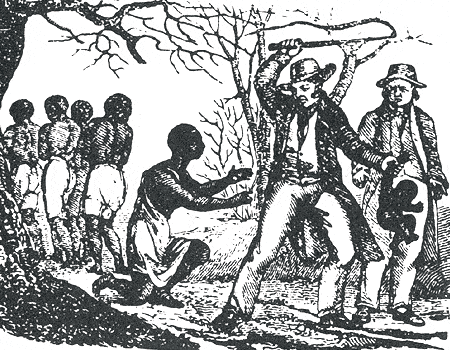 Imagine a man born in Ethiopia, raised and educated in Puerto Rico presenting slavery as an epithet for Negroid in a three-piece suit. What Irony. He forgot the briefcase and brolly. Dr Yosef Jochannan’s specious disputation is a convenient distortion of reality. Yes slavery (and attendant atrocities) has existed and will continue to exist. However, to present slavery as an epithet for Negroid is an over-characterisation. Negroes were not the first human beings to be enslaved. Slavery is not and never was unique to the Negro. There was white slavery going back to at least Roman times. Later other ethnic groups were also enslaved. The implicit assumption that slaves everywhere endured the same treatment is unsustainable. Today slavery is rampant in Africa, India and elsewhere. He forgot that Africans also sold their brethren into slavery both yesteryear and today
Regarding Africa Cecil Rhodes in keeping with the prevailing sentiment candidly stated that “we (the mother country and other colonists) must find new lands from which we can easily obtain raw materials and at the same time exploit the cheap slave labour that is available from the natives in the colonies…The colonies would also provide a dumping ground for the surplus goods produced in our factories…..” The sentiment was also echoed by Nigerian governor, Lord Lugard and former French president Jules Ferry (Goldsmith, Development & Colonialism) This suggests that the primary purpose was not enslavement/slavery as such but economic progress and ‘development.’ Workers including slaves were consumers just as they are today. Then as now progress was measured by the value of what consumers consume and their contribution.
Also then as now progress and economic development required an ongoing supply of an array of human resources—political, organizational, management and technical. The Cecil Rhodes Foundation and ‘associates’ directly and indirectly contributed substantially to the economic development of much of the world. Africans may not have won Rhodes Scholarships but they benefited substantially in other ways.
Slavery was a consequence of and a permanent feature progress and what we know of as economic development. And it was and is not restricted to Blacks. African commercial interests and politicians in mineral rich Sudan and oil rich Nigeria, like many of today’s international corporations, show little responsibility for their people or accountability beyond verbiage except for their own kind or class.
That Rwandans are still to understand why or what caused them to slaughter one another is a bad joke. Rwanda’s slaughter occurred around the same time as similar atrocities (rape mutilation ethnic cleansing and genocide) occurred and are occurring in Somalia, Congo, Sudan, Ethiopia and Nigeria. In the Congo some of the minerals used to make cell phones and related items are ‘produced’ under atrocious slave conditions by the Congolese. In some African states children are captured by blacks and sold into slavery on coffee and cocoa plantations; others given guns and taught to destroy their own kind Today slavery of yore (hard labour under horrendous conditions etc) appears mild when compared to what Black Africa has experienced and continues to experience at the hands of their own; a holocaust in some cases.
In presenting slavery as an epithet for Negroid Dr. Y uses race and ethnicity interchangeably. But they are not the same thing. Race used collectively refers to a people of different physical characteristics (skin colour). The three major races are said to be Negroid, Caucasoid and Mongoloid. Ethnicity on the other hand relates to a group of people having certain traits (cultural, linguistic, racial, religious etc) in common. Black Indians and Sri Lankans may and do experience discrimination because of their skin colour but are not seen as Negroid. Not all black people identify with Africa per se.
The insinuation that first Jews were black and from Ethiopia is by no means new. It raises the question as to whether Adam and Eve were black or white. No one really knows for sure. A long unexplained gap exists between the “Beginning” and recorded world history. It is misleading to identify Jews purely as a race. That said black and white Jews can be found all over.
It was in Barbados that Jews first became free people (here Bagatelle is important). Nisan, a sugar-boiler with expertise in laying out fields and equipping factories, was one of the four Jews ‘imported’ from Brazil by Colonel Holdip of Locust Hall to upgrade sugar production (Mosheh his brother worked at Drax Hall). Nisan married Annu, the very highly educated daughter of Chief Dosu and lived at Holland Bay. The ‘indigenous’ population is made up in part of whites of Jewish extraction. A large part of the non-white (black and variant shades thereof) is of Jewish and white extraction. Those who think that mixing race/ethnicity is to our detriment should thing again. Our roots are not only black.
Barbados was not discovered in 1619 as Dr. Y suggested. It was an Englishman, not Columbus, who first discovered the island in 1625, and another 2 years went by before settlement began. The early colonist settlers grew cotton, tobacco and indigo for export. In the early 1630s white indentures were imported to serve as bondsmen for 5 years after which they became free and were each given 5 acres of land. John Tatum was among the first indentured group. The year after his indenture ended, an English ship on its way to the island with a cargo of white indentures captured a Portuguese slaver, found 8 Africans and auctioned them in Barbados. They were the first Negroes slaves on the island.
A 1636 ordinance decreed that slaves, local or Indian and their offspring remain slaves for life. This was at a time when they were few black slaves and mostly indentured whites in the 6000 or so population. Three major factors led to the introduction of sugar on the island, 1) soil depletion 2) more expensive and inferior cotton and tobacco compared to Virginia, Carolina and Georgia, 3) declining revenue (sounds familiar).
By 1649 there was much dissent by black slaves then about ½ the 60,000 population over the 1636 ordinance. Hamilcar, a John Tatum slave, and a man reported to be of high intellect, organizational ability and capacity for leadership planned the island’s first rebellion/insurrection. It failed because Naomi, a black house slave, inadvertently let out the secret. As a result Hamilcar and 17 others were hanged. Later Naomi was found with her throat cut by the Tatums. All this at a time when Africans were selling Africans into slavery at home and abroad.


The blogmaster invites you to join the discussion.