Banner promoting anonymous crime reporting with a phone and contact number 1 800 TIPS (8477), featuring the Crime Stoppers logo and a QR code for submitting tips.

← Back

Your message to the BLOGMASTER was sent

In a week the Governor of the Central Bank of Barbados reported good quarter performance in the economy for the period January to March 2026, Barbados recorded another homicide, bringing the count for 2026 to 23. On current trajectory the blogmaster conservatively projects Barbados will record its highest number of 55 since Barbados Underground started the homicide tracker, relying on barbadoscrimeblog.com repository of data.

Barbadians have become numb to routine shootings across the 166 square mile island in recent years. This desensitisation and normalisation have become baked into the Bajan psyche. It begs the question, where will we land as a nation on current trajectory?

In 2018 when the Barbados Labour Party (BLP) won an unprecedented 30 seats, the most ardent supporter marked it down as a deserved victory given what had transpired during the so-called period of the lost decade. It repeated in 2022 and 2026 and we find ourselves in a country where an obvious constitutional crisis is not being given the required attention by its citizenry, including the media and academia.

How many times the well worn saying has been quoted in this space – “democracy is the worst form of government, except for all the others.” If our democratic system has inherent flaws, then every check and balance must operate at full strength to ensure that governance functions in practice, not merely in name. How can we feel comfortable as civic minded educated citizens if there is no ‘living’ Public Accounts Committee (PAC)to highlight just one check and balance, the last Auditor General retired in April 2025, over one year later and what? There is an environment that is fertile for opposition politics, however, we can manage only a token opposition given the feeble and mechanical dissent that prevails. If we continue to trivialise and give lip service to important matters what will be the result? The result is current state.

One group- and there are others- in our society that continues to fail given our investment in education is academia. Our culture is one that inflicts severe criticism on the political class but what about academia? By academia we mean – professors at UWI, Cave Hill; the researchers, lecturers, academic administrators, even some members of the student guild. We hear from a few but the injections of views and reviews of events occurring in society is not strident enough to resonate with a cynical and apathetic public. We are not getting the return on education (ROE) given the significant allocation to the national budget.

There must be something that continues to restrict us from solving our problems. One clear example: our inability to address the chaos in the public service sector (PSV). For over 50 years this group has been allowed to terrorise Barbados; sprout a subculture that has forced us to leave thousands of our young people behind – in the process, destabilising our small society.

The blogmaster has also become numb to what is a continuing creep towards societal decline. Do you remember when Barbados Underground highlighted indiscretions in the Barbados court system in the early 2000s, the many that accused the blogmaster of being alarmist? Do you recall when almost weekly Barbados Underground opined on the implications of not addressing our waste management system, and this was before waste was allowed to run on the streets on the South Coast. A reminder waste management is not about purchasing garbage trucks.

Barbados drifts, not because the warnings from here and elsewhere were unclear, but because the recurring of events have dulled our senses. The homicides increase, key institutions are visibly in decline, we have 3 billion dollars in foreign reserves BUT much of it borrowed, there is no oversight we can trust; the people we elect and hire to manage are asleep at the switch. Yet we have to listen to moderators, social media influencers, political scientists, some from academia et al offering empty explanations why citizens have become cynical and apathetic.

This is how a society slides, not in a single dramatic collapse, but through a steady erosion of standards that we quietly allow to normalise. What are WE doing?


Discover more from Barbados Underground

Subscribe to get the latest posts sent to your email.

78 responses to “Understanding Barbados’ societal decline amid economic growth”


  1. Barbados is now EXACTLY where the USA is…
    So let us talk about the USA…

    A leadership that destroys all internal checks and balances – while building all kinds of monstrosities in the form of state ballrooms, hotels, monuments, gardens, and private homes

    A leadership that associates with the known criminals in the society – once they control significant wealth and votes

    A highly disengaged voter population – with less than 20% voter support for their shenanigans

    A huge focus on accumulating MONEY and POWER, to the exclusion of service and quality…

    A deeply divisive internal political system – seeking to establish POLITICAL dominance, rather than pursue NATIONAL ends

    A deep and growing lack of ethical and moral foundations – such that ‘Epstein-like’ mobs now run the society…

    So… who is actually surprised that we are now where we are…?
    Not stinking Bushie…

    Steupsss!
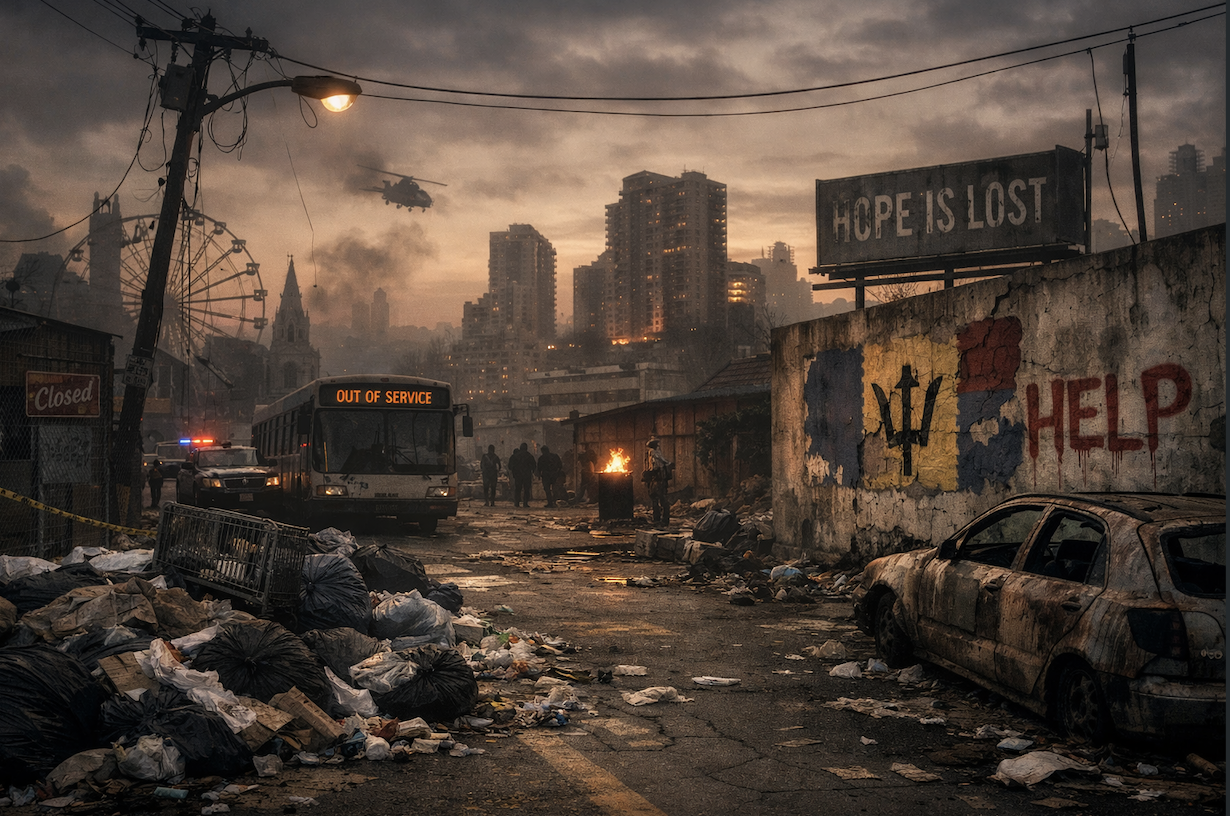
    The only mistake in your illustrative picture is that the street light is actually shining…
    Dat gotta be a reflection from the setting sun…?

    What a place!


  2. As to the governor of the Central Bank…

    Using GDP as a measure of national growth epitomizes the idiocy of our modern leadership.

    You have an environment where the cost of basic living has outpaced the incomes of average citizens by a MILE over the past decade, and you have the GALL to come to the public quarterly with shiite talk about ‘growth’…?

    GROWTH SHIITE!!!

    When prices of basics INCREASE by 10%, and wages are stalled, it INCREASES the GDP numbers.
    BUT this is OBVIOUSLY having an INVERSE impact on quality of living…

    …and to think that he does it with a straight face…

    Then they measure ‘unemployment’ to exclude all those who are not actively looking to be exploited for the menial wages – like the ongoing SLAVE-SOCIETY that we continue to be…they then seek to IMPORT desperate immigrants to do the slave labour.

    What a place!
    Even the Creator must be near the end of his patience with this jobby by now…


  3. WHAT A DYSTOPIAN PICTURE THE BLOGMASTER CHOSE TO USE FOR THIS PIECE

    I wanted to reserve commentary for after the “SABBATH”, but after seeing the #BUSHMAN locked & loaded on this, I had to follow thru’ although Britain is heading for 20-something degrees in the shade today, & I want to take in as much “VITAMIN SUNSHINE” as I possibly could #BareBack…

    Yesterday, I posted a VT on a book aptly titled “PROJECT 2025” – written & published since 1996 -1997, sadly most have not read the 502 page treatise on what the “DIRTY BASTERDS” intend to do in our world…

    IF YOU MISSED IT – HERE’S THE SHORTER VERSION


  4. There are no political or constitutional crises! For the systems are working exactly as they were designed to.

    We have also long known that capitalism gives us a downturn or recession every 5 to 7 years years. Once every century or so we get a deep depression.

    These are the most likely prospects to be confronted. The last one being around 1929. Right on time!

    That under financialization and neoliberalism where the recycling of debt on top of the maldistribution patterns of growth underlying were always as uneven as could be imagined.

    In addition to being a socalled Westminster model, the country has long ignored any alternatives which would have made an elected dictatorship impossible.

    Even when presented with an opportunity to re-write a constitution, there was no general willingness to prevent elected dictatorship, even under the pretenses of a republic.

    Clearly, both incarnations of governance equal a sameness. Recently murmurings about democratic socialism were as mesngless then as before.

    These have always been the games of fools.

    That the CBoB is talking about paper growth when the entire world is set to be under deep depression conditions should solicit a question as to whether its governor has gone mad.

    Yes, these might be historical measures. However, this writer would have expected an astute governor to make the judgement that what the near term future holds for us is of such magnitude that such questionable growth statistics would have been considered totally irrelevant.

    The dark clouds are threatening to descends upon our worlds.


  5. Bushie

    Everything you said about the current midleadership class in the USA, elsewhere, is true!

    However, theirs represent the end of the end. Not the beginning thereof.

    In others words, it gives this gang too much power to be as totally destructive in such a short period. Certainly, those coming before prepared the very best wicket on which to bat. And those coming after will be no better.


  6. The reported GDP is REAL GDP as explained by the governor a few years ago. It takes into account the inflation factor.

    In the last 8 years government raised government wages by 10% . 5 when they took over and 3 and 2 the last two yrs ( if I remember correctly). 2 increases in minimum wage, reverse taxes, tax exemptions etc
    What impact does these have on quality of living and GDP?

    For the last was just over 1% which is below normal (standards) . Why go out to 10 yrs?????

    When has wages ever outpaced inflation over a long period of time?

    #propagandanotbasedonfacts


  7. * for the last report q1 inflation was just over 1%


  8. @John2

    Who gives a shit about real or nominal GDP if Barbadians are not getting running water, have to avoid potholes on the ABC highway and a culture that promotes consumerism with diluted values?

  9. NorthernObserver Avatar
    NorthernObserver

    “has long ignored any alternatives which would have made an elected dictatorship impossible”

    Since when have you any issue with elected dictatorships?


  10. What is blatantly obvious here is the difference between implementation of law and enforcement of law.

    So we rushed to past laws on dark tint and after 3 delays of implementation dates, finally IMPLEMENTED the law. It clearly however has not been ENFORCED as they are a wash of vehicles on the road still with dark tint. An F therefore is awarded here for success.

    There was talk about doing something with the scrambler motorcycles on the roads with no license plates, lights, indicators etc. As of today they are still on the road like sand. Why is that and what is the hold up here with ensuring ENFORCEMENT is applied? Another F therefore is given here.

    30,000 vehicles on the road uninsured which according to the insurance industry not John A, equates to roughly 30% of all vehicles on the road. Why have the authorities not deal with this? Yep another F.

    The mad ass ZR sector which our leaders talk about but do not act on for some unknown reasons. They continue to stop where they like, drive how they like, ignore red lights and on they go daily. What have authorities done other than run dem mout? Again another F here for law enforcement.

    Now we come to crime and homicides! What can I say here other than we are on the road to a record year of homicides in 2026. Guns blazing assassins in professional assault attire and dem look like SWAT on TV. I heard the boss man at the police say he knows who the criminals are, where the guns and drugs are coming from and how they get here. So I can’t help but ask then why wunna aint moving on these criminals then?

    Now to the gem they love to talk about and that is the GDP growth of the economy, which is said to of had 20 quarters of growth which is 5 years in Bajan terms. Well I only went to Brumlee, but 2025 minus 5 takes us to 2020 correct? Wunna remember covid in 2020 when we was shut down? Well that is the bench mark the Governor is using as the beginning of his review period. Well cuhdear if you did not have growth from ground zero in 2020, we would be brek as tail by now aint it?

    This statement opens a can of worms and creates questions that ALL sensible Bajans must now ask and it actually ties crime to GDP over the 2025 and 2024. This is when crime picked up with large shipments of drugs being found in and around Barbados. What percentage of our bragged about GDP is now made up by crime? Remember the drug men and criminals can’t go into Scotia and open an account. How will they show proof of earnings when they have to fill out the account application form? So the drug man or woman has 2 options, either store the cash or spend the cash, or a mix of both. This drug spending goes into the supermarkets, furniture stores, restaurants and on and on. This can not be stopped either as it now becomes “legal” income for these legit businesses. Oh shite I nearly forget to included the big rides that bout the road like ants! Right so my question is this, have we reached the stage where crime makes up such a large percentage of our famed GDP that crime is now untouchable?


  11. @John A

    “The toe bone’s connected to the foot bone.
    The foot bone’s connected to the heel bone.
    The heel bone’s connected to the ankle bone.
    The ankle bone’s connected to the leg bone.
    The leg bone’s connected to the knee bone.
    The knee bone’s connected to the thigh bone.
    The thigh bone’s connected to the hip bone.
    The hip bone’s connected to the back bone.
    The back bone’s connected to the shoulder bone.
    The shoulder bone’s connected to the neck bone.
    The neck bone’s connected to the head bone.” – Wikipedia


  12. @ David.

    Don’t mind me I was just talking to myself cause I don’t expect answers to none of my concerns.


  13. @John A

    We have so much psychoanalysis at our disposal and yet we are unable to implement relevant intervention strategies. It must be deliberate, just like the sub culture that has enveloped the PSV sector.


  14. The 2026 Election result is a new chapter and a new beginning,
    perhaps someone (who shall not be named) is missing the point..

    Open The Gate

    A time will come when every fig tree shall find its own vine
    That the only solution, to end all this crime

    They took us away from Africa on a rocking ship
    Then brought us to Jamaica, in the valley of Jehoshaphat

    So open the gate, let’s repatriate, I say
    Open the gate before it’s too late, idren

    So bide up, Rastaman, for the time is at hand
    So bide up, African, for the time is at hand

    Me say, a time ago come
    The time when there come Jesus, the Indian, the white man too
    Go do a test, then what else he’s gonna do?

    They took us away from Africa on a rocking ship
    They brought us to Jamaica under heavy ginalship
    So open the gate before it’s too late, I say
    Open the gate before it’s too late, idren

    Bide up, Rastaman, for the time is at hand
    Me say fi bide up, African, it’s time to stand up strong
    Me say fi bide up, Rastaman (Hey)


  15. @ David

    Antigua’s PM, Gaston Browne, secured a historic fourth consecutive term in office, leading the Antigua & Barbuda Labour Party (ABLP) to a commanding landslide victory defeating United Progressive Party (UPP), in the Thursday, April 30, 2026, general elections.

    ABLP = 15 seats
    UPP = 2 seats


  16. @Artax

    They are using the Mottley playbook, call early elections.


  17. We’ve always seen elected dictatorships with a jaundiced eye.

    We would much prefer those ones bearing guns – like Maurmar Gadafi or Ibrahim Traore. The real dictators which were always so central to democracy as the Greeks and the Romans saw dictatorship and governance. For them the dictator was essential, indispensable. For when their systems confronted problems not amenable to democracy, dictatorship stood in the breach.

    History clearly shows that the dictatorship and democracy are Siamese twins. Read the histories and you’ll know this toooo.

    Central to our objections to elected dictatorships is the pretense that they are democracies when in truth and in fact they are dictatorships. Thus ‘elected dictatorships’. A phrase not coined by this writer but well found within the political science, academic literature. Historically, a real dictator was never elected, never tried to be.


  18. SPIRIT AIRLINES FOLD WITH THE LOST OF 17,000 JOBS – IS THIS A SIGNS OF THINGS TO COME

    #YouDecide

  19. Terence Blackett Avatar
    Terence Blackett

    FOR THE PEOPLE OF IRAN WHO WERE VICIOUSLY ATTACKED AND ASSAULTED FOR NO GOOD REASON – PLUNGING THE ENTIRE WORLD INTO AN ECONOMIC CRISIS. LET’S PRAY THAT THE OMINOUS PIC USED BY THE BLOGMASTER DOES NOT BECOME A LIVED REALITY ON WHAT IS A PARADISE ISLAND TAINTED BY GREED, CORRUPTION & INCESTUOUS EVIL

    #WeShareThePain


  20. Barbadians do not care about micro, macro or geopolitical issues, what matters is who is the BLP politician said to be engaged in low activity.


  21. @ Pacha
    “History clearly shows that the dictatorship and democracy are Siamese twins.”
    ~~~~~~~~~~~~~~~~
    Actually, ‘democracy’ has a historically worse record.
    Because while there have been examples of some intelligent, honest and righteous dictatorships, among the despots…
    the likelihood of such attributes originating via general consensus among brass bowls has been elusive.

    This also explains the INEVITABLE catastrophic outcomes that will derive from AI…
    which is essentially the compressed, collective, ‘wisdom’ of all human brassbowlery.

    We would be much more likely to see some positive outcomes under the ‘dictatorship’ of the CREATOR who actually made everything that exists…

    …But we will go with the ‘technology’ and hope for the best.

    What a curse!


  22. @ Bush Tea

    Truth is dictatorship can be a double edge sword. Singapore was built by a dictatorship. Thing is he wanted better for his people and took that country out of being a collection of villages in the 1960s to what it is today.

    Then we have the blood suckers like Maduro and Marcos who sucked the money out of their countries for their personal benefit. Personally I do not support any system that does not practice free and fair elections. Having said that I can not fault Signapore for the success it has achieved.

  23. Hippy Hooray Avatar

    The collapse of society is a first step towards a change for the better
    it is part of the process
    towards when the collective minds reach a tipping point for a consensus

    Think, Egypt, Greece, Rome, Britain, Colonialism, US Civil Rights Fights etc

    Do Barbadians want to live as “civilised” people who are dead
    or as “primitive” people who are alive
    Do they want a European mindset as per their brainwashing
    or a African mindset as per their original design DNA

    The reprehensible Trump Chump nonsense exposes US’ backside to the world

    Hippy Hooray
    Babylon the great is fallen


  24. Bushie

    No system is perfect. Not even a real dictatorship. Not the elected dictatorships of America or Barbados.

    Indeed, those who impose elected dictatorship on us as the most “desired” system misleadingly told us, as mantra, this.

    They recited that no system was perfect but that “democracy’, meaning elected dictatorship, was the least imperfect.

    If perfection is the underlying ingredient you seek then such fanciful notions of having somebody somewhere is the clouds, all-knowing, may serve to satisfy that desire. This conception has long been seen as a fool’s errand.

    Of course, they were and are those who suggest that a natural person and this Being from above were One. Pacha’s remit does not extend to the specious.

    All weee seek to do is to make the best efforts in solving the material conditions for most of the people, most of the time. Leaving them with governance of their own minds to create their own magical thoughts and not requiring such a generalized kind of thinking to be a condition precedent.

    The kinds of problems this world faces can never best be solved under elected dictatorship or petite bourgoise democracy, not with elections and public sentiment getting in the way.

    For even this socalled democracy is again led to fascism, like it did before. And what is fascism – the conjuncture of the interests of the political and economic elites. And nobody can argue that these two classes have not been working in consort against the masses almost everywhere.

    Elected dictatorship and fascism have much in common. It’s difficult to slip a ten pence between these two cheeks of the same political backside.


  25. @ Pacha
    Not sure exactly what you are saying above – with your lotta fancy verbosity and tautology, (LOL)
    …but COMMON SENSE (Bushie’s only claimed attribute) tells us that there IS a PERFECT SYSTEM…

    Clearly that would be the system that has been designed, presented, and mandated by the CREATOR and MANUFACTURER of ‘Project Life on Earth’.

    And just because some shiite brass-bowl clowns fail to endorse it…
    or fail to connect the dots…
    or insist on democratically choosing their OWN albino-centric based system (based on their collective ‘wisdom’) instead…

    Does NOT invalidate the BASIC common sense that the SUPERIOR WISDOM, KNOWLEDGE, VISION and EXPERIENCE of whatever superhuman CREATORS that we refer to as ‘God’ – MUST represent the absolute truth, rightness, justice, and hence must represent THE ONLY path to true success.

    After THOUSANDS of years of brass bowls trying EVERY OTHER POSSIBLE alternative system, and failing miserably, …common sense would seem to dictate that ‘when all else fails, we should probably try reading the manufacturer’s INSTRUCTIONS’… ???

    But common sense died some years ago…
    So we will now depend on AI for guidance… (Accumulated Ignorance)

    What a state!


  26. There is the present reality, too many citizens do not have confidence in this government or any other to fix our critical issues. Take the chaos in the transportation system as one example.

    CLASH OVER BILLS

    Govt dismisses DLP claims of threat to national sovereignty

    By Maria Bradshaw

    mariabradshaw@nationnews.com

    A heated clash has erupted over the reintroduction of the Barbados Citizenship Bill, 2026, and Immigration Bill, 2026, with Government dismissing Opposition criticism as “ridiculous” and ill-informed, but the Democratic Labour Party (DLP) warning the measures could undermine national sovereignty and the integrity of the Barbados passport.

    Minister of Home Affairs Gregory Nicholls fired back at DLP spokesperson Corey Greenidge within hours of the party’s statement yesterday, accusing him of showing “a lack of understanding of the parliamentary process”. He insisted that the legislation was properly returned to Parliament to continue unfinished work before a Joint Select Committee.

    However, Greenidge is charging that the process is a “political buffer” and argued that despite public consultation, the core provisions of the bills were unchanged, raising serious concerns about fasttracked citizenship and its potential impact locally and internationally.

    The bills, which seek to repeal and replace existing laws on citizenship and immigration, were reintroduced in the House of Assembly last Wednesday. They were initially proposed in October 2025, just months before the February 11 General Election, but referred to a Joint Select Committee following public outcry.

    In a statement yesterday, Greenidge, DLP spokesperson on legal affairs, office of the Attorney General and Home Affairs, contended that the committee process was merely a “political buffer” used to quiet dissent during the election season. He noted that despite submissions from civil society and professionals regarding employment, social services and national security, the core provisions of the bills remained the same.

    “The only reasonable conclusion is that the committee process was never intended to meaningfully reshape the bills,” he stated.

    “It served as a way to diffuse public concern during the election period . . . . That is not consultation in any meaningful sense. It is political gamesmanship.”

    Central to the DLP’s concerns is a proposed drastic reduction in the time required to obtain citizenship. Under the current Barbados Citizenship Act (Cap 186), naturalisation typically requires seven years of lawful residence, a process the DLP describes as one of “gradual and deliberate” integration.

    Under the proposed new legislation, however, citizenship could be obtained after as little as 180 days (six months) of residence for CARICOM nationals, and 270 days (nine months) for others.

    The opposition party warned that when read in conjunction with the proposed Immigration Bill, which introduces a points-based system for permanent residence favouring financial resources and property ownership, the laws create an accelerated pathway to citizenship.

    “Individuals with sufficient financial means can strengthen their eligibility for permanent residence

    Continued on Page 5A.

    ‘Barbados passport reputation may be at risk’ through their economic footprint alone,” Greenidge argued.

    “This creates a system where financial capacity becomes a factor that can materially accelerate access to permanent residence, which in turn accelerates access to citizenship.”

    He highlighted the potential international repercussions of the reforms, specifically citing recent actions by the United Kingdom and Canada to impose visa restrictions on Dominica, and St Kitts and Nevis, due to concerns over citizenship-byinvestment programmes. While the new bills do not technically constitute a citizenship-by-investment programme, Greenidge, an attorney, warned that the “fast-track” nature of the legislation could be perceived similarly by international partners.

    “Barbados currently enjoys one of the strongest passports in the region . . . . That privilege is not automatic. It is based on trust. If citizenship becomes too accessible, particularly where financial pathways are involved, the passport itself becomes a potential back door into [international] borders.”

    The party cautioned that the Mia Amor Mottley administration was engaging in a “calculated gamble” with the reputation of the Barbados passport, risking the withdrawal of visa-free access to major global destinations.

    However, Nicholls, who reintroduced the bills, reiterated that submissions made to the Joint Select Committee would still be under review.

    “Mr Greenidge has demonstrated a lack of understanding of the parliamentary process,” he said, pointing out that the committee never concluded its work before the election was called.

    “So, therefore, this ridiculous statement from the Democratic Party shows that they don’t understand the political process when Parliament is dissolved. All bills and all the processes of Parliament are ongoing in respect to any legislation that has not been completed . . . . So, therefore, the bills were brought back by Government to continue that process before a joint parliamentary select committee,” he stated, adding that submissions previously made would be considered and new one could also be made.

    “The Government signalled its intention once we had won the election to bring back the bills that were before the joint parliamentary select committee. All the pieces of legislation that were before the parliamentary process will come back in the same form that they were. It would be disingenuous for Government to change the bill when that process was not completed. I would hope that the Democratic Labour Party would not do what it did at the last joint select committee; that is, not attend any meetings.”

    Regarding the DLP’s concerns about wealthy individuals being able to cement their eligibility for citizenship, Nicholls also dismissed them.

    “There is no evidence that the provisions in the bill will allow Barbados immigration system to be overwhelmed with people of wealth. That is an alarming statement being made before any real tangible evidence of that happening or what provision in the bill will allow our system to be overwhelmed by people of wealth. Indeed, what is wrong with people who have means coming to invest in Barbados, invest in industry, invest in development of human capital and to invest in the development of the Barbados economy?

    “Mr Greenidge’s statement again notes that he has a profound ignorance of the mechanics that will allow the Barbados economy to be able to sustain a level of growth and to maintain a quality of life and a standard of living that Barbadians have become accustomed to . . . .” the Minister stressed.

    Source: Nation


  27. Please tell us something we do not know? We will hear the stakeholders in the sector voicing alternative positions this week to counter what is a fact.

    Tourism concern

    Economists raise questions about over-reliance on sector

    By Colville Mounsey colvillemounsey@nationnews.com

    Barbados’ economic stability is dangerously over-reliant on tourism and could quickly unravel if that sector falters, economist Professor Troy Lorde has warned.

    Reacting to the Central Bank of Barbados’ first quarter review last week, he said the headline figures, while positive, tell only part of the story, pointing out that growth remained heavily concentrated in a single sector.

    His colleague at the University of the West Indies Cave Hill, Professor Don Marshall, described the recent performance as a “remarkable stabilisation achievement”, but cautioned that the country had yet to achieve meaningful economic transformation.

    Expansion

    Central Bank Governor Dr The Most Honourable Kevin Greenidge on Wednesday reported that the economy grew by 1.7 per cent in the first quarter of 2026, resulting in 20 consecutive quarters of expansion, with inflation at 1.1 per cent and unemployment at 7.2 per cent.

    Tourism again drove much of that performance, supported by increases in both stay-over and cruise arrivals, along with continued activity in construction and services.

    Lorde said the Central Bank’s latest report masked a deeper structural imbalance in the economy.

    “The rest of the economy is lagging . . . . Tourism is essentially the economy right now,” he said, noting that while the sector expanded by more than three per cent, overall growth was just 1.7 per cent, implying that other sectors grew at roughly one per cent or less.

    “That tells you the structure is still very dependent and very imbalanced. If tourism is not doing well, that stability narrative would disappear.”

    He added: “That 1.7 per cent is a headline figure. It doesn’t tell the story.”

    He explained that Barbados’ dependence on tourism left it highly exposed to external shocks, particularly as leisure travel was discretionary and driven by global economic conditions.

    “When people don’t feel confident about their finances, they don’t travel. That is the nature of tourism, so we need other sectors that can function when tourism is not firing.”

    Marshall, head of the Sir Arthur Lewis Institute of Social and Economic Studies, said while the combination of steady growth, low inflation, falling unemployment and improved fiscal balances reflected sound economic management, the underlying structure of the economy remained largely unchanged.

    “This is not diversification in any meaningful, developmental sense. It is sectoral deepening within an already narrow structure,” he said, pointing out that growth continued to be concentrated in tourism, construction and services, with investment largely tied to real estate and tourism-related activity.

    External demand

    He said Barbados remained locked into a model that depends on external demand, one that “exports experiences and imports necessities”.

    Both economists also raised concerns about the disconnect between official data and the realities facing households.

    Lorde questioned whether the low inflation rate of 1.1 per cent reflected actual cost-of-living pressures, arguing that increases in essential goods and services were often masked within broader price indices.

    “Inflation is made up of a number of items . . . but the things people have to buy – food, rent, transportation – did those only go up by one per cent? Probably not,” he said.

    Marshall noted that rising costs in key areas such as transport, health care and education were being felt disproportionately, even as overall inflation remained subdued.

    “Low aggregate inflation masks the reality that cost-ofliving pressures are concentrated precisely where households feel them most,” he said.

    On the fiscal side, Marshall acknowledged Government’s success in restoring discipline, with a strong primary surplus and declining debt levels, but questioned whether those gains were being used to fundamentally reshape the economy.

    “This raises a crucial question: what kind of investment is being prioritised, and whom does it serve?” he asked, stressing that fiscal prudence without structural change risks reinforcing existing economic dependencies.

    Lorde took issue with the continued reliance on tax concessions and incentives to attract investment, adding that such measures could undermine Government’s ability to fund essential services.

    “If your model can only succeed on the back of concessions and reduced taxes, then you’re putting pressure on the Government to provide education, health care and everything else with less revenue,” he said.

    Both agreed that diversification remained the central challenge, with Lorde pointing out that responsibility must be shared between Government and the private sector.

    “The Government has to send signals, but investors and entrepreneurs also have to take risks,” he said.

    Marshall said Barbados must move beyond a narrow focus on macroeconomic stability and pursue a model centred on productivity, resilience and economic sovereignty.

    “Stabilisation was necessary; it was not sufficient,” he said, warning that without meaningful change, the country risks remaining in a “low-diversification, high-debt equilibrium”.

    Source: Nation


  28. Today’s Nation editorial is amusing. As some say, we will judge them by their fruit. The press Must earn and demand respect from the stakeholders as well.

    We must guard against erosion of Fourth Estate

    Today is being celebrated as World Press Freedom Day under the theme Shaping A Future At Peace: Promoting Press Freedom For Human Rights, Development And Security.

    This was established by the United Nations in 1993 to underscore the essential role of Press freedom as a fundamental pillar of democratic governance, sustainable development and social stability.

    This theme highlights the crucial role of independent journalism as a peace-building tool, countering disinformation and fostering accountability during periods of global instability and conflicts.

    This year’s observance takes place amid rapid transformation in the global media landscape, driven by technological advances, and evolving professional and ethical challenges brought about by artificial intelligence.

    These developments are prompting broader reflection on the future of journalism and the need to strengthen its independence, professionalism and resilience. In Barbados, as everywhere, the landscape is dominated by social media.

    Today is a day of support for media which are targets for the restraint, or abolition, of Press freedom. It is also one of remembrance of those journalists who lost their lives in the pursuit of a story.

    We see access to information as a fundamental human right and will continue to press for a Freedom of Information Act to be passed in Barbados in order to give both the media and the public the right to information from Government on matters that affect them, except those of national security.

    We have highlighted – in one of our Editorials last month – of a trend with the current administration where senior political and State officials are resorting to pre-recorded video statements on important matters, instead of facing the Press to answer the burning questions on which John Public, through the media, would want responses. Others, like the Prime Minister, are even now posting important information on their own social media pages and “speaking at the country rather than to the country”, as we stated.

    The Press is not isolated from the country; rather, it is called the Fourth Estate, and for good reason, as its role is to keep a critical eye on three arms of State – the Executive, Legislature and Judiciary.

    It represents the average man and woman who would like to get near these officials to get answers and clarity on a host of issues, but have to rely on the media to do so in a fair and balanced way. When that access is denied or being circumvented, freedom – not just Press freedom – transparency and democracy as a whole become the victims – and this has long-lasting effects way after the politicians and officials have gone or called it a day.

    This day also provides an opportunity for us to examine responses to the challenges confronting journalism, including achieving an appropriate balance between freedom of expression and professional responsibility. Not everything is fit to be published.

    We must also seek to strengthen legal and regulatory frameworks to safeguard media independence, and enhance the economic viability of media institutions.

    We encourage professional responsibility and integrity from journalists, as well as continual training and development as they will face fierce competition from social media platforms and subtle pressure from advertisers, both public and private. There is no doubt that professional ethics remain critical to journalism, anchored in accuracy, objectivity, integrity and respect for privacy. However, these principles are under increasing pressure from competitors for breaking news and publishing cycles.

    It has now become absolutely necessary to highlight the importance of addressing misinformation and rebuilding public trust in media content in the context of ongoing digital transformation being seen globally. Barbados is no exception.

    Reports by international Press organisations indicate a marked deterioration in Press freedom, amidst tightening restrictions, increased censorship and growing threats to journalists in many countries where many face arrest, harassment or death each year.

    Many media analysts have noted that a declining adherence to ethical standards across some online platforms has contributed to the proliferation of unverified and unprofessional content, undermining media credibility and eroding public trust. In an environment characterised by rapidly evolving events and expanding information flows, free and responsible journalism remains a critical pillar in fostering informed societies capable of addressing complex issues.

    The future challenges to the Press are enormous but we offer support and encouragement to our colleagues to uphold freedom and remain fearless while adhering to the truth.


  29. David

    “Who gives a shit about real or nominal GDP if Barbadians are not getting running water, have to avoid potholes on the ABC highway and a culture that promotes consumerism with diluted values?”

    And how do you get running water and no potholes without real growth and or borrowing? Certainly not by coming on BU and spout bs like the narrow minded egofowls of the BU intelligentsia. #echochamber


  30. Bushie

    A few points and the last words are yours.

    One, a few thousand years is nothing. The earth is 14 billions years old. Mother Nature took as long as She did to evolved a one-cell organism into a human, and it was not linear. Not perfect!

    That political systems come and go should not mean the conclusion that that, by itself, is an end state. Everything evovles!

    Humans themselves may not be a work completed. Those who so contend could be made fools of 14 billion years from now.

    Two, within the natural world there are no perfect systems. If that were so, everything would have been perfect. We would argue that imperfections are the building blocks of all there is, has been.

    Three, the lack of socalled common sense represents such an imperfection. And well evidenced by you.

    Four, you are in danger of leaving this earth having not lived the truth about your own existence.

    Five, after 15 years and you continue to claim a general misunderstanding, twice above, could only be interpreted as your way of saying that nothing else but the cool aide of your book is sufficient.

    Gallop on!


  31. The editorial in the Nation Newspaper continues the unfreedom of the press long practiced.

    It talks about the United Nations as a champion of these freedoms when that institution itself does nothing, and is unable to do anything, when hundreds of Palestinian and Lebanese journalists have been, for three years now, systematicaly murdered by the Zionist entity and the Americans. Indeed, this level of targetting of journalists has broken all records in conflicts, wars, worldwide.

    And there are many other contradictions to this “bovine excrement” on which the Nation has made a good living for some.

    Maybe it would have been a good opportunity for the editorial staff at the Nation to critically access the damage it has done to all freedoms, more generally, over decades.


  32. “…And how do you get running water and no potholes without real growth and or borrowing?”
    ~~~~~~~~~~~~

    …by the creative, competent, transparent, management of your available resources – like we started back on the 70’s when we benefited from good leadership – whose focus was on national best interest, much more so than on petty self-glorification.

    In any case, ‘real growth’ is measured by national, social, political, spiritual and sociological progress of the citizens … and NOT by counting fiat, shiite US dollar numbers…that will all crash and burn very shortly.

    …just saying!


  33. Bushtea

    If, like you have been, I were shown to be uninformed, wrong abd deluded so many times, I’d at least recalibrate my thoughts. But nooo, like a typical egofowl, you continue with your nothingness–myths and fairy tales.🤣


  34. The legislation outlined in the Barbados Citizenship Bill, 2026, and Immigration Bill, 2026, is proposing that citizenship could be obtained after 180 days, or 6 months of residence in Barbados for CARICOM nationals.

    Under the existing arrangement, provided for in the Revised Treaty of Charaguamas, CARICOM nationals can freely relocate within participating nations for SIX (6) MONTHS WITHOUT SCRUTINY.

    Is this BLP administration suggesting a Jamaican, for example, can visit Barbados, given the mandatory 6 months stay, during which time he/she could APPLY and OBTAIN Barbadian citizenship?

    And, by extension, given similar opportunities afforded to citizens of Belize, Dominica and SVG as a result of full freedom of movement initiative?

    In other words, is the legislation ‘cleverly and surreptitiously’ fast tracking the process of Barbadian citizenship for nationals of those CARICOM member states that have DELAYED IMPLEMENTING full freedom of movement for various reasons?

    Mottley sought the opinions of Barbadians as it relates to traffic management, but went ahead and drafted legislation that would ultimately increase the population, without any consultation with the populace?


  35. No surprises there @ Enuff…

    If indeed you were ‘like Bushie’,
    then you would have eyes to see and ears to hear…
    – and you would have a VERY different perspective…

    Alas you have unfortunately not been so blessed,
    and so you are wont to crucify what you deem to be delusion.

    Perhaps you ought to remember that it is the person who has the last laugh
    …that counts!

    …so hold off on the “🤣” for a bit longer… just in case!!

    BTW
    …any comment on Bushie’s above prescription
    for getting “running water and no-potholes” ???

    …or wunna sticking with begging, borrowing and pretending growth?

    LOL


  36. Well we know about the borrowing cause we got certificates in how to do that !


  37. Artax

    Haven’t the bills been sent to Committee again as was done during the last parliament and the public can submit comments and appear at the committee hearings? Do encourage Bushtea and other BUI members to go before the committee and granstand like they do on BU.


  38. @Bush Tea… A sincere question.

    What are you trying to achieve?


  39. WHEN CUNTS RUN CUNTRIES & PUSSIES MEOW IN THEIR FLESHLY FRAGILITY -WE ARE SCREWED

    #Madness

    #SMDH


  40. “Do encourage Bushtea and other BUI members to go before the committee and granstand like they do on BU.”

    Enuff

    That task is way above my pay grade.


  41. 1.7% growth, 100% dependence

    THE CENTRAL BANK’S first quarter review of the Barbadian economy reads like a document of quiet success. Growth is steady. Inflation is contained. Reserves remain strong. The tone is reassuring: “Resilient growth, strong buffers”.

    Real gross domestic product (GDP) expanded by 1.7 per cent in the first quarter. International reserves stand at roughly $3 billion, providing over 25 weeks of import cover, more than double the conventional benchmark. The fiscal position is disciplined, with a primary surplus of four per cent of GDP. By all conventional macroeconomic indicators, Barbados is doing what it is supposed to do.

    And yet, if one reads the report more carefully, a more nuanced story emerges. Beneath the language of “resilience” lies a structural dependence that continues to define, constrain and ultimately distort Barbados’ development trajectory.

    Tourism is no longer simply a sector. It is the economy.

    The report indirectly makes this clear. Tourism value-added grew by 3.3 per cent in the first quarter. Travel credits continue to dominate the external account. Even the improvement in the current account – from a deficit of $56.1 million to just $6.3 million – is largely attributed to stronger tourism receipts.

    Remove tourism from the equation and the stability narrative completely collapses.

    The implications of this concentration extend far beyond economic vulnerability. They shape the very geography of the country. The same report also notes that construction expanded by 3.5 per cent, driven in part by “commercial and residential developments”. In plain language this means hotels, villas and high-end coastal projects.

    Growth is physically embodied in concrete along the coastline.

    High-end developments occupy prime coastal land, often accompanied by public infrastructure improvements and duty and tax concessions.

    The Pendry project in St Peter is emblematic: luxury residences priced in the millions, a private marina and a development footprint that reconfigures the surrounding space in subtle but significant ways.

    This is not simply about one project. It is about a model in which the coastline is treated as a revenuegenerating asset to be optimised.

    The Central Bank report inadvertently reinforces this logic, highlighting an economy whose stability is existentially tied to continuous expansion of tourismrelated infrastructure. And that expansion has consequences.

    The first is spatial. As more of the coastline is developed for tourism, the nature of public access changes. It becomes managed, channelled and psychologically restricted. A beach that is technically public can become socially inaccessible.

    The second is social. Rising land values, driven by tourism investment, feed into the property tax system. Residents in coastal communities will face increasing tax burdens based on valuations that reflect global demand, not local income. This creates a quiet but powerful mechanism of displacement.

    The third consequence is economic vulnerability – ironically, the very thing the report seeks to reassure us about. It acknowledges that Barbados remains highly exposed to external shocks. It highlights the country’s deep dependence on imports. This is the paradox. We generate foreign exchange through tourism to pay for the imports required to sustain tourism. Not exactly the “circular economy” to which we aspire.

    Efforts at diversification are not yet obvious. The global business sector, once a pillar of growth, showed signs of contraction. Manufacturing output fell by 2.3 per cent. Agriculture remains marginal.

    The Central Bank’s report is correct to highlight resilience. But resilience to what? A model that depends on external sentiment, imported inputs and gradual enclosure of its most valuable natural asset is not resilient in any meaningful sense.

    And this is where the Prime Minister’s framing of “Tourism 3.0” is both important and revealing. Because embedded in that language is an admission – however carefully expressed – that the current model has reached its limits. You do not reset a sector functioning optimally. You reset one straining under its own contradictions.

    If Tourism 3.0 is merely an updated version of the current model, then we will continue along the same trajectory: more upscale developments, more pressure on coastal land – rebranded as innovation. If it represents a structural shift, then it must confront the difficult issues headon: land use, local ownership, environmental limits and the right of Barbadians to occupy their own coastline without mediation.

    Tourism cannot be “3.0” if the spatial logic remains “1.0”.

    You cannot speak of transformation, inclusion or resilience while the coastline continues to be enclosed, while the structure of ownership remains unchanged, while doubling down on the very dependency that has placed us as this juncture.

    At that point, the issue will no longer be whether the model is evolving. It will be whether we ever truly intended it to.

    Professor Troy Lorde is an economist and Dean of the Faculty of Social Sciences at the University of the West Indies Cave Hill Campus. Email troy.lorde@cavehill.uwi.edu

    Source: Nation


  42. Rebuilding the village

    The following is the second and final part of an article published in yesterday’s SUNDAY SUN. by GUY HEWITT IN PART ONE, I tried to capture where we are as a society and how we got here. The statistics are challenging, the trends are alarming and the human cost is real. But I refuse to end the conversation there, because dwelling in the problem without turning toward solutions is its own kind of failure. If there is one thing the village mindset demands of us, it is action.

    So let us talk about what rebuilding looks like, not in vague, feel-good terms, but in practical, shared commitments – some for Government, some for non-state actors, some for communities, and yes, some for each of us as individuals.

    Start in the schools and start early Our schools are the most accessible community institutions we have.

    Every child passes through them.

    Right now, too many children are passing through and emerging on the other side without the emotional and social tools they need to navigate life.

    Criminologists have been clear on this point: students who are suspended or expelled are significantly more likely to enter the criminal justice system. That pipeline from school exclusion to street involvement is not inevitable – it is a policy choice. Schools must move away from punitive responses toward restorative practices that keep young people engaged, supported and held accountable in ways that work.

    Beyond discipline, our schools need to become genuine hubs for emotional intelligence, conflict resolution and mentorship. These are not soft extras to be squeezed in when there is time but are foundational. A young person who cannot identify and manage anger, who has never been taught how to resolve conflict without violence, who has no trusted role model to turn to, that young person is already at risk, long before any crime is committed.

    Guidance counsellors need to be properly resourced. Mental health support must be accessible in schools, not simply referenced. And the curriculum itself must speak to the realities young Barbadians face today, not the world as it existed a generation ago.

    Intervene early and coordinate

    Cheryl Willoughby, head of the Criminal Justice Research and Planning Unit, has called for interventions beginning at the polyclinic stage – identifying and supporting at-risk families long before a crisis emerges. That is not radical but common sense, backed by decades of evidence. Early adverse experiences, family instability, poverty and trauma do not wait for a child to reach secondary school before they begin to shape behaviour, therefore neither should our response.

    What this requires, however, is genuine coordination. The Child Care Board, National Council on Substance Abuse, the National Peace Programme, community policing units, youth commissioners, social services, civil society and the private sector cannot operate in silos – each aware of a piece of the problem but none holding the full picture.

    The recent establishment of the National Crime Observatory is a welcome step. It must be properly resourced, its findings must drive policy and the various agencies must be held accountable for working together rather than in parallel.

    Open real economic pathways

    Let’s be real about this: no mentoring programme, however well designed, can fully compete with the pull of the street if a young person genuinely sees no credible future for themselves in the formal economy.

    Hope is not just an emotional state – it is also a rational calculation.

    When the calculation does not add up, people find other ways to survive and to matter.

    As I previously stated, the foundations of a stable future – a steady job, owning a home, earning enough to support a family – have become out of reach for far too many of our young people.

    This is not a personal failing but a structural problem that demands a structural response.

    We need targeted vocational programmes genuinely connected to labour market demand. We need meaningful apprenticeship schemes with the private sector. We need youth entrepreneurship support that goes beyond one-off competitions to sustained mentorship, access to credit and real business development.

    We need an honest national conversation about housing and wealth-building for the next generation, because if we do not address it, the alienation and the anger will only deepen.

    Challenge the culture, not just the crime Pastor Roger Husbands, of Drug Education and Counselling Services, has spoken compellingly about unaddressed anger as a core driver of violence; anger that, without a safe outlet or a trusted guide, festers into aggression, retaliation and despair.

    This is something the courts and the police alone cannot fix.

    We need to actively challenge the narratives our young people are absorbing – about what it means to be respected, about how conflict is resolved, about what success looks like. Those narratives are being written every day on social media platforms, in music and in the behaviour of adults that our young people observe.

    These will not be countered by a single programme or a Government campaign. They will be countered by consistent, visible, credible alternatives – lived out in real communities, by real people.

    This means more Bajan men and women of character stepping into mentoring roles. It means role models who reflect the full diversity of meaningful paths in life – not just the lawyers and doctors, but the tradesperson, the farmer, the entrepreneur, the coach.

    It means communities reclaiming the right to set their own standards for what is acceptable, rather than outsourcing that function entirely to social media and the courts.

    Rebuild civil society – deliberately Hold the intergenerational contract sacred Community clubs, sporting leagues, cultural organisations, neighbourhood associations are not nostalgic relics. They are the connective tissue of a functioning society, and their decline has left a vacuum that nothing constructive has rushed in to fill. Bringing them back will not happen on its own. It requires investment of time, money and institutional support.

    The private sector, which has long benefited from the Government’s investments in ensuring a talent pool and a stable society, has a particular responsibility here.

    Corporate social responsibility must mean more than a cheque written once a year. It must mean showing up in communities, sponsoring youth leagues, providing internships and genuinely opening doors.

    Government too must create the enabling environment – funding community infrastructure, supporting civil society organisations and recognising that a vibrant social fabric is not a luxury. It is a national security matter.

    There is one principle that underpins all of this, and I want to name it plainly: the social contract between generations is not optional.

    Every generation has an obligation to create the conditions for the one that follows. The pathway my generation walked – free education, accessible employment, a credible shot at stability and home ownership – must remain open.

    Allowing it to close is a betrayal of that contract and we are all diminished by it. Our youth and future generations must be given the same genuine opportunities that those who came before them enjoyed.

    Failing to uphold this is not just a moral failing, as the evidence in front of us makes painfully clear; it is a danger to all of us.

    What each of us can do – starting now The “village” is not a Government responsibility. It is ours, collectively, and there are things each of us can do, starting today: Notice the young people around you. The children in your street, your niece, your neighbour’s son who seems to be drifting. A consistent, caring, adult presence in a young person’s life can be the difference between two very different futures.

    Volunteer. Schools, community organisations, youth programmes – they all need adults willing to reliably show up and with genuine interest.

    Speak up. When you see young people being written off, dismissed or failed by institutions, say something.

    Advocate for them. Do not look away.

    Model the values you want to see. Young people are watching how we as adults handle conflict, how we treat each other, what we celebrate and what we condemn.

    Support what is working. Put your time, your money and your voice behind businesses and programmes that are genuinely investing in youth.

    The village is still here

    I returned to Barbados because I believed in what the country stands for, not just what it was. The qualities that built one of the most meritocratic small nations in the world remain.

    The discipline, the community solidarity, the fierce collective pride have not disappeared, but have simply been pushed aside by forces we allowed, without fully realising it, to take root.

    Our young people are not the problem. They are the consequence of our collective choices and they can just as readily become the beneficiaries of our collective commitment – if we choose, clearly and urgently, to make one. Our village is not gone but is simply waiting for us to decide to strengthen and rebuild it. All hands on deck, Barbados. All hands on deck.

    Canon Guy Hewitt, a former High Commissioner to the United Kingdom, is a priest and social policy specialist.

    We need an honest national conversation about housing and wealth-building for the next generation, because if we do not address it, the alienation and the anger will only deepen.

    Source: Nation


  43. The Governor of the Central Bank appears to be comfortable with our over reliance on tourism.

    Tourism dependence narrative must change

    Last week, Central Bank of Barbados Governor Dr The Most Honourable Kevin Greenidge held a first quarter press conference to report on the economy’s performance between January and March.

    Speaking at the Courtney Blackman Grande Salle, he reported that Barbados’ real gross domestic product expanded by an estimated 1.7 per cent, supported by sustained activity in tourism, business and other services, and construction.

    Greenidge answered questions from the media.

    TO WHAT EXTENT are you concerned about the rate at which Barbados is borrowing?

    We are not concerned at all about the rate of borrowing. The rate of borrowing is consistent with the rate of development and if you’re going to do a project, you have got to finance it.

    What is important is that the debt is sustainable and so I present a baseline scenario, which is based on our expected GDP growth this year, between two and three per cent, and expected primary surplus of four per cent, those two things will push the baseline [debt to GDP] trajectory to 60 per cent right, and in that we built in certain projects and the borrowings related to that.

    Under those scenarios, the debt is sustainable and on a downward trajectory. Sustainability is also about how you can stand up when you get a hard lash, when you get a shock to the system. So if you get another pandemic like COVID, or you get a hurricane, you have got to go and spend some money. That means you got to take on more debt.

    Does the country have enough reserves considering the geopolitical shocks it is facing?

    At $3 billion, I expect the reserves to slip because most of what we consume, or even use for productive purposes, to build a house, to build a road, a lot of that is imported. So as you grow, you might expect money to be spent on imports and supplies, machinery, et cetera.

    So, there is an outflow of US dollars and [other] foreign currency, and therefore the reserves will slip a little bit. But at $3 billion, that is not what keeps me up at night. It is like you have got a big tank and you took out a teaspoon and ask me if I should be concerned. I’m not concerned at all.

    We have 25.5 weeks of import, well above [the] 12 [weeks benchmark].

    I have enough cushion there that should we have a shock, we can start to convert and spend and fix things.

    Think about it, in some tourism seasons, you have slow seasons and you have fast seasons. In the better seasons, you will get more inflows than in the slow season. So you expect this sort of fluctuation.

    Giving higher prices at restaurants and elsewhere, are domestic pricing pressures beginning to replace imported inflation risks?

    No, because at the end of the day, our inflation is 75 per cent imported and 25 per cent domestic, so it is not being replaced. But what you see there, to me, is not something to be overly concerned about because as the economy grows, people get more disposable income and they enjoy themselves.

    If you were a restaurant owner, and you could only accommodate [between] 50 and a 100 bookings, what are you going to do? Increase the prices. So I don’t see it as a bad thing. If it was structural, if it was coming because there was a shock to agriculture, and because of that the foods going into hotels and restaurants are higher, that is a little more concerning. But this is demand driven, and you expect that to happen. That’s why we will never have inflation at zero, because demand will always push it above zero to maybe two. Our natural inflation rate is two per cent roughly.

    With cruise ship arrivals increasing by 30 per cent, how would this growth translate to real benefits for local businesses and people operating in Barbados?

    Cruise adds about one-ninth of the long-stay arrivals. In terms of real benefits, spending is where it comes from. So first they get port fees, et cetera, for landing in Barbados, but beyond that, as long as they spend some time off the boat, we get them off the ship, then they interact with the terminals in the port, then they come out and interact with persons in Bridgetown, take tours and see attractions, et cetera, and that’s how you get the benefits.

    The taxi fella then takes them by a shop and they get a bread-and-two and a coconut water. That’s how the reaction will happen. The focus for us should be that when the cruise person comes here, they don’t leave with money in their pocket, I am talking about providing opportunities and attractions to make them spend that money.

    So, we have to focus on building up some of those venues and showing them some of the sites and make sure that they are spending.

    Tourism continues to drive growth.

    What is being done to reduce dependence on this sector over time?

    Let me make it clear, I am never one to think that we are overly dependent [on tourism]. Every country in the world depends on something as its main bread and butter. We can tell the Saudis that they are too dependent on oil. No, this is a narrative that needs to be contextualised.

    What I want us to do is within tourism to diversify, so we are not dependent on any one traditional source market. Let’s move into the Latin American areas, non-traditional areas, because the way the world works is that a shock doesn’t always hit the same people at the same time.

    So, a shock in Europe, I still got some buffer in Latin America.

    Let’s go to the African area. Let’s build our tourism and diversify within that. Let’s diversify within product, within tourism. [It’s] no longer sand and beach and sea, we are doing education, we are doing heritage, you got sports, you got health.

    So, you are diversifying the product. At the same time, you are building the linkages so that as these things grow, agriculture is coming along.

    Agricultural products are going into the hotel sector, we are selling our craft to tourism people.

    We are doing niche markets, we are focusing on food security, we are importing from cheaper areas and becoming a food hub. We call that in economics comparative advantage.

    I have got to work with what God gave me. He gave me sun, sand, sea and an amazing human capital to work with. The narrative of [being] too dependent on tourism needs to change.

    Source: Nation


  44. @enuff

    We shall know them by their fruit.


  45. Imagine we are discussing so many issues from implementing robust governance framework, e.g. no proper public accounts committee that is responsible for probing how taxpayers money (or a vacant Auditor General) is being spent and you @enuff visit the blog with your narrow partisan vacuous bs. The blogmaster has reached a point where the obvious is obvious. The blogmaster does not suffer from the emperor has no clothes malady.


  46. Seupsss!!
    Perhaps Bushtea and some other BUI members can see where bullshit is being used to baffle weak BB brains…

    Committee Bushie’s black donkey!!!
    Bushie don’t wast time with brassbowlery!

    Easiest thing for a mafia boss to do is appoint some shiite committee of mendicant sycophants to grand stand about ‘inclusiveness’, when in fact the agenda is being driven by back-hand deals, hidden agendas, and quid pro quo arrangements.

    Wunna can’t complete a damn Republic constitution – with unlimited examples from which to copy and endless contributors…
    Can’t implement SIMPLE laws to control traffic chaos, littering and illegal dumping, noise pollution – not even kite bulls, energy transition, tint…
    Can’t come up with a coherent plan to provide clean water to some parishes, or indeed to give ANY reliable water supply to some…

    Committee shiite!!!

    What we REALLY need is a Pacha-styled guillotine party – held in honor of the lotta incompetent hands that cannot make one shiite work…

    LOL
    The Transport Board divested yet…?
    …or wunna awaiting different ideas for that committee…

    So much like Trump and his ‘tariffs’, ICE, and now his latest Iran ’not-a-war’…
    Lotta shiite talk
    Lotta social media bluster
    but…
    Fail! Fail! Fail…”

    …and why!?
    …because the wages of brassbowlery is failure and death…
    BUT RIGHTEOUSNESS EXALTETH A NATION.

    What a place!!

  47. NorthernObserver Avatar
    NorthernObserver

    Pacha
    I cannot find major flaws in most of your findings, esp that perfection doesn’t exist, and living in a continuum means constant adjustments. Somehow, human nature?, the forces for fascism seem to be constant everywhere.

    @enuff
    Post 2018, one of the Boss lady’s favourite terms was the Lost Decade. Post this last 30-0 sweep, the appointment of arguably the architect of that lost decade, not only to the Senate, but then into her Cabinet was a WTF moment.
    The BDLP is a thing? Add Lashes. Tron must be in their glory.
    Is this blind hypocrisy or is there another explanation?


  48. BREAKING: IRAN STRIKES UAE HARD – OIL @ US$150 PER BARREL POTENTIALLY WILL CLIMB TO US$200 BEFORE NEXT WEEK WHEN ISRAHELL & AMERIKKKA HITS IRAN AGAIN – ESCALTING WAR ACROSS THE GULF WHERE ALL THE GULF NATIONS WILL BE DESTROYED – LOOKING LIKE GAZA! ISRAHELL WILL BE DECIMATED; US NAVY SHIPS WILL BE SUNK; US BASES AS FAR AS CYPRUS, DIEGO GARCIA ET AL WILL BE HIT HARD & AS DAY MEETS NITE, CHINA, RUSSIA, CHECHNYA, NORTH KOREA, YEMEN, PAKISTAN ET AL WILL BE ALL EMBROILED IN A HOT WAR THAT WILL DRAG US ALL INTO #WW3

    Europe & the western alliance will have no choice in the war that will be brought to their door!!!

    #ProbationaryTime is almost @ an “END”!!!

    NO ONE IS READY FOR WHAT’S COMING


  49. I found the writing and thoughts of Professor Troy Lorde and Guy Hewitt et al worth reading and thinking about.

    Please know that some want us to fail. Just read “The Prince” for context.

The blogmaster invites you to join the discussion.

Trending

Discover more from Barbados Underground

Subscribe now to keep reading and get access to the full archive.

Continue reading