



Submitted by ivan hugh walters (rev.)
Joint Criminal Enterprise by the State, the White Plantocracy and the Anglican Church: Reparatory Justice for the Exploitation of African Humanity
The main theme and thrust of this essay are to critically examine the role which the Anglican Church in Barbados played in the exploitation of African humanity in the joint criminal enterprise by the State, the White Plantocracy and the Anglican Church during slavery. This issue is raised in light of the current assertion of the Anglican Church that it is or that it aspires to be a champion for reparatory justice for the descendants of African slaves who reside in Barbados (the Caribbean (perhaps?)).
Based on my knowledge of the history of the Anglican Church (limited though it be), I would have found the assertion amusing if it were not such a serious topic. But I must say that this assertion is very ambitious and worthy if it is not a mere pretension, a blatant hypocrisy. The jury is out on that. My skepticism is located in the knowledge that the Anglican Church will not lift a finger to lend any assistance to the congregants who sits in its pews every Sunday and contribute to its continued existence because there is no profit in it for it.
The Anglican Church has always been numbed to the concerns of most of its congregants, especially the very poor. It would seem that the Anglican Church has effectively managed to dominate God whom it proclaims to serve and has jettisoned and banished him to Hades. Replaced him with a glorious theology. Such profound and egregious hypocrisy hawks back to the period prior to the Sixteenth century Reformation. By parity of reasoning, I am inclined to believe that this uncharitable attitude of the Anglican Church makes even the Devil blush at the contrivance without any compunction or contrition; not a sliver of mia culpa. This unashamed, unabashed, egregious cupidity of the Anglican Church is the effective opiate for the unsuspecting congregants. It has worked well over the many years of the Church’s existence, and it continues to work well to their detriment, but since its manifestation, it has grown exponentially to the enduring benefit of its clerical beneficiaries.
So, the congregants by being the captive audience of the clergy, who with a righteous scowl, perches aloft in his bully pulpit each Sunday become their own gaoler; they entered the cell, locked the door, and they threw away the key.
Mind you, I am not a paragon of virtue, and I declare that my sins are many. I paraphrase words that Shakespeare put it in the mouth of Portia, “I am better able to tell twenty souls what is good for their salvation than to be one of those twenty souls to follow my own prescription”. In my writing this essay, I do so with humility and filial piety without installing myself in a bully pulpit. My objective is to be innocuous; simply to place my opinion on the record for the consideration of the congregants, to peruse and review and make their own conclusion. I dare not insult your intelligence.
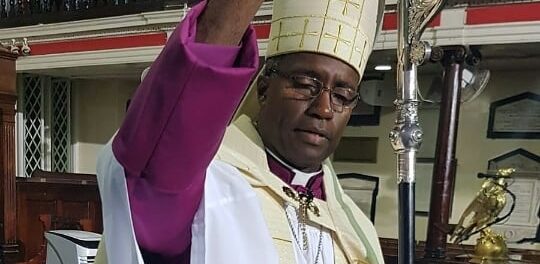
I refer to the Lord Bishop’s Charge to Synod on Sunday May 19, 2024, wherein his Lordship pontificated on the need for reparatory justice in relation to the exploitation of African humanity during the plantation system of slavery. I was taken aback, but pleasantly surprised. I thought something significant was going to happen. But I believe that his Lordship had superficially alluded to the Anglican Church’s involvement in the travesty. I listened to the delivery of his Lordship’s Charge with keen interest and bated breath, as though I were sitting on the edge of a pin or point of a blade expecting to hear at least a brief description of the joint criminal enterprise by the State, the White Plantocracy, and the Anglican Church’s exploitation of African humanity and how the Anglican Church intended to make reparation for the same. But alas! There was no cathartic moment that provided psychological relief through the open expression of strong emotions. No such thing was forthcoming from the mouth of the good Bishop. Neither were the members of the clergy so moved nor, for all I know, the congregants. I was disappointed. I was bereft. I had also noted that his theme for the said Charge was based on: “God’s Church for God’s Mission: Still Standing and Not Standing Still”. It would take an effective emoticon to convey the distress that I had felt at the end of that Charge on that night. It was a booming harangue that says little and offers even less in the way of reparatory justice.
My expectations were that the issue of reconciliation would have been discussed that involved the acknowledgement that slavery was a crime against African humanity. That the Anglican Church repented of its involved in the criminal enterprise. That as an institution that bases its doctrine with generous portions of morality that has profited from slavery, it would have had the profound courage, the moral fiber to acknowledge through the Lord Bishop that slavery as practiced in Barbados which the Anglican Church participated in was a crime against African humanity (UN World Conference Against Racism 2001; today one of the crimes under the jurisdiction of the International Criminal Court; “International Seminar tackles teaching about slavery.”
http://portal.unesco.org/education/en/ev.php-URL_ID=54784&URl_DO=DO_ Section=201.html)
The subtitle of theme for the Synod Conference is: “Still Standing and not Standing Still”, which suggests to me that there was a period of historical inertia which has now past, and the position has morphed into “the Anglican-Church-in-Action-on-fire-for-Christ’s-mission” in the world. However, this suggestion lacks veracity. The Anglican Church for the better part of its historical existence and in the present time has failed miserably to make any meaningful change in the social ordering of things, much less to be “on fire for Christ”. For example, its lack of contrition and penitence for its sins in participating in the joint criminal enterprise for the exploitation of African humanity for money.
The Church supported slavery and the slave trade for centuries. It has been historically established that the Anglican Church participated in centuries of systematic dehumanization, abuse, and exploitation of African humanity through which it had acquired wealth and prestige. The planters (many of whom were Anglicans) vehemently opposed the teaching of Christianity to their slaves because it made them resist their servitude. There was also the fear that to give the slaves instructions in the English Language will ferment rebellion because then they would be able to use a common language. As the late Dr. Eric Willimas wrote:
The Church obediently toed the line. The Society for the Propagation of the Gospel prohibited Christian instruction to its slaves in Barbados and branded “Society” on its new slaves to distinguish them from those of laity; the original slaves were the legacy of Christopher Codrington (William, E. (2005). Capitalism & Slavery (p.42). Kingston: Ian Randle Publishers).
The Anglican Church repeatedly betrayed its moral responsibility and its moral accountability to the ordinary persons who sit in its pews on Sunday mornings and ultimately to Yahweh. When the evidence is marshalled, you will find:
- that it is historically documented that Anglican Church was complicit in the ownership of slaves and sugar plantations from which it made approximately £5,000,000 per year ($17,500,000 in today’s money); slavery lasted for some 400 years, but I defer to the accountants and the economists to determine the quantitative benefit which the Anglican Church received;
- slave owners who were members of the Anglican Church refused the requests of slaves to be baptized because they understood the liberatory potential of Christianity;
- that the Anglican Church did very little or nothing to ameliorate the harsh conditions under which African slaves were forced to live but rather subjected them to inhuman and degrading treatment;
- that the Anglican Church branded their African slaves with a hot iron with the name “Society” (United Society Partners in the Gospel – the Anglican mission agency) to show that they were the property of the Church;
- that African slaves died regularly due to the harsh treatment meted out to them by the Anglican Church;
- that the wealth which the Anglican Church enjoys today together with its ownership of vast tracks of land, Glebe Land, which was bestowed upon it by the Crown for its cooperation and its profits are based on the shameful blood money from the exploitation of African humanity.
Therefore, whether the Anglican Church is “Still Standing” and “not Standing Still” or had stood still and continues to stand still for “donkey years” is debatable and by parity of reasoning, whether it has made any meaningful change(s) in the social order within the same period(s) is also up for debate.
However, the Lord Bishop had hypothesized that the Anglican Church is not standing still, presumably that is to say, it has been on the move. That may be so, but I do not see it, nor do I know of it. I cannot see it. The Lord Bishop failed to prove his hypothesis by citation of any evidence whether historical or current or anecdotal. One might even draw the inference and agree with his position, i.e., the Anglican Church has been on the move – only that it has been marching from nowhere to nowhere, quite unlike what took place on the Day of Pentecost (Acts 2:1-13).
To go back to the main title of the Theme for Synod 2024, “God’s Church for God’s Mission”. With respect to the good Lord Bishop, that begs the question whether God has any involvement in this activity in the Anglican Church. The Anglican Church partnered with the white planters in a joint criminal enterprise for the enslavement and exploitation of African humanity in exchange for land, money, and power in Barbados. Was this God’s Mission? Did God sanction these horrendous crimes against African humanity? If not, then it is imperative that the Anglican Church repent of its sins, its weaknesses and turn to Christ before it can fulfil its moral and civic responsibility to be the moral conscious of the social order. When this is accomplished then it can become the advocate for reparatory justice for the descendants of African slaves.
Beneficiaries of the Exploitation of African Humanity
The Anglican Church like the descendants of the white planters is the beneficiary of the exploitation of African humanity. The historical evidence shows that:
- the Anglican Church stood still while Africans were converted to property,
- the Anglican Church stood still while Africans were converted to chattel slavery;
- the Anglican Church stood still while African women, men and children were brutally whipped, had their limbs severed, women raped, African families were made dysfunctional or non-existent;
- The Anglican Church stood still while Parliament enacted laws that managed and created offences to keep African slaves subservient and tied to the plantations.
It is to be noted that the infamy of the Anglican Church is known throughout the world where there are indigenous people with whom the interlopers came into contact; they were dispossessed of their lands and condemned to servitude (see the decisions in Wi Parata v. Bishop of Wellington (1871) and Mabo v. Queensland (1992)), for example.
It is fair to say that through its bastardization of the Gospel of Christ and its betrayal of the salvific message of Christ, the Anglican Church made significant material gains and profits which it still enjoys up to the present time in the form of the Glebe Lands, for example. Glebe, also known as church furlong or rectory manor or parson’s close(s) is an area of land within an ecclesiastical parish which is used to support a parish priest. The land is owned by the Anglican Church, or its profits reserved to the church or its incumbent. This is a gift from the Crown.
Glebe lands have since ceased to belong to individual incumbents or churches. It is now vested in the Diocesan Trustees of the Anglican Church in Barbados and may have done so “without any conveyance or other assurance”. Because the Anglican Church came into ownership of these lands by the dint of its criminal participation in the joint criminal enterprise, equity would demand that the Anglican Church be disgorged of its ill-gotten profits that it has made from the exploitation of African humanity. But it is unlikely that that will happen. And I discuss why this is so below.
Glebe lands are currently occupied by descendants of African slaves who are tenants of the Anglican Church/Diocesan Trustees, and they pay annual rent to the Anglican Church/Diocesan Trustees for their continued occupation of Glebe land. In some instances, they continue to pay annual rent for many, many years and in several instances even after they had paid their portion of the purchase price under the Tenantries Freehold Purchase Act, Cap. 239B of the Laws of Barbados (TFPA) and while they continue to contribute to the Sunday monetary collection in the Anglican Church. So, the exploitation of African descendants by the Anglican Church continues in this form of landlord and tenants.
The Church is not Equity’s Darling, but it can Become Equity’s Lover
Given that Anglican Church’s hands are not clean and as such is not the darling of equity, it is obliged to demonstrate that it has repented and that it desires to make atonement for its sins in its joint criminal enterprise in the exploitation of African humanity with the plantocracy and the State. It can do so by expeditiously effecting the transfer to the qualified tenants on Glebe land their parcels of land by perfecting their title deeds, even where the Government is tardy in paying the subsidy to the Landlord (the Anglican Church). This would be a small demonstration that it has finally turned from its wicked ways and desires to make reparation for the wrongs that it had committed against African humanity. The Anglican Church/Diocesan Trustees can do so in full confidence that while Government’s payment of the subsidy is frequently slow in reaching its destination, the satisfaction of the cupidity of the Anglican Church, it can be assured that it will reach its destination in due course.
This would remove from the Church the charge that it has been standing still for over 40 years on the transfer of Glebe Land to legislatively qualified Tenants who have been tenants of Glebe land for most of or the entirety of their lives to the extent that many have since died and ironically, the estates of those deceased persons, many of them being faithful members of one or other of the Anglican Churches, can have the right to a transfer the said Glebe Land or plot of land on which they lived realized during their life time or inure to their descendants.
Demonstration of the Anglican Church’s Good Faith in Reparatory Justice
I have mentioned above the Glebe lands and the Tenantries Freehold Purchase Act, Cap. 239B of the Laws of Barbados (TFPA) because under the TFPA Glebe Tenantry falls under and is governed by that legislation. The TFPA regulates Tenantry Lands as defined in the legislation. The TFPA was enacted by the Parliament of Barbados under the Tom Adams Administration. This is an innovative and revolutionary piece of legislative measure which was created by that Administration. The aim of the TFPA is to give recognition and ownership of Glebe lands to the descendants of former African slaves who are recognized as the “qualified tenant” under the TFPA.
Briefly, on one hand the TFPA is a progressive piece of legislation, but on the other hand, in my considered opinion, its interpretation by the courts is retrogressive. I have formed this open because in the several decide cases, the courts have unanimously decided that Glebe land and other lands under the TFPA which the qualified tenant is entitled to purchase at “pepper corn” price do not form part of his/her estate that passes on testacy to his/her beneficiary or on intestacy to his/her descendants as per section 49 of the Succession Act, Cap. 249 of the Laws of Barbados. This view is fortified by several local decisions, to name a few. the case of Livingston Edgar Pinder and Hyacinth Pinder v. Michael Laurie Pile, Ivan Nathaniel Jessamy and Ronald Lewis, CV1307 of 2016. Carrington J. took an opposite view in citing Beula Adeogun v. The Registrar and the Attorney General No. CV 1413 of 2017/CV1778 of 2017 at [74]- [75]:
This Act is indeed very forward-looking and benefits qualified tenants who must be sold the lots by the owners. In order to ensure the constitutionality of the Act, it was specifically stated that it amends section 16 of the Constitution. That section protects property owners against deprivation of property except by or under the authority of written law.
The learned judge continues:
The Act is innovative and revolutionary in its application and impact such that many regard it as sacrosanct and inviolate, deserving of strict interpretation and application. In some quarters, it is regarded as a Special Act and indeed, Prime Minister said at page 4285 (of the Hansard Report), that “The Tenantries Freehold Purchase Bill, 1980, when enacted cannot be considered ordinary law since it was passed by the special requirement of the Constitution, that is to say, in the manner and form prescribed therein”.
Therefore, by this innovative piece of legislation one can argue that the Government of Barbados has moved towards the principle of reparatory justice on its side. The descendants of African slaves have been given the possibility to own a parcel of Glebe Land.
However, it is to be noted that the drawback to this innovative piece of legislation is that, as the courts of have pronounced several times over, Section 4(1) of the Tenantries Freehold Purchase Act Cap 239B does not operate to transfer the right of purchase to the estate of a deceased person: Pauline King v Anthony Wiltshire BB 2018 HC 14. This is the retrograde interpretation of the Courts. Of course, I disagree. This means that, if the qualified tenant dies without obtained his/her title deeds to the land, the landlord, in this case, the Anglican Church, can sell it on the open market for market price. This would no doubt place the descendants of the qualified tenants, many of whom are poor people at serious disadvantage. Bearing in mind, of course, that at the demise of the qualified tenant, it will take one or other of the descendants of the deceased (previous) qualified tenant five years post his/her demise to qualify as the qualified tenant. In the meantime, the landlord (the Anglican Church) is free to dispose of the land as it deems fit in its sole discretion.
However, to obviate the negative impact of the adverse interpretation of the TFPA on the qualified tenant’s estate, the Anglican Church/Diocesan Trustees can decline to assert its strict legal rights against the qualified tenant’s estate because as the landlord (the Anglican Church) for the Glebe lands, it lies within its power to take the position that it will sell the land to the descendant that is next in line to inherit on testacy or as per section 49 of the Succession Act, Cap. 249 of the Laws of Barbados, despite the fact that the case law allows it to so disregard the qualified tenant’s estate. The pertinent question is whether the Anglican Church or the Anglican Diocesan Trustees would condescend to this suggestion in the interest of reparatory justice. The Anglican Church is yet to move in this direction, but I think it is highly improbable because it is not serious about reparatory justice, but only to satisfying its own cupidity; this is far more important than any such reparatory justice.
My foregoing position is based on the fact that when considering the current modus operandi of the Anglican Church, as Landlord, that is to say, under the TFPA, that if a “qualified tenant” pays his/her portion of the purchase price as is permitted under the TFPA (and the Government is tardy in paying its portion of the purchase price), the qualified tenant is obliged to continue to pay rent to the Landlord (the Anglican Church) as his/her Landlord despite having paid his/her portion of the purchase price. The pertinent question is whether this modus operandi is fair and equitable to the qualified tenant.
I would dare to suggest that the Landlord, the Anglican Church/Diocesan Trustees, consistent with its effort to satisfy its participation in reparatory justice as it has publicly declared:
- it can refrain from continuing the acceptance of the payment of rent from the qualified tenant after s/he has paid his/her portion of the purchase money;
- it may wish to forego its strict legal right to demand payment of rent in these circumstances based on its touted commitment to morality and ethical behavior that is above reproach;
- it may refuse to assert the position taken in the secular courts and go with the person who is entitled to take the estate pursuant to section 49 of the Succession Act, Cap. 249 of the Laws of Barbados, or
- the person(s) who is agreed by all the beneficiaries of the estate of the deceased qualified tenant on who should take the conveyance.
The foregoing the Anglican Church would willingly do despite of and contrary to the decision in Coral King v Ena Payne (by her Administrator ad litem Roderick Robinson) CV 712 of 2012 that the TFPA does not create any other rights for the qualified tenant and as such rent may have to be continued to be paid until the government pays the subsidy amount and the conveyance is perfected.
Further, it can disregard the position, according to a stack of first-instance decisions, that have unfortunately decided that the right of the qualified tenant to purchase the lands subject to TFPA is personal to the qualified tenant only and so cannot form part of his/her estate. This is the jurisprudence that is seen the cases such as Livingston Edgar Pinder and Hyacinth Pinder v. Michael Laurie Pile, Ivan Nathaniel Jessamy and Ronald Lewis, CV1307 of 2016 citing Beula Adeogun v. The Registrar and the Attorney General No. CV 1413 of 2017/CV1778 of 2017, Rawle Anthony Jordan (Administrator and Personal Representative of the estate of Ursula Jordan et al) and Belfield Company Ltd v. Lionel Riley’s Holding Inc No. 1267 of 2005, Coral King v. Ena Payne (by her Administrator ad litem Roderick Robinson) CV 712 of 2012.
The Anglican Church, as a non-secular organization, can share opinion with me that the jurisprudence as enunciated in these cases, in my view, has taken the unfortunate position that the right to purchase by the qualified tenant is not an interest in land that can form part of his/her estate. Therefore, at the death of the qualified tenant, the land reverts to the owner (the Anglican Church/Diocesan Trustees) who may be able to sell it at market price in the absence of a qualified tenant. The Anglican Church/Diocesan Trustees can make a difference here as part of its touted interest in reparatory justice efforts by refraining from asserting its strict legal right in the instance when the property reverts to it for sale on the open market.
Such a move would be consistent with this innovative, revolutionary piece of legislation and so avoid the egregious effect on the estate of the qualified tenant as exemplified in the aforementioned cases.
Furthermore, this may be treated as an open invitation for Parliamentary overruling to reverse this effect. Otherwise, the decisions may remain in perpetuity. For while the aforementioned decisions were made at first instance, other High Court Judges, while not obliged to follow them, may feel constrained by judicial comity to follow them. It is highly probable that the Court of Appeal and the Caribbean Court of Justice may also follow the jurisprudence that has been established in this line of cases. However, the jury is out on that.
My Hypothesis
My hypothesis then is, where the qualified tenant at least becomes ‘part owner’ of the land his/her having paid his/her portion of the purchase price, should not the Anglican Church as a show of good faith and reparatory justice expedite the transfer of the parcel of land while it awaits the Government payment of the subsidy?
Section 4(1) of the TFPA stipulates that, “notwithstanding any other law or any term or condition of any lease, contract or license relating to tenancy, it is a term or condition of every tenancy within a plantation tenantry or other tenantry that the tenant, as of right and at his/her option may, if he/she is a qualified tenant, purchase the freehold of the lot of which he/she is tenant at a price to be determined” according to the relevant provisions of the Second Schedule. Hence, giving the qualified tenant the right to purchase the property.
Furthermore, section 10(5) provides that where the tenant gives notice of the intention to purchase, it becomes the duty of the landlord to convey the freehold of the lot to the tenant at a price to be determined pursuant to section 4(1).
However, it is prudent to note that section 10(7) states that the qualified tenant must pay the purchase price in full at the time of the conveyance except where alternative arrangements have been made as between the qualified tenant and landlord. In this regard because the Government is frequently tardy with the payment of the subsidy, the conveyancing process is usually stalled for many years and the qualified tenant is effectively kept out of full ownership of the land while he continues to bleed rent year after year. Here is where the landlord, the Anglican Church, can demonstrate its good faith that it wishes to make reparation for its role in the exploitation of African humanity and arrange to transfer the ownership in the land to the qualified tenant pending the Government’s payment of the subsidy. Bearing in mind that the Government’s tardiness is not that of the qualified tenant’s making.
The TFPA does not prevent the Landlord, the Anglican Church, from contracting out of it, so alternative arrangements can be made as between the qualified tenant and landlord. That is to say that the Anglican Church would not seize the opportunity to deny the qualified tenant’s entitlement to purchase even although he may be disqualified under sections 10A and 10B which speaks to the qualified tenant’s failure to complete within the 3-year period which may cause his right to purchase to cease to operate. This the Anglican Church would do to demonstrate its good faith and commitment to reparatory justice.
The Anglican Church would willingly do the foregoing today because we are disciples of Christ. Here the leaders of the Anglican Church, as good Christian people, are reminded of the lessons which Christ taught in the Sermon on the Mount, when the disciples of Christ sat at his feet listening to him as he taught them how to approach God’s law. In each case, Christ spoke of going beyond the letter of the law to its intent, discussing the spiritual dimensions of commandments such as those prohibiting murder and adultery (Matthew 5:21-48). At one point in this extensive discussion, Christ told his followers that when someone “compels you to go one mile, go with him two” (verse 41). I am saying that the Anglican Church can go the extra mile to secure its redemption in the eyes of Christ and his Church.
A Policy Position: An Opportunity for Redemption
Therefore, herein lies the opportunity for the Anglican Church or the Trustees of the Anglican Diocese, as the Landlord of the qualified tenant(s), to demonstrate that it has taken a genuine position that it desires to participate meaningfully in the cause of reparatory justice and to rebut claims of its historic disingenuity in its several declarations. As the words of Saint Paul cautions the Anglican Church and all of us: “Though I speak with the tongues of men and of angels, and have not charity, I am become as sounding brass, or a tinkling cymbal” (1 Corinthians 13:1). This Scripture may be reinforced by what my granny used to say: “Charity begins at home.”
This proposal can be translated into a meaningful policy position of the Anglican Church/the Diocesan Trustees, as the Landlord of Glebe lands:
- that on the payment by the qualified tenant or the estate of the qualified tenant’s share of the purchase price to the Anglican Church/Diocesan Trustees, the Anglican Church/Diocesan Trustees prepare the transfer to the qualified tenant or the qualified tenant’s estate (in escrow) while it waits for the payment of the Government portion of the purchase price which is guaranteed;
- that the Anglican Church/Diocesan Trustee will not assert its strict legal right to seize the opportunity to deny the qualified tenant and/or his/her estate the accommodation to acquire the parcel of land pursuant to TFPA;
- that the Anglican Church/Diocesan Trustees will do all things necessary to perfect qualified tenant(s) title deed.
Such a worthy policy position would endear the Anglican Church to its members and a fitting and proper demonstrations of its metanoia, and its genuine repentance for its part in the joint criminal enterprise with the white plantocracy and the State in the exploitation of African humanity.
You should note well that the Church is being taken over by secularism because its adherents have become so woefully disillusioned with it and its moral authority has been badly damaged. The booming harangue on a Sunday morning coming from the pulpits has little effect on the people sitting in the pews. They seem to be saying to you: “damn your precepts – leads us by example”.
This is my witness: “And in God’s house forevermore, my dwelling place shall be” (Psalm 23:4).





The blogmaster invites you to join the discussion.