



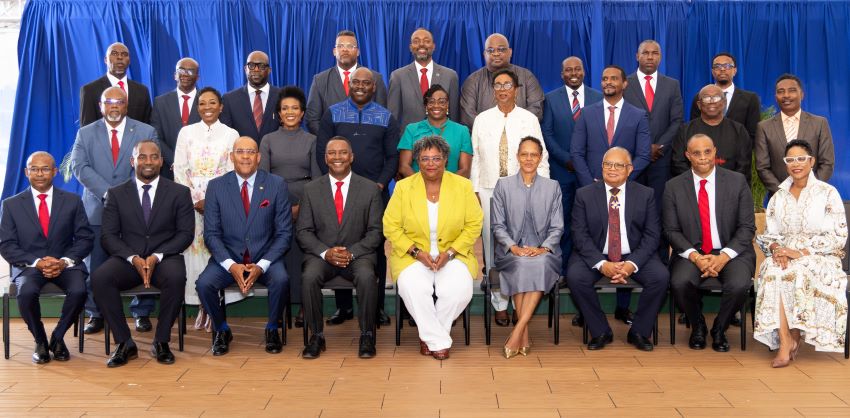
The Caribbean Development Bank (CDB) recently held its 44th Annual Meeting Board of Governors in Guyana. The closing statements of CDB meetings in recent years have all listed the concern about high debt ratios of Caribbean countries and 2014 is no different. The theme of the CDB conference this year, Unlocking Opportunities for Competitiveness and Growth, the Role of Energy. On cue the President of CDB Warren Smith quoted in the closing statement for 2014, “Our anaemic growth performance is further manifested in widening fiscal imbalances; high debt ratios; and declining levels of foreign exchange reserves”. Smith’s observation should not surprise because ALL Caribbean countries with the exception of Trinidad has accumulated significant debt in the last decade both domestic and foreign.
Chairman elect of the CDB Board of Governors Prime Minister, the Rt. Hon. Dr. Denzil Douglas of St. Kitts and Nevis in his closing statement urged the CDB to act as a greater catalyst for faster change and adaption in the Caribbean. One suggestion he made is for CDB to expand the use of policy based loans (PBLs). While this type of loan, by its design, is important for developing countries to access: “fast disbursing loans to strengthen institutional and policy environments”. If it walks like a duck and quacks like a duck it is more debt Prime Minister Douglas has requested the CDB make available to regional governments. Given our high debt ratios acknowledged by the President of the CDB one wonders where do Caribbean countries make the jump to prosperity given the current state of regional economies.
At the household level there is an appreciation to what high debt does. This appreciation should guide how politicians who manage households accrue public debt but corruption and inefficient use of public monies through the years have forced debt ratios in the region upwards. At a seminar convened recently in Barbados Ron Salole, deputy chairman of the International Public Sector Accounting Standards (IPSAS) Board made the observation:
One of the key indicators of fiscal health is . . . net debt. Net debt is the money the Government is going to have to find in the future, and . . . if you look at all the Auditor General’s report, he makes a very clear statement that net debt is going up and has increased significantly.
So if you want to tackle [the fiscal deficit] you need to inform people about what the net debt is, how it’s increasing and how it needs to be managed. I sense that the Auditor General is getting frustrated because immediately after his report is issued it dies down and nobody then picks it up again. But he deals with it very, very well in his report and for my jurisdiction, which is Canada, that was one of the ways which we had to tackle our deficit.
Salole said what Barbados was doing was akin to “borrowing from your kids. You are going to give them some real difficulty around their necks for future generations” – Nation newspaper
Many commentators including BU have been highly critical about the lackadaisical approach to managing public debt over the years. Instead we allow the debate to be derailed by partisan political positions. Sadly future generations will have to pay for our short sightedness but what do we care.
To compensate for the lack of ‘fiscal space’ created by high debt profiles, regional government including Barbados have turned to grant financing. If we accept that grant funding means non repayable funds it begs the question – what are the conditions attached when grant funding is received from a country or other entity. Recently Minister of Foreign Affairs Maxine McClean at a function to remove visa requirement for Chinese entering Barbados identified 11 projects awaiting approval from China, we assume to access grant money. BU has no issue with building relationships with other countries to open avenues for mutual benefit, we do it with the UK, USA, Canada why not China? The issue for BU is, if we are using grant financing as a compensating strategy because of bad fiscal management over the years, is this a sustainable approach and what is the price we have to pay China, eventually.
Should the citizenry be concerned by regional governments fraternizing with China? BU is unsure however we are aware that we should be wary of Greeks bearing gifts. It is ironic that we have a DLP government in office who is should be familiar with the foreign policy approach guided by “we are friends of all, satellites of none…




The blogmaster invites you to join the discussion.