Banner promoting anonymous crime reporting with a phone and contact number 1 800 TIPS (8477), featuring the Crime Stoppers logo and a QR code for submitting tips.

โ† Back

Your message to the BLOGMASTER was sent

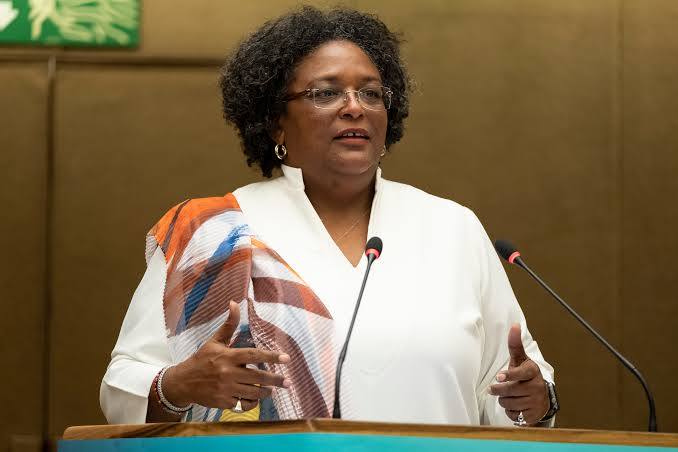
Leader of the Opposition Mia Mottley
Leader of the Opposition Barbados Labour Party Mia Mottley
Mr. Harold Hoyte is a founding member of the Nation Group and is President and Editor-in-Chief of The Nation Publishing Company in Barbados.
Harold Hoyte Editor Emeritus of The Nation Publishing Company
Lindsay Holder, former Chairman of the BAMC
Lindsay Holder is a former Chairman of the Barbados Agricultural Management Company Limited

Over the last couple years BU has articulated, we hope dispassionately, on the issue of the open immigration policy which was practiced by the previous government. At no time have we supported xenophobic behaviour or bigotry in the ensuing discourse. We have simply held a position that while Barbados should be committed to its obligations under the Treaty of Chaguaramus, it does not mean that our borders should be assaulted by all and sundry seeking the proverbial streets lined with gold at the expense of the vision which Barbadians have held-up for itself through the years. BU readers can do a search using the keyword โ€˜immigrationโ€™ to access the many blogs posted on this subject.

The conspiracy which has emerged across the region to spin a false position in response to Prime Minister David Thompsonโ€™s Ministerial Statement after he announced an amnesty for CARICOM nationals, has been blatant and symptomatic of a political and social immaturity.

Any interested observer of regional affairs would conclude that the issue of immigration is a topical one. Since the announcement by Thompson of the amnesty the issue has become accentuated. In the Advocate Newspaper of 14 June 2009 a Mr. Lindsay Holder was as clear as anyone can be in elucidating on the immigration issue which Barbados and the region is currently battling, he did so without the use of jargon, fuzzy logic, ideological or jingoistic biases. We highly commend the Advocate Newspaper for giving voice to this important issue which is being manipulated by politicians, academics, Fourth Estate and prominent and other influential persons in Barbados and across the region.

As the popular saying goes we will probably not agree with the many persons who submit articles to be published on BU, but we will always defend their right to be heard. In recent days BU in this vain would have published two submissions by George Braithwaite, a PhD Candidate in International Politics researching the topic of immigration in the region.

In the Sunday Sun of 14 June 2009 the headline Bad Rep, the Opposition Leader of Barbados Mia Mottley was highly critical of the Barbados governmentโ€™s new immigration policy. She suggested that Barbados isย  likely to suffer a backlash from some Caricom members as a result. The point which continues to elude Mottley is the fact that managing our borders is a matter of sovereignty and MUST not be dictated by those who themselves have done a muck-up job of managing their own countries.

Increasingly in recent weeks one of the characteristics which defines an American has beenย  been flickering in the minds of the BU household. The best definition we could find of what it meansย  to be an American is an unswerving support and devotion to our flag, our elected officials, our men and women in uniform. For others, patriotism means criticizing politicians when they take America in the wrong direction, protesting in the streetsโ€”sometimes even burning the flag. Patriotism also has complex ties to citizenship, race, and nationalism, as well as to the ways in which we remember our wars and the people who fought in them โ€“ University of Chicago.

Barbados for all that it has accomplished, and which has led to it being considered the island of opportunity in the region, has been allowing slowly but surely, a conspiracy by some to take root to undermine the Bajan success. The issue which Barbados faces is not honouring its obligations under the Treaty of Chaguaramus, but one of ensuring that it effectively manages the country in the way that it has successfully done in a post-independence era.ย  Many of the countries in the region who are crying foul of the new immigration policy i.e. Guyana and St. Vincent would do well to use Barbados as a model to their own revival of political and economic fortunes.

The two stakeholders in Barbados we are most disappointed are the Opposition Barbados Labour Party and the Fourth Estate. In the face of a regional conspiracy to undermine the reputation and goodwill of Barbados which was built under the astute management by successive governments, we have a situation now where for political expediency the government in waiting is safeguarding it legacy by confusing the illegal immigration problem faced by Barbados by masking its position in the known challenges of implementing a political and economic union. In another place BU used the analogy that if CARICOM/CSME were a regional company its profitability would hinge on an efficient implementation of aย  vertical integration strategy. CARICOM conversely has not done enough to strengthen and harmonize key institutions and procedures.

The Fourth Estate in Barbados has aided and abetted the vulnerable position which Barbados now finds itself by being unpatriotic in the positions is has taken, the Nation Newspapers and Voice of Barbados the main culprits. The media in Barbados has been generous in giving a voice to an anti-government sentiment concerning the immigration issue. The populist view in Barbados is a commonsense view that the previous governmentโ€™s position of allowing unskilled people whether from Guyana, Jamaica and elsewhere is untenable. Even the other ethnic groups from Europe and China have come under the microscope. Talk show host Dennis Johnson always uses the example that all are welcome to Barbados but it must be done under agreed terms. In other words if you are invited to someone’s home one still needs to knock on the door and remain seated in the sitting room before being invited to the bedroom. After all it is our home and respect and common courtesies are due!

The fact that our Fourth Estate in Barbados gives a generous voice to Rickey Singh, who continues to bite the hand which has fed him for so many years, and not give EQUAL voice to other views which represent ordinary Barbadians is disgusting. Bare in mind that Singh has not used his pen to expose the atrocities currently at play in Guyana.

The fact that the Fourth Estate ignores the hatchet job being done on the good reputation of Barbados by Singh, Saunders et al who are syndicated columnists and remain passive to respond is an indictment on their duty to accurately report the views of ordinary Barbadians who are its supporters.

The fact that the Guyanese media has been freely publishing articles which are unfairly critical of Barbadosโ€™ immigration policy with no response from the Barbados media except to cherry pick those opinions which support narrow political views is hypocrisy of a high level.

The fact that the media in Barbados continues to blackout reporting on the political and racial tensions in Guyana which have spurred an exodus of Guyanese to swarm the smaller Caribbean nations to the North is journalistic dishonesty.

The fact that the media has ignored the commonsense concern of ordinary Barbadians that learned behaviours derived in a Guyanese environment rifted with racial conflict may pose issues to the stable host population of Barbados is ignorant.

The fact that the Fourth Estate and the Opposition Party of Barbados led by Mia Mottley sit passively and allow Jagdeo to cherry pick the issue of immigration to undermine the earned good reputation of Barbados is unpatriotic. The known political and racial conflict in Guyana and the accommodation of unsavoury people like Roger Khan et al which have been left silent represent a betrayal of Barbados and a usurping of their core responsibilities.

The Chairmanship of CARICOM will be passed to Jagdeo in July, he will without a doubt use tit o promote his narrow interest.ย  It maybe the last straw which will break the backย  and or setback the regional initiative of CARICOM and the CSME.


Discover more from Barbados Underground

Subscribe to get the latest posts sent to your email.


  1. No Scout, comments were directed at anonymous.

  2. livinginbarbados Avatar
    livinginbarbados

    @David

    Clearly the media can perform its core function whether it is commercial (profit-oriented) or public, but what it gives the public needs to be seen in the context of commercial operations needing to be profitable, and public operations being constrained by the limits put on it by government (both financially and politically). Hope that’s clear.

    The Nation editorial today (“Immigration policy deserves support”, see http://www.nationnews.com/comments/editorial/wedn-editorial-june-17-copy-for-web) makes interesting reading when considering your comments on VOB. It reads somewhat like some copy I have seen elsewhere recently.

    That said, we have had a discussion about how corporations should be responding to the recession in the context of reported layoffs in Barbados by the OMG set up. Hence my bread and butter remark.

    More important to me is that you know that a particular media organ has a stance/bias. Then you know what you are dealing with.

    Immigration policy deserves support

    Published on: 6/17/2009.

    A price worth paying. – Norman Lamont.

    IN THE FULLNESS OF TIME Prime Minister David Thompson will be gratified by the timeliness and rightness of his recent immigration policy. As leader of a country, already among the most densely populated in the world, it could not have escaped his attention of the need to ensure employment for Barbadians was a priority.

    It is therefore surprising to hear comments of dissent and disagreement, supposedly based on moral and humane grounds, that the new policy was “despicable, offensive and xenophobic”, coming from the mouths of CARICOM nationals.

    Every country has at some time or other relaxed or tightened its immigration policy according to circumstance and need. There is no doubt that Barbados, given its rating as a developing country, its record of political stability, its known high standard of education, enlightened workforce and standard of living, has been seen as an object of admiration, not only regionally but also globally.

    It is little wonder that it has proved so attractive to sundry persons who seek to take up residence here legally or in more recent times, undocumented. Ours, a country lacking in natural resources, except for its people, given the harsh economic times prevailing, could hardly sustain an unmanaged immigration policy without inflicting on itself certain ravages.

    These include housing shortages, insufficient school places, an overstretched medical facility, declining wage levels, the threat of corruption and a disturbance of the existing equilibrium among races, a hallmark of Barbadian life.

    Of special interest is the fact that neither the disastrous Federation nor CARIFTA nor CARICOM has been able to forge a union of citizens based on freedom of movement.

    Few, if any, can deny Barbados’ purposeful and exemplary stand in its support for Federalism, regionalism and an unquestioned commitment to regional institutions, such as the Regional Police Training Centre, the CCJ, CARICOM Secretariat, the Regional Security Service and LIAT.

    Despite the foregoing, some still find it satisfying to label our country as heartless and inhumane merely for doing no less than what the European Union territories have to secure their separate economies.

    The United States, Canada, England, Australia, Bermuda and The Bahamas have always protected their shores from “open door” migration. Citizens of the Caribbean have faced expulsion and deportation without similar outcries from those who now consider it their duty to protect the “rights” of undocumented migrants, as though such exists.

    We say now is the time for all men to come to the aid of country.


  3. A member of the BU household almost feinted upon reading the Nation editorial!

  4. livinginbarbados Avatar
    livinginbarbados

    @David,

    I look forward to hearing some radio reactions later.

    I’m not going to take issue with its arguments, but would like someone to make the logical connection for me between its saying that Barbados is “among the most densely populated in the world” and “the need to ensure employment for Barbadians…a priority”


  5. See the story in starbrok news about guyanese being deported.

    I get the distinction impression that starbtork newspaper is trying to fan the flames of hostility against barbados and is keeping this issue alive with a column every day.


  6. David

    you should direct your request to Bush tea. By his “logic”, since there are many Bajans living in other countries this would suggest that Barbados is “brek down”!!!

    I also find as a nonsense the charge that the BLP is unpatriotic! One may disagree vehemently with the position of the BLP without resorting to such baseless but emotive sentiment. This last refuge of despots only serves to divert attention from all possible ramifications (real or imagined) of policy decisions.


  7. Anonymous @8.20 a.m.
    I made a comment to that newspaper a few minutes ago and immediately the link developed technical problems. I was just telling a blogger that instead of criticising my government for regularising their immigration, guyanese should be investigating why its citizens are fleeing that country. Guyana, properly governed, should be the one putting policies in place to control migration to that country because of the potential of that country through its natural resources. I think it is time guyanese start calling their government to account for its mishandling of the country. I sympathise with the guyanese people, especially the blacks but Barbados and indeed the other countries in the region cannot allow the guyanese situation to pull them down too. With good management, guyana can rebound but if most of these other countries slip, the fall is going to be hard and long. We here in Barbados have worked too hard to bring this little “big rock” to this stage and it would be folly if we allow parasites to come in a devour our gains through personal greed.


  8. Scout the same thing happened to me earlier to when I made a comment about guyanese behaviour.


  9. I heard Jagdeo on the radio telling persons that the Sugar industry will collapse if they dont pull together ….. He went on to say that he was willing to defend all Guyanese in this time of need!

    All I can say is that Jagdeo is a FAILURE!

    Why LIB, J, Anon and company deal with that! Silly nitpicking lot!


  10. ‘…… my government would outlaw the rental of rooms, as has been the pattern in Barbados over the last 10 years or so.’
    ______________________________

    Scout, tell the Bajans who will lose what maybe their only source of income, not me, as I am not in the rental business.

    This outlawing includes the rental of ROOMS in Husbands, Wanstead, Oxnards etc to UWI students as well?

    The practice of renting rooms is nothing new and is prevalent in metropolitan cities and university towns. It caters to immigrants, guest workers, students etc.

    Some of the same users of this site who are immigrants in other people’s countries may have, or knows someone who have, experienced the concept.

    The issue is regulating the conditions under which such rooms must be rented, not the elimination.


  11. @Bush Tea…….You my cerebral brother, has been blessed with an overdose of basic commonsense which is a deficiency among the economists & other phdicks. You along with that patriot Negroman and all the others continue to fight the good fight until I get back there. I give my support to the economy in another way.


  12. Enuff
    Everything is not about dollars /gain. It is also about being healthy and security. Imagine a simple wooden 3 bedroom house being sub-divided into 6 bedrooms with people vertually sleeping head and tail on a 3’6″ bed. In some cases 20 and over persons living in a house designed for 6 persons. This is a fire or a catastrophy about to happen


  13. @Anonymous………..There are too damn many people/invaders/interlopers in Barbados who are just natty for the opportunity and because they are running from ‘shitty’ governance. They find a ‘bed well made’ and they don’t give a damn how it was made, they just want to lay in it. Ya crazy! Rout them out! Ya’ll tek Bajans for granted that why the shit got out of hand. Bajans need to wise up and stop giving aid and comfort to the enemy. And FYI, I have children and they have already insisted that they too, want land in Barbados and they are so entitled to it because their parents, gand-parents and foreparents toiled and tilled that soil. So they have more claim to that inheritance than these clanish parasites.

    @@LIB……..”The contraction of credit (and cash money/visible money has not declined) is a consequence not a cause. It reverses bad decisions, namely lending to those who have who have borderline or bad credit ratings and should not have borrowed in the first place, and are clearly less likely to re-obtain credit even with inflated rates of interest.”

    If you are truly teaching this hogwash at the graduate level, you are part of the problem. It is so easy to blame this problem on the ‘little’ people when the real blood-suckers are just draining the life-blood out of the economy. The contraction of money (both visible and invisible) is the CAUSE of this financial bloodbath today. Nothing else. I hope that the GOB is not paying you a fat cat salary to disinform and mislead.

  14. livinginbarbados Avatar
    livinginbarbados

    @Hopi

    You have a particular mindset. I did not mention little people (most of whom do not borrow), and often it is not small borrowers who bring down down lenders. If a financial institutions lends to someone who cannot really repay (or put another way, makes a dud investment), that’s a bad decision and the financial institution will suffer for it and all such decisions. That applies if you are Joe Blow or if you are Russia, or CL Financial.

  15. livinginbarbados Avatar
    livinginbarbados

    @Hope

    “I hope that the GOB is not paying you a fat cat salary to disinform and mislead.”

    Sorry to disappoint, but I work for no one and for no pay.


  16. @Enuff,

    “Scout, tell the Bajans who will lose what maybe their only source of income, not me, as I am not in the rental business. ”

    Sorry, but I think you have to make up your mind on the immigration issue. If there are too many Guyanese here, then something has to give. To allow people to pack Guyanese like sardines in houses so they can get the most for the houses without having to repair them etc. is to encourage slavery and human trafficking, but worse of all it is to encourage the existence of substandard housing in Barbados, which we have spent the last 20 years trying to eradicate.

    I am sure that up to this week in the news, we heard of how UDC and RDC are embarking on the construction of houses to ease the housing situation in Barbados. Does it makes sense to be doing this and in another breath allowing new cases to spring up?

    You see, a lot of the people now renting rooms in houses will probably be the same ones, after their guests have worn out their houses, that will seek out the UDC or RDC to repair them, after getting the windfall from the houses that you speak of and not repairing them.

    Let them get Bajans to rent from them and help ease the housing situation in Barbados too… but you know what, a Bajan is not going to pay what the Guyanese paying or live under the conditions that a Guyanese would for that money.

    This means that the spin off from this activity is less housing for Bajans and more problems for Government. There are some cases where the national good has to take precedence over what I call greed, because it is not need that drives these landlords.

    Finally, Tom Adams did it. He brought a law which may very well be still on the statutes books (but relaxed by the Ministry of Finance) which made every Landlord register their rental properties and he controlled them from there. I must say the policy ran into a few law suits which the Government lost, but that is because he tried to go too far with it. You see, it was also designed to give tenants rights and this is where the complication set in, but the point is you have to know how to use the law to regulate.


  17. @ rok i like how you is think


  18. @LIB…….”You have a particular mindset” Can’t I say the same for you, even though you and I are separated by day and night? And if we all have brains in our heads, I think that we all have particular mindset, albeit, some more indoctrinated to think according to the ‘values’ of the establishment than others.
    When the ‘shit started to hit the fan’ the first people to blame were ‘sub-prime’ borrowers. Isn’t that so? And who are sub-prime borrowers? Who were sold a ‘bill of goods’ only to realise that they paid for ‘pigs in bags?’
    And since it is not small borrowers who bring down big lenders (according to you) why place the blame in the ‘sub-prime’ area? Who is it that cannot really repay? The ‘big’ guy or the ‘little’ guy?

    And to you not working for/paid by anyone, I say God bless Barbados, because that would be money that could go to the pensioners….you know those old people who built up Barbados to a point where you can now go and live big and free.
    J’ca has mucho problems too, how are you helping them out?

  19. livinginbarbados Avatar
    livinginbarbados

    @Hopi

    I will labour under my illusions. To me (indoctrinated as I am) it was not subprime borrowers who thought they were sold ‘pigs in bags’, but subprime lenders who pretended that they had a ‘bill of goods’ which they passed on to others (seeking to make another buck), who then found they were holding ‘pigs in bags’. Then the party got sloppy.

    What I know about how Barbados has developed (which has come to me mainly from old Barbadians here and abroad) is the following. That the country exported a lot of its people over a long period of time (famously to Panama, other Caribbean islands such as The Bahamas, the UK, US and Canada; some of these I have met in those places, and I have not asked them why they have not returned to Barbados and wont speculate other than they have built lives abroad), who mainly did well and sent back a good amount of their income to support their families. The country also imported a lot of labour (mainly from nearby islands such as St. Vincent, but also Jamaica, and from countries like Guyana), to do work that Barbadians ‘said’ they needed doing but did not want to do themselves. Put simply, Barbados has not developed simply because Bajans did x or y: there was a lot of interdependence (there I go again with my indoctrination).

    As for living big and free, I would like to think that the money I saved when I worked for an employer was meant to give me support then and later in life. I am not sure how I am living free, given that I do not steal the goods and services I consume in Barbados, but pay the prices that are asked, VAT and excises included. Perhaps I should try the ‘free’ route and not pay; I certainly try to consume less because the prices are pretty high and as I consume few public services I wonder if my tax paying is value for money. But, I have to try to be the good citizen, and do the decent thing.

    Helping Jamaica? I’ll get into that when BU posts on that subject. Don’t want to abuse more of David’s time here.

  20. livinginbarbados Avatar
    livinginbarbados

    Indoctrinated as I am, I am for law and order and accept that dealing with illegal and legal migration is each country’s sovereign right. Hopi’s remarks about “those old people who built up Barbados” has set my mind rolling. As I know, those old people were not all Barbadians. It’s also the case that older Barbadians got to where they are now by not building themselves up in Barbados, some even found non-Bajan partners in their new foreign homes (some married into my Jamaican family, some married into my wife’s Bahamian family), decided to stay abroad and helped those of their families still in Barbados if they could.

    For decades now Barbados has seen the opposite in operation, with migrants coming here.

    All of that is to say what? Clearly, the demographics of the country has changed and clearly there are those who do not like that. Being a very small place, those changes can be more easily noticed. But one question I have, is whether there is really an issue about illegal immigration or about immigration generally, and if the latter, its composition.

    I know nothing of the make up of immigrants in Barbados, but pose this question. What would be the national reaction if the illegals who DO NOT REGULARISE are mainly Afro- in ethnicity, but those who DO REGULARISE are not (let’s cite Indo- in ethnicity, to make the issue simple)?

    In the UK, when immigration issues were boiling in the 1950s-70s, the matter was clear: those who did not look English were the problem, with their different lifestyles, the pressure on wages, etc. No matter that they were mainly legal. As the UK moved into EU integration, the issue became more complicated. Yes, “send the blacks and Indians back” was still a mantra, but it was also clear that many people had issues with ‘undesirable’ foreigners in their midst: undesirable meaning anybody that was not liked. So, European migrants such as Poles, Serbs, Spaniards, Greeks, Lithuanians, and more, have now become the focus of the migration issue.

    The UK and Barbados are vastly different, and anwhere else can be substituted, but people’s reactions to immigrants is very similar.

    Just food for thought.


  21. Truth is I have a problem with how most indo-Guyanese think and behave.

    The ones i know have been raised in a country far different from Barbados in culture and behavior. I don’t have a problem with their culture in fact i like to sample new things from new cultures when i can, as Barbados being such a young state, basically has NO culture.
    (+ i love curry)

    Fact is that people that have foundmade something that’s working don’t just up and leave it, so immigrants will always be people looking for greener pastures. More importantly immigrants will always be people leaving their host countries because it is viewed as undesirable.

    What i think is the problem is the average indo-Guyanese behavior gives the impression to the Barbadian (whither, Black, White Chinese or Indian) that the same results archived in their home land will be duplicated on this soil if the indo-Guyanese population becomes large enough.

    The Barbadian instinctively and collectively knows that such a small land mass is incapable of handling that type of behavior, it just too small, the rebuilding process would take forever.

    Therefore we seek to keep the peace that allows Barbados to focus on important issues, the average Barbadian may appear docile by comparison, but that is what is required in the demographic. Where elese could you find two different political party supporters in a rum shop on election day cussing each other while pouring out the same rum bottle.

    The above example is to show the love for country is what drives the Barbadian not the love for who is controlling it, another example that comes to mind is a law passed in Antigua (not sure) that states a government cant be in power of 4 terms, (correct me if i am wrong) With the current mindset in Barbados a government will never get 4 consecutive terms it’s too much power and power corrupts.


  22. LOL well the day after election as rum dont sell on election day

  23. livinginbarbados Avatar
    livinginbarbados

    @Ready-Done

    Clear where you stand on Indo-Guyanese. Thanks for that frankness.

    I would take issue with “Fact is that people that have foundmade something thatโ€™s working donโ€™t just up and leave it, so immigrants will always be people looking for greener pastures. More importantly immigrants will always be people leaving their host countries because it is viewed as undesirable.” Look at the Jewish experience, for instance, or that of any group that is targeted and then expelled from a country that they felt was their own. Look also at the experience of those who left Europe to colonize the Americas. Many were forced to leave for reasons that had to do with religious beliefs: my understanding was that they would have preferred to stay put.

    Look also at the experience of migration from the Caribbean. Guyana’s history of ethnic division is not common, but let’s start with that, and the way that Afro-Guyanese or Indo-Guyanese have been targeted whenever the other hs had political power.

    Most migrants from the Caribbean to the UK, US and Canada went for understandable economic reasons: well-educated, well-experienced workers, job-seeking, but economies that could not support them. The UK and US offered clear demands for labour from the region. Stay and be idle or leave and work? I think most would opt for the decision to leave, and many did so with a view to return home that has been not so easy in the end till nearer retirement age.

    When my mother went to England as a nurse, my father also in nursing did not want to leave. But did so a year later to hold the family together. He sacrificed his 20 year old career, and ended up like many, working way below his potential and experience in activities that were available but not ones they would have chosen (public transport workers, factories, etc.).

    Many left unvoluntarily, and I mean children such as myself at the time. No discontent with my homeland, but no choice either. Once you are of age, you can try to choose, but then the landscape has changed. In my case, in Jamaica, after graduating from universtiy, I return to Jamaica, but I had no local ‘big man’ to sponsor me, and no political affiliation to play off, so education and work skills or not, I cannot get a job. Options? Stay in UK and make a career there. I have at least myself to feed.

    Interesting, perhaps, I had a job offer in Barbados in 1990, which I had to refuse because the cost of moving and salary etc. meant taking a halving of income. What to do? Stay in UK and cater for my family. Right choice? Time will tell.

    Twenty years on, back in Barbados, looking on and wondering.

    Just offering a personal perpective, and no one need feel inclined to offer any vicious remarks.


  24. @LIB

    Times have changed and it is now a different world.

    Don’t think that you will find many Bajans knocking the benefit of migration.

    The current debate is about a perception by Barbadians the there has been an unregulated influx of migrants for several years now and especially indo-Guyanese of the unskilled variety. This for many Barbadians to see has led to slumming and squating on the increase among other social sores.

    BU would have covered the gamut of this issue in the last two years. On top of it all and confirmed by the AG our MIS at the immigration department leaves a lot to be desired.


  25. @ LIB you said.

    Look also at the experience of migration from the Caribbean. Guyanaโ€™s history of ethnic division is not common, but letโ€™s start with that, and the way that Afro-Guyanese or Indo-Guyanese have been targeted whenever the other has had political power.

    So from the influx of Indo-Guyanese it would be safe to assume Afro-Guyanese in power now.

    I also assuming Indo-Guyanese running from Afro-Guyanese to Afro-Barbadians.

    What type of feelings are they harboring towards Afro-Barbadians, who just happen to look like Afro-Guyanese? And what feelings does the Afro-Barbadian has towards the novel Indo-Guyanese? and what are the bases these feelings are perpetuated on as we have never had a large resident Indo-Guyanese population?

    We can only observe what actions have been in/on other land masses.

    Just clearing where i stand on the topic of ethnic division beingnot being common place where IndoAfro-Guyanese are major forces.


  26. @LIB……You are constantly twisting & trying to spin fact which certainly does not bode well for you a ‘trained economist.’ Now you want me to settle for your opinion….. “to me.” As an economist that’s how you operate?

    For starters the ‘sub-prime’ lenders did not pretend to have a ‘bill of goods,’ they knew exactly what they were doing. Precisely why they went after that particular grp.

    You know that Barbados developed because it exported a lot of its people to other countries and because it imported a lot of other people from the region. Now what happened to those Bajans who stayed in Barbados? Seems like you willfully neglected to mention that it was on their backs, by their blood sweat and tears that Barbados was built. Why give the impression that external forces surpassed the contribution of the native Bajans?

    Irregardless of how you try to spin this immigration issue you cannot negate the fact that the land mass of Barbados cannot accommodate these intruders..be they white, chinese, indian or arabs, [hereby rendering your comparison to europe/n.amerika null and void.] It can’t and it should not be forced upon the natives. When whitey, the chinee or anyone come down with their plane load of ‘ill-gotten’ gains, they should never be allowed to purchase and own 1 sq ft of land there. If they want to honestly contribute to the economy fine, then give them a 2/5yr renewable LEASE. And clause that lease with specific revocations. NEVER allow foreigners/interlopers to own Barbados.

    When Bajans migrate, they never adopt any clanish behaviour. Anyone can tell you that we are some of the most naive people on this planet who are always ready and willing to assimilate, share and accept others…and sadly that is a part of the problem Barbados is now facing to our detriment.Our kindness has been misunderstood for weakness.

    And don’t ever compare Barbados to any ‘jewish’ problem or any other europeans issue. This is a whole other topic.

    And at this particular juncture where the economy is in a tailspin Barbados does not need any manage migration. She needs to secure and protect her own. And let the chips fall where they.


  27. @ The Scout
    “Everything is not about dollars /gain. It is also about being healthy and security. Imagine a simple wooden 3 bedroom house being sub-divided into 6 bedrooms with people vertually sleeping head and tail on a 3โ€ฒ6โ€ณ bed. In some cases 20 and over persons living in a house designed for 6 persons. This is a fire or a catastrophy about to happen.”
    I think my statement was and remains clear:
    “The issue is regulating the conditions under which such rooms must be rented, not the elimination.”
    It is obvious that if the conditions are regulated or whatever existing legislation (according to RoK) enforced, then the scenarios (over crowding) you mentioned would become less frequent even if not non-existent.
    Financial costs both true and perceived, are at the root of the immigration debate.
    __________________________________
    @ RoK

    โ€œTo allow people to pack Guyanese like sardines in houses so they can get the most for the houses without having to repair them etc. is to encourage slavery and human trafficking, but worse of all it is to encourage the existence of substandard housing in Barbados, which we have spent the last 20 years trying to eradicate.โ€
    I never promoted the idea of allowing the rental of substandard and over crowded rooms. I argued that rather than disallowing the rental of rooms, the conditions under which rooms are rented should be regulated.
    โ€œI am sure that up to this week in the news, we heard of how UDC and RDC are embarking on the construction of houses to ease the housing situation in Barbados. Does it makes sense to be doing this and in another breath allowing new cases to spring up?โ€
    As far as I know both UDC and RDC are in the business of repairing or reconstructing already existing houses. They seldom increase the existing stock, which is the role of the NHC.
    โ€œYou see, a lot of the people now renting rooms in houses will probably be the same ones, after their guests have worn out their houses, that will seek out the UDC or RDC to repair them, after getting the windfall from the houses that you speak of and not repairing them.โ€
    The Minster only this week outlined criteria for accessing housing assistance from UDC & RDC. You must be a pensioner or disabled (and I assume also financially unable to help yourself) or indigent. I doubt a large number of such persons currently rent rooms to illegal immigrants, and if they do then my point about the economic benefit to some is justified.
    However once the rental system is properly regulated and applicants to UDC/RDC similarly assessed, should government then not know whether or not an applicant previously rented rooms in his/her property and if he/she is truly deserving of assistance even if he/she falls into one of the three categories?


  28. livinginbarbados // June 18, 2009 at 8:08 am

    @Ready-Done

    Clear where you stand on Indo-Guyanese. Thanks for that frankness.
    ————————————————-
    Ready-Done you are not alone. Below are the words of the former Richard Allsop, on why he left in 1963

    Why I left Guyana Published on: 9/4/05.

    by PROFESSOR RICHARD ALLSOPP

    GUYANA’S VASTNESS is legendary, but so is the undeveloped Sahara Desert’s.

    The size of its mineral wealth, much of which I hear is being clandestinely siphoned off, has to remain imagined.

    But it is there, its natural beauty, which fully deserves the word “fantastic” โ€“ and the Kaiteur falls for example, is the only thing I have ever seen which is worthy of the description “awesome”.

    All this interior beauty, islands, rivers and many waterfalls, are hidden from its population which is largely coastal and which has been reduced by emigration, for one reason or another, from about 850 000 to about 720 000 when the last elections were held.

    It used to be called the “Land of Six Peoples”, Amerindians, Europeans, Africans, East Indians, Chinese and Portuguese, these last being considered class-wise, non-Europeans.

    That is a piece of social history.

    Confrontation

    However, when we were six peoples as a colony you can say we were happy people together, but politics, from 1953 to the present, has driven out the Europeans, the Chinese, the Portuguese; and since the Amerindians have always been marginalised, that has left a massive confrontation of the Africs and Indics.

    I use the term “Africs” to embrace all descendants and mixtures thereof, of the African Diaspora, and “Indics” to embrace all the descendants of the indentured labourers who came from the Indian subcontinent.

    You can’t say “Indian” today because India is a separate country. Pakistan, Bangladesh and Sri Lanka are all different countries.

    So “Indics” embraces them all and from all over the subcontinent, Guyana has had labourers and immigrants of one kind or another, for one reason or another.
    More recently in terms of traders.

    Let me recall therefore, British Guyana up to 1953 when the People’s Progressive Party (PPP) was first elected to power, the pre-political Guyana, using the term pre-political to describe the era, the age of vibrant politics as we know it today.

    Before 1953 politics was of very little public interest.

    Cheddi Jagan came back to Guyana about 1949 and I think got his first political seat then.

    Forbes Burham came back about the same time, and they both had had contact with the Socialist International in different places, Burnham in England and Jagan in
    the United States.

    Whatever superior or international powers they were, they obviously put these two men together and they did wonderful things for us all at first.

    These were the days of euphoria, when, as from 1950 to 1953, we saw a horizon of beauty and sunrise because everything they said and did seemed so natural and correct to us.

    Their meetings were crowded, they had also arranged for hoax meetings, a corner away from the Opposition.

    We didn’t realise it at the time, but there were some jokers who were not really serious contestants, who would hold meetings that would cause a lot of laughter and become amusing popular distractions about a corner away from where the other party, the United Democratic Party (UDP) was holding its meeting and really destroyed the attention of the crowds of the UDP; whereas PPP meetings were overcrowded.

    Even in the rain, people would turn up with umbrellas listening to the wonderful words of Burnham and Jagan and their followers.

    Many of them were professionally qualified, such as Clinton Wong, a young Chinese lawyer, and there were many others whose names I don’t recall, but they were all well educated, very articulate and no jokers at all, and they spoke about issues which would concern us all.

    Issues such as fairplay in employment, rights to property, laws that interfered with our liberty, especially labour laws and promised things that we all thought were obviously necessities.

    Nothing stood in their way and, in 1953, they won 18 out of 24 seats.

    To great popular applause.

    But the music that we had been so charmed by in their public platform performances, was too good to stop.

    So after entering Parliament (with a great display of marching down to Parliament in white shark-skin suits), they continued to hold public meetings on Saturday nights, or whatever, explaining to the public the difficulties they were having with the governor, the government, the permanent secretaries and all the senior administrative officers, and we were cheering and cheering not realising that they should be getting on with the business of government and managing those people who were giving them difficulties.

    Well, we gathered later that Sir Alfred Savage, who was our governor at where black people would readily sell theirs to anybody.

    At least that is our experience in Guyana.

    Culture also divided the races.

    My family lived next to an East Indian family, with whom we were extremely close; and at Christmastime they would send us a pile of beautifully made roti and curry, but we could not reciprocate with our own pepperpot, because they did not eat meat, that
    kind of thing.

    Although now, the whole country and much of the Western world are going for curry and roti as almost an international dish.

    Christians were mostly Africs with very, very few Indics; and the Indics had their own religions โ€“ Hinduism and Islam โ€“ with temples and mosques, plentifully present in the countryside especially.

    We played together, we sang and worked together. The vital fact is that we went to school together. There grew up, later I think, in my life, a set of Indic schools, but generally speaking, all schools run by the Christian church were without any
    divisions of race.

    All classes were mixed and all races were mixed.

    When I say all classes were mixed, I mean that, of course, education was not marked by race and we all grew up admiring, and appreciating the academic merits
    of each other.

    However, the separatist propensities of the East Indian, almost naturally developed a label “Apanjaat”, meaning “one’s own kind”, which the East Indian grew to understand from their earliest years and did not have to repeat it, which is an important point.

    “Apanjaat” became a worry, mainly for the Blacks who had nothing to confront it with and the Africs are naturally given anyway to separation among themselves.

    They do not group, or naturally accept or support each other, especially in the matter of shades of skin, something that does not really bother East Indians, or, if it does, not to any significant degree.

    So you would not expect, in the era of the 1950s to ’60s, Africs to respond automatically with anything like “vote for black people” or “vote for Blacks alone”.

    In fact, the counter movement of Black-Power, flowing in from the United States, was bitterly condemned by many Afric leaders whether in public, private or in the church.

    “Apanjaat”, was also denied by some East Indians, but it has continued, in my view, to undermine the whole political scene, the whole socio-political fabric of Guyana, up to this stage.

    Politics took hold of the implications of the voting power of this label, or understanding, or misunderstanding of East Indians. For it is more of an understanding than anything that the leaders have said.

    The population of Guyana being divided racially with 50 per cent or more of East Indians and the rest mixed, with about 40 per cent actually black or Africs, that’s the problem.

    I would call Africs, all mixtures of the Diaspora, but you still have people who speak of themselves, or think of themselves as not African at all, nor would want to hear the word, (same as I think in Barbados, where you don’t have the bother of the demographic Indic confrontation, and you are very lucky there).

    Now “Apanjaat” and socio-political attempts to counteract it, by the Guyanese Opposition I must say, have done so much damage over the last 50 or 60 years to Guyana, that unless Guyana can find a leader or, better luck, two leaders of the quality of Nelson Mandela, with a gift for overlooking ills and bringing people together; unless we can find at least one, preferably two, one from each side, we are going to divide that country as I see it.

    That country is already emotionally divided in a bad way, and we might have to go politically that way too, if anything is to come of the potentialities of the country.

    There is much more that could be said about racism, but I think that
    I must leave it there. Against this background, I left Guyana as early as 1963 to live in Barbados!

    That was before the debacle which drove so many more away to Barbados and elsewhere.

  29. livinginbarbados Avatar
    livinginbarbados

    @Ready-Done

    When I said the division is not common, that was short-hand. Jamaica’s experience of relations between Indo- and Afro- is very different, and part of that I think comes from relative balance. Trinidad’s case is closer to that of Guyana’s but my sense (not experience) is that there has been a similar tension between Afro- and Indo- and some clear political divisions can be seen. But Trinidad’s economic success has allowed them to deal with such tensions differently (and I am not suggesting that things are better).

    What I observed in Guyana when I worked there several years ago (during the period that saw transfer from Presidents Hinds (Afro) to Janet Jagan and then Jagdeo, though these were all of the same party) was a complex conflict between Afro- and Indo-Pakistani Guyanese, that had its place in politics, economics and social issues. The movements are also not simple to map in time, as their origins can be some longer time in the past. But, if I can be brief and simplify. Many Afro-Guyanese worked in the public sector and gained status under Afro-Guyanese-led governments of Burnham and Hoyte. When government changed many feared a purge based on political allegiance, and some decided to leave before being pushed, going to a range of places but more the US. In sugar, most of the labour is Indo-Guyanese, and when that sector falters, there tends to be an exodus of those agricultural workers (to other sugar growing places nearby, mainly). I think (but am less sure) that a similar situation applied to mining (gold and bauxite). So there are push factors that are part racial, part political (and racial) and part economic.

    What I saw in Guyana and elsewhere is that local racial antagonism does not necessarily translate across borders: it’s a mainly domestic fight. Bajans’ experience of this, however, may be different and I cannot comment. By best analogy is that as a black person in the US I have witnessed different treatment myself than is meted out to black Americans in the same situation: I sound foreign at least. Just my experience.

  30. livinginbarbados Avatar
    livinginbarbados

    @David
    “Times have changed and it is now a different world.

    Donโ€™t think that you will find many Bajans knocking the benefit of migration.

    The current debate is about a perception by Barbadians [that] there has been an unregulated influx of migrants for several years now and especially indo-Guyanese of the unskilled variety.”

    Clearly, I cannot disagree that times have changed. However, I do not believe that Barbadians are as neutral as you suggest about migration. Your other Bajan commentators can clarify.

  31. livinginbarbados Avatar
    livinginbarbados

    @Adrian Hinds
    Guyana’s misuse of its riches is not unique: there is even a good body of research on the so-called ‘resource curse’ (see http://www.prio.no/CSCW/Events/Event/?oid=20911884, for example). It’s not something unique to a race or region: Brazil, Nigeria, the Persian Gulf countries, much of sub-Saharan Africa, are oft-cited recent examples.


  32. Guyanaโ€™s misuse of its riches is not unique, but it is proven.

    Ethnic division in Trinidad, Jamaica & Guyana is not unique, but it is proven.

    Ethnic division in Barbados is not a problem right now, & we gin keep it so.


  33. What I saw in Guyana and elsewhere is that local racial antagonism does not necessarily translate across borders: itโ€™s a mainly domestic fight.
    ————————————————

    What pray tell you mean by the above?

    I live and played cricket in North East United states, and I am yet to find a cricket team comprise of guyanese that is both afric and Indic. The samething amongst Trini teams. I hardly see Afro trini’s and Indo trinis together in My neck of the woods.

  34. livinginbarbados Avatar
    livinginbarbados

    @Hopi

    Let me let you play banker. Get B$10 from someone and then lend half each to two people, and back the lending with a certificate. You sell the certificates to someone else, saying that the loans are of equal value, and get back your B$10. You’re happy. But one borrower cannot repay, and the person now holding the certificates finds that his ‘asset’ of B$10 is now only worth B$5. What do you do with the liabilities and capital you had to match the B$10?

    Those Barbadians who remained behind? Are you suggesting that non-Bajans just loafed around and made no contribution to the island’s development? My understanding is also that Barbados has never had enough financial resources of its own to go forward. That use of foreign resources is not trivial, though perhaps easier to deal with because its money not people. So I cannot understand an argument that suggests the country somehow made it on its own blood, sweat and tears. Perhaps I missed the point.

    I wont respond on the experience of Jews: it’s an example cited to meet another commentator’s remarks.

    Your view would suggest that the airport and port be closed now and all the foreigners and their foreign exchange that would come in be turned away; likewise, any use of foreign loans needs to be stopped. The country does not need them. It will be interesting to see where the chips fall then.


  35. @Adrian

    You should email that Allsop musing to Peter Wickham. Did you see how he used his tribute to Allsop in his last column to feather his position?


  36. @LIB

    The simple point which Hopi is making is that the vision and the culture and ethos which followed was shaped in the main by Black Barbadians in the post-independence period.

  37. livinginbarbados Avatar
    livinginbarbados

    @Adrian Hinds

    “I live and played cricket in North East United states, and I am yet to find a cricket team comprise of guyanese that is both afric and Indic. The samething amongst Trini teams. I hardly see Afro triniโ€™s and Indo trinis together in My neck of the woods.”

    Well, I lived in Washington DC, coached and played soccer on a men’s team that had Afro- and Indo-Trinis and Guyanese (plus some Turks and various Latinos).

    I’ve also been involved in many soccer tournaments for Caribbean teams in that same area of the US where teams from the region came and played and Afro- and Indo- from various places were on the same team.

    What does that tell me? That cricket has a problem that soccer doesn’t? Or that we have had different experiences.

  38. livinginbarbados Avatar
    livinginbarbados

    @David

    “The simple point which Hopi is making is that the vision and the culture and ethos which followed was shaped in the main by Black Barbadians in the post-independence period.”

    Thank you for trying to clarify.


  39. @LIB……….Is that $10B computer generated money? Pls explain!

    At the onset of that transaction did you verify that both borrowers could in fact hold up their end of the deal and what in borrower #2 situation changed to place him in default?

    Regards to para 2, you have missed the point by decades. You are so in denial and damn dishonest that it pains you to even conceive that those Bajans who did not travel built up that little island! Where the hell were you when Bajans were building that island. You think that its development only just started yesterday? You are now beginning to show your true colours, so keep going.

    How does my view suggest that the port and airport be closed?

    Why don’t you deal with the issues?

  40. livinginbarbados Avatar
    livinginbarbados

    @Hopi

    It doesn’t matter what the origin is of the money (which is only a proxy, anyway). You get the point. You lend to people who should not be borrowing as if they were good borrowers. What we have is SUBPRIME (meaning risky) being treated as if they were not. The deals should have gone sour, but the pretence was that the deals would be sweet. Last person holding the loan is the patsy.

    Tell the Bajans that did travel over the decades that they had no hand in building Barbados through their financial or material contributions. In more recent times, some of them travelled and returned and have led this country, so I presume have had some hand in its development.

  41. livinginbarbados Avatar
    livinginbarbados

    @Adrian Hinds

    Your extract from Professor Allsopp includes a point that I say is at the heart of this discussion: “Culture also divided the races”. I did not know Professor Allsopp, but knew his linguistic works, which I hold in high regard.

    One of my contentions is that the issue is not only about illegal migration, which is itself a legitimate concern, but may be more about the presence of a certain group of foreigners. Hence my question earlier, which no one answered (but that’s fine) about how Barbadians would react if all those who regularised their status were Indo-, while those who let theirs lapse were Afro-.

    It is very rare for migrant groups to just go and assimilate in another country. While Barbadians might not have sought to set up exclusive areas and clan together, they were much happier settling in areas with other West Indians/English speaking Caribbeans. That soon made areas such as Brixton, Moss Side, and Edgbaston in England places known to have have sizeable Caribbean communities, and a certain momentum built up as new migrants came in. Those areas are now heavily populated by Caribbean peoples. I know the US less well, but have a similar impression regarding places in and around Washington DC, NY City and say South Florida. The host (white) population in those places quickly got uneasy with these black groups in their midst and reacted in various ways, including by leaving.

    But the same was true of the English reaction to Chinese, Bangladeshi, Pakistani, Hindi, Sikh communities that developed.

    Guyana and Trinidad in this region went a route that included ethnic divisions as a key part of their politics. It’s much easier to divide and rule.


  42. @LIB………No smoke no mirrors, my dear just answer that question. Is that screen money and what changed borrower #2 position?
    It does matter!

    Stop skirting the subject…Who is gonna tell Bajans who travelled that they did not contribute? Those are your crystallized thoughts not mine!


  43. ROK I see you have another fan! LOL


  44. @LIB:
    Hence my question earlier, which no one answered (but thatโ€™s fine) about how Barbadians would react if all those who regularised their status were Indo-, while those who let theirs lapse were Afro-.
    ————————————————

    I have spoken about this back in 2004.

    So do we have the ethnic break down of the 25-30 thousand guyanese in Barbados? Back in Feb both Q and BB made reference to the number of Guyanese indians and Gyanese asian, which i assume where one and the same. This article only address one side of the equation, that of the Afro-guyanese. I believe that if the majority of the 30,000 guyanese where of African decent the hue and cry would not be as loud. There is something inherently disturbing that Barbadians find in Indo-Guyanese and i believe it is the same thing that Indo-guyanese are guilty of in Guyana—- they have a deep deep hate of Black people. The Guyana Indian Heritage Association (GIHA) has rejected an invitation by the Ethnic Relations Commission (ERC) to participate in its ‘Conflict Transformation Training Course’, citing a lack of confidence in the credibility of the ERC. They have some how link the stated goal of seeing Guyana’s six races as one— as a threat to their Indian indentity. The ERC denied making the statement— What they really want is a little India complete with it’s caste system, in South America.

    We have never seen this level of complaining against St.Lucians, Vincentians, Indians from india.

    It is nonsense to talk about caribbean unity– inclusive of people (indo-guyanese) who see themselves as Indian and nothing else.

    http://www.barbadosforum.com/index.php?s=&showtopic=1119&view=findpost&p=11369

    These are known facts that caribbean a academics friends have not discuss as loudly as they have been cussing Bajans.

    As for Trinidad: What did Ricky Singh means when he said the following?

    “The second group, comprising mainly Indo-Trinidadians, see dilution of their political clout in any move towards further integration, and more so in Prime Minister Manning’s initiative towards an undefined political unity with three OECS countries. ”

    and

    “The second group, comprising mainly Indo-Trinidadians, see dilution of their political clout in any move towards further integration, and more so in Prime Minister Manning’s initiative towards an undefined political unity with three OECS countries. ”

    Was Richard Allsopp wrong? then why did we not seek to deal with it instead of the top down approach that was always doomed to fail? Did Ricky Singh now realize these things of his Indo-Trini counterparts? why no real effort to deal with it? WHY MUST BAJANS CHANGES THEY THEY DON’T.

    Bajans have shown their willingness to integrate with anyone who shares a common goal. Why no outcry against Indians and only Guyana Indics? Something fuh wunnuh academics to study, rather than cussing us.

    http://www.trinidadexpress.com/index.pl/article_opinion?id=161490660


  45. Sorry about that:

    As for Indo-Trinidadians who see self-preservation as being more important than survival of the Caribbean, they live in as unrealistic a world as their gas-forever counterparts. I fully agree that Guyana and Suriname must be part of any deepening of Caribbean integration. But so must the other islands, however poor in resources they may be.

    Don’t the people have a say in any of this?

  46. livinginbarbados Avatar
    livinginbarbados

    @Hopi

    On borrower #2, the inability to pay can come from any reason, but let’s use an oft-cited example that the person was loaned an amount too large relative to income. That could reflect an unscrupulous action by the lender (turning a blind eye to established lending criteria) or by the borrower (lack of full disclosure). You can choose.

    On the matter of the travelling Bajans, did I misunderstand “You are so in denial and damn dishonest that it pains you to even conceive that those Bajans who did not travel built up that little island! Where the hell were you when Bajans were building that island. You think that its development only just started yesterday?”?


  47. David // June 18, 2009 at 10:43 am

    @Adrian

    You should email that Allsop musing to Peter Wickham. Did you see how he used his tribute to Allsop in his last column to feather his position?
    ————————————————-

    Where would I find that? I have not seen his articles in a while.


  48. Hopi you have LIB good. LIB just respond to the Hopi’s scenario without attempting to first change it?


  49. @LIB……….You are still avoiding the subject of the money.

    Wasn’t this same lending criteria established so as to prevent and safeguard against this ‘lack of full disclosure’ by the borrower? And didn’t the borrower get away with this because the lender allowed him? Don’t you see the connection, and who is in control here the borrower or the unscrupulous lender?

    On your 2nd para….No you did not misunderstand me. Maybe your own language has got you confused!


  50. Adrian check under guest columnist.

The blogmaster invites you to join the discussion.

Trending

Discover more from Barbados Underground

Subscribe now to keep reading and get access to the full archive.

Continue reading