Banner promoting anonymous crime reporting with a phone and contact number 1 800 TIPS (8477), featuring the Crime Stoppers logo and a QR code for submitting tips.

← Back

Your message to the BLOGMASTER was sent

Submitted by Observing

Let us talk plainly about data in Barbados.

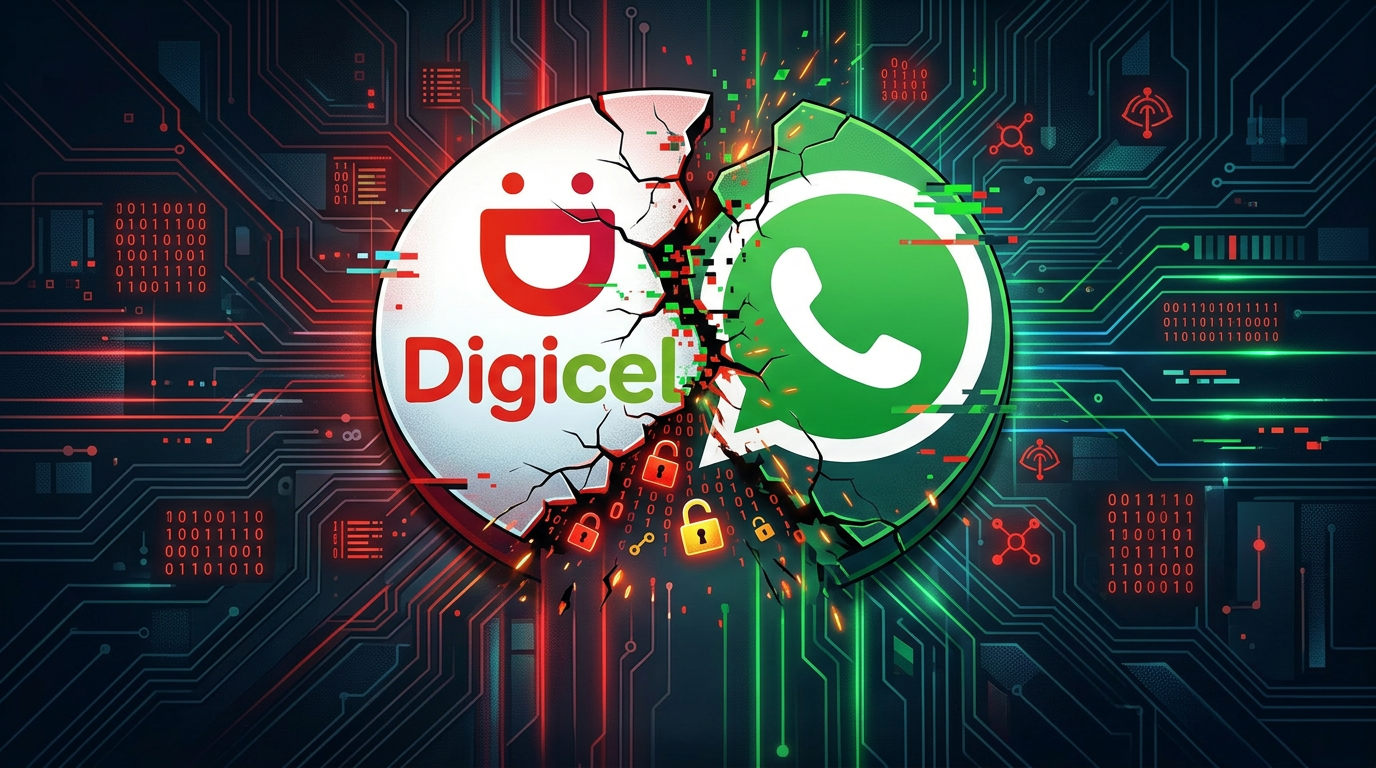
Earlier this year, Digicel confirmed that customer information, including names, physical addresses, email addresses and phone numbers had been shared externally. The company described it as an ‘error’ and said no financial information or passwords were involved.

That may be true, but it misses the bigger point.

A phone number, email address and home address are not small things. In 2026, those three pieces of information can open the door to a person’s wider life. They can help someone find your social media pages, confirm where you live, connect you to relatives, identify your workplace, trace your habits, and build a profile convincing enough to fool you or someone close to you. It really isn’t that hard. 

So when we now hear that people are being targeted through WhatsApp, Facebook, phishing messages and account takeovers, we have to really ask ourselves…what is really going on??? Especially when almost all if not all of them are Digicel customers? 

A reality also kicks in. Once personal data is out there, it does not politely disappear.

Beyond that…there is the accountability issue.

What exactly happened after the Digicel leak? Who was held responsible? What changed? The CEO left the post afterwards, and ordinary customers were left to speculate because, as usual, the public explanation was thin. Do the recent significant increase in scam attempts have anything to do with this? 

And no, this is not just about Digicel. We still remember the Electoral Commission breach from a few years ago. Again, where was the accountability? Where were the consequences? Where was the public assurance that lessons were learned?

Barbados has a Data Protection Act, but a law on paper is not enough. The real test is enforcement. The real test is whether organisations face consequences when people’s personal information is mishandled.

Because data is not just data. It is power. It is leverage. It can be a weapon. And when thousands of records are exposed in digital form, searchable and shareable, the damage can continue long after the press release fades.

So the question is simple: are we serious about data protection in Barbados, or are we only serious after something goes wrong or our bank accounts are drained and our friends and family are scammed?

A ‘developing’ country should pay attention to all things that development brings. Especially when it exposes its peoples to what they may not be accustomed to. 


Discover more from Barbados Underground

Subscribe to get the latest posts sent to your email.

4 responses to “The damaging effects of data breaches: The Digicel scenario”


  1. Digicel probes WhatsApp lockouts

    Digicel says it is working with Meta to investigate reports from customers who have been locked out of their WhatsApp accounts after experiencing problems receiving verification codes via SMS.

    In a statement issued yesterday, the telecommunications provider said it was aware that a small number of customers had reported issues involving WhatsApp verification messages, but maintained that there was no fault with its SMS network.

    “We are not aware of any issue affecting Digicel’s SMS services at this time,” the company said.

    “We are aware that a small number of customers recently reported an issue involving WhatsApp verification messages. Digicel worked closely with Meta, WhatsApp’s parent company, to investigate the matter and continues to monitor the situation. Customers who experience issues or have concerns are encouraged to contact Digicel Barbados Customer Care for assistance.”

    The company added that customer security remained a priority.

    “At Digicel, safeguarding our customers’ security, privacy and trust is our highest priority. We treat any report relating to the integrity of our services with the utmost seriousness and investigate thoroughly.”

    The statement follows

    Correction

    On the front page of yesterday’s Daily Nation, as part of the story Harbour Them And Face Jail!, it was incorrectly published that criminologist Kim Ramsay was still associated with the Criminal Justice Research and Planning Unit. She is a senior research officer with the Ministry of Legal Affairs and Criminal Justice Additionally, the unit is not responsible for the public service announcements or posters as those were created by Ramsay at the behest of Minister of Legal Affairs and Criminal Justice Michael Lashley. (CA) complaints from several Digicel customers who said they were suddenly locked out of their WhatsApp accounts and were unable to receive the SMS verification codes needed to regain access.

    Many customers reported first receiving unsolicited WhatsApp verification requests on their mobile phones, along with messages that appeared in Arabic. Shortly afterwards, they said they were logged out of their accounts and repeated attempts to receive verification codes via SMS were unsuccessful.

    Some customers also claimed that suspicious or malicious messages were sent from their compromised WhatsApp accounts after they lost access.( JRN)

    Source: Nation


  2. @Observing

    This is where our media can be more helpful. Given the ubiquitous nature of technology, in this case WhatsApp, we cannot afford to allow transgressors and incompetents to be not held to account. Another example is the obsockey implementation of BIMpay.

    IMF weighs in on BiMPay

    BiMPay could bring economic benefits to Barbados, but its adoption could also present important risks and challenges.

    That is the crux of an International Monetary Fund (IMF) staff assessment of the national instant payment system (IPS) prepared before it went live on June 12.

    The payment rail, which since being implemented has faced some challenges resulting in the late payment of some salaries and pensions, was examined by IMF experts as part of the international financial institution’s latest Article IV consultation.

    The analysis BiMPay: Potential Benefits And Costs Of Barbados’ New Instant Payment System said that the experience of other countries “suggests that BiMPay has the potential to reduce transaction costs and increase efficiency; improve financial social inclusion and reduce informality; and spur financial development and institutional and regulatory reform”.

    It added, however, that “the transition can also present challenges to adoption, regulation and supervision, privacy, and governance”.

    The assessment, which was published in the 2026 Barbados Article IV report, noted that “the authorities are monitoring technical, financial and cybersecurity risks as the new system is rolled out”.

    Aims of system

    “BiMPay aims to foster more efficient, interoperable, and consumer-friendly payments, generating positive spillovers for the economy,” the IMF team noted.

    “The objective of BiMPay is to increase the speed and convenience of domestic payments, with a view to fostering financial inclusion, helping business operations, for example, cash flow management, record keeping, payroll management, invoicing, encouraging financial technology innovations, and facilitating Government payments to citizens, reducing informal employment.

    “It also aims to strengthen the [Central Bank’s] regulatory authority over payment systems, clearing, and settlement services, and to boost economic activity.”

    The report observed that “while digital payments have grown in Barbados, surpassing traditional payment methods in 2019, the use of cash remains prevalent and is still the only option for many small businesses, referencing information from the Central Bank”. “While mandatory participation by core financial institutions aims to ensure sufficient BiMPay coverage from its launch, increasing financial inclusion will be key for operators without a bank or credit union account,” it added.

    The IMF staff said that based on the experience of 120 countries which had introduced IPSs, BiMPay could bring economic benefits.

    “They enable instant transmission of payment messages and immediate availability of funds 24 hours a day, seven days a week, facilitating payments for households and firms,” the IMF staff said.

    “Research suggests that IPSs can raise household incomes, small business activity, and credit supply. IPSs also generate data that allow users to access financial services like credit provision.

    “As a lower cost payment option, they can raise savings in financial institutions and foster competition and interoperability, which is relevant to Barbados, given low penetration of payment cards and financial inclusion.”

    The IMF report said nevertheless that “the adoption of BiMPay could also present important risks and challenges”.

    The report elaborated on this, stating: “The introduction of an IPS raises questions about the supervision of real-time activity; liquidity assurances for participants; consistency of capital regulations; testing of crisis management arrangements; and mitigation of anti-money laundering/combatting the financing of terrorism.

    “IPS adoption can also be constrained by uneven mobile and Internet penetration; uncertain takeup by the public, given that existing payments are convenient and have the advantage of anonymity; difficulties in reaching individuals without stable employment and access to a bank or credit union account; and low financial and digital literacy, especially for less educated users.”

    Early evidence

    The report also pointed to early evidence which indicated that “the success and drivers of IPS adoption can vary across countries”.

    “Technical characteristics play a key role, notably temporary offline functionality requiring central bank capabilities, strong supervision and monitoring, and simplicity of use,” the IMF staff said.

    “Importantly, the Central Bank needs to clearly establish its role in regulating and overseeing the IPS on a sound legal basis, while carefully designed state intervention in the IPS can support competition and innovation, address coordination issues, and ensure the security and accessibility of the system.

    “For example, in Brazil, important factors in the successful adoption of Pix, an IPS owned, operated, and maintained by the central bank, included mandatory participation of larger payment providers, active stakeholder engagement, a user-centric approach, low fees, and emphasis on security.” (SC)

    Source: Nation


  3. CENTRAL BANK SENDS CAUTION REGARDING FALSE MESSAGES AND CALLS

    The Central Bank of Barbados is warning the public that WhatsApp calls displaying the Bank’s logo and falsely claiming to be associated with the Bank and BiMPay.

    The Bank stressed that the calls did not originate with them but from a Pakistani country code.

    In a media statement the Bank says it will not make unsolicited calls to anyone about BiMPay and strongly encourages persons not to share sensitive information such as passwords, PINs, or security codes with anyone who contacts them.

    If you have already shared sensitive information with someone claiming to represent the Bank or BiMPay, you are advised to contact your financial institution immediately using verified channels and take steps to secure your account, such as changing your passwords or PINs.


  4. Actually, instead of the former CEO being held to account, she was serenaded and allowed to regale the public: to conquer new and exciting challenges to make her career. To continue to be the social light being the wife of a minister of government demands.

The blogmaster invites you to join the discussion.

Trending

Discover more from Barbados Underground

Subscribe now to keep reading and get access to the full archive.

Continue reading