Banner promoting anonymous crime reporting with a phone and contact number 1 800 TIPS (8477), featuring the Crime Stoppers logo and a QR code for submitting tips.

← Back

Your message to the BLOGMASTER was sent

Submitted by Ron Cheong

The next Secretary-General will inherit a deeply divided world. For Guyana, that may make the case for Carolyn Rodrigues-Birkett more compelling – but winning the race will require careful diplomacy among the major powers.

The next Secretary-General of the United Nations will inherit one of the most difficult international environments in the organisation’s history.

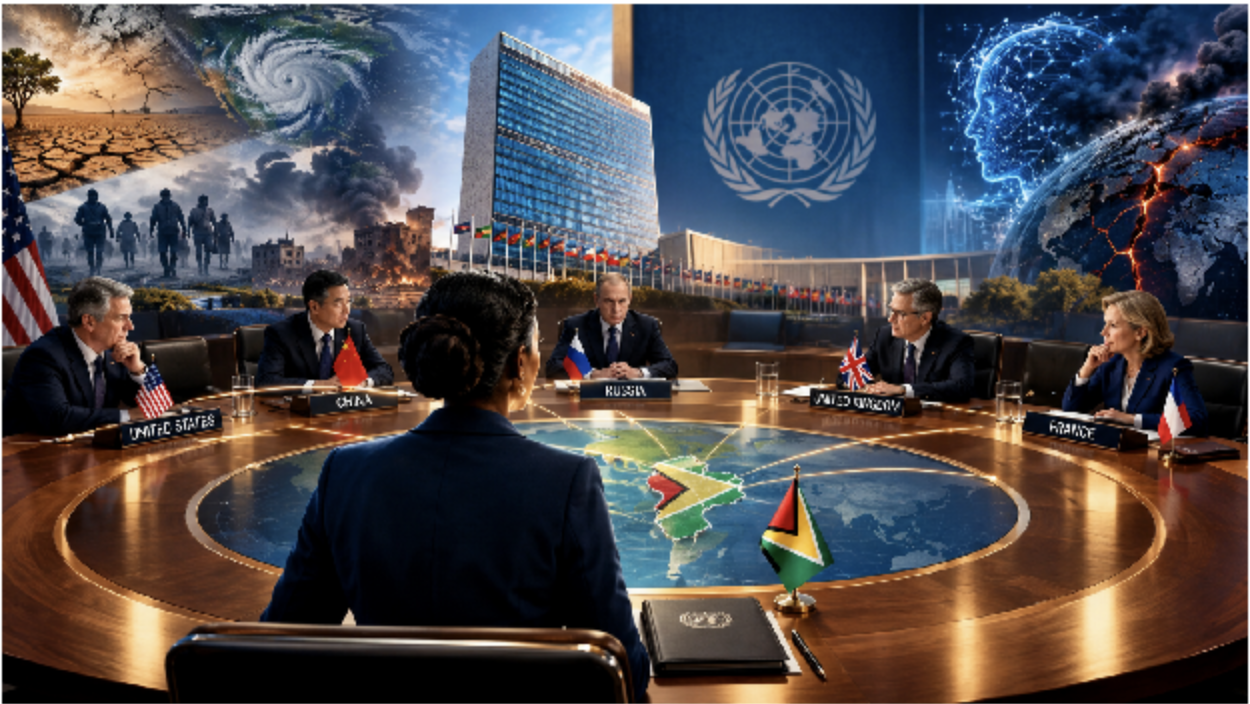
Speaking at the Munich Security Conference, outgoing Secretary-General António Guterres warned that the global community had become more fragmented and divided than at any time in the previous 75 years. He went further, arguing that the transition toward a multipolar world was taking place without sufficiently strong global institutions to manage it. The result, he warned, could be greater chaos, opportunism and transactional politics rather than structured cooperation.

Remarkably, Guterres suggested that the Cold War was, in some respects, less dangerous. The confrontation between the United States and Soviet Union carried the constant threat of nuclear war, but it also produced established mechanisms for arms control and crisis management. Today, he argued, the world faces not only nuclear danger but also the existential challenges of climate change and uncontrolled artificial intelligence – without comparable mechanisms for managing them.

That is the world into which the next Secretary-General will step.

Global cooperation has become harder to sustain. Strategic competition between the United States and China is reshaping trade and supply chains. Traditional alliances are under strain as national interests increasingly take precedence over collective approaches. Regional conflicts have multiplied, while the international system faces mounting pressure over climate change, food security, migration, technology and artificial intelligence.

And the Secretary-General will have to manage a crisis of confidence within the United Nations itself: pressure for institutional reform, chronic funding difficulties and paralysis within the Security Council, where the veto powers of the five permanent members can prevent collective action.

The question, therefore, is not simply who should occupy the Secretary-General’s office. It is what kind of leadership the international system requires at a moment when the old assumptions underpinning that system are being challenged.

A Race at a Critical Stage

Against this background, the contest to succeed António Guterres has reached a critical stage.

The third Security Council straw poll, conducted on September 18, put Costa Rica’s Rebeca Grynspan narrowly ahead of Guyana’s Carolyn Rodrigues-Birkett. Grynspan received nine “encourage” votes, five “discourage” votes and one “no opinion”; Rodrigues-Birkett received eight “encourage,” six “discourage” and one “no opinion.” The two have emerged as the leading candidates through the first three rounds.

The result is significant because the race remains far from settled. The eventual candidate must secure at least nine votes in the 15-member Security Council and, critically, cannot receive a veto from any of the five permanent members – China, France, Russia, the United Kingdom and the United States.

Guyana’s candidacy has the backing of CARICOM, and President Irfaan Ali used his address to the 81st session of the General Assembly to make a direct appeal for Rodrigues-Birkett. He argued that the world should look beyond the size of the country that nominated her and consider the experience and qualities she could bring to an organisation in need of renewal.

The symbolism is considerable. The Caribbean has never produced a Secretary-General. No woman has ever held the position. Rodrigues-Birkett would therefore represent not simply a Caribbean candidate, but a woman from a small developing state and an Indigenous Caribbean background seeking to lead the world’s principal multilateral institution.

But symbolism alone will not decide the contest.

How the Decision Is Actually Made

Although all 193 UN member states ultimately participate in the formal appointment process, the decisive stage takes place in the Security Council.

During the informal straw polls, the 15 Council members indicate whether they “encourage,” “discourage” or have “no opinion” on each candidate. In the early rounds, the identities of the permanent members behind individual votes are not disclosed. Later stages are designed to make the positions of the five permanent members clearer.

Under Article 97 of the UN Charter, the General Assembly appoints the Secretary-General only after receiving a recommendation from the Security Council. The General Assembly then votes on that recommendation. In practical terms, therefore, the Security Council is where the decisive bargaining occurs.

That makes the current geopolitical environment both a complication and a potential opportunity for Guyana.

Guyana’s Security Council Record

Guyana has something important to bring to the table: recent experience at the centre of the very multilateral system that the next Secretary-General will be expected to repair.

Guyana served a two-year non-permanent term on the Security Council in 2024–2025 and held the Council presidency in February 2024 and June 2025. During its tenure, Guyana placed particular emphasis on climate change, food insecurity and conflict, while also highlighting peacebuilding, women and security, and youth and children in conflict.

Its February 2024 presidency was particularly notable. Guyana brought the relationship between climate change, food insecurity and conflict to the centre of a high-level Security Council debate. The UN itself subsequently highlighted the importance of the climate-food-conflict nexus

This gives Guyana a credible argument that the concerns of small and vulnerable states are not peripheral to international security. They are increasingly central to it.

Climate change, food insecurity, poverty, environmental degradation and conflict are no longer neatly separated problems. For many developing countries, they are interconnected drivers of instability.

That perspective is particularly relevant to a UN struggling to adapt institutions created in 1945 to the realities of the twenty-first century.

The Geopolitical Tightrope

But there is another dimension to the campaign, and it is considerably more complicated.

Guyana’s strategic relationships intersect with the interests of all three major powers: The United States, China and Russia.

Guyana has a particularly close security relationship with the United States, especially in the context of Venezuela and wider Caribbean security. At the same time, China is an important economic partner with interests in infrastructure, trade and development throughout the region. Russia, meanwhile, maintains a close relationship with Venezuela.

Guyana therefore has to navigate a diplomatic landscape in which its national interests do not always align neatly with those of any one major power.

That makes the campaign less a matter of persuading countries to “support Guyana” than of demonstrating why a Rodrigues-Birkett Secretary-General could serve the broader interests of a divided international community.

There may also be an important regional calculation.

President Ali and Guyana’s delegation recently joined US President Donald Trump, Secretary of State Marco Rubio and other leaders of the Shield of the Americas in adopting a joint communiqué focused on economic, security and multilateral coordination. Guyana’s participation reinforces its growing role in the security and economic architecture of the Western Hemisphere. 

That relationship should not be reduced to a simple quid pro quo over the Secretary-General’s appointment. But it does give Guyana a channel for making the case directly to Washington that the choice of Secretary-General matters to the future effectiveness of the multilateral system – including one in which the United States has substantial strategic interests.

The same logic applies, in different ways, to China and Russia.

The objective should not be to present a Rodrigues-Birkett candidacy as an instrument against any particular power. That could make her less acceptable, not more. The stronger diplomatic argument is that the next Secretary-General must be someone capable of working across competing geopolitical blocs without becoming the representative of any one of them.

A Caribbean Moment

This is where CARICOM’s collective weight becomes important.

The Caribbean has never occupied the Secretary-General’s office. The region has a legitimate interest in greater representation within an international system in which small states often find themselves negotiating with much larger powers.

Rodrigues-Birkett’s candidacy also carries a wider representation argument: a woman from the Caribbean, from a small developing state and with Indigenous Caribbean heritage, would bring experiences that have never been represented at the highest level of the UN.

But CARICOM should be careful not to frame the contest simply as a test of whether the great powers respect small states. That risks turning a campaign for a candidate into a confrontation between blocs.

A more effective argument would be that the present crisis of multilateralism is precisely why the next Secretary-General should be someone capable of building bridges across those divisions.

That is a message that can potentially resonate in Washington, Beijing, Moscow, London and Paris – as well as among the many smaller states whose interests are often overshadowed by great-power competition.

The Work Ahead

The third straw poll should therefore be viewed not as a verdict but as a map.

Rodrigues-Birkett is only one vote short of the nine “encourage” votes required in the latest informal poll, but the six “discourage” votes demonstrate that significant resistance remains. More importantly, the early straw polls do not reveal which positions belong to the permanent members.

Table displaying results of a straw poll taken on September 18, 2026, for candidate Carolyn Rodrigues-Birkett from Guyana, showing 8 encourage, 6 discourage, 1 no opinion, and a total of 15 responses.

Guyana and CARICOM consequently have considerable diplomatic work ahead.

They need to identify where support for Rodrigues-Birkett is firm, where it is movable, and where resistance may be connected to particular geopolitical concerns. They need to understand not only the positions of the five permanent members but also the calculations of the elected members of the Council.

And they need to make the campaign about more than Guyana.

The central message could be much larger: the world is entering an increasingly multipolar era, but the institutions designed to manage that world have not kept pace. The next Secretary-General therefore needs to be a bridge-builder – someone able to engage great powers without becoming captive to them, while ensuring that the concerns of smaller and developing states remain part of the global conversation.

That is a difficult case to make. But it is also precisely the kind of case that a candidate from Guyana can credibly embody.

The paradox of this race is that the very fragmentation threatening the effectiveness of the United Nations may create the opening for a candidate whose principal asset is the ability to bridge divides.

For Guyana, the challenge now is to turn that possibility into a diplomatic strategy – quietly, persistently and with enough sophistication to make the major powers see Rodrigues-Birkett not merely as Guyana’s candidate, but as a potentially useful candidate for a United Nations struggling to find its way in a fractured world.


Discover more from Barbados Underground

Subscribe to get the latest posts sent to your email.

9 responses to “Can Guyana Turn a UN Crisis into a Diplomatic Opportunity?”


  1. Old vs new world order

    THE SPEECHES OF Heads of Government at the 2026 UN General Assembly revealed the rapid slide of the UN from a podium of peace to a platform of war. The event marked the deliberate effort to destroy the post-war diplomatic architecture.

    First, it was United States President Donald Trump who threatened to annihilate Iranian civilisation, with the Iranian embassy staff staring calmly back at him. Then, it was a salivating Israeli Prime Minister, Benjamin Netanyahu, holding up a pager, suggestively reminding all delegates of how easily they could be eliminated, like the Hezbollah leadership in 2024.

    The speeches indicated strongly the intention by a belligerent group to replace the so-called rules-based global order with one of force. When taken with Trump’s call to disband the International Criminal Court; the threats to arrest the visiting Iranian leadership; and the blocking of the Palestinian leadership from the UN General Assembly, the evidence of the blatant rejection of diplomacy becomes clear.

    Nevertheless, UN General Assembly speeches revealed an international order split into three camps. One grouping, represented mostly by the United States and a few white supremacist allies like Israel, Argentina and other Latin American states, seem intent on replacing the post-war Bretton-woods system with a force-based model, akin to fascist Germany. The Caribbean and Latin America have been the main victims of this new shift.

    A second tier of countries are those states that wish “things would stay the same”, and fantasise about the return of the liberal, rules-based order. Among this second group are Canada, Barbados and most Western European countries.

    They long for continued US hegemony, but with “better manners”. They oppose the inequalities of the present world but wish for its reform rather than overthrow. They cannot imagine a world different

    from the post-war order. They hope for a post-Trump US.

    The third group comprises states with the military might, economic leverage and proven history of resisting US hegemony and which are themselves regionally hegemonic.

    They have a track record of pursuing alternative global institutions. Countries in this group include Russia, China, Iran and some of the BRIC nations, like South Africa or possibly Brazil, were all able to speak, unafraid, at the UN podium.

    This was seen, for example, when Russia’s Foreign Minister Sergei Lavrov called openly for the release of Venezuelan President Nicholas Maduro and when Iranian President Masoud Peseshkian openly rejected the US’ demands for surrender and signalled Iran’s ability and willingness to fight as a militarily competent nation.

    The UN General Assembly 2026 revealed most clearly that the world is at an inflection point. It revealed clearly a struggle between the old world and the new.

    Sooner or later, there will be a test of wills on the battlefield. The one thing that is certain is that the post-war order is dead.

    Tennyson Joseph is Associate Professor of political science at North Carolina Central University. Email tjoe2008@live.com

    Source: Nation


  2. The UN is troding the same path of the League of Nations.

    Life has taught this writer that when organisms find their natural death moment – we should let them be.

    The fantasy that a Guyanese woman could single-handedly reverse the course of Mother Time is best located within the fiction well presented by over-zealous peons supposing that somehow they can make what has been shown to fail better.

    A United Nations which has never been more than an instrument of Western colonial powers at the imperial core has earned its death.

    And these ill-concieved suggestions arise at the time of the open and ongoing genocide of Palestinians. A time when one of the leading countries of the UN has its leader threatening to use the most powerful weapons on earth to “annihilate” a member nation of the UN and 100 million of its citizens within the highest organ of that very institution as a consequence of an illegal war he started.

    John Bolton, a former UN ambassador, once posited that half the floors of the UN building in NY could have been destroyed and it would have made no difference.

    Weee say let’s allow the UN to die and build another institution somewhere else. Let’s stop lying to ourselves under the emotion that some appointment of some Guyanese woman could reverse the many crimes against the peoples of the world by this United Nations.

    Inevitably Carolyn Rodrigues-Birkett. Like the others, will be no more than an international civil servant, well-schooled in the nothingness of not rocking the UN boat and will be more interested in keeping things as status quo as they’ve always been.


  3. USA + Israel are partners in crime war whores who cheat to win
    responsible for black ops, false flags and false propaganda
    with dodgy Trump and Netanyahu facing deserved imminent defeat in elections
    they could be responsible for the Dubai plane incident and US air force base terror alert in UK blaming Iran


  4. The issue with you is that you always go the personality and not the root cause. If Trump and Nathanyahu lose the elections as you have opined would it change anything?

    If the UN is believed to be a toothless tiger, should it be dismantled and replaced with what?

    Another question: have we lost all hope that it is possible for transformational leaders to emerge?


  5. All of this shiiite talk about transformational leadership is just that, nothing more.

    And it is reached for by those who have a deep-seated obeisance to a certain kind of world. Such limits are the only parameters in which things can happen, for them.

    As someone who has spent years teaching the history of leadership and truly sought radical transformation, and it can’t be transformative unless radical, it’s know that when orgainzational culrures have been baked in for decades no kind of change is ever possible unless structures are totally dismantled and new ones built having absolutely no connection to their formers.

    More importantly, when a structure like the UN has had a predecessor which died earlier on, one has not to be apocryphal to see one following the other.

    Soon, countries are going to start surrendering their memberships within this useless organism that is the UN.


  6. Trodding or treading!

  7. World Citizenship Avatar
    World Citizenship

    This world is my world

    World Citizenship

    Perhaps the problem with the United Nations is the Nations ain’t Uniting

    A One World Nation One World Government world make the white majority a minority and people of colour would not need to be held down and could rise which is how God planned it, when there is peace in the Middle East and world peace all over planet earth as above as is below.

    The two biggest warmongers since Y2K (who shall not be named to protect the guilty fuc*ers) would have to lay down their arms and stop making money blood weaponising everything from the gun to the bomb to the nuke to the smart bomb to the drone to AI.

    This is how Jesus and Buddha had a vision for mankind but mankind ain’t kind.

    You may say I’m a dreamer
    But I’m not the only one
    I hope someday you’ll join us
    And the world will be as one

    Imagine there’s no heaven
    It’s easy if you try
    No hell below us
    Above us, only sky
    Imagine all the people
    Living for today
    I

    Imagine there’s no countries
    It isn’t hard to do
    Nothing to kill or die for
    And no religion too
    Imagine all the people
    Living life in peace
    You

    Imagine no possessions
    I wonder if you can
    No need for greed or hunger
    A brotherhood of man
    Imagine all the people
    Sharing all the world
    You


  8. Nation Editorial

    UN’s credibility at stake

    Every year in September, the world has to witness the spectacle of the United Nations (UN) General Assembly with a parade of speeches which, in the classical Shakespearean language, were “full of sound and fury signifying nothing”.

    This year was no exception, except it came against the backdrop of the military conflict in Iran and the ongoing war in Ukraine, the significance of which has faded in the background and both of which have aggravated the global supply problems.

    Unfortunately, the UN today is beset with corruption scandals, questions about its relevance and a funding crisis so severe that the outgoing Secretary General António Guterres warned of “imminent financial collapse” .

    For many years there have been incessant calls for reform and changes in the way the UN functions. The most important is the veto power among the major countries within the Security Council.

    Prime Minister Mia Amor Mottley, in her speech at the UN last week, also reiterated her concern about the veto power of countries like Russia, China, Britain, France and the United States, which often undermine the will of the majority of states in the General Assembly.

    That’s not the only problem facing the UN. It is now an unwieldy organisation and many people are advocating for major changes with the UN system itself.

    Guterres acknowledged that the state of the world has become more complex and is “getting worse”.

    In his final address to the UN General Assembly last week, he gave a stark warning to member countries that growing geopolitical divides have paralysed the Security Council and left the most vulnerable “in very dramatic situations”.

    In a wide-ranging interview with Al Jazeera on the eve of his final address as secretary general, Guterres discussed the major military conflicts happening in the world and whether the UN was still relevant in addressing today’s challenges.

    He said the involvement of “superpowers” and key

    council members in the wars has created a crisis due to the continued violations of international law. That has created an environment of impunity, in which mid-sized powers believe they are mere spectators.

    Guterres outlined the real-life problems that the Russia-Ukraine war and US-Israel war in Iran were having on many countries, particularly around food accessibility, rising fuel prices and global inflation, which were having devastating consequences on many economies around the world. Yet these wars continue unabated.

    In all of this turbulence, the UN remains impotent. It was established in 1945, in the wake of World War II, to prevent humanity from more cataclysmic conflicts.

    Regrettably, major powers are now ignoring the UN as a mediator of conflicts.

    The League of Nations (forerunner to the UN) also failed in its mission to address conflicts fairly and effectively, and melted away as Hitler marched across Europe.

    There is still a forlorn hope the UN will do better; if it listens.

    After two world wars claimed millions of lives, the UN’s founding members sought to replace the failed League of Nations with a functioning forum capable of resolving global disputes before they spiralled out of control.

    Rarely has an institution founded on such noble ideals been plunged to such depths. Some critics are now saying that the UN’s failures are largely indicative of a sprawling bureaucracy that has become bloated and inefficient. There is considerable truth here.

    In a world where real change remains elusive, the UN must do much more to regain credibility. For the future, it needs to clearly demonstrate that it is capable of achieving its original mission.


  9. Over the last week we’ve had two apparent false flag terrorist attempts which the UN could never stop but were the proximate handiwork of the the Zionist regime.

    One was a failed attack on a military base in England, the Profidious Albion of all times. The second one was a botched hijacking from Dubai to Tel Aviv. These criminals are the gang which can’t even shoot straight.

    They seemed to be aimed, if successful and spectacular enough, to be use as a propaganda tool against Iran.

    A terrorist global regime made up of the Western countries – Israel, the United States, the Europeans primarily, again trying to use terrorism to gain a propaganda victory, with their media whores as mouthpieces. And they control all major media!

    For centuries the Europeans, the Russians, conducted extermination pogroms against these so-called Jews who presently control the military instincts of the Western world.

    Having led the West to an ongoing genocide the largely Jewish global elites, the techno-feudalists, the Christian-Zionists and others are now intent on maintaining a criminal global system. Further, they now intend to make their wicked system even more exploitative, even as their power grows weaker.

    Clearly, these forces, the rasssoul White people and their allies have long centralized terrorism as their main means of projecting force, ruling the world. As a result Western sponsored terrorism is their vicious force projection method in the world.

    And it’s the projection of their own mindset until their perceived enemies which indict the West. Aimed to lead ignorant publics into believing that a country like Iran, a country willing to die on the alter of justice, could be made interested in competing with the West in an area of warfare totally controlled by them – terrorism.

The blogmaster invites you to join the discussion.

Trending

Discover more from Barbados Underground

Subscribe now to keep reading and get access to the full archive.

Continue reading