Banner promoting anonymous crime reporting with a phone and contact number 1 800 TIPS (8477), featuring the Crime Stoppers logo and a QR code for submitting tips.

← Back

Your message to the BLOGMASTER was sent

Silent Ministers Indar Weir, Sandra Husbands, Colin Jordan and Jonathan Reid to mention four.

Barbados has perfected a political art: the ability to establish ministries that barely speak, report, are a no show- yet engage in business as usual activities, untouched, unchallenged. These low visibility ministries operate like shadows in the Bajan political system that rewards noise, theatrics and political expediency above meritocracy and accountability. And the public, numbed by decades of deference -in sheep like fashion- has learned to accept silence as good governance.

The truth is uncomfortable: some ministries survive because they stay quiet. They avoid scrutiny by making little noise, avoiding a moribund media. Dishing out ‘favours’ to so called social media influencers. In a small society where political attention is a precious resource fueled by the Queen Bee, silence is a value added for the parasites.

Take the ministries responsible for vocational training, innovation, public investment, housing, or legal affairs. These portfolios touch critical national priorities, however, they rarely dominate local news. The lack of visibility is not just a function of political tactics fused with incompetence; it is a function of our political culture. Barbados has built a governance environment where only the politically urgent gets oxygen, and everything else suffocates, especially national priorities.

This is where political expediency rears its head. Barbados’ political class has mastered catering to public attention: increase the noise coming from the ministries that deliver quick wins, visible projects, or emotionally charged talking points, and let the rest blow in the wind. The ministries that deal with long term structural issues – the ones that require transparency, patience, and hard conversations – are allowed to operate away from the glare of the public.

Political expediency thrives on immediacy. It rewards ministries that can produce ribbon cuttings, press conferences, and photo ops. It rewards ministers who can stand in front of a camera and declare progress, even if the underlying systems remain unchanged. Meanwhile, the quieter ministries become repositories for slow moving reforms, deferred decisions, and administrative inertia. They become the places where political promises go to hibernate. The inability to operationalise integrity and freedom of information laws spring to mind.

And Barbadians, conditioned by decades of Westminster conventions, rarely demand more. We critique institutions in rum shops and WhatsApp groups but less so in formal channels. This cultural nuance creates the perfect environment for low visibility ministries to operate without pressure.

The result is a governance ecosystem where silence becomes a form of political survival. A ministry that does not speak cannot be contradicted. A minister who does not appear cannot be questioned. A portfolio that does not report cannot be measured. And in Barbados, where political loyalty outweighs performance, this silence is rarely punished. Then add a group of MPs ‘debating’ issues in parliament without an elected opposition.

Barbadians should know that silence has consequences. It breeds lethargy and mediocrity. It erodes trust. It allows inefficiency to masquerade as stability. It creates a government where the public sees only what is manufactured to be seen. Does anyone believe the recent expose of migrant workers was staged to generate PR for the two stakeholders, government and the BWU?

If Barbados is serious about institutional maturity, the country must frontally confront this inbred culture. Accountability cannot depend on which ministry is politically fashionable. Transparency cannot be optional. And public engagement cannot be reserved for crises.

The quiet ministries must be pulled into the light – not to shame them, but to ensure that governance is not a performance but a practice to pursue excellence. That it becomes wired in a preferred governance model. Barbados deserves a government where every ministry is visible, every minister is answerable, and silence is no longer a pathway to achieve.

Are we there yet?


Discover more from Barbados Underground

Subscribe to get the latest posts sent to your email.

10 responses to “Barbados quiet ministries: the culture that protects them”


  1. Two points

    First, it’s far better to keep quite than to open one’s ministry to dispel all doubts that nothing is happening therein.

    Second, when one gets a pick, the equivalent of recieving unearned income, or as Barrow said being a leading member of “the army of occupation” it’s tactical that attention should never be sought to disturb the peaceful inflows of resources, for life!

    These dispositions represent the most dangerous actors within the regime.

    It’s impossible to hide as a paasenger on a professional cricket or football team. But in a regime where one woe-man craves all attention hiding is easy, especially when paid so to do.

    Coming from one who in the beginning thought that the elected “dictatress” should be allowed to have her “many hands make light work” mantra, is a long standing reversal. For whether a small, médium or large cabinet the results are the same.

    Maybe a guillotine represents a corrective.


  2. In any event circumstances are evolving where there’ll soon be no place to hide.

    Jimmy Cliff sang, maybe from Bushie’s book, about people running to rocks and cabinets for shelter, but there was no rock, no cabinets.

    Of course we write of the gorilla in the room against which only quite accompanied by the childish determination that unseen forces somewhere will intervene into the affairs of the country to prevent the worst from happening.

    We see no such sets of magical interventions.

    For these longstanding imbalances stare into the face of nature itself, remaining pregnant with the need for correction. And nature abhors any void!

    But there’s another world. The world of BRICS. A bloc of countries, following a long history of resistance against Western colonialization and empire, which presents a different vision of the future.

    Even as Barbados remains so tetthered to that which ails it that no world, other than that which emerged after 1945, could become a viable alternative. The story of the host and the parasite interchanging functions.

    And the functions of these sets of actors are totally different from the mind of the “sherpa” integral to radical transformation.


  3. Same blah blah. Nothing to see here


  4. Deisel over 10 dollars a gallop in empire


  5. For instance, we have a minister like Indar Weir whose tenure did not result in a significant improvement in national output in agriculture. Despite this, the Prime Minister accepted his mediocre performance by creating a new ministry for him.

    Only bout here.


  6. When David Thompson died a political consultant, so sorrowful, offered to die with him. A dramatic rechtorical gesture we presumed.

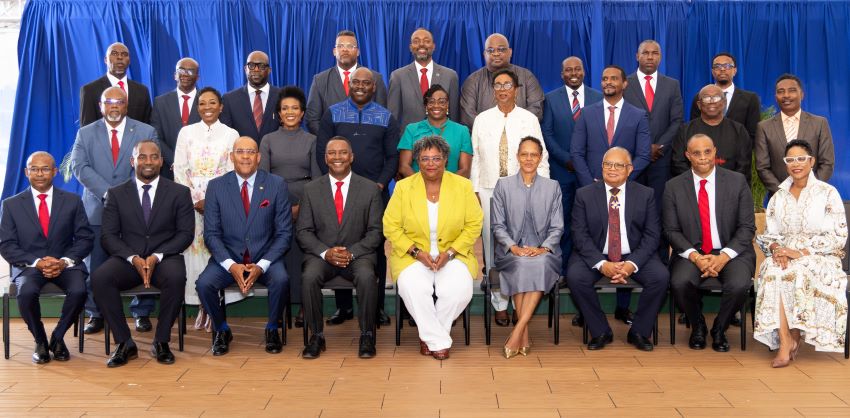
    In the picture above we see one of Thompson’s closest buddies, former finance minister Christopher Sinckler.

    Sinckler, a man the DLP invested much into solely to prove that party politics is a pappyshow. That there were never any Bees or Dees, just personal interests. Many were the hordes fooled.

    And Sinckler is not alone in buttressing that notion as the presence of a former DLP housing minister Lashley, now AG we believe, fortifies the centrality of the political duopoly now best represented as an elected dictatorship.

    A full-bloomed dictatorship which these two, now and in the past, acted and are acting, to deliver the total destruction of that which they once boosted to have so beloved.

    So instead of these two dying with Thompson, dying with the DLP, it was much easier to become BLPs, instead of endlessly being politically dead within the vineyard of oppositional politics for an eternity.

    Maybe this story is one of fiction. Maybe both Sinckler and Lashley are displaying the deepest knowledge of the political game.

    Maybe Thompson, himself, being a close buddy of Mottley would have played the same game, the same way, if he were here and Sinckler and Lashley were detained within the great beyond.

    Certainly, there must be the hottest fires, on the other side, for this breed.


  7. Vladimir Putin was the star man of the BRICS Summit these few days.

    Well-loved in India especially amongst the women. Populations of whom made no secret about what they would like to do with him.

    They mostly had to do with Kama Sutra yoga!


  8. Perhaps Barbados is suffering from low energy.
    30-0 x 3 seems to have stopped momentum for change.
    Doing nothing but maintaining the same legacy system is common in ex-colonial lands.


  9. Caddle tackles water zoning and housing

    BARBADOS’ ZONE A water protection order and the wider planning legislation governing what can be built and where are both set to be revised, says Minister in the Prime Minister’s Office with responsibility for Economic Affairs and Planning Marsha Caddle.

    Speaking last night at the Barbados Labour Party St Michael South Central branch annual general meeting, at her constituency office on Tweedside Road, St Michael, Caddle said the changes are aimed at balancing land pressures against the need to safeguard the water supply.

    She said the current rigid approach to Zone A designations, which restrict development around wells supplying the public water system, may no longer be sustainable given the island’s limited land.

    “I am not sure that we can continue to say simply, this is Zone A, so nothing can happen here,” she stated, adding that the Barbados Water Authority is instead exploring engineering and treatment standards that could allow limited activity in some zones, rather than blanket bans.

    She pointed to the wave of hotel construction under way in the north and west of the island.

    “We did the work and estimated that across most of the developments that we plan… it’s going to call for about three million more imperial gallons a day of water. The current groundwater abstraction that is going on in the north cannot begin to cover the new demands,” she said.

    That shortfall, she explained, is why Government is pursuing a new desalination plant in the north; structured not as a straightforward public asset, but through a partnership that invites citizens’ buy-in.

    “We’ve opted to come up with a kind of a public-private partnership that allows Barbadians to invest in the desalination plant,” she said, pointing to possible returns of “around 12 and 13 per cent” as

    an incentive.

    The changes to water zoning are tied closely to housing policy, Caddle said.

    Barbados’ housing density – about seven houses per acre on average – is low by international standards, and government is working with the Ministry of Housing to allow greater density in select areas through high-rise development and revised setback rules. “Barbados must be one of the last countries where we are sticking to UK standards,” she said, arguing that colonialera setback rules no longer serve their original purpose.

    She noted that established communities would not be targeted for redevelopment.

    “We’re not talking about areas that are already densely populated. We’re talking about making better use of new housing developments so that more people can have a chance at home ownership,” she stated. (DDS)

    Source: Nation


  10. Who funds parties?

    Analysts: Candidates’ spending not as important

    by ANTOINETTE CONNELL antoinetteconnell@nationnews.com

    TWO POLITICAL ANALYSTS have agreed that the public declaration of who is funding political parties is more important than the just released candidates spending.

    A published advertisement in last week’s SUNDAY SUN revealed that combined, the ruling Barbados Labour Party’s 30 candidates spent almost three times the amount of their main opposition the Democratic Labour Party’s $565 929.97 total. The Return of Election Expenses list released by the Electoral and Boundaries Commission (EBC) shows that Member of Parliament for Christ Church East Central and Minister of Finance Ryan Straughn had the highest total of any candidate spending $103 317.12 of the BLP’s overall $1 555 108.07 in the February 11 General Election.

    When contacted for a reaction political analysts Professor Cynthia Barrow-Giles and Devaron Bruce said the emphasis should be on revealing sources of party campaign financing in the interest of transparency and good governance, with both questioning the capacity of the EBC in any event to verify the individual spending by candidates in their bid to win a seat in Parliament.

    Barrow-Giles, whose expertise is in constitutional governance and politics said that Barbados’ legal framework for the conduct of elections in terms of political finance was one of the weakest globally.

    “That is primarily because there are few limitations on who can donate, whether corporate or individuals, domestic or foreign and that includes foreign governments. The spending limits are clear under the law and unfortunately, we must accept what is accounted for by the candidates but I do not think that the EBC has the capacity to verify the accounts and therefore it makes a nonsense of a seemingly useful legal requirement,” she observed.

    More importantly, she said, was the fact that though it appeared that there was a very unequal playing field in the reported spending, it did not exceed the legal ceiling for the constituencies.

    “However, there is this huge problem precisely because the political parties are not required to report election campaign finances. All we have here is a candidate accounting, not the party, which would be more revealing and perhaps disturbing.

    “So perhaps BLP candidates spent more than three

    times as much as the DLP’s, what is missing is what the parties spent on activities on behalf of the candidates and what the parties spent on election workers, election rallies, posters and other paraphernalia, advertising in the print and non-print media and the hiring of pollsters and PR consultants. These costs are incalculable and important and what we do not see is the entire financial structure of the campaign,” she said.

    Likewise, Bruce believed there is a need to strengthen the integrity framework in relation to knowing the funding sources of political parties.

    “There is the old adage who pays the piper calls the tune, and persons who are proponents of a solid national integrity system do believe that there should be some emphasis on campaign finance and declaring the sources of funds. This is particularly relevant to political parties which can be quite opaque when it comes to their funding sources,” he said.

    The list of candidates’ returns held no surprise for Bruce since, he said, campaigning and politics were expensive undertakings. However, while political parties might not need to have a cap put on their spending, the source of the contributions, especially large ones, should be revealed, he added.

    The issue, Barrow-Giles insisted, was about parties and elections where the law is silent and presently it was not possible to understand political money by focusing on the candidates’ spending.

    “Unfortunately that is what the current legal framework invites or limits us to and this is far more critical than what the existing law requires. A better question should be how much did each party spend. We will not get the truth until the law catches up to current global standards,” she noted.

    On the face of it, the legally required candidates report created a false impression of transparency in the system when “in truth there is little to no transparency in spending on elections”, Barrow-Giles pointed out.

    “Candidates’ apparent transparency does not equate to transparency of the system of money in politics,” she said.

    Source: Nation

The blogmaster invites you to join the discussion.

Trending

Discover more from Barbados Underground

Subscribe now to keep reading and get access to the full archive.

Continue reading