← Back

Your message to the BLOGMASTER was sent

The pappyshow presently unfolding has catapulted Barbados. This is for the wrong reasons. It has brought the country to the centre of regional attention, if not international. As one BU commenter posted:

How could you [David] allow Barbadians to accept such blatant disrespect. Barbados has now become the laughing stock of the Caribbean. Former BLP minister is President of Barbados and former BLP politician and speaker of the house appointed as independent Speaker Of the House.

– Donald

The blogmaster has a confession to make. He has joined the rank of the apathetic and cynical. He has become totally turned off at the political orchestrations in Barbados in recent years. It is surprising that a country with heavy investment in education finds itself mired in the ongoing governance crisis. The BLP’s dominance of 30-0 wins in the last three general elections is worrying, including two by elections. This dominance raises serious questions about the quality of our governance. Our system is designed to thrive on a strident dissenting voice in parliament. Instead, we will have to tolerate another session that will be nothing more than an echo chamber.

Besides the House of Assembly becoming an echo chamber – which is antithetical to the Westminster style democratic system practiced in Barbados – we have:-

A government is presided over by a President (Jeffery Bostic). Up to three years ago, he was a minister in the Mottley Cabinet. A President that was circumvented by Mottley in the procurement of Covid 19 vaccines by a company led by Mark Maloney. The late Walter Blackman did his best to prosecute this matter before he crossed the mortal coil.

We selected an INDEPENDENT Speaker. Arthur Holder, just a few weeks ago, he was the sitting member in parliament for the Barbados Labour Party (BLP) acting in the very role.

Prime Minister Mottley appointed two former SENIOR Democratic Labour Party ministers (Chris Sinckler and Michael Lashley) in her 25 strong Cabinet.

The former Chairman of the Electoral Boundaries Commission (Ramon Alleyne) was appointed a government Senator. It is worth mentioning that he is the lead counsel representing Barbados Lights & Power in the ongoing legal battle with the Fair Trading Commission (FTC) over electricity rates. He also headed an EBC that presided over the last general election where irregularities occurred.

We reelected 30 Barbados Labour Party members to the Lower House in a country where almost every road is littered with potholes – even the President thought it worth mentioning in his government prepared ‘throne’ speech. The minibus/zr culture lives on. Our murder rate continues to climb. National agriculture output – despite flowery promises by former Minister Weir – did not materially contribute to GDP of food security. Our primary healthcare institution continues to labour to deliver best in class care. The court system headed by another former Chairman of the EBC (Leslie Haynes) continues to groan under the weight of a backlog in cases.

Why is this important? With the exception of William Duguid, all former ministers were reappointed to ministries. No explanation was given for dropping Duguid from cabinet by Prime Minister Mottley, there goes her effort to be transparent with citizens. Stay tune because Duguid was dropped before he mysteriously was added as a senior minster.

The issue that has captured public attention regarding the selection of Senators by the President, AND, DLP misteps in the transaction, is simply a symptom of a dysfunctional democratic system. It begs the question why have we not implemented the necessary constitutional and parliamentary reforms. Then again, we know why.

Long live the political class!

P.S: Did the blogmaster hear correctly a VOB moderator feigning ignorance about what does political class mean?

Things fall apart; the centre cannot hold. — W. B. Yeats


Discover more from Barbados Underground

Subscribe to get the latest posts sent to your email.

36 responses to “P for Parliament, P for Pappyshow”


  1. When systems have reached the end-state they cannot be reformed. Indeed, attempts at socalled reforms are more than likely to make them worse. It may even be too late for radical transformations, such are the innate features of deeply embedded political cultures. Others as well – religious, economic, family formations, companies, etc

    Look further afield, Barbados is not alone. The whole of the Western world, christiandom, is facing cultural self-destruction. All of Europe, North America are the best examples. So this is bigger than Barbados. However, in no case can those within these political cultures able to see that the end of the system of things cometh. They are far less able to change from within.

    We are best advised to let them die!

  2. upper class empire based system Avatar
    upper class empire based system

    The Westminster system is bad for democracy

    Historically Barbados was the Brit’s biggest military fort in New World Colonies,
    and was the Caribbean slave port for Atlantic Slave Trade shipping millions to the Americas.

    The biggest problem with expecting radical changes to the Parliamentary system for the New Republic is that the people who can make the changes are the people who are the Parliamentary system. The system is regulated by itself.
    The people in the public who make suggestions for improvements on behalf of the public can only put ideas out into the public domain which can be picked up or put down again. Perhaps a vacuous MP or Politician can take the soundbites and make it onto their own platform to fill the gap in his/her own original ideas.

    Barbados’ cut of the Westminster System was a crude version of an upper class empire based system of the past, which has been kept intact and is more British than the British. There is something unsettling about watching Caribbean people imitating their stuck up slave masters mannerisms speaking in posh British telephone voices acting out the ancient Parliamentary Punch and Judy Show.

    A more inclusive system for the public is the best way to go.
    such as forums for debates etc


  3. Where in the Constitution does it say the Speaker has to be independent? Are you aware that the speaker has a casting vote in the event of a tie?


  4. @Enuff

    Why was the speaker role change to be ‘independent’ during this period?

  5. P NACK'D Status Posted Not Acknowledged Avatar
    P NACK’D Status Posted Not Acknowledged

    Comments Key
    P = Posted
    NAK’D = Not Acknowledged
    Quotes ” = sarcasm

    Speakers retire ‘Party Affiliations’ to be ‘Independent’


  6. “With the exception of William Duguid, all former ministers were reappointed to ministries. No explanation was given for dropping Duguid from cabinet by Prime Minister Mottley, there goes her effort to be transparent with citizens.”

    @ David

    Is it FAIR to say ‘Duguid was DROPPED from the Cabinet,’ especially under circumstances when an election is called, there is a DISSOLUTION of Parliament, officially TERMINATING the parliamentary session and all Members of Parliament essentially LOSE their seats…… a process enabling the electorate to vote for a NEW Parliament?

    If we accept this is a NEW LEGISLATIVE TERM, isn’t the PM within her rights to appoint whomever she chooses to the NEW Cabinet?

    If so, then why should Mottley explain to the public her reasons for not including him in the Cabinet?

    Since ALL the MPs ‘start at zero,’ should she also explain to the public why the ‘backbenchers’ were excluded from the Cabinet as well?


  7. The opening of parliament was a magnificent event. Our wise president punished the rebel Thorn in an exemplary manner. Very good!

    The Supreme Leader has filled all positions from the president downwards in full accordance with the constitution. For her will is the unwritten highest constitutional norm above all.

    Tron
    Secret State Councillor


  8. Fashion show.


  9. P is for Pachamama tooooo!

    A Pachamama who supported this government’s suggestion, in the first term but less so in the second, that “many hands made light work”.

    And we so supported the regime primarily because the marginal cost associated with a bloated cabinet would have been a far greater benefit to the country should clearly desired outcomes were made, were possible, measurable.

    Unfortunately, this has been a gross misguidance. For beyond the incessant lyrical waxing of Mottley, her government and she herself, have been less than poor rakey, no different than the ineptitud of the former.

    And as Barbados escalates towards levels of uncertainty hithertofore unknown, this writer cannot see any set of circumstances where any number of ministers, any cabinet size, would produce a net benefit to the country.

    And that we’re making these remarks within the shadows of a third 30-0 in a row speaks to a broader question, not limited to the obvious inabilities of the main opposition party, but to the fecklessness of the wider political culture in re-asserting even the semblance of diverse political possibilities other than the one-party statism the culture seems intent on normalizing.

  10. Chapter 4 (Ain't No Sunshine) Avatar
    Chapter 4 (Ain’t No Sunshine)

    “And that we’re making these remarks within the shadows of a third 30-0 in a row speaks to a broader question”

    The next in the sequence is Chapter 4 (Ain’t No Sunshine)

    Opposition in Parliament is toothless unless they have a significant number of seats plus can swing some votes against the Government’s majority of MPs in bipartisan issues.

    DLP/BLP are much of a muchness anyway
    and it’s pretty much the same as the new BLP/BLP dynamics

    If public are not voting due to the lack of meaningful choice, then woman voting as part of the sisterhood against misogyny emancipation may be the biggest factor in reelecting 1st female PM again and again and again.., MIA has had an easy ride due to preamble of DLP effectively bankrupting the nation after global financial crises and leaving people in penury.


  11. The law was changed for the speaker to be elected from outside the Parliament. I don’t see any reference to being independent for appointment. Correct me if I’m wrong. The impartiality/independence is expected while in the role. Point me to a speaker anywhere in the world who is not aligned to the ruling party in or out of parliament? Furthermore, with a 30-0 lower house who will Holder be biased against? Remember Senator Drakes moving seamlessly from Opposition to independent senator? After 92-0, all yuh still hard ears.


  12. Barbados combines the best of all political systems: the people love their parliament as in the best democracies, and parliament can make decisions quickly as in the best autocracies.

    If someone asked me, this political situation could last a century.

    Tron

    p.s. I wouldn’t be surprised if the opposition leader in the green costume soon gets a government job. She seems to be less challenging than the failed trade union leader and former senator.


  13. @Artax

    Of course the PM is under no obligation to explain why she drooped Duguid. In must she was under no obligation to explain why she included Sinckler and Lashley in the Cabinet, but she did.


  14. @ David

    Come on, David.

    Explaining why two former prominent members of the previous DLP administration were included in the Cabinet is completely different from explaining why Duguid was excluded.

    It’s all about ‘political optics.’

    It’s simply anticipating and managing the public’s perception of a decision, to secure favourable public opinion.

    On another note.

    Firstly, there is a letter circulating on social media allegedly sent to the DLP by President Bostic.

    Secondly, I read that there weren’t any DLP members in attendance at the swearing ceremony for Opposition Senator Ryan Walters.

    Those guys continue to dig holes for themselves.


  15. @Artax

    Is it considering he was dropped in 2022?


  16. @Enuff

    Your reply will resonate with the loyalists but to civic minded citizens, it was a politically motivated and expedient move. No wonder more and more and getting turnoff. We are on a slippery slope. Be warned!


  17. More and more people are looking to Barbados and marvelling at the epochal transformation of democracy into a higher state of consciousness.

    Where will Barbados stand after the fifth election with a score of 30:0? Certainly no longer on the basis of the current constitution, which no longer has any binding effect on our Supreme Leader.

    Westminster democracy is a tale from a distant past. Mottley’s people’s democracy is the present. Prosperity and security are no longer a utopia, but the future that awaits us tomorrow. Our great nation will save a lot of money without a parliament, without election campaigns and all the other fuss.

    Lets push together the cart carrying the remains of the outdated party state from the Westminster era and plunge it off the cliffs into the open ocean.

    Parliament has been brought into line, as has the government. What we need now is to bring the press and social media into line. For the good of everyone under heaven.

    Tron
    Studies on New Democracy Part 1


  18. @Artax did you really ask David why lashley and sinckler were included. Mia remind them of their bad deals and they have no choice but to jump ship to help weaken the DLP. Mia would have the files on the NHC deals and also the 4 Seasons dirty deals as she get legal fees


  19. Repair voters’ confidence

    The seemingly widespread criticism of the voters’ list has been dominating the news cycle for the past several weeks. I believe a core issue is being missed during these discussions. Let me explain by reference to a past experience.

    I recall telling a previous romantic partner that I felt inadequately cared for during a bout of illness. He responded that he’d given it thought and was satisfied he had adequately cared for me.

    I was shocked. He asked no questions. Sought no information on why I felt dissatisfied with my care, or how he could have done better. This occurred during a bout of serious illness when I was unable to ambulate without a cane and required assistance with basic aspects of self-care, nourishment and medication.

    Yet, due to his schedule and poor communication, I was repeatedly left without assistance and with insufficient time to seek alternative help. I do not think he intended to neglect me. But intention does not negate impact.

    The result was that I struggled to care for myself during a challenging time. He even insisted that if I wanted better care, I should have done more to ensure he took better care of me. I felt dismissed, overlooked and as if my experience did not matter.

    His lack of empathy, accountability or even inquiry cut me to the core and drove a wedge between us.

    Countless people expressed negative experiences on Election Day. Several spoke of their names being missing from lists at the polling stations they had been directed to attend by the Electoral and Boundaries Commission (EBC) website or from letters they received from the EBC. Even the Nation’s Editor-in-Chief Carol Martindale shared in her article last Wednesday that she had this experience. She first checked the website and was given one polling station. Then, through a circular in the mail, was given another location.

    On Election Day she was then redirected to her original polling station.

    General secretary of the Congress of Trade Unions and Staff Associations of Barbados, Dennis de Peiza, spoke of a letter from the EBC which he received at his home addressed to his deceased son. Meanwhile, living voters were omitted from the list.

    Despite what have been clear errors by the EBC, the messaging remains, and was even communicated by the Independent CARICOM observers that it was the duty of voters to verify the location of their polling stations or that their names were on the list.

    Yet many did.

    Addressing the issue in language that blames rather than in language that fully and frontally acknowledges the errors, ignores or downplays the experiences of those who, through no fault of their own, experienced challenges voting or on Election Day. This causes a disconnect from the electorate, who are the most essential element to any election and for a healthy democracy. Then we question the increase in apathy among the voting populace.

    An article published in the Weekend Nation last Friday referenced comments by the EBC chairman and newly appointed Government Senator Ramon Alleyne following his swearing-in ceremony.

    According to the article, when questioned about the criticisms of the voters’ register he “suggested that some interventions were not genuinely solution-oriented. Issues of the list and the nature that have been raised, the reality is that many of those were raised in a manner less than purposeful in terms of seeking to solve an issue, but maybe more to create an issue. I am settled that the process went well . . . . There are issues to be addressed and we will address them”.

    Most people who complained about their negative experiences with the voters’ list did not attribute any untoward motive to the EBC. They were highlighting their frustrations, lived experiences and a wish for improvement.

    This was a perfect opportunity to acknowledge their experiences, express compassion and take accountability for what were likely innocent administrative errors due to a contracted election process. Expressing that the process went well failed to communicate what was truly needed to repair the trust and confidence of the electorate.

    Michelle M. Russell is an attorney with a passion for employment law and mental health. email:mrussell.ja@icloud.com

    Source: Nation


  20. Questions and musings

    This is my final contribution in this Hindsight election series. My first two contributions looked forward, contemplating the General Election and potential voter behaviour. Last week’s contribution considered the 30-0 electoral victory of the Barbados Labour Party (BLP). Now, a week later, much has transpired.

    First: the selection of a large Cabinet. When I saw the front page of last Tuesday’s Nation, I counted the photos to be sure I didn’t need to see the optician. By my reckoning the Cabinet comprises the Prime Minister plus 26, including two from the much pilloried “lost decade”. One of the “lost decaders” has even been named a senior minister. The explanation: these “lost decaders” have skills and meaningful contributions to offer Barbados.

    A large Cabinet, we are informed, allows the country to handle the complexities that Small Island Developing States must address, including climate and other crises, characteristic of existence in our tumultuous world. These rationalisations leave one to wonder whether the criticised Cabinet members, when cloaked in yellow, were also then skilled and with valuable contributions to offer Barbados. Surely, they were doing their best for Barbados then.

    Complexities

    Moreover, wasn’t the criticised large Cabinet of the Prime Minister plus 19 under the previous Democratic Labour Party (DLP) administration also dealing with steering a small island developing state through the complexities of an unpredictable world? I guess competencies have only recently developed in the lost decaders and that the world has suddenly become capricious. Right?

    And let’s not forget the publicly raised concerns about the Electoral and Boundaries Commission’s (EBC) independence.

    In regards to the Senate, there is also the somewhat odd statement from the DLP’s president about seeing an opportunity to return to private life and then a few days later, humbly accepting his party’s selection of him for nomination to the Senate of Barbados. Talk about seesaw stuff to make you raise an eyebrow!

    While these questions and musings are a bit cheeky, I raise them not (only) to be troublesome, but to link them to voter behaviour. In 2022, voter participation stood at around 42 per cent, which I assessed then and, two weeks ago, as being linked to the COVID-19 pandemic and related restrictions. Although official voter participation figures for 2026 are still unavailable, it appears that they will show a sub-50 per cent participation rate.

    When we ask questions about the population’s disinterest in civic duties and people’s detachment from advancing democratic principles, we seem to expect people to have faith in electoral processes and political hopefuls when we witness some curious actions such as those that have transpired within a week of the last General Election.

    None of the decisions of the week and a half following the election mean that the country’s affairs will be especially poorly managed. Indeed, I hope the country will be exceptionally well managed, will see constitutional rewriting, the enactment of meaningful and necessary legislation, the advancement of progressive policy and inclusive economic growth.

    Social capital

    Even if Barbados is well governed, trust is difficult to regain once lost. Trust is one of the essential elements of what sociologists term “social capital”, or the web of relationships, shared beliefs, expectations and trust that help to enrich society together. Strong social capital has been integral to the progress, though plodding, we have experienced in independent Barbados. However, voter behaviour in 2026 is yet another signal of diminished trust in institutions, systems and those involved in formal politics. Catch phrases, four-letter acronyms, missions and appeals for the return of morality are unlikely to be sufficient to salvage lost trust.

    Five years from now, or whenever a General Election is next called, I hope I will look back, in Hindsight, and be wrong.

    Thanks to the Nation for providing me this space to exercise my pen.

    Dr Kristina Hinds is a political scientist with over 20 years’ teaching and research experience, a radio talk show host and business manager.

    Source: Nation


  21. One wonders why she would include an established idiot like Stinkliar, (although he probably understands decimals better by now…) and a renown ‘ZR license seller’ in her Cabinet…
    … and exclude an economic genius like ‘hardwood Mascoll’ for all these years….

    But then…
    Trying to rationalize Barbados politics is EXACTLY like trying to make sense of Trump’s satanic antics up North…

    There is a common denominator…

    Sowing shiite seeds can be great fun, …but reaping the resulting fruit can be Hell.
    (Wuh sweeten goat mout…)

    Hopefully, we will not need to worry about any negative fallout from the Epstein files related to Jay-Z and our national hero.

    What a state!


  22. Behaviour in church!!!!


  23. “Is it considering he was dropped in 2022?”

    @ David

    Duguid should’ve been dropped BEFORE 2022.


  24. Constitution by instalment

    Treating reform as a series of technical edits strips the Constitution of its role as a social contract and turns it into a legislative convenience.

    BARBADOS IS, ONCE AGAIN, amending its Constitution. But not reforming it.

    The Prime Minister has announced that one of the first bills of the new parliamentary term will be anti-defection legislation – requiring Members of Parliament who leave the party on whose ticket they were elected to return to their constituents for validation, most likely through a by-election. The proposal comes in the wake of the Barbados Labour Party’s third consecutive 30-0 victory, and is framed as a matter of democratic clarity: voters elect not merely individuals, but party programmes and manifestos.

    This decision follows a familiar pattern where constitutional amendments have been brought to Parliament in a piecemeal fashion – technical changes, symbolic adjustments and institutional tweaks – while the comprehensive report of the Constitutional Reform Commission (CRC) remains largely undiscussed in the public sphere and unacted upon in Parliament. The criticism that has emerged concerns how power, legality and political imagination are being managed in a post-republic Barbados.

    Manufactured urgency

    The Government’s approach to date suggests a preference for incremental amendments detached from a broader constitutional conversation. Each amendment is presented as discrete, manageable and often urgent. Yet, urgency feels manufactured. None of the recent changes required bypassing a structured national debate on the CRC report, which was explicitly commissioned to offer a holistic rethinking of Barbados’ constitutional order after the transition to a republic.

    This approach is reducing constitutional reform to administrative housekeeping. It narrows the horizon of reform to what is politically safe rather than what is imperative.

    Treating reform as a series of technical edits strips the Constitution of its role as a social contract and turns it into a legislative convenience.

    Instead of beginning with a structured parliamentary and public debate guided by the CRC report, reform has proceeded episodically.

    Now, anti-defection legislation is to be one of the first bills of the new term.

    This is not an argument that anti-defection legislation is inherently illegitimate. It is an argument about sequencing, coherence and constitutional imagination.

    The experiences of 2018 and 2024 clearly inform the present proposal. On both occasions, members elected on a governing party ticket crossed the floor and assumed the role of Opposition Leader. To some, this looked like opportunism. To others, it was the only mechanism available to create an opposition in a Parliament otherwise devoid of one.

    Comparative models exist. Some jurisdictions require MPs who resign from their party to vacate their seat. Others impose stricter anti-defection regimes designed to prevent instability.

    So the idea itself is not novel, nor automatically undemocratic.

    But constitutional reform is not only about correcting perceived unfairness. It is about strengthening democratic structure.

    Context matters. In a political landscape defined by repeated 30-0 victories, the optics of anti-defection legislation are delicate. When one party controls every seat in the House, any measure that tightens party discipline will inevitably be viewed through the lens of power consolidation.

    That is precisely why constitutional sequencing is so important.

    If Barbados is serious about constitutional modernisation, anti-defection does not sit at the top of the reform hierarchy. More urgent questions remain unresolved.

    Issues of voter registration, process integrity, and electoral administration require attention. Integrity legislation and campaign finance transparency remain central to public trust. The formal recognition and regulation of political parties should precede any rule penalising party departure.

    Most fundamentally, the deeper structural issue of the Constitution’s treatment of inherited colonial laws remains largely untouched in public debate. The so-called savings clause and its successor provisions continue to insulate preindependence legal frameworks from full constitutional scrutiny. That continuity affects not only criminal justice and civil liberties, but economic governance itself.

    Anti-defection legislation does not solve the democratic tension created by repeated 30-0 outcomes. It does not recalibrate executive dominance. It does not confront colonial legal continuity. It does not resolve the structural imbalance revealed by successive landslides. In a republic that has described itself as standing at an inflection point, it is a modest ambition.

    Debate proposals

    The overwhelming mandate could be used to undertake integrated constitutional reform – debating the CRC’s proposals comprehensively, prioritising foundational issues, and building a coherent constitutional settlement for the next generation.

    Or, it can be used to introduce targeted amendments shaped by immediate political expedience.

    Anti-defection legislation may well pass. It may even function reasonably if narrowly designed. But as a “first bill”, it symbolises the continuation of constitution by instalment.

    A republic confident in its democratic maturity should not fear a full constitutional reckoning. It should welcome it. The question is whether Barbados will continue to amend its Constitution, piece-by-piece, or embrace the task of true reform.

    Professor Troy Lorde is an economist and Dean of the Faculty of Social Sciences at the University of the West Indies, Cave Hill Campus. Email troy.lorde@cavehill.uwi.edu

    Source: Nation


  25. The salami slicing tactics have the huge advantage that voters do not notice how our beloved government is dismantling Westminster democracy and introducing People’s democracy.

    Once the dissenters have been eliminated, I propose a further reform: a ban on private financing of election campaigns. Only state funds may be used. For the sake of transparency, of course!

    However, such state funds will be available to all parties that are represented in Parliament by at least five MPs and behave patriotically. In this way, we are cementing the power dynamics in our one-party state for a hundred years.

    Tron
    Secret State Councillor


  26. @Enuff

    You always have talk for the BUI, what about these well known talking heads from the Hill on the ‘indepoendence’ of the speaker? Do wanna ting hear?

    Questions over Speaker’s ‘independence’

    by TONISHA ROCK-YAW

    tonisharockyaw@nationnews.com

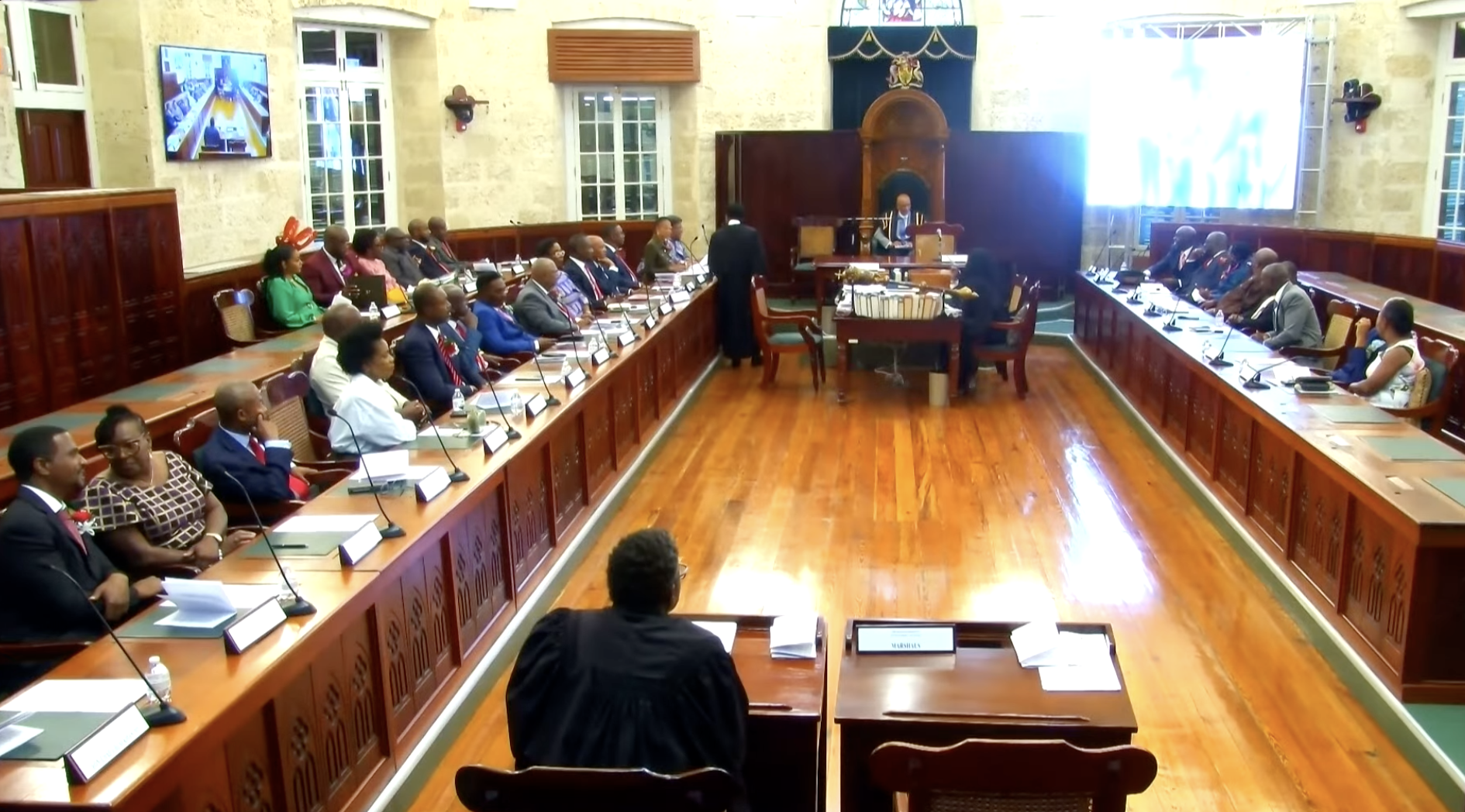
    DEBATE OVER political independence has intensified following the opening of the new Parliament last Friday, where Arthur Holder was named the first Independent Speaker of the House – not drawn from one of the elected Members of Parliament (MPs).

    While the appointment was made in keeping with constitutional rules, political observers say the issue is not simply about what is legally correct, but whether the public believes the process truly reflects independence.

    Holder, who was Speaker from 2018 up to when Parliament was dissolved last month to make way for the February 11 General Election, previously served as Member of Parliament for St Michael Central under the Barbados Labour Party (BLP). For some, that history sits uneasily with the label of “independent”.

    Political scientist Devaron Bruce told the DAILY NATION the public concern was understandable.

    “Regarding the position of Arthur Holder again as the Speaker of the House and the connotation that he is independent, naturally persons could raise questions as to whether he really is, given the fact that he ran on a BLP ticket and won on a Barbados Labour Party ticket on two occasions and in recent memory. So it is not an unreasonable criticism,” he said.

    However, he stressed that the bigger issue was not necessarily Holder’s ability to perform the job fairly, but whether the way he was chosen gives the appearance of true neutrality.

    Bruce said he believed the selection process itself could have been structured differently to strengthen public confidence. He suggested that the President, who is widely viewed as a neutral constitutional figure, could have been given responsibility for choosing the Speaker.

    Election process

    “To my mind, a Prime Minister, who is the most partisan individual in a Parliament, ought not to be selecting what is supposed to be an independent Speaker,” he said.

    Still, Bruce made it clear that questioning the process was not the same as questioning Holder’s conduct in office.

    “No, that does not mean that he can’t be independent in the execution of his job,” he said.

    “But is the process of his election one of genuine independence? That is the real question.

    “Nobody is saying that Arthur can’t be independent in his duties, but we should really focus on whether the process itself engenders a level of confidence that it has been an independent process.”

    On the reappointment of St Michael North West MP Neil Rowe as Deputy Speaker, Bruce suggested familiarity with the role might have played a part.

    “He’s been elected before as Deputy Speaker . . . so it’s just really assuming a responsibility that he would have had before.”

    Political scientist Dr Kristina Hinds was more direct.

    “Mr Holder is not an independent Speaker. He was just in Parliament as a representative, elected on the BLP side,” she said.

    “He is independent of those who were just elected, but this person cannot be viewed as independent.”

    Hinds, a former Independent senator, said while Holder might be capable in the role, independence in the strict sense would have required selecting someone with no present or past ties to a political party.

    “Is he a competent speaker? Sure. Independent? No,” she said.

    “They could have gotten somebody who was not in the Barbados Labour Party; that’s what they could have done.”

    Despite concerns about the composition of the House and Senate, Hinds said that citizens still hold power within the democratic system.

    “The people of Barbados always have a say and it is up to the people of Barbados to exercise their right to ensure that their voices are heard on important issues.”

    Providing a legal perspective, attorney Kristin Turton said much of the debate might stem from how the term “independent” has been interpreted by the public.

    She said that, in law, independence does not refer to freedom from political affiliation, but to the fact that the Speaker is not an elected MP.

    “When you look at the legislation, it does not speak to independence in terms of any political party or affiliation. It is more concerned with the fact that this is the first Speaker who is not an elected Member of Parliament.”

    Political ties

    Under the constitutional amendment, MPs select someone who is not elected to the House or Senate to serve as Speaker. There are no rules preventing that person from having past political ties.

    “I think that is the challenge, how it has been communicated to the public,” Turton said.

    “People took that change to mean that this was a person who would no longer be associated with any political party.”

    She said the Speaker also has a casting vote in the event of a tie, something that could heighten public concern about political background if such a situation arose.

    “The question of political affiliation may come into the minds of people and whether that concerns them is really a political question,” said Turton, who is also a moderator on Starcom Network’s radio call-in programme Down To Brass Tacks.

    “Mr Holder has been appointed in accordance with the constitutional amendment and, similarly, Mr Rowe was properly appointed,” she added.

    Source: Nation


  27. Democratic governance – dead or alive?

    by SIR ERROL WALROND WITH THE THIRD TIME that a Government is formed in the Parliament of Barbados with no representative to fill the post of Leader of the Opposition, one could argue that parliamentary democracy is under serious threat in Barbados, if not already dead.

    The pollsters and the pundits have spoken, and, generally, they have blamed the Democratic Labour Party (DLP) for their inability to motivate the voters to elect any of their candidates. As regards, the low voter turnout, they have blamed the youth, although this can in no way account for two-thirds of the electorate who did not go to the polls.

    The Prime Minister has spoken, and she has prioritised the wish of her “parliamentary representatives” to introduce legislation to prevent one of them “crossing the floor” to become Leader of the Opposition and thus fulfil the spirit and letter of the Constitution in having a democracy that can reflect more than one voice.

    Such legislation will fundamentally alter the Constitution, which does not recognise any political party and ignores the vote of citizens who were not called upon to vote on the ballot for a representative of any political party.

    A look at the raw figures of those who voted on an electoral list that some have contended had been purged, and therefore made smaller, will show that the successive “whitewashes” have been on a declining percentage of the electorate and none of them over 50 per cent and now reaching a third of those entitled to vote. My simple interpretation of these figures would be that there is widespread disaffection with the performance of Government as well as an overwhelming distrust of the DLP’s ability to govern the country again. These two things can be examined separately although they have some common features.

    First, the DLP, because of its inability to gain any of the 30 available seats. The DLP should ask itself why it rose and became so popular with the voters, who then became so disenchanted with them. The DLP rose on the then “revolutionary” political concept of lifting the poor masses up by providing free secondary education and free access to health care. This was carried out by a leadership which eschewed corruption in public life, but did not ignore the need to allow businesses to develop in transforming the economy. It formalised the concept of Government-built housing for the poor and created opportunities for the middle class to own land and build their houses.

    The sacrifice that the families of some representatives faced was that they died in office without riches, indeed some were in debt. This circumstance led parliamentarians to look at their own conditions, better salaries and pensions for themselves and a stout resistance to any examination of the sources of their funding.

    Unfortunately, the self-serving conditions created has led to a situation where becoming a Member of Parliament is no longer a vocation. It is now a job opportunity, with full-time salaries and pensions for part-time jobs. On the other hand, constituents came to believe that such “job” rewards should be shared for their vote, and what started as corned beef and biscuits at election time has escalated to year-round demands and increased expenditures at festival times as well as at election time. Where does the money come from for the constituents’ demands?

    Repeated calls from the electorate at large for effective “integrity” legislation has been met by reluctantly passed legislation, but then, making sure that there is no established mechanism to enforce such legislation.

    The actions of parliamentarians in general were exacerbated by the DLP’s last performance in government, where the country was faced with declining management of its finances and Government-run facilities; state-run organisations not accounting for themselves; garbage collected infrequently in poor neighbourhoods; Governmentrun buildings, including schools, becoming “sick” and failing to adequately address the underlying causes; a public transport system allowed to become increasingly unruly; failure to adequately address the ageing water distribution system and destroying the reputation of the island for clean drinkable water from every tap. This Barbados Labour Party (BLP) Government reversed the declining financial status of the country. The financial recovery itself was done in part at the expense of former Government Savings Bond holders and the NIS fund. Previous BLP spokespersons, having originally opposed the introduction of free secondary education, are now presiding over a declining examinations performance in the sector and an expressed dissatisfaction by some parents as to the social policies that may be introduced to their children.

    Sick school buildings remain unaddressed for long periods, and parents are fed-up with their children being unable to attend school or being shuttled to temporary facilities.

    A previous BLP Government had closed down health facilities and current efforts to expand such access have left the public dissatisfied with their inability to access Government health facilities.

    Electric buses were obtained and deployed to the great satisfaction of the public, but PSVs transporting schoolchildren and encouraging feting and the children arriving late at school remained unaddressed.

    The last blow to the bus-travelling public was the Government’s promise to divest the Transport Authority and the electric buses it had acquired. The workers were said to be those who will be able to acquire these buses, which everyone knows is beyond their means. So the buses purchased with taxpayers’ money and enjoyed by them will now be divested to “workers” and the service to remote areas will decline, and the electric buses will join the unruly PSV system transporting schoolchildren on a “fete” rather than to school.

    More garbage trucks were imported, but garbage collection continues to be a problem in some poor areas. Conversion to solar electricity generation was promoted as a way to help save the planet and to reduce our electricity bills, but many citizens who wish to participate in this exciting opportunity cannot do so because they are not allowed to connect to the grid and no other alternative is offered to participate in this widely applauded initiative.

    Potholes spring up on newly surfaced roads and the importation of multiple machines to fix them is hailed as a triumph. Last but not least, after complaining that a DLP Government was too big, almost every parliamentarian is given a ministerial post.

    Whenever there is a looming problem, the Prime Minister steps in to deal with it and not far away is a feting opportunity for the public. On the other hand, our Prime Minister has commanded great respect on the international stage by speaking truth to power as a small developing state, and this has rightly been a great source of pride to many, both at home, in the region and farther away.

    The real interpretation of the decline to one-third participation by the electorate in the elections could be the dismay with which the people view the performance of both parties in Government in addressing the daily issues in their lives – garbage collection, public transport, sick buildings, particularly schools, the declining school performance of children as well as their behaviour in public places.

    These are issues that are seen to affect both parties, and the reason why the DLP remains out of favour is that they do not appear to have taken responsibility for any of the problems that occurred when they were in office, as well as the complete disarray shown in dealing with a seemingly straightforward matter of a defection from the BLP ranks to claim the office of Leader of the Opposition and to join their party.

    In reality, the two defections to become the Leader of the Opposition have resulted in political graves so far, yet we hear Government unconstitutionally wishing to prevent such an act by one of the few parliamentarians that would not have had their salaries raised to a ministerial one.

    Restoration of confidence by the electorate to come out and vote in greater numbers will rely on a political party declaring a philosophy of governance for the country that can be bought into over the tenure of this Government; a party that produces a manifesto for governance from now, not a few days before an election. Yes, some ideas will be stolen but this can be pointed out to a literate electorate who will see the party as being ready to govern.

    With the means of communication available today, an effective Opposition can be led from outside of Parliament. These ideas should, in my opinion, include measures for integrity in office, in spite of any internal party problems that might bring. Many people entitled to vote are no longer willing to vote for political infelicities and powergrabbing; they want to see governance for the benefit of the people, not for the politician – whether in Parliament or out. It is only when political transparency is restored that the people are likely to return to the ballot box. I will not hold my breath.

    This article was submitted as a Letter to the Editor.

    Source: Nation


  28. No unity plan

    by MARIA BRADSHAW mariabradshaw@nationnews.com

    THE DEMOCRATIC LABOUR PARTY (DLP) and its breakaway faction, the Friends of Democracy (FOD), are pressing the brakes on major decisions regarding leadership and potential reunification until they meet with their memberships later this year.

    General secretary of the DLP, Pedro Shepherd, and his FOD counterpart Steve Blackett, have confirmed that these critical issues – including a post-mortem of the recent General Election – will be agenda items for their respective upcoming internal meetings. The DLP is scheduled to hold its annual conference in August while the FOD has set its meeting for May.

    The discussions come on the heels of a General Election that saw the DLP suffer a third consecutive 30-0 defeat at the hands of the Barbados Labour Party.

    Speaking to the DAILY NATION yesterday, Shepherd said that despite the crushing electoral loss, the party is continuing to move forward. He added it currently retains a presence in the Senate and has an operational leadership structure in place.

    “The party has to move forward. It has one seat in the Senate, it has a president, it has a general secretary, who are seen as more or less the leadership of the party,” he stated.

    Shepherd outlined a temporary division of labour to keep the party functional, explaining that the general secretary would handle administration and the General Council, while the president manages the General Council and executive matters. Senator Ryan Walters, he added, will focus on parliamentary issues.

    Regarding the contentious issue of selecting a political leader, Shepherd said the DLP intends to follow its constitution, while dismissing the notion that it is a pressing crisis.

    “There’s an issue of political leader and so on. The constitution speaks to how that person is chosen, so we will follow the constitution. The party will go through those stages and find a resolve over those issues. I don’t think it is the biggest issue at this stage, but we will be meeting shortly.”

    He added that he, Walters and president Ralph Thorne are working to set the stage for the party’s rebuilding efforts.

    When asked if the DLP had considered changing how its leader is selected, Shepherd indicated that constitutional amendments were not currently a priority.

    “The constitution is due to be amended, but we haven’t given any thought recently to that. I don’t know if it will come on the agenda of the party coming up soon, but at this stage, it is not a consideration,” he said.

    On the possibility of joining hands with the FOD – whose president, Karina Goodridge, was also afforded a Senate seat – Shepherd revealed that informal discussions have taken place.

    “Persons on the executive and ordinary members of the party would have been in communication with members of the Friends of Democracy to see if they would be willing to come back, what arrangements the two groups can have and that kind of stuff,” he said.

    Not immediate

    However, the general secretary acknowledged that a merger might not happen immediately, pointing out that the FOD left due to leadership issues that they may still perceive to exist. Despite this, he stressed the need for opposition unity, saying that it is “better for us to all work together for the common good of working against the Barbados Labour Party”.

    Shepherd said Barbados remains a two-party state, indicating that smaller parties would struggle to make an impact alone.

    “The party is still very much open for all of these smaller parties to meet with us and discuss how we can join forces in whatever form or fashion,” he said.

    The DLP’s 30 candidates met on Sunday to review their election performance and Shepherd said while it was too early for definitive decisions on future runs, none of them indicated a desire to step away from politics.

    Blackett adopted a more measured tone regarding a potential reunion with his former political home.

    While acknowledging he holds a “personal position” on the matter, Blackett, a former general secretary, Member of Parliament and Cabinet minister in the last DLP administration, said the FOD was focused on the road ahead.

    Source: Nation


  29. Had COMMON SENSE not been taken away from us due to our endemic brassbowlery, it would have been obvious – even to students at school, that ANYONE who was seriously interested in the BEST INTERESTS of the country would have moved the earth to FORMALLY INCLUDE such brilliant natural talents as:
    -PLT
    -Caswell Franklyn
    -Tricia Watson
    -Ricky Went
    …into the policy-making aspects of National management at the senate level.

    They would also obviously FORMALLY include our professional organizations into the national planning and ‘think tank’ processes – and be guided by their considered and collective wisdom.

    ‘Merit’ would be the guiding factor in decision-making. Those who PRODUCE RESULTS would be elevated to higher responsibilities, those who fail will be positioned at their appropriate levels.

    Instead, we see a system of partisanship designed to retain ‘powah’ rather than to achieve ongoing development and improvements…
    and the BBs cheer….!

    Spiritual blindness is a serious curse.
    What a place!


  30. @Bush Tea

    What incentive is there for members of the political class’ or ‘political directorate’ to include/embrace outsiders?


  31. It seems on path to access being named a senator or getting a ‘pick’ is to be a moderator.

  32. simplicity people Avatar

    There is something wrong when the man and woman on the street are mumbling and grumbling about flaws in the Parliament system on a wish and a prayer that something be done (by Parliament) to remedy the situation.

    I understand the dissolved Parliament needs to be reformed quickly or there would be anarchy. But, the original issues of having no opposition and LoO in the lower house has been ignored / deemed unnecessary. Now, the next set of issues is the formation of the Senators in upper House, which is discretionary and arbitrary, and seems like it’s just a process of sending out Party Invitations to best friends.
    The next gaping hole / gap in the system to address would be redesigning formal Constitutional rules how should the Senate should be constituted.

    I had tried to post a link on why the Westminster system is well dodgy and will try again with another Re-Up
    https://politicsforthemany.co.uk/why-the-westminster-system-is-bad-for-democracy/


  33. 30-0 is rubbish.

    Three times we have had a House of Assembly but no Parliament.

    To understand King Charles you have to understand that Britain is deliberately trying to destroy the financial system of the world.

    The man is into globalization.

The blogmaster invites you to join and add value to the discussion.

Trending

Discover more from Barbados Underground

Subscribe now to keep reading and get access to the full archive.

Continue reading