

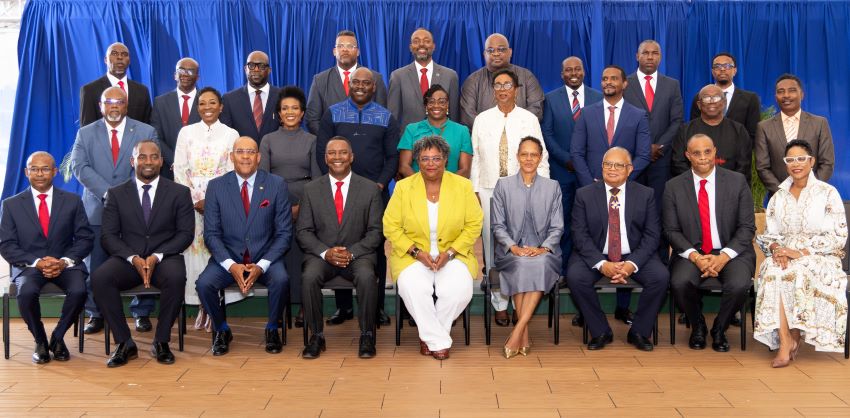


Silent Ministers Indar Weir, Sandra Husbands, Colin Jordan and Jonathan Reid to mention four.
Barbados has perfected a political art: the ability to establish ministries that barely speak, report, are a no show- yet engage in business as usual activities, untouched, unchallenged. These low visibility ministries operate like shadows in the Bajan political system that rewards noise, theatrics and political expediency above meritocracy and accountability. And the public, numbed by decades of deference -in sheep like fashion- has learned to accept silence as good governance.
The truth is uncomfortable: some ministries survive because they stay quiet. They avoid scrutiny by making little noise, avoiding a moribund media. Dishing out ‘favours’ to so called social media influencers. In a small society where political attention is a precious resource fueled by the Queen Bee, silence is a value added for the parasites.
Take the ministries responsible for vocational training, innovation, public investment, housing, or legal affairs. These portfolios touch critical national priorities, however, they rarely dominate local news. The lack of visibility is not just a function of political tactics fused with incompetence; it is a function of our political culture. Barbados has built a governance environment where only the politically urgent gets oxygen, and everything else suffocates, especially national priorities.
This is where political expediency rears its head. Barbados’ political class has mastered catering to public attention: increase the noise coming from the ministries that deliver quick wins, visible projects, or emotionally charged talking points, and let the rest blow in the wind. The ministries that deal with long term structural issues – the ones that require transparency, patience, and hard conversations – are allowed to operate away from the glare of the public.
Political expediency thrives on immediacy. It rewards ministries that can produce ribbon cuttings, press conferences, and photo ops. It rewards ministers who can stand in front of a camera and declare progress, even if the underlying systems remain unchanged. Meanwhile, the quieter ministries become repositories for slow moving reforms, deferred decisions, and administrative inertia. They become the places where political promises go to hibernate. The inability to operationalise integrity and freedom of information laws spring to mind.
And Barbadians, conditioned by decades of Westminster conventions, rarely demand more. We critique institutions in rum shops and WhatsApp groups but less so in formal channels. This cultural nuance creates the perfect environment for low visibility ministries to operate without pressure.
The result is a governance ecosystem where silence becomes a form of political survival. A ministry that does not speak cannot be contradicted. A minister who does not appear cannot be questioned. A portfolio that does not report cannot be measured. And in Barbados, where political loyalty outweighs performance, this silence is rarely punished. Then add a group of MPs ‘debating’ issues in parliament without an elected opposition.
Barbadians should know that silence has consequences. It breeds lethargy and mediocrity. It erodes trust. It allows inefficiency to masquerade as stability. It creates a government where the public sees only what is manufactured to be seen. Does anyone believe the recent expose of migrant workers was staged to generate PR for the two stakeholders, government and the BWU?
If Barbados is serious about institutional maturity, the country must frontally confront this inbred culture. Accountability cannot depend on which ministry is politically fashionable. Transparency cannot be optional. And public engagement cannot be reserved for crises.
The quiet ministries must be pulled into the light – not to shame them, but to ensure that governance is not a performance but a practice to pursue excellence. That it becomes wired in a preferred governance model. Barbados deserves a government where every ministry is visible, every minister is answerable, and silence is no longer a pathway to achieve.
Are we there yet?




The blogmaster invites you to join the discussion.