← Back

Your message to the BLOGMASTER was sent

*Isidoros Karderinis, journalist, foreign press correspondent accredited by the Ministry of Foreign Affairs, regular member of the Greek Foreign Press Correspondents' Association, novelist, poet and lyricist. Facebook: Karderinis Isidoros
Submitted by Isidoros Karderinis

US President Donald Trump’s attempt to “grab” Greenland constitutes a neo-colonial effort by a global “sheriff” who clearly does not respect the island’s national sovereignty and fundamental human rights.

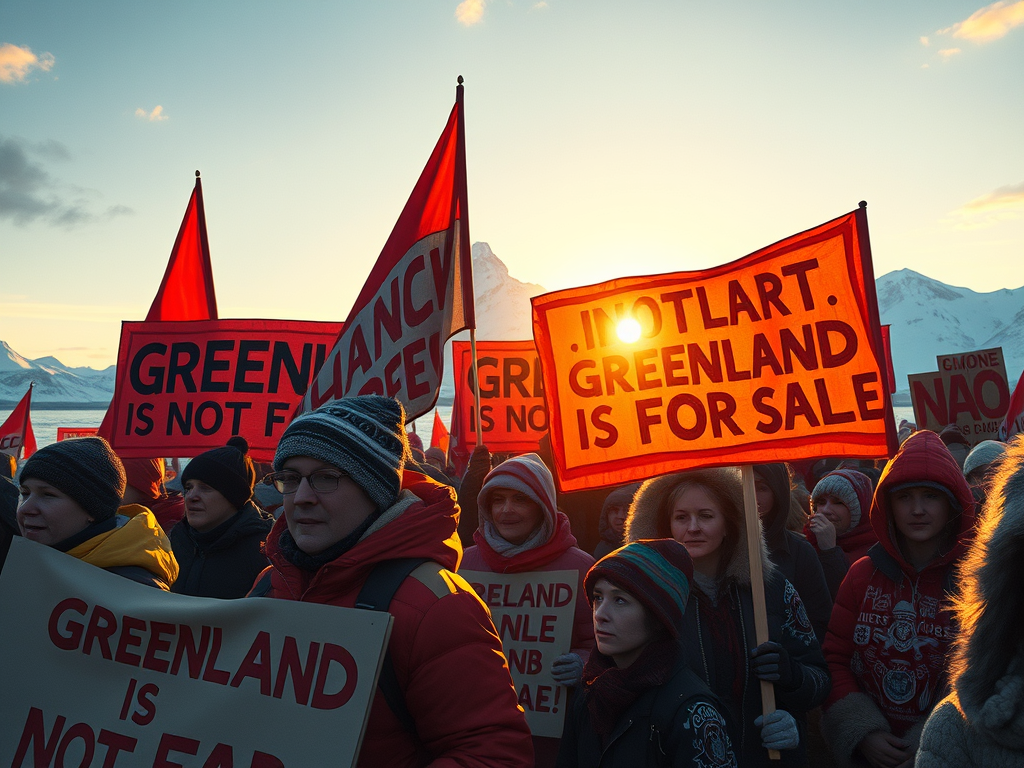
Thus, demonstrations took place in the capital Nuuk – the largest demonstrations in Greenland’s history – and Copenhagen, with slogans such as “Greenland is not for sale” and “Greenland belongs to the Greenlanders”, and which highlighted the will for self-determination. At the same time, polls show that about 85% of Greenlanders reject the prospect of joining the US. Greenland’s 34-year-old Prime Minister Jens-Frederik Nielsen, moreover, has described the pressure as “disrespectful” and has called for an end to threats and rhetoric about annexation “among friends.”

The Prime Minister of Denmark, Mette Frederiksen, speaking in Parliament on Tuesday, January 20, 2026, stated the following: “This is a dark chapter we are in” and clarified that “Denmark cannot negotiate sovereignty, identity, borders and democracy.”

The subsequent retreat of US President Donald Trump on plans to use military force to occupy Greenland and the cancellation of additional tariffs on eight European NATO member states that opposed his plans to acquire the island is phenomenal because his aggressive, conquering dispositions have not in essence diminished at all, while the “rift” in the Euro-Atlantic axis has become deep, testing the cohesion of the Western world.

But let’s see what Greenland’s data is and why it is so important island. Greenland is the largest island on our planet with an area of ​​2,166,086 square kilometers, since Australia, although larger in area, is considered a continent and not an island. At the same time, it is currently an autonomous island and is a member of the Kingdom of Denmark, which, it should be noted, has been a member of NATO and an ally of the United States, since 1721.

Greenland was a Danish colony until 1953. Since that year, it has been a county of Denmark. It has been self-governing since 1979, and in 2009 it was granted even greater autonomy, with the right to exploit its natural resources, a move that many saw as paving the way for eventual full independence.

The head of state is King Frederick X of Denmark (since 14 January 2024), who is represented by a high commissioner. The head of government is the prime minister, who is elected by Parliament. The cabinet is also elected by Parliament, called Landstinget. The 31 members of Parliament are elected by the system of simple proportionality in multi-member constituencies by the people and their term of office lasts 4 years. Anyone aged 18 or over has the right to vote in elections.

The majority of the population, which amounts to approximately 56,000, are Inuit (Eskimos), who came into mixing with the first European settlers (of Danish and Norwegian origin) and speak Greenlandic and Danish.

This Arctic island is geographically located in North America, while culturally, demographically and politically Greenland is an island linked to Europe. To the southeast of Greenland are the Atlantic Ocean and Iceland, to the east the Greenland Sea, to the north the Arctic Ocean and to the west Baffin Bay and Canada.

Most of the island, i.e. about 80% of Greenland’s surface, which corresponds to 1,700,000 square kilometers, is covered by a huge ice sheet. Only the southwestern and southeastern coastal zones, which correspond to the remaining 20%, are not covered by ice. It is the only free and inhabited area, but bare, with many rocks, fjords and islets. For two months every summer it experiences the “Midnight Sun” with continuous light, while in winter it experiences the “Polar Night” with continuous darkness.

Greenland does not have a developed road network connecting towns and villages. Transportation is mainly by sea and air, with airports and heliports throughout the country. On land, transportation is by snowmobile and sled.

The economy of the island, whose currency is the Danish krone and whose GDP is estimated by the World Bank to be between $3.5 and $4 billion, is based on fishing, which accounts for 95% of Greenland’s exports, and fish processing, which is a major industrial activity. A few residents also engage in limited farming on the southwestern coast, where cattle, sheep and poultry are raised.

Greenland is therefore not rich in the conventional sense and given that its resources are largely underutilized. Its economy is small and in order to “survive” it receives an annual subsidy of 520 million euros from Denmark – that is, about 9,000 euros per inhabitant. This is also why many on the island are hesitant to demand immediate independence from Denmark, which has shown colonial behavior in the past.

Greenland also has deposits of gold, uranium and coal. According to recent research, there are also deposits of oil and natural gas. Its territory also contains large deposits of rare earths. According to reliable data, 25 of the 34 minerals that the European Commission has classified as “critical raw materials” are found on the island.

The US, however, does not see Greenland simply as a repository of raw materials, but as an island with strategic value that ensures access, surveillance, and defense over the North Atlantic and Arctic corridors.

Militarily, the US already maintains the Pituffik Space Base in northwestern Greenland, near the city of Kanak – one of the northernmost cities in the world. The base hosts early warning radars, integrated into the US missile defense network, and operates as an advanced part of the NORAD system to detect ballistic missile launches crossing the Arctic.

Denmark, for its part, is constantly strengthening its presence in the region with new warships, drones and satellite infrastructure.

In closing, I would like to emphasize that the only ones competent to decide on the fate and future of the island are the inhabitants of Greenland. It is not possible for our world, the international community, to be allowed to turn into a world where the principles of international law are blatantly violated, turning it into a tattered paper, and in which the law of the jungle, that is, the right of the strong, will prevail. Therefore, every democratically and rationally thinking person cannot help but shout loudly: “Trump, hands off Greenland.”


Discover more from Barbados Underground

Subscribe to get the latest posts sent to your email.

10 responses to “Greenland: Trump’s predatory mood”


  1. What “international law”?

    There is no such thing!

    What Drumpf is mouthing is indistinct from what White people have always done and what he has doubling down on in Venezuela, Gaza, Iran and everywhere else which his demented mind or his bagmen suggest might enhance Drumpf’s personal wealth.

    However, the White people of Denmark should not attract the support of the world because they have a history of the exploitation, genocide, of the Inuit peoples of Greenland not unlike the Americans, the Canadians, the Europeans too. Even as the other Europeans are lying in wait to use Greenland as a chip to trade with the Americans in exchange for concessions over Ukraine or with NATO.

    In any event American has no money, other resources, to properly exploit the mineral resources under the melting ice sheet for they lie 200 kilos deep. And even if they did the Chinese currently control 90 percent of rare earth, which are everywhere, but require refining processes largely so controlled.

    In addition, America has no industrial capabilities to build-out the large fleet of ice-breakers necessary for navigation during most of the year. It’s the Russians!

    Most importantly, this play by Drumpf is merely geo-strategic. For the North-West Passage is seen in Washington as the way Russia and China, the BRICS more generally, seek to bypass sea corridors currently controlled by the West and do so much more inexpensively. To have freedom of navigation unempeded by the West. This is the real game here.

    Another data point of a dead umpire displayed signs of rigor mortis.


  2. ANOTHER EXAMPLE OF WEAPONS OF MASS DISTRACTION IN THE CAMP OF MEAT-HEADS WHO ARE CLUELESS ON THE ISSUE OF PRESCIENCE, FOREKNOWLEDGE, FUTURISM & PROPHETIC PERTUBATIONS

    #WhyIsThisEvenAStory

    The “ISSUE” is not even about “GREELAND” or any of the “HORSE MANURE”!!!

    Since the “LAME-STREAM MEDIA” made a lotta’ “HOOPLA” about a “STORM IN A TEACUP” – “IGRUNT” people have jumped on the bandwagon that was hitched to the “DRUNKEN” salon in Trump’s “DEMNTIA” brain!!!

    Now that the “FAKE PIXIE DUST” has settled & the “RASTAMAN GANGA SMOKE” has cleared, attention is being shifted every which way (TOWARDS EPSTEIN FILES TO GOD KNOWS WHAT), when the real “ISSUES” are being “SKIMMED” over or blatantly overlooked!!!

    According to Ukraine’s Commander-in-Chief Oleksandr Syrskyi, over 427,000 Ukrainian military casualties occurred in 2024 alone & the numbers in 2025 are still being assessed – expecting those numbers to almost “DOUBLE”!!!

    70,668 Palestinians were killed in the Gaza Strip between 7 October 2023 & 17 December 2025, according to the Gaza Ministry of Health (MoH), as reported by OCHA in UNRWA Situation Report #202

    Since the ceasefire took effect on October 10, 2025, Al Jazeera analysis states that 526 Palestinians were killed & 1,447 injured by Israeli attacks during the ceasefire period from October 10, 2025, to January 31, 2026!!!

    “JARED KUSHNER” & “BENJAMIN NETANYAHU” has been pushing “TRUMP” to hit “IRAN”, but have “WALKED BACK” from the edge due to Chinese “INTERVENTION” but everything is in place for major escalation & all that is needed is for some “DAMN ASS” to “SCARTCH A MATCH” & the Middle-East becomes a “ONCE & 4-ALL GUY FAWKES DAY”!!!

    I keep saying that “EVERYTHING” is gonna’ “BURN”!!!

    Europeans are “PREPPING” 4 THE CONTINUATION WORLD WAR II* & its aftermath – while the “Middle East” (BUT ESPECIALLY ISRAHELL*) is preparing for #WW3 & THE APOCALYPTIC FALLOUT!!!

    This is “GEO-POLYTRICKS” on steroids & it ain’t about “GREENLAND” – where nothing will ever be the same “AGAIN”!!!


  3. @ Isidoros

    A new world order isn’t coming, it’s already here − and this is what it looks like:

    On Sept. 3, 2025, China celebrated the 80th anniversary of its victory over Japan by staging a carefully choreographed event in which 26 world leaders were offered a podium view of Beijing’s impressive military might.
    The show of strength was deliberate and reignited a debate in Western media over whether we are on the cusp of a China-centric “new world order” to replace the U.S.-dominated international “rules-based order.”
    But as someone who writes about geopolitics, I believe we are already there. It might be in flux, and the U.S. still has a big role in it, but a new world order has begun – and as it develops, it will look increasingly different than what it’s replacing.
    A brief history of world orders
    Global history can be understood as the rise and fall of different orders, defined as a given era’s dominant power relations and attendant institutions and norms.
    From 1815 to 1880, the United Kingdom was the undisputed world superpower, with an empire and navy that spanned the globe. The period from 1880 to 1945 was one of imperial rivalries as other countries – largely European and the U.S. – sought to copy Britain’s success and replace its dominance. Supplanting that was the bipolar world of two competing superpowers, the Soviet Union and the U.S., marking the period from 1945 to 1991.
    The fall of the Soviet Union was the beginning of a brief period, from 1991 to 2008, of a unipolar world centered on U.S. global dominance, military power and economic might. With the retreat of global communism, the U.S. increased its influence, and that of the international rules-based order it helped establish after 1945, through institutions such as the World Trade Organization, World Bank and International Monetary Fund.

    It did not last long in the face of a long war on terrorism, the fiasco of the invasion of Iraq, the long occupation of Afghanistan and finally the 2008 global financial crisis that undermined U.S. strength and weakened domestic support for Washington’s role as the world’s policeman.
    Toward a multipolar world
    In recent years, a new multipolar world has emerged with at least four distinct sources of power.
    The U.S. remains central to this world order. It is blessed with a huge territory, a dynamic economy and the strategic luxury of large oceans on its east and west and much smaller powers to its north and south. The U.S. had a global military presence in the previous bipolar and unipolar order. But the cost of this imperial overstretch has prompted Washington to shift the cost burden toward its former allies, leading to a new militarization in Europe and East Asia where most countries now aim to increase military spending.
    There is also a change in economic arrangements. In the unipolar order, the U.S. promoted a frictionless free trade arrangement and economic globalization. This resulted in the global shift of manufacturing that in turn created a populist backlash in those countries where manufacturing employment was hollowed out.
    Now, economic nationalism is becoming a much more common refrain than free trade. Long the promoter of purportedly open markets, the U.S. is now leading the way in resurrecting tariff barriers to levels that haven’t been seen on the global stage in decades.
    The military realignments and growing trade barriers will make it increasingly difficult to assemble durable alliances. In the short term the U.S. can leverage its existing power to its advantage, but over the long term other countries will likely pivot away from too much reliance on the U.S. The American Century that publishing magnate Henry Luce famously described in 1941 has to all intents and purposes come to an end.
    China is now a peer competitor to the U.S. in both economic and military power. Increasingly, under the powerful leadership of Xi Jinping, China openly seeks a more Sino-centric world order with institutions and a global arrangement to match. To that end, it is assembling an axis of resistance to a U.S.-dominated world order. Russia, suffering from post-imperial syndrome, is an important member but not an equal partner.
    Russian power is limited to establishing a Eurasian sphere of influence across its former Soviet republics and disrupting liberal democracies. But in that, Russia is more of a spoiler than an architect of the new order.
    And then there is Europe, facing what British Prime Minister Keir Starmer referred to as a “generational challenge” as the U.S. pivots away from Europe toward the Indo-Pacific just as Russia poses a more serious threat to Europe, especially for its easternmost states.
    Europe is remilitarizing after decades of demilitarizing. Sweden and Finland joined NATO in 2023 and 2024, respectively. In the coming decades, Europe could emerge as an independent source of both economic and military power with a different agenda from the U.S. – more keen to confront Russia, less willing to support Israel, and perhaps more willing to engage with China.

    But all three power centers – the U.S., China and Europe – will struggle with similar and unique internal challenges.
    All of them have sluggish economies and aging populations. The U.S. faces growing inequality and political instability as it shifts from a liberal democracy to competitive authoritarianism. China has an untested military, a looming demographic crisis, a faltering economy and a forthcoming succession struggle.
    Finally, Europe is beset with a nationalist populism and growing social welfare costs just as military expenditures are set to increase.
    The growth of the Global South
    This threefold division is strangely reminiscent of the tripartite global division in George Orwell’s “1984,” where Oceania, Eurasia and Eastasia fought a permanent war of shifting alliances.
    But Orwell was writing at a time when much of what is now called the Global South was either under the informal or formal control of the superpowers. That is no longer the case in the Global South, especially in the case of the larger countries such as Brazil, India and Indonesia.
    The Global South is not yet a coherent bloc, more an informal arrangement of independent actors that tend to hedge between the major powers.
    A world in flux
    Yet none of this new global reality means that things are now fixed. Indeed, the new world order is in a state of disruptive flux that promises years of growing pains. Both the U.S. and China need allies, and countries in the Global South will continue to hedge between the competing powers.

    As such, the world is in for a process of constant jostling as the major powers seek alliances while dealing with domestic pressures. In that messy status quo, many questions remain: Who will be most effective in building durable alliances? Will China manage its internal challenges? Will Europe get its act together? Will Russia continue its disruptive ways? Could a post-Trump U.S., post-Putin Russia and post-Xi China move the world in yet a different direction altogether?
    And there is one large question above all others: Can the major powers manage their competition through shared global interests, such as combating climate change, environmental pollution and pandemic threats? Or will mounting conflict in the newly contested areas of the Arctic, cyberspace, outer space and the oceanic realm, and in ongoing geopolitical hot spots provide the trigger for outright conflict?
    All world orders come to an end. The hope is the old one is doing so with a whimper rather than a bang.

    In the new world order, small countries may face significant challenges but can also find opportunities for strategic advantage.
    Shifting Power Dynamics
As larger nations assert their influence, small countries may struggle to maintain autonomy. However, they can leverage their unique positions to act as mediators or hubs for diplomacy, fostering relationships between larger powers.
    Economic Opportunities
Small nations can benefit from niche markets and specialized industries, attracting foreign investment. By focusing on sectors like technology, tourism, or renewable energy, they can enhance their economic resilience.
    Regional Alliances
Forming coalitions with neighboring countries can amplify their voices on the global stage. Collaborative efforts in trade, security, and environmental issues can provide small nations with greater leverage against larger powers.
    Adaptation to Global Trends
Embracing globalization and technological advancements can help small countries innovate and compete. By investing in education and infrastructure, they can better position themselves in a rapidly changing world economy.
    In summary, while small countries may encounter difficulties in a multipolar world, strategic adaptation and collaboration can lead to favorable outcomes.


  4. It’s here!

    A new world order isn’t coming, it’s already here − and this is what it looks like:

    On Sept. 3, 2025, China celebrated the 80th anniversary of its victory over Japan by staging a carefully choreographed event in which 26 world leaders were offered a podium view of Beijing’s impressive military might.
    The show of strength was deliberate and reignited a debate in Western media over whether we are on the cusp of a China-centric “new world order” to replace the U.S.-dominated international “rules-based order.”
    But as someone who writes about geopolitics, I believe we are already there. It might be in flux, and the U.S. still has a big role in it, but a new world order has begun – and as it develops, it will look increasingly different than what it’s replacing.
    A brief history of world orders
    Global history can be understood as the rise and fall of different orders, defined as a given era’s dominant power relations and attendant institutions and norms.
    From 1815 to 1880, the United Kingdom was the undisputed world superpower, with an empire and navy that spanned the globe. The period from 1880 to 1945 was one of imperial rivalries as other countries – largely European and the U.S. – sought to copy Britain’s success and replace its dominance. Supplanting that was the bipolar world of two competing superpowers, the Soviet Union and the U.S., marking the period from 1945 to 1991.
    The fall of the Soviet Union was the beginning of a brief period, from 1991 to 2008, of a unipolar world centered on U.S. global dominance, military power and economic might. With the retreat of global communism, the U.S. increased its influence, and that of the international rules-based order it helped establish after 1945, through institutions such as the World Trade Organization, World Bank and International Monetary Fund.

    It did not last long in the face of a long war on terrorism, the fiasco of the invasion of Iraq, the long occupation of Afghanistan and finally the 2008 global financial crisis that undermined U.S. strength and weakened domestic support for Washington’s role as the world’s policeman.
    Toward a multipolar world
    In recent years, a new multipolar world has emerged with at least four distinct sources of power.
    The U.S. remains central to this world order. It is blessed with a huge territory, a dynamic economy and the strategic luxury of large oceans on its east and west and much smaller powers to its north and south. The U.S. had a global military presence in the previous bipolar and unipolar order. But the cost of this imperial overstretch has prompted Washington to shift the cost burden toward its former allies, leading to a new militarization in Europe and East Asia where most countries now aim to increase military spending.
    There is also a change in economic arrangements. In the unipolar order, the U.S. promoted a frictionless free trade arrangement and economic globalization. This resulted in the global shift of manufacturing that in turn created a populist backlash in those countries where manufacturing employment was hollowed out.
    Now, economic nationalism is becoming a much more common refrain than free trade. Long the promoter of purportedly open markets, the U.S. is now leading the way in resurrecting tariff barriers to levels that haven’t been seen on the global stage in decades.
    The military realignments and growing trade barriers will make it increasingly difficult to assemble durable alliances. In the short term the U.S. can leverage its existing power to its advantage, but over the long term other countries will likely pivot away from too much reliance on the U.S. The American Century that publishing magnate Henry Luce famously described in 1941 has to all intents and purposes come to an end.
    China is now a peer competitor to the U.S. in both economic and military power. Increasingly, under the powerful leadership of Xi Jinping, China openly seeks a more Sino-centric world order with institutions and a global arrangement to match. To that end, it is assembling an axis of resistance to a U.S.-dominated world order. Russia, suffering from post-imperial syndrome, is an important member but not an equal partner.
    Russian power is limited to establishing a Eurasian sphere of influence across its former Soviet republics and disrupting liberal democracies. But in that, Russia is more of a spoiler than an architect of the new order.
    And then there is Europe, facing what British Prime Minister Keir Starmer referred to as a “generational challenge” as the U.S. pivots away from Europe toward the Indo-Pacific just as Russia poses a more serious threat to Europe, especially for its easternmost states.
    Europe is remilitarizing after decades of demilitarizing. Sweden and Finland joined NATO in 2023 and 2024, respectively. In the coming decades, Europe could emerge as an independent source of both economic and military power with a different agenda from the U.S. – more keen to confront Russia, less willing to support Israel, and perhaps more willing to engage with China.

    But all three power centers – the U.S., China and Europe – will struggle with similar and unique internal challenges.
    All of them have sluggish economies and aging populations. The U.S. faces growing inequality and political instability as it shifts from a liberal democracy to competitive authoritarianism. China has an untested military, a looming demographic crisis, a faltering economy and a forthcoming succession struggle.
    Finally, Europe is beset with a nationalist populism and growing social welfare costs just as military expenditures are set to increase.
    The growth of the Global South
    This threefold division is strangely reminiscent of the tripartite global division in George Orwell’s “1984,” where Oceania, Eurasia and Eastasia fought a permanent war of shifting alliances.
    But Orwell was writing at a time when much of what is now called the Global South was either under the informal or formal control of the superpowers. That is no longer the case in the Global South, especially in the case of the larger countries such as Brazil, India and Indonesia.
    The Global South is not yet a coherent bloc, more an informal arrangement of independent actors that tend to hedge between the major powers.
    A world in flux
    Yet none of this new global reality means that things are now fixed. Indeed, the new world order is in a state of disruptive flux that promises years of growing pains. Both the U.S. and China need allies, and countries in the Global South will continue to hedge between the competing powers.

    As such, the world is in for a process of constant jostling as the major powers seek alliances while dealing with domestic pressures. In that messy status quo, many questions remain: Who will be most effective in building durable alliances? Will China manage its internal challenges? Will Europe get its act together? Will Russia continue its disruptive ways? Could a post-Trump U.S., post-Putin Russia and post-Xi China move the world in yet a different direction altogether?
    And there is one large question above all others: Can the major powers manage their competition through shared global interests, such as combating climate change, environmental pollution and pandemic threats? Or will mounting conflict in the newly contested areas of the Arctic, cyberspace, outer space and the oceanic realm, and in ongoing geopolitical hot spots provide the trigger for outright conflict?
    All world orders come to an end. The hope is the old one is doing so with a whimper rather than a bang.

    In the new order, small countries may face significant challenges but can also find opportunities for strategic advantage.
    Shifting Power Dynamics
As larger nations assert their influence, small countries may struggle to maintain autonomy. However, they can leverage their unique positions to act as mediators or hubs for diplomacy, fostering relationships between larger powers.
    Economic Opportunities
Small nations can benefit from niche markets and specialized industries, attracting foreign investment. By focusing on sectors like technology, tourism, or renewable energy, they can enhance their economic resilience.
    Regional Alliances
Forming coalitions with neighboring countries can amplify their voices on the global stage. Collaborative efforts in trade, security, and environmental issues can provide small nations with greater leverage against larger powers.
    Adaptation to Global Trends
Embracing globalization and technological advancements can help small countries innovate and compete. By investing in education and infrastructure, they can better position themselves in a rapidly changing world economy.
    In summary, while small countries may encounter difficulties in a multipolar world, strategic adaptation and collaboration can lead to favorable outcomes.

  5. Terence Blackett Avatar
    Terence Blackett

    @DirtFarmer

    CAN WE HAVE SOMETHING MORE GERMANE 2 WHAT COME FROM BETWEEN YOUR 2 EARS, PLEASE???

    If you are “INTENT” on “TEXTBOOK” – then #ArtificialIntelligence is NOT* it!!!

    Then 2 be “REPETITIVE” shows a lack of precision, “INDEPTH” analysis & poor analytical thought!!!

    This is what we would expect from the “SPIN-MERCHANTS” @CNN et al

    #CmonMan

  6. Terence Blackett Avatar
    Terence Blackett

    @DirtFarmer

    CAN WE HAVE SOMETHING MORE GERMANE 2 WHAT COME FROM BETWEEN YOUR 2 EARS, PLEASE???

    If you are “INTENT” on “TEXTBOOK” – then #ArtificialIntelligence is NOT* it!!!

    Then 2 be “REPETITIVE” shows a lack of precision, “INDEPTH” analysis & poor analytical thought!!!

    This is what we would expect from the “SPIN-MERCHANTS” @CNN et al

    #CmonMan

  7. Basslines & Ballistics Avatar
    Basslines & Ballistics

    Rise Warriors
    Extreme Indigenous Resistance

    The Fire This Time, Basslines & Ballistics, Still Standing On John Wayne’s Head


  8. When will authorities dig up the back nine of the greens at Mar A Lago, to check for bodies?

    Certainly not while Trump is sitting President. Nor Vance.

    But it needs to be done, if what is in the Epstein files are to be believed.

    You should now be understanding just how dire this situation is.

  9. Monkey Grinds The Organ Avatar
    Monkey Grinds The Organ

    Trump posts a video of Obamas as monkeys on Truth Social.
    Some people are calling this racist saying he is unfit to be President.

    For two seconds, the video shows the smiling faces of the Obamas superimposed on monkeys bobbing to “The Lion Sleeps Tonight”.

    As of Friday morning, the video has been liked more than 2,500 times and reposted more than 1,100 times, as prominent Democrats decried the post.

    “Disgusting behavior by the President. Every single Republican must denounce this. Now,” said the press office of California governor Gavin Newsom, a longtime Trump critic and potential 2028 Democratic presidential candidate.

    “This is overt racism. Full stop. There’s no ‘misinterpretation’ and no excuse. This is who he is, who he’s always been, and why he should never be anywhere near power again,” political strategist Adam Parkhomenko posted on X.

    The video was just one of more than 60 posts the president made on Truth Social over the course of three hours. In addition to repeating lies about the 2020 presidential election, Trump posted the Trump Accounts Super Bowl ad and calls to add his face to Mount Rushmore.

  10. PotCallinKettleBlack Avatar
    PotCallinKettleBlack

    After the #AMOUNT of shiiite you spew daily on this BLOG, to call out others is special.

The blogmaster invites you to join and add value to the discussion.

Trending

Discover more from Barbados Underground

Subscribe now to keep reading and get access to the full archive.

Continue reading