



Submitted by Tara Inniss, Historian
Growing up in Canada as the daughter of a Barbadian civil servant — whose own father could not vote at the time of his birth — I was raised to understand that voting is a central part of democratic participation. I have voted in every election in which I have been present and eligible since turning 18. It feels strange to have to affirm that so soon after an election, but I do so because choices can be difficult, and the stakes can be high. I therefore understand the challenges many citizens face in casting their ballot.
Another essential part of democratic life is the freedom to follow one’s conscience and to associate freely within civil society. I never imagined these freedoms would be tested in any country to which I belong — until the past two weeks. Our newly elected government is asking Parliament to consider yet another amendment to the Constitution. It is time for Barbadians to decide holistically what our new Republican Constitution should look and feel like, because it cannot continue to be reshaped by political expediency into a social contract that lacks durability.
I return often to the advice my uncle, another Barbadian career civil servant, gave me well before I voted in my first election here. When I cheekily asked him which party he supported, he simply said, “All.” I took that to mean two things: first, that he valued the freedom to choose from a political spectrum he once did not have; and second, that he guarded the anonymity of his choice and his independence to follow a path of conscience. That principle has guided my civic life, and I cannot think of a more important legacy for the 21st century than the right to act on one’s conscience free from repercussion.
Crossing the floor may unsettle voters, but ultimately we all need time to understand who is best suited to represent us — and not always from a party platform. I have lived in a constituency where my MP crossed the floor. I may not have liked it at first, but I came to understand it, and later to respect it. I needed time. Even the 2024 Parliamentary Reform Commission affirmed that freedom of association is a fundamental right of Members of Parliament, and a Minority Opinion proposed a 90 day period before a by election is called. The point is that constitutional decisions must be made not for what benefits any one of us now, but for what strengthens democracy for the future.
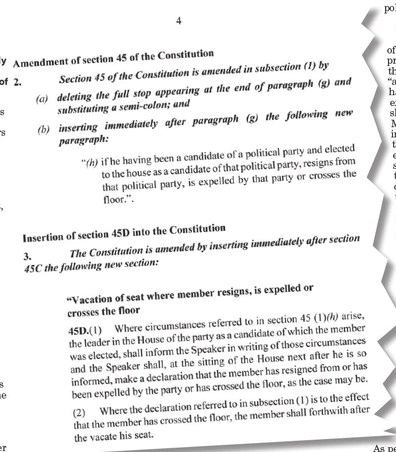
It may be too late for me or any other citizen to influence the process, since this amendment has taken priority over all else since February 11. But I am concerned that the proposed anti defection amendment undermines the fundamental freedom of association by tying an MP’s tenure to party membership. It effectively entrenches political parties into the Constitution without safeguards for internal democracy. MPs who leave or are expelled risk losing their seat immediately — even when acting on conscience or ideology.
In a small state like Barbados, this narrows democratic space and limits parliamentary independence. Introducing such a significant constitutional reform immediately after an election, and ahead of broader constitutional changes, leaves too little time for meaningful public deliberation.
As Barbadians, we deserve the opportunity to reflect fully on these changes together.





The blogmaster invites you to join the discussion.