Banner promoting anonymous crime reporting with a phone and contact number 1 800 TIPS (8477), featuring the Crime Stoppers logo and a QR code for submitting tips.

← Back

Your message to the BLOGMASTER was sent

The ‘omnipresent’ Governor of the Central Bank Dr. Kevin Greenidge is on message for the start of 2025. After a recent upgrade by Trinidad based CariCRIS, he called for Barbadians “…to invest. Whatever project they were planning, take it off the shelf, dust it off and go because that is how we are going to get the economic growth”.

There was also hype about the economy achieving 3.9% growth and unemployment rate holding at a respectable 7.7%. Truth be told GDP and the unemployment rate are the two key indicators used to track economic performance by successive governments. If it were business as usual the blogmaster would give unequivocal congratulations.

Traditional media actors and talking heads must be dispassionate in commentary about the performance of the local economy. There has been no fundamental change to the economic engine driving the economy. The growth being heralded by the Governor and government can be attributed to tourism with financial services chipping in. The ‘other sectors’ like manufacturing, agriculture and other services are statistically insignificant to moving the performance needle.

If we agree that Barbados is a one-leg economy, on what basis is Governor Greenidge and Prime Minister Mottley saying the economy has become more resilient in the post 2018 period? As far as the blogmaster is concerned we have no R&D and export creating industries; we continue to be a net purchaser of products and services, practically all of our foreign direct investment is tourism related.

The blogmaster recognises that there are ongoing attempts to rebuild crumbling infrastructure but much needed governance and law and order initiatives continue to undermine government’s transformation program. Lack of reform to State Owned Entities (SOEs) is one example of government’s lack of serious commitment to a transformation program it promotes. Does public sector reform sound familar?

Back to Governor Greenidge’s call for Barbadians to invest. In theory some of us understand for the economy to grow individuals and businesses will have to invest. Investment increases productivity, jobs, consumer activity and so on. However, Greenidge must know it is not that simple to command Barbadians and private sector to invest and it will occur. There are cultural characteristics that have given good reason for Barbadians to be described as being risk averse.

Historically Barbadians have not had appealing options in which to invest. The Barbados Stock Exchange exists in name only with small trade volumes. There is no Secondary Market. Even if these markets existed there is good reason to doubt a significant number of Barbadians would participate.

A lot of work is required to educate Barbadians about the upside to investing given what opportunities available. Bear in mind too many Barbadians are financially illiterate. An average Barbadian understands investing to be growing a saving account. Although in the past a segment of Barbadians was bullish on government bonds as the preferred option to invest, the 2018 haircut the Mottley government gave to bondholders has undermined public confidence in government bonds. On a daily basis the public is bombarded with promos to encourage Barbadians to purchase BOSS bonds.

There is a lot of work to be done to shore up the Barbados economy before any credibility can be earned that it has become more resilient. Also, let us tone down the rhetoric about ratings by credit rating agencies. Some of us have not forgotten these agencies were partly responsible for the 2006 global financial collapse.

Discover more from Barbados Underground

Subscribe to get the latest posts sent to your email.

158 responses to “Who wants to invest?”


  1. Three state-owned agencies posing ‘significant risk’

    written by Barbados Today 04/01/2025 4 min read   

    Three state-owned entities (SOEs) have been identified as posing a “significant risk” to the country’s fiscal plan, according to a government report, including a fledgling housing project, the 61-year-old national broadcasting and the national bus company.

    The HOPE Inc project, Caribbean Broadcasting Corporation (CBC), and Transport Board were all described as “technically insolvent” and undermined the International Monetary Fund-supervised austerity drive.

    A red flag has been raised about the risk posed to the fiscal plan due to the millions in debt which the government has guaranteed for three state-owned entities (SOEs) in particular.
    But other vital public services providing health, education, housing and farm produce remain under watch from month to month.

    The administration’s Barbados Medium- Term Fiscal Framework 2025/2026 to 2027/2028 said “the most significant risk” is posed by the government’s implicit guarantee of the liabilities of the controversial HOPE Inc project, the CBC and the Transport Board.

    The section, Performance and Outlook for Major SOEs, noted that under the IMFbacked Barbados Economic Recovery and Transformation (BERT) programme, the Queen Elizabeth Hospital (QEH), University of the West Indies (UWI), the Transport Board, Barbados Agricultural Development Management Corporation (BADMC), the National Housing Corporation (NHC) and the CBC were all being monitored on a monthly basis.

    “Guaranteed debt stood at $56.0 million at June 30, 2024, an increase of $23.3 million from the same period in the previous year, due mainly to a new loan secured on behalf of Kensington Oval Management Inc. Guaranteed debt consists of external multilateral loans and one external bond issue secured on behalf of three SOEs,” the document stated.

    But the operations of HOPE Inc, CBC, and the Transport Board were flagged for the elevated risk they posed. The report declared that these three agencies were “technically insolvent” as their total liabilities exceeded their assets.

    It said: “This risk is most significant for a few SOEs with total liabilities exceeding total assets, making them technically insolvent, namely [Transport Board], CBC, and HOPE Inc. Additionally, other SOEs, such as [National Petroleum Corporation] NPC, [Barbados Water Authority] BWA, and QEH, are facing liquidity challenges related to settling accounts payables arrears and/or pension liabilities.”

    It added: “HOPE Inc. has experienced recurring annual net losses since its inception in January 2021. The BWA has been adversely affected by prolonged delays in collecting accounts receivables, while the NPC has faced cash-flow issues due to consecutive net losses from 2019 to 2024.”
    But while there was concern that many agencies were targeted for reform and thus an expected slash in government transfers to support their operations, it was conceded that several SOEs still received larger amounts of taxpayer support.

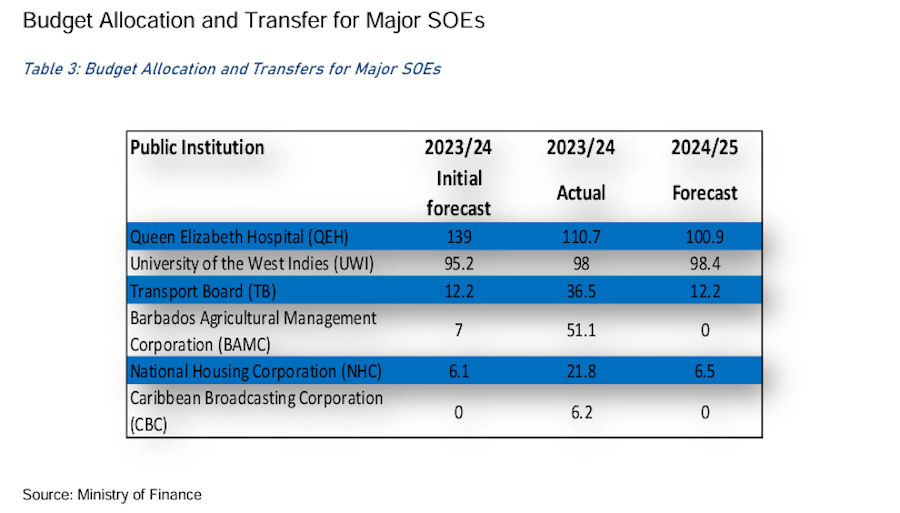
    The QEH was budgeted to receive $139 million in 2023-2024 but actually got $110.7 million and was set to get $100.9 million in 2024-2025. The Transport Board was to receive $12.2 million for the financial year 2023-2024 but actually received $36.5 million; it is again scheduled to get $12.2 million in 2024-2025.

    The document revealed that the BADMC, which handled state agricultural lands, was only budgeted to receive $7 million in state funding in 2023-2024, but got $51.1 million and in 2024-2025 the government has allocated zero financial support to the entity.

    According to the extensive 47-page document which was laid in Parliament: “Several SOEs received higher funding than initially projected due to higher-thanexpected operational expenses. However, the [government] managed to adhere to the cap set under the [IMF’s] Extended Fund Facility supported programme for entities monitored by the Technical Memorandum of Understanding [TMU], which was $477 million.”

    Importantly, the document disclosed: “Anticipated grants to public institutions for the 2024/25 period are estimated at $542.3 million.

    . . . Expected transfers to entities not monitored under the TMU include $50.0 million for the Barbados Defence Force (BDF) and $39.8 million for the Barbados Revenue Authority (BRA).”

    The report continued: “Detailed plans have been drafted for the restructuring of the Transport Board and the National Housing Corporation, and for the amalgamation of the operations of the Rural Development Corporation and the Urban Development Corporation; the National Petroleum Corporation and Barbados National Oil Company Ltd.; as well as for the merger of the social services entities of the Child Care Board, National Assistance Board, Welfare Department and the National Disabilities Unit. These and other reform measures are expected to result in reduced SOE transfers over the medium term.”
    (IMC1)


  2. The genesis of this tragedy can, perhaps, be traced back to the time of Owen Arthur when the Barbados economy started to embrace a more liberal position. .

    The years of absolute corruption shared by both parties have brought as to this position. Simpson Motors benefited from government largesse. The Williams clan and his successor – the Maloney boy all benefitted from their sugar daddy – the G.O.B. The DLP handsomely rewarded Sandals with an extraordinary 50 year sweetheart deal to do business in Barbados.
    Wade through the archives of BU, And the now defunct Barbados Free Press. Inform yourself people. The information is out there.

    The titanic called the Barbados economy will now be fully privatised on the request of the IMF.

    Waru, Hal Austin, Pachamama, William Skinner, Bush Tea and one or two others have proven to be correct in their assessment of Barbados. It is too late to bring out the guillotine. However, Bush Tea may well want to advice Mia to stock up on plenty of vaseline for her population. They are going to need it.

    The freemasons have been successful in Barbados. When you see the next advertisement that a company has to look abroad to recruit a worker then you can rest assure that the Masons are probably involve.


  3. “The document revealed that the BADMC, which handled state agricultural lands, was only budgeted to receive $7 million in state funding in 2023-2024, but got $51.1 million and in 2024-2025 the government has allocated zero financial support to the entity.”
    ~~~~~
    Steupsss
    The document says the BAMC
    NOT the BADMC.

  4. NorthernObserver Avatar
    NorthernObserver

    I amuse easily, so calling the TB a national bus company, versus a national transport company brought a 😊.
    Having liabilities greater than assets isn’t a problem, you simply declare bankruptcy? The social challenge is when much of those liabilities are unfunded pensions, esp at the BWA, CBC and TB.
    The bad news, budgeting remains a challenge; the good news it is being managed.
    BAMC = sugar? Suggesting the deal to offload sugar was costlier than projected?
    One recipient of the overages was the QEH who got $30M less than budgeted.
    With corporate tax increasing to 9% Jan 2024 seems to have produced some unexpected gains. Tax on a group on multi nationals increased Jan 1 ’25. VAT remains the big tax.


  5. Police in helicopter search for Mary Jane. This was a classic song from John Holt, shortly after he turned rasta.

    What steps have the government implemented to ensure that the locals are not pushed out of this growing trade?

    https://www.theguardian.com/world/2025/jan/05/the-rastafarians-opening-up-caribbean-cannabis-farms-to-build-a-flourishing-medical-industry


  6. @TLSN

    IF you had you ears to the ground you would have heard about the inability of actors in the ‘industry’ to secure adequate banking arrangements which was discussed in this space when the flowery talk emerged about rolling out this new business. Here is a report as recent as October 2034, you probably missed it.

    https://barbadostoday.bb/2024/10/12/medicinal-cannabis-industry-faces-major-obstacles-including-banking-block/


  7. Limping with a crutch

    THE BARBADOS ECONOMY is like an old man limping with a crutch. The International Monetary Fund may continue feeding loans as long as interest payment is received. If or when it stops, then there is nowhere to go and its vaunted reputation will be tarnished as its last resort status would be regarded as rubbish.

    As regards to Barbados, look at the statistics.

    Rising all the while are two fundamental factors. The foreign exchange on which the value (that is, its real external purchasing power is based) is mainly borrowed money and more and more to maintain this is a one-foot economy – tourism.

    No longer do we have external companies bringing in business and creating employment. No longer are we reaping foreign exchange from the export of sugar, molasses and rum.

    We are hoping that some relief will come as we seek to increase our tourism product. However, investors in tourism will see our weak position and will demand more and more concessions or find means to repatriate less foreign exchange earnings; there will be more and more efforts to keep foreign exchange earned abroad and less and less opportunities to attract businesses that require a fluent exchange arrangement. I have already alluded to an impact on sales of property and businesses.

    There is no use banking on the Opposition whose mismanagement landed us in this position since that Opposition is now more concerned with organising itself. Pundits in the country are at a loss as to what to do as their power is non-existent and depends on the general community, and the general community is conflicted with its own concern of survival for where to go in a changing world.

    How about changing the Government? That would be like jumping from the frying pan into the fire. You mean that we took the wrong decisions in 2018? Tell that to Barbadians and you will be starting an argument, since Barbados’ economy and management are the pride of the Caribbean. I remember, when I had a voice, telling a former Prime Minister that increase to foreign commodities had an impact on the foreign exchange holding and he immediately ordered the country to tighten its belt.

    What have we now? A management that forecasts a debt to Gross Domestic Product of 60 per cent by 2036 with more deficiencies and increased responsibilities where we are swapping debt responsibilities for debt responsibilities with more borrowing that have attendant liabilities. There are few plans to increase production or reduce demand of foreign commodities. And, if we reduce foreign demand, do we know how to survive on less, and what would less mean? In one of my articles, I asked the question of where to go in order to seek help. My answer would be to rely only on ourselves.

    But we cannot switch the Government control to a disorganised Opposition, so we have to depend on where this Government is heading.

    Call on the people to change their lifestyle.

    Depending on the country to swap expensive debt arrangements for cheaper debt arrangement with additional liability involvements is like swapping black dog for monkey. The cost of living and the increased taxation is already evident in people struggling to survive so it can only get worse. Swallow our pride, as did Guyana before it discovered oil, and find substitutes for imports even if you fear that it will impact tourism. That is an unknown factor.

    There is another worry. What to do with people living longer and bringing their own problems?

    They are putting pressure on our health system, and some are taking up jobs on which younger people may be waiting. But are young people rising to the survival demand? This may be the question that we may ask; but our rising crime rate among younger people puts a damper on this question.

    The minor victories we may have with climate solutions will not be enough to make a difference to this borrowing trend that sinks us further into the unknown.

    What is also unknown is the future of our charismatic leader whose impact on the world stage adds a voice to our demands for help, a future that may deprive us of the benefit of her leadership, a worrying factor that may have played a part in some successes so far. I cannot help feeling that we may have lost an opportunity for Barbadians to have sought solutions such as devaluation of currency rather than borrowing to defend its value.

    However, look at the United States dollar.

    Some may say that the Wild Coot has had his life and it is all well and good for him to suggest hard times, but I have loved people to follow.

    Harry Russell is a banker.

    Source: Nation


  8. Good luck!

    Push for regional stock exchange

    by SHAWN CUMBERBATCH shawncumberbatch@nationnews.com

    MORE THAN 35 years after a regional stock exchange was proposed by Caribbean Community (CARICOM) Heads, efforts are intensifying to finally make it a reality.

    This comes as the CARICOM Private Sector Organisation (CPSO), which is leading the effort, states that “the absence of a regional securities market, or alternatively, adequate arrangements for cross-listing and cross-selling has significantly impacted capital mobilisation among the Community”.

    The CPSO is hiring a consultant “to articulate feasible models to effect a regional stock exchange among participating states of the CARICOM Single Market and Economy (CSME). Interested consultants had until last November 30 to submit proposals to the CPSO in this regard.

    CPSO chairman Gervase Warner said in the organisation’s review of 2023-2024 that it “is leading an initiative to establish a Regional Stock Exchange”.

    “The initiative requires support from a myriad of stakeholders to be successful. Consensus terms of reference for a consultancy study have been achieved. The study will be completed in financial year 2025,” he stated.

    The terms of reference document recalled that CARICOM’s Revised Treaty of Chaguaramas (RTC) emphasised the importance of integrating financial and capital markets to the CSME.

    Renewed focus

    It also noted the integration of capital markets in CARICOM is central to realising the vision of the CSME committed to at the 10th Meeting of the CARICOM Heads of Government at Grand Anse, Grenada in 1989, and that CARICOM Heads, at their July 2019 summit held in Montego Bay provided a renewed focus on the goal and vision of a Regional Securities Exchange.

    While pointing to the existence of seven individual CARICOM stock/securities exchanges, including the Barbados Stock Exchange, the CPSO terms of reference document indicated that the absence of a regional stock exchange was an impediment to regional capital market development. “The absence of a regional securities market, or alternatively, adequate arrangements for cross-listing and cross-selling has significantly impacted capital mobilisation among the Community. Such absence has also limited foreign direct investment inflows and slowed capital and finance market development,” it said. “The foregoing occurring in the face of yawing opportunities to fund critical infrastructure investments at the national and regional levels, provide options to the citizens of the Community to earn greater returns on savings, and create opportunities for the emergence and growth on new and nascent micro small and medium enterprises (MSMEs) – which account for over 70 per cent of CARICOM enterprises.” The CPSO submitted that “efficient functioning capital markets enhance financial intermediation through directing resources from investors (individuals and institutions) to business and states to support operational, investment and capital expenditure requirements”.

    “The benefits of securities exchange integration are recognised to include optimal capital mobilisation to support development, diversified risk, more efficient functioning and competitive financial markets, lower financing costs, higher returns, and the overall increase in cross-border flow of capital,” it argued.

    “Among CARICOM Member States, capital and financial market development has been uneven, with considerable differences in market size, sophistication, depth and product innovation, as well as of financial products and instruments traded.”

    The organisation added: “It is an established fact that securities exchanges are vital vehicles for capital market development, though their existence does not necessarily ensure satisfactory levels of market capitalisation. Many factors affect capitalisation, the number of (potential) participants being among the chief reasons.

    “The continued existence of seven individual stock/ securities exchanges, throughout CARICOM, apart from possibly conflicting with the vision for the CSME à la the Grand Anse Declaration and the Revised Treaty of Chaguaramas – which commits CSME member states to free movement of capital among the Community, may be considered as inefficient given the Community’s small size – both population and economic.”

    Regulatory requirements

    It pointed out that Barbados and other CARICOM states “have retained exclusive competence over the functioning of their domestic capital and finance markets”.

    “Accordingly, varying legal frameworks and rules have emerged across member states. Differences in registration and regulatory requirements have made it financially and administratively burdensome for companies and other issuers of securities to cross-list across exchanges,” it stated.

    The CPSO said it was committed to intensifying work related to establishing a regional stock exchange, saying the effort “holds out the promise of democratising wealth, fostering financial inclusion, entrepreneurship and innovation, stimulating MSME growth”.

    Based on consultation with key stakeholders including the stock exchanges and broker dealers the CPSO says it is “convinced that accelerating the pace of capital and financial market integration must proceed from a re-visiting of the past approaches, and the re-visioning and re-conceptualisation of the single CARICOM securities market, among others, to finally realise the goal envisioned at Grand Anse by the CARICOM Heads in 1989”.

    The CPSO said the major problem now was how to create the institutional set up to ensure that the surplus financial resources of the Community are efficiently and effectively intermediated to sound financial ventures in a manner that accelerates wealth creation and overall economic development.

    “The fragmentary nature of the capital market in CARICOM means that cross-listing is the only method available to companies and other issuers of securities to gain access to a CARICOM wide capital market,” it said.

    “However, attempts to cross-list on other national stock exchanges attract onerous and costly listing fees, which multiply according to the number of exchanges targeted for listing. Such challenges, among others, have limited the extent to which cross listing has occurred and have stymied the ability and the interest of many firms to become publicly listed cross CARICOM.”

    The CPSO also said that while the creation of a Regional Securities Exchange seems like a possible solution to this problem, it was not a straightforward proposition given several challenges. This included the supporting legislative and regulatory architecture required for such an undertaking.

    As proposed, the consultant being hired “will form an important input to developing a consensus on a roadmap towards a Regional Stock Exchange”.

    The consultant’s study will consider critical foundational elements in this regard including the following specific outputs.

    • Assess the financial and administrative cost of cross-listing across national exchanges as a means raise capital in a pan-CARICOM fashion.

    • Determine the likely level of demand for a Regional Securities Exchange.

    • Identify the vital elements for common legal and regulatory framework needed to support a Regional Securities Exchange.

    • Evaluate ways in which the common legal and regulatory framework (in c above) may be achieved.

    • Examine the efficacy of the simultaneous existence of national and regional securities exchanges.

    • Explore regulatory linkages, audit and accounting standards.

    • Provide substantive recommendations on the nature of trading architecture that may be employed in Regional Securities Exchange; how the Regional Securities Exchange will facilitate cross border settlements in view of the multiple currencies in use in the Community; and how securities and futures dealers and other financial intermediaries will be licensed in a regional capital market.

    • Identify socio- economic and political risk factors to the viability of the Regional Stock Market as well as potential opportunities for the application of new technologies and offering new financial products beyond stocks and bonds.

    Limited opportunities

    The renewed effort to establish a regional securities exchange in CARICOM comes as the management of Barbados-based investment firm Fortress Fund Managers (FFM) continue to point to limited opportunities for investment in Caribbean stock markets.

    In the director’s report of FFM flagship $688 million Caribbean Growth Fund 2024 annual report, FFM chairman Roger Cave and chief executive officer/chief investment officer Peter Arender outlined the challenges.

    These included “relatively small, illiquid stock markets in the region”. They reported that for the financial year ended September 30, “United States, developed international and emerging market stocks saw double digit returns while Caribbean stocks slumped”.

    “The global index, tracking securities all over the world, was up 33 per cent while in the Caribbean, the Trinidad and Jamaica indices fell 13 per cent and five per cent respectively. The Barbados index posted a nine per cent gain, largely due to movement in shares of CIBC Caribbean on thin trading volumes,” Cave and Arender reported.

    Source: Nation

  9. NorthernObserver Avatar
    NorthernObserver

    @HRussell raises the important political question, who is the next BLP leader and when.
    I have heard opposite reports on MAM and the UN job, but being an elected position today, candidates have to declare their intentions by early 2026, a year away. She would the first UN Gen Secy who isn’t fluent in more than one language.
    As far as devaluation, there is plenty of time for that. I expect the prognosis is some debts will be forgiven. Despite the recent borrowing, local debt still outstrips foreign debt 2-1. Meaning, foreign debt forgiveness would likely be a 50-50 match with local debt. And we know who holds the bulk of the local debt.


  10. @NO

    You read John Beale’s article? What influence does the US have on the selection of a UN Secretary General?


  11. I must be careful for I often have an opinion on matters which are well outside of my area of expertise (Murdah! Theo gun kill muh. He is talking about his ‘area of expertise’. Talking nonsense does not count.)

    Anyhow, I was looking at some of the financial advice given here and some of it could have been written in the 1960’s. Indeed, if it were possible, some of these advisors should be arrested for financial fraud. The recommendation about the BSE cannot be taken seriously.


  12. Interesting to listen to the talk show today which is inundated with calls about the current investment market in Barbados. Good to hear this type of conversation in the country.


  13. I saw a recommendation to open a savings account. I received a renewal for a CD in Barbados and the interest rate is given as 0.15%. For every $1000.00 I get $1.50.

    This finance guru should be encouraging folks to pool their money and try to start a business instead of waiting a year to get $1.50 To talk of BSE and to regurgitate the silly investing lines that were applicable for an earlier times is utter madness/folly/ignorance.

    On the TheO’s scale … bad advice. A clown with Google could have done a better job. It pisses me off, when our gurus are unable to deliver meaningful advice. They need to stop throwing shit on the wall.

    Boys and girls… the time has come for you to abandon sacred cows, pundits and gurus. Face it, many of them cannot google as good as you can. All these folks want to do is to separate you from your hard earn cash. First they will give you advice that will make you take your money from under your bed and then they will make it disappear.

    Do your own research.

  14. NorthernObserver Avatar
    NorthernObserver

    David
    I didn’t read JB. One would imagine the US would have some say on any UN decision.
    At least you know the incoming US admin, has no love for Canada’s outgoing PM, whose name has also been batted around.


  15. Tell me what control does the central bank have over private lending entities lending up to say 25k or 30k, in terms of both interest charged on loans and interest offered to depositors of capital? We know their is no type of deposit insurance, so what protects us from another CLICO in the making? Not saying there is one brewing of course just asking a question! What protects us from an entity in the future offering depositors say 7% on deposits, then lending at loan shark rates of 11 or 12% to persons the bank would not touch? What jurisdiction would the central bank have to protect us from such a creature in the future, should one ever present itself that is. Also what security would such an entity have to have in order to convince the central bank of its ability to withstand a run on deposits, or a sizable amout of bed debt from say another covid type situation? Would they be required to lodge a percentage of their capital with the central bank for example as the commercial banks do?

    I hear everyone talking about invest, but no one talks about security of investment, especially in an environment where not even state paper was safe.

    CART BEFORE THE HORSE DONT YOU THINK.


  16. John Beale’s article to the Nation yesterday.

    Consider Mottley for UN Secretary-General

    The following article was submitted by John Beale, a former Barbados Ambassador to the United States of America, Mexico and the Organisation of American States and Honorary Consul in Brazil, as well as the Honorary Consul of Uruguay and Belize in Barbados .

    As we enter the New Year, it is an opportune moment to consider a bold and historic opportunity for both Mia Mottley, Barbados and CARICOM. The next election for the position of United Nations Secretary-General (UNSG) is set for 2026. While this idea has not been discussed in any official circles, I believe Mia Mottley, the current Prime Minister of Barbados, could be an exceptional candidate.

    The election process for the UNSG involves member states presenting candidates via a letter to the president of the general assembly and the president of the security council. Ultimately, the successful candidate must secure the support of at least nine members of the security council, with no vetoes from any of the five permanent members (P5): Russia, China, the United States, the United Kingdom, and France.

    Leadership

    Historically, the position has been held by individuals from middle powers, with nine secretaries-general to date hailing from Norway, Sweden, Myanmar, Austria, Peru, Egypt, Ghanaian, South Korea, and Portugal. While there are no official prerequisites, candidates are expected to demonstrate proven leadership, managerial expertise, diplomatic skills and significant experience in international relations.

    There is also an increasing call for greater gender and regional diversity. After nearly 80 years of male dominance in this role, many argue that the next secretary-general must be a woman, and by regional rotation, it is now Latin America and the Caribbean’s turn.

    Mia Mottley is a formidable leader with an extensive track record of achievements. Known for her ability to get things done, she has been at the forefront of global discussions on climate change, sustainable development, and financial equity. Her passionate advocacy has earned her numerous international accolades and recognition.

    Importantly, her candidacy would bring representation from a Black woman of a small developing nation – a significant and inspiring milestone for the United Nations. Mottley’s reputation for forging connections between the global North and South further strengthens her case as a consensus-builder for multilateralism in these turbulent times. While Mottley’s credentials make her a strong contender, significant geopolitical challengers must be considered. Currently, CARICOM’s 14 independent states are supporting Albert Ramdin, Suriname’s Foreign Minister as their candidate for Secretary-General of the Organisation of American States (OAS). If CARICOM’s candidate succeeds, it is most likely that Latin America – already fielding at least three female aspirants for the UNSG position – will oppose another CARICOM candidate for the UN role.

    Latin America and the Caribbean are often treated as a single bloc in international diplomacy. If the region’s leadership at the OAS is already held by a CARICOM representative, Latin America will probably rally behind one of its candidates for the UNSG, potentially fracturing the unified regional support needed for Mottley’s candidacy.

    The idea of Mia Mottley running for the position of United Nations Secretary-General is my own suggestion and has not been considered by CARICOM or discussed in any official circles.

    To address this potential conflict, I propose that CARICOM reconsider its current focus on the OAS Secretary-General position. Instead, CARICOM could prioritise support for a UNSG candidacy for Mottley while fielding a candidate for the Assistant Secretary-General role at the OAS. However, this would require significant diplomatic effort by Barbados to persuade CARICOM Heads of Government to shift their strategy – a move that carries risks of internal division and would depend on assurances of broad international support for Mottley’s bid.

    It should be noted that the vote for the OAS SG is in March 2025 – less than three months away – and the election for the ASG of the OAS in May 2025. Therefore, there is not a moment to spare.

    Elections

    On the other hand, since the UNSG election is not until 2026. Mia Mottley and Barbados could simply wait out the OAS elections, whatever the result, and then announce her candidacy for the UNSG toward the end of 2025. At that point, Barbados could put all its diplomatic resources behind securing support from the Caribbean, Africa, Asia, the Pacific, and North America.

    Another challenge lies in the influence of the P5 countries, each of which holds veto power over UNSG appointments. While Mottley’s leadership and commitment to multilateralism may appeal to many member states, her advocacy for Security Council reform – especially ending veto powers – and her strident position on transforming the global financial architecture could provoke resistance from some P5 members. Barbados would need to carefully navigate this delicate dynamic, building coalitions to neutralise potential opposition at the very least.

    To bolster her candidacy, Mottley should focus on speaking Spanish fluently and deepening her connections within Latin America by spending time in that region. This would strengthen her appeal as a candidate representing the broader Latin America and Caribbean bloc.

    Mia Mottley has accomplished extraordinary things for Barbados and while the idea of her running for UNSG remains my personal suggestion, I believe her leadership qualities make her an excellent candidate for the role.

    While the road to the UNSG position is challenging, it is far from insurmountable.

    A successful candidacy would not only elevate Barbados on the global stage but also serve as a testament to the power of visionary leadership from small nations, demonstrating the transformative change the UN desperately needs in these turbulent times.

    Mottley’s reputation for forging connections between the global

    North and South further strengthens her case as a consensus-builder for multilateralism in these turbulent

    times.’

    Source: Nation

  17. NorthernObserver Avatar
    NorthernObserver

    Tks David.
    A fair assessment. I was going to say earlier, once you hear Mia’s taking Spanish lessons, watch out
    The other side, is compliments of accounting timing, the vice tightening in Bim, is 2 years off, but Mia knew this all along.

  18. NorthernObserver Avatar
    NorthernObserver

    @JohnA
    This is for you.
    Dr.Melville has researched the SOURCE of the bonds being “swapped”.
    Few surprises.
    The NIS tekking it in every available orifice 😁

    “Since debt buyback involves a loss of value for the holders of the debt, one also needs to be concerned about who is bearing this loss, the size of this loss and the possible impact on the investors’ activities or operations. Minister in the Ministry of Finance Ryan Straughn explained that the intention was to repurchase $400 million of Series E Bonds, and $100 million each of Series B and D bonds (Down to Brasstacks on VOB on November 22, 2024). Series E bonds are to be repurchased at par (face value) and the other two series by reverse auction which was due to close last Friday. Series B bonds are held by individuals and institutions, Series D by institutions and Series E bonds are held by one investor, the National Insurance and Social Security Service (NISSS). According to the Estimates of Revenue and Expenditure 2024-2025, $2.72 billion Series B, $1.22 billion Series D and $2.05 billion Series E bonds were outstanding at the end of 2023. The interest rate on these bonds is currently 3.75 per cent, 4.25 per cent and 8 per cent respectively.
    Based on publicly available information, the debt buyback is expected to result in an overall reduction of $442 million in interest payment to bondholders; with Series E suffering losses of around $300 million; Series D, $121 million and Series B, $19 million.
    This reduction in interest payment to bondholders, which is equivalent to the gross interest savings accruing to the government, is the difference between the total interest that the Government of Barbados would have had to pay if the debt was held to maturity less the accumulated interest paid at the time of the buyback. Depending on the price at which Series B and D are repurchased, the holders of these bonds can see additional losses of between $25 million to $40 million in principal. At present, it will be difficult to find alternative investment opportunities that will allow bondholders to recoup these losses.
    Series E bonds were also the target of the 2022 debt buyback which resulted in estimated losses of $127 million in interest income for the NISSS. This was approximately 75 per cent of the gross interest payment avoided by the Government of Barbados due to this operation. The two debt buyback operations would therefore result in overall losses of approximately $428 million in interest income for the NISSS compounding the losses incurred in the 2018 debt restructuring. At the time of the 2018 restructuring, GOB liabilities with the NISS stood at $4.4 billion, with contribution arrears amounting to $468 million. The NISSS lost $1.46 billion in the nominal value of this debt due to the restructuring (NIS 17th Actuarial Review). This does not account for the loss of interest income due to this transaction. Approximately $3.5 billion of this debt was restructured into Series E bond with a 37.5 per cent ($1.3 billion) reduction in the face value. Overall, the NISSS could see an erosion of $1.7 billion in the value of its investment in Series E Bonds across all three debt operations. The NISSS also has holdings of Series B ($324 million) and Series D ($89 million) bonds, and if these are part of the repurchase auction this will add to the NISSS losses. The holders of Series D and Series B bonds (except the University of the West Indies) suffered no reduction in the face value of their debt, but because of the lengthening of the maturity period and a reduction in interest rate, they would have endured the loss of interest income due to the 2018 debt restructuring.
    Since 2018, the government has completed two debt operations and is in the process of implementing a third, the debt for climate swap. These three operations, while they have impacted the debt metrics positively and have created fiscal space for the government, have resulted in significant erosion of the value of domestic bondholders’ assets and could weaken the financial position of the affected parties. It appears that the NISSS has been bearing an unequal share of the burden of the government’s debt management strategy. In all three debt operations, the reduction in debt and savings in interest payment have been absorbed primarily by the NISS.

    Dr Juliet Melville is a former Director of the Economics Department at the Caribbean Development Bank and a former lecturer at The University of the West Indies, St Augustine campus.


  19. Revisiting the Debt for Climate Swap: The Debt Buyback
    The debt for climate resilience arrangement which the Barbados government last month announced it had completed has been described as innovative and the first of its kind. Intuitively, John Public understands the justification advanced for the debt for climate swap, but many will not comprehend the complex structure nor the risks associated with the debt arrangement/facility.
    Various terms have been used in connection with this debt swap, with each characterisation reflecting the focus and priority of the various parties involved in the operation.
    The debt for climate swap involves at least six different sets of actors, namely the Government of Barbados (GOB), the European Investment Bank (EIB), the Inter-American Development Bank (IDB), a consortium of private banks operating in Barbados led by CIBC Caribbean and includes Royal Bank of Canada and Scotia Bank (CIBC/ RBC/Scotia), the Green Climate Fund (GFC) and the bondholders. It also comprises five distinct but related financial transactions, namely: – the repurchase or buyback of $600 million (mn) worth of restructured domestic debt; – a new domestic (Barbados dollardenominated) $600mn loan; – two Guarantees – a Counter-Guarantee; and – an external US$70mn investment loan and a US$40mn grant.
    In a previous article, the implications of the debt buyback for bondholders were discussed.
    This article’s focus is on the essential elements of the debt for climate swap and the role of the other parties to the transaction. It is important for the public to have a full appreciation of these types of financial arrangements, especially as the government has signalled its intention to pursue more debt swaps.
    The debt for climate swap comprises: – Firstly, the repurchase of some of the 2018 restructured domestic debt using a loan for an equivalent amount but carrying a reduced interest rate leading to savings on interest and, possibly, principal payments in the event the debt is repurchased at less than face value (The Debt Buyback); – Secondly, the securing of external loans from the GCF and the IDB, with some grant resources from the GCF, to fund the South Coast Waste Water Rehabilitation Project on the basis of the GOB’s commitment to use the savings arising from debt buyback to service these loans and to invest on other identified climate-related projects in the water and sanitation sector (The Debt Conversion).
    Sounds simple enough, but according to the popular adage, the devil is in the details. To understand the nature of the transaction, one must delve into the details of the arrangement. In the first part of this two-part article, the debt buyback is examined.
    The debt buyback entails the repurchase of $600mn worth of 2018 restructured domestic debt with a loan from three commercial banks (CIBC/ RBC/Scotia), supported by guarantees from the IDB and the EIB for US$150 mn each. The loan, characterised as a Sovereign Sustainability Linked Loan (SSLL), matures in 20 years and has a grace period of five years three months and 3.25 per cent interest rate payable quarterly and a Natural Disaster and Pandemic Clause. The debt being repurchased consists of $100mn of Series B bonds maturing in 2033 with annual coupon rate of 3.75 per cent and $100mn of Series D Bonds with weighted average coupon rate of 6.0 per cent maturing in 2053 in a reverse auction, and $400mn of Series E bonds maturing in 2043 with a coupon rate of 8 per cent at par. The coupon rate on Series D bonds is 4.25 per cent until Year 10 and increases to 6 per cent from Years 11 – 15, and thereafter rises to 7.5 per cent until maturity.
    The buyback is debt neutral, in that it will not increase the amount of outstanding domestic debt.
    The buyback is expected to provide savings of US$125mn.
    We were told that the IDB and the EIB provided guarantees of US$150 million, respectively. This credit enhancement was vital in ensuring the participation of the commercial banks in this operation. In the event the borrower, GOB, is unable to meet its commitment with respect to the loan, IDB and EIB are legally obligated to meet the debt service payment. The details of the guarantee have not been publicly disclosed. The guarantee served to make the deal more attractive to the commercial banks and permitted them to reduce their risk premium, charge a lower interest rate and offer a loan with a longer tenor.
    GOB was also required to provide a counter-guarantee as a pre-condition for the issue of the guarantee by the IDB. This means that any payment made by the IDB under the guarantee will be considered a loan to the GOB, and the GOB will be ultimately responsible for reimbursing the IDB, within a period not exceeding 180 days. Further, if the GOB fails to make any payment of principal, interest, transaction costs or fees or any other payment on the sum advanced by the IDB and does not cure the breach within 60 days, the IDB can suspend disbursement on any other loan in its Barbados portfolio as well as initiate early maturity of the loans. It is unclear whether the GOB has a similar counter-guarantee agreement with the EIB. The commercial banks also benefitted from another credit enhancement as the EIB and IDB also required the lenders to retain $6.0mn of the loan amount. This represents interest for one quarter and 14 days. Only $594.0mn of the $600mn loan was disbursed for the debt swap.
    The SSLL, the guarantees and the counterguarantee are all policy-based meaning that the GOB has committed to put in place certain policies and/or institutional arrangements as a condition for accessing these financial facilities.
    The conditions attached to the guarantees and the loan are intended to hold the GOB’s feet to the proverbial fire. Except for the IDB counterguarantee, the details of the policy conditions attached to the SSLL and the EIB and IDB guarantees are not publicly available. Section 2.03 of the IDB counter-guarantee contract details the policy conditions that the GOB was expected to complete before the issuing of the guarantee. This document also makes reference to a policy letter dated June 13, 2024, describing GOB’s commitment under the Programme to Enhance Climate and Financial Resilience. The IDB guarantee has been issued suggesting that the prior conditions were met.
    Details pertaining to the policy conditions underpinning the SSLL were not available, but presumably, these conditions relate to how the fiscal space created from the repurchase of the bonds is to be used and the key performance indicators that the climate-related projects, made possible with the fiscal savings, are expected to satisfy. Specifically, the savings are to be used for financing the upgrading of the South Coast sewage treatment plant into a modern water reclamation facility and for investment in other agreed projects to reduce water losses and improve the sewer system.
    According to a joint press release on December 2, 2024, “the sustainability targets underpinning the loan relate to the volume and quality of reclaimed water generated by the upgraded plant.
    If the targets are not met, the government incurs a financial penalty, which will be paid into a specialised trust for environmental investments, the Barbados Environmental Sustainability Fund.”
    The terms and conditions detailed in the schedule of the Resolution on the SSLL approved by the Parliament on November 19, 2024 note that failure to meet certain specified sustainability performance targets will incur a penalty on any outstanding balance at a rate of “0.2 per cent per annum until 2032, then 0.1 per cent per annum until maturity”.
    The policy conditions underpinning a debt buyback, which delimit the use of the fiscal savings and set out the performance criteria to be attained by agreed projects funded from this, are what define the nature/purpose of a particular debt swap or debt conversion.
    For example, in this operation, the savings have to be used for the South Coast Water Reclamation Project and related works which are deemed priority climate-related interventions by the GOB. In the case of the first debt for nature swap, the Blue Bond, the fiscal savings are being channelled into the protection and development of the marine space. In debt swaps, the GOB undertakes to use the fiscal savings from a repurchase of debt in a pre-agreed specific way.
    That is the debt conversion.
    I will discuss the debt conversion in the next article.

    Dr Juliet A. Melville


  20. Mia’s Maxim clearly states:
    “Bullshit baffles bajan brass bowls”

    So..
    Gimme de vote and watch muh..
    Many ministers make light work..
    Each parish speaks, (but not a shiite gets done..)
    We Gatherin – (lord knows why, but some money must flow..)
    Debt restructuring (if we can’t repay it, then let’s re-borrow it)
    HOPE, BOSS, BOSS1, NISSS, HELP, 10,000 homes, etc

    Lotta shiite!
    Proverbs 22:7
    The Borrower is the slave of the lender.

    BASIC common sense should tell us where we are situated, ..but we can ONLY look for ways to become EVEN MORE enslaved….

    What a world
    What a place
    What mental chains
    What a love for vaseline
    https://www.youtube.com/shorts/8ZKr1bUAA3E?feature=share


  21. @ Northern

    Somebody call Diddy and tell him send 1 case of vaseline a 1 case of baby oil cause the paper holders about to take a backward assault!

    Well that will be a considerable lost in revenue to the shareholders and by extension the economy. Lord the NISS will need a serious cash input when all this is over. As for the other investors, well wait till the auction done before wunna take any pain killers.

    Would be interesting to see the results of the reverse auction though.

  22. NorthernObserver Avatar
    NorthernObserver

    JohnA
    The auction long over
    https://www.centralbank.org.bb/news/general-press-release/reverse-auction-for-series-b-and-series-d-bonds

    Outside of the grease, while tekking a loss, they are also getting cash for paper. If you think selling new Bonds is an issue, try selling the older ones?
    Hopefully this cash is ending up in the NISSS, but we can never be sure.

  23. NorthernObserver Avatar
    NorthernObserver

    JohnA
    Had to run earlier.
    What we need is a Debt for NIS swap?
    The auction is back to 2018, with the negotiating parties being GoB, CenBank, NIS, all chaired by White Oaks. Same people they just change hats.
    The Bonds are somewhat worthless in an open market, so who knows what number the auction settled on. It is a shuffle between the Bajan taxpayer, the NIS shareholders, and the voters. All the same people?
    So the GoB announces a swap, whereby the GoB debt service obligations are reduced. Meanwhile, the debt reduction is offset by the loss at the NIS (Bond owner), but they get cash (or should).
    Hopefully Dr.Melville’s final article will delve into the fees, associated with each of these manoeuvres.


  24. Revisiting the Debt for Climate Swap: The Debt Conversion

    by Dr Juliet Melville

    In Part 1 of Revisiting the Debt for Climate Swap published in the Tuesday, January 7 edition of Barbados TODAY, I focused on the debt buyback in the debt-for-climate resilience arrangement that the Barbados government last month announced it had completed. In the second part of the two-part article, I discuss the debt conversion.
    On the basis of the savings expected from the debt buyback, the Government of Barbados (GOB) was able to secure upfront funding from the Inter-American Development Bank (IDB) and Green Climate Fund (GFC) for the South Coast Waste Water Rehabilitation Project. This is intended to develop the capacity to utilise wastewater to augment the country’s water supply. The reclaimed water is to be used for agriculture and for recharging the aquifers.
    Funding totalling US$110mn in the form of a US$30mn loan and US$40mn grant from the GCF and a U$$40mn loan from the IDB was unlocked on the basis of the commitment that the savings from the buyback will be used to service these loans. These loans will increase the outstanding external debt by US$70mn.
    The GCF loan has a maturity of 20 years with a 5-year grace period and a fixed interest rate of 0.75 per cent. The IDB loan matures in 30.5 years with a grace period of 5.5 years and has a variable interest rate based on the Secured Overnight Financing Rate (SOFR) published by the New York Federal Reserve and the IDB funding margin and lending spread. As at January 5, 2025, the average of the SOFR for the last 90 days was 4.66 per cent. For the last quarter of 2024, the IDB funding margin was 0.41 per cent and the lending spread 0.8 per cent, yielding an interest rate of over 5.5 per cent.
    According to the GCF project document, GOB is also expected to provide US$101.4mn in parallel financing for the water sector. These funds will be channelled through the Barbados Water Authority (BWA). Any excess savings from the debt buyback, after accounting for debt service for the Sovereign Sustainability Linked Loan (SSLL) and the GFC and IDB loans, are to be allocated to a separate account and used for identified eligible investments such as non-revenue water reduction, improvements in wastewater infrastructure, and institutional strengthening. Savings of US$126mn over 15 years is projected with US$102mn earmarked to cover the debt service for the IDB and GFC loans, with excess savings of US$24mn.
    Based on the publicly available information, the projected savings appear optimistic. Neither the results of the reverse auction nor the overall savings from the buyback have been confirmed. Also, it is unclear whether this figure takes account of the many fees and associated costs with each of the financial transactions. Some have pointed to the steep costs associated with debt swaps in general, which erode the expected savings from the arrangements while being a “good source of profits for third parties”. Additionally, increases in the variable rate of the IDB loan, which will increase debt servicing costs, pose a risk to the attainment of the estimated extra savings.
    The GCF and IDB project documents set out in detail the sustainability objectives of the project and the key performance and results indicators, including the volume of reclaimed water for agriculture and the aquifers that the project is expected to yield.
    The debt for climate swap is a policy-based operation. The debt buyback is connected to the debt conversion by the policy undertakings of the GOB concerning how the fiscal savings from the repurchased debt are to be utilised and by the associated policy conditions attached to the guarantees from the EIB and IDB and the SSLL which impose penalties for non-compliance.
    The GOB has discretion in determining upfront how any resources not used for debt servicing will be utilised, but once it has reached an agreement with creditors, this discretion no longer obtains.
    The financing structure is innovative and allows for the channelling of funds to climate-related projects. However, this financing structure which targets domestic creditors, especially the National Insurance and Social Security Scheme (NISSS), raises questions about distributional equity given the fact that the NISSS has suffered a significant loss of value in its assets as a result of the series of debt restructurings. The loss of revenue by the NISSS has implications for its ability to discharge its mandate to provide social security programmes including pension benefits.
    The GOB’s debt management strategy seems to be compounding the costs on domestic creditors by reducing the value of their investments. Whereas most debt swaps tend to be transactions involving external creditors, Barbados debt swaps are notable for their targeting of domestic creditors.
    Although not framed as a debt relief transaction, debt swaps are de facto debt relief transactions. One may therefore ask whether the debt for climate swap has provided the necessary debt relief that will allow the country to more effectively manage its debt and achieve sustainable development. This is debatable as the structure has many fees associated with each financial transaction and heavy penalties for breaches of the policy conditions, as well as debt service obligations.
    Most importantly, the benefits to the GOB of the guarantee provided by the EIB and the IDB appear to be nullified by the requirement for the GOB to provide a counter-guarantee. In addition, although the guarantee is for US$300mn, it is being implemented as a rolling guarantee covering one payment at a time. Moreover, it is being applied as a loan to the GOB with settlement required within 180 days. Further, the non-payment of sums owed by the Counter Guarantor (GOB) to IDB, may also lead to cross default on other loans and/or an early call on the outstanding balance. These onerous provisions will significantly reduce the GOB’s policy space and lead to the prioritisation of debt servicing of this facility.
    A recent report on the use of guarantees in development and climate finance concluded that “if designed and deployed appropriately, guarantees can be a major opportunity for mobilising both public and private finance”. The report, however, identified a number of risks associated with guarantees, including exacerbating indebtedness; promoting questionable debt swaps; promoting politically and economically costly policy reforms through conditionalities; and encouraging increased private finance in climate while evading the responsibility of the global north.
    The structuring of policy-based guarantees and loans gives considerable influence to third parties in the domestic affairs of the country. The financing structure also dictates the economic priorities and other policy measures of the country, which may not be consistent with the government’s overall strategy over time. Further, this approach may not take full account of the capacity constraints of small states which often have limited financial and technical resources to undertake wide-ranging reforms agreed to as part of the package.
    As a result, these limitations may impede the attainment of the policy targets, resulting in dire consequences for the country given that the loan contract indicates that non-compliance will attract penalties.
    The design of the Barbados debt for climate swap seems to accord with some of the principles identified as critical to the success of such arrangements, including country ownership of climate change mitigation and adaptation plans, alignment with development priorities and national strategies, and capacity building support to institutions. However, the available details and information on the debt for climate swap are inadequate to get a full understanding of the various transactions and all their ramifications.
    Dr Juliet Melville is a former Director of the Economics Department at the Caribbean Development Bank and a former lecturer at The University of the West Indies, St Augustine campus.


  25. @ Northern 3.14 pm

    Your idea outlined is a good one but my fundamental problem is how do we fix an offer value for these bonds? The debt is straightforward, but again what do we base the debt on and how much is the state (us by extension), willing even to swallow?

    Then there is the even bigger problem and that is the NISS actually insolvent in real terms? In the absence of years of audits we can only guess at that. So at what point do we start to unravel this yarn? My questions would be when last were their real estate assets valued? Are they carrying these assets at inflated prices because of cost over runs? In fact what does the total portfolio of the fund actually yield over a 12 month period, based on their total asset base? Can its annual revenue even run the fund and its commitments, while setting aside a reserve for the future?

    Yes I understand what the intention is, but unless they address the questions I have posed all you are doing is filling a leaking rusty bucket with water and hoping enough water reaches the plants before the bucket empties and the plants perish.

    I don’t think most people understand the seriousness of the issue and the impact that 20 years of state dabbling in the fund by both parties, has affected its long term viability. What did their ad say in the past ” The NIS its your life line.”


  26. What the Hell!!!
    @ John A & NO…
    How are such intelligent and educational exchanges even possible- in a place where BBs don’t even trust themselves to own their own banks or supermarkets?

    Thanks to you two and the blogmaster for the enlightening exchanges above.

    When our BB politicians get around to dabbling with our ‘lifeline’, we know that it is time to make our Wills….

  27. NorthernObserver Avatar
    NorthernObserver

    @JohnA
    I have no concrete factual answers. Beside the work presented by Dr.Melville, and snippets from the triannual Audit, one is left to guess.

    What is clear is the NIS ‘should be’ receiving cash in the swaps, albeit less than full value should redemption be 100% assured. The burden is switched from the NIS to GoB.
    Instead of the GoB owing the NISSS money for Bonds it holds, part of that holding is settled, and the GoB now owes another master, not the NISSS.

    Anything else relating to the NIS/NISSS remains a closely guarded secret.


  28. The success of the debt swap deal can only be achieved with time given the many ‘moving parts’.


  29. @ Northern

    This sounds like the game with 3 cups and you are asked which cup is the 25 cent under. Lol

    In my view this is a glorified ” slide of hand ” where we shuffle debt from one entity to another with the left hand and right hand being either US the owner of the funds in the NISS, or US the tax payers who will somehow be taxed to make up the shortfall, or indebted to whoever the state ends up running to for money.

    If money is replaced in the fund at even 80 cents on the dollar that would be good for the fund PROVIDING ITS NOT TOUCHED BY THE POLITICIANS AGAIN.

    The fund needs a hard cash injection of roughly 80 million a year for the next 10 years to right some of wrongs both our divine parties have done, the sooner the better too!


  30. @ John A
    “The fund needs a hard cash injection of roughly 80 million a year for the next 10 years to right some of wrongs both our divine parties have done, the sooner the better too!”
    ~~~~~~~~
    Are you not contradicting yourself here?

    What EXACTLY will be the point of taking $80 million a year (in taxes) from taxpayers, to repay the taxpayers Pension fund to protect the taxpayers from financial hardship?

    Boss that is like Bushie withdrawing money from the credit union to put in a savings account at the bank, because the credit card at the bank was used with wild abandon for the last decade.
    At the end of the transactions, Bushie is even poorer – given the lotta fees involved in the useless transactions.

    We BREK….
    It matters not if we hold the many IOUs in our left hand, our right hand, or even where the monkey put the nuts….


  31. @ Bush Tea

    So we formed a new entity called the NISS who were given the mandate by the state to take the NIS to stability. If the board is any use the first thing they SHOULD be calling for is a cash injection into the fund, plus audited financials would be nice too.

    If they want more people to join the fund they need to first convince potential contributors that the fund is turning over a new leaf. This means putting the fund in a position where it is at least able to meet its committments and pension payments. Once this is done then a true financial position of the fund must be determined. This is not as difficult either as they are claiming, as a demand audit can be done. This simply means a audit company comes in looks at the payables, receivables, cash flow and asset base as of 2025 and creates an opening balance sheet. Is this ideal no it is not, but based on the lack of information this is what a good board would do. In other words establish a ground zero to work with.

    We HAVE TO DEMAND that if the above is done the NISS will cease to be a piggy bank for the state by legislation. Will this ever occur, of course not because all the political talk about change is just that TALK.


  32. But John A
    You are talking as if Bushies’ savings account is completely independent from Bushies’ credit union account and from Bushies’ overdrawn credit card at the damn bank.
    ALL BELONG TO BUSHIE!!

    So what if the savings account is made to look good- by withdrawing all the funds from the credit union?
    When you add the total up, the ONLY difference will be the FEES charged by the bank, credit union and credit card… ADDED to the liability side.

    You already know the kind of fees that White Oak, Government consultants, the MULTIPLE PR entities paid to bamboozle brass bowls, and the ever-present public service ‘Army of occupation’ will charge….

    Face it John A…
    WE DOG DONE DEAD!!!


  33. @ Bush Tea

    Well you may well be right. I remember once wnen a minister was asked going back a few years about the state of the NIS, he said ” the fund good the account got money in it.” A clear example of financial illiteracy is there ever was one!


  34. The Graeme Hall sanctuary will now be managed by Anthony Da Silva. It would appear that some type of sweetheart deal has been entered by both the BLP and Da Silva.

    In today’s BT, no mention is made that Da Silva runs a company that provides ancillary services to the construction industry. The article only mentioned that he was a prominent business man and a “philanthropist”.

    His company, Innotech Services Limited, does not have any “real” experience or knowledge of managing the natural environment.

    Should this story surprise us? No!!!. We saw an earlier precedence when Mia gave authority to Maloney to become Barbados chief procurer for the covid-19 vaccine. Please remind me. How did that turn out?

    I would advice Mia that Barbados wetlands act as the lungs for Barbados natural environment. I would be grateful if her government could explain the rational why they chose to give such an important role to an organisation that clearly has no knowledge of wetlands.

    https://www.barbadosindex.com/company/2756/Innotech_Services_Limited

    https://barbadostoday.bb/2025/01/09/trust-to-manage-graeme-hall-expand-conservation-efforts/


  35. Many people you chat with have plans to put in for early NIS pension which even if it means losing 3% per year.


  36. I guess this hastily put together website would have convinced Mia that Da Silva the “philanthropist” was going to be the chosen one.

    https://www.dontwastebarbados.com/who-we-are/


  37. “…. the fund good the account got money in it”
    ~~~~~~~~
    LOL @ John A
    Murduh!!
    A few years back????!!

    Boss, EVERY TIME any government officials speak about the country’s finances they effectively say EXACTLY that…

    “No problem, our foreign reserves are high”. (so we can carry on smartly).

    Lotta shiite!!
    Those ‘foreign reserves’ are mostly the money from Bushies’ credit union shares (that were supposed to give his children a head start in life) plus some ADDITIONAL loans he took from friends (and from some wolves and sharks) to deposit in the (foreign owned bank) savings account – so that it LOOKS good.

    Since most BBs tend to be financial illiterates, the CROWS then say “look how much in the ‘foreign reserves…
    – we can afford to buy a new fleet of electric SUVs for the hoard of Judges to drive around (- instead of giving long overdue judgments).
    – $400 million (welALL know it will be $800 million) for a toilet on the South Coast ONLY.
    – We can afford to fly around the world talking shiite, and seeking out more wolves and sharks.
    – We can afford to sit back and let agriculture die… let manufacturing die …let merchants just import junk and markup big…

    Steupssss…
    The Only REAL choice now, is between Westbury, Harben Alley, or Coral Ridge….


  38. @John A

    Do you mean Ian Gooding-Edghill the star minister? He was echoing the view of the actuary who assure the nation the fund is not immediate danger but …


  39. @TLSN

    Who was the previous owner of the Nature Sanctuary?


  40. @ Bush Tea,

    The last time I heard the term “Harben Alley” was about 60 years ago and it referred to St. James cemetery.


  41. fact check.

    Harbin Alleyne Road is next to Lascelles and is located in Saint James, Barbados


  42. I believe it was a man called Mr Hallard whom I seem to believe was from Canada.

    Reading between the lines of this BT article we should reference one paragraph which hinted why this deal was done:

    “Da Silva said the purchase of the unique ecosystem includes the 33 acres of real estate and the name of the Graeme Hall Nature Sanctuary, which will remain in use until some other decision is made regarding it.”

    It would be interesting to get some feedback from the eccentric Quaker John.


  43. “Steupssss…
    The Only REAL choice now, is between Westbury, Harben Alley, or Coral Ridge….”

    Or we could send our boys and girls to Haiti?


  44. Remember Discovery Bay Hotel was built on another wetland in Holetown.


  45. @TLSN

    Why are you blaming government for the sale?


  46. I had no idea that Discovery Bay Hotel was built on wetlands for a handful of predominantly white faced foreigners, read tourists.

    When I look at Barbados and see how it’s progressing as a republic. I remain convinced that we are incapable of running the country. If we were enchained once more as a people would we be any worse off?

    David, it’s all about the real estate. A pack of green monkeys would have a better understanding of the wetlands than this (Trinidadian philanthropist?).

    Our wetlands are critical and should not be managed by some private foreign entity with no knowledge of wetlands.


  47. @TLSN
    At a next site, a proud Bajan also came to the conclusion that we were incapable of running the country. In one case, he was suggesting that we import someone (white) to run one of our institutions.

    It is frightening to see proud black folks doubting themselves and looking for a white Jesus
    Society failing
    Schools failing
    Education failing
    Institutions corrupted and failing
    Colony=>Independence=>Republic=> Colony again…

    Will we reach a state where John and his quaker buddies will be taking care of us?


  48. @ Goeht,
    Take your pick from the list below:

    1. The black petite bourgeoisie/elite who have been running Barbados since independence.

    2. John and his Quaker friends.

    3. A bunch of foreigners

    4. Or, the cemetery as proposed by the griot Bush Tea.

    Irrespective of your pick. The majority population will see their status and life chances contnue to diminish.

    Option two, may be the less of the four evils. When Quaker John speaks of issues outside his usual racist comments he does speak with a degree of knowledge and history. Especially when it comes to all issues concerning water.

    I agree with you, it’s embarrassing when black folks devalue themselves and seek some white or foreign God to come to their rescue. This formula has been adopted from the first day when Mia came into power.

    Both of us know that Barbadians have become canon fodder; or should I say they have been viewed by both parties as mere collateral damage.

The blogmaster invites you to join the discussion.

Trending

Discover more from Barbados Underground

Subscribe now to keep reading and get access to the full archive.

Continue reading