


Submitted by Dr. GP
For our meditation today, we give a short meditation from Luke 24 that point out the three openings that Jesus achieved among some of his followers on the first “Easter” Sunday.
 Click image to view presentation


For our meditation today, we give a short meditation from Luke 24 that point out the three openings that Jesus achieved among some of his followers on the first “Easter” Sunday.
Click image to view presentation
Subscribe to get the latest posts sent to your email.

There is no such Tradition in the bible known as Easter
None of jesus followers after his resurrection while meeting with Jesus set aside a time to celebrate a tradition called Easter
Setting aside a time of pray and fasting to celebrate the resurrection of Jesus is quite appropriate
Since Jesus did use some of his time to pray and fasting
But this idolatry steeped in pagan beliefs and widely adopted by the church called Easter is blasphemy

THE RESURRECTION IN THE NT:
A PROOF,
A PATTERN,
A POWER,
A PROMISE,
A PLEDGE
The resurrection is variously presented in the New Testament as at once a proof, a pattern, a power, a promise, and a pledge.
It is the proof of our acceptance of Christ’s death and of our acceptance with Him (Ro 4:24, 25-notes):
it is to be the pattern of our holy life (Ro 6:4-note);
it is also the power for Christian character and service (Eph 1:18, 19, 20-
it contains the promise of our own physical resurrection (1Th 4:14);
and it is the pledge of our life hereafter (Jn 14:19). In the present passage our resurrection is associated with Christ’s because we are united with Him in such a way that, whatever He did, we are regarded by God the Father as having done also (Col 2:12, Ro 6:8).
The best way for true believers to “celebrate” the resurrection is to realize that we not only have died with Christ, but also have risen with Him, and that therefore — now that we are living with Him— it is only natural that we should live for Him.
Christians were raised spiritually when Christ was raised physically; and this identification was the foundation of their spiritual position.

Jesus was never about Jesus
He was all about God and humankind as one
Christian society has come short and has become a euphemism for global white supremacy of west and wars with its roots in hook and crook global capitalism, where man’s worth is measured by wealth more than health. People are divided into and judged by their skin colour and black is a term for texture of afro hair. There is no level playing field, USA wants to rule all and won’t let China rise as it is deemed a threat, like muslims for last 30 years and blacks were for last 400.

@555dubstreet at 6:36 AM
I concur with your two opening sentences. What a resurrection! The opening of man’s eyes that he may see and understand. It is more about INSIGHT than SIGHT.
@ GP
You are getting there. This submission is less literal.
You are getting there.

Out of the global population of over 7 billion humans why should any intelligent black person think that a Jewish concocted mythical figure was the only begotten son of Yahweh who was crucified and was resurrected to save only the souls of just over 2 billion the vast majority totally divided on the ‘right’ path to salvation.
Instead of being brainwashed by the Jewish fables plagiarized by the European for their own political and economic advantage, why can’t black people choose from the list of the many “messiah like saviours [who] were crucified on a cross or tree before ascending into heaven”?
How about one from the following:
• Thulis of Egypt, 1700 B. C.
• Krishna of India, 1200 B.C.
• Crite of Chaldea, 1200 B.C.
• Atys of Phrygia, 1170 B.C.
• Thammuz or Tammuz of Syria, 1160 B.C.
• Hesus or Eros 834 B.C.
• Bali of Orissa, 725 B.C
• Indra of Thibet (Tibet), 725 B.C.
• Iao of Nepaul (Nepal), 622 B.C.
• Buddha Sakia (Muni) of India, 600 B.C.
• Mitra (Mithra) of Persia, 600 B.C.
• Alcestos of Euripides, 600 B.C.
• Quezalcoatl of Mexico, 587 B.C.
• Wittoba of the Bilingonese, 552 B.C.
• Prometheus or Æschylus of Caucasus, 547 B.C.
• Quirinus of Rome, 506 B.C.
‘Here is also an addendum listing a number of other “holy figures who took the form of men and then ascended into heaven”:
• Salivahana of Bermuda
• Zulis or Zhule of Egypt
• Osiris of Egypt
• Oru of Egypt
• Odin of the Scandinavians
• Zoroaster of Persia
• Baal of Phoenicia
• Taut, “the only Begotten of God” of Phoenicia, inventor of letters
• Bali of Afghanistan
• Xamolxis (Zalmoxis) of Thrace
• Zoar of the Bonzes
• Adad of Assyria
• Deva Tat of Siam (Thailand)
• Sammonocadam (Sommona-Codom) of Siam (Thailand)
• Alcides of Thebes
• Mikado of the Sintoos
• Beddru of Japan
• Bremrillah of the Druids
• Thor son of Odin of the Gauls/Norse
• Cadmus of Greece
• Hil/Feta of the Mandaites
• Gentaut of Mexico[
• Universal Monarch of the Sibyls
• Ischy of Formosa (Taiwan)[
• Divine Teacher of Plato
• Holy One of Xaca[
• (Fohi) of China
• Tien of China
• Adonis son of the virgin Io of Greece
• Ixion of Rome
• Mohamud or Mahomet of Arabia.
RE Vincent CodringtonApril 12, 2020 9:39 AM
The opening of man’s eyes that he may see and understand. It is more about INSIGHT than SIGHT.
WHAT A LOAD OF RUBBISH!
RE @ GP You are getting there. This submission is less literal. You are getting there.
AS A COMPLETE BIBLE ILLITERATE YOU CAN NOT SEE THAT THE SAME LEVEL OF EXEGESIS THAT I ALWAYS USE IS EMPLOYED HERE
I PERCEIVE FROM YOU MORONIC MOUTHING THAT YOU HAVE NEITHER SPIRITUAL SIGHT OR INSIGHT.
THE PASSAGE IN LUKE WHICH YOU PROBABLY HAVE NOR READ OR UNDERSTOOD TEACHES THAT THE TWO MEN ON THE ROAD TO EMMAUS HAD THE JOY OF THE LORD HIMSELF OPENING THE SCRIPTURES THAT SPOKE OF HIMSELF.
LATER WHEN THEY ACTUALLY SAW HIM BREAK THE BREAD IN THE CUSTOMARY WAY THAT HE USUALLY DIED, THIER EYES WERE LITERALLY OPENED AND THEY RECOGNIZED THAT IT WAS THE LORD HIMSELF WHO HAD BEEN WALKING WITH THEM IN THE WAY.
LATER THEIR UNDERSTANDING WAS OPENED
THERE IS A DEFINITE PROGRESSION.
ONE MUST OPEN THE SCRIPTURES IF ONE’S SPIRITUAL EYES WILL BE OPENED AND IF ONE’S SPIRITUAL UNDERSTANDING WILL BE OPENED.
THE SCRIPTURES HAVE WELL DESCRIBED THOSE OF YOUR ILK IN Romans 1:22
Professing themselves to be wise, they became fools,

Good, concise breaking of the bread GP. The Road to Emmaus is one of my favourite passages of scripture.
thanks Dullard!
Yes it is one with lots of deep truth which we will explore.
@ GP at 3 :26 PM
I agree GP we must always open our eyes ,physically ,mentally,and spiritually and explore deep truths.. Quoting scriptures out of geographical, philosophical and historical contexts will not cut it any longer. We have a Gospel to proclaim.
Christ has risen. He has risen indeed.
re Quoting scriptures out of geographical, philosophical and historical contexts will not cut it any longer.
ALL SANE SOUND SERIOUS STUDENTS OF THE SCRIPTURES CITE THE BIBLE IN THE geographical, philosophical and historical contexts DUMMY. I HAVE BEEN DOING THAT SINCE I WAS AGED 16, AND DO IT HERE EVERY WEEK.
WHY DO BU BIBLE ILLITERATES THINK THAT THEY CAN TEACH ME ANYTHING ABOUT THE BIBLE? WHY?
re We have a Gospel to proclaim.YES WE DO BUT DO YOU KNOW WHAT THE GOSPEL IS?
DO YOU KNOW WHICH BIBLE PASSAGE DEFINES THE GOSPEL.

This Heartrendingly Beautiful rendition of ‘Were You There’ sung by Kathleen Battle gives you Chills and Brings Tears to the your Eyes.
A beautiful and brilliant soprano !
@ GP at 5:30 PM
Now I understand. I could not have said it better.
Walking to Emmaus (Luke 24:13-14)
13 And, behold, two of them went that same day to a village called Emmaus, which was from Jerusalem about threescore furlongs.
14 And they talked together of all these things which had happened.
It’s noteworthy that Luke doesn’t try to describe the resurrection or explain it. Rather his account focuses on what eyewitnesses see. How they react. How they begin to grasp the momentous event that is indescribable.
This passage is so compelling that for centuries it was banned from public reading in the synagogues lest any more Jews see the Messiah in it and convert to Christianity.
In this rather long passage, Luke narrates the story of a walk from Jerusalem to the nearby town of Emmaus, culminating in an appearance of Jesus himself. As you read and study this passage, look for what Jesus is seeking to drive home to his disciples, here represented by his two travelling companions.
HE SEEKS OUR FELLOWSHIP TO ILLUSTRATE WHO HE IS FROM THE WORD at the beginning of the story, and
TO ILLUMINATE OUR MIND as seen at the end of the story
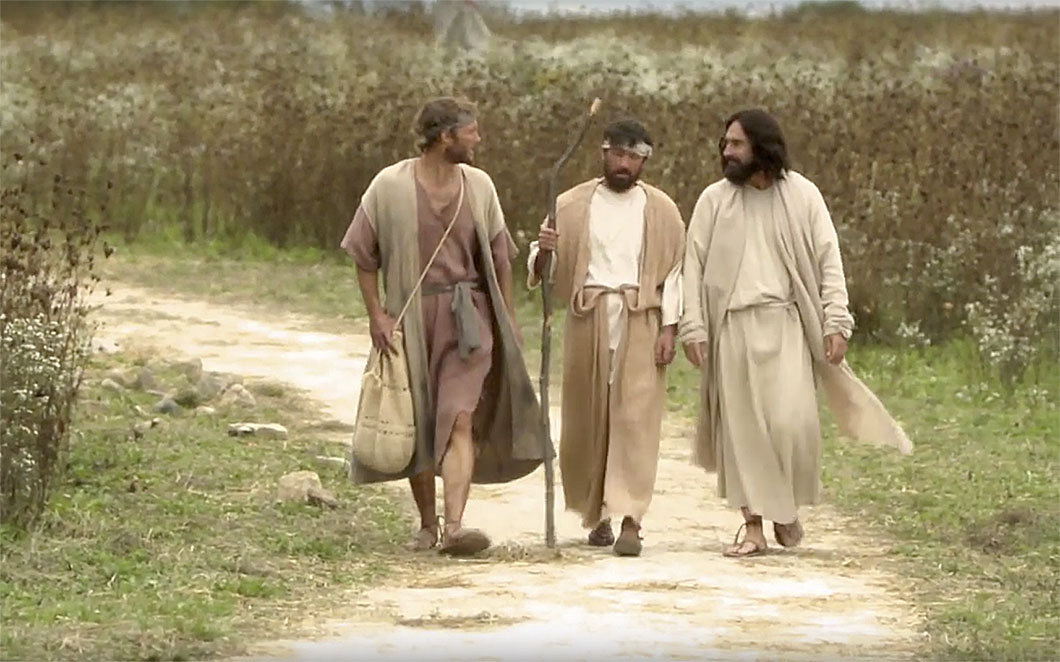
On the evening of the day of the Lord’s resurrection, two of His followers were travelling from Jerusalem back to their home in the village of Emmaus, which was situated about three score from Jerusalem . As they walked, they talked about all the recent happenings in Jerusalem with respect to the crucifixion of the Lord Jesus Christ. (v 13-14.)
The location of Emmaus isn’t clear. Whatever its location, Luke isn’t retelling a myth but an actual historical encounter based in time and space. Fortunately, it isn’t necessary for Twenty-First Century readers to know the exact location in order to understand the story.
The location of Emmaus isn’t clear, but what happened next is very clear!
Jesus himself drew near and went with them (Luke 24:15-16)
15 And it came to pass, that, while they communed together and reasoned, Jesus himself drew near, and went with them.
What a precious thought! As are all the other scriptures with the phrase about “Jesus himself”
Apparently they were not walking too fast, because Jesus, travelling the same direction, overtook them (Greek eggizo, “draw near, approach”) and then slowed to walk along with them.
16 But their eyes were holden that they should not know him.
Cleopas and his fellow disciple were deeply engaged in a discussion (Greek suzeteo) about all the recent happenings in Jerusalem with respect to the crucifixion of the Lord Jesus Christ, when “Jesus himself” approached them. They were talking with each other about everything that had happened recently in Jerusalem. As they talked and discussed these things with each other, Jesus himself came up and walked along with them; but they were kept from recognizing him.
Jesus may walk beside us unrecognized as he seeks us for fellowship
Just as Jesus was not recognized by the travelers to Emmaus, he can be with us and even encourage us in our struggles, even though we aren’t aware that he is present, or recognize him in our lives. The risen Christ is not limited, as we are, by geography or time.
Vs. 16 says that their eyes were prevented from recognizing Him.
I believe that Jesus veiled their eyes so that they could not recognize Him as Christ because He was illustrating an important principle which would be in operation now that the resurrection had taken place. His disciples would be entering a new phase of His ministry, in which they would be instructed to “walk by faith and not by sight”! ….as taught in 2Corinthians 5:7
I believe that Jesus is illustrating an important principle; that the person of Jesus Christ is revealed in scripture. Truth is revealed in scripture, and Jesus is the manifestation of that truth, the word of God. So when they saw the truth of scripture, they would see God. This is clearly taught in Hebrews 1:1-3.
There eyes were closed until they believed in the word of God. This is why we put such an emphasis on the authority of scripture. This is why we preach the scriptures word by word, verse by verse. This is why it is so important. This is why we say that the scriptures are the inerrant, God breathed words of God.
Heb. 4:12 says that “the word of God is living and active and sharper than any two-edged sword…” It’s alive, it’s active, it’s the Spirit of God contained in the word of God.
. I believe the Lord, in His grace and mercy, prevented them from recognizing Him so they would have the opportunity to see with real clarity. They needed to understand by way of His recounting of the Scriptures concerning Himself, as He was about to do. Had He immediately revealed Himself to them, it would have been obvious that He was risen indeed. However, it was imperative that they first see with their hearts and minds before recognizing Him with their natural eyes.
Since our Lord’s desire is for us to share Him with others through His Word and not His physical body, that is what they needed to see first. They needed to see Jesus the Messiah, foretold throughout the Scriptures.
In John 20:29 Jesus said to Thomas, another chap who needed a bit of clarity, “Because you have seen Me, have you believed? Blessed are they who did not see, and yet believed.”
God prevented these two disciples from recognizing Jesus to convey a deep truth: Even if we were to see, we might still not believe. We must trust the testimony of Scripture.
Jesus tells us that we must have the scriptural truth to understand who He is. Romans 10:17 tells us that faith comes by hearing and hearing by the word of God.
Outside of the word of God there is no reliable witness to who Jesus really is.
The scripture tells us the truth about Jesus.
Like us today, those men needed to trust the Word, from Moses to the Prophets and the Psalms, before relying upon His physical presence for evidence to His identity, purpose, and glory. For soon, that was exactly what they would need to teach others to do, to trust Him by His Word not the manifesting of His body.
We, like the two disciples on the road to Emmaus, have sorrows, confusion, disillusionments, and despair. It is our lot as fallen individuals, living among other fallen individuals. Yet, 1 Peter 1:6-9 is a great passage to realize the depth and truth of Jesus’ words in John 20:29: In this you greatly rejoice, even though now for a little while, if necessary, you have been distressed by various trials, so that the proof of your faith, being more precious than gold which is perishable, even though tested by fire, may be found to result in praise and glory and honor at the revelation of Jesus Christ; and though you have not seen Him, you love Him, and though you do not see Him now, but believe in Him, you greatly rejoice with joy inexpressible and full of glory, obtaining as the outcome of your faith the salvation of your souls.
Some people need to “see” by way of proof and evidence. I thank God for divinely preventing those two downcast men from immediately seeing or recognizing Him, as it brought about a cementing of their faith and a radical transformation from sorrow to joy inexpressible and full of glory. And it is just that kind of transformation that turned the world upside down.
And it is just that kind of transformation that the world needs today!
ALL THAT DR. GP HAS EXPLAINED WAS GOOD AND TRUE BUT HERE IS AN ADDITIONAL PERSPECTIVE BUILDING ON WHAT HE SAID…
Anyone reading the Story of the journey to Emmaus gives them Great Joy because we recognise something in it that Rings True but sometimes we are to immerse in the Story to recognise the Pattern that causes us a good feeling. It is as if you Zoom out in a Map to see the overall picture and not all the details and the image that appears is this. People Recounting the Events which would be akin to bits of Data that was weaved into Information, concerning the Events that Transpired in Jerusalem and they pondered on these things and Christ being in their company explained the Scriptures showing the links of all that was said, connecting/linking it to the then present day events. The Discussion and Learning was filling their Hearts that caused the Burning within them, feeling the Truthfulness of it. When they entreated Jesus further to abide with them, and because of the invitation and the sweetness of the feelings that they were receiving, and the willingness of those that received on the road to Emmaus to have this person reside longer with them and to Sup with them, then came the final understanding and their minds were illuminated and all the Connections to the Truthfulness of what was said and had Transpired, opened their minds to that Ah Ha moment of the Understanding, of WHO it was that was in their company.
The Stages that they went through, was recounting the bits of Data they had putting it together as information, pondering on it until it became Knowledge, all the while feeling their hearts tingling/burning until they reached out to the person that was helping them put all these things together to arrive at a knowledge. By encouraging the Influence that got them to that point to Abide with them and to break bread with them, they showed a willingness for the Influence to Stay with them. And then their Eyes were opened meaning they had the Ah Ha moment and everything came together touching all points of their understanding that they recognised who it was that was with them and brought them to that point.
Here we see the stages of learning and how to transform the Knowledge of all of the Scriptures that were Expounded by Inviting that same Spirit to remain with them and to Abide with them and to eat bread with them, then what they knew was Transformed to Understanding.
The Moral of the Story is, Christ is with us from our humble learning beginnings of Data, to Information, to Knowledge unto Understanding and because of our willingness, the Eyes of our Understanding will be Opened. We will have Eyes that See and Ears that Hear within our Inner Being. Christ is with us all the time (24×7) in our Sojourn through this life. In just a few Versus the Process of how we Learn and Understand was Explained.
https://wi.adventist.org/wp-content/uploads/2019/04/road-to-emmaus.jpg
GREAT EXPOSITION AND PICTURE FREEDOM!
YOUR THOUGHTS ARE A PERTINENT ADDITION TO THE DISCUSSION— AND REACH A HEIGHT NOT USUALLY SEEN ON THIS BLOG IN ITS 6 MONTHS OF EXISTENCE
THANKS
I HOPE THAT OTHERS CAN RISE TO SUCH HEIGHTS. INSTEAD OF THE NORMAL CONCENTRATED RUBBISH THAT IS PURVEYED HERE ON A WEEKLY BASIS —–BUT I DOUBT IT VERY MUCH.
THE THOUGHT THAT Christ is with us from our humble learning beginnings of Data, to Information, to Knowledge unto Understanding and because of our willingness, the Eyes of our Understanding will be Opened REMINDS ME (AS I OFTEN DO) OF PLAYING AT MY GRAND MOTHER’S FEET, AS SHE SANG CHILDREN’S HYMNS FROM HYMNS A AND M WAY BACK IN THE LATE 50’S. THESE WERE MY PRIMORDIAL OR humble learning beginnings.
IN FACT, IN RECENT TIMES, I WAS ABLE TO USE ONE OF THESE HYMNS AS A BASIS OF A TALK IN BREAKING OF BREAD.. WITH A MUCH GREATER UNDERSTANDING OF THE WORD 60 YEARS LATER I COULD SPEAK FERVENTLY OF THE FRIEND THE SONG, THE ROBE, THE CROWN, THE HOME, THE HARP ETC THAT CHRIST HAS FOR “LITTLE CHILDREN” .ABOVE THE GREAT BLUE SKY
MLK last Sunday Sermon
Jesus started communication with them (24:17)
17 And he said unto them, What manner of communications are these that ye have one to another, as ye walk, and
Jesus asked this leading questions, not to be duplicitous, but to get them to declare their theology, and then, having heard it, he could use that as a means to teach them.
So the key to their bad theology was that they knew that Jesus was a great prophet, and they had hoped He was the Messiah. However, the crucifixion of Christ had destroyed that hope, because their theology called for a living, physical king to take the throne and overturn their enemies. They were good on the glory part of their theology. But they had no understanding of the suffering part of the Messiah. They hadn’t been taught that in synagogue. hey had merged the mountain top of the prophecies of His first advent, with that of the mountain peak of his glorious appearance,
I find that analogous with a lot of some “Christian” theology today. The television evangelists are really good on the glory part. They are all about having your best life now. They are really good on the parts about freedom in Christ, and blessings in Christ. But they have failed to comprehend the suffering parts. The forsaking of the world. The crucifixion of the flesh. The denial of the lusts and passions of the flesh so that we might live a God pleasing life. That part is not being preached today. They fail to understand the same thing these two on the road to Emmaus failed to understand; that the path to glory is on the road to suffering.
The Messiah’s suffering was to come before His glorification. And Jesus said the disciple is not above His master, ladies and gentlemen. We must join the fellowship of His suffering in the present world if we expect to be glorified with Him in the next. Paul said in Rom. 8:17 that we are the children of God and fellow heirs with Christ “if indeed we suffer with Him so that we may also be glorified with Him.”
18 And the one of them, whose name was Cleopas, answering said unto him, Art thou only a stranger in Jerusalem, and hast not known the things which are come to pass there in these days?
Of the two disciples, only one is named — Cleopas — perhaps, because he would have been well-known to Luke’s readers. The name Cleopas (“renowned father”) is a Greek name, which was probably used as an equivalent to the Semitic form “Clopas.” Clopas is identified in John 19:25 as the husband of one of the Marys who was present at the crucifixion and also the name of a brother of Joseph. If Cleopas/Clopas are the same person, then this resurrection appearance on the road to Emmaus happens to the father of Simeon, who is later head of the church in Jerusalem.
Cleopas was surprised that the “stranger“ had not heard about the things that had been going on in Jerusalem, and figured that he was speaking to recent visitor to the city who was only just passing through.
And he said unto them, What things?
“What things are these” or “What are you talking about?” Jesus asks, prompting these disciples to explain.
“What things are these” or “What are you talking about?” Jesus asks, prompting these disciples to explain.
Reports of Jesus’ Resurrection (24:19b-24)
And they said unto him, Concerning Jesus of Nazareth, which was a prophet mighty in deed and word before God and all the people: v 19
20 And how the chief priests and our rulers delivered him to be condemned to death, and have crucified him.
21 But we trusted that it had been he which should have redeemed Israel:
These disciples described Jesus as a “prophet, powerful in word and deed” (24:19b). While we may realize that Jesus is much more than a prophet, in Jesus’ day to be called a mighty prophet is high praise indeed. It compares Jesus with Israel’s greatest miracle-working men of God — Moses, Elijah, Elisha, and the like.
These disciples had expected Jesus to be “the one who was going to redeem Israel” (24:21a). The promised Davidic Messiah was widely anticipated to redeem Israel from her enemies and to set up the Kingdom of God afresh. “Redeem” is the Greek verb lutroo. The basic meaning is “to free by paying a ransom, redeem,” but here it has the extended meaning “to liberate from an oppressive situation, set free, rescue, redeem.”
While we may think of Christ’s work as a spiritual redemption from sin brought about by means of the cross, Cleopas and his friend and many Jews were thinking of a military redemption, setting Israel free from Roman occupation.
Alas, this kind of redemption was now impossible they complained in despair, since Jesus is now dead.
This is why they are so downcast.
The word translated “had hoped” (NIV) or trusted in the KJV is the Greek verb elpizo, “to look forward to something, with the implication of confidence about something coming to pass, hope, hope for.”
In the imperfect tense it has the idea of continued action in the past, “were hoping.” But now their hopes of a military redemption, setting Israel free from Roman occupation were dashed. Jesus had been crucified.
and beside all this, to day is the third day since these things were done.
22 Yea, and certain women also of our company made us astonished, which were early at the sepulchre;
23 And when they found not his body, they came, saying, that they had also seen a vision of angels, which said that he was alive.
24 And certain of them which were with us went to the sepulchre, and found it even so as the women had said: but him they saw not.
In addition to being downcast, these men were also confused, because part of the day’s events included reports from prominent female believers which stated that Jesus was alive. They report this to Jesus as a curiosity, but clearly don’t give it full credence or their demeanor would have been one of excitement. Rather than believing, they are described as “amazed” (NIV) or “astonished,” Greek existemi, “to cause to be in a state in which things seem to make little or no sense, confuse, amaze, astound.”
A good place for some of us to be in. “Confused,amazed,astounded”. Usually the Tipping Point ?
RE A good place for some of us to be in. “Confused,amazed,astounded”.
NO NOT AT ALL!
YOUR PROBLEM IS THAT YOU CAN NOT READ!
BELIEVERS ARE NOT “Confused,amazed,OR astounded”.BECAUSE THEY KNOW whom THEY have believed, and ARE persuaded that he able to keep that which THEY have committed unto him against that day. 2 Timothy 1:12 B
Prophecies Concerning the Christ (24:25-27)
25 Then he said unto them, O fools, and slow of heart to believe all that the prophets have spoken:
26 Ought not Christ to have suffered these things, and to enter into his glory?
27 And beginning at Moses and all the prophets, he expounded unto them in all the scriptures the things concerning himself.
But the “stranger” rebuked them for their unbelief. Jesus was not very tolerant of his disciples’ unbelief in the face of the Scriptures and the events of the day.:
He called them “foolish,” using the Greek adjective anoetos, “unintelligent, foolish, dull-witted.” It is a compound word, formed from two words meaning “without, not” and “understanding, perception”.
His other descriptor is “slow of heart to believe.” “Slow” is the Greek adjective bradus, “slow, figurative of mental and spiritual slowness.” “Slow of heart” means “dull.”
He then continued by reminding them bout certain things that were said about him in the Old Testament, especially the fact that “that Christ had to endure the suffering that they had witnessed, prior to entering his glory. He also explained what was said in all the Scriptures concerning himself, beginning with Moses (i.e the Pentateuch) and also l the prophetic scriptures.
Jesus convinced them that Scripture teaches two things about the Messiah which they should know and believe, namely that “The Christ” would have to suffer death, and then enter into his glory(i.e his resurrection and ascension and current vital session.) Jesus expects his disciples to believe what he says in His Word.
Jesus says in vs. 24, “O foolish men and slow of heart to believe in all that the prophets have spoken! Was it not necessary for the Christ to suffer these things and to enter into His glory?” Then beginning with Moses and with all the prophets, He explained to them the things concerning Himself in all the Scriptures.
What scriptures is Jesus referring to? Well, the NT scriptures have not been written yet.
So Jesus is preaching NT theology from OT scriptures. I want to be sure you get that today. Jesus is the same yesterday, today and forever. The OT is still the inspired, eternal word of God. Jesus said He didn’t come to annul the law, but to fulfill it. So Jesus started with Moses, that means He started with Genesis and worked through the Pentateuch, which was called the Law, then through the Psalms, and through the minor prophets, showing them how they taught that the Messiah must suffer before He enters His glory
They had a picture in their minds. They knew what they saw, what they experienced, and this they tried to reconcile with their own presumptions regarding the coming Messiah. They exchanged meaningful, impassioned words, but until the Word Himself walked with them, their exchange only amounted to more confusion and despair. Especially, it seems, when they had to explain those painful events to that Unannounced Eavesdropper. There seems to be a bit of irony in their desperate search for truth, as Truth Himself walked beside them.
Verse 27 says, “Then beginning with Moses and from all the prophets Jesus interpreted for them the things concerning Himself in all the Scripture.”
While we do not know the specific passages Jesus used, we know He opened to them the Scriptures with a view toward showing them how all the Old Testament pointed to Him as its fulfillment.
the Word explains it all. Beginning with Moses, to the Prophets and the Psalms, we find Him: the Alpha the Omega, the Beginning and the End, the First and the Last. If you seek Him throughout His Word, the Lord God, will be found by you. What the natural eye cannot see, the Spirit will surely reveal. Here is what they could not see; that the Messiah must suffer and die before He could enter into His glory.
It is clear that this passage constitutes a continuation of Jesus’ discipleship training. There are several points he seeks to get across to his disciples, those in the First Century and today:The Messiah must suffer. This is not some convenient rationalization by disciples after the fact. Jesus makes it abundantly clear that the Old Testament teaches it in the Suffering Servant passage in Isaiah 52:13 – 53:12.When you connect the Messiah with the Servant of Yahweh, it is pretty clear that we are reading a prophecy and interpretation of Jesus’ death and resurrection. The meaning of his death becomes obvious as a substitutionary sacrifice for sin.
Then the Messiah will enter into his glory. Isaiah 53:11-12 talks about the Servant’s glory: “After the suffering of his soul, he will see the light of life and be satisfied… Therefore I will give him a portion among the great, and he will divide the spoils with the strong.” The Church has portrayed most effectively in the agony and suffering of Christ, and has understood the glory of the resurrection, depicted by the empty tomb. Together these truths must both be understood and treasured by the Church.
Your problem is that I understand.

You can listen to the Books of the Bible read on the internet.
This one is great.
I hope to listen to all.
Lie down, relax and enjoy the Gospel of Mark read at St. Paul’s Cathedral.
THANKS JOHN
DAVID SUCHET HAS READ THE GOSPEL OF MARK VERY WELL

Inspector Poirot.
@ GP April 15, 2020 9:42 AM
“THANKS JOHN
DAVID SUCHET HAS READ THE GOSPEL OF MARK VERY WELL..”
+++++++++++++++++++++++++++++++++++++++++++++++++++++
How about the authoritative substance of what he read?
Why can’t you act as his defender of the integrity of the gospel of the playwright using the pseudonym ‘Mark’ by telling us why fabrications about the ancestry, conception, birth and early years of Jesus have been omitted?
Is it because the introductory part of the plot about Jesus being born of a virgin girl and visited by wise men in a house and by shepherds in a manger while hiding from a king of mass infanticide was really to far fetch for the human imagination to travel in the realm of mythology and childish credibility?
So which gospel is closest to the Truth about the birth, life and death of the eponymous Jesus?
GO ONLINE
SEARCH FOR WHY FOUR GOSPELS BY ARTHUR PINK
READ IT AND YOU SHOULD GET A DETAILED ANSWER
@ GP April 15, 2020 1:02 PM
You little punk, you!
You are nothing but the biggest coward in the class of intellectual pugilism.
You have been thrown up against the ropes punched drunk from that volley of uppercuts and ending with that direct hit to your solar plexus of Jewish concocted religious mumbo-jumbo.
What’s wrong with reading the actual written “Holy Bible” published and printed in ‘Christianized’ England under the special appointment of Her Majesty’s special command to be read in (all) churches including your extremist religious Jim Jones-type joint teller of tall tales to keep black fools like you in continuing subjugation aka mental slavery?
This may be helpful.
Lie down, relax and enjoy.
@ Miller
The original languages of the Bible( OT and NT) said “young woman” ; not “virgin”. I think that translation/concept of virgin came much later. This includes the often quoted reference to 2 Isaiah/
Alec McCowan (dec’d) recited the Gospel of Mark.
It took him 16 months to memorise.
Amazing.
@ Vincent Codrington April 15, 2020 5:51 PM
“The original languages of the Bible( OT and NT) said “young woman” ; not “virgin”. I think that translation/concept of virgin came much later. This includes the often quoted reference to 2 Isaiah…”
++++++++++++++++++++++++++++++++++++++++++++++++++++++++
Even if she was a “young woman” she was clearly still a “virgin” to Joseph when he found out she was carrying a baby which was not his since he had not yet “known her” in the way Adam knew Eve and “was minded to put her away privily” until the angel of the Lord appeared to him in a dream to ‘man up’.
The point being made is that there is no consistency among the four gospels to support the authenticity of circumstances surrounding the actual birth of Jesus.
Matthew’s account differs from that of Luke’s and neither Mark nor John deals with that most secretive topic of Jesus’s immaculate conception.
Some Simple Notes on CHRIST-And The Virgin Birth for BEGINNERS
What doctrines are dependent on the veracity of the virgin birth of Christ?
The Doctrines of Final Authority of the Bible are the atoning death of Jesus, His bodily resurrection, the lordship and intercession of Christ, and His second advent. All of these are dependent upon the veracity of the virgin birth of Christ.
Why did Christ have to become a man?
Christ had to become man in order to manifest God to man.
Explain why Christ could have a human mother but not a human father? What Biblical promise does this fulfill?
Christ’s could be through a human woman, but not from the seed of a human man, because the seed of man carried (and carries) the penalty of sin with it, that is, death and sin itself. The Holy Spirit had to be the agent of conception so that Christ could be born perfect and without the taint of sin.
What is the Hebrew word translated “Virgin”? What does it mean? Where is this important prophesy found?
The word translated “Virgin” from the Hebrew is “ALMAH.” It means a lass, damsel, maiden, WHO HAD NOT EVER HAD SEXUAL RELATIONS.
What is the Hebrew word that those who do not believe in the virgin birth want us to think is the original word ?
“BETHOOLAH” is the word which those who do not believe in the virgin birth want us to think is the original word.
In which Scripture did Jesus spoke of Mary, His mother, as “woman.”
John 2:4
In which Scripture did Paul confirmed the prophecy below? Quote this scripture.
I will give unto thee, and to thy seed after thee, the land wherein thou art a stranger, all the land of Canaan, for an everlasting possession.
Paul confirmed this prophecy in Galatians 3:16 thus: Now to Abraham and his seed were the promises made. He saith not, And to seeds, as of many; but as of one, And to thy seed, which is Christ.
What testimony to the virgin birth of Christ does Moses give in the Pentateuch? How do we know that this is so?
Moses, writing in the Pentateuch, bore unequivocal testimony to the virgin birth of Christ by showing that (1) the “seed of the woman” would bruise the serpent’s head; (2) that Shiloh would come to gather back His people; (3) that the Star out of Jacob; (4) the Scepter shall arise out of Israel, (5) that they would harken to the great Prophet whom God should raise up; (6) and that the serpent in the wilderness should be raised up, which Christ said, unequivocally, was prophetic of Himself. To make doubly sure His listeners would understand what He was saying, Christ said, “Moses wrote of me. ”
When the Psalmist, says, “I will make Him My first-born, higher than the kings of the earth,” to whom does he refer? Which New Testament scripture refers to this prophesy?
When the Psalmist, says, “I will make Him My first-born, higher than the kings of the earth,”he is referring the Emmanuel-King, looking beyond the Davidic covenant to One higher than the kings of earth. This prophecy is referred to by the writer of the Hebrews in chapter:1:6 ,when he says..When he bringeth in the first-begotten into the world, he saith, And let all the angels of God worship Him.
Comment briefly about prophecies of the Old Testament that have found their fulfillment in the New, relative to the birth of Jesus.
Among the prophecies of the Old Testament that have found their fulfilment in the New, relative to the birth of Jesus, are the one about where He was to be born: But thou, Bethlehem Ephrathah, though thou be little among the thousands of Judah, yet out of thee shall He come forth unto Me that is to be ruler in Israel. Micah speaks with authority in foretelling the coming of the King. No one would have expected a ruler or king to come from little Bethlehem.
Hosea prophesied, “I called my Son out of Egypt.”
This statement of Hosea not only had a historic but also a prophetic value. Primarily, it refers to Israel as a nation. God is calling her out of spiritual harlotry and pollution, from her chastisement for sin, and calling her back to her first love, Jehovah. several hundred years a “child” is born, and Matthew’s Gospel uses the love quotation of Hosea to his estranged wife as applying to Christ. The history of Hosea saw the child (Israel) going into Egypt, but it is also a type, as Matthew sees it, of the child-Christ coming out of Egypt. While Matthew’s Gospel might well be called the “Gospel of rejection” it can also be called the “good tidings of deliverance.”
Jeremiah records: A voice was heard in Ramah, lamentation, and bitter weeping; Rachel weeping for her children refused to be comforted for her children, because they were not. Thus saith the Lord; Refrain thy voice from weeping, and thine eves from tears; for thy work shall be rewarded, saith the Lord.
And Isaiah says, “And there shall come forth a rod out of the stem of Jesse, and a Branch shall grow out of his roots.”
In this prophecy Jeremiah predicts the doom of a dying nation. Rachel is portrayed as lamenting the destruction of her descendants. Her anguish found a counterpart in the grief of the mothers in Bethlehem. The prophet gives a ray of hope and comfort in the coming of a Deliverer-Christ. The Gospel of Matthew quotes this prophecy but only that portion dealing with the doom and weeping. Rachel’s weeping is to cease, for the King has come.
The Old Testament closes looking for the coming of the Messiah, which was prophesied 400 years before fulfilment: Behold, I will send My messenger, and he shall prepare the way before Me; and the Lord, whom ye seek, shall suddenly come to His temple.
Malachi saw both Advents of Christ, but did not separate them in his prophecy.
What was the first prophecy fulfilled in the New Testament? Where is the prophecy recorded and where is the prophecy found of which this is the fulfillment.?
The first prophecy fulfilled in the New Testament was She shall bring forth a son, and thou shalt call His name Jesus: for He shall save His people from their sins ( Matthew 1:21).
Matthew 1:21 is the fulfillment of the prophesy given in Isaiah 7:14 of Immanuel, the virgin’s son, which states: Behold, a [the] virgin shall conceive, and bear a son, and shall call His name Immanuel.
Quote and memorize Isaiah 9:6.
For unto us a child is born, unto us a son is given; and the government shall be upon His shoulder; and His
name shall be called Wonderful, Counselor, The mighty God, The everlasting Father, The Prince of Peace.
Comment briefly on the concept of Christ as the Scepter, and on the statement.. “The birth of Christ is promised as the “Star,” a type of Christ who was to rise and guide His people.”
I shall see Him, but not now: I shall behold Him, but not nigh: there shall come a Star out of Jacob, and a Scepter shall rise out of Israel. The Scepter (Hebrew, shevet) is a symbol of the sovereignty of Christ, indicating His holy character and righteous acts in judgment:
The Scepter shall not depart from Judah, nor a lawgiver from between his feet, until Shiloh come; and unto Him shall the gathering of the people be. Shiloh (Hebrew, meIech, meaning King; Hammashiach, Messiah) is a name given to Christ, the word meaning “The Peace-maker.” This prophecy has a twofold reference, to both Christ’s First and Second Coming. It is plainly shown in the seven “shalls” of the Gospel of Luke:
And, behold, thou shalt conceive in thy womb, and bring forth a son, and shalt call His name Jesus. He shall be great, and shall be called the Son of the Highest: and the Lord God shall give unto Him the throne of His father David; And He shall reign over the house of Jacob for ever: and of His kingdom there shall be no end.
How many of the seven “shalls” of Luke 1:31-33 have been fulfilled? Which three await fulfillment?
The first four “shalls” have been literally carried out, and the last three are awaiting fulfilment at the Second Advent of Christ.
Comment briefly on the Hebrew word “peleh”, translated “Wonderful” in Isaiah 9:6.
The Hebrew word “peleh”, translated “Wonderful” in Isaiah 9:6 has even a deeper meaning, that of “miraculous, mysterious, indescribable, unfathomable,” which only could apply to Deity. Only Christ could say, “Search the Scriptures [O.T.] . . . they are they which testify of him.”
ALL SERIOUS SOUND SINCERE STUDENTS OF THE SCRIPTURES KNOW THAT EACH OF THE FOUR GOSPELS WAS DIRECTED TO DIFFERENT AUDIENCES AND CONSEQUENTLY THE CONTENTS WERE COMPOSED BY THE SPIRIT ACCORDINGLY
I HAVE ALREADY RECOMMENDED THAT BIBLE ILLITERATES READ ARTHUR PINKS DETAILED AND EXCELLENT TREATISE ON THIS SUBJECT ENTITLED “WHY FOUR GOSPELS”
ALL DECENT COMMENTARIES ON THESE FOUR GOSPELS ADDRESSES THESE ISSUES TO SOME EXTENT, BUT NONE DO THIS AS WELL AS ARTHUR PINK

Quite true! Intended for different audiences.
In Matthew, Christ is presented as the Son of David, the King of the Jews, and everything in his narrative centers around this truth. This explains why the first Gospel opens with a setting forth of Christ’s royal genealogy, and why in the second chapter mention is made of the journey of the wise men from the East, who came to Jerusalem inquiring “Where is He that is born King of the Jews?”, and why in chapters five to seven we have what is known as “The Sermon on the Mount” but which, in reality, is the Manifesto of the King, containing an enunciation of the Laws of His Kingdom.
Mark, Christ is depicted as the Servant of Jehovah, as the One who through equal with God made Himself of no reputation and “took upon Him the form of a servant.” Everything in this second Gospel contributes to this central theme, and everything foreign to it is rigidly excluded. This explains why there is no genealogy recorded in Mark, why Christ is introduced at the beginning of His public ministry (nothing whatever being told us here of His earlier life), and why there are more miracles (deeds of service) detailed here than in any of the other Gospels.
In Luke, Christ is set forth as the Son of Man, as connected with but contrasted from the sons of men, and everything in the narrative serves to bring this out. This explains why the third Gospel traces His genealogy back to Adam, the first man, (instead of to Abraham only, as in Matthew), why as the perfect Man He is seen here so frequently in prayer, and why the angels are seen ministering to Him, instead of commanded by Him as they are in Matthew.
In John, Christ is revealed as the Son of God, and everything in this fourth Gospel is made to illustrate and demonstrate this Divine relationship. This explains why in the opening verse we are carried back to a point before time began, and we are shown Christ as the Word “in the beginning,” with God, and Himself expressly declared to be God; why we get here so many of His Divine titles, as “The only begotten of the Father,” the “Lamb of God,” the “Light of the world” etc.; why we are told here that prayer should be made in His Name, and why the Holy Spirit is here said to be sent from the Son as well as from the Father.
It is a remarkable fact that this fourfold presentation of Christ in the Gospels was specifically indicated through the Old Testament seers. Conspicuous among the many prophecies of the Old Testament are those which spoke of the coming Messiah under the title of "the Branch." From these we may select four which correspond exactly with the manner in which the Lord Jesus is looked at, respectively, in each of the four Gospels: -
In Jer. 23:5 we read, "Behold, the days come, saith the Lord, that I will raise unto DAVID a righteous Branch, and a King shall reign and prosper, and shall execute judgment and justice in the earth." These words fit the first Gospel as glove fits hand.
In Zech. 3:8 we read, "Behold, I will bring forth My Servant the Branch." These words might well be taken as a title for the second Gospel.
In Zech. 6:12 we read, "Behold the Man whose name is the Branch." How accurately this corresponds with Luke's delineation of Christ needs not to be pointed out.
In Isaiah 4:2 we read, "In that day shall the Branch of the Lord be beautiful and glorious."
Thus, this last quoted of these Messianic predictions, which spoke of the Coming One under the figure of “the Branch,” tallies exactly with the fourth Gospel, which portrays our Savior as the Son of God.
Matthew is the only one of the four Evangelists who presents Christ in an official relationship, namely, as the Messiah and King of Israel, and Matthew himself was the only one of the four who filled an official position; for, unlike Luke, who was by profession a physician, or John who was a fisherman, Matthew was a tax-gatherer in the employ of the Romans.
Again; Matthew presents Christ in Kingdom connections, as the One who possessed the title to reign over Israel; how fitting, then, that Matthew, who was an officer of and accustomed to look out over a vast empire, should be the one selected for this task. Again; Matthew was a publican. The Romans appointed officials whose duty it was to collect the Jewish taxes. The tax-gatherers were hated by the Jews more bitterly than the Romans themselves. Such a man was Matthew.
How feelingly, then, could he write of the One who was “hated without a cause”! and set forth the Messiah-Savior, as “despised and rejected” by His own nation. Finally, in God appointing this man, who by calling was connected with the Romans, we have a striking anticipation of the grace of God reaching out to the despised Gentiles.
Mark’s Gospel sets before us the Servant of Jehovah, God’s perfect Workman. And the instrument chosen to write this second Gospel seems to have held an unique position which well fitted him for his task. He was not himself one of the apostles, but was rather a servant of an apostle. In 2 Tim. 4:11 we have a scripture which brings this out in a striking manner – “Take Mark, and bring him with thee: for he is profitable to me for the ministry.” Thus the one who wrote of our Lord as the Servant of God, was himself one who ministered to others!
Luke's Gospel deals with our Lord's Humanity, and presents Him as the Son of Man related to but contrasted from the sons of men. Luke's Gospel is the one which gives us the fullest account of the virgin-birth. Luke's Gospel also reveals more fully than any of the others the fallen and depraved state of human nature. Again; Luke's Gospel is far more international in its scope than the other three, and is more Gentilish than Jewish - evidences of this will be presented when we come to examine his Gospel in detail. Now observe the appropriateness of the selection of Luke to write this Gospel. Who was he? He was neither a fisherman nor a tax-gatherer, but a "physician" (see Col. 4:14), and as such, a student of human nature and a diagnostician of the human frame Moreover, there is good reason to believe that Luke himself was not a Jew but a Gentile, and hence it was peculiarly fitting that he should present Christ not as "the Son of David" but as "The Son of Man."
John’s Gospel presents Christ in the loftiest character of all, setting Him forth in Divine relationship, showing that He was the Son of God. This was a task that called for a man of high spirituality, one who was intimate with our Lord in a special manner, one who was gifted with unusual spiritual discernment. And surely John, who was nearer to the Savior than any of the twelve, surely John “the disciple whom Jesus loved,” was well chosen. How fitting that the one who leaned on the Master’s bosom should be the instrument to portray Christ as “The only-begotten Son, which is in the bosom of the Father”! Thus may we discern and admire the manifold wisdom of God in equipping the four “Evangelists” for their honorous work.
RATLEY’S INTRODUCTION TO THE FOUR GOSPELS
The four Gospels are the crux of the Bible. They are the historical focus of Old Testament prophecy, and the factual basis of New Testament theology. They are not the terminus of Old Testament prophecy, much of which runs on into times even yet future; but they are the mainline junction, on which all Old Testament branch-lines converge. All lines now become one main line in the historical JESUS OF NAZARETH. We change here from that which is distinctively Jewish to that which is distinctively Christian; from the old covenant and dispensation to the new covenant and dispensation; from Moses to Christ; from law to grace.
Let us now look at the parallel which can be seen between the four Gospels and the “living creatures” or cherubim in the opening vision of the prophet Ezekiel. Ezekiel 1:10 describes them as thus: “As for the likeness of their faces, they four had the face of a man, and the face of a lion, on the right side; and they four had the face of an ox on the left side; they four also had the face of an eagle.” The lion symbolizes strength, kingship; the man, highest intelligence; the ox, lowly service; the eagle, heavenliness, mystery,
Divinity. These “living creatures” symbolically express the four basic social aspects of the Divine Nature; and it was inevitable that when the Divine Son Himself became incarnate the same four aspects should again conspicuously manifest themselves – as they do in the characteristic emphases of the four Gospels.
 In Matthew we see the Messiah-King (the lion).
 In Mark we see Jehovah's Servant (the ox).
 In Luke we see the Son of Man (the man).
 In John we see the Son of God (the eagle).
It needs all four aspects to give the full truth. As Sovereign He comes to reign and rule. As Servant He comes to serve and suffer. As Son of Man He comes to share and sympathise. As Son of God He comes to reveal and redeem. Wonderful fourfold blending – sovereignty and humility; humanity and deity!
Likewise Ezekiel’s vision shows – ‘!they four had one likeness” and two wings of every one were joined to another” – so it is with the four Gospels: amid their marked diversity they all portray “one likeness,” the same wonderful Person, and all the way through their “wings are joined one to another.”
That is what this Bible semi-literate was taught.
Everything shut down.
People have time at home.
Use it.
Spend some of it with the Bible.
Listen.
Read.
Study.
Things will open soon again.
Use the opportunity.
Jesus is a form of God’s divinity in man.
GP’s biblical postings are countless but words are useless to do full justice to God.
Nurture the divinity within yourself as God and you are one.
@ GP April 15, 2020 9:36 PM
“Matthew is the only one of the four Evangelists who presents Christ in an official relationship, namely, as the Messiah and King of Israel, and Matthew himself was the only one of the four who filled an official position; for, unlike Luke, who was by profession a physician, or John who was a fisherman, Matthew was a tax-gatherer in the employ of the Romans.
Again; Matthew presents Christ in Kingdom connections, as the One who possessed the title to reign over Israel….”
++++++++++++++++++++++++++++++++++++++++++++++++++++++++++
How can that be in keeping with the laws of regal succession?
Jesus was NOT the natural or biological son of Joseph (his mother Mary’s husband); unless you want to change the Jewish rules of kinship and allow for adoption?
If we were to follow your contrived thesis of Jewish genealogy to support a claim for Jesus’s entitlement to being called King of the Jews by descent through Joseph, David and Abraham then a similar claim could be made out for any of the descendants of Ishmael (Abraham’s firstborn) to sit at the right hand of Yahweh.
Now cuss muy now! Go ahead and call me the bible illiterate with the first class honours in the ‘black’ art of devil worship and who has a pew all for himself reserved in hell.





The blogmaster invites you to join the discussion.