← Back

Your message to the BLOGMASTER was sent

Barbados voter turnout 2026
Source: caribbeansignal.com

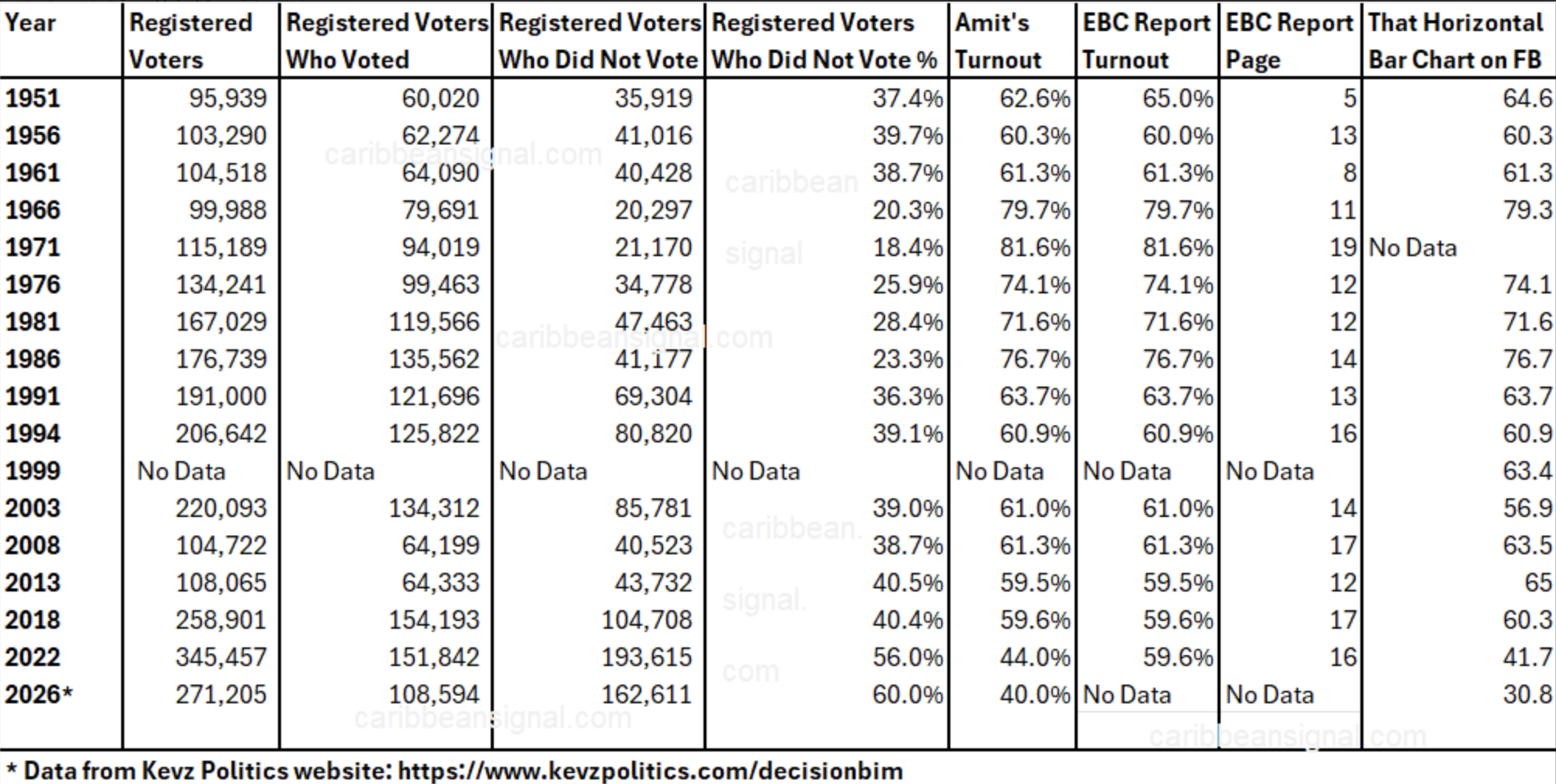
Soon after the election, I saw a horizontal bar chart circulating on Facebook showing voter turnout figures going back decades (see above). The chart looked authoritative, but no source was attached (I have since found out the Author of the chart). The Chart prompted me to go back to the official Election and Boundaries Commission (EBC) General Election reports.

(NOTE: You can access the reports directly from the EBC website here, or, via my archive website here. Yes, I know directory listing is enabled).

I dug through the reports year by year, extracted the number of registered voters and the number who voted, compared those figures to the turnout percentages published by the EBC, and then ran my own calculations. I also placed those results side by side with the figures shown in the circulating bar chart.

Source: Amit


Discover more from Barbados Underground

Subscribe to get the latest posts sent to your email.

41 responses to “Voters not interested: a look at the voter turnout”


  1. What about the people who registered but were told there was no record of their registration, and then given a bunch of stupid reasons why?


  2. Prime Minister Mottley wants to introduce legislation to prevent crossing the floor. In the last election, DLP actors Michael Lashley and Tyra Trotman crossed the ‘floor’ after resigning from the DLP.

    If the PM is serious about changing our political landscape, any proposed legislation must require a minimum 3-year cooling off period for political party resignations.


  3. How many persons were turned away? Unless we have an idea we are debating in the dark.


  4. David
    Neither Lashley nor Trotman ‘crossed the floor’, they were not MPs. They both opted to change political party, prior to the election.
    Thorne crossed, as did Atherley.
    While the concept of ‘banning crossing’ is appreciated on the surface, it is a ‘brain fart in the moment’.
    The current system as constructed, places that power in the individual, not the banner they ran under when elected.


  5. @NO

    Meant to park crossed between quotation which explains the last sentence.


  6. Ha! the PM is against floor crossing 😊, Did she ask Mascoll? (mentioning Mascoll may create some waves, when Mascoll crossed the floor Arthur put the cat among the pigeons by naming him co-leader) How bout party hopping? There are a few party hoppers in her orbit, one was known to make remarks about blubber when he was on the other side, and I heard the Honourable Ambassador Thompson positively chortling on CBC election night about a DLP member wearing a red shirt

    I don’t think the PM is really worried about any “floor crossers” she didn’t seem too concerned about the bishop, his announcement solved what was considered a constitutional dilemma as it fixed the issue of who would appoint opposition Senators. As for Ralph she probably said, “good riddance” given her remarks after he fled the hive. In fact, both moves gave her some cover as it could be argued that because of the presence of the token opposition all legislation was debated by both sides in the House.

    How about this for a headline “The PM announces that one of her first acts is to ensure the new Constitution is officially adopted”


  7. Well guess who is the DLP first vice president and should become the leader of the party until next AGC ???

    Lord have mercy on DEM


  8. David,

    The USA is murdering Cubans. I can’t even bear to think about it.

    The world is silent. These are darker times than I ever imagined I’d live to see.


  9. Well, the statistics tend to tell the whole story. However, even without a clean, updated, reliable, fairly accurate voters’ list, weeee see no set of circumstances where the result could have been too much better for the Dems, inspite of their strenuous efforts.

    And if weee are to move on and accept this journey into a very dark night, this weee must!

    Unfortunately, neither party, or their leadership, seemed to have any idea, vision, about the immediate future as based largely on externalities currently looming large.

    And in both cases weeee would have been well within the horns of a dilemma.

    Clearly, the next five years, or the interregnum between elections, portend severe difficulties at orders of magnitude unknown hithertofore.


  10. The figures for 2008 and 2013 are incorrect.

    Tron
    fair and balanced


  11. It doesn’t matter how you slice and dice it, we cannot have 30% of voters not having representation in parliament. There is a need to reform the system if we are honest about social justice.


  12. @David February 14, 2026 at 5:56 pm

    That’s debatable. 30% of 30% is 10% of all eligible voters. Why should a tenth of all eligible voters have any say in the matter? I don’t follow that logic.

    In general, if citizens do not vote, they tacitly agree with our great government. The actual support for the best government ever is therefore 20% of voting citizens plus 70% of non-voting citizens = 90%.

    So we are a flawless democracy.

    Tron
    fair and balanced


  13. The reverse argument is true. In addition, a government has a duty to ensure the governance structure is ‘fit for purpose’ to deliver to all.


  14. BLP real voters slapping it up.

  15. Critical Analyzer Avatar
    Critical Analyzer

    All the voter statistics are a total joke and will remain so until the voter register is properly cleaned up of the deceased and persons no longer living in Barbados.

    A random sampling and tracing of the status of 1% of the voter’s list should give a great indication of the true number of available voters.


  16. getting down


  17. So what’s the solution?

    Do we set a minimum voter count required to qualify an election as valid?

    Do we limit the rule of any party to a minimum of 3 consecutive terms?

    Do we restrict any PM to a limit of 3 terms over their lifetime?

    Do we make it law that all must vote? In my view this is pointless as one can deliberately spoil a vote.

    What do we do at the end of the 3 consecutive terms if there is no real alternative party to take over?

    I don’t really see any guaranteed road that will address all concerns without opening other challenges for us. The current system served us well since independence, however it has also failed us over the last 3 elections. But who do you blame for this? The Bs are strong and there is no opposition recognised by the electorate. What do you do when you reach this point? There really is no law that takes into account the total failure of a party to win a single seat in 3 consecutive elections is there?

    As Bushie says what a time we live in.


  18. Headline: Thorne talks about integrity legislation when he cannot keep his own house in order.

    Those who lament a democratic deficit should complain about the DLP bigwigs. They made a convicted orange sumpsuit vice president who made our great nation look like a joke.

    I find it simply appalling that many commentators on BU readily accept corruption because it is perpetrated by their favourite party.

    Tron
    fair and balanced


  19. Voter turnout figures ‘best from EBC’

    Political scientist Kevon Edey has dismissed claims that only 30 per cent of eligible voters turned out in last week’s General Election, describing the figure as inaccurate and not supported by preliminary data.

    “The EBC [Electoral and Boundaries Commission] still has to certify the results so any final figure on voter turnout would really be given via the EBC. However, the preliminary numbers indicated that the voter turnout actually was on par with 2022 at 41 per cent. That’s an official preliminary. So that 30 per cent figure is actually not true, from what I gather from this point that we would have been privy to as a country. It’s in the ballpark of around 41 per cent, lower than the average but it’s actually 41 per cent,” Edey said.

    He cautioned that while figures announced on election night were official, they remained subject to a certification process.

    “There’s some legalese there where . . . if the candidate wants a recount, for example, it allows for that to take place so that takes about a few days. So when EBC gives their certification of the results then that would be the official voter turnout,” he explained.

    When contacted, political scientist Peter Wickham declined to comment, citing a lack of all the relevant information from the EBC to accurately do so.

    Turning to the overall outcome of the election, Edey said the one-sided result did not come as a surprise, pointing to what he described as a focused and effective campaign by the governing Barbados Labour Party (BLP).

    “The one-sided outcome in the just-concluded election did not come as a surprise as the Barbados Labour Party [BLP] in particular ran a very strong campaign on leadership and on defending its record,” he said.

    National message

    “And that particular aspect resonated clearly with the voters in Barbados. As it pertains to the Democratic Labour Party (DLP), it unfortunately was not able to have a national message to connect with overall voters. And, as a result, their showing in the election pretty much stayed on track to their 2022 and was below their 2018 levels,” Edey added.

    He noted that while the Democratic Labour Party made “some inroads” in constituencies such as St Lucy and St John, where “local issues seem to have reigned a bit more supreme over national issues”, the overall result represented “very much a retaining of the status quo”.

    Edey also suggested that turnout patterns reflected the parties’ ability to mobilise their support bases.

    “The Democratic Labour Party seems to have had their base not come out to vote in ways that they would like . . . while the [Barbados] Labour Party seems to have retained a lot of their support base through all 30 constituencies. So, as a result, I think that the Democratic Labour Party, within these next five years, will have to probably do some level of introspection which, in this instance, I hope for their sake that it would show in terms of better performance in future elections,” he said. (SG)

    Source: Nation


  20. The voter list will never be perfect. There is not country that it is. We have to do the best to ensure the margin of error is as narrow as is possible.


  21. Déjà vu and desensitisation

    By Dr Kristina Hinds

    Following a short election campaign period and a long polling day, Barbadians have for a third time elected all 30 of the Barbados Labour Party’s (BLP) candidates. Although the teams are different, the result has been the same and Barbadians are perhaps accustomed to what, less than a decade ago, seemed unthinkable.

    In 2018 I was shocked while taking part in an election night panel, as box after box went to the BLP. In 2022, I was less moved by there being no representative elected who could serve as an opposition member in the House of Assembly.

    This General Election, I was rather unmoved by the result.

    Although it seemed to me that there may have been chances for the Democratic Labour Party (DLP) to win ridings in St Philip North and West, considering the margins of 235 and 440 votes, respectively, in 2022.

    Further, some may have guessed that St Lucy and St John would be returned to the DLP.

    Clearly, none of these outcomes materialised, nor did the close race between the DLP’s Ryan Walters and the BLP’s Neil Rowe in St Michael North West, bring the DLP joy.

    There are many discussions one can have about the reasons for this BLP “three-peat”, about party strategies, candidate selection and more, but instead of concentrating on these here, I turn to the lack of surprise and the sense of continuity that some of us may feel.

    The idea that Barbadians may now be inured to having a single political party control the Government and to having no opposition is cause for pause. That we have become hardened to the reality that there is one party that calls the tune while the country’s other major party has been unable to even strike up the band, may be linked to voter abstention. While unable to assess voter participation on February 11 via official figures, early estimates point to a level of participation that may be of concern, likely of 50 per cent or less. If confirmed, this is time to sound the alarm and work to correct.

    Without laying responsibility for voter participation at the feet of the Electoral and Boundaries Commission (EBC), one feature of this General Election was that this body has come into focus. The EBC should learn from the irritations expressed by the public. Further, they should consider thoroughly explaining the reasons for the pain points that surfaced this year.

    Again, it would be unfair to attribute possible low voter participation to the EBC’s handling of election issues. All the same, studies from other parts of the world show that inconvenience is a deterrent to voting. People don’t have the time, energy or inclination to be chasing information about their registration, polling station and other particulars.

    If it is a hassle, those not highly motivated to vote, won’t!

    Consequently, improving on the reported frustrations that electors faced over the last three weeks is critical for improving voter participation, though not in isolation. While the BLP faithful and its newly elected Members of Parliament may be basking in jubilation, sobriety should be the order of the day. Governing well when, yet again, there are few checks on power, requires a restraint and modesty that one hopes can prevail.

    Additionally, rather than resignation or desensitisation, this result demands active citizenship, not a focus on living one’s own life despite electoral outcomes and coloured by indifference towards the Government. This moment calls for energy and discernment from political parties and the many associations and groups that exist across Barbados to ensure that multiple voices and interests can be heard and felt. In the end though, the General Election has been completed and whatever one thinks or feels, the result is the result. Congratulations to our new Government: may they serve us well!

    Dr Kristina Hinds is a political scientist with over 20 years’ teaching and research experience, a radio talk show host and business manager.

    Source: Nation


  22. Is now the time of monsters?

    Around 1930, theorist Antonio Gramsci wrote, “The crisis consists precisely in the fact that the old is dying and the new cannot be born; in this interregnum a great variety of morbid symptoms appear.” The “interregnum” is an ancient Roman term referring to a gap between reigns.

    It was the period of uncertainty and instability after one ruler had died and a new ruler was yet to be crowned. Gramsci uses the term to describe a moment in time when a ruling class loses power but a new order has yet to emerge. A more melodramatic version of the saying has become popular to describe the instability and uncertainty of the current times. It goes, “the old is dying and the new cannot be born; now is the time of monsters.”

    The low voter turnout in the last few elections is not simply an indication of voter apathy. It is an indication of citizen disengagement from the political process altogether and dissatisfaction with the current political culture.

    It reflects, not simply dissatisfaction with any one party, but a growing dissatisfaction with the state of politics in general. This is a space to be filled. My observation and intuition are that the old order is slowly dying, but a new one has yet to be born. A variety of political and social animals will seek to fill this space. Some of the monstrous kind.

    Those who criticise Prime Minister Mia Amor Mottley with the term dictator should spend some time in a truly authoritarian state to gain some perspective. On the contrary, she has been the last woman standing and capable of holding together an era of political order in Barbados, however imperfect, order nonetheless.

    Barbados remains a constitutional democracy with functioning institutions and regular elections. What the more genuine among these critics may be feeling is a sense of fear from the old order becoming unstable and an atmosphere increasingly conducive to the emergence of monsters waiting within and among us. Dictators, strongmen, dons and thugs look to take over when order collapses.

    Freedom to experiment

    How and who the Barbados Labour Party evolves to come after PM Mottley will heavily influence the transition to a new era. The opposing political parties have a major role as well. Their defeat is a challenge which provides an opportunity for them to renovate and refashion themselves in innovative ways better fit for the times. They will have some freedom to experiment that the ruling party may not as it must adapt while also focusing on governing and holding things together.

    The group with the greatest potential to influence the future, though, comes from among the large percentage of eligible voters who did not vote. If they become more persistently proactive, informed and engaged with political culture and process, they can have a major say in choosing their destiny.

    All of us have a responsibility to help prevent the morbid symptoms that can arise from times like these. If, on the other hand, you remain passive and disengaged, you clear the way for the monsters waiting among and within us to appear and take charge. Now may be the time of monsters or the time of great women and men.

    Adrian Green is a communications specialist. Email: Adriangreen14@gmail.com

    Source: Nation


  23. All-seats democracy? An oxymoron

    There are therefore gaping gaps in the Constitution which do not deal with this now normalised process of not having a ‘grouping’ to fill the constitutional office of Leader of the Opposition.

    By Sir Errol Walrond Prime Minister Mia Amor Mottley must be congratulated and will no doubt go down in the history of parliamentary democracy anywhere in the world, as the leader of an all-seats elected victory in parliament, not once but now three times.

    Amongst her justified jubilation she has also pointed out the obvious dangers for the democratic representative process in the island, and one can justifiably point out that an all-seats party democracy is an oxymoron in itself. But the prime minister’s expression of concern for the democratic process was in my opinion spoiled by the vow to introduce legislation to prevent ‘crossing the floor’ to fill the position of Leader of the Opposition.

    This vow may appear a simple matter to some, but it appears to be against the spirit of the Constitution and the actual electoral process itself.

    The recent constitutional commission had the opportunity to address this issue and it did not.

    Fiction

    The underlying structural issues are these: the Constitution does not recognise political parties and the Parliament elects a government and its prime minister, as well as the Leader of the Opposition from groupings commanding the majority of elected representatives.

    This ‘fiction’ if one might call it so, is reflected in the electoral process at the time of casting one’s vote, when you are faced with a series of names, but no indication of what party or ‘grouping’ to which they belong. This anomaly may suit the ambitions of those who wish to achieve the distinctive offices of Prime Minister and Leader of the Opposition by stealth.

    Indeed, it has long be rumoured that on one occasion, following the sudden death of a Prime Minister in office that a new Prime Minister was sworn into office by simply getting to the Governor General along with one other and presenting themselves as the leader of the group which had not met to do any such selection. There are therefore gaping gaps in the Constitution which do not deal with this now normalised process of not having a ‘grouping’ to fill the constitutional office of Leader of the Opposition.

    The Prime Minister is proposing that anyone ‘crossing the floor’ should have to go back to the electorate. On the face of it this is also unconstitutional but can no doubt be ‘rammed’ through by a 100 per cent or is it 75 per cent loyalty vote. The reason that it is unconstitutional is that when electors went to cast their vote, there was no indication on the ballot as to the allegiance of any candidate to a party/grouping.

    Indeed, it is possible that those persons who vowed to ‘vote for an opposition’ may have mistakenly voted for an incumbent by simple name recognition. It is also possible that voters could be misled by similar names on the ballot.

    It is therefore essential that if any ‘anti crossing’ legislation be introduced, that it must be accompanied by legislation that identifies at the ballot box the party or ‘grouping’ to which each candidate belongs.

    Sir Errol Walrond is a retired surgeon.

    Source: Nation


  24. The blogmaster is listening to @VOB http://tun.in/senqF


  25. Adrian Green, what anti-intellectual bullshiiite to cover the crast devotion to the elected dictatorship which you youself have subourn.

    Now you seek to hide within a psiedo-intellectual discourse as a way of washing your soiled hands and shouting haw-haw as if an innocent child.

    For there are no connections between the entrenched elected dictatorship of a Mottley and any possibilities of any set of futures. She has no ideas and none have been demanded. For such is the culture of elected dictatorship.

    And if this epoch is to be as momentous as he seems to presume, maybe he might have suggested a single hint from his political boss which indicates that there is any vision of the present geopolitical dynamics far less how this dictator is planning for possible futures.

    At the end of the day, the scribe Green, is merely using his pen to encourage wide acceptance of the normalcy of the elected dictatorship of a Mottley regime.

    Green, in acting as a mouthpiece, somehow and scrupulously managed to avoid interrogating any of the indicators, often displayed by Mottley, which would have made it clear to many that she is, has been, and will be till death, an elected dictator. Intellectual honesty would have require such at base.

  26. Stakeholders in Government Avatar
    Stakeholders in Government

    Some Dividends were paid to the public a while back,
    a next round of payments could be linked to people who vote as being Stakeholders in Government, with rights to hold Government to account*,

    (*) these rights should be adapted to their full expression of providing input to National / Government matters at grass roots levels.

  27. Disgusting Lies and Propaganda TV Avatar
    Disgusting Lies and Propaganda TV

    David
    February 14, 2026 at 5:56 pm
    “It doesn’t matter how you slice and dice it, we cannot have 30% of voters not having representation in parliament. There is a need to reform the system if we are honest about social justice”.

    I hope the BLP govt makes parliamentary reform a front burner issue in this term. I think most people though that the 30-0 situation in parliament was transient i.e. I thought it would last, at most, two general elections. Even before this. The “first past the post” system always had it weaknesses.
    In my opinion, it is time to implement some form of proportional representation. Since we have a bicameral legislature and we don’t directly elect senators, proportional representation can easily be implementing in the senate, The “first past the post system” in the lower house can continue as is in the Lower House. It would be a less complicated but straightforward solution have major parties( based on votes) be represented in parliament.
    With talk of anti floor crossing legislation, it would only have meaning if political parties are recognized in parliament. As is, we don’t vote for a govt or opposition MP. Strictly speaking the MP makes the decision. That is why MPs can easily “cross the floor” in Barbados. If political parties are recognized, an MP wishing to cross the floor would be now be legally equivalent to changing parties. This lines up with our “understanding” of how MPs comprise the govt and opposition sides .Thereafter the MP wishing to cross the floor must automatically have the seat declared vacant and a by election called within a reasonable period (30-90 days)


  28. FACT: The BLP got more votes in 2026 than the DLP in 2008 and 2013. There was no hue and cry about mandate or voter turnout in 2008 or 2013.


  29. @enuff

    Even the PM has admitted we have to address concerns regarding our governance system.


  30. Whither democracy and the DLP?

    by DR DON ANDERSON

    HAVING CONDUCTED a significant number of political polls in nearly all the Caribbean territories over the last 37 years, I was asked to prepare for a poll in Barbados and this was on the cards until the Prime Minister called a snap election, which did not allow sufficient time for the design of a meaningful strategy for any party, arising from any data collected.

    Instead, I had a very good seat as an independent spectator in this 2026 election in Barbados and wish to articulate my considered perspectives, the result of deep analysis of the voting trends in each of the 30 constituencies over the last five elections – 2003 to 2022 inclusive.

    The only party that could win this election, won. After two consecutive elections in which the Barbados Labour Party (BLP) won all 30 seats, the only way that the Democratic Labour Party (DLP) could have won this election was if there was a serious incumbency disaffection or strong positive re-connection of voters with the DLP.

    Neither was evident over the period since 2022 and indeed the perception of Prime Minister Mia Amor Mottley as one of the Caribbean’s really dynamic leaders, especially over the last three to four years, anchored support for her and the Bees in a way that made it difficult for the Ralph Thorne-led DLP to gain sufficient traction. Mottley’s calling of a snap election did not totally surprise politicians, but still did not give the Opposition adequate time to mount a meaningful campaign, obviously a deliberate strategy. A master stroke perhaps. The script was well written and efficiently executed based on the outcome of the election.

    The DLP really then went into this election without a cohesive and well-thought-out platform and perhaps without good data and information with which to seek to give the voters a good enough reason-why to vote for the party.

    The snap election appears to have negatively impacted the willingness of voters to show up. Voter turnout has been consistently high for the 14 elections between 1951 and 2018, averaging approximately 65.6 per cent. Over the last two elections 2022 and 2026, that average has fallen dramatically to 39.8 per cent, with an all-time low of 37.5 per cent in the 2026 election.

    Whilst various factors including COVID-19 could be blamed for the relatively low turnout in 2022, the 30.8 per cent voting incidence is extremely worrying for democracy in Barbados and for the DLPs based on their generally worsening position. An in-depth analysis clearly needs to be done before any concrete conclusions can be drawn, but considerations like voter apathy, voter acceptance that the DLP could not win, based on a zero out of 60 performance in the last two prior elections might have seriously eroded voters’ desire to turn out. It could also be due to dissatisfaction that elections were being held so soon after the 2022 election and long before it was constitutionally scheduled.

    More evaluation would fine-tune answers here. Suffice to say a 38 per cent average turnout over the 2022 and 2026 election takes the country into uncharted and worrying waters.

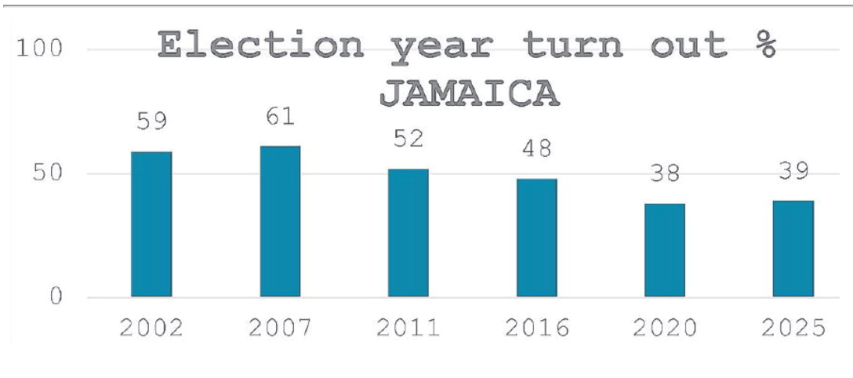
    Statistically, it means that the Government has been elected by a significant minority of persons eligible to vote (26 per cent) and questions could be asked, but perhaps not answered here, as to whether this really represents the will of the people, as election outcomes should. A similar situation exists in Jamaica of course, where voter turnout is now averaging in the 30s against a sharply growing number of persons registering to vote.

    Arguments have been put forward for the institution of a fixed election date. The same in Jamaica. Indeed data from polls conducted by my organisation over the last ten years in Jamaica, have shown a strong desire amongst the voters for a fixed election date.

    In the last national poll conducted just prior to the calling of the last election in 2025, over 80 per cent of Jamaicans expressed the view that there should be a fixed date for elections. Prime Minister Andrew Holness actually signalled in his 2016 campaign that he would begin discussions towards the holding of elections at fixed periods. Ten years later? It is not wise for the public to hold its breath on this becoming a reality in the near future. Leaders will not be easily willing to give up the strategic advantage to call an election when they think that they are in the best position to win and stay in office for another five years.

    Hence the calling of snap elections or the cat and mouse alternative of biting the electorate over often prolonged periods, until they think the time is right and pole position secured. This doesn’t always work, but in this case, Prime Minister Mottley could have called it anytime, knowing that it is extremely difficult for an opposition to do well after two consecutive 30-0 defeats. So much for fixed election dates, this remains wishful thinking for the moment.

    What of the DLP? Very real concerns exist and I am not sure they know why, empirically. One reality is that over the last five elections, the BLP has been dominant, largely due to the consecutive 30-0 wins, 2018 and 2022. Across the 30 constituencies over the past five elections prior to this one, the BLP has won approximately 60 per cent of the votes cast. But this was not always so.

    https://barbadosunderground.net/wp-content/uploads/2026/02/voter-turnout-1-854×378.png
    https://barbadosunderground.net/wp-content/uploads/2026/02/voter-turnout-2-854×386.png

    Two thousand and eighteen was a massive turning point for the DLP. They plunged from being the government of the day to winning zero seats in that election and they have not won any since then. The turnout in that election was 60 per cent. In the 2022 election voter turnout dropped by some 20 percentage points to just over 41 per cent and it was clear that the large majority of those numbers were people who had supported the DLP in prior years.

    BLP won by a higher percentage

    The base of the party then fell out in the 2022 election and there has been further retrenchment in the recent election. This is evident from the fact that whilst the BLP also lost voters over this time, the DLP lost this last election by a larger percentage than it did in 2022. A constituency by constituency analysis of the 2026 results shows that the BLP did better percentage wise (winning a higher percentage of votes) in close to 20 of the areas, compared to the DLP, who did show some improvement in the others.

    Evidence of further loss of core support for the DLP. There are similarities with the (People’s National Party) PNP in Jamaica. Between 2011 when the PNP won that election 42-21 and 2020 when they lost that election gaining only 14 of 63 seats, 165 000 people less turned out to vote. Approximately 158 000 people less, voted for the PNP over this time.

    Happily for the PNP, there was a leadership change and the party has managed to claw its way back to being a meaningful opposition, coming close to winning the 2025 election. They did that by finding means, through consistent scientific evaluation of public sentiment amongst other strategies, thereby re-engaging the rank and file of the supporters lost in those ten telling years. Lessons perhaps for the DLP.

    Huge psychological hurdle

    But the fact that the party has not won a single seat as against the 90 won by the BLP in the last three elections presents a huge psychological hurdle for the party and a massive challenge to convince their supporters in any future election, that it is a party that could be effective as government and therefore worthy of their vote.

    A final word on third and other parties. In recent years, other parties apart from the mainstream two that exist in several of the Caribbean countries, have not fared well in elections. Having other options is always good for democracy in principle, however, independent and other such parties will for some time find it difficult to attract voters because of the entrenchment of support for the two main parties, who already are not seen to be too diverse in their offering.

    From this perspective, other parties will for some time find it difficult to appeal to corporate donors in sufficient quantities to make a hugh difference in party financing and hence the ability to effectively campaign nationally to any serious degree of success. Other parties in this election did not meaningfully impact or dent the chances of the main candidates and in no way influenced the outcome of the results in any of the 30 constituencies.

    The DLP must now, having not won a single seat out of 90 contested over three consecutive elections, do some serious soul-searching and deep introspection for it to remain relevant.

    Dr Don Anderson has been conducting political polls in nearly all the Caribbean countries since 1989. He is a former lecturer in survey research methods to post-graduate students at the University of the West Indies’ Mona Campus and tertiary institutions in other jurisdictions.

    Editor’s note: Figures for voter turnout in the 2026 election are provisional. Official figures are yet to be released by the Electoral and Boundaries Commission.

    Source: Nation


  31. My post-General Election thoughts

    THE PHILOSOPHERS Theodor Adorno and Max Horkheimer viewed stupidity as a kind of blind spot formed by psychological scarring.

    They believed that every human being has these blind spots and is therefore stupid about something. They saw our resistance to advantageous behaviours and outcomes – blatantly so – as a reaction to an old wound sown during childhood.

    Critical Theory (as developed by Adorno and Horkheimer) therefore does not attribute stupidity to a lack of intelligence but to psychological defence mechanisms.

    If we take this as valid, we have to give some credit to Plato – one of the founders of philosophy – who argued that we can’t see what we are not looking at.

    We are all stupid because we are scarred, defensive, and can’t see it for ourselves. Society plays an important role in placing that mirror for us to evaluate our own behaviours. It is as stupid as it is helpful in letting us see ourselves.

    Bearing these thoughts in mind, I couldn’t help thinking how stupid we all looked during election season – present company included. I, for one, went out of my way, against my better judgement, to predict a swing towards the then Opposition Democratic Labour Party (DLP).

    I was stupid because some trauma from my childhood must have led me to believe that people are more rational than they seem. So I thought the use of the term “swing” was elementary. Clearly it wasn’t, judging by the calls for my head from ardent followers of the ruling party. I never said that the DLP was certain to win any seat. My sincerest congratulations go out to each and every one of you.

    Vote regardless of options

    “Post-COVID-19” voter-turnout reflected growing voter apathy. The reasons behind it are even starker. Low turnout during the pandemic seemed due to apathy, yes, but a significant part stemmed from illness and the general difficulties at the time. The same cannot be said for now. I’m left to say that the results stand as a rejection of all political parties and the first-past-the-post system – despite total voter numbers published by the Electoral and Boundaries Commission (EBC).

    I am one who believes you should vote regardless of your options. We will all look stupid once that right is severely infringed upon – or taken away completely. Imagine my surprise at the number of people who trusted that the EBC would operate as the older individuals amongst us know it to be. Worse are those who felt betrayed, despite allegedly receiving circulars and/or checking online, only to learn on voting day that they were to vote at a completely different location.

    People vote for all manner of reasons. A new term sprang up on the back end of the election: voter entrepreneurship. I wouldn’t have believed it if I didn’t hear it myself. It stems from stupidity and plays on it as well. The field couldn’t exist without greed but, more so, widespread and growing poverty. Poverty also scars the mind.

    People have to survive by whatever means, and society tries to control those means in the guise of legality. But with voter entrepreneurship, it seems as though legality may soften with time.

    You can only expect people to react to their trauma, in hope of acquiring those basic needs (amongst others), as per Maslow’s theory.

    Regrettably, the major negative externality (indirect downside) leads to the misallocation of Government resources each cycle. Cost over-runs and delays are the first examples that come to mind. Investment in voterentrepreneurship “start-ups” often has “returns” that lie outside the investor’s capacity to deliver in a timely manner. I sincerely “hope” you understand what I am implying here. You readers are by no means idiots; just stupid.

    Taxpayers pay for these errors continually.

    Some of us refuse – stupidly – to make the connection. Public financial data is daunting, but sometimes I wish someone would altruistically create a course in public finance. This matters all the more because any three-term government is likely to show obvious forms of hubris. It’s stupid to believe otherwise; there’s too much historical and recent evidence in the region.

    Pick your poison.

    Meaningful reform

    We are blessed to have a charismatic leader in our Prime Minister. I like her a lot. She dreams big, especially where the economy is concerned.

    Barbados is in need of massive reform, but meaningful reform is slow and patient. Time and time again, we have witnessed steep numbers of initiatives presented in manifestos and, more pertinently, in budgets – and most are not completed within the timelines promised.

    As things take time, and as you introduce more variable resources (many of them wild-carded) into projects, you should expect delays and cost over-runs. I am never upset at the Government for doing this if we, the people, buy into it. I’m lying: I tend to be upset when it’s clear that an initiative will threaten our foreign reserve positions or our fiscal balance – anything that leads to unjust taxation in the long run in the name of stability after bad management.

    So colour me jaded about detached voters and non-voters. I have basically lost confidence that we are about to build an economy that is truly sustainable and/or explosive in growth. Maybe it’s just the case that we don’t deserve that, and we vote (or don’t vote) accordingly.

    I had a hard time coming to a choice myself, seeing the stupidity around me. Every political party played to common denominators and produced manifestos with nothing bearing a timeline, except for that concerning the Barbados Republic Wealth Fund. I find the ruling Barbados Labour Party’s discussion around this a bit too careless, despite the Government being in an actually “stable” financial position after a long time.

    My calculations on its success have been reported in the media, but that – like the 13 other initiatives – will depend heavily on the Government’s ability to find credible funding sources over the next six to seven years.

    Furthermore, only initiative number 14 will offer any immediate relief to the cost of living in Barbados. The others realistically cannot. Number 14, on its own, depends on the Government’s ability not to overtax a growing economy over time. We know how that goes, based on experience, don’t we? Therefore, our stupidity as a nation disregards the fact that Barbados will never be a low-cost jurisdiction as presently constructed.

    My previous article explored the reasons why.

    Although I sympathise with the feeling – and the downright need – I’m not sure we are willing to take the risks needed to become a high-wage/ high-cost society in the near term. Then again, maybe I’m just stupid for thinking this way.

    Jeremy Stephen is an economist/financial analyst with extensive experience in private equity and economic consulting in Barbados and the region. Email: economistfeedback@gmail.com

    Source: Nation


  32. […] Source: Disgusting Lies and Propaganda TV […]


  33. David

    The fact remains that last week the BLP got more votes than the victorious Dems in 2008 and 2013, when DLP supporters rejoiced. Last week’s tally is also more than the BLP won with in 1994 and 2003. The issue seems to be DLP apathy, but nobody wants to say it. Greater voter turnout may very well bury the DLP for good. Tek it light.


  34. @Enuff

    You are discussing the math, others are prepared to go beyond.


  35. LMAO the basis of your argument is a number. If you want to now go beyong numbers, explore why BLP support is increasong and the DLP’s has collapsed. Furthermore, to conclude that because one is on the list and didn’t vote means one does not support the victor is also rooted in a number. Go beyond the number. Does absence in the lower house but a presence in the upper house equate to an opposition? Or 2 plus the independents is too small a number?


  36. “You are discussing the math, others are prepared to go beyond.”

    @ David

    Yes, “others are prepared to go beyond discussing the math,” perhaps because the math presents a REALITY, (ESPECIALLY for the DLP), they’re either PURPOSELY or CONVENIENTLY choosing to IGNORE.

    Let’s look at the math.

    The voter turn out was said to be 30%.

    Of the 101,838 persons who voted, the BLP received 71.109 (69.83%), DLP’s 27,808 (27.31%), Friends of Democracy (1.40%), People’s Coalition for Progress (0.89%), Independent Candidates (0.42%), and Bajan Free Party (0.16%).

    Although both the BLP and DLP were able to increase their support in specific constituencies, the DEMS were unable to win any seats.
    Let’s look at St. Michael South East, for example. In 2022, Santia Bradshaw received 2,786, to Pedro Shepherd’s 699. In 2026, Bradshaw = 3,050 (264); Shepherd = 734 (35).

    70% of persons registered to vote did not exercise their constitutional right to do so, which clearly indicates they rejected the BLP, DLP, ‘third parties,’ and independents.

    We seem to more focused on how the numbers affected the BLP. That a political party and its leader winning an election with a 30% voter turn out are not as popular as is being characterised, which is essentially true.

    However, based on recent election trends, analyses, and an increasing voter apathy, the DLP, a political party that was founded almost 71 years ago on April 27, 1955, can be REASONABLY described as becoming PROGRESSIVELY UNPOPULAR……

    …… perhaps due to shift in sentiment of the electorate, (e.g. although Barrow remains respected among older Barbadians…… and continues to be the central focus of the DEMS to attract voters, the youngsters have a completely different view of politics), perceived misalignment with its supporters, and not articulating specific political or innovative socio-economic policy initiatives.

    Unfortunately, after the death of Barrow in 1987, the DEMS have been constantly fighting amongst themselves, culminating in the exodus of several ‘young and old Democrats,’ many of whom opted to join the BLP, while a few others either formed or joined ‘third parties.’

    Another interesting observation was the escalation of that infighting after two former BEES, Ronnie Yearwood, and Ralph Thorne, subsequently, joined the DLP and were immediately elevated to leadership roles, as well as the resulting fallout thereafter when they opposed each other.

    In my opinion, the manner in which the DEMS dealt with the ‘Thorne controversy’ clearly indicated the ‘OLD GUARD’ is ‘still in charge,’ which means there hasn’t been any SIGNIFICANT CHANGE in that political party’s underlying political or ideological beliefs.

    They orchestrated the expulsion of Ronnie Yearwood and Steve Blackett from the party, while EMBRACING Donville Inniss, and voted for him as their first vice-president.

    It was also the ‘old guard’ who elevated Thompson above Mascoll, after he (Mascoll) brought a level of stability to the party after they were defeated 26-2, in the 1999 general elections.

    A member was also their campaign manager for the disastrous 2018 election campaign.


  37. @Artax & Enuff

    There is no doubt the BLP is dominating because of a vacuum in opposition politics, specifically the demise of the DLP, the other member of the duopoly.

    Again, can we look at the numbers without invoking meaning? How many voted for the BLP for example because it was the opportunity to exercise their civic duty rather than vote for a party or candidate? In other words, they held their noses and voted because the DLP is seen as ‘shelf-ready’.

    The bigger point is that the BLP is doing a good job to capitalize on the porakey political climate – however, if things continue on current trajectory and it leads to where we have a dominant political party for decades to come – what does it portend for us?

    Let us look beyond the math to visualize a few what if scenarios.


  38. @ David

    Of course there are situations where ‘first time voters,’ for example, would follow a household tradition of voting for a specific political party.

    In all reasonableness, however, it would be difficult to determine ‘how many people voted for the BEES, because it was an opportunity for them to exercise their civic duty.’

    Additionally, I do not believe a majority of the electorate voted for the BLP because, according to you, ‘the DLP was seen as “shelf-ready”.’

    Assuming ‘this was true,’ then the voter turnout would’ve been much higher. In other words, the number of people who did not vote would’ve been much less than 169,367.

    According to information I’ve seen, of 271,205 persons who were registered to vote, 101,838 voted, resulting in a voter turn out of 37.3%.

    Although both BLP and DLP recorded increases and decreases in support, there really weren’t any significant statistical differences between the 2022 and 2026 general elections.

    Let’s analyse the results.

    Total votes in 2022 = 114,013
    …… BLP = 78,960 (69.26%)
    …… DLP = 30,112 (26.41%)

    Total votes in 2026 = 101,838
    …… BLP = 71,109 (69.83%)
    …… DLP = 27,808 (27.31%)

    The reality is, whatever their motivation, people who decided to vote for the BLP, voted for the BLP, and ceteris paribus, the DLP.

    I believe we should be a bit more concerned about the 169,367 people who refused to “exercise their civic duty.”

    We could ‘use our imagination,’ as suggested by TLSN, to determine other reasons why the DLP were unable to secure any seats.

    For example, people (‘die hards’) who would’ve normally supported and voted for the DEMS refused to do so, for various reasons.

    ‘What if’ many of them believed Ronnie Yearwood represented the ‘NEW GUARD,’ and the party was on the verge of being settled and making a ‘come back’ under his leadership?
    That his system of order conveyed to a wider, younger membership than under the old dispensation.

    Supporters would’ve witnessed losing DLP candidates abandoned George Street immediately after the 2018 general election results, the subsequent efforts of stalwarts such as Steve Blackett, who worked tirelessly thereafter to mobilise the base, and were willing to work with Yearwood.

    ‘What if’ they implicitly suggested Thorne represents the ‘OLD GUARD,’ under whose leadership (Stuart and DePeiza) the DLP suffered two (2) consecutive 30-0 defeats, and was responsible for the expulsion of Blackett and Yearwood, an exodus of prominent members, as well as the resulting rift in the party.


  39. Guys there is not an issue of voter apathy, what we do have is a wash of people that do not feel what was offered fills their requirements for leadership. Don’t let us dress it up as anything else.

    The Bs won lets give them that, but when nearly 70% of voters don’t vote, these people are sending a loud message to the winners and others seeking to represent them at state level. The phrase I heard most from people I spoke with was “why bother its 6 of one and half dozen of the other.” When things reach that stage the only thing that will bring them out is a change in the type of persons running for office. The party faithfuls vote for party, some of the rest vote for who had the best fetes and music and others ask the old question of “what’s in it for me?” With those accounted for you have the ones who want to hear the plan going forward based on facts, sadly however the campaign “performances” are not designed to answer such questions. As a result those voters seeking a stated and fact based plan as opposed to pie in the sky statements, simply stay home on elections day.

    Then we had the final crown showing what politics is all about. The entering of Sinkyuh into the BLP fold with open arms after years in political exile, now being offered a big up position in the party having never won 1 vote on elections day! Imagine If I had voted B so that the nonsense the Ds did never raised its head again, only to hear that the main actor in the destruction of the NISS had not only become a B, but was not holding high office under the Red Flag! Then we hear about legislation coming to prevent persons crossing the floor. But wait wunna realise dem aint got nobody left now to cross the floor though? LOL

The blogmaster invites you to join and add value to the discussion.

Trending

Discover more from Barbados Underground

Subscribe now to keep reading and get access to the full archive.

Continue reading