← Back

Your message to the BLOGMASTER was sent

Bar chart illustrating the Debt-to-GDP ratio in Barbados from FY 2017/18 to FY 2024/25, showing domestic and external debt contributions.

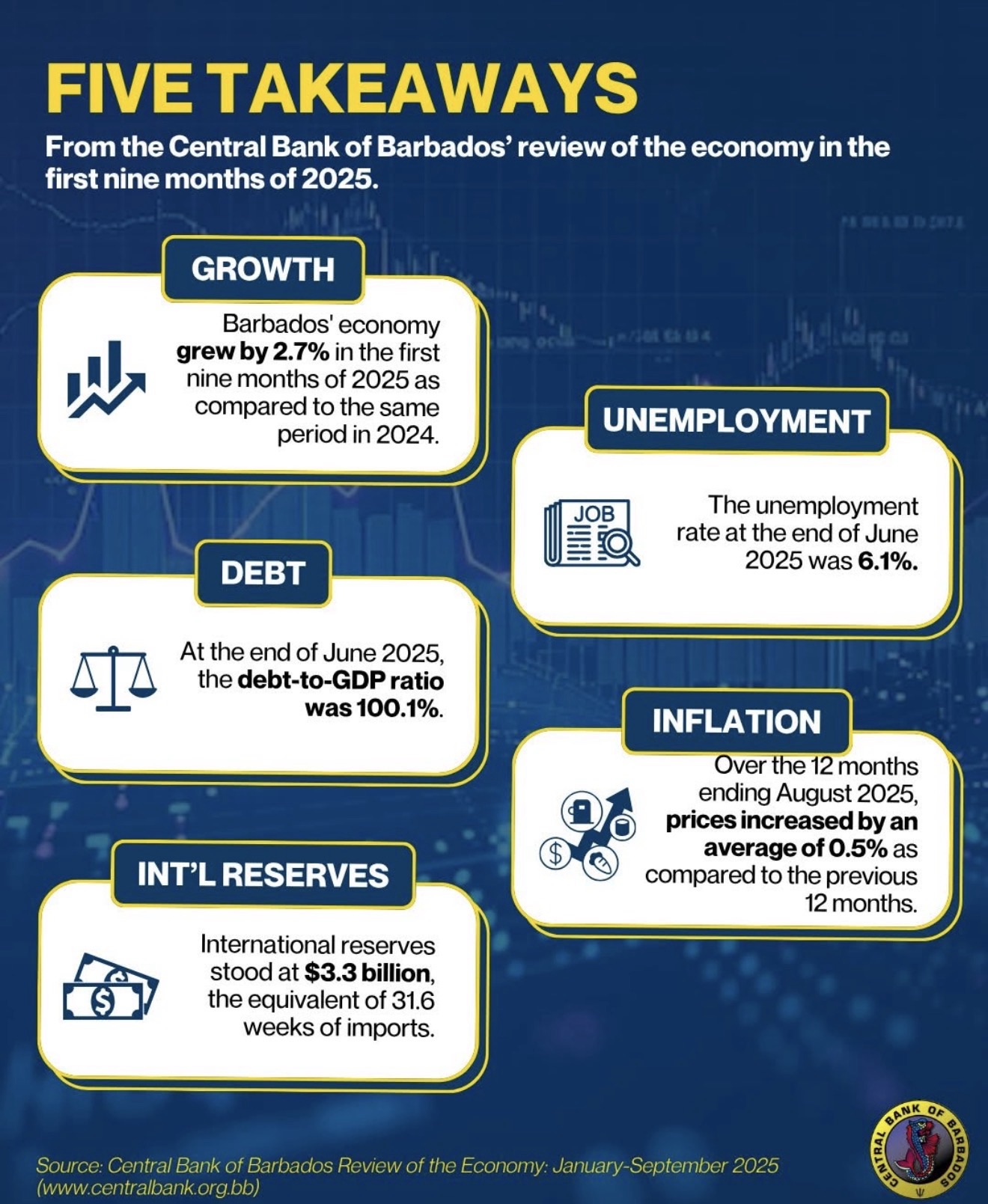
The Central Bank of Barbados will release its economic review for the first nine months of 2025 on Wednesday, October 29 at 11:00 a.m. The review will be live streamed on the bank’s Facebook and YouTube channels. 

The blogmaster is of the view there is not enough relevant national discussions being had about the state of the economy. An activity that should be informed by our learned men and women on the Hill.

The debt to GDP graph for Barbados at first glance supports a boast by the Mottley led government. There is a steep descent from the high of 150% in 2017-2018 to a projected 102.8% by 2024-2025. However this visual masks structural fault lines in the economy we continue to ignore.

A reminder that the 2018 debt restructuring as a result of Barbados debt default is responsible for the significant decline in our debt to GDP. The domestic debt was reprofiled and bondholders took haircuts. The graph does not show the cost of the restructure WHITE OAK ADVISORY negotiated, however, there is no doubt investor confidence was negatively impacted in the domestic and international markets. The debt stock – as it is labeled by economists -was cosmetically altered, not reduced based on payback from earnings. The optics improved but the underlying liabilities have remained.

Our economic model is powered by the public sector, bloated and inefficient we know it to be. The government is the largest employer, the largest spender, and the slowest to implement projects. Productivity is stagnant, innovation is of little consequence. The private sector is largely parasitic, it feeds off government contracts and knockoffs from tourism.

The fickle tourism industry is our main engine of growth. It is one hurricane, one pandemic, one geopolitical flareup away from what Covid 19 showed us. Construction, the other ‘pillar’ is not sustainable. It is not export oriented, not foreign exchange earning. Also Barbados produces little the world wants, and imports almost everything. The foreign exchange reserves are therefore always under threat because of the fault lines in our economic model. We are therefore forced to borrow at usurius rates in the capital market because of our junk bond credit ratings.

Something we have mentioned in this space many times – Barbados operates a defined benefit scheme for public servants with payouts guaranteed regardless of economic conditions. The National Insurance Scheme (NISSS) is under pressure with pension obligations growing faster than revenue. These future liabilities are not adequately captured in the debt to GDP graph based on the blogmaster’s research.

The graph is simple to follow, although the debt to GDP trend line is heading in the right direction the fundamentals of the economy have not changed. The economy remains vulnerable, the debt remains high, and our economic model is not fit for purpose. This graph the blogmaster anticipates will continue to be used as a political tool to distract from the economic reality.

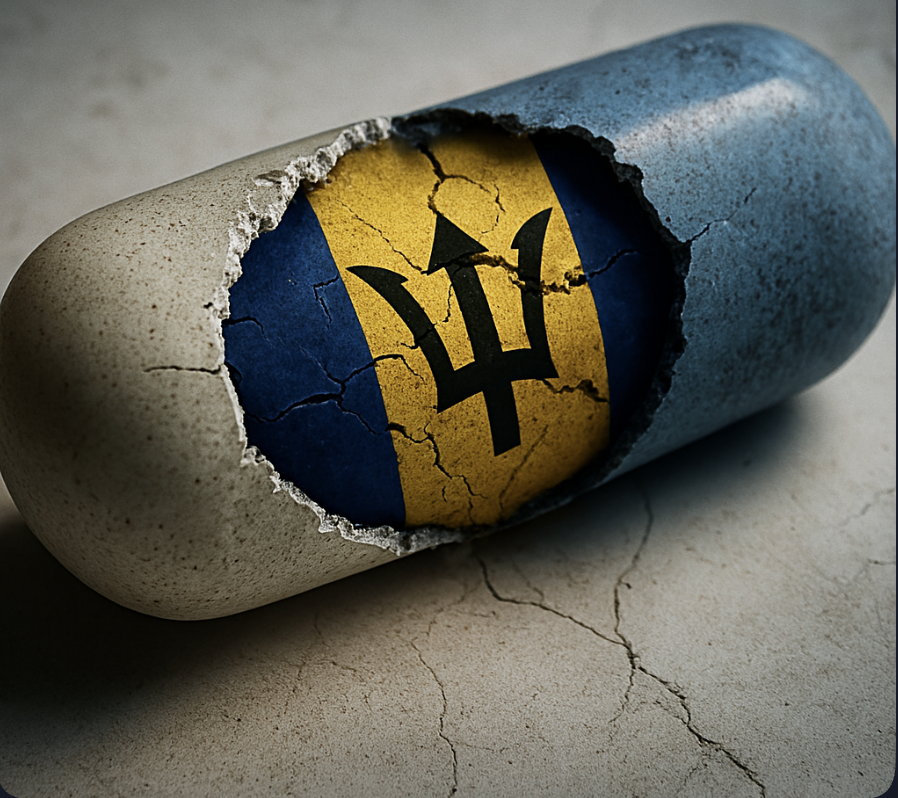
If we are to progress, our decision makers need to recalibrate our economic model. Are we to be satisfied with the placebo narrative and continue ignoring the disease our economic model endures? How long is too long if it hurts?


Discover more from Barbados Underground

Subscribe to get the latest posts sent to your email.

52 responses to “Our placebo economy”


  1. This information is dated.

    What is and should be of moment are the economic or early indicators resulting from the high likelihood of war in the Caribbean Sea.

    War or rumours of war!

    We would imagine that there are impacts on tourism for the bookings for the coming winter season, the high season, are usually made in this time period or before.

    If already made, we would imagine that a certain amount of tapering would be taking place, refunding or changing of destinations.

    Weee only know what the our predictive algorithms are saying but area specialists should be looking at this information.

    Of course there are other likely impacts as well – shipping, internet disruption, aviation, other commercial activities etc


  2. The blogmaster is a fan of Senator Dr Crystal Drakes

    Call to prioritise national issues

    While Barbados can benefit from more regional unity to survive in an increasingly insular world, it must urgently fix the increasingly visible societal cracks, which if left unattended “could break our society”.

    That is the assessment of economist, Senator Dr Crystal Drakes.

    In her view, there were very few Barbadians who have an issue with regional integration.

    “When you go to the heart of the matter, it has always been the free movement of people colliding with the national circumstance of citizens in the country,” she said.

    That national circumstance which Drakes referenced yesterday during her contribution to debate on the Caribbean Community (Free Movement of Nationals) Bill, 2025 in the Senate included shortcomings in the economic, social and environmental aspects of the society and “even from a national consciousness position”.

    She noted, for example, that Barbados’ economy had annual growth averaging one per cent over the past 24 years, there was no meaningful economic diversification, the cost of living was the third highest in the Caribbean after the United States Virgin Islands and The Bahamas, wages were “stagnant”, and social, education, and health care services all need improvement.

    The economist also said another challenge was that about 21 per cent of the workforce was employed by Government, which was “comparable with places like the Nordic countries, without the benefit of the type of fiscal space that they have”.

    “So, when people have legitimate fears or concerns, this is within the context that these issues are arising as it relates to people coming to Barbados for work, jobs, [and so on],” Drakes said.

    “This debate has placed regionalism and national development somewhat at odds, and that may be because we feel as though there are things in Barbados that are not going the right way, and they need to be addressed in order for us to have the comfort level in the public domain and in public discourse as it relates to the free movement of persons.

    “My position is that we do need to have regional integration, I support it, but that has to be done concomitantly with a complete overhaul of some of the systems that we have that currently service the Barbadian public if we want to reside and live in a country that functions in a 21st Century context,” Drakes stated.

    Her suggestion was to consider having a “smaller Government focusing on core social issues, and leaving all of the other frills to public private partnerships or the private sector, or reduced tax regime concomitant with that reduced Government and allow a level of innovation and creativity to flourish.

    “This is just an alternative I’m putting out, I’m not saying this is the solution, but what I am saying is a lot of the things that we are currently doing are not working in our favour for us to compete and to continue to be the first mover in a globalised world that is becoming more insular,” she added.(SC)

    Source: Nation


  3. @ David

    Looking at the graph the first thing that one sees is that the 2019- 2020 and the 2024-2025 debt are roughly the same. The post Covid year also shows high debt, basically as a result of our one leg economy not being able to offer much income based on the Covid shutdown and global environment.

    The question though is what does the graph not show? In other words it shows the outcome without showing the cost of the outcome. I know some are saying what shite is he talking now? So let me explain what I mean when I say that.

    The debt restructuring largest victim was the NIS at the time. They lost in excess of $1 billion in write offs on their asset base, with no provision in the restructuring being made to replace any of the NIS funds over the upcoming years. The paper they were left with also saw its annual return drop from 7% to roughly 1%. Of course others were affected too by the exercise, but lets focus mainly on ” The People’s Lifeline.” So remember that billion for now.

    Secondly we are shown that the Debt has fallen over the last few year’s but has it really? So lets remember that debt has two cost and not one. One is the actual Capital cost and the other is the hidden and unmentioned expense of finance cost. So when we speak of debt here on this graph that refers to ONLY THE CAPITAL COST OWED NOT THE TOTAL FINANCE COST. If you remember we have over the past few years, been very proud of the fact that we were able to transfer debt at say 5% to loans with ” better terms” of say 3%. Sounds like a good deal at face value but was it in real terms? So lets say you owed the Bank $1000 at 5% with 12 months owed to the close. The Bank being the kind and loving people they are, offer you a “limited promotion deal” where they will lend you now the amount owed at 3% over 36 months, thereby reducing your monthly debt service, while not increasing what you owed. Sounds real good ney?” It isn’t though because you will now pay nuff more in interest on the balance owed.

    So the graph shows above the total owed in capital, but you see that secret cost I explained which is interest over a projected period, that is not shown here. Why has it not been shown? Well interest is an expense to borrow and not a debt in terms of how it is booked.

    Finally what would the debt be today if a provision to repay the NIS at say $80 million a year since 2018 to 2028 been made? Also what was the total cost of the restructuring inclusive of White Oaks fees and other expenses?

    Closing let us agree that based on the fact debt showed is only the capital of the debt without borrowing cost and that no provision has yet been made in any financial year since 2018 in the estimates, to refinance the NISSS Fund, where are we in real terms when it comes to our TRUE DEBT inclusive of all finance cost and obligations?


  4. @David You know me, and you know that I will demand intellectual rigor when discussing the economy. I demand that we raise the level of conversation here beyond loose “rum shop” talk or “street talk”. A few points. You keep referring to the Tourism industry as “fickle”. What is you definition of “fickle”?, what sectors or industries would you consider to be “safe” in todays world? What policies would need to be adopted to guard against these fault lines as you put it. Please provide evidence to back your claims.

    Rapid AI adoption, rapid automation, rapid adoption of renewable energy fragmented trade relationships. All of these factors are changing the world as we know it. This is not something that projected to occur in the future, it is happening right now.

    Let’s look at Europe for example. A manufacturing powerhouse like Germany is currently under pressure and is struggling with low growth. Competition from China and Germany’s slowness to further digitize has caused it’s car industry to to hit a road hump, leading to headlines like this :https://www.dw.com/en/german-car-industry-sheds-51500-jobs-in-a-year/a-73768859
    I don’t know how much you travel around Barbados, but you must have noticed that Chinese electric vehicle brands like MG, GWM (Haval), BYD and Changan are increasing their share of new vehicle sales.

    Spain on the other hand is one of Europe’s fastest growing economies. Their economy has been boosted mainly by Tourism and high-end services. Spain’s policy decision to adopt renewable energy at a faster rate than most countries over the last 15 years is also paying off as lower energy costs is reviving manufacturing. https://www.ft.com/content/643a6a5d-f5af-464c-86c3-0fe5396d707e

    China will continue to outpace the United States in manufacturing, not because of cheap labour, those days are long gone, but because of technology and innovation. China has one of the highest number of industrial robots per capita. Before 2019 it wasn’t even in the top 10.
    https://interestingengineering.com/innovation/china-cements-global-lead-in-robotics

    A dirty secrete of America is that American pharmaceutical companies are now increasingly depending on Chinese companies for research into cutting-edge cancer drugs. https://finance.yahoo.com/news/us-pharma-bets-big-china-100725826.html

    The worlds largest food manufacturer, Nestle revealed last week that they will be cutting almost 16,000 jobs due to automation. Nestle has factories in 75 countries.
    https://www.ft.com/content/9bf755d8-5831-4bab-b1a1-6dc66f6cf252

    Being an oil dependent economy over the next 10 years is also fraught with danger. The rapid adoption of renewable energy and electric vehicles is causing the IEA to project a larger oil surplus next year. https://www.iea.org/commentaries/as-oil-market-surplus-keeps-rising-something-s-got-to-give

    Oil producing economies like Saudi Arabia are already looking for ways to diversify their economies before it’s too late.

    This is the current state of play. What are your solutions?


  5. ubereyecandy.

  6. NorthernObserver Avatar

    Once tourism is strong, and tax rates are ticking up, all is good. Fete nuff and be happy.
    The attendant risks remain where they have always been, at the BACK of our minds.
    The NIS will continue to meet it’s obligations for as long as it can. Other related unfunded liabilities will remain unfunded, until decision day arrives.
    The BWA is a few years away from a crisis, but if the NIS and BAMC are any example, fold that into a new entity, possibly merging with Sanitation, to great fanfare. And ignore.
    Thankfully, we can borrow from the Chinese and the Arab oil nations, so entities like the IMF and development banks are not our sole lifeline.
    The QEH will be expanded, long overdue. We are aware of other philanthropic entities building prefab schools elsewhere, to ultimately replace our educational stock. Upgrade our air and sea ports.

    We only live once. Enjoy. 😅🇧🇧


  7. @wargeneral

    Tourism is fickle in the context of our over reliance on the sector. This has been stated repeatedly.


  8. @wargeneral

    AI is at a nascent stage, where are you examples how what you mentioned can add value to the Barbados economy?


  9. @wargeneral

    Our biggest fault lines are tangential to the economy: our democracy is ill, our working committees of parliament do not operate as required. Our courts are inefficient. Our business facilitation is uncompetitive in our peer group. Our public sector is a joke l. Should we go on?

  10. NorthernObserver Avatar

    @David
    Tourism is not fickle, it is a single source, not unlike fossil fuels to many places.
    Possibly, while many public bodies are not operating as “stated in their formal operational rules”, they are operating as current conditions require.
    I mean you don’t steal, and then provide public proof of your misdeeds? You don’t mismanage and then provide proof of that mismanagement?
    We have GUBA awards next week !!!
    Republic Day soon come. Tourism season begins, and all can charge Moore. Then the Christmas season.


  11. @ David In the broader context, I prefer to start by asking what do we have?

    We have a small country with a population of just 280,000 people (might be a bit more with some Jamaican immigrants).

    An education system which is ok at covering basic literacy, but has fallen short in fostering innovation. Education is free at the point of delivery up to University level. Training programmes such as NTI (which offers free Coursera) and the Construction Gateway Initiative exists to upskill the population.

    A financial sector that does not have the capability at this time to fund innovation or expansion . A government funding ecosystem that is quite good, which can take you from trust loan funding for micro enterprises to fund access in the growth stage to the private/public Enterprise Growth Fund.

    The problem comes with riskier ventures and securing equity. An underdeveloped capital market and an inactive Stock exchange.

    The tax structure for companies has advantages. the General corporate tax rate is 9%, even though most companies will pay 5.5 %,which is low. There is currently a 100% tax credit available for companies which invest in digital technology upgrades.

    Export Barbados (once BIDC) provides rented space for companies to innovate and produce at scale, such as the International Food Science Center in Newton.
    They also recently started the process of sending employees of Barbadian companies overseas to train as robotic engineers. https://barbadostoday.bb/2025/08/26/bajan-engineers-first-in-caribbean-to-earn-industrial-robotics-certification/amp/

    Export Barbados is also launching a new initiative called the GIGA (Green Industrialisation Gateway Advantage) to reindutrialise the economy using modern technology and renewable energy.

    Barbados has a large number of entrepreneurs for it’s population size. They mainly operate in Food service and production, entertainment, professional services, beauty and small manufacturing. The problem is the lack of growth among these micro businesses and the lack of innovation. Very few grow large enough to hire 50 employees or to export.

    Barbados also has an aging population and decline workforce.

    Solutions

    Based on some of the things outlined above the main issues for us are:

    Education reforms to make the education system more friendly to creators and innovators (coding, robotics and video game development has already been introduced) ,

    Figuring out a way to fund Research and development here. This is the most difficult task. The good news is that Barbados already has a partnership with Afrexim Bank which is about to construct a Trade Center in Bridgetown. UWI should partner with them to seek funding for research grants for graduate students. This has to be done at scale.

    The last one is the funding of risky investments and business expansion. The IGM 200 was recently launched in Barbados. This will be the new Junior Stock Exchange. Venture capital will still be needed before companies can go public.

    Learn more about the IGM here: https://www.igm200.com.bb/


  12. If you check facts Barbados Government’ debt was rising from 2000 to 2018 dropped for 2 years and rose again in 2020 and has been going down for 5 years… Take the pill and come back in another 10 years…

    Wrong Move Rock


  13. @wargeneral

    It reads nice.

    Are you aware the government continues to print money?


  14. @ David

    Not only print money but running up financing cost not shown in the dept figures, while making no provision for refinancing the NISSS fund.


  15. Tourism!!!

    Noted Trinidadian journalist says the Caribbean’s Tourism product is at stake with Venezuela and USA tensions rising

    https://starcomnetwork.net/blog/2025/10/24/noted-trinidadian-journalist-says-the-caribbeans-tourism-product-is-at-stake-with-venezuela-and-usa-tensions-rising/


  16. Thanks.

    Well, that’s good to know at least one person has started to count the costs, economically, in tourism.

    However, that is merely a single vector. We have so much stuff coming down the pike that it seems to this writer that there’s a need to put all these strands together within a brain trust meeting and thinking about these things on a full time basis.

    And this is geared with the immediate and the future in mind. But remember that we already have massive deficits. Maybe we’ll have to go backward and forward at the same time.

    We have long suggested that in these times all these situations should have a range of possible responses before they occur. Policy option!


  17. The average Barbadian does not understand or could care less about:

    Intervenor goes after BL&P’s financials

    By Shawn Cumberbatch shawncumberbatch@nationnews.com

    With Barbados Light & Power Company’s (BL&PC) rate hearing appeal expected to go to trial in December, intervenor Ricky Went has turned to the High Court in an effort to get access to documented information on BL&P’s financial performance.

    On Tuesday, attorney Hal Gollop, K.C. filed an application on behalf of Went and his team asking the court to rule that the documents or information requested from BL&P through the Fair Trading Commission (FTC) are relevant to the appeal hearing and must be provided to intervenors.

    Went confirmed the submission to the court and reminded that the information being sought is already known.

    He said the hope is that the court will now intercede so that the following documents requested by him and his team are made available to all intervenors:

    • The compliance filing as outlined in the Commission’s Decision & Order of February 15, 2023.

    • BL&P’s audited non-consolidated financial reports for 2022 to 2024 and the half year report as at June 30 this year.

    • The same audited financial reports for 2022 to 2024 in the established “test year format”.

    • The audited financial reports for BL&P’s Self Insurance Fund for the years 2022 to 2024 and half year report as at June 30, 2025.

    Went insisted that the information was required for several reasons.

    “FTC in its own 2023 decision stated that ‘the Commission and intervenors have not had the opportunity to review the minimum-system study for accuracy, errors, or reasonableness’ and the same applies in relation to the compliance filing,” he said. “BL&P was granted a rudimentary 37 per cent increase as interim relief in November 2022 ahead of the main public hearing. Consumers are now paying excessive rates for almost three years. Without the 50 per cent VAT reduction on first 250 kilowatt hours, the less fortunate would have been in dire straits,” Went also claimed.

    Another reason the intervenor said the information was needed related to replenishment of the SIF, one of the issues BL&P is opposing in its appeal.

    “Other changes mandated by FTC will significantly reduce BL&P’s revenue requirement,” he stated.

    Before making last week’s application, Gollop, in association with Ralph Thorne, KC sent a 37-page pre-action protocol letter to the FTC on September 29 requesting the information it is now seeking via the court.

    Attorney Alrick Scott, KC, responding on the FTC’s behalf in writing on October 2, said there were “currently no live applications or live rate review proceedings before the FTC”.

    “When a decision is given, the process of interrogatories, submitting evidence and arguments is at an end. Your letter seems to think that after a decision is given, the discovery or interrogatory process continues, without end. There is no legal basis, of which I am aware, to support such a position,” Scott said “Further, BL&PC has appealed the FTC’s review decision on BL&PC’s Application for Review of Electricity Rates. That matter is before the High Court. If it is your client’s contention that documents are relevant to that hearing, it would be proper for your client to make the application to the High Court, which we would advise the FTC to oppose.”

    Scott also said he had not “seen any authority or statutory right for intervenors to monitor utility rate recovery to ensure that the utility does not over recover after a decision has been made”. In an October 8 reply to Scott, Gollop said that “in our view the proceedings are not closed so as per Rule 31(1) Utilities Regulation (Procedural) Rules, 2003 URR 31(1), all approved intervenors are permitted to request information or particulars relevant to the proceedings from BL&PC to: (i) ‘clarify evidence filed by the BL&PC; (ii) simplify the issues of the matter before the FTC; and (iii) permit a full and satisfactory understanding of matters to be considered’. Gollop also reminded his previous statement in the September 29 correspondence that the proceedings ought not be considered closed for several reasons.

    This included that Went and other intervenors “remain active parties in the proceedings in the appeal which is to be heard in December 2025, so it is critical to ensure a comparison of BL&PC’s 2021 to 2025 forecasts with its audited financial statements as well as analysis of the compliance filing and any other facts that were not previously placed in the proceedings and could not have been discovered . . . at the time, would now be available to the court”.

    Source: Nation


  18. His thoughts expressed are vaguely familiar.

    Barbados and the Fourth Estate

    By Ralph Jemmott

    In the 18th century, during the period in France known as the Ancien Regime before the Revolution of 1789, there were three recognised Estates.

    The First Estate was the Lords Spiritual, the Clergy. The Second Estate was the Nobility, the Lords Temporal or the landed gentry. The Third Estate ( tiers etat) comprised the Commoners. The term “commoners” should not be confused with the working class as we know it today. The working class as we know it today, had no say in governance.

    The term, the Fourth Estate, is of more recent coinage and has come to refer to the press or the media which is seen as a vital component of a functional democratic polity. Within the context of a viable democracy, the Fourth Estate is viewed as having a responsibility to educate and inform the people, to hold government accountable for its actions and thirdly, to serve in encouraging and facilitating public discourse.

    The First Amendment to the United States constitution prohibited laws “abridging the freedom of the Press” and the growth of the United States witnessed a fast growing media. In Barbados, the Fourth Estate is relatively small and it is often critiqued for its failure to do more by way of what is termed “investigative journalism”. It invariably reflects the values of the capitalist economy and the assumptions of a moderate middle of the road bourgeois polity. The laws governing slander and libel are relatively strict and generally speaking the news houses out of an abundance of caution tend to practise a form of self-censorship. The local press is mildly zealous in performing a watchdog function over public officials and institutions. The Government-run Caribbean Broadcasting Corporation (CBC) tends to be protective of Government interests – whatever political party – reinforcing the ruling political consensus.

    Barbados is a very small society in which we tend to shy away from critical comment for fear of offending. Critique is viewed as an attack, for if you are not for me, then you must be against me. The failure of successive Governments to enact a Freedom of Information Act, has been a major hindrance.

    The enquiring journalist looking for “the big scoop” has to hope that some piece of information will fall from the proverbial truck. It is difficult to see regional journalists pursuing the kind of investigative probing associated with MSNBC’s Rachel Maddow or Beth Rigby and Sophy Ridge, of Sky News, or CBC Canada’s “The Fifth Estate”.

    The initiation of a Prime Minister’s answer time in the Barbados House of Assembly would go a long way in enhancing the democratic ethos in our politics. As someone once said, we must make better the promise of our democracy by making better the practice of our democracy. Fear of lawsuits have inclined the local press to become even more risk averse than before.

    Public concern

    The current issue over the role of the Fourth Estate in large part springs from a comment made by Dr Don Marshall, director of the Sir Arthur Lewis Institute for Social and Economic Studies. The professor is perceived to have accused the press of not doing its job of adequately questioning the present administration over the resignation of the former Minister of Housing.

    On that matter, the media did seem to fall short in asking relevant questions on an issue that was clearly of public concern. An ad on BBC World, warns that the media in dealing with government officials must not only pose the appropriate questions but question the answers proffered. One finds that increasingly the print media in particular is retreating from hard investigative journalism to a soft narrative, focussing on so-called “human interest” stories.

    The press is a business, and as such, is expected to make a profit. Its level of advocacy often depends on its ownership and its profitability derived from readership and advertising. It is not unknown for advertisers to threaten to withdraw adverts, if and when it is perceived that the tenor of the press is not in sync with its own pecuniary interests.

    Interestingly, Marshall included the “academy” by which one infers he means the University of the West Indies as part of the Fourth Estate. This led one editorial writer to suggest that while levelling critique at the press, the UWI teacher by his own admission notes that the academy or what the writer terms, “the holy ground of academia in the region” has not always been forthcoming by way of critical comment on governmental matters. I once asked a UWI acquaintance why he was not more given to public comment. His answer was that he only did so “at strategic points and on strategic issues”. I found that strange and a bit of a cop-out.

    Ralph Jemmott is a social commentator and former educator.

    Source: Nation


  19. @ David
    “Another thing, the average Barbadian does not understand or could care less about:….”
    ~~~~~~~~~~~~~~~
    Bajans somehow have been conditioned to EXPECT to be ripped off by authorities and foreigners. We smile and wink … and brag to each other how well we understand that, and how, we are being scammed…
    BUT WE accept it because we think and accept that it is our lot in life.

    Can you grasp the concept of a brass bowl ACCEPTING its continued use as a topsy..?

    Thankfully, persons like Ricky Went and Tricia seem to have missed the conditioning process.

    What a curse!


  20. Yes Bush Tea, the bajan social media space is choked with Michael Lashley attendance at the BLP annual conference, a man who was a member of perhaps the worst government of Barbados.


  21. Recall the audio file on BU when a certain accused sitting MP was going to use a certain defense counsel. Or in 2013 when B supporters called out (what was) essentially the end of PAC, calling Lashes a thug.
    These days are indeed funny nights.


  22. Boss,
    For 10 points…
    Discuss what type of personalities a Mafia outfit would seek to attract to its ranks.
    …And for an additional 2 marks, suggest the KIND of persons that seek such attachments.

    There are ZERO marks available if you choose to identify the kind of brass bowls that actually cheer when such thugs gang up to assault their donkeys…

    Based on the precedents, Stinkliar should be next in line….

    What a place!!


  23. S&P Global upgraded Barbados’ credit rating again. Barbados needs to stay consistent over the next two to three years to get back to investment grade. I remember when the country lost investment grade status around 2012.

    https://www.spglobal.com/ratings/en/regulatory/article/-/view/sourceId/101653385


  24. High credit ratings by the albino-centric demons are directly correlated to our complete compliance with their racist rules and regulations.
    Based on our level of deference to World Bank, IDB, WHO and the other agencies of Evil, Bushie would have thought that at least ‘A’ ratings would be in order for Brassbados…
    But perhaps even these outside predator agencies are aware of the degree of disfunction and malfeasance that exists in our governance systems.
    What a place!


  25. @wargeneral

    These are the same credit rating agencies that fuels the 2007/8 financial crisis?

  26. NorthernObserver Avatar

    Murdah.
    We cuss when the Ratings fell, the least one can do, is recognise the improvement?
    One doesn’t have to like ratings agencies, nor agree with their findings, yet they remain the go-to for institutional investment.


  27. @NO

    Our critique of credit rating agencies is reasonable. The integrity of them especially due to the fact they use an issuer pays model discussed in this space highlights an obvious conflict of interest.

  28. NorthernObserver Avatar
    NorthernObserver

    @David
    I didn’t say the way these agencies operate is without flaws. This space has similarly determined the 4th Estate is largely bought and paid for by both the political and business class. One reads both with a few grains of salt.


  29. @NO

    Fair enough.


  30. Steupsss!!

    How is this growth measured?
    Is it by dollar value?
    If so, can we be told what is the BASE currency being used?
    For example, are we measuring by the CURRENT VALUE of the Barbados dollar?
    …by last years value as at Dec 31?

    CAUSE THESE FIGURES ARE DIFFERENT due to inflation.

    Cuh shiite!!
    If prices RISE by 10% and ACTUAL business DROP by 5%, and we choose to measure the change by the RAISED PRICES, then we get FALSE growth of 5%… ent it?

    This is the same shiite with unemployment figures.
    These political demons ONLY measure those who are actively looking to work for some ‘massa’ as unemployed…
    So when a fella get FED UP with sending in applications (that get no response, and he seeing foreigners getting work permits), HE IS NO LONGER COUNTED as unemployed.

    Lotta shiite!!

    Any citizen who is not gainfully employed for WHATEVER reason, …should be counted as unemployed, and systems deployed to deal with this obvious problem (just pass by ANY block on any day)

    Instead, our government CHOOSES not to count them, and then bragging about making ‘progress’.

    @ John A, @ NO
    Surely Bushie gotta be talking shiite!!
    We CAN’T be so gullible!
    Explain um fuh we nuh!!!

    What a mess!!


  31. “One doesn’t have to like ratings agencies, nor agree with their findings, yet they remain the go-to for institutional investment.”
    ~~~~~~~~~~~~~~
    @ NO
    Don’t you get it?
    The GLOBAL systems are flawed.
    They are EVIL!
    The measures are DESIGNED to achieve albino-centric ends, NOT community-centric outcomes.

    We have two real choices.
    1 – Join the albino-centric choir and try to out-sing, out-play and out-dance them at THEIR own game… LOL – The Ratings Agencies are like COSCAP for the AC Choir.
    Or…
    2 – ABANDON that shiite, learn the RULES of the game that comes NATURALLY to us, and demonstrate the REAL POWER of love and community-mindedness over hate and selfishness.
    Choice one is clearly suicidal.
    Choice two requires cojones.

    Where there are no cojones, the people will perish.


  32. hopefully?

    His company has been contracted to build eighty-six houses for the HOPE Project in St. Lucy.


  33. Fuh true ?

    “Barbados’ employment rate has fallen to a record low 6.1 per cent, as more people find work in the construction sector in particular.”

  34. NorthernObserver Avatar
    NorthernObserver

    Bushie: You have been going on about this community centric story, since I first joined this blog. Not that the concept is without merit, but it certainly isn’t being adopted on any scale?
    Note I said “institutional investment” and they could give a flying flamingo about your centricity, or whether you or anyone else see it as evil. They set the rules, don’t like um, play somewhere else?
    There are others who place less focus on credit ratings, for they tie ownership of the asset to themselves in case of default. One of those hybrid capitalist features which have found their way into operations of supposedly non-capitalist regimes.
    ——
    Not from any factual numbers, other than my observing prices in Barbados in the grocery store, cars, real estate etc, how can annual inflation be 0.5%?


  35. @ NO
    “They set the rules, don’t like um, play somewhere else?”
    ~~~~~~~~~~~
    Correct.
    But with what results so far?
    And what are the future prospects?

    You must admit that a community-focused philosophy is MUCH more likely to produce positive overall results, and also better future prospects.

    Why do we have to persist with failure?

  36. NorthernObserver Avatar

    The simple answer, is almost immediate gratification. Whether you or I like it, that is the current standard.
    Btw…I have 3 stocks all related to nuclear energy. All are up min 75% in the last year. One of only a handful of things you’ll find Pacha and I in total agreement on.


  37. @NO

    Agree with you, and this has been mentioned on the blog several times. Our system compromises 100% commitment to public service by the political directorate and their underlinings in order to achieve the easy path to popularity. This is not how the system was envisaged to work.


  38. “The simple answer, is almost immediate gratification. Whether you or I like it, that is the current standard.”
    ~~~~~~~~~~~~~~
    Again perfectly correct!
    So here is the REAL question.

    Why do YOU / David / Bushie / and Any thinking BB HAVE to conform to this OBVIOUSLY doomed standard?
    What stops us from INDIVIDUALLY being rebels, and pursuing investments in LONG TERM assets such as love, compassion, patience, righteousness (doing the right things according to our conscience), and community well-being?
    Both the short-term and long-term ROIs would be impressive … and no mushrooms are likely to result.

    What is wrong with being a bushman?
    LOL


  39. @Bush Tea

    It is the biggest cliche but it has to do with good parenting, good teachers, good neighbours you get the point. The way we live our lives now has changed significantly. We have moved from being a personable community to god knows what now.


  40. @ David
    You know of course that this has all been said before…

    “Enter through the narrow gate. For wide is the gate and broad is the road that leads to destruction, and many enter through it. But small is the gate and narrow the road that leads to life, and only a few find it”

    The more things change…
    What a world!


  41. Fiscal performance ‘must improve’

    by SHAWN CUMBERBATCH

    shawncumberbatch@nationnews.com

    BARBADOS has not had an investment grade credit rating for more than ten years and to get one, Government will have to significantly improve the country’s fiscal performance.

    Experts at global credit rating agencies Fitch Ratings and Standard & Poor’s (S&P) made that clear last week, in response to questions from Barbados Business Authority.

    Their view was shared as Central Bank Governor Dr Kevin Greenidge told his third-quarter press conference on Wednesday that even without an investment grade Barbados was seeing the benefits of improved credit ratings from these agencies.

    Greenidge said there was a need to “solidify the gains we’ve made, continue in terms of the strong fiscal performance, continue the work we have done in terms of strengthening growth and diversification and continue primarily with the debt [management]”, with the objective to regain a coveted top credit rating.

    On October 9, Fitch affirmed Barbados’ ‘B+’ credit rating and changed the outlook from stable to positive. Then on October 24, S&P announced its credit rating for Barbados was upgraded from ‘B’ to ‘B+’ with a stable outlook.

    This means that Barbados’ ratings from the two rating agencies remain in non-investment grade, otherwise known as speculative or junk. That is also the case for Moody’s Investors Service, which upgraded Barbados’ long-term issuer rating to B2 from B3 with a stable outlook in April.

    Key to further upgrades

    Asked about the prospects for Barbados ultimately getting an investment grade rating in the future, Joshua Grundleger, director of sovereigns at Fitch Ratings, said that “analytically, improvements in fiscal metrics are key to further upgrades for Barbados”.

    “Barbados has a rating of ‘B+’ with a positive outlook, which is four notches below investment grade – ‘BBB’. As we highlighted in the recent report and rating action, when we affirmed the rating and changed the outlook to positive), the following factors could lead to an upgrade,” he stated.

    Those factors are: Public finances: Preservation of high primary surpluses that lead to a continued sharp reduction in the government debt/GDP ratio.

    Public finances: Continued demonstration of improving access to financing sources beyond multilaterals, for example, through a deepening of the domestic debt market.

    Macro: Higher trend growth driven by progress on economic reforms or stronger investment.

    Grundleger elaborated, stating: “As you may be aware, our analytical framework has two pillars: one, a quantitative model and two, qualitative overlay that adjusts the model output up or down.

    Mechanically, a change in one of these could lead to a rating change, so for instance, an improvement in the underlying metrics that moved the model, absent an analytical view of a need to offset that model change with an addition or removal of a qualitative notch, would be one path to a rating change.”

    “Further deepening and greater institutionalisation of the fiscal policy framework would also support the credit profile,” he said.

    Precise path

    “Likewise, diversification of the economy and improved resilience vis-à-vis external risks would also be supportive. Multiple notch improvements in credit ratings generally take a number of years, but the precise path is obviously subject to many factors and uncertainties.”

    While Government is targeting a debt to GDP ratio of 60 per cent by fiscal year 2035/2036, Grundleger said Fitch did not “do not forecast a debt path out that far”.

    He stated: “But I think hitting the target is ambitious but possibly achievable if strong fiscal discipline is maintained and a severe shock is avoided.

    Grundleger’s overall conclusion was that “maintaining fiscal discipline is key, which will inevitably become challenging as policy priorities change and needs arise”.

    “The risk of shock, whether a downturn in the tourism industry or a large external event such as a hurricane, could cause difficulties. Domestic financing flexibility is improving but could serve as a constraint. Likewise, a slow down in the economy, say from reduced investment, could also serve as a drag on the credit profile,” he said.
    In her response, Jennifer Love, associate director at S&P, said: “We could raise our ‘B+’ ratings on Barbados a notch if continued reform momentum and fiscal adjustment support sustained higher GDP growth above that of other sovereigns at a similar level of development.”

    Like Grundleger, she was asked about the 60 per cent debt to GDP target by 2036.

    “Our outlook horizon is one to two years. Over that time horizon, we expect net debt to GDP to approach 90 per cent,” Love stated.

    She pointed out that for S&P “we believe the key risks to the rating at the current level would be diminished political commitment to strengthening public finances and reducing the Government’s still high debt burden, which could lead us to revise the outlook to negative”.

    “We could also revise the outlook to negative if the Government encounters difficulties in getting funding to meet its fiscal or external financing needs,” Love said.

    While Barbados does not have an investment grade credit rating, Greenidge said the island was already seeing the benefits of upgrades and improved outlooks from agencies like Fitch and S&P.

    “The benefits [are] clear. Rating upgrades reduce the cost of borrowing, because the borrowing cost is directly related to what the market sees as your perceived risk, and an upgrade in ratings should reduce that perceived risk,” he said.

    “And it makes it easier for you to get the borrowings that you will need if you go to the capital market in order to do the kind of economic development you will need. So that’s the direct impact of it.

    “We have already seen that happen, . . . we recently went back to the international capital market . . . and we would have floated [a] US$500 million [bond] and the interest rate we got, which is eight per cent, was the rate that we would have gotten that reflects countries in a higher risk rate ranking.”

    His assessment was that “the market is already starting to price Barbados even above where the rating agencies are pushing us”.

    “For example, the Bahamas . . . would have floated probably earlier, but got a much higher rate. So already you see the benefits of that market confidence,” he shared.

    The Governor said that to get an investment grade rating “we need to continue the work we have done”.

    “So we need to solidify the gains we’ve made, continue in terms of the strong fiscal performance, continue the work we have done in terms of strengthening growth and diversification and continue primarily with the debt [management],” he stressed.

    “And what we need to do is continue the [stateowned enterprises reform] work, which reduces reliance on the fiscal position, . . . that work was paused because of COVID and we need to continue doing that work in terms of efficiency and continue the debt trajectory.”

    “There is almost like a psychological number in the rating agencies’ mind, which is a hundred per cent of GDP, I believe once you break that [debt to GDP] you will see us moving [our credit rating up],” he said.

    “We are fairly close to investment grade, I think on S&P we are four notches away, etc, but that is what will be needed to be done, just continue doing what we have been doing in terms of our economic projection and growth.”

    Source: Nation


  42. Saving the region’s investment grade region’s last grade rating

    by PROFESSOR JUSTIN ROBINSON

    FOR TRINIDAD AND TOBAGO’S 1.4 million citizens, the recent warning from Standard & Poor’s (S&P) could mean the difference between affordable government services and painful economic hardship.

    The rating agency’s decision to downgrade the country’s outlook from “stable” to “negative” puts the twin-island nation just one step away from joining its Caribbean neighbours in financial exile – with borrowing costs that could cripple public spending on everything from healthcare to education.

    Key takeaways The warning: S&P sees a one-in-three chance of credit downgrade within six to 24 months.

    The stakes: Trinidad and Tobago is the Caribbean’s last investment-grade sovereign; losing this status means much higher borrowing costs.

    The problem: Over-dependence on declining oil/gas sector, chronic deficits, economic stagnation.

    The deadline: Government has less than two years to implement fundamental reforms.

    What’s at stake for everyday citizens

    When countries lose their investment grade status, the impact ripples through every household. Look no further than Barbados, which saw borrowing costs surge after its 2014 downgrade, eventually forcing the government to suspend debt payments in 2018. The result? Austerity measures that cut public sector wages, reduced social programmes, and increased taxes on essential goods.

    “The US dollar shortage is already affecting our ability to import medical supplies and spare parts,” explains a Port of Spain business owner who requested anonymity. “If borrowing becomes more expensive, it will only get worse.”

    Trinidad and Tobago currently sits at BBB-, the lowest rung of investment grade status. Fall one notch to BB+, and the country enters “junk” territory – a classification that forces institutional investors like pension funds to sell their holdings and dramatically increases the cost of government borrowing.

    Understanding the credit rating cliff

    Think of credit ratings as financial report cards that determine how much countries pay to borrow money. The system works like this: AAA to AA: Premium borrowers with rock-solid finances.

    A: High quality with minimal risk. BBB: Good quality but vulnerable to economic shocks.

    BBB-: The critical threshold – investment grade’s last line of defense.

    BB+ and below: “Junk” status with significantly higher borrowing costs.

    grade’s The difference isn’t academic. When Barbados lost investment grade status, its borrowing costs increased by several percentage points. For a government budget, that translates to millions less available for hospitals, schools, and infrastructure.

    The Caribbean’s domino effect

    Trinidad and Tobago now stands alone as the Caribbean’s only investment-grade sovereign – a position that carries both privilege and pressure. The region’s other economic anchors have already fallen. Barbados tumbled first, losing investment grade status in 2013-2014 before defaulting on external debt in 2018. While the country has since restructured and improved to B status, it remains firmly in junk territory.

    The Bahamas followed around 2016-2017 and currently sits at B+ – well below the investment grade threshold. Both countries now pay premium rates to access international capital markets. Trinidad and Tobago’s potential downgrade would leave the entire English-speaking Caribbean without a single investment-grade sovereign.

    The numbers behind the crisis

    S&P’s concerns aren’t abstract – they’re grounded in troubling economic fundamentals:

    Energy addiction: Oil and gas still represent over 25 per cent of GDP, nearly 80 per cent of exports, and the bulk of government revenues. But production has been declining for years, and new projects require expensive deep-water drilling.

    Chronic deficits: The government spent six per cent more than it earned in 2024, with S&P projecting similar deficits through 2026. Energy windfalls traditionally covered these gaps, but that strategy is no longer sustainable.

    Anemic growth: Economic expansion is projected at just one per cent annually through 2026 – far below what developing economies need to improve living standards and generate sufficient tax revenues.

    Debt burden: Government debt reached 81.3 per cent of GDP in 2024, while the Heritage and Stabilisation Fund – built from past oil booms – continues shrinking as the government withdraws funds to balance budgets.

    Currency crunch: Chronic US dollar shortages have hampered businesses’ ability to pay suppliers and import essential goods, from medical equipment to food staples.

    The government’s reform challenge

    S&P has essentially issued an ultimatum: implement fundamental structural reforms within six to 24 months or face junk status. The required changes include: Economic diversification: Moving beyond oil and gas into tourism, agriculture, manufacturing, and services – something successive governments have promised but failed to achieve.

    Fiscal discipline: Reducing dependence on volatile energy revenues while improving tax collection and spending efficiency.

    Currency management: Addressing the US dollar shortage through more flexible exchange rate policies or improved foreign exchange management.

    Institutional strengthening: Building robust institutions that can weather political changes and implement long-term strategies.

    Reasons for cautious hope

    Despite the challenges, Trinidad and Tobago retains several advantages that distinguish it from regional peers:

    Political stability: The country maintains a functioning parliamentary democracy with peaceful transitions of power – increasingly rare in a volatile global environment.

    Financial cushions: Unlike many developing nations, Trinidad and Tobago still possesses substantial liquid assets and maintains a strong external creditor position.

    Monetary discipline: Inflation has averaged just 2.7 per cent over five years, indicating sound monetary management.

    Strategic location: The country’s position as a regional energy hub and gateway to South America offers diversification opportunities.

    Learning from regional examples

    While the Caribbean’s recent credit history offers cautionary tales, it also provides roadmaps for recovery. Barbados, despite its ongoing junk status, has successfully restructured its debt and stabilised its economy through comprehensive reforms and international support. The key lesson: early action matters. Countries that wait until crisis hits face far more limited and expensive options.

    The bottom line

    S&P’s negative outlook serves as both final warning and last opportunity. For too long, Trinidad and Tobago has relied on energy windfalls to mask fundamental economic weaknesses. That luxury has expired. The stakes extend far beyond credit ratings.

    Success could position Trinidad and Tobago as a model for small island developing states navigating the transition to post-petroleum prosperity. Failure would not only burden citizens with higher borrowing costs but also eliminate the Caribbean’s last beacon of investment-grade credibility.

    Professor Justin Robinson, Professor of Finance, Pro-Vice Chancellor and Principal, University of the West Indies Five Islands Campus.

    Source: Nation


  43. Compare this article with today’s Nation editorial. No wonder many are confused.

    Economy too reliant on construction

    A section of the Press reported certain statements by the Governor of the Central Bank, Dr Kevin Greenidge, during his third-quarter press conference, which need careful examination.

    First, he is not concerned that construction will run out of steam to the extent that the jobless rate (unemployment) will be significantly affected. This unfortunate statement suggests that Dr Greenidge is gripped by short-termism in the performance of the economy.

    With limited success in diversifying the Barbadian economy and the growth in the economy predicted to slow from 2026, the recent trend in the declining unemployment rate will be reversed.

    The Governor of the Central Bank and the Government should be concerned about the employment situation when the construction boom subsides.

    Of particular concern will be the plight of the CARICOM nationals gaining employment in the construction sector who would have received indefinite stay in the country with the recent unrestricted migration policy.

    Second, Dr Greenidge is not worried about the heavy reliance on construction for employment opportunities. Implicit in this statement is the acknowledgement of the administration’s failure with its economic diversification efforts.

    Over-reliance on construction to boost short-term employment means that large numbers of university graduates and other young persons with qualifications unrelated to the construction industry will be unemployed, underemployed, or have to seek employment opportunities in extraregional economies, thereby exacerbating the brain drain problem.

    Third, as a result of the perceived labour supply constraint in the construction sector, Dr Greenidge welcomed the full free movement of labour regime started in CARICOM on October 1, 2025, involving Barbados, Belize, Dominica, and St Vincent and the Grenadines.

    His support for the free movement policy in this regard should be examined in relation to the revised Treaty Of Chaguaramas and the bilateral arrangements Barbados has with other non-CARICOM countries.

    The Revised Treaty Of Chaguaramas,

    signed in 2001, granted rights for skilled workers (University of the West Indies graduates) to move and work freely across member states. Over the years, the categories of workers entitled to such rights expanded from university graduates to include nurses, teachers, artisans, agricultural workers, domestic workers and security guards.

    Such a move, along with Barbados’ ability to access other foreign workers through bilateral arrangements – for example, Cuba, China, Ghana – means that labour market shortages were dealt with seamlessly within the previous managed migration system.

    In other words, there is no additional benefit with regard to addressing a labour shortage in the construction sector (or elsewhere in the labour market) from Barbados’ involvement in the unrestricted migration policy with the other three CARICOM countries. – Anthony P. Wood, economist, former lecturer in economics, banking and finance at the Cave Hill Campus of the University of the West Indies and a minister in Owen Arthur’s Barbados Labour Party administration.


  44. Dr Greenidge is a joker and, based on his amateurish appearances in those childish TV skits, he is also blissfully unaware of his limits.
    Clearly he was selected by the Prima Donna for his perfect fit into the role of obedient economic poppet.
    A central banker who can take on the role of political defender, in the face of harsh criticism from his betters, …economists (whatever the Hell THOSE are) such as Wood and Howard, and know-it-all’s like Bushie, is a VERY RARE find…

    Our PM DOES have some extraordinary selection talent after all…
    -Doo Shiite, dumped and suddenly promoted to sell out Barbados..
    -Mascoll, former DLP leader and BLP joint leader and now a ‘go-fetch’ boy
    -Kerrie, former 1000lbs of blubber champion, now chief blabber-mouth shiite talker
    -Liz – Queen of Greenland land fill – now know-it-all senate deputy
    -The fake professor of Four Seasons fame, an ongoing national embarrassment
    -Fred, with the anti-midas touch – now at Home Affairs (watch out!!)
    LOL
    It is almost as if we are working to prove Terence 100% right, and as soon as possible…

    What a place!

The blogmaster invites you to join and add value to the discussion.

Trending

Discover more from Barbados Underground

Subscribe now to keep reading and get access to the full archive.

Continue reading