Banner promoting anonymous crime reporting with a phone and contact number 1 800 TIPS (8477), featuring the Crime Stoppers logo and a QR code for submitting tips.

← Back

Your message to the BLOGMASTER was sent

Submitted by Steven Kaszab

Super Powers have been unleashing their corporate strategy Teams to politically conquer and financially control many smaller nations around the globe. Most nations are in need of infrastructure rebuilds as the passing of time has worn out their roads, bridges, power plants, transit hubs, electrical grids and harbor bases. China has been expanding its outreach in a well planned manner, incorporating both political and financial incentives to their smaller “partners” while they manage and build these structures. To China these construction projects are part of a greater, broader geopolitical strategy connecting China to the world, particularly European and Asian Markets. 

A super power has the capital and engineering expertise to design, manage and build structures most smaller nations cannot. Nations such as Serbia, Bulgaria, the Congo, Kenya and the Caribbean Basin are prime candidates for Chinese Financial largesse with strings attached. Barbados is receiving large loans and assistance in their infrastructure plans not realizing that such economic connects place their security in jeopardy. As you know all Chinese corporations must partner with the Chinese security Apparatus, owing its allegiance first to China, then its customers. Barbados has now tied itself to this Chinese Connection. Chinese Corporations will apply for all forms of controlling interest in Barbadian Public enterprises. Once a door is opened to a Super Powers Team it is very hard to control its enterprising influences. 

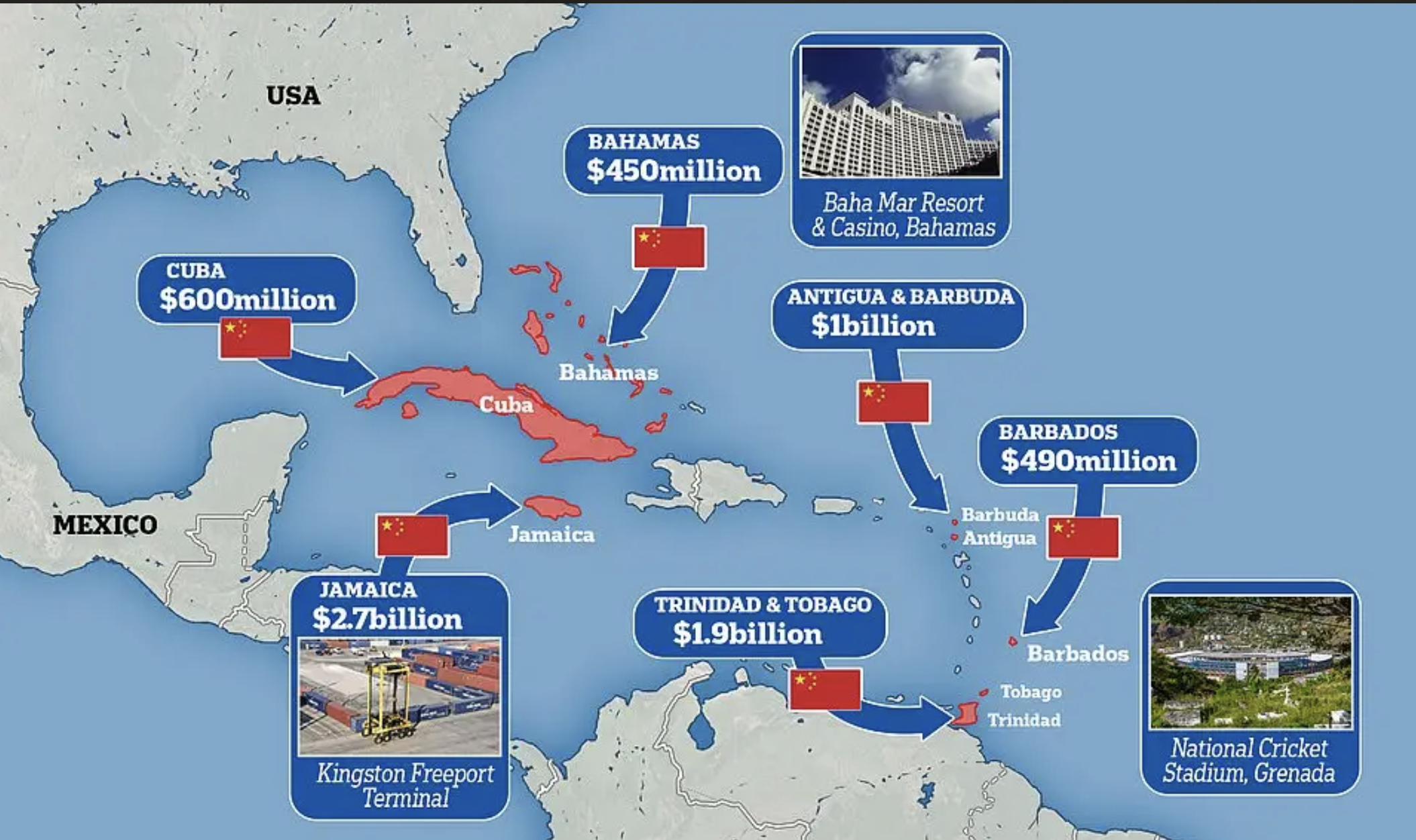
Antigua, Jamaica, Barbados, Cuba and Trinidad-Tobago are just some of the Caribbean’s largest nations receiving $Billions of Chinese Funds/Investments. Why is China so aggressive? First of all all the super Powers are competing with each other. Some have a greater allowance for their corporations to gain control of projects and their locations, while others take a more political stance such as China. In order to receive massive investments an island like Barbados must go along with China’s Foreign policy and protect china’s image globally. If you partner with China, Russia, the EU or America all your diplomatic, foreign policy and economic policies must meet these Super Powers approval. For instance Jamaica has received billions of dollars in investments. to protect this investment Jamaica will now be silent about China’s domestic and foreign policies, even cheer leading some for China’s approving glance. 

In Africa and the Middle East China and Russia even hold political sway within these nations in need. China has over a hundred thousand troops in Africa, Cambodia and Tajikistan protecting its mining interests, while Russia has stationed its special forces in fourteen specific economic zones to protect their interests and investments as well. These troops act as mercenaries for the hosting national governments. America 128 military bases are stationed in over 55 nations and territories. The United Kingdom has over thirteen bases spread across the globe. Super Powers project their power through two distinct ways…

Military Power: Military bases within foreign lands is a way to control the hosting nations government and project a regional power scope

Economic power – Tariffs: Foreign Corporations invest in foreign lands for two reasons, profit and to project their homelands power base. Tariffs have become an essential way for America to project its power and influence. You want to play in the worlds largest marketplace, then you better be pro-American. 

American Power is felt in Canada through the force of America’s Financial institutions and investments. Also America can damage Canada’s economy in many ways. Little is know of the American ability to control Canadas’ various power grids, but it can. Most Canadian Unions are allied to larger US Unions capable of closing Canada’s Ports and transportation lines. America has only applied tariffs as a negative financial tool against Canada, but there is so much more they can do. Being an ally to a Super Power places many forms of responsibility upon the smaller ally. Simply put the smaller nation becomes the larger ones bitch in every way possible, be it financial ,political, social or even ethnic in nature. America is stream lining its ability to drive non white immigrants from its lands. We all need to see what is happening and respond appropriately. 

Former Colonial Powers remain as powerful in their former colonies as they once were. The Colonial Power (Super Power) has controlling interests financially and politically. France is as present in Africa today as it was two hundred years ago. Spain is as financially and political influential today in Central and Latin America as it once was as a colonial power. 

The excuse is the building of infrastructure, but the true purpose of Super Power involvement with smaller nations is to gain control and influence of these “partners”. 

subtitle: Be Careful of What Your Government Wants. 


Discover more from Barbados Underground

Subscribe to get the latest posts sent to your email.

8 responses to “Infrastructure as a Tool of Power”


  1. Comparative analysis: Governments borrowing in 2025

    by INDAR WEIR IN 2025, governments around the world continued to rely on borrowing to address fiscal imbalances, manage debt refinancing, and finance developmental goals.

    While advanced economies like the United States (US), United Kingdom (UK) and Canada face increasing costs due to rising interest rates and large debt stocks, Caribbean nations have adopted more targeted and strategic borrowing policies aimed at building resilience and promoting sustainable development.

    United States: deficit-driven borrowing

    The US borrowed approximately US$1.3 trillion in the first half of 2025 to finance persistent budget deficits.

    Total federal debt increased from US$36.1 trillion to US$36.6 trillion by mid-July.

    To support ongoing financing needs, Congress raised the debt ceiling to US$41.1 trillion. A key concern is the US$9.2 trillion of debt maturing in 2025, which heightens exposure to refinancing at higher interest rates. The Treasury front-loaded its borrowing, with US$815 billion issued in the first quarter and US$123 billion in the second quarter.

    United Kingdom: elevated borrowing amid rising interest costs

    In June 2025, the UK government borrowed £20.7 billion, up £6.6 billion year-on-year, marking the second-highest June borrowing on record. Interest payments surged to £16.4 billion, largely due to inflation-linked gilts, now consuming nearly ten per cent of monthly government expenditure.

    Second quarter borrowing totalled £57.8 billion. While the Chancellor reaffirmed commitment to borrowing for investment, rising interest costs may necessitate tax increases in the upcoming autumn budget.

    Canada: strategic high-volume bond issuance

    Canada posted a CAN$12.4 billion deficit in the first quarter 2025, narrowing from CAN$22 billion the year before. For fiscal year 2025 26, the government expects to borrow CAN$623 billion, mainly to refinance maturing obligations.

    Analysts suggest total issuance could exceed CAN$628 billion, the highest since the pandemic.

    Despite this, Canada’s 42 per cent debt-to-Gross Domestic Product ratio remains modest, and its borrowing costs are 1.2 percentage points lower than the US, offering some protection against financial volatility.

    Caribbean: borrowing for development and resilience

    Across the Caribbean, governments are directing borrowing towards national development and climate adaptation. In Grenada, planned borrowing exceeds EC$700 million for the 2025 national budget. The Dominican Republic authorised more than US$6.5 billion in borrowing for infrastructure across water, energy, transportation, and education.


  2. First Weir and now Lorde, you can’t make this stuff up!

    What the numbers don’t show you

    SINCE THE CENTRAL BANK of Barbados presented the half year review of the economy, continuing debate suggests that the upbeat tone of the report glossed over the lived reality of stubbornly high prices, modest wage growth and an economy whose recovery remained uneven.

    In many ways, the report served as a reminder that while macroeconomic stability is essential, it is not the same as broad-based economic health. This distinction is clearest in three areas that deserve closer attention: the labour market, the performance of state-owned enterprises and the interplay between monetary policy and credit growth.

    The labour market has recovered in broad statistical terms.

    Unemployment is down from the double-digit peaks of the pandemic years; tourism is hiring again and construction tied to climate-resilience projects has given some sectors a lift.

    But, these improvements mask a concerning reality: much of the job creation has been concentrated in lowwage, low-productivity work, while higher-skill positions remain scarce.

    Youth unemployment, though lower than before, still hovers uncomfortably high and many of the island’s bestqualified graduates continue to seek opportunities abroad.

    Skills mismatches appear persistent in the domestic economy, leaving employers struggling to fill technical and managerial roles even as young people complain of unemployment and underemployment. If this trend continues, the fiscal gains from BERT (Barbados Economic Recovery and Transformation) could be undermined by low productivity growth, weaker tax revenues and a deeper dependence on remittances rather than homegrown economic dynamism.

    Layered onto this is the persistent challenge of state-owned enterprises.

    While debt restructuring addressed much of the government’s direct obligations, the contingent liabilities lurking in underperforming stateowned enterprises (SOEs) remain a fiscal time bomb. Most of these entities depend on annual subsidies to survive.

    Some have taken steps to reform, improving cost recovery or trimming payrolls, but others continue to operate with structural deficits that the central government must fill. The cumulative effect is that resources which could be channelled into growth-enhancing investment are instead spent keeping inefficient operations afloat.

    SOE reform has long been considered essential to locking in fiscal sustainability, but progress has been uneven, slowed by political sensitivities and the social role of some enterprises. Without decisive reform, the fiscal risks will linger in every budget cycle.

    Monetary policy and the health of the credit system add another layer of complexity. The Central Bank has maintained an accommodative stance, keeping domestic interest rates low in line with US rates to protect the currency peg and encourage investment. Liquidity in the banking system remains ample and reserves are healthy.

    Yet, private-sector credit growth has been tepid, concentrated largely in personal loans and mortgages.

    Small and medium-sized enterprises, the backbone of any dynamic economy, are still starved of affordable financing. Conservative lending standards and risk-averse banking culture keep the sector timid and undercapitalised. Without productive credit flowing into the economy, growth will sputter no matter how carefully the macroeconomic dashboard is calibrated.

    These three issues – labour market health, SOE performance and credit dynamics – are interconnected. A stronger, more productive labour force would boost tax revenues and reduce social spending pressures, while more efficient SOEs would free up fiscal space for strategic investment. A more vibrant credit market oriented towards productive sectors would, in turn, create the jobs and business activity that reinforce both fiscal stability and social well-being.

    Yet, if any one of these remains weak, it can pull the others down: underperforming SOEs can crowd out productive spending, a stagnant credit market can stunt job creation and a fragile labour market can depress growth and widen fiscal gaps.

    The dangers are not just economic – they are also political. A recovery built on narrow, uneven gains does not inspire lasting public confidence.

    When ordinary Barbadians look around and see stagnant wages, scarce opportunities and public money wasted on failing and inefficient enterprises, they will not be swayed by fiscal targets and debt-to-Gross Domestic Product ratios. They will see a system that is not working for them. And that is a dangerous place for any government to be.

    The structural reforms needed are not optional – they are the price of making the recovery real, durable and inclusive. That means rethinking how we train and deploy our workforce, taking a scalpel, not a paintbrush, to loss-making SOEs and compelling the financial sector to channel credit towards productive enterprise, not just consumption and property.

    Unless we confront the weaknesses hiding beneath the fiscal gloss, the next quarterly review could be less about steady hands and more about another round of firefighting. And the tragedy is that we will have seen it coming all along.

    Professor Troy Lorde is an economist and Dean of the Faculty of Social Sciences at the University of the West Indies, Cave Hill Campus.

    Email troy.lorde@cavehill.uwi.edu

    Source: Nation


  3. @Hants

    We clearly do not have the infrastructure to regulate coconut vending, PSV operators to name two. If we can’t solve for routine matters, how will we fare for the complex?


  4. “Gupta also extended an invitation for a Barbadian delegation to visit Kerala, India—a region renowned for its coconut industry—offering full logistical support to enhance knowledge exchange and capacity building.”


  5. Well Mr Weir sir help me here with you figures. You said that borrowing by the USA INCREASED by $1.6T in the first half of 2025 correct? Then you said that the debt increased from $36.1T to 36.6T by mid July. So my question is if dem borrowed $1.6T during the six month period but dem debt only went up by 0.5 T over the same period where the borrow money went? I mean as a humble shopkeeper if i did borrow $1600 from de credit union in January and by July my check book overdraft only was higher by $500, then i do good as ass over that 6 month period! Cause the shop not only operate but in just 6 months i pay back $1000 dollars of the $1600 loan!

    So what em is you trying to say here? I think you better use anuder example.


  6. Sorry meant pay back OVER $1000 of a $1600 loan. Lol


  7. @ John A
    Interesting that Weir was unable to engage David Ellis on the state of the sugar industry – UNLESS MASCOLL WAS PRESENT WITH HIM, … but he is free to pontificate on national and international loan financing.

    Steupsss… Bushie didn’t even bother to read that….

    Perhaps, (like a former ‘Pit Bull’ – who REALLY turned out to be a shiite hound) he REALLY wanted to be Minister of Finance ….RATHER than Agriculture…

    Shiite!!
    We seem to be stuck with a lotta square pegs in the wrong holes yuh…
    What a place!

The blogmaster invites you to join the discussion.

Trending

Discover more from Barbados Underground

Subscribe now to keep reading and get access to the full archive.

Continue reading