← Back

Your message to the BLOGMASTER was sent

Robert MacLellan Managing Director, MacLellan & Associates
Robert MacLellan
Managing Director,
MacLellan & Associates

I read with interest a recent article by Alexander Gumbs, decrying potential increases in cruise ship taxes in the Caribbean. As CEO of the Port St Maarten Group, Mr Gumbs has a vested interest in Caribbean cruise tourism. To be fair, I have a different vested interest through many years involvement in resort development consultancy across the Caribbean.

Mr Gumbs argued that “cruise tourism is sometimes assessed too narrowly through the lens of taxation rather than its broader economic contribution to destinations and tourism authorities should instead pay closer attention to how cruise passengers actually spend money during their visits.” 

With three years’ experience as a hotel officer on board cruise ships and, later, as Hotel Services V P for four explorer cruise ships, I believe that I have a well-founded viewpoint in evaluating how passenger spend, operating costs and taxation applies to the cruise industry in the Caribbean, compared to the stay-over visitor tourism of island hotels, condo rentals, timeshare and marinas.

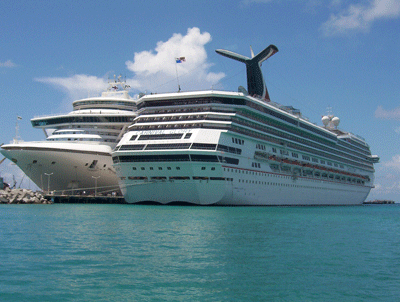
Today’s giant cruise ships have large scale leisure facilities on board including multiple restaurants, bars and shops, as well as casinos and water parks, which all now present a direct disincentive to spending time – and money – in Caribbean ports. Ships now ban bringing duty free liquor on board in calling ports – on “security” grounds. Ships have their own jewelry and electronics shops on board. St Maarten is still one of the more successful cruise calling ports for retail outlets but, even there, the size of the duty-free retail sector in Philipsburg has shrunk considerably in recent years, thanks to direct competition from onboard shops. 

Ships’ commissions for shore excursions have risen over the last few decades from 10% to 50%. That inevitably drives shore excursion prices significantly higher, as local companies struggle to operate vehicles and boats on a viable basis. The end result today is that fewer passengers actually go on excursions and more passengers never go ashore at all in many Caribbean ports. On that basis, trying to compare “spend per hour” from the reduced percentage of cruise ship passengers going ashore against the spend of longer term stay-over tourists on the islands is fanciful. The average spend per cruise ship passenger, quoted in the recent article at $165 (over $30 per hour ashore), also seems dubious. 

Average cruise ship ticket prices have declined in real terms over recent decades, attracting more budget-oriented passengers. After having to haggle with cruise ship passengers over the fare, most taxi drivers in the Caribbean will tell you – from their personal observation – that the average purchase per person ashore is more like “two beers and a tee shirt”. How does that start to even compare with the average stay-over guest’s vast spend on island accommodation, restaurants, bars, car rental and day trips? 

A March 2025 World Bank report, argues that the region’s reliance on high-volume cruise tourism is unsustainable, yielding the world’s lowest revenue per cruise visitor at $37–$139 per visit compared to over $1,600 for stay-over visitors.

That brings us to the question of comparables in operating costs and taxation. Cruise ships inevitably benefit from much lower operating costs, due to their tax structures in off-shore jurisdictions and from their ultra-low direct wage costs for most of their third world sourced crew. However, island based companies in the hospitality sector pay high local taxes and employ local staff – at the very least – on a legal minimum wage basis. Those local payrolls, including income tax and national insurance contributions, have a beneficial multiplier effect across island economies on a much higher ratio than direct cruise ship revenue. 

In the Caribbean cruise ships currently pay very low port taxes on a per passenger basis, contrary to the much higher taxes levied in Alaska, New England, Canada and the Mediterranean. It appears that the Caribbean genuinely needs to catch up or remain being unfairly exploited in this respect. 

In the meantime, the stay-over visitor contributes to local taxation via very high taxes for airport arrivals / departures and on local air tickets themselves. Incidentally, these high airline related taxes have decimated the Caribbean’s intraregional air travel, while local airlines have only marginal viability. Hotel occupancy taxes and sales / value added taxes represent further stay-over visitor contributions, as well as customs import duty on the multiple items which those visitors consume on island.

The imbalance in operating costs, taxation and profitability seems clear between the cruise industry and the Caribbean based hospitality sector. However, there is an even greater and longer-term insidious impact on the region. The Caribbean currently has the highest density of cruise ship operations in the world, particularly, in the Caribbean’s winter high season. 

It is my contention that this high-volume presence acts in many ways as damaging unfair competition to the region’s onshore accommodation providers. This is particularly impactful when winter high season occupancy and room rates are critical for the financial success of Caribbean resorts – but most cruise ships reposition to other high season destinations elsewhere in the summer. Furthermore, this level of competition from the cruise sector represents a significant economic challenge to the viable development of new resorts in many islands, which already struggle with high construction costs, high energy costs and high shipping costs.

I really encourage governments in the region, as well as the Caribbean Tourism Organization and the Caribbean Hotel & Tourism Association, to re-evaluate this imbalance and adjust their policies going forward. 


Discover more from Barbados Underground

Subscribe to get the latest posts sent to your email.

47 responses to “Is the Cruise Industry Eating the Caribbean’s Lunch?”


  1. So imagine if St Maarten is under pressure for business what we are feeling here in Bim.

    We are the last port of call on the itinerary usually, which means the travellers have already passed through several destinations selling duty free items. We can not compete with St Maarten price wise either, as they have no customs duties, hence businesses do not have to maintain expensive software systems and put up bonds to do business. They pay no customs brokers or clearance fees either. A business can simply go to the airport and collect their shipment the same day it arrives.

    Recently it was featured in the press how the City is dying with stores closing. Have any of you ever watched the visitors walking back to the harbour and noticed they have no bags in their hands? They don’t come here to shop, those that do get off the ship do tours or head to The Boatyard or some other beach nearby to relax.

    Long and short we can not undersell the players in St Maarten or USVI. We also can not change our geographic location which has us at the bottom of the island chain. Duty free retail is therefore not our future. Ask the Rolex agent here how many watches he sells to cruise ship passengers a year if you doubt me.


  2. @John A

    Didn’t Barbados expect to receive highly favoured treatment because of our accommodating overtures to them during Covid pandemic?

  3. Samuel S. Shank Avatar
    Samuel S. Shank

    The Barbados government especially this current BLP administration have been raping the tourists for years.
    The first thing that this PM did was it increase the airport tax (departure tax) for visitors and locals but visitors by a much higher percentage.
    Now the latest rape is the levy on car rentals. A Bajan can go most places in the world and drive on their Barbados drivers license without a charge.
    Why would people want to get off a cruise ship to walk around Bridgetown to be accosted by taxi drivers, drug dealers and vagrants begging for money. Bridgetown needs to be cleaned up.
    Take note: there are cheaper places for people to go on holiday and the Barbados lure is waning.


  4. This is a vital question which was maybe more appropriate several decades ago.

    For tourism within the Caribbean, not unlike all other industries, has long been the regional centre of a neoliberal race towards the bottom.

    Before the advent of neoliberalism, circa 1980, hotel workers were maybe some of the best paid in the country. For in addition to their wages or salaries, points and tips would normally surpass basic income. Those days too have also gone the way to which Barbados, maybe the Caribbean, of yesteryear is said to be.

    We’re pointing to indicators of maldevelopment which always disguises itself as anything but. And the tourism industry has been so highly financialized that most of the benefits are now consolidated into the hands of the operators in source markets and local hotel corporates, leaving very little residual or net incomes for regional people or treasuries.


  5. We struggle to get things right in the Caribbean and specifically Caricom because we do not have an underlying culture of wanting to collaborate. We see it with Kamala, now the Minister of Tourism of St. Lucia and others. There is no way all of our countries will defends a single position at the negotiating table with the cruise ship industry.


  6. Caricom’s manufactured crisis

    WHEN A REGIONAL LEADER is invited to offer a comment on an established and entrenched regional organisation like CARICOM, and the most that she can say is “CARICOM has been failing for 52 years and will continue to fail for the next 52 years”, we can conclude that this is an unserious comment, not worthy of any further discussion.

    Had Trinidad and Tobago’s Prime Minister Kamla Persaud-Bissessar been intellectually committed to CARICOM, she would have been more technically specific about which aspect of CARICOM was dysfunctional and what her remedial alternatives would have been.

    Indeed, she appears neither interested in, nor indeed capable of, offering intellectually and insightful analyses about CARICOM.

    Sorry Gen-z, but we are no longer in the era when our leaders demonstrate oratorical finesse or political substance. Many are content to emulate Donald Trump, who has proven incapable of treating a global war with the seriousness that it deserves. Reporters’ questions are met with untruths and derisive nonsense, full of sound and fury signifying nothing.

    For those unaware, Persaud Bissessar’s missive against CARICOM was issued in the context of her opposition to CARICOM’s decision to reappoint the sitting Secretary General Dr Carla Barnett, for an another five-year term. In addition to her sideswipe about CARICOM’s 52-year failure, she indicated that her rejection of Dr Barnett was due to the absence of Trinidad and Tobago and at least one other CARICOM state when the voting occurred. As a result of her purported opposition to Barnett’s appointment, she voiced her intention to discontinue “funding CARICOM at the current levels that we are providing”.

    I submit, however, that Trinidad’s noises over Dr Carla Barnett have nothing to do with Carla Barnett. It is much ado about Carla. Had the issue been about Barnett, Persaud-Bissessar would have offered clear arguments for her objection, identified her concrete alternative and explain why her alternative was better from T&T’s perspective.

    Any discussion of a “crisis” in CARICOM over the re-appointment of Dr Barnett is merely a manufactured crisis which masks deeper truths of which every observant citizen in the Caribbean is aware.

    What are these deeper truths? Long before the issue of Dr Barnett’s appointment, Persaud-Bissessar had already outlined her rejection to CARICOM. Significantly, she had first done so in the context of a United States invasion of Venezuela, an action which CARICOM was not willing to cheer with the gusto that she expressed. This is the basis of Persaud-Bissessar’s analysis that CARICOM has “failed”.

    I humbly submit that it is more likely that Persaud-Bissessar and her modus operandi will disappear long before CARICOM.

    Committed Caribbean people must commit themselves to ensure that CARICOM and the Organisation of Eastern Caribbean States become stronger over the next 52 years, with or without T&T.

    Tennyson Joseph is Associate Professor of Political Science at North Carolina Central University.Email tjoe2008@live.com

    Source: Nation


  7. @ David

    That favoured status was like old fish and has long past its expiry date.

    The goal of the cruise sector is to collect every cent they can. Last figures I saw on these super size ships stated in many of the island ports as low as 40% of the passengers disembarked. There is everything on these boats now and by the time you reach us, they have spent what they have and do not intend to buy a coke when it’s free on the boat.

    In the old days of cruise ships there was little to do on the boats when in port, so the get off rate was over 80%. In those days the vendors got a sale, a few places in town did some business and all was well. Ask any older taxi driver who operated in the city in the 80s and is still there today what he has witnessed.

  8. Viterose vanhuis Avatar
    Viterose vanhuis

    Barbados is not making what it used to make. Tourist prices here too high


  9. The uncomfortable fact is that we as taxpayers have paid millions upon millions to accommodate cruise ship tourism but they spend very little money in Barbados… it has been an extremely poor investment.

    Cruise ship passengers represent the majority of Barbados arrivals (approx. 75%) but account for only about 12% of total tourist expenditure… and if we zero out the public investment in cruise ship tourism we could very easily invest that money elsewhere in the tourism sector to make a dramatically better return on investment.


  10. @ Peter
    Uncomfortable fact…?

    How is that any different to the hotel sector – owned 75% by foreign interest, …and where the forex is received in overseas accounts – or exported to the jurisdictions where the owners (even the few local owners) choose to keep their profits?
    …while taxpayers pump subsidies into the industry…

    How is it any different to the foreign banks where the hundreds of millions in profits are paid to the (foreign) shareholders every year?
    …while depositors get 0.01% interest…

    Or to the supermarkets?

    Or to the utility companies?

    Or to almost all of the insurance companies?

    The uncomfortable FACT is that we have put our country into the hands of blinded jokers with NO VISION, whose ides of ‘success’ is foreign direct investment…
    AKA – selling your natural birthright for a bowl of soup ( …for a temporary belly full)

    Where there is no vision, Brass Bowls will always be overflowing with jobby…

    Isa. 3:12
    Childish leaders oppress my people,
    and women rule over them.
    O my people, your leaders mislead you;
    they send you down the wrong road.

    What a curse!!


  11. What about the increase in home porting and the spinoff economic activity to support it ?


  12. Bushie

    Pacha would prefer a woman, or two, or three, or four, to rule than all of dem men your book would prefer. Your sexist, chauvanistic, dated, body of lies.

    Dr. Ben has long taught us that the only thing sweeter than a Black woman in charge is two Black women in charge.

    Even when these said same women bettering the men at the amount of shiiiite duh doing. Some muh duh even want to take Pacha’s birthright as theirs.

    At least de women got something much desired. A heaven right here on earth!

    While you continue to look for some shiiiite heaven somewhere in the clouds. Pacha tekking his right here, right now!


  13. BLP town.


  14. The reality is when it comes to return per head its a case of fluff vs reality with cruise ship traffic.

    It’s like a shop with nuff people in the store but little cash in the register at the end of the day.


  15. IF PAX AMERICANA IS ON LIFE-SUPPORT – HOW DOES BARBADOS SURVIVE THE COMING OIL WAR & THE GLOBAL US MONETARY HEGEMON?

    Well, #StayTuned

    The players have devised a “SYSTEM” where you “TRADE” your “US DOLLARS” to “BUY GOLD”…

    You then “TRADE” your “GOLD” to “BUY CHINESE YUAN” and/or “RUSSIAN RUBLES”…

    You then use your “YUAN” or “RUBLES” to “BUY OIL” from “IRAN or “RUSSIA”!!!

    VOILA*

    The #USDollarDies – a “SLOW DEATH”!!!

    Sounds ridiculous – then see:


  16. I see that my customary response to the misogynist in chief is unnecessary.


  17. The real ECONOMICS of it says that all those taxi drivers ( for example ) outside the port seem to be making a living and some of those one day visitors may in the future become a long stay visitor / more $ spend .


  18. Not sure that what is depicted on the video is authentic Bajan culture @hants.


  19. An economy cannot be sustained based on how many taxmen get a couple jobs. Get serious.


  20. @ David

    The cruise sector has changed dramatically over the last 3 decades, from one of prestige to one of floating Holiday Inns.

    The days of boats like the QE2 and others no longer come our way. What we see is large vessels with thousands on board, many of whom booked 3 days before sailing date at a 40% discount. The problem with these large boats is filling them year around. What happens as a result is massive discounting a few days before sailing date, which allows many who could not afford the cruise to get on board by placing the heavily discounted cruise on their credit card. They then pay this trip off over the next 8 months. This type of traveller therfore has little disposable income and hardly disembarks the boat as all food is free on board.

    These travellers are not like those of the 1970s or 80s as a result of the above. They basically are persons who come for the boat ride and free food, many of whom refuse to miss a single meal including the midnight buffets. Sadly there is nothing any caribbean island can do to change this either, as these mega cruisers are designed to extract every cent from these people on the boat. From duty free shopping to free ice-cream machines, it’s all on the boat. I mean let’s be honest after seeing 2 caribbean islands higher up the island chain, getting off here to put more on your already maxed out credit card is not a priority to these people.

    That my friend is the truth about our current cruise ship sector and the sooner we accept this the better. Yes we will get a few dollars from them, but do not expect their spend per head count to do much for our economy when compared to the longstay visitor. Its good politics though as you can brag about “record arrivals” which sounds good to the electorate.


  21. @John2…

    What data suggests your statement is correct?

    I would be interested in hearing about hard evidence.


  22. @John A.: Yes we will get a few dollars from them, but do not expect their spend per head count to do much for our economy when compared to the longstay visitor.

    Thank you for speaking truth to power.

    I have hosted many friends here in Bimshire who came in here via flights and boats.


  23. Chris

    Do not go down the rabbit hole with David

    There is a difference between ECONOMICS and (an) ECONOMY). I used the economics in caps I don’t know how David arrived that I said economy

    Take a trip down to the port and have a chat with the driver there

    Yes the spend from the cruise passengers ( one day ) will be much less than a long staying visitor

    What John A isn’t saying is that as the ships increased in size and passenger count so did the number of taxis , coach busses , safaris etc.
    I only used taxis as an example

    The same way the government ( b or d) caters to the hotel / hotels workers to make a living from the long staying visitors they are /must also cater to those employed around the seaport with the short term cruise arrival

    There are both parts of the overall ECONOMY
    Check the Central bank reports and you will see that the mentioned the numbers of both the longer stay and cruise visitors


  24. GOOD MORN’ ALL – IF THE DIRTY BASTERDS WHO RUN THE WORLD WHO ARE QUICK TO INSULT OTHERS – DROPPING “F-BOMBS” & EQUALLY CALLING OTHERS #Basterds BECAUSE THEY REFUSE TO DO AS YOU WANT – THEN STEVIE WONDER CAN SEE* THE MADNESS OF THE BLIND LEADING THE BLIND (#NoPunIntended)

    Every “WESTERN” cuntry* (#ExcuseMyFrench) is up “SCHITT CREEK” without a “RAFT”, “POLE” or “PADDLE”!!!

    PM STARMER* will be “GONE” by “SUMMER 2026” (if the “PUNDITS” are right) & “THE ORANGE MAN” will be “IMPEACHED” & DRAGGED* off in a “WHITE STRAIGHT JACKET” – if it is left up to those who want to see him placed in a “PADDED ROOM IN A PSYCHE WARD”, as “PRISON” is not good enough for him!!!

    Then there are the “OTHERS” – I call them the “NEO-FRENCH REVOLUTIONARIES” who want “TRUMP & NETANYAHU” tried in a modern form of “NUREMBERG” – sentenced & “HANGED” or “GUILLOTINED”!!!

    Let’s face it – the world is in a very “DARK PLACE”!!!

    Now beyond those “GENERIC” issues – “THE WORLD IS GOIN’ 2-HELL IN A 3-WHEEL PANCART”!!!

    Why I say that:

    If the “IRAN CRISIS” continues for any protracted time beyond this Spring – “NO ONE CAN IMAGINE THE UNTOLD GLOBAL SUFFERING THAT IS LOOMING” – but tell ya’ what, let the so-called “EXPERTS” tell you what the scenarios are & where we are all gonna’ be this time “NEXT YEAR” (if we survive the tectonic fallout, & aftermath)!!!

    Have a #BlessedDayYall


  25. @John2

    Can you explain how economics can be divorced from the economy for Dummies?


  26. All Dummies on BU is educated enuff and have access to things like Google and ChatGPT etc


  27. There is another problem with depending on the cruise sector as an income source as well, especially for private business and that is the seasonality of it.

    If you notice in the months of December to early April we have boats nearly every day, with some days having multiple boats. Then from later April through summer we have many weeks with sometimes only 2 boats for the whole week. This is not just Barbados mind you but most of the southern Caribbean. The ships move to other itineraries during this time leaving very few in this region. Most businesses that depend solely on this sector “suck salt” as we say, during this 8 month period as a result. Most of them end up drawing on the funds made in the winter months to see them through the summer period, especially those with fixed expenses like rents, vehicle loans etc. By the time they reach December their cashflow is depleted basically as they patiently wait for December to come and start the same cycle over again.

    I always found the cruise business a testing one. If you did not make enough in the winter months to help cover expenses in the summer, then God help you. The summer was also plagued with another issue as well in this sector. Because the cruises were cheaper then and quite often heavily discounted on top of that especially in Spetember and October, the people travelling then had even less disposable income than those in winter, which meant they spent little in the island at all. Personally I would warn government to be very careful how much they invest going forward to service this sector, as while the numbers make for good politics the returns make for poor economic returns. If you doubt me ask any taxi driver in the city or beach vendor and hear it from them.

  28. Terence Blackett Avatar
    Terence Blackett

    WHEN THE HEAD IS BAD – THE BODY SUFFERS IRREPARABLE DAMAGE! THIS IS WHY THE ENTIRE WORLD IS IN THE DIRE STRAITS OF HORMUZ

    Here’s your “LEADER OF THE FREE WORLD”!!!

    P.S. The ‘GRAPHIC “cussing” LANGUAGE’ doesn’t reflect the “INTENT” of your humble servant! #RatedPG


  29. ANY NATION STATE HOLDING ON TO THE SKIRT-TAIL OF AMERIKKKA* WILL TOPPLE & FALL WHEN MODERN ROME FINALLY CRASHES & BURNS TO THE GROUND

    These are NOT* my conclusive findings alone – “MANY” like myself hold this same fait accompli!!!

  30. Terence Blackett Avatar
    Terence Blackett

    A GLOBAL MARKET CRASH IS AN INEVITABILITY & NO AMOUNT OF MINDLESS DISTRACTION WILL REMOVE THE FACT THAT THE “titanic” IS SOON TO SINK INTO THE DARK MURKY WATER OF ATLANTIS


  31. NO AMOUNT OF SPIN DOES NOT CHANGE THE REALITY OF LOSS

    #TrumpIsALIAR*


  32. “Most businesses that depend **solely** on this sector “
    ———————————————————

    I wonder how many persons this sector maintains, supported / kept from going on welfare 🤔


  33. @John2 April 5, 2026 at 7:52 am
    “The real ECONOMICS of it” is that the Taxi drivers outside the port cannot even afford their cat insurance in 2026… go and talk to them.
    https://barbadostoday.bb/2024/12/03/cruise-boom-bypasses-taxis-drivers-call-for-more-work/amp/


  34. PETE HEGSETH IS A LOW-DOWN DIRTY DOG AS CARICATURED BY IRANIAN MEDIA

    From #BallisticMissiles – to #PopCulturesNukes

    #IranReshapingTheWorld


  35. Amazing…!
    “I wonder how many persons this sector maintains, supported / kept from going on welfare”
    ~~~~~~~~~~~~~~~~~~
    Not as many as were ‘kept from going in welfare’ when we were ‘supported’ by slavery and apprenticeship for 5 centuries…

    Shiite!!
    That serious persons can still limit our BB potential in this 21st Century – to escaping welfare, has to be the clearest indication of our blindness, cursedness, and of endemic brassbowlery, that there can be…

    This has been the root mis-education perpetuated by our former slave-owner demons, …and has now been weaponized by our new class of mafia-styled political devils.
    The ‘eddykashun’ process has been so ingrained, that even the BB victims still see themselves as ‘lucky’ to eek out a survival that is barely above welfare status…

    What a state of affairs…!
    Thankfully, it all ends shortly…


  36. @John A: “[SNIP] If you doubt me ask any taxi driver in the city or beach vendor and hear it from them.

    Thank you for this analysis. IMHO, spot on.


  37. When U talk to them ask try to find out how many of them were making their living outside the port for over 10yrs?

    How many of them ever had a second job /side hustle to supplement their income ( farming etc)?

    How they paid for or is now paying for said taxi?

    How the feed clothes and house themselves/their families ?

    Etc. their economics

    —————-

    🤔. I think I recalled a couple yrs ago MOST of the fishermen/boat owners complaining that couldnt afford to insure their boats. ( sounds familiar?) Yet they were/are the back bone of the fishing INDUSTRY.

    —————-

    Now tell me, if there is no money in the Cruise Industry in Barbados whose interest is the president of the Bridgetown PORT co-op (?) is representing or is he just wasting his time?
    Now it is not the the taxis association or the ports taxis association. It is The BRIDGETOWN PORT…… t

    If there is no or very little money from the cruise industry why are the moneyed men investing in the big luxury coaches and eating the smaller taxis lunch?


  38. Bushie.
    Seriously????

    Do u understand what ( / ) that means / says/ or stands for for ?

    I think I now understand when David referenced Dummies


  39. Today’s Nation editorial.
    Guarding against over-tourism

    BARBADOS IS COMING to the end of what Government officials and private sector representatives, including hoteliers, have reported as another successful winter tourist season. This is why Prime Minister Mia Amor Mottley and Minister of Finance Ryan Straughn could boldly declare during the recent debate on the Budgetary Proposals that the economy is expected to record 19 consecutive quarters of economic growth.

    They were referring to the January to March period which is traditionally the strongest for long-stay tourism, Barbados’ main bread and butter, and, hence, the economy. This success is likely to be shown in data reported by the Barbados Statistical Service (BSS) and the Central Bank of Barbados in the coming weeks.

    Reviewing the economy’s 2025 performance during a press conference in January, Central Bank Governor Dr The Most Honourable Kevin Greenidge said that tourism activity reached record levels in 2025, underpinned by expanded airlift and strong demand from key markets.

    From January to December, long-stay arrivals increased by 3.3 per cent to 727 310 visitors, the highest level recorded for any year, he added. This was the main reason Barbados had real economic growth of 2.7 per cent last year.

    Tourism industry stewards, including Minister of Tourism and International Transport Ian Gooding-Edghill, have spoken about plans to grow tourist arrivals even more, partly through an effort to end the industry’s long-standing seasonality. This means that, if successful, Barbados’ annual long-stay arrivals could head closer to the one-million-a-year mark. This prompts the question of: how much of a good thing is too much?

    Conducing research into the island’s carrying capacity for tourists and the possibility of over-tourism is important.

    It is an issue that takes tourism beyond its economic dimension to consider the social and environmental impacts the industry can have on destinations which, while popular, are small – for example, Barbados.

    During the recent debate on the Appropriation Bill, 2026 in the House of Assembly, Gooding Edghill said that Barbados would have an additional 1 600 hotel rooms by 2031. He was responding to questions from Minister of Energy, Business Development and Commerce Kerrie Symmonds, who asked about the island’s carrying capacity given the projections of a substantial increase in the number of stay-over visitors.

    Gooding-Edghill voiced confidence that Barbados was fortifying and developing key infrastructure, including the Grantley Adams International Airport and services like water and electricity to accommodate the predicted tourism expansion. Permanent Secretary Francine Blackman said research suggested that Barbados could cater to 14 000 visitors per day “before you start to see any degradation of the services”.

    It would be worthwhile for the Ministry of Tourism and International Transport to share more details of any studies on Barbados’ carrying capacity in relation to tourist stays, and Government’s plans to ensure that over-tourism does not become an issue for Barbados in future years.

    News of more than $1 billion in tourism-related investment is good, especially if the bulk of that money remains here. However, the authorities must ensure that the island never reaches a point where the quality of life for Barbadians, and the quality of visitor experiences are at odds, as has happened in some leading tourist destinations, particularly in Europe.

    The authorities must ensure that the island never reaches a point where the quality of life for Barbadians, and the quality of visitor experiences are at odds.

    Copyright (c) 2026 Nation Publishing Co. Limited, Edition 4/7/2026Powered by TECNAVIA

    Source: Nation


  40. @John2

    Name calling is always a sign. You would be surprised at the credentials of many that post to BU.


  41. @ John 2
    “Bushie….Do u understand what ( / ) that means / says/ or stands for for ?”
    ~~~~~~~~~~~~~~~~~~

    You will get no counter arguments from Bushie here…

    Walk good
    … as the Boss is wont to advise.


  42. “The new service will operate on Thursdays from December 17 on Air Canada’s 177-seat Boeing 737 MAX 8 aircraft.”


  43. @ David

    Our leaders are really not understanding where the challenges will come from in the long stay market and that is evident from their proclamations.

    The biggest dark horse for us here in the Caribbean could well come from Cuba. Once they make peace with Trump and he gets what he wants, the sanctions will be lifted and USD investments will flood into Cuba. Do not be surprised in the next decade if names like Hilton and other big players are not operating in Cuba. Their beaches are amazing and the cost of doing business there is a fraction of here. They are also close to the USA and Canada so flight time is in their favour. Do not be surprised if they do not prove a rival to The Dominican Republic in the next decade as well. Yes their infrastructure will need work, but once the green light is given that will quickly be addressed.

    For those not familiar with the growth of Guyana and the timeframe it came in, let me say major development can take place and change a countries future in just 10 years and Guyana is living proof of this. Cuba has always been the “forbidden” destination, hence it will hold major appeal when the green flag is offered. The fact that they also have Unesco heritage status in many areas will make it worth visiting for many who like historIc sites.

    They are interesting times ahead for us all. The new global economy will have different players in it. The new Golden Triangle may well form in our area between Trinidad, Guyana and Venezuela, making the southern Caribbean a power house globally. Its not all doom and gloom for us in the Caribbean, its just a matter of some golden children being replaced by others that’s all. For our brothers and sisters in these countries, I wish them well and hope prosperity finds them, as many there have suffered way too long.


  44. JohnA

    Wake up! wake up ! U dreaming .
    With the political licks ur main man getting from the war in Iran what incentives does Cuba have for making peace with TACO ?

    He should go ahead and stop the sanctions though

    November is around the corner


  45. Fitch warns of tourism pressures

    About six months after affirming Barbados’ credit rating and changing the outlook to positive, Fitch Ratings is warning of increased pressure on tourism and prices for the island if war in the Middle East persists.

    It is also predicting that the country’s economic growth will “taper to two per cent over the next two years”.

    Fitch Ratings published a Barbados update last week which examined the latest credit developments, and gave an assessment on future economic and fiscal performance.

    The international credit rating agency said that the immediate impact from the energy shock caused by the war in the Middle East was expected to be minimal, but could worsen depending on how long the conflict lasted.

    Minimal impacts

    “The economic and fiscal impacts on Barbados will be minimal under Fitch’s baseline of an average global oil price of US$70 per barrel in 2026. We expect tourism to be stable, given still positive economic growth in the United States and United Kingdom”, it said.

    “Higher energy prices will increase domestic prices, albeit it from historically-low inflation rates. The Government has mitigated some of these dynamics by absorbing 50 per cent of electricity price increases, locking in imported fuel prices at US$92 per barrel and capping fuel taxes for three months.”

    However, Fitch had concerns about downside risks for Barbados from a longer conflict.

    “Downside risks will increase if the Iran war continues for longer than expected, if the current ceasefire does not hold and energy prices remain elevated for the rest of the year,” it advised.

    “The tourism and inflation channels, as well as the external position, will experience greater pressure under a downside scenario of average oil prices of US$100 per barrel.

    “This could yield more calls for fiscal support and pause the improvements in both economic and fiscal metrics that have underpinned recent credit momentum.”

    On Barbados’ economic prospects, Fitch predicted slower economic growth over the next two years.

    “The economy continues to grow above potential, expanding 2.7 per cent in 2025, which is on par with the average in 2023-2024 and well above the flat growth experienced prior to the pandemic,” it stated in the update.

    “Given the plateauing of tourism growth and global economic uncertainty, Fitch Ratings expects real GDP growth to taper to two per cent over the next two years.”

    The agency acknowledged that tourism “remains the engine of the economy”, with total arrivals growing by 6.7 per cent in 2025, down from 17.7 per cent growth in 2024.

    Economic shock

    “The cruise industryled growth, with cruise arrivals up 9.6 per cent, while the more lucrative stay-over arrivals grew 3.3 per cent, we expect arrival growth to taper but still be strong, unless there is a prolonged economic shock,” the report predicted.

    Fitch saw Government’s fiscal position as “still strong”.

    It elaborated, stating: “Government finances continue to improve with the general government deficit shrinking to an estimated $83 million – 0.5 per cent of GDP – in the fiscal year to end-March 2026 – fiscal year 25/26.

    “The fiscal balance will maintain positive momentum, moving to neutral – zero per cent of GDP – in fiscal year 26/27 and a small surplus – 0.1 per cent – in fiscal year 27/28. As a result, debt/GDP has shrunk to 95 per cent in 2025, still much higher than the ‘B’ [credit rating] median of 51 per cent. We expect progress to continue with debt/ GDP falling to 91.3 per cent in 2026.”

    Fitch also said that Barbados’ stock of foreign reserves compared favourably with other countries it rated ‘B’, although the current deficit was high.

    “The current account deficit expanded to 7.6 per cent in 2025, after shrinking to 3.8 per cent of GDP in 2024, just under the post-pandemic average,” the report added.

    “Outflows weighed on international reserves, which fell to US$1.6 billion – five months of current external payments) from US$1.7 billion – 5.7 months – in 2024. This compares favourably to ‘B’ peers at 4.4 months, although Barbados’s high external exposure argues in favour of additional buffers.” (SC)

    Source: Nation

The blogmaster invites you to join the discussion.

Trending

Discover more from Barbados Underground

Subscribe now to keep reading and get access to the full archive.

Continue reading