← Back

Your message to the BLOGMASTER was sent

Thanks to Bentley for the video short – Blogmaster

In recent years, we’ve watched large tracts of land across Barbados swallowed up by photovoltaic panels. In a country that has to survive on its “look” to pay the bills, this is nothing short of visual vandalism.

The panels are often plonked down in the middle of agricultural lands, with no regard for aesthetics or maintaining harmony with the landscape. It is as if beauty and planning were jettison in the rush to tick a renewable energy box. And almost daily we read notifications in the press indicating more unsightly photovoltaic implementations on the way.

Aerial view of a large photovoltaic solar panel installation on agricultural land, surrounded by greenery in Barbados.
Solar Farm that Barbados Light & Power has plonked down in rural St. Lucy

The blogmaster does not want to stand in the way of technology. However, contrary to what Allyson Leacock and more recently Prime Minister Mottley have been opining, some of us offer constructive criticism because we believe Barbados decision makers can do better. All wisdom does not reside in the Cabinet of Barbados or a few from Mottley’s inner circle.

The following video short (57 seconds) is a clear example of how photovoltaic deployment and agriculture can coexist to maximise land use, it is called agrivoltaics.

Relevant Article: What is Agrivoltaics?

Barbados deserves better than a patchwork of metal scars ‘planted’ across our endangered picturesque landscape. Let’s innovate while utilising a sensible land use policy.


Discover more from Barbados Underground

Subscribe to get the latest posts sent to your email.

12 responses to “We Should Consider Agrivoltaics”

  1. Critical Analyzer Avatar

    It sounds good in theory but probably will not be feasible in practice based on how we currently farm and storm wind damage risk.

    The panels will need to be at least 12 feet high to allow ploughing underneath unless the farm is practising no-till which does not involve ploughing.

    However, Panels that high up will get destroyed in storm winds unless the mounting is very strong which will be very costly.

    It can work on buildings and livestock pens or on a small scale in the fields like a row of 10 or 20 panels to zero the farm’s electricity costs.


  2. The BL&P project was completed in 2016. A bit of research on more recent, as in post 2018, projects would show that the majority of the projects approved in Barbados are agrivoltaic. More misinformation.

  3. Critical Analyzer Avatar

    All the agrivoltaic projects I have seen in Barbados put panels on agricultural land and plant nothing except lawn grass for a lawnmower to cut instead of sheep to eat.


  4. Maybe just maybe you’re seeing photovoltaic rather than agrivoltaic projects.


  5. @Enuff

    Where are three of the approved agrovoltaic projects?


  6. Don’t some of the projects include having sheep on the site to control the grass. This would make it a joint PV /agro venture….


  7. There are numerous carparks around Barbados that can be covered with these panels no need to use agricultural lands.

    Another next thing;
    Can the company “that moves the earth to please” transport arable land from St George and Christ Church to less prime locations in St. John,, St Thomas and St Far Up?


  8. Wunnah forget that Mia and her handlers stated, from way back, that Barbados should focus on tourism and leave all things agricultural to Guyana with its larger land mass and therefore economies of scale. By the way how has the black belly sheep experiment gone? Have we seen a rise in the consumption of lamb meat in Bimshire?


  9. Can’t seem to get the full video.


  10. David
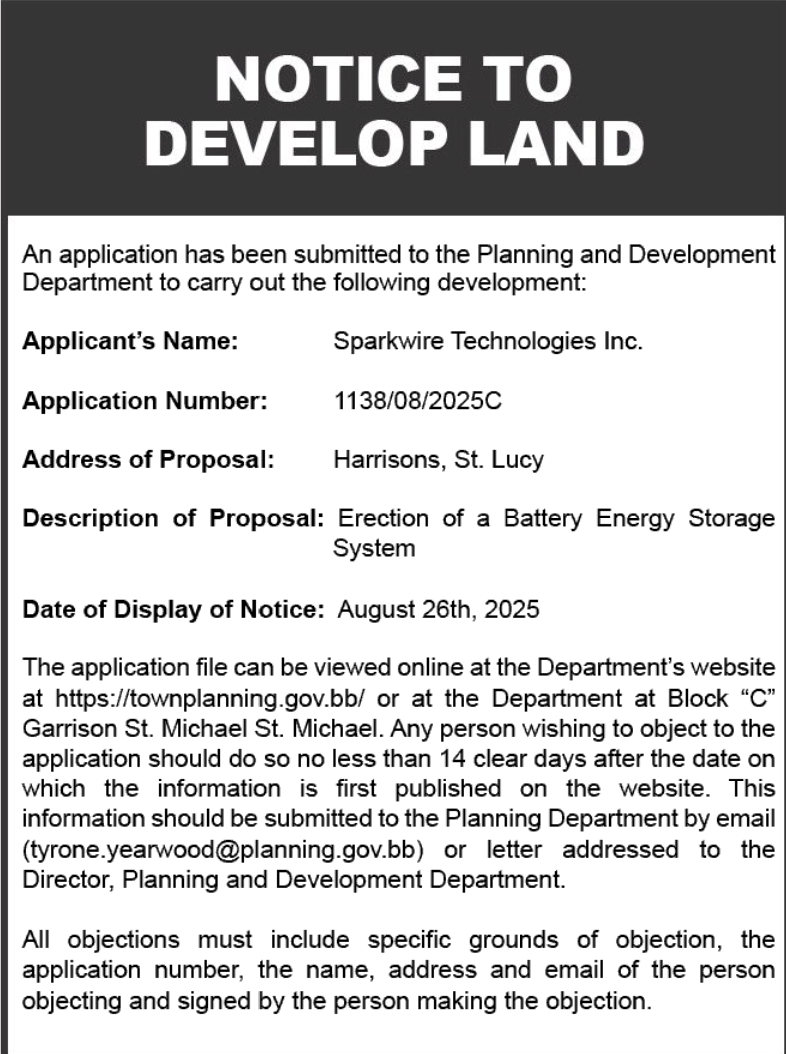
    Even an agrivoltaic project needs BESS. https://www.breretonsolarfarmbb.com/


  11. Thanks @enuff, hopefully we will see a stop to the other unsightly installations.

The blogmaster invites you to join the discussion.

Trending

Discover more from Barbados Underground

Subscribe now to keep reading and get access to the full archive.

Continue reading