Banner promoting anonymous crime reporting with a phone and contact number 1 800 TIPS (8477), featuring the Crime Stoppers logo and a QR code for submitting tips.

← Back

Your message to the BLOGMASTER was sent

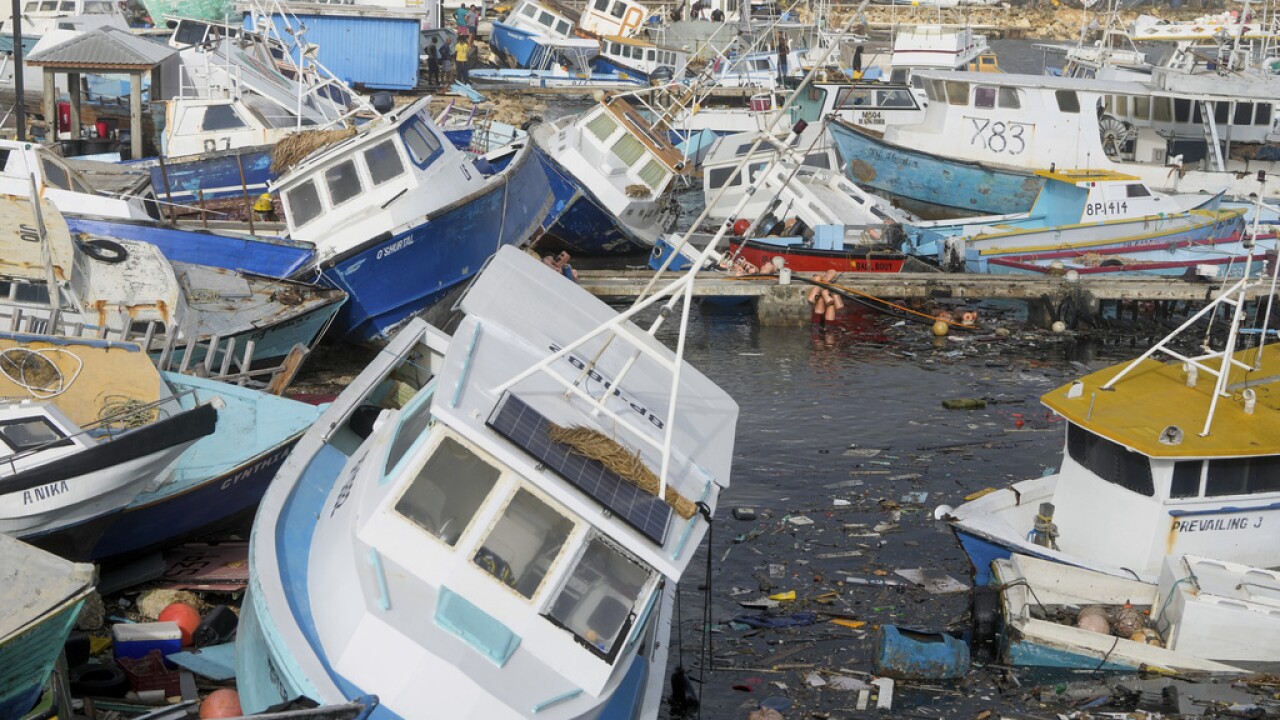
Although Hurricane Beryl skirted the south of Barbados yesterday, early damage assessment includes major damage incurred by the fisherfolk and related facilities.

Barbadians are inclined to be ‘mealy mouthed’ addressing the issues which contrast with the forthright comment from the blogmaster. It is well known a majority of the fishing boat fleet – many reported to have been destroyed or damaged yesterday were NOT insured.

One does not have to think too hard who will suffer the financial burden were government to bailout the fisherfolk who have delivered strident feedback to the Prime Minister when she toured yesterday. The blogmaster understands from a reliable source the principals at Port St Charles and Port Ferdinand offered safe harbour to the fisherfolk once they had insurance, however, only a handful were able to produce proof of insurance. 

On her first stop, Mottley met boat owners and other concerned fisherfolk who came to the complex on the Princess Alice Highway, The City, to salvage what they could from the vessels.
“The greatest damage is in coastal assets and coastal infrastructure. I am told by many of you [fisherfolk] that you have never seen these kinds of waves, this kind of force, come across this part of the island.
“But the most important thing is, we do not panic from here on in. You have life, that is the one thing I can’t give back to anybody,” Mottley said around 3:50 p.m., close to two hours after Barbados was given the all-clear.
Several senior Government officials, such as Minister of Home Affairs Wilfred Abrahams; Minister of the Environment and the Blue Economy Adrian Forde; Kerry Hinds, director of the Department of Emergency Management; Chief Fisheries Officer Shelly-Ann Cox, were gathered.
There was a persistent strong smell of diesel as the fisherfolk assessed the damage and attempted to remove fish stored on the boats. High sea swells continued to crash into the wave barrier, the ripple effect of which was boats hitting the dock.

Nation Newspaper – 2 July 2024

There is therefore merit to the following observation:

Should the Barbados taxpayer have to pay for any bailout for fisherfolk if one is being planned?

Why doesn’t the Fisheries Unit insist on insurance as a prerequisite for annual registration? Is this a case of the state failing to safeguard taxpayers?

Although it is fair to accept some fisherfolk may be suffering from money issues, many of them own two and three boats which were damaged or destroyed yesterday. The level of financial illiteracy and carelessness continually exercised by actors in civil society is unacceptable. The government as ‘guardian’ of the state has a responsibility to protect citizens and business players from themselves AND taxpayers.


Discover more from Barbados Underground

Subscribe to get the latest posts sent to your email.

379 responses to “Fisherfolk, insure your boats!”


  1. Grenville speaks.


  2. Thanking Grenville for that information for my son. It does not appear to be beyond our capacity to build resilient homes.


  3. So the minister has now said on the news that 90% of the fishing boats were not insured!


  4. Abrahams delivers damage report

    GOVERNMENT HAS REVEALED that 90 per cent of the fishing boats damaged or destroyed by Hurricane Beryl last week were not insured.

    In addition, more than 200 people in the hotel sector will be laid off as some properties will have to close for up to six weeks to effect repairs.

    Delivering a Ministerial Statement in the House of Assembly yesterday evening that lasted an hour, Minister of Home Affairs Wilfred Abrahams gave a breakdown of all the sectors that faced minimal to major damage, with the fishing industry, the West and South Coasts, as well as the housing stock most impacted.

    He said that in the five remaining months in the Atlantic hurricane season, he wanted Barbadians to “be prepared, stay prepared. We have a long way to go”.

    While Beryl brought minimal rainfall across the island, the stormforce winds wreaked havoc on the Bridgetown Port, Bridgetown Fisheries Complex (BFC), parts of the Barbados Defence Force (BDF) Coast Guard base, the housing stock, some hotel accommodations and beaches along the West and South Coasts.

    “ Beryl is the first to form so early in the Atlantic and . . . is a new phenomenon. Speaking to fishermen, they said this is the first in living memory they have seen such sea swells.

    “The fishing village livelihood was devastated by the horrendous damage to the Fisheries Complex. They face the daunting task of putting their lives back on track. As of July 5, a total of 209 boats were affected, directly impacting 560 persons. There were 200 boats that suffered some form of damage to its structure and nine were a total loss. Currently, the number of boats docked in the BFC is unclear, as [boats from] other landing sites also docked there during the passage of Beryl.

    “We are at the end of the fishing season, so landings would have decreased for [some], but it is . . . not yet clear how long it will take to get half of our fleet back into operation,” the minster said.

    He said there will be updates on the repairs or replacements of the vessels, with 108 iceboats topping the list, long liners at 32 and the rest comprising a total of 70.

    “We have been informed that in the statistics, what is most striking is that 90 per cent of the boats affected were uninsured. This has consequences for the Government,” Abrahams told parliamentary colleagues.

    He said debris clean-up at the Bridgetown Fisheries Complex was ongoing and reports were that as of Sunday, Hinds Transport, Crane & Equipment and Marinko Marine Ltd had hauled out 114 boats, placing them at five locations, with 13 travelling out on their own. Twentynine boats were scheduled to be lifted between Monday and yesterday.

    Measures

    He said the suite of measures announced by the Prime Minister last week was to assist the fishermen.

    “There [was] no loss of life and we received 261 reports of structural damage to homes from the Barbados Statistical Services on July 1, which included roofs, fallen trees, downed poles and so on. There are now housing rehabilitation and damage assessments, and needs analysis are ongoing as we clean up and rebuild.”

    The clean-up campaign was undertaken by the Sanitation Service Authority, Ministry of Transport and Works (MTW) and the BDF which removed debris after the storm, with MTW citing damage to Highway 7 and Oistins in Christ Church, and Speightstown, St Peter, with storm surges.

    “The Coast Guard base was also affected with structural damage due to intense storm surges. The BCGS Pelican and other small boats, piers and essential facilities were affected and some areas rendered unusable.

    “The Bridgetown Fishing Harbour had a third of its breakwater destroyed and the jetty in Oistins received substantial damage, with half of the privately-owned ice jetty being destroyed.”

    Abrahams said Barbados Port Inc reported negligible damage to the cargo terminals “while the storm surge significantly damaged the cruise terminals. Of the 66 business, 41 were impacted by water and debris. The taxi dispatch centre has been extensively damaged and has to be demolished”.

    The storm surge also resulted in the sinking of two pleasure vessels – the Jolly Roger and Dream Chaser.

    The minister stated that reports from the Barbados Hotel & Tourism Association and Intimate Hotels showed no damage to property but there was some inland damage.

    He said ten per cent of the hotel stock will have partial closure, another ten per cent will have full closure lasting one to six weeks, resulting in more than 200 people being laid off during that period.

    “In our assessment, almost all of the beaches on the West Coast are decimated. The damage to Paynes Bay Fish Market (in St James) and other private facilities, including hotels and restaurants, is still being assessed.”

    Abrahams also reported that the utility companies were not damaged and there were no issues at the Queen Elizabeth Hospital.

    Thirty-three Category 1 shelters were opened, with 443 people using the facilities.

    As for the sewage pipes that were broken underwater at the Worthing Beach, Christ Church, repairs were almost completed.

    The agricultural sector was also affected, with 35 acres of bananas destroyed and some damage to plantain and papaw crops.

    Abrahams expressed disgust at the behaviour of some people, who did not wait for the all-clear to be given after Beryl’s passage and were outside doing “doughnuts and wandering around”.

    “The Barbados Police Service said they did not encounter any issues before, during or after, but the only complaint they had was the disregard to stay indoors until the all-clear was given,” he said. (NS)

    Source: Nation

  5. William Skinner Avatar
    William Skinner

    We are unsurprised by the lukewarm response the Prime Minister in relation to resuscitating the fishing industry. The government simply does not have the money for such an undertaking. In our system of government straight talk is not expected. We are living in an essentially “borrow” economy.
    We note that after five years of going to the IMF, we are now hearing that we were never expected to meet the targets until 2035. We recall being severely criticized on BU and elsewhere, when some were told this fact. They believed that the great turn around of the economy was expected before the ink on the IMF loan was dried.
    Since the government does not have the money and will scarcely want to underwrite revitalizing the industry, we suspect it will be in the doldrums for several and years and will probably be no more developed than before when whatever fixes are made.
    In an economy such as ours with a high food bill, we must at some point admit that without modern agriculture and fishing industries, the next fifty years of economic development would be as stagnant as it is at present. To recognize this possibility , we only have to look at what underdevelopment of the past fifty years has put us today.
    Opposition grandstanding and political public relations by the government cannot solve our problems. We cannot be seriously interested in our children eating better and have the two main food industries underperforming or not performing at all.
    Both COVID and the destruction of the fishing industry, are exposing our lack of creative and progressive economic vision. We are doing the same things, even after crises , and expect different results .
    Our universities , throughout the region , seem to be producing people who simply are incapable of presenting alternative methods of real economic development . On the current collective trajectory, we seem very comfortable in being where we are today in fifty years as we feel today when we reflect on the last fifty.


  6. @William

    Was it reported it will cost 300 million for St. Vincent to rebuild its fishing industry?

    In the case of Barbados there is more reason to press on with expanding tourism.


  7. The benefits of being at sea during a hurricane!!

  8. William Skinner Avatar
    William Skinner

    @ David
    As we mentioned on BU earlier , in our case, quite a few hundred million over 3-5 years. We don’t figure it will be any substantial difference in St.Vincent.
    Tourism gives with one hand and takes twice as much more with the other.

  9. NorthernObserver Avatar
    NorthernObserver

    Amidst the doom and gloom, the fishing industry is a revenue business, it will recover.
    90% w/o insurance= 90% w/o official loans?
    The same way it was built before, it will be built again. And getting loans for a revenue generating industry is easier than money for providing non revenue services or infrastructure.


  10. @ Northern

    These loans will have to be state loans cause I would bet 99% do not keep financials and hence have nothing to take to the bank for proof of income.


  11. LOL @ NO
    …getting loans for a revenue generating industry is easier than money for providing non revenue services or infrastructure.
    ~~~~~~~~~~~~~~~~~~~~~~~~~~
    One of the rare occasions on which you are wrong…. at least from the perspective of the average boat owner….

    Admittedly,
    For SOME Bajans of a special hue,
    this is NOT a known issue.

    But for MOST of us…
    Firstly, it will not be ‘easier’ if the owners do not possess corresponding assets as security for any new loans. So if your property secured an original loan (like a mortgage, or even the sunk boat) – or if your house is of negligible value …
    Goose cooked… no matter how attractive your business plan. (which then coincidentally turns up in another initiative)

    Secondly, Banks in Brassbados are very reluctant to lend money to Bajans for productive enterprises – since they all KNOW that between:
    -Other Bajans NOT supporting the business
    -Public officials going overboard to frustrate it
    -Politicians looking for handouts
    -Plain wufflessness of the part of the victims of mental slavery,
    …most such enterprises WILL fail.

    If however the loan is needed for CONSUMER items such as a fancy new car, a cruise, or some home renovations needed to bypass the ‘Joneses’ next door, then just sign on the dotted line…


  12. I’ll tell you what I think. I don’t know how it would be/could be/ can be done. Perhaps you have answers.

    It would appear that the fishing industry is profitable. It is clear that folks try to maximize profits by skimping on insurance. It is also clear that some will need help going forward. Instead of relying on the government, it would be good if private citizens were able to invest in some of these boats.

    But what is the machinery for doing so? How does one get back a return on their money? How do you know you can trust your ‘business partner’? How do you vet him or her? How do you account for daily catches and money made? Some of the savings that are locked up in banks could be put to use here, but some are afraid of the too smart Bajan.

    Needed, a researcher and honest guy.


  13. The government promises to assist but the only way for the industry to attract private /investors – create equity opportunity- is to form a cooperative or legal entity. This would be a revolutionary step which the blogmaster is unconvinced will become a reality given current state.

  14. William Skinner Avatar
    William Skinner

    @ David
    We should check what successful businessman , Andrew Bynoe has said in a letter in the press a day or two ago. His views are similar to yours.
    We just can’t seem to go forward , the mental remnants of slavery , are keeping us from any productive or progressive thinking.
    Here we have the opportunity to build a modern fishing industry and we can’t see any real enthusiasm from the government or private sector. This plantation economy is going nowhere, it seems.


  15. @William

    The thinking is that the fishing sector doesn’t add significantly to GDP, therefore there is no justification for mobilizing significant resources behind the industry.

  16. William Skinner Avatar
    William Skinner

    @ David
    True, but can’t we ever look at 25/50 years down the road and not how many votes we going to get in Christ Church South in the next election ? We are so frigging backward -do we Bajans know that a high quantity of fish used in the tourist industry is imported ?
    Do we know the millions of dollars that will be taken out of the economy because of the current state of the industry ?
    Do we really know the sustainable benefits that will accrue from building a new modern fishing industry over the next 3-5 years ?
    Don’t be surprised if the minority boys , who pretend they have no money, come forward and tek um over completely.


  17. @William

    Feeling your pain, it is one shared.

    To be a today’s politician is analogous to a today’s CEO of a large company. There is the long term interest of the company that must be managed while many CEO’s have relatively short tenure / contracts. Always a challenge to reconcile the two interests.


  18. If it were not ever profitable, people would not be owning two boats worth $600,000. Just like if minibuses and zrs weren’t profitable, they would be off the road. And insurance for them is very high, due to their driving habits.

    I don’t know when last I have seen a minibus packed to capacity like before COVID. And yet they are still running.

  19. NorthernObserver Avatar
    NorthernObserver

    @JohnA & BT
    The negativity aside, how the rambam did they get the boats in the first place?
    You maybe unaware, people work together and have done so for donkeys years.
    Fish is currency.
    One of my biggest surprises when I got involved in “estates” (not plantations) is how many had a connection to a lil fish. A doctor who had been seeing a family for years, no book entries, “he does bring me some fish”. Another, in fact more than a few, owned piece of a boat. And it was frequently a very loosy goosy deal.


  20. @ Northern

    Listen fishing boats have good money in it. They have many white business men in collar and tie who have boats too but theirs were insured.

    Now I am not making excuses for the fishermen but many of them would not be able to provide a P&L or balance sheet if they had to. That business is a cash business and many see it as cash out for diesel and cash in for sales. So in other words what they sell less what they spend they view as PROFIT. This is not profit it is simply a surplus of cash on expenses or gross income.

    Net profit is what’s left AFTER ALL EXPENSES INCLUDING INSURANCE AND DEPRECIATION. Now has any thought in the cash drop planned, to meet with these guys and give them some basic accounting lessons? All this, along with structured state secured loans SHOULD be the plan. So proof of insurance would be a must. There is also nothing wrong with fisheries and the relevant minister getting involved with getting these guys insurance either. In other words structure this as a business going forward, so that 20 years from now we have a structured fishing sector that functions and protects itself. Don’t tell me nonesence either bout these is poor people. A man with 3 paid for iceboats worth over 1 million dollars aint no pauper!


  21. You could give them all the lessons you like, unless they have a daughter or son who will keep the books, there will be no books.


  22. @ Donna

    Well then they need to pay a small book keeper to do their monthly entries. Remember no books no money for expansion from a bank. Dodging the tax man will only benefit them to a point. Once you want to make a business that can borrow and grow then you shooting yourself in the foot if you don’t get your act together. They are so many legally allowable expenses on boats etc that they would be surprised how little tax they would pay. Plus corporation tax for them would only be around 5% of NET profit after expenses. People think by operating under the table they robbing government but the only body they really robbing is themselves from growth. You just need to keep records or pay someone to do it for you. Plus remember the same insurance wunna dont want to pay is a tax allowable expense yearly as well!

  23. NorthernObserver Avatar
    NorthernObserver

    @JohnA
    All you are saying is many of the fisherfolk are like the shop keepers 😁
    And a whole lot of other small business people.
    Same here in NA. I used to have sub-contractors arrive with large garbage bags full of paper. 9 of 10 times, they hadn’t been remitting VAT and the relevant tax authorities were up their ass. Occasionally it would be health and safety, or failing to remit contributions on unemployment insurance or pension.
    For the most part, I and the various trade unions had a cold relationship, but I will say one positive, is the unions did help several of their members in this way.
    Another issue, I expect is potentially moreso in Barbados, is people don’t like others ‘knowing their business’. Hiring a bookkeeper, means someone else knows your business, maybe better than you. Hence I suspect why @Donna recommended a relative.


  24. @ Northern

    It’s true that Bajans don’t trust their own but these guys need someone who knows things like depreciation allowances, difference between an asset or an expense and other basic things like that.

    Listen we one door shop keepers had different envelopes for different people. Wibisco had one, the drink truck one and so on. Well what drop through the floor boards was for de owner. LOL

    It boils down to you could be a good fisherman but poor business owner all at the same time.

  25. William Skinner Avatar
    William Skinner

    FISHING FALLOUT
    BERYL’S BLOW TO FISHING FUEL INFLATION, WARNS ECONOMIST
    by Sheria Brathwaite
    The devastation wrought by Hurricane Beryl on Barbados’ fishing fleet could cause inflation to spiral among other significant economic challenges, according to leading economist Professor Justin Robinson.
    Professor Robinson, Pro Vice Chancellor for Undergraduate Studies at the University of the West Indies, warned that the destruction of fishing boats at the Bridgetown Fisheries Complex could have far-reaching consequences despite the industry’s relatively small contribution to the island’s GDP.
    “If there was a significant reduction in fish, it would have a negative impact on GDP and as expected, there may be a shortage of fish and if the prices were to go up, given the importance of fish in the diet of Barbadians, it certainly could be a source of inflation,” Professor Robinson said.
    He added that the potential shortage of freshfish could also affect the tourism industry, particularly during the Crop Over season when visitor numbers typically surge.
    Home Affairs Minister Wilfred Abrahams reported to Parliament that as of last Friday, 209 boats were damaged, with 90 per cent uninsured. Some boat owners estimated repair costs could reach up to $50 000 per vessel.
    Professor Robinson highlighted the personal impact on fisherfolk, many of whom lack insurance coverage or national insurance contributions. “It’s a significant impact on those persons and their families, there could almost be an impact along the lines of what some people experience during [heightened periods of COVID-19],” he said.
    The economist predicted that recovery could take at least six months, depending on access to financing and supply chain issues for boat replacement and equipment.
    But Professor Robinson also suggested that the crisis could reshape the industry. “There is some potential for ownership of the sector to reshape if some players take advantage of this gap. Are we gonna see new players come into this, people with capital available bringing in boats and entering into the sector?”
    While acknowledging the relatively small share of fishing in the overall economy, Professor Robinson emphasised its importance to Barbadian diet and culture. He warned that any significant reduction in output or increase in imports “would have a negative impact on GDP and maybe more significant from a macro viewpoint, it could have an inflationary impact”.
    The economist called for state intervention to address both immediate loss of income and long-term fleet replacement challenges faced by affected fisherfolk.
    He said: “If there’s any intervention from the State [it must be taken into consideration that] this loss of income could be for a significant period of time. [Again,] while it’s (the fishing industry) is not necessarily a huge part of the economy, it’s quite a significant impact on a chunk of our population which depends on this for their livelihood and they are facing a current loss of income and the financial challenges of replacing their feet; and in the absence of insurance and NISSS (Barbados National Insurance and Social Security Service) coverage, I could see that this can be quite a major challenge for the current players. Some persons will have access to the resources to get through this but a significant chunk doesn’t. We can totally expect some call on the State to provide some support in terms of the two problems, the loss of income and fleet replacement.”
    Elaborating on the length of time it would take for the industry to recover, Professor Robinson said: “I think it would depend particularly on access to financing, how quickly players can get access to financing to replace their fleet and then the supply chain — how long it takes to order a boat, get a boat fitted and equipped. I’m thinking that this could easily bearound six months at least.”
    The economist said that despite the losses there could be room for new players to enter the industry.
    “There is some potential for ownership of the sector to reshape if some players take advantage of this gap. Are we gonna see new players come into this, people with capital available bringing in boats and entering into the sector? There is some potential for some reshaping of ownership in the sector.” sheriabrathwaite@barbadostoday.bb


  26. Before Somalians turned to pirates they were great fishermen who trawled their seas and captured their fish in an environmentally and sustainable manner.

    One day foreign fishermen from Europe, primarily, and then other foreigners decided that they would fish in Somalia’s seas to capture horrendous amount of fish in as little time possible.

    No longer able to make a living as fisherman, the Somalian fisherman decided that they would make a living from hijacking foreign vessels for money. They became wealthy pirates and good luck to them all.

    I said that storm Beryl would act as a stress test for Barbados infrastructure and their economy. Was I right; or was I right? We look at the destruction of our fishing fleet. However, how many Bajans are aware that the fish stock numbers from within our territorial waters are extremely low. The primary cause of this is due to successive Barbados governments and the cruise ship industry using our high seas as open sewers. However the biggest problem facing our fishermen comes from foreign vessels illegally fishing within our waters.

    The Chinese are probably the worse. Our ignorant governments over the years are acutely aware of this issue and are incapable of policing our territory. Drone technology has been with us for a long time. Perhaps Mia could start patrolling our seas with drones. I mean, how difficult is that?

    The government official who talked about modernising our fishing fleet and the fishing industry is clueless. The Chinese perhaps have the most efficient and modern international fleet of shipping vessels. As a result they are fishing to such an extent that it is quite possible that the fish population could be decimated.

    This is the problem with our people we only have the mental capacity to see a few yards ahead when we she should be looking out into the horizon.

    https://insightcrime.org/wp-content/uploads/2022/09/SSRN-IUU-Fishing-Crimes-in-Latin-America-and-the-Caribbean-American-university-InSight-Crime-2022.pdf


  27. Oh, it’s the Chinese is it? I thought it was the Japanese. Or is it both?

    Good luck to the much maligned Somali pirates, I suppose.

    ” Do fuh do en nuh obeah.”


  28. @William

    It would have been useful for the fisherfolk to have had our talking heads on the economy support the sector over the years.

  29. William Skinner Avatar
    William Skinner

    @ David
    There is a lot that could have been done. The question is what we are going to do now. From what we have observed , it looks like business at usual. Let’s hope the rest of the season is not too destructive.


  30. Where is the evidence that suggests “the biggest problem facing our fishermen comes from foreign vessels illegally fishing within our waters,” when:

    (a). BDF has the Coast Guard, while BPS has a Marine Unit, both of which patrol the island’s territorial sea boundaries.

    For years RBPF/BPS and BDF had ‘drone technology,’ which, in the case of BPS, are operated by specially trained police officers, to assist the fight against crime.

    (b). ‘Day boats’ usually fish within the boundaries of this island’s territorial waters, while ‘ice boat’ fishermen, who go out fishing for at least one week and bring in the bulk of fish, ply their trade beyond the territorial waters, even as far as Grenada or Tobago.

    Remember, during the period 1992–2002, there was at least one report of Barbadian fishermen being arrested, charged and fined for fishing illegally off Tobago’s waters.
    On January 15th 2003, during a lapse in the negotiations which had re-started in March 2002, Barbadian fishermen were again arrested and fined.


  31. ” Flying fish are commercially fished in Japan, Vietnam, and China by gillnetting, and in Indonesia and India by dip netting. Often in Japanese cuisine, the fish is preserved by drying to be used as fish stock for dashi broth. “


  32. @William

    If the destruction of a significant number of the fishing fleet does not trigger an overhaul read strategy approach to the industry, nothing will. Then again, we thought the last pandemic would have accelerated change but has it?


  33. How many of you have gone fishing for 6 months or more on a day boat ?


  34. Good news ?


  35. Insurance companies seem to be saying insurance is available between 2,000 and 4,000 but there are conditions to accept in the event of a claim which is standard.

    Boat insurance available, owners told

    Head of the General Insurance Association of Barbados (GIAB) Randy Graham has reassured members of the fishing industry that insurance coverage for marine vessels remains available.

    Graham said going forward, coverage must go hand in hand with adherence to risk mitigation strategies to protect boats from future storms.

    “The insurance companies are available for marine vessels. If boats need insurance, they will get it,” Graham stated. In an earlier interview he noted that the cost of boat insurance ranges from about $2 000 to $4 000 per year.

    “What the insurance companies will tell them is that hauling up the vessel is the best way to operate and get it into a safe place if something is coming. If you don’t have that, then we will tell them that the best option is to move it into a safe harbour,” he added.

    Graham highlighted the lack of safe harbours in Barbados. “Some countries have safe harbours, but we do not have safe harbours in Barbados. There is no water in the middle of the island. If you don’t have haul-up facilities and you don’t have safe harbours, then we would say to them to move the boat to another country that is not in the hurricane path,” he said.

    He stressed that insurance companies were not looking to restrict coverage but to encourage boat owners to take proactive measures.

    “It is not that we will restrict the cover, but we will say to them that those are the risk mitigations that they should follow if something were to happen. What happened in Barbados was unfortunate because everybody went to a place which got damaged and then you’ve got a lot of boats being damaged.”

    Graham underscored the insurance industry’s commitment to protecting the country and supporting vital sectors like the fishing industry. “The insurance companies want to protect the country and we want to ensure that sectors such as the fishing industry have the capability to recover quickly,” the GIAB president said.

    However, during the salvage efforts by the Coast Guard at the Bridgetown Fish Market yesterday, boat owners overseeing the recovery of their sunken vessels, were not so upbeat about the prospect of insuring their vessels. Some pointed out that insurance premiums could go as high as $15 000 per year.

    Alfonso Barrow, a boat captain, expressed frustration over the prohibitive costs.

    “What I have found out is that insurance is very expensive, too expensive and that is one of the reasons that people do not want to insure their boats. The amount of money that you have to pay per year and if you multiply that by three or four boats, you can actually buy another boat. At one time I know it was as much as $10 000 and that figure has to have gone up significantly by now,” he said.

    Cliviston Harris echoed similar sentiments, highlighting the financial burden. He said: “Insurance is not so easy to get. When you insure a boat like that you have to look for $15 000 every year. It is not easy; it is just too expensive. The next thing is that the insurance companies don’t pay for disasters, so what is the point of insuring your boat?”

    Jerome Holder also shared his experience with rising premiums.

    “Every year we go and insure the boats and the premiums keep going up even if you make no claims. There are some boats paying as much as $13 000 per year, some as much as $9 000. So it is a very expensive undertaking. You have the boats to run and you have this very high insurance bill hanging over your head.” (CLM)

    Source: Nation


  36. two words to research
    Available
    Affordable
    Cist mentioned are
    2K-4K
    10K
    13K
    9K
    15K


  37. Insurance companies have declared insurance is available for boats.

    It is known the vast majority of the fisherfolk boat fleet was uninsured, EVEN THOSE WHO OWNED MORE THAN ONE AND CAN AFFORD to PAY.

    Barbados has been spared the kind of surf activity witnessed with Hurricane Beryl, one can assume this lulled that sector into some complacency. The blogmaster will take the opportunity to observe that many homeowners are operating with the same level of complacency by not insuring or underinsuring their homes. Every year at this time we have to listen to pleas from insurance officials.

    Many avoid paying insurance and all of us know it is to pad their profit margin. Does the industry need help? Of course it does but we have to be balanced in our commentary.


  38. The link below clearly highlights the vulnerability of these small Caribbean island states. Barbados was praised to the hilt within the region when it became a republic. However, Barbados is merely one or two hurricanes away from been dealt a blow equally as severe as their neighbours whom were hit severely by Beryl.

    Is there anyone out there who still believes that we can maintain a tourism industry with these messages from God hurricanes. It is highly unlikely that 80,000 foreigners would be attracted to migrate to a region which is a hurricane magnet. When the big one comes will our proud republic run to the mother country seeking for assistance.

    I am well aware that some on BU will take umbrage with my post. However, to them I would say Barbados is in a perilous position. Let us hope that this government has read the tea leaves and that it has a contingency plan in place when the shit hits the fan.

    https://www.theguardian.com/world/article/2024/jul/18/caribbean-leaders-marshall-plan-rebuild-hurricane-beryl


  39. Check storm-readiness!

    Call for national assessment of country’s structural resilience

    CHAIRMAN OF THE Barbados Private Sector Association (BPSA) Trisha Tannis is calling for a comprehensive national assessment of this country’s infrastructure resilience in the aftermath of Hurricane Beryl.

    Speaking yesterday at the Lloyd Erskine Sandiford Centre during the launch of a damage and loss assessment to be conducted over the next four weeks by the United Nations Economic Commission for Latin America and the Caribbean (ECLAC), she emphasised the urgency of evaluating the sturdiness of both coastal and inland infrastructure, and the need for proactive measures in light of increasingly severe weather events.

    “Most of our challenges occurred, as you have heard, on the coastal shores, particularly our north and south-west shores. What comes to mind, given the projections for not just the frequency of hurricanes but the strength of the anticipated hurricanes, is the issue of infrastructural resilience, both inland and on the coast.

    Critical concern

    “We may not find ourselves so fortunate and, therefore, looking at our inland infrastructure is also a critical concern to the private sector,” Tannis said.

    Beryl, despite only brushing the island on July 1, managed to wreak havoc on the fishing sector, with two-thirds of it being destroyed. This has sparked a broader conversation about the preparedness of Barbados to withstand future hurricanes.

    “What is critical for us is a re-evaluation as to how sturdy all of our physical infrastructure is against Category 4s and Category 5s. To do a national assessment, or to encourage and partner with a national assessment, of really assessing how sturdy both domestic and corporate, Government and hurricane shelters are against a Category 4 fight, because this has not been tested in well over maybe 50 years. Therefore, we may assume a lot that may not be true,” she added.

    Tannis spoke of collaboration with ECLAC to leverage their expertise and resources in strengthening the resilience of Barbados’ infrastructure. She said the damage caused by Hurricane Beryl’s outer bands serves as a stark Tannis: Renewable energy framework a concern reminder of the potential devastation that could occur if a hurricane were to make a direct hit on the island.

    “It is not something that we’re taking lightly. One of the things that has to come out this week is how do we partner; how do we take advantage of the resources that ECLAC has put to bear on strengthening, reassessing first our physical infrastructure against Category 4 or 5 events,” she said.

    The BPSA head also said the hurricane brought to light concerns about the sustainability of Barbados’ renewable energy infrastructure, particularly photovoltaic (PV) panels.

    With Government and private sector investing heavily in renewable energy, the susceptibility of PV panels to hurricane damage could undermine these efforts, she stressed.

    Tannis said her call for a national assessment was not just about evaluating the current state of infrastructure but also about planning for improvements. She suggested that the findings could guide policy and investment decisions.

    (CLM)


  40. Better insurance strategies’ a must for private sector

    WITH A WORRYING START to what is predicted to be an above average hurricane season, Trisha Tannis, chairman of the Barbados Private Sector Association (BPSA), is concerned about insurance coverage in Barbados.

    Speaking yesterday at the launch of a damage and loss assessment spearheaded by the United Nations Economic Commission for Latin America and the Caribbean (ECLAC), she said there was a critical need for improved insurance strategies, especially for the informal sector.

    “I had a chat with a fisherman and they were very proud to tell me that they were insured. When I asked about the issue of business interruption, however, they had no business interruption insurance,” Tannis stated.

    She noted that many individuals, particularly those in the informal sector, were content with having property damage insurance without recognising the importance of business interruption insurance. This gap in coverage left many vulnerable to prolonged economic hardship following disasters, she added.

    “They were satisfied to only have property damage insurance, and they were in the few, based on reports. The issue of business interruption, therefore, particularly for what we would consider the informal sector, is something that we have to pay very close attention to,” the BPSA head stated.

    Tannis warned that primary insurance costs were likely to rise which could further marginalise those unable to afford comprehensive coverage.

    Insurance rates

    “The insurance industry is anticipating a very buoyant 2024. They’re anticipating a return to growth after the pandemic and the hits that it took. Now, when the global insurance industry anticipates being buoyant, you have to look at the primary insurers, and you can anticipate that the costs and rates of insurance are going to escalate,” she said.

    She proposed that Government consider a model like Australia’s that would provide a safety net for those unable to afford market rates, particularly in the informal sector.

    “What I want to put before this forum for consideration, essentially, is institutional strengthening for the Barbados Government to do something similar to what Australia had to do, and that was to create a secondary mechanism for cyclones. Reinsurers, particularly focused on the informal sector, as almost a safety net as it were, insurance-wise, for persons who may not be able to afford market rates, because the resilience has to be just beyond physical,” she said.

    Tannis stressed the importance of restorative measures, not just physical reconstruction but also economic recovery, which was crucial for the sustainability of businesses in the aftermath of natural disasters.

    “It has to be restorative, particularly for business interruption, which a lot of our informal sector pay very little attention to.”

    During the session held at the Lloyd Erskine Sandiford Centre, it was disclosed that the ECLAC-led assessment over the next four weeks will be critical in understanding the full extent of the damage, and identifying the necessary steps to enhance resilience and recovery for all sectors of Barbadian society. (CLM)

    Source: Nation


  41. Mandatory insurance ‘on the cards’

    by CARLOS ATWELL

    carlosatwell@nationnews. com

    LEGISLATION IS IN THE WORKS to make insurance for fishing boats mandatory.

    Chief Fisheries Officer Dr Shelly-Ann Cox said following the unprecedented destruction caused by the passage of Hurricane Beryl on July 1, Government was not taking chances.

    “New draft legislation was approved by Cabinet, so we now have to go back to Cabinet and then to Parliament. But we’re looking at the timeline of this year, where we’ll mandate third-party liability insurance for vessels. So it’s something that we are actively pursuing,” she told the DAILY NATION yesterday.

    Cox said they were also looking into parametric insurance and negotiating with companies to determine what would be an affordable premium. She added that any boat owner wishing to get comprehensive insurance would be free to do so but they wanted to at least ensure every boat had third party.

    She acknowledged that some fisherfolk had bad experiences with insurance in the past, which was why they had to work out something reasonable, especially if Barbados was to meet its international obligations.

    “Persons have had issues with the claims process in the past. So that would have discouraged them from signing up for insurance and then self-insuring based on their savings that they will put aside for boat repairs, or if anything happened to the boat.

    “However, this kind of intervention took guidance from a lot of the International Maritime Organisation standards and guidelines. We want to make sure that we implement certain standards that we’re signing on to. That was really the premise from which we went about trying to integrate that into the new legislation. But knowing that, we still have to do a bit of groundwork before we can implement that,” she said.

    Benevolent fund

    In the meantime, Government has established several ways for boat owners and fishermen to recoup some of their losses, such as a benevolent fund, a 30-year revolving fund and a grant of up to 25 per cent of the cost of any new boat or repair, which was announced by Prime Minister Mia Amor Mottley. However, some fisherfolk said this grant was insufficient given the huge costs incurred by the loss of their vessels.

    “I think there was something the Prime Minister was talking about offering to the fishermen to get the boat repaired, but I know there’s some kind of issue with it, saying that we wouldn’t be able to afford that. We still haven’t received clear guidance on that . . . . We have to wait till everything is firmed up in terms of the details on how it would be dispersed, what’s the eligibility criteria and so on,” Cox said.

    In terms of the ongoing salvage operations at the Bridgetown Fisheries Complex, the Chief Fisheries Officer said 214 boats had been lifted from the depths, three were unsalvageable while three large boats, each more than 50 feet long, were waiting to be extracted.

    “I think we’ve recovered most of the boats thus far. One long liner has already gone out, which was reported in the press, and the owner caught 11 tunas on his return trip. Another boat, one of the first boats to get hauled out, called It’s Mine, was extracted July 2 and is now going back into the water on August 12.

    “I think it’s still a good sign of resilience to see that boat owners are still actively working to get back out there fishing. The long line season is still every month from January to December so it’s in our best interest to get back out the active long liners so that we can return to exporting fish to the United States and getting some foreign exchange earnings,” she said, adding she hoped to have at least ten active long liners back up and running by month end.

    As for the overall costs to the industry, Cox said it was a complex issue as it was more than the damage to boats.

    “We still have to take into account the infrastructure damage, but we have been doing some estimates and the United Nations agency ECLAC (Economic Commission for Latin America and the Caribbean) is finalising the damage assessment. I don’t know what the final figures would be but it will be in the millions [when you figure in damage] to the jetties, the breakwater as well as the fuel pumps.”

    Bounce back

    She praised the “optimism and resiliency” of Barbadian fisherfolk, saying “they’re the type of people that bounce back quickly after significant impacts”.

    “The sector still looks positive, and the fact is that we were trying before to build out the development of the sector a bit ambitiously.

    So we were already looking to integrate a lot of a lot of things in terms of standards, even for vessels and the regulations and legislation to support that. So I think now that there is this opportunity to raise the awareness of the country to the importance of the sector and to what is required to make it reach its potential,” she said.

    The DAILY NATION also sought to get updates on the sunken party vessels Dream Chaser and Jolly Roger, the latter of which sank in the Bridgetown Port. However, it appears to still be a wait-and-see game.

    Dream Chaser’s management said they were “waiting on the process” to complete and would prefer not to say anything more as yet. When contacted, Barbados Port Inc’s divisional manager business development & strategy Jane Brome said: “I’m sorry but we don’t have an update just yet. We are mindful of the media interest and will provide one when we do.”

    Source: Nation


  42. You cannot make this up.

    Boat owners divided over insurance

    By Carlos Atwell carlosatwell@nationnews.com

    Some boat owners are not in support of any move to make insurance mandatory.

    In fact, they said the measure would cause people to leave their boats on land permanently and exit the industry.

    On Wednesday, Chief Fisheries Officer Dr Shelly-Ann Cox revealed a plan by Government to make third-party insurance mandatory for all boats in keeping with Barbados’ international obligations.

    However, this was not welcome news to some boat owners.

    Yesterday, the Weekend Nation

    spoke to fisherfolk at the Bridgetown Fisheries market along Princess Alice Highway as well as the temporary boatyards along Prescod Boulevard, Brighton and Wharf Road, near the helipad – all in St Michael.

    Insure crews as well

    “I think it’s wrong to make it mandatory. You shouldn’t have to look for Government to fix your boat, you should have the money saved,” said boat captain/boat owner Percy Harris.

    He explained some fishermen saved their money rather than poured it into insurance, which could run into the tens of thousands a year.

    “If you put the money one side instead of paying insurance, you would gain better because you would have access to the money faster. Insurance has to make checks and then they pay you less than what you would have if you had saved. I know people with insurance who ain’t get no money after their boats were damaged,” he said.

    Clinton Wiltshire said the crew of boats should be insured as well, adding there were many negatives which had to be addressed.

    “When you get a problem and have to be towed back to shore, it is the fishermen who foot that bill and that’s not right. Plus, many of these boats are ‘dead’ and just look pretty with a new coat of paint but there’s no thorough inspection. They don’t even have proper safety equipment. We should have dinghies in every boat. They talking about insurance but insurance must be more reasonable; insurance companies don’t like to pay anyway,” he said.

    A boat owner who did not want to be named said the move was a bad one and would result in pushing people out of the industry.

    “Many can’t afford that, only the rich boys will be able to manoeuvre. Right now my boat out by the Coast Guard (Brighton) and there’s no electricity or water so I can’t even get my boat fix. I don’t know if I would survive mandatory insurance,” he said.

    An irate boat owner said he did not want to hear anything about insurance, adding: “I would sell my boat first!”

    “Even with comprehensive, you get so much problems, but they want to force you to get third party? I would done with this industry first – tell who want to make insurance mandatory to get a boat and do it,” he said.

    Process claims quickly

    Another boat owner predicted a mass exodus should mandatory insurance become a reality.

    “I got two boats and I don’t plan on paying no insurance. I can save my money and repair my own boats. I don’t want that and a lot of people will just done away with boats. You asking people to pay thousands out of their profits to pay insurance? It ain’t often you get an accident with a boat and then if it is under the deductible you still have to pay out of pocket so why bother with insurance? It makes no sense,” he said.

    A fisherman said insurance takes a long time to pay and the investigators look for ways to void the policy while another fisherman/boat owner said they go through the third degree when a claim is made. However, he said it could be a good thing.

    “Mandatory insurance could work once claims are processed quickly and you get money. My boat is insured because we got a loan from the bank to get it. This is our first claim,” he said.

    A female boat owner with two boats said she had no issue with mandatory insurance.

    “I agree with it because we are facing a lot of drama right now. We don’t have the money to repair the boats so we need help. Government made a lot of promises but we haven’t seen any money yet, I don’t know what is going on. Most times, insurance companies don’t want to insure your boats, only if it’s through a bank loan,” she said.

    Source: Nation


  43. Will this mandatory insurance be run by different types of administrators than those who run the mandatory NISSS, FTC, Sewerage taxes, Electric self insurance fund etc????

    It is not difficult to understand the SKEPTICISM of fishermen who will now be required to hand large sums of money over to yet another government splurge fund – only to hear sad stories when the time comes tom make claims.

    What government needs to do is to DEMONSTRATE a minimum level of competence, and especially ACCOUNTABILITY- before rushing into Parliament with more mandatory shiite laws.

    Fishermen SHOULD insure their equipment (and health and lives), but should do so because it makes good business sense. Not because government has been left yet again looking like incompetents jokers….and HAVE to do something quickly…


  44. @Bush Tea

    We live in a world where to be skeptical has become the norm. The question you need to answer based on your observation, does the average fisherman have the wherewithal to self finance?


  45. …does the average fisherman have the wherewithal to self finance?
    ~~~~~~~~~~~~~~~~~
    They seem to have done pretty well so far – except for Beryl.
    Which government run entity has done well – even before Beryl?

    No question that insurance is an excellent step. BUT first, we need to overcome the national epidemic of incompetence and lack of accountability so that citizens can have CONFIDENCE that good ideas will stand a chance of success.

    Did Bushie just read that a senior minister personally negotiated the sale of a Bridgetown property to be used as a police station?
    …for an alleged $10 million?
    What was the process?
    How did it improve on the process used for the Chinese Steal Houses?
    Why is everything about the process NOT made public info?

    …of course, since the police DO NEED facilities, you would want to suggest that we wait and see how THIS ONE turns out…

    What a place!!


  46. @Bush Tea

    You cannot justify your argument by including the word ‘except’ because this is the reason we are having the discussion about boats not covered. The reality is that a majority of the fisherfolk are unable to self finance in the event of a significant disaster.

The blogmaster invites you to join the discussion.

Trending

Discover more from Barbados Underground

Subscribe now to keep reading and get access to the full archive.

Continue reading