← Back

Your message to the BLOGMASTER was sent

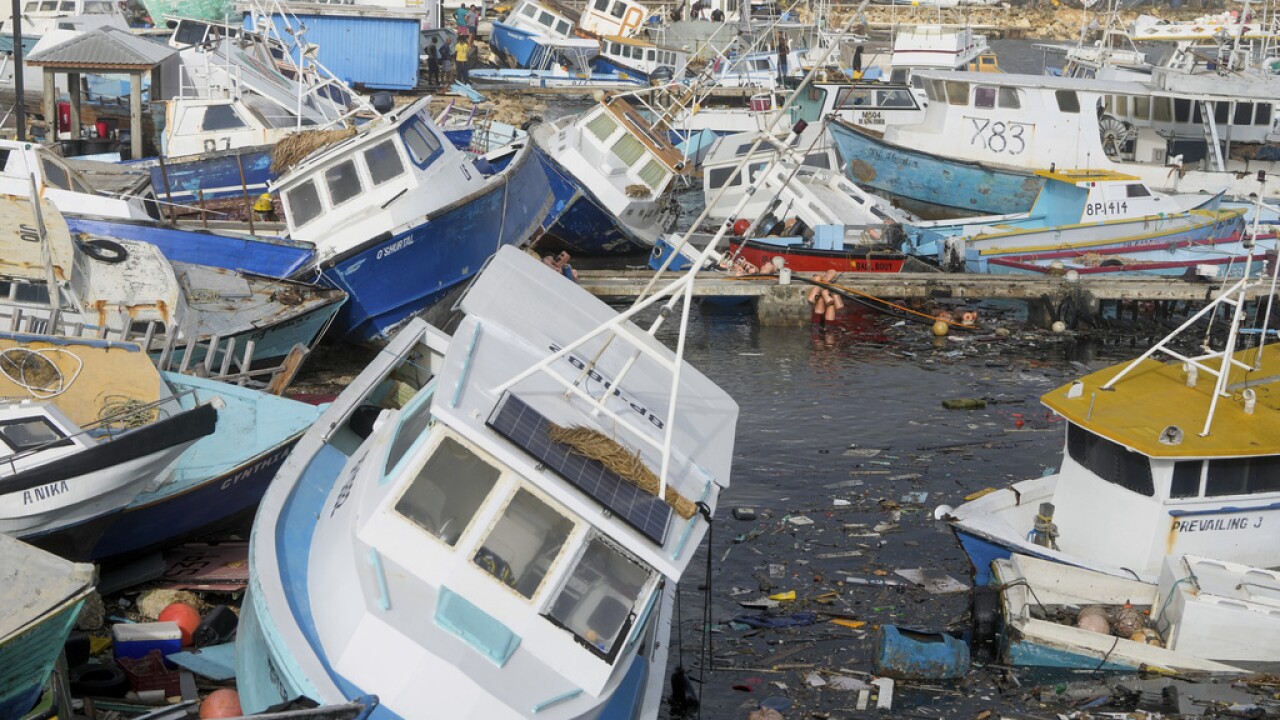
Although Hurricane Beryl skirted the south of Barbados yesterday, early damage assessment includes major damage incurred by the fisherfolk and related facilities.

Barbadians are inclined to be ‘mealy mouthed’ addressing the issues which contrast with the forthright comment from the blogmaster. It is well known a majority of the fishing boat fleet – many reported to have been destroyed or damaged yesterday were NOT insured.

One does not have to think too hard who will suffer the financial burden were government to bailout the fisherfolk who have delivered strident feedback to the Prime Minister when she toured yesterday. The blogmaster understands from a reliable source the principals at Port St Charles and Port Ferdinand offered safe harbour to the fisherfolk once they had insurance, however, only a handful were able to produce proof of insurance. 

On her first stop, Mottley met boat owners and other concerned fisherfolk who came to the complex on the Princess Alice Highway, The City, to salvage what they could from the vessels.
“The greatest damage is in coastal assets and coastal infrastructure. I am told by many of you [fisherfolk] that you have never seen these kinds of waves, this kind of force, come across this part of the island.
“But the most important thing is, we do not panic from here on in. You have life, that is the one thing I can’t give back to anybody,” Mottley said around 3:50 p.m., close to two hours after Barbados was given the all-clear.
Several senior Government officials, such as Minister of Home Affairs Wilfred Abrahams; Minister of the Environment and the Blue Economy Adrian Forde; Kerry Hinds, director of the Department of Emergency Management; Chief Fisheries Officer Shelly-Ann Cox, were gathered.
There was a persistent strong smell of diesel as the fisherfolk assessed the damage and attempted to remove fish stored on the boats. High sea swells continued to crash into the wave barrier, the ripple effect of which was boats hitting the dock.

Nation Newspaper – 2 July 2024

There is therefore merit to the following observation:

Should the Barbados taxpayer have to pay for any bailout for fisherfolk if one is being planned?

Why doesn’t the Fisheries Unit insist on insurance as a prerequisite for annual registration? Is this a case of the state failing to safeguard taxpayers?

Although it is fair to accept some fisherfolk may be suffering from money issues, many of them own two and three boats which were damaged or destroyed yesterday. The level of financial illiteracy and carelessness continually exercised by actors in civil society is unacceptable. The government as ‘guardian’ of the state has a responsibility to protect citizens and business players from themselves AND taxpayers.


Discover more from Barbados Underground

Subscribe to get the latest posts sent to your email.

379 responses to “Fisherfolk, insure your boats!”


  1. Which company would provide the insurance?

    ICBL perhaps?

    You know, the one associated with Donville, Alex Tasker et al.

    Alex Tasker just squeaked by being extradited for alleged crimes in a foreign jurisdiction and looks like he will be tied up in a court in which the Chief Justice is a former director of CLICO.

    Maybe CLICO could be resurrected and take on the portfolio!!

    https://barbadosunderground.net/2009/05/09/is-clico-being-used-as-target-practice/comment-page-2/


  2. @ David

    Do you know if any state-owned agency would be overseeing the mandatory insurance proposal……

    …… or would it be a system similar to that of mandatory insurance coverage for motor vehicles?

    As I’ve mentioned in previous contributions, owners of taxis, PSVs and hired vehicles, for example, are required to submit tax and NIS clearance certificates when renewing their permits.
    Applying for a tax clearance certificate means having to file income tax returns. The process, which is simple, is facilitated through their TAMIS account.

    However, I wasn’t surprised to read about fishermen objecting to the proposal of insuring their boats.
    It’s much easier to ‘play victim’ and beg to be compensated by the Treasury, in times of adversity.

    After all, the PSV operators were arguing for a terminal, which they seldom use, preferring instead to block the entrance of the Fairchild Street bus terminal or the junction of John Beckles Drive and River Road.

    Or ‘government’ building markets for vendors who, rather than use them, prefer to ‘set up shop’ in front of those same markets. The Cheapside and Marhill Street markets are perfect examples.
    Or set up stalls in various alleys and on the sidewalks around Bridgetown.

    But, I must add that, despite the semantics and ‘word play’ some of us engage in on NIS, many of those entrepreneurs do not contribute the fund, but would expect to receive a NIS pension at pensionable age.

    I suggest similarly to how fishermen prefer to save their money rather than insuring their boats, perhaps they should save towards retirement as well.

    Seems as though ‘we do everything backwards’ in Barbados.


  3. @Artax

    From what can be gleaned from the following article, it is a work in progress.
    Govt plan ‘step in right direction’

    President of the General Insurance Association of Barbados (GIAB) Randy Graham says while Government’s plan to introduce mandatory thirdparty insurance for boat owners in the fisheries sector was a step in the right direction, it might not be adequate protection in the event of another natural disaster.

    He said the passage of Hurricane Beryl, which destroyed more than 200 boats, unearthed a significant funding gap for the sector.

    “If you have all of the boat owners having vessels that they’ve either bought or built and investing in, if they don’t have insurance and they are trying to save their money in case something happens, what we’ve seen from Beryl is that there’s a funding gap. They do not have enough savings to rebuild all of these vessels. So you get a hurricane, you sustain damages, you are losing millions of dollars in boats,” Graham explained.

    “If you don’t have the millions of dollars in savings, it creates a funding gap that somebody has to pay for. Somebody has to pay for that. I think this is what they are trying to address. Insurance is an option, but as we keep saying, more may be needed to bridge the gap,” he said.

    The GIAB president acknowledged Government’s efforts to address this gap through various means, including insurance, loans and a proposed benevolent fund. However, he emphasised the importance of a comprehensive approach.

    Chief Fisheries Officer Dr Shelly-Ann Cox said following the unprecedented destruction caused by the passage of Hurricane Beryl on July 1, Government was not taking chances.

    “New draft legislation was approved by Cabinet, so we now have to go back to Cabinet and then to Parliament. But we’re looking at the timeline of this year, where we’ll mandate third-party liability insurance for vessels. So, it’s something that we are actively pursuing,” Cox said in an earlier interview.

    Cox said they were also looking into parametric insurance and negotiating with companies to determine what would be an affordable premium. She added that any boat owner interested in comprehensive insurance would be free to do so but they wanted to at least ensure every boat had third party.

    When asked about the feasibility of the proposed plan, Graham expressed reservations. He explained that third-party liability insurance did not cover the boat itself, only the damages it may cause to others’ property.

    “So it’s almost like your third-party motor insurance. If you injure somebody or your car causes damage, that policy will pay the third-party. It does not repair your car. So in the same vein, a thirdparty liability insurance policy on the boat will pay for damages that the boat causes, but it doesn’t actually cover the value of the boat itself,” he said.

    Graham said while third-party liability insurance was feasible, it was not sufficient.

    “Is a mandatory third-party liability structure feasible? Yes, it is feasible. Is it all that is needed? No, it’s not all that’s needed because those owners still need something to cover the boat itself. Now, Dr Cox references a parametric model, which I haven’t seen the structure, but I can only assume that will cover the boat,” he said. (CLM)

    Source: Nation


  4. Bush Tea
    August 9, 2024 at 9:59 am
    1 Vote

    No question that insurance is an excellent step. BUT first, we need to overcome the national epidemic of incompetence and lack of accountability so that citizens can have CONFIDENCE that good ideas will stand a chance of success.

    ++++++++++++++++++++++++++++++++++

    It is not incompetence it is incontinence where very competent thieves and front men drain various enterprises of their resources in collusion with the powers that be who should be locking them up.


  5. It is also called fascism!!

    It is another form of totalitarianism, like communism and socialism where the state is preeminent.

    Capitalism in contrast emphasizes the individual and works best with minimal state interference.


  6. Yeah right! Capitalism cares! 🤣🤣🤣🤣🤣🤣🤣🤣🤣🤣🤣🤣🤣🤣🤣🤣🤣


  7. It isn’t Capitalism that has racked up 100 million deaths in Russia, Europe, China, Vietam etc, it is totalitarianism.

    So, you are right, Capitalism cares!!


  8. The following excerpt was taken from page three (3) of Thursday, August 23, 1951, edition of the Barbados Advocate.

    Three Fishing Boats Lost During July

    During the month of July, 1951, a sum of $799.63 was repaid by boat-owners against loans; this makes a total of $62,024.65 repaid to date, writes Mr. C. C. Skeete, director of Agriculture.
    Interest collected for the month amounted to $18.76 making a total of $793.93 paid to date.
    At a meeting of the Fisheries Advisory Committee held on 25th July, 1951, loans amounting to $1,359.53 were approved.
    During the month more flying fish boats were hauled up pending the approach of the hurricane season, as a result flying fish became scarce; however, some of the boats at Bathsheba and Half Moon Fort continued to fish.
    Three fishing boats were reported lost at sea due to squally weather; all of these were covered by Marine Insurance.
    ~~~~~~~~~~~~~~~~~~~~~~~~~~~~~~~~

    Seems as though it was much less difficult for fishermen to receive and repay loans; haul up their boats pending the approach of the hurricane season; and purchase Marine Insurance coverage for their boats in 1951……

    …… than it is to do so seventy-three (73) years later, in 2024.


  9. ……. and today we got all kinds of cranes!!

    In 1951, the fishing boats were sailing boats, smaller and more easily handled. People knew how to use block and tackle and other means of moving large masses because they had done so for generations.

    There were 500 plus windmills to maintain all requiring the same technology to maintain as a ship in the days of sail. Thats why windmills had sails and the man who ran one was known as the boson.

    The sea is unforgiving and anyone making his living from the sea will either prosper or die.

    It was so from time immemorial.

    What is the most prosperous company ever in world history?

    The Dutch East India Company.

    The sea is all about profit or loss because the sea allows activities for which any amount can be charged …. assuming you live to collect. There are huge windfalls possible, and also death.

    It is the ultimate gamble and the ultimate capitalist activity.

    The fishermen are no poor class deserving of Government handouts although they will accept it if offered.

    The type of investment and risk is such that only the most astute businessmen will play the game. Many of the actual fishermen who go to sea have little ownership interest in the boats they fish, they just love to fish and the sea.

    Only agriculture can compare for risk and reward but at least agriculture is not nearly as fatal as the sea is. Agriculture is also more easily controlled (and destroyed) by the Government.

    https://www.msn.com/en-gb/money/other/the-richest-company-in-world-history-and-why-it-s-still-notorious-today/ss-AA1oaQr2?ocid=msedgntp&pc=W069&cvid=cec6ae9e24eb4dc39b1dbc548cb270b8&ei=81#image=15


  10. Fishing in Barbados in the 1950’s


  11. Even the ladies fish!!

    https://youtu.be/S8USLjRB0Uc


  12. Those who fish will eat and also can prosper financially. There is no way for the GOB to control the landing of a catch except through spies!!

    The GOB has destroyed much of the agricultural lands of the island but a determined fisherman will eat as will his family.


  13. Fishing industry feels the strain

    By Michron Robinson

    From coast to coast across Barbados the cry remains constant on the lips of fisherfolk: fish landings are down but just who or what is to blame? And with less fish available, does this now mean that fishermen must find alternative employment?

    What is of greater concern even now is the damage to the southern and northern coasts caused by Hurricane Beryl, which unleashed her fury on July 1 this year.

    There was also major damage to the fishing vessels at the Bridgetown Fisheries Complex.

    Parliamentary representative for St Peter, Colin Jordan, reported to Caribbean Investigative Journalism Network (CIJN) that the wrath of Beryl is testament to the ongoing climate crisis.

    “It is affecting our public spaces where people gather. It is affecting the housing [stock] and commercial activity. We need mitigation intervention and our beaches need to be protected,” he reported recently during a damage assessment tour.

    Not the same

    In Six Men’s, St Peter, spear fisher Davian Bailey, who was preparing fish, said that his catch had not been the same as it was ten years ago and he admitted that he was feeling hollow, much like the fish he guts, because of the reduced fish landings.

    While the fish are looking for cooler temperatures with warmer waters present because of climate change, Bailey, too, is considering new opportunities outside of fishing.

    “To me, the demand for money using fish (isn’t making sense). I find that I would have to find a different source of income so fishing then becomes a part-time thing more so than a Monday-to-Friday source of income. (I can’t) depend on fishing every single day because it’s getting difficult as time goes on because of how hard it is to catch fish,” he said.

    While the Barbados Fisheries Division was not able to comment on reduced fish stock or landings at the time of publication, evidence-based research by the Food and Agriculture Organisation of the United States shows that: “The unknown status of stocks of many of the marine fisheries resources, suspected overfishing and overexploitation of resources and the lack of infrastructure and facilities, as well as sub-regional management, feature prominently as the major constraints faced by the local fisheries sector.”

    Weighing in on the matter was experienced marine biologist and blue economy advocate Nikola Simpson, who told CIJN that generally fish species had been declining over time, resulting in decreased landings.

    “I don’t want to make the assumption that fish stock is declining without evidence; however, landings of fish species have declined over time. There are a number of factors – a big part of declining fish stock is overfishing and impacts of the climate crisis and warmer temperatures. This seems to be affecting the migration of some fish species [and] pollution also affects water quality as well,” she said.

    Meanwhile, Bailey admitted that if the fish were more plentiful, he would consider staying within fishing.

    “Bajans love fish real bad but because the fish are scarce, it drives the price up and alternatives are stepping in,” he said, making mention of other protein options.

    “The actual fish is getting too expensive.”

    Reduced landings

    Meanwhile, fisherman Jim Miller, who has lived in Barbados for over two decades since leaving New Jersey, admits that since the pandemic fish were plentiful, but now they are scarce.

    While there is no evidence to suggest that fish stock is on the decline in Barbados, fishermen have been complaining of reduced fish landings.

    “Even during COVID when we weren’t allowed to dive or spearfish or do anything on the water, when we got back in the water after COVID there were fish everywhere for that time and it had nothing to do with the Fisheries (Division). It was COVID-19 that shut us down and we saw fish.”

    Miller said that overfishing may be to blame for reduced fish landings and added that the pandemic reset helped the fish to breed and multiply but now it was back to an ocean of scarce fish sightings.

    “I think it may be the global warming and the change in water temperatures. We are seeing more seamoss than ever, but the warm water may be keeping the fish back . . . . We are seeing fish out there, but they are not coming in,” he said.

    “When I first came to Barbados it seemed like fishing was more productive and there were more fish around, but right before COVID-19 we didn’t see as many fish. We see a lot more warmer water and sea moss which seems to be pushing the fish back.”

    With an opposing view was fisherman at the Bridgetown Fisheries, Anderson Lorde, who said that he realised that fish landings were down only because of the passage of Hurricane Beryl and he explained that climate change has had some positive effects.

    “The impact of climate change has affected us not only in Barbados but worldwide; it has had some good and some negative.

    “Since the influx of the Sargassum seaweed we have seen more amber fish, more trigger fish and also more dolphin in the summer.

    “I don’t see an impact on our industry because our fish depend on warmer waters to migrate, breed and spawn. We don’t normally see those during the summer time. It has been keeping some people fed and keeping food on tables,” he said.

    Having faced the wrath of Beryl, Lorde said that currently the fishing boat stock was almost non-existent.

    “It’s been completely depleted. We had close to 300 boats and now we only have three . . . . What wasn’t destroyed and what was damaged was put on the land for repairs.

    “All the fish processing companies are the ones making the money now – the stock has been completely depleted.”

    Meanwhile, a senior official of one of Barbados’ main fisherfolk organisations, who preferred anonymity, said there was no evidence to suggest yet that there was reduced fish stock but agreed that landings had been low within the past decade.

    Michron Robinson is a Barbadian communications professional. This was an investigative cross-border piece for the region’s investigative news network, Caribbean Investigative Journalism Network (CIJN).


  14. Blue levies ‘would benefit’ fisheries

    by SHAWN CUMBERBATCH

    shawncumberbatch@nationnews.com

    INTERNATIONAL EXPERTS are recommending that Barbados consider the introduction of environmental taxes, also known as “blue levies”, among a suite of innovative solutions to scale-up sustainable financing of the country’s fisheries and aquaculture industries.

    The advice, which is also being given to Grenada and St Vincent and the Grenadines, follows research by Professor Pierre Failler, director of the Centre for Blue Governance at the University of Portsmouth, United Kingdom and researchers Michael Bennett and Antaya March.

    In their study Blue Economy Financing Solutions For The Fisheries And Aquaculture Sectors Of Caribbean Island States, the trio reviewed various financing solutions available for fisheries and aquaculture development in the three islands.

    A primary recommendation is the introduction of blue levies which the researchers said are “special fees that help finance research and conservation projects, directly benefiting the fishing industry”.

    They also suggested the use of blue tokens, where financial technology and blockchain technology are used to raise money for blue economy development projects, and natural asset companies that allow fisheries and aquaculture projects to fund themselves by leveraging natural capital as public equities.

    Failler, Bennett and March argued that the use of blue levies is recommended and applicable in almost every scenario, as they allowed the fisheries and aquaculture sectors to “drive their own development in financing research and conservation projects to their own benefit”.

    “There is an opportunity for increased environmental taxes and fees in countries like Barbados for development revenue generation, where existing taxes and fees fall below regional averages or when the current taxes as a proportion of national GDP are generally limited, for example, less than three per cent of national gross domestic product,” the study advised.

    The researchers noted that several countries impose levies that are targeted at environmental protection, usually in the form of environment or tourism enhancement levies.

    “Similarly, this kind of mechanism can be used to enhance the fisheries and aquaculture industries in various ways, such as environmental protection, marine protected areas management, and infrastructure development,” they explained.

    “These levies are usually applied in different ways, at different rates and at different levels of organisation, like on importation, consumption, accommodation, service, or travel.”

    They pointed out that the British Virgin Islands (a known SIDS country) imposed an Environmental and Tourism Levy of US$10 to be paid on arrival at all ports of entry.

    “The tourism, hospitality, cruise and charter, extraction, and ports and shipbuilding industries could be potential targets from which the proceeds of blue levies could be directed to support fisheries and aquaculture in Barbados, Grenada, St Vincent and the Grenadines,” the study said.

    Failler, Bennett and March said that environmental taxes or levies “could be applied to organisations that rely on natural resources on which fisheries and aquaculture industries are reliant as well and are known to negatively affect those environments”.

    They suggested that the revenue from these taxes “could then be used to reverse the degradation and further improve the environment or intensify the ecosystem service these areas provide to fisheries”.

    “Similarly, an organisation can be incentivised to proactively develop these environments of importance and, in exchange, receive specific tax exemptions, thereby fostering an enabling environment of coastal systems protection, which would ultimately benefit the fisheries and aquaculture sector,” they added.

    The study said in this regard that “potential industries that can be targeted are tourism, terrestrial agriculture, fisheries and aquaculture, and maritime transport”.

    Further, the researchers said that “a regional environmental tax could be established to support fishing grounds shared by multiple states or multiple sectors, ensuring that no one country or industry is more negatively affected by another”.

    They said this would require “transparency and control over the number of vessels from each country allowed to access such a particular fishing ground”.

    Source: Nation


  15. Boat owner’s cry

    Govt ‘didn’t keep promise’ to fix haul-up beach path

    by CARLOS ATWELL carlosatwell@nationnews.com

    THE HAUL-UP AREA in the Oistins boatyard is set for a revamp, says Chief Fisheries Officer Dr Shelly-Ann Cox.

    “We requested proposals for the development of the slipway (haul-up) at Oistins. We are not at liberty to speak of who submitted proposals, but we have actively looked for pricing and a proposal for there.

    “Boats used the slipway before [Hurricane] Beryl [struck on July 1] and we did a launching operation there. It is operational, but we have sought proposals to further develop it and we are reviewing them,” she said.

    Cox was speaking to the DAILY NATION during a conference call that included Minister of the Blue Economy Adrian Forde and Permanent Secretary Yolande Howard.

    The chief was responding to concerns raised by fisherman and boat owner Charles Harewood yesterday who blamed the current administration for the state of the slipway area.

    “When the Prime Minister first won Government, she came here and we aired our concerns, which were the slipway and the securing of the dockyard. She brought in [The Most Honourable Ralph] “Bizzy” Williams and he brought in engineers so we thought something was happening, but a year and a half later, nothing happened so we went back and tell them the rocks in the sea are a problem,” he said.

    Large boulders

    The slipway is bordered by large boulders but the path is too narrow. In addition, bad weather washed some of the boulders out to sea and Harewood said those were a danger to boats being hauled up. He argued that if the slipway had been fixed, he would not have had to take his boat to the Bridgetown Fisheries Complex where it was destroyed by the hurricane.

    Harewood said one of the fishermen, who also operated a construction firm, offered to do the job but was denied.

    According to law, no one can operate heavy machinery on the beaches of Barbados without permission from the National Conservation Commission or the Coastal Zone Management Unit.

    Some fisherfolk also queried what happened to a Canadian grant programme.

    “We want to know what happened to that Canadian grant that used to be given to the Barbadian fishing sector every year. Why the fishermen don’t see a cent of this grant? We understand it still comes but they don’t publicise it anymore; that shut down. Before, they used to send us to Canada to learn how to mend nets and navigation but then it was a cash grant, but now we’re not seeing it anymore,” said a fisherman, who gave his name as “King”.

    Cox said there were people sent overseas for training in the 1990s but that was as far as she knew, adding she could not speak to what happened to that programme as she had only been in office for a short time.

    Boat owner/fisherman Robert Green complained that large long-line boats were being procured from overseas and smaller boat operator were being left out.

    “All the boats that coming in are for the big-boat people, so how will the small man get through?” he asked.

    Howard denied this, saying Government was not involved in buying and giving boats to anyone.

    “What we have done is that we were trying to assist the fishermen, those that lost their boats because of the extensive damage, to find sources of boats so that they can get back into the water as soon as possible. One of the places that we identified was Canada, particularly Nova Scotia and New Brunswick.

    “We took a team there . . . to look at the boats that were there and look at the option of having boats built by Canadian manufacturers for boat owners. The boat owners were quite satisfied with what they saw, so we’re now awaiting a final proposal on how that particular option can be implemented – whether we can build the boats in Canada and ship them down, or if we can have people come here and build the boats here for us,” she said.

    “But no boats have been bought. If any boat owners were interested in buying boats on their own, then they would have done that but Government has not bought any boats.”

    Howard said they were also looking at Dominica, Japan and Colombia but added a challenge was the unique nature of local boats as many made overseas were too small. She said the ultimate aim was to ensure any new boats which go into Barbados’ waters were going to be very resilient.

    “We want to be prepared for any other weather systems that could hit Barbados, which are going to be similar strengths [to Hurricane Beryl] or higher than that.”

    Forde spoke about the ongoing coastal assessments at the Barbados Port, Bridgetown Fisheries Complex and beaches affected by Beryl.

    “We will do everything in our power to build forward the industry to gain greater resilience using advancements in technology,” he said.

    Source: Nation


  16. ‘Shame’ on uninsured boat owners

    Fishermen at Oistins, Christ Church, demanding an urgent meeting with Prime Minister Mia Amor Mottley and 100 per cent financing to fix or replace their boats were soundly chastised by the public.

    Online readers said in the same way drivers were required to insure their vehicles, boat owners should so the same. Charging that fish prices were high, they said some of the earnings over the years should have been put towards their investments.

    The comments arose in relation to boat owners and operators in the southern town saying they asked for the haul-up facilities to be fixed but nothing was done, forcing them to take their vessels to Bridgetown, where they were damaged or destroyed by Hurricane Beryl.

    They say they are too old to qualify for loans and the lifeline handed out by Mottley was not enough.

    This is what readers had to say. George Lorenzo: Simple fix: Just form small collectives amongst yourselves, pool all your shares and build one or two bigger, robust boats. There is strength in numbers, this thing of a man is an island unto himself ain’t it anymore in these times.

    Ernest Gittens: You must be crazy. The Government is not your personal bank. What if the home owners, vehicle owners came with the same argument? It’s your fault not to insure your boat. I have to insure all the above mentioned. Take it or leave it, clearly your choice Karr Black Chiney Lee: Seems like you want Mia to give everyone a new boat; hope you will give

    back fish from your catch, papá!!

    Chesterfield Clarke: Always save for a rainy day. Tell the people of Barbados why some of the boats were never insured. A lot of people like to depend on the Government when things go wrong. When the Government introduced a next tax, everyone start crying out.

    Kimberly Hamilton: I don’t get it, the fishermen didn’t insure their boats but now expect the Government to pick up the costs for repairs and replacement?

    Sophia Smith: Where I can agree that their boats should have been insured, they were told this is safe harbour for their vessels. And let’s not pretend, every day the Government gives away our tax dollars to millionaires and associates for much less, not to mention the absolute shoddy work we the taxpayers foot the bills for.

    Emma Evelyn: As I said before, the same way the Government took $400 million of taxpayers’ money to help hoteliers during COVID, they need to finance the vital fishing industry. If big, thriving hoteliers needed significant funds to operate closed hotels, fisheries folk, who are generally not wealthy, should get the same level of assistance – especially when their boats were damaged in a Government facility! Seriously!

    Kate Lynch: Behaving like wanna entitled to tax payers’ money to fit boats that them should be responsible for – madness. ( SAT)

    Source: Nation


  17. If as reported on the back page of today’s Nation, many of the fishers [no doubt mostly MALE] were not paying income tax or national insurance; and if as previously reported they were not paying insurance on their boats either, where have their earnings gone? Most of us in our lifetime pay hundreds of thousands of dollars in income and other taxes, national insurance, and property and vehicle insurance. If so many of the fishers have not paid these expenses, surely they must have some, perhaps significant assets, including properties and significant savings.

    Or am I getting it all wrong?


  18. It’s simple Simple.

    They deal in cash.

    Best way to keep your earnings, ….. except if there is a woman.

    They can be like vultures.

    One fisherman told me the female bank tellers were always on the look out for fishermen because they had so much cash.


  19. Fisherfolk handed insurance lifeline

    by ASHADA JOSEPH FISHERFOLK still reeling from the damage caused by Hurricane Beryl and the stress of having to pay full insurance premiums have been thrown another lifeline.

    President of the General Insurance Association of Barbados (GIAB), Randy Graham, said in their discussions with the fisheries sector, the option to pay in monthly instalments has been put on the table.

    More than 200 boats were damaged or destroyed by high surf during the passage of Beryl last July 1, and captains/owners complained of high insurance premiums.

    “The conversation was that some fisherfolk were saying they were paying up to $4 000 a year and so on in premium. It was hard for them to afford to pay that in one go. What the sector offered was a discussion with the association about how we could make it more affordable and maybe pay it off in monthly instalments, as opposed to having the fisherfolk seek to pay all at the same time,” Graham told the MIDWEEK NATION yesterday.

    He revealed that the meeting, held with a broker who worked with the fishing association, devised a group plan that would cover all fisherfolk, giving them the option to determine the time each instalment would be paid.

    “They would choose whether they wanted to do three months, six months, nine months, but they could pay the premium for the year over an instalment monthly plan. That plan is available today but it would be up to the fisherfolk association as to whether that’s something they want to do,” he said.

    Under-insurance

    He encouraged owners to make the effort to protect their boats “so that if something happens again in the future, which we hope would not happen, but if it does, they’ll have their own insurance policies that will allow them to get money faster, repair faster and back in the water faster”.

    The GIAB head also raised concern about the overall level of under-insurance and the “funding gap” in the sector.

    “In Beryl, we had the unfortunate damage to the fishing industry; 240-plus vessels were damaged. I think the last thing I saw from a recent IMF [International Monetary Fund] report was that it was $193 million in damage bill for the country that we had to sort, much of which was related to the fishing sector.

    “In the insurance sector we only ended up paying $15 or $20 [million], maybe a little bit more in these claims, which leaves a big funding gap for the country to have to fill,” Graham said.

    He stressed that Government should not be placed in a position where it was left to fund most of the damage when people had the ability to take out insurance policies.

    “That’s what the insurance is there for. We prefer to use the insurance to help us build resilience as opposed to always putting pressure on the Government to have to raise the funds, because that only puts more pressure on taxpayers to have to fund that loan.”

    Meanwhile, in terms of vehicular and home insurance, he said it was too early to share any information on whether premiums will increase, but added he did not expect them to be the same level as in the past.

    Graham said there were high points in the insurance sector and areas that needed improvement, but more people were taking greater responsibility in ensuring they were fully prepared for any disaster or catastrophe before the hurricane season arrived.

    Source: Nation


  20. Over 60 boats still need repairs

    NINE MONTHS AFTER Hurricane Beryl decimated hundreds of fishing boats, over 60 vessels still have to be repaired.

    Similarly, the breakwater at the Bridgetown Fisheries Complex which was damaged also has to be repaired, says Chief Fisheries Officer Dr Shelly-Ann Cox.

    “Everyone is working assiduously to make sure that the sector gets to a point that is even better than it was, but that will be based on the consistent support and provision of fibreglass materials for the boat and launching operations.

    “There are 250 boats actively fishing but there are still over 60 boats on land that are undergoing repairs. We still have the boat replacement project to implement later this year,” she told the DAILY NATION yesterday at the Barbados Fisheries Division, Princess Alice Highway, The City, after the launch of the Barbados Coastal Fisheries Resilience Project.

    She also gave an update on the repairs to the jetties, the fuel docks and the breakwater in the complex which was damaged when Beryl passed last July 1.

    “Both fuel docks were [destroyed] during the passage of Beryl so we had to go about almost six months without fuel being available at the Bridgetown Complex to serve the fleet. It is not quite completed but it has resumed fuelling the boats. Most of the work on the jetties has already been completed, but at least the vessels will have a way to safely tie up.

    “[The breakwater] is still on schedule. We may have to be working in July. We have to work on the same timeline to have the breakwater repaired, so when the boats go in there is protection for them if something should happen.

    “However, there were setbacks because of the high surf advisories we had. We had a lot of wind but they are working to be able to start the repairs,” she said.

    Project

    Cox reminded that all of the armour stones needed for the breakwater project were already on the island and were being stored along the Mighty Grynner Highway.

    Last October, Government announced that the fishing industry was expected to benefit from a $54 million loan from the World Bank under the Barbados – Beryl Emergency Response and Recovery Project.

    Under that project, US$7.5 million is being used for climate-resilient coastal protection, including the design and construction of critical coastal protection works for priority sites to enhance coastal resilience.

    The World Bank loan is not to be confused with the Barbados Coastal Fisheries Resilience Project – which was launched yesterday through a partnership with the Japanese government and the UNDP-funded project.

    Yesterday, president of Barbados National Union of Fisherfolk Organisations, Vernel Nicholls, predicted that there might not be as many fish this Easter because fewer boats have been out to sea.

    “At this time we are still struggling to build back. A lot of vessels have not been able to go fishing because the owners are still struggling to get their boats finished. It is impacting livelihoods in a very serious way.

    “Since last week, we have not been having the landings that we are accustomed to at this stage. This is Easter week and we are still hoping to have one of those familiar Easters that we are accustomed to,” she said.

    Nicholls, who is also a vendor, said she was also impacted.

    “Livelihoods are very much impacted, including me, so I know this is a serious issue,” she added.(TG)

    Source: Nation


  21. As Bushie has warned, we should expect bad things this hurricane season.
    The KEY indicator is that we have a minister with the ANTI-Midas touch in charge.
    …so what a time this is, to COMPLETELY REVERSE government’s policy on housing resilience and insurance.

    After setting a PRECEDENT of providing housing and boats to those persons suffering damage in storms…
    After refusing to implement minimum building codes for housing…
    After wasting $millions on Steal Houses, Hopeless houses and Hardwood houses… we are now told that it is ‘every man fuh heself….’

    So what about Bushie? … who went a built a little shack in de tenantry – waiting for some kinda freak storm in June (so that one of those steal houses can be appropriately allocated?)
    What to do with that shack now…?

    How is a BB supposed to PLAN when government policy can up and change overnight?
    Who came up with this foolishness that people should accept responsibility for their own family’s safety and assets?
    Steupsss…
    What a place!!


  22. wtf.


  23. @David
    The Deputy PM said that the oil spill didn’t reach the sea, yet I saw a video in which the narrator claims oil is in the sea at Enterprise (Miami Beach).

    What is the truth of the matter?

The blogmaster invites you to join the discussion.

    Trending

    Discover more from Barbados Underground

    Subscribe now to keep reading and get access to the full archive.

    Continue reading