



The following was submitted by a member of the BU family. We have published with minor edits in the interest of creating greater public awareness on the importance for all stakeholders in Barbados to pursue a sustainable energy strategy. We are sure that Keith Headley (the son of the late Oliver Headley, solar energy pioneer), Bush tea et al can lead the discussion on behalf of the other non-technical members of the BU family. If the BU family member who made the submission wants to reveal his identity, we invite him to comment as well.
Barbados Underground
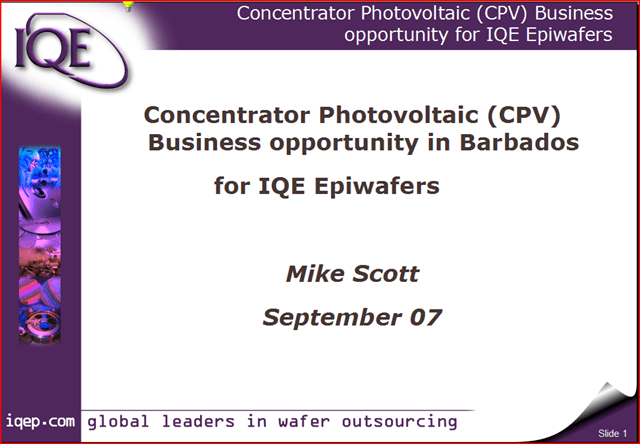
The information included in that attachment was part of a presentation by Professor M. Scott at the Future Centre on Dec.10, 2007. I invited him to speak to the stakeholders here (Barbados) because he knew what he was speaking about. I asked, “If I could arrange a meeting with the stakeholders here would you be willing to do a presentation for me?” He agreed.
I had met Prof. Scott briefly before but on this occasion, I learned what he did. He was amazed that Barbados had not made any strides in Solar- PV business. He felt Barbados could the leader in the Caribbean. I am confident he would do everything to assist Barbados.
Northern Ireland under the leadership of Peter Hain, commenced a project by offering grants to householders to install PV on their rooftops. The system worked like this:
PV on the roof to generate metered electricity for the grid; each dwelling has 2 meters, one records electricity used in the household and the other records electricity manufactured by the PV system. The meter man comes along and reads both meters. If the householder uses less electricity than what is recorded by the PV system, the householder is given a credit note. Next time if the householder uses more than what the PV manufactured, he pays the full amount or the remainder on his credit note.
In the summertime, some householders did not pay anything for their electricity and those PV system were at most 10% efficient. (There is one meter available now to do the jobs of both; it can spin forward as well as backward). The Government of Mauritius is on record that it intends to have every household with PV on their rooftops. A few months ago, a relative of mine in the South of Ireland (Eire) rang to say the Government was introducing solar PV on the rooftops. If such a system was introduced here; with our year round sunshine, many of us would not have to pay for our electricity…. We the people would benefit, but this would not be good for the shareholders of BL&P – Perhaps a set rate could be introduced to be connected to the grid, or the PV system can be installed by BL&P for a set period of time.
The PV system now mailed to you is similar to that in the Israeli video clip in your earlier blog on solar, but not as bulky; please see ‘slide 6’… it doesn’t take up much room; can generate much more electricity than the system now being used on rooftops. A space about the size of an ordinary house could generate electricity for many homes. You can read what is taking place in California, Spain and Portugal.
In February 2008, I attended a presentation on renewable energy at Cave Hill University. Mr. Blackman from BL&P was invited to speak for 10 minutes. In his brief message, he stated that solar panels located on the roof of the ‘Future Centre’, was providing more electricity than they anticipated; no maintenance is necessary…..Again I must add those are the less efficient PV system. Professor M. Scott says, the efficiency is improving all the time. The system is built so that as improvements in the system continue, sections can be removed and the improved parts can be added. Professor Scott thinks Barbados could be the leader here in the Caribbean and could export to the rest. This would generate many long term jobs here in Barbados. Those interested would be put in touch with the right people.
Germany is excelling in this technology for domestic and export. Most of the manufacturing businesses are from what was termed, the Eastern side of Germany and were encouraging workers from the ‘Western side’ to better paid jobs, to assemble this technology. This Government can join with the private sector to set up a system here to assemble for the market, Barbados and the Caribbean. It may be costly at first, but in the long term, we the people would benefit. (The sun would not be expensive in 10, 20 or 100 years). The government can introduce a system similar to water metering. Calculate how many Kilowatts of electricity an average household would use and then introduce a tier system above that rate;those who are careful would pay less.


The blogmaster invites you to join the discussion.