← Back

Your message to the BLOGMASTER was sent

69 responses to “2025-2026 Draft Estimates – D for DEBT, D for DEFICIT”


  1. $1 billion deficit

    Govt looking mostly to domestic financing to make up shortfall

    by SHAWN CUMBERBATCH shawncumberbatch@nationnews.com

    GOVERNMENT WILL HAVE a $1 billion deficit in its budget for the new fiscal year starting on April 1 and it will be relying on domestic financing to make up the shortfall.

    With higher debt repayments plus interest predicted to account for $1.76 billion of expenditure in 2025-2026, the Ministry of Finance, Economic Affairs and Investment expects to benefit from a primary surplus of $613.6 million.

    This is detailed in the 2025-2026 Estimates of Revenue and Expenditure which was laid in Parliament on Tuesday. It will be the focus of debate on the Appropriation Bill, 2025 when it starts in the House of Assembly on Monday.

    Reacting to the fiscal projections, University of the West Indies Professor of Finance Justin Robinson’s verdict was that Government’s budget was “a manageable risk”.

    However, he said the numbers revealed “a delicate balance between economic growth and a persistent debt burden [and] suggest a Government walking a tightrope between investment and fiscal responsibility”.

    “The Government’s budget strategy prioritises fiscal balance and investment, but with large amounts of debt maturing, the debt stock will remain elevated,” Robinson added.

    Debt to GDP ratio

    “Unless there is further austerity in the form of aggressive revenue-enhancing reforms or expenditure cuts, policy should focus on growing the economy and maintaining fiscal prudence so as to reduce the debt to GDP ratio in line with the Barbados Economic Recovery and Transformation programme.”

    The Ministry of Finance said that on the accrual basis, Government’s revenue for the next fiscal year is projected at $3.98 billion, while on the cash basis it is projected at $3.88 billion, an increase of $110.3 million.

    Total expenditure on the accrual basis will be $5.13 billion, and $5.08 billion on the cash bases.

    This means that Government’s fiscal deficit on the accrual basis is projected to be $1.15 billion on the accrual basis and nearly $1.2 billion on the cash basis.

    “Expenditure on goods and services is expected to increase by $79.9 million over the revised figure for 2024-2025 to $645.5 million. Current transfers are projected to increase by $45.1 million or 4.3 per cent to $1.08 billion.”

    In his examination of the Estimates on the cash basis – the method used by the Accountant General – Robinson said “a striking 44 per cent increase in non-tax revenue points to a greater reliance on levies, fees, and service charges, raising concerns about potential cost increases for businesses and individuals”.

    “While this diversifies revenue streams, the sustainability of this approach remains uncertain,” he observed.

    He noted that $720.4 million (14.2 per cent of total spending) of the projected 10.1 per cent increase “is tied to debt repayments rather than development”.

    He also said “despite a successful debt swap reducing service costs, high interest payments (14.2 per cent of revenues) and recurrent expenses (53.8 per cent of spending) limit the Government’s fiscal flexibility”.

    His view was that “this leaves less room for social services, infrastructure, and economic stimulus measures”.

    Robinson said regarding the fiscal deficit and debt burden that while the fiscal deficit on the cash basis is $1.2 billion, lower than 2024-2025’s $1.45 billion shortfall, “when maturing debt of $1.07 billion is subtracted, the actual need for fresh borrowing is significantly lower”.

    While seeing Government’s continued projection of a primary surplus as a positive indicator, he pointed out that “the sheer volume of debt rollover keeps total debt stock elevated”.

    Government is planning to fund its fiscal deficit with foreign financing of $518.4 million and $678.5 million from domestic sources.

    “Foreign borrowing offers lower interest rates and longer repayment terms, helping ease short-term fiscal pressure. However, this increases exposure to exchange rate fluctuations and external lending conditions,” Robinson said.

    “Domestic borrowing, while reducing currency risks, may increase competition for credit in local markets, raising interest rates and impacting private sector growth.”

    QEH subvention

    The 2025-2026 Estimates includes a $120.9 million subvention for the Queen Elizabeth Hospital; $94.6 million for the amalgamated Social Empowerment Agency; a $98.4 million subvention and $20.7 million for economic costs and tuition fees for UWI; $8.5 million for the Change Management Unit in the Ministry of Education; $11 million for the female dormitories at the Regional Police Training Centre; and $16.4 million for the Hope Agriculture Training Institute and the UWI Centre for Food Security and Entrepreneurship (China Aid Project).

    With Barbados holding We Gatherin’ celebrations all year, the Estimates show that Government has budgeted $3.9 million on the initiative. Based on the 813-page document, the bulk of the expenses – $2.5 million – are with the Prime Minister’s Office (Culture).

    Please see also Page 5.

    Revenue projected:

    $3.98

    billion

    Expenditure projected:

    $5.13

    billion

    Projected deficit:

    $1.15

    billion

    Debt payments projection:

    $1.7

    billion Expenditure on goods and services:

    $645.5

    million


  2. What a total and complete joke!!
    Have these people no shame???!!

    There can be no clearer sign of ongoing incompetence than continuously spending significantly more that you are able to earn.

    This is the very definition of a ‘Parro’.

    If we are REALLY incapable of earning our basic upkeep, then those who have taken on the responsibility of leadership should admit failure, and submit their resignations.

    We may as well have Ninja Man running things…

    What a disgrace.
    What a place.
    what a curse.


  3. It’s the little things that get to me.
    This is just a comment and not an attack, but the graph at the end of the 8:50 a,m. article is one of the ways to lie with statistics.

    The $5.13B should be 8 time as large as the $645M, 3 times as large as the $1.7B. and four times as large as the $1.15B. Other bars in the chart should be adjusted accordingly. The reader would then get a greater understanding of the different amounts and their relative sizes.

    These presentations are often meant to increase our understanding of numbers cited, but they can also be used to mislead us. You be the judge.


  4. @Goeht

    Don’t think you can blame the government re:graph that looks like it points to the Nation newspaper.


  5. Now I know someone will talk about how tall the charts would have to be – that is a silly point.

    There are many other ways that these data can be presented, but the relative sizes should be accurately displayed.
    A next approach would be a pie chart with the slice of pie proportional to the actual number so that the reader can easily grasp the difference in magnitudes. A suitable legend would help the reader.


  6. I hereby signing a declaration to call the above document GUESTIMATES and shall from today refer to them as such.

    These guestimates are no more that that due to the fact that with the amount of unaudited state entities years behind on audited data, what else could these figures be based on?


  7. @John A

    Are you aware the number of Doctors who assisted in the preparation of the document probably under the watchful eye of IMF technical staff?


  8. @ David

    I am also aware of the fact that these guestimates CAN NOT be based on audited figures of performance, as practically all state entities including big ones like the NISS and transport board have no accurate audited data. For example what stock of buses have been written off their asset base recently? Have receivables been written off and are payables up to date? If every entity with unaudited financials are sending in house figures to their relevant ministries and these figures are the basis for the guestimates, then look for a massive difference at the end of this year compared to the estimates. After all has this not been the case for the last decade or more? Have we not voted massive suplimentaties within weeks of previous estimates being laid?

    Look let’s be honest, at this stage both the guestimates and Central Bank Report have to be taken with a pinch of salt for the very same reasons.


  9. This is just another PR gimmick designed to mask gross incompetence.

    Much like a student coming up with the ‘final answer’, but unable to show the ‘workings’ that got to the answer.
    FEW government agencies have audited statements less than five years old. As John A says, ‘guestimate’ is the best term that can be applied here…
    Bushie prefers to use the phrase ‘lotta shiite’.

    In ANY CASE, we all know from past experience, that the expendature will be HIGHER and the revenue guestimates will be lower.
    Excuses will be PLENTIFUL…

    “The fire station windows costs $3 million more – but it was all good”
    “The STEAL houses cost $50 million more – money well spent “ ..(no doubt)

    ..and
    Revenues were down because we had a storm..
    …or government shut down the whole damn countery because of a covid19 farce
    …or we gathering was affected by Trump’s policy – where many Bajans won’t even go to the damn supermarket – far less to the airport – for fear of ICE

    The WHOLE thing is a case of monkey playing with gun or the Peter principle gonr mock!!!
    Take your pick…

    In any case, our ass is grass!


  10. Every year at this time we witness public servants sitting meekly in the well of parliament like the dutiful servants they are repeating the tired lines.

    What we want to hear are the ideas, projects designed to increase output and productivity to reduce or eliminate the deficit.


  11. “The blogmaster invites you to join and add value to the discussion.

    Debt payments projection: $1.7billion
    Expenditure on goods and services: $645.5”

    Big Smile 😃
    Proud Yourself


  12. @ David

    I said here nearly a year ago that the measures we had introduced and the path we were on was going to lead us to a massive deficit going forward. I was told by the faithfuls i was all doom and gloom. The truth is that numbers dont lie. They did not lie then and they will not lie now.

    Now we have a large deficit confirmed in the estimates that has to be financed. So will we go the road of cutting back on state spending, or will we use the ever faithful approach of increased taxes? Our interest charges alone are stripping apart our income so more borrowing would be restrictive, that leaves taxation and cutbacks. Added to this we have learnt that tourism spend is down even with all the arrivals. So where does all this leave us? Have we finally now hit the reality wall where deciaions have to be made, or will we try and borrow our way out of this? Sounding alot like the Sinkler approach to me. He printed and we borrowing instead.

    BOTH APPROACHES POINT TO THE FACT THAT OUR EXPENSES WAY EXCEED OUR INCOME AS CONFIRMED NOW BY THE 2025 ESTIMATES.

    I rest my case.


  13. What is the projected revenue from tourism?

    How much of that revenue belongs to foreign owners?
    How much to Government and locals (who keep their funds onshore)?

    If our tourism receipts are largely based on taxes levied, then we MUST know that owners PASS ON THESE COSTS to customers – making the local product that much more UNCOMPETITIVE… then they come begging for ‘incentives’.

    How much of those SAME DAMN taxes are then GIVEN to the tourism owners via free promotion, tax breaks and grants?

    Do we even have Enuff data to JUSTIFY our dependence on this shiite industry – and bfor Doo Shiite to turn the whole damned place into a concrete jungle?

    Who EXACTLY is running this freak show anyway ..?
    steupsss…


  14. Don’t BUY a BOND or TBill or any GoB issued debt instrument, UNTIL they provide the many outstanding Annual Reports.

    I have warned for weeks now.


  15. @David

    I think that sensationalist headlines like the one above might be a bit misleading.

    “With higher debt repayments plus interest predicted to account for $1.76 billion of expenditure in 2025-2026, the Ministry of Finance, Economic Affairs and Investment expects to benefit from a primary surplus of $613.6 million.”

    Robinson said regarding the fiscal deficit and debt burden that while the fiscal deficit on the cash basis is $1.2 billion, lower than 2024-2025’s $1.45 billion shortfall, “when maturing debt of $1.07 billion is subtracted, the actual need for fresh borrowing is significantly lower”.
    Almost all of the $1 billion gap is due to amortization or maturing debt as Robinson put it. It is not due to current spending by the government. This is just debt that the country has owed over the past 30 years that is now maturing. On the current account, the government is actually projected to record a large primary surplus ($613.6 million) so in terms of current spending the government is actually spending less than it is taking in taxes.

    I do agree with Robinson though that the focus should be on the type of reforms and capital spending needed to generate economic growth. In that way your debt to GDP ration can continue to fall.


  16. @ Northern

    Problem is it now runs deeper than that. We are currently budgeting our spending where we will have a massive deficit for 2025 based on grossly inaccurate figures. So will we end up with a 25% higher deficit for example? So they predict their revenue on last years, but when it comes to adding right downs and asset adjustment to the entities giving central government these figures, you know the figures going be nuff worst!

    I cant for the life of me understand how we as a people can think we can handle billions of dollars yearly without accurate audited figures. This is abosolute madness yet we make NATIONAL decisions based on rubbish data! Watch and see post estimates the amount we going have to look for in supplementaries. Or in plain bajan words “bills we din know we had.”

    On the revenue side have we factored in the lower earning numbers for the winter season so far over the 12 month year? Look i done wid dat cause i might only let go 2 cuss words here today! LOL


  17. @General

    Your statement checks some boxes for those so inclined BUT notwithstanding a large primary surplus you ignore the underlying weakness of Barbados’ fiscal position which remains a clear and present problem.

    Barbadians should be communicated with in more realistic terms given the current economic situation. It would set more realistic expectations given our addiction to rabid consumption behaviour.


  18. @ David

    Let me put this in simple Bajan terms by saying this.

    If i say i have a surplus in my cash tin of $10 dollars because i have $50 in the tin but owe the drink man $40 then so be it. The problem comes in that because i did not remember to write it down, i actually still owe him another $20 from the week before so i have now overstated my surplus. Its back to record keeping.

    The problem is that many look at the face figures as they are easily seen, but few drill down on the make up of these figures. As Northern always says if I am to buy paper from you then you got to do a better job in your book keeping. Would you for instance buy an offering from Sagicor if they did not publish audited financials for 10 years? Forget the tap dancing if you spending more that you making you running up debt. This is true for man or county, forget the fact the left pocket got in $6 and the right pocket $4.


  19. @David I get what you are saying. But the “pace of travel” (how fast you bring down your debt to GDP ratio) now depends on how fast you can grow GDP. Since 1961, Barbados’ GDP growth has averaged around 2.5%. Our target GPD growth rates should be around 5% going forward. To achieve that, the country needs to ramp up investments in science, technology, training and overall infrastructure. Take for example what is happening at Newton.

    The government has invested in building a heritage district (which includes the controversial slave burial memorial). This is being done to diversify within tourism, so that Barbados draws people interested in heritage and history and not just sun, sea and sand. Across the road from there is the Digital Innovation and Health tech Hub. Around the corner from there is the International Food Science Center which was opened two years ago to provide small manufacturers with the technology and the lab testing services to scale up and meet international standards.

    David, the problem though, is that while these investments are needed, it is only a drop in the bucket and it is all government driven. Because a lot of Barbados’ debt has matured in the last couple of years with more set to mature in 2027, government doesn’t have much more fiscal space. Large primary surpluses can only take you so far.

    What I would propose is for the creation of more instruments which enables smaller Barbadian investors and savers to invest in domestic ventures to help them scale up.

    Take for example, the Barbadian start-up Touchstar Robotics. The can find and niche to solve problems unique to the Caribbean, however, they will probably need much more capital to expand regionally.

    https://robotics.touchstar.group/about/


  20. @General

    Now you are talking the blogmaster’s language. Some of us don’t want to hear or see Governor Greenidge pretty charts which help to reinforce consumption behaviour. We want to see graphs and metrics that show increase in new, emerging or repurposed non traditional businesses and how they’re adding to GDP/employment stats etc. we tired of the old jargon and measurements. How else can you change an incent new thinking/behaviours?


  21. Do people here really understand that Barbados is no different than any other country similarly involved in the global Ponzi scheme which national economy has long become?

    None of this is real. We must start to see the functions of this regime, the CBoB, as part of the system where all the players know the truth and that it will soon come tumbling down – the party of Mr. Ponzi!

    Understand! That the game requires the players to blick the systems for as much fiat possible before the music stops and some players are left without a chair while fiat money blows the streets with no one even stooping to pick one up.

    Are we not seeing that in the midst of empire’s collapse, very similar to Rome, that Washington is, amongst others irrationalities, sanctioning and imposing tariffs on peoples, while fecklessly demanding that they must use USDs.


  22. @JohnA
    It was approx the same years after initial election, that the DLP put back to back billion dollar deficits into wunna.
    Somebody said something about…..doing the same things over and over, while expecting different results?
    Do NOT buy a Bond or TBill.
    #ShowUStheREPORTS


  23. @ Northern

    Well I watching the tourism earning for this winter season closely. If it continues on the trend it is on that deficit going be a good bit bigger than projected. The people like dem coming but lef the wallets home!


  24. Anyhow i see in todays press alot of brand name economist echoing the same concerns as this one door shop keeper that went school at Brumley. Basically them asking if we cutting state spending or we increasing taxation? Well many hands mek light lifting so i guess em is more taxes!

    Wunna watch what the deficit will END UP AT NEXT YEAR and not what they guestimate it to be. With toursim revenue looking weak for the winter seaaon at this point and that is the 1 foot economy we now got, what wunna think going happen?


  25. @John A

    We have to wait on ‘we gatherin’ spend to kick in.


  26. “Residents in Trents, St James, say they are being traumatised by an eight-year-old boy and are calling for an urgent intervention by police and the Child Care Board.”

    https://nationnews.com/2025/02/14/concern-over-troubled-boy/


  27. @ David

    Gathering spend, you feel that could generate enough to pay back for putting it on?

    Cuhdear i still waitig to hear the net earnings from cricket after we deduct the full cost of putting it on. Dem did promise them figues “soon” didnt they? Then again 7 years ago they promised up to date audited figures “as a matter of urgency ” for the NIS and all i get so far is a name change!


  28. Revenue shortfall ‘may force’ govt to recalibrate spending priorities

    written by Shanna Moore  Updated by Barbados Today 14/02/2025 3 min read   

    https://barbadostoday.bb/wp-content/uploads/2025/02/ALLEYNE.jpg

    Professor Antonio Alleyne.

    The government’s revenue target of $3.98 billion for the 2025-2026 budget has been questioned by a University of the West Indies economist, who warned that the projection was seemingly  based on overly optimistic assumptions.

    Professor Antonio Alleyne, commenting on the newly revealed Estimates of Expenditure and Revenue for the new fiscal year beginning on April 1, noted that Barbados has consistently fallen short of its revenue projections in past budgets.

    “Anything is possible,” he said, noting that he did not want to come off as a pessimist.

    “However, the government has never collected 100 per cent of its budget, or estimated revenue and I don’t foresee it doing that either so this is my projection as it relates to patterns.”

    According to the economist, the numbers simply don’t add up.

    “We’ve always fallen short, and for various reasons,” he said.

    “I think it’s overly optimistic, by a long shot, for the government to assume that it will collect that much revenue, given the history of revenue collection in Barbados.”

    The government has already admitted that it expects to fall $1 billion short of its budget, collecting only 75 per cent of the estimated revenue. But Professor Alleyne argued that even this figure is doubtful.

    “I just think the government is trying to paint an optimistic picture of the way forward. Persons are never really that compliant. So, out of $4 billion, they’re assuming a fall short of maybe $1 billion– that’s a 75 per cent collection overall. Again, still a little optimistic, in my opinion.”

    Professor Alleyne also noted that even Value Added Tax (VAT), which he said is one of the easiest revenue streams to collect, often falls short of expectations.

    “Given the history of revenue collection in the country, including VAT, which is one of the easier forms of revenue collection, it is still a challenge… that 75 per cent is still high.”

    The economist further warned that if revenue does not meet expectations then the government will have to make tough decisions about which areas to fund and which may face cutbacks.

    “They need to ask the questions like what area you’re going to spend the revenue in… what’s most important,” he said.

    “Because if you fall short of what you aim for, you will likely have to recalibrate in terms of what money goes where.”

    Professor Alleyne, however, acknowledged that the government’s optimistic outlook could help build public confidence.

    “Well, I think the government is just trying to paint an optimistic picture in terms of the way forward. And if the society holds to that, maybe things will look good.”

    But, he added: “To me, from an analyst’s perspective, it is overly optimistic.”

    shannamoore@barbadostoday.bb


  29. Ryan Knows best!

    Straughn defends $3.98bn revenue target as ‘conservative’
    By Shanna Moore

    Minister in the Ministry of Finance Ryan Straughn has robustly defended the government’s $3.98 billion revenue target for the 2025-2026 Budget, dismissing concerns that it might be unrealistic.
    He insisted that the nation has consistently exceeded its revenue estimates as the economy grows, countering claims by economists.
    His comments come in response to economist Professor Antonio Alleyne, who warned that Barbados has never collected 100 per cent of its projected revenue and described the government’s targets as “overly optimistic”.
    Straughn pushed back, questioning the basis of that claim.
    “Really? Overly optimistic?” he questioned. “We have always been conservative in our revenue projections, and I must say that as the economy has grown, Barbados has allowed us to surpass those very conservative revenue projections.”
    Though he acknowledged that the global economy faces uncertainty, Straughn said the government’s focus remains on stimulating growth to match revenue expectations.
    “The world is moving into a very uncertain phase, and therefore we have been focused on how we get more growth out of the economy, such that our assumptions for growth and revenue are matched,” he said.
    He stressed that this approach allows the government to pay down debt, provide public services, and still have room to adjust if necessary.
    “That allows us to be able to continue to pay down debt, provide the public services that we said we would provide, and still have some flexibility to adjust should something happen.”
    Alleyne had further suggested that if revenue falls short, the government may need to recalibrate spending priorities, but the minister also dismissed this as nothing new.
    “The government has always recalibrated. There has not been a single year since we’ve been in government that we have not had to recalibrate expenditure,” he said.
    He pointed to 2024’s unexpected repairs to the fishing harbour following Hurricane Beryl as an example of how the government redirects funds when necessary.
    Straughn said: “Last year, when Hurricane Beryl hit, wehad to prioritise monies to be able to get the repair done for the fishing harbour and therefore, that was something that was not expected, and we looked through our budget, and we determined what would have, at that point, been less of a priority, which is what everybody does in their household.”
    Despite concerns that the $1 billion revenue shortfall may require spending cuts, Straughn insisted that no such decisions have been made at this time, stating, “There’s no conceivable adjustment because we haven’t faced anything this year yet.
    We have set some priorities, and we will ensure that those priorities are addressed.”
    Though he was careful not to rule out adjustments if circumstances change, he made it clear that no planned initiatives have been put on hold.
    “There’s nothing that we are saying, ‘Oh, if this happens, then we won’t do X, Y, Z.’ Those things will materialise if they materialise, and if they happen.”
    The 2025-2026 Appropriation Bill, on which lawmakers will vote after debate of the Estimates of Expenditure and Revenue for the 2025-2026 Financial Year, and set to be debated in Parliament from Monday, has already drawn questions about the sustainability of spending, debt repayments, and revenue projections from the opposition leader and economists.
    But, the finance minister remained confident that the government remains in control of its fiscal management. shannamoore@barbadostoday.bb

    Source: BT


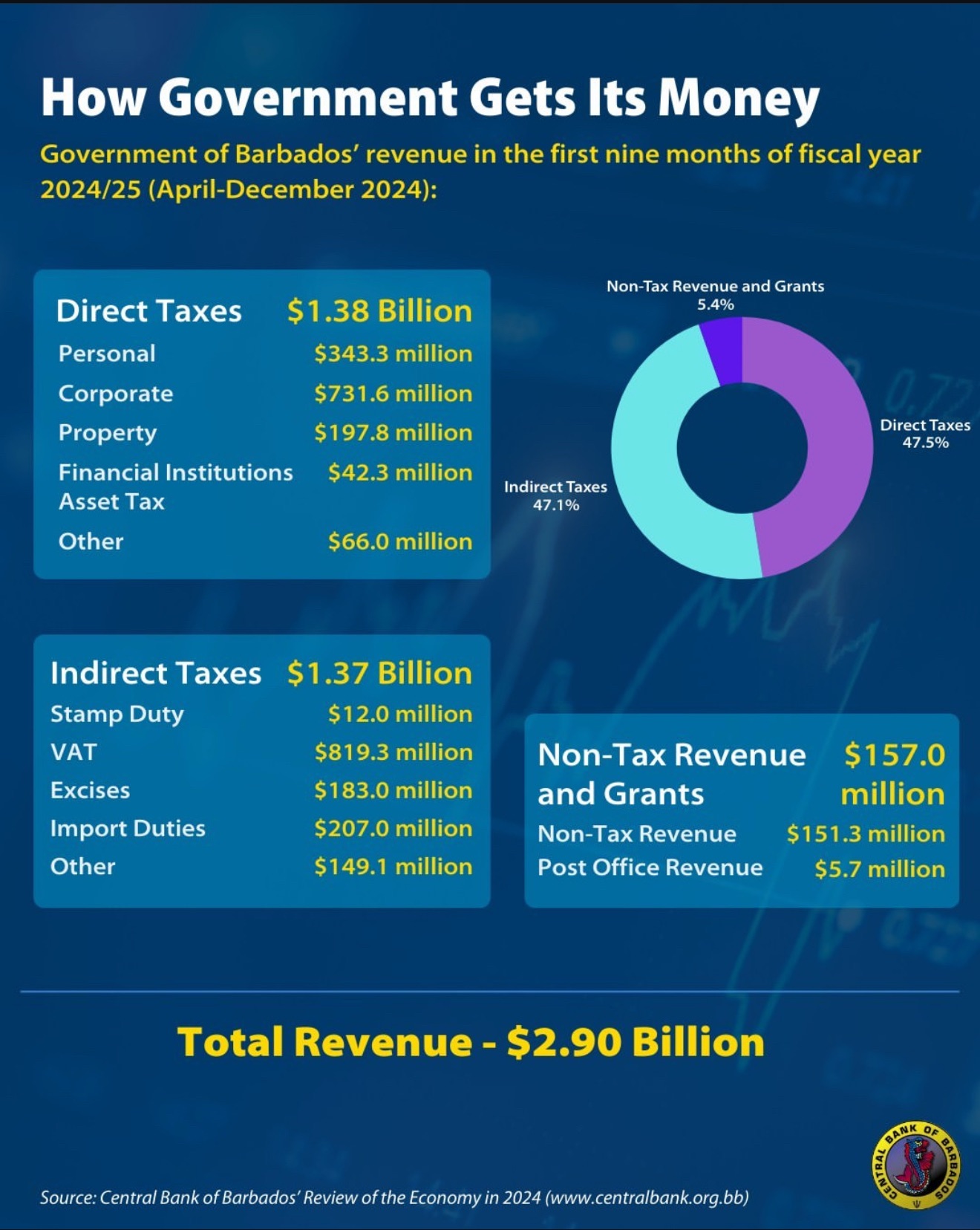
  30. @David To be fair. The revenue for this current financial year( 2024-2025), will far exceeded the projections laid in the 2024 estimates. For the first three quarters of this FY (March to December), revenue was $300 million more than projected due to larger than projected corporate taxes and vat revenue. In the last two budgets the government has not implemented any new taxes, so this is due to two things; and uptick in economic growth driven by construction and tourism and the adoption of the global minimum tax for international businesses.
    That is why the revenue authotity is now reporting this:
    ‘BIG RETURNS’
    REVENUE AUTHORITY REPORTS STRONG TAX COLLECTION GROWTH
    The government has seen significant increases in tax revenue across key earners, with construction leading at 38.6 per cent growth, followed by the wholesale and retail trade, and tourism driving tax collections over the past year. the Barbados Revenue Authority (BRA) said on Friday.
    Revenue Commissioner Louisa Lewis-Ward confirmed at an Institute of Chartered Accountants of Barbados (ICAB) Annual Tax Update that revenue collection targets are being met, with increases recorded across several industries.
    Between April and December 2024, Value Added Tax (VAT) contributed $503 million, accounting for 37 per cent of total tax revenue and corporate tax revenue stood at $316 million (23 per cent).
    Personal income tax collections reached $296 million (22 per cent) while land tax generated $141 million (11 per cent).
    Lewis-Ward said: “Between April 2024 to December 2024, aggregated revenue collections have seen the largest increases in the areas of financial and insurance activities—an increase year on year of 11.45 per cent, wholesale and retail trade—an increase of 15.83 per cent, accommodation and food services—an increase in revenue of 12.28 per cent, and construction—an increase of 38.6 per cent.”
    She noted that revenue performance reflected continued economic activity and improved compliance measures, which the BRA has been working to strengthen.
    “Currently, revenue targets are being met,” she said.
    “These numbers will be further enhanced with the launch of the collections initiative, which will allow taxpayers to come forward to settle any old balances on the major tax types.”
    The revenue commissioner also revealed that the BRA is finalising preparations for the 2025 tax filing season, with a series of digital tools, compliance measures, and taxpayer support services being rolled out to improve efficiency.
    Revealing that personal income tax filing will begin on March 1, with taxpayer outreach centres in place to assist individuals, she said: “There should not be many changes to the personal income tax form this year.
    “However, we wish to implore employers to complete the PAYE upload obligations so that taxpayers are not filing without adequate data being included in the return form.”
    For businesses, the new corporate tax return form— which was initially scheduled for release in December 2024—will now be launched by month-end.
    The delay was necessary due to the complexity of the tax changes being implemented, Lewis-Ward said.
    While the system is being finalised, businesses can continue using the prepayment platform introduced last year to allow for early tax payments.
    To further enhance tax administration, the BRA will introduce a new “check your balance” feature on its website in March, allowing taxpayers to view their outstanding balances across the TAMIS, legacy E-Tax and VETAS systems.
    The BRA is also expanding its online services to reduce in-person visits.
    As of next week, the agency will soft-launch an online vehicle registration disc portal, allowing taxpayers to digitally retrieve or print their vehicle registration discs using their licence and engine numbers.
    “This should relieve some of the lines at locations where vehicle owners visit to collect their registration cards,” the BRA chief said.
    “Additionally, this portal service will allow The Barbados Police Service to access and review registration data in real time as they ensure vehicles on the road are compliant and to keep Barbados safe.”
    For property owners, the land tax portal will also be upgraded in April, enabling taxpayers to complete landadjudications and download tax clearance certificates online.
    The BRA will further launch a Compliance Risk Management Unit this month, which will collaborate with the National Insurance Scheme and the Customs and Excise Department to monitor tax compliance across agencies.
    “This will enable the authority to have a holistic view of taxpayer compliance and this should contribute to better policymaking,” she said.
    She also confirmed that the BRA’s refund team is on track with monthly repayments and that corporate and personal income tax overpayments will be processed this month.
    Noting that the BRA is celebrating its 10th anniversary, Lewis-Ward stated: “The authority has been able to fulfil its core administration functions and looks ahead to continuous improvement to meet these strategic goals.”
    “Nevertheless, there’s always room for improvement, and we welcome your feedback as we continue to evolve,” she said, adding that as the tax filing season is about to begin, taxpayers are being encouraged to stay informed and take advantage of digital services to ensure a smoother filing process. (SM)


  31. @General

    Is it also fair to say that the significant % of the 300m increase is due to tourism? We keep coming back to the same discussion points. What are we doing to reduce over dependence on tourism? Of course we have many sectors that add to the revenue bucket but it is about the size of the contribution?


  32. @ David
    When all is said and done, there is a BIG elephant in the room and we are all dodging around him…
    The price to be paid for social stability and development is PRODUCTIVITY.

    It is one of the spititual LAWS that are unavoidable. Whatsoever a man soweth, THAT also he will reap.

    The fundamental role of government is to promote, facilitate, and encourage PRODUCTIVITY in all sectors of the society.

    The lotta nonsense of Government ‘looking after the needs of citizens’ is a path to sure poverty. That role is intended ONLY to apply to sincere cases of need – and even so, is a role best played by family, neighbors, communities and NGOs – WELL BEFORE any Government gets involved.

    But these politicians see PERSONAL and political benefits in these ‘Santa Claus’ roles – and come up with the mendicancy-based economic idiocy that we now have.

    Of course they ALSO fear the situation where GENUINELY competent talents in the community would obviously rise to the top – in terms of PERFORMANCE, and displace the stupidity that currently passes for leadership.

    Our system is currently configured for the SHORT TERM benefit of JA politicians and their lawyer and economists (WETHTA) cohorts, and to the long-term DETRIMENT of the damn society.
    …but rather than deal with THAT reality, we tend to focus on how we too, …can cash in on the short term benefits ourselves…

    What a place…


  33. The Master Key Meditation Vibrate the Cosmos
    Barbados needs a master key to the Cosmos, which opens the way forward when you are stuck. When you chant this mantra then after that never utter a wrong or negative word.

    Chipping away at the debt boulder on your shoulder is like a monkey on your back which means a problem that someone cannot easily get rid of or solve : a problem or situation that makes someone unhappy and that lasts for a long time. His debt / credit addiction has been a monkey on his back for years.

    Drastic changes are needed.
    Barbados needs to form alliances and connections to prosper in business with friends and allies such as Caricom, Africa, Black Diaspora, developing nations, China, BRICS etc.

    David mentioned investing in AI and technology as a positive plan for the future. This goal could be accomplished with help from China for example.

    Resonant frequency is the natural frequency where a medium vibrates at the highest amplitude. Resonance is witnessed in objects in equilibrium with acting forces and could keep vibrating for a long time under perfect conditions.

    Divine Soul Song for Divine Financial Blessing

  34. NorthernObserver Avatar

    @David
    I know you have a passion for economic diversification. While desirable, you have to ride the horse currently available. And that horse is currently in form.
    We know both tourism and global minimum tax rates are subject to change. So make hay while the sun shines.
    With DJT at the helm, anything is possible.
    Takes today’s wins.


  35. @NO

    It is at this time the tourism horse is winning we have to allocate resources whether financial, knowledge capital, strengthening strategic partnerships etc to develop other animals on farm.


  36. What is the update re partnership with Rwanda, Guyana, Barbados to grow a pharmaceutical industry?


  37. CASH, NOT BONDS

    Lawyer to take Govt to court over method of payment

    By Maria Bradshaw mariabradshaw@nationnews. com

    A senior attorney is planning to take Government to court over its system of issuing bonds in lieu of cash settlements.

    He told the Sunday Sun the system, which was legislated by Government in 2021 for personal injury and land acquisition claims, was creating further hardship for many people who waited sometimes as long as 20 years to be paid.

    “I believe that it is unconstitutional and Government has instituted this system for their own benefit without taking into account how disadvantageous it will be for many claimants,” he said.

    The civil litigation attorney said he would be writing Attorney General Dale Marshall and Solicitor General Anika Jackson on the matter as his client was not in favour of receiving bonds.

    “My client, who is elderly, has instructed me to indicate that he wants his money paid in full. After waiting so many years to receive a settlement for land which the Government took from him, he feels it is an insult for him to be paid in this manner. So, I will be writing the Attorney General and the Solicitor General to indicate that he wishes to receive the settlement in full. Depending on the response received, my client is willing to challenge this bond payment in court.”

    The lawyer charged that after four years of issuing bonds, Government should be in a position to revert to regular payments.

    “We understand the predicament that Government was in post-COVID, but I don’t think this system should be allowed to continue indefinitely. It is particularly taxing on persons like my client who are elderly and have waited for so many years to receive a settlement. This is called the Debt Settlement (Arrears) Act,

    but Government has not taken into consideration the considerable personal

    Continued on Page 4A.

    Lashley calls for Government to revise legislation

    From Page 1A.

    debt that people have incurred while waiting for their claims to be settled, and the debt that will continue to confront them over the four-year period of payment with no interest attached. It is not a win-win situation for everyone.”

    Other attorneys shared similar views. Senior Counsel Stephen Lashley said Government should go back to Parliament and revise the legislation.

    “I do have a matter before the court where the estimated damages are going to be very, very high and the Office of the Solicitor General has indicated the idea or the option available to the Government of paying bonds. I’ve not yet responded to that, but . . . given that they have been waiting for so many years, in many cases for a matter to be concluded in the judicial system, and then at the end of the matter you’re told that you still have to wait to get your just rewards by virtue of bonds . . . . I can’t think of any client, any litigant in Barbados, that would want to take bonds instead of hard cash for the damages.”

    Lashley said while he understood Government’s position when the system was first put in place, since then there have been positive changes in the economy.

    “I know that during COVID, the Government enacted legislation to allow it to have access to the option of bonds instead of cash. That was done, as I understand it, specifically in relation to the crisis that Barbados was in at the time in its fiscal position . . . . I don’t believe that those conditions obtain today that would validate the State seeking to pay damages in bonds. I believe that legislation was very specific, as it related to a specific time period.

    “Certainly, the economy has significantly improved, as you’ve heard from the Governor of the Central Bank, and I think the Prime Minister said that we are showing positive positions on all fronts. So, the circumstances on which that legislation was brought no longer obtain. I do believe that the Government should go back to Parliament and revise that legislation so that matters that were caught by [it] are freed from this onerous position of paying in bonds.”

    Another attorney submitted that the settlement of bonds had been particularly stressful on her clients as there were issues with its administration.

    “It appears to be very poorly administered. There is a disconnect between the Solicitor General’s chambers and the Central Bank in that orders are made for the payment of a global sum of damages and costs, and the amounts to be paid by the Central Bank for the bonds can sometimes be inaccurate. There is often no supporting reference information and there is no one whom you can speak with to clarify the challenges.

    “In one case, our clients were required to receive a specific set of money for the 42 months and that amount fluctuated and was clearly inaccurate. Despite repeated attempts to have it rectified, we are being told by the Solicitor General that we should follow up with our client on a matter that has already been concluded.”

    She said the system needed to be foolproof. “If the insistence of Government is that parties should be paid their awarded damages and costs in this manner, it is more than reasonable to expect that the administration of those payments should be efficient and correct. With the significant backlog in civil cases, it seems cruel and unusual punishment to have a claimant wait for years for a resolution of a matter, to then make them have to wait even further for the payment of damages, and not have that payment be done efficiently or correctly.”

    Source: Nation


  38. Debt and the 2025/2026 Estimates

    This article was written and submitted by Professor Justin Robinson, professor of finance, principal Five Islands Campus and Pro Vice Chancellor planning and academic industry partnerships at the University of the West Indies.

    A reader of the Nation newspaper reached out to me on my FaceBook page and said: “I don’t understand your comments on the 2025/2026 Estimates and why the Government is not getting our debt down. Can you please explain your perspective in English?” So here goes my attempt in English.

    Understanding the intricate world of government finance, particularly the difference between a government bond and an amortising loan, is crucial. It’s a complex landscape that Caribbean governments navigate and it’s not always easy to grasp. Most of us are familiar with amortising loans in our personal lives, but governments operate on a different level with government bonds. These two financial instruments function in distinct ways, akin to the difference between securing a mortgage for a house and borrowing your uncle’s fishing boat with a promise to return it in pristine condition.

    An amortising loan is like that car loan you took to impress the neighbourhood, except this one involves millions (or billions) of dollars. With this type of loan, the borrower (in this case, the government) makes fixed periodic payments that cover both the principal (the amount borrowed) and the interest (the cost of borrowing). Think of it like cooking a big pot of pelau – you don’t eat all at once; you serve it bit by bit until the pot is empty.

    Amortising loan

    Example: A ten-year amortising loan of $10 million with a five per cent annual interest rate means the borrower must pay $1 295 045 yearly. By the end of the ten years, the loan is fully paid off – no fuss, no mess, just like making steady payments on your hire-purchase fridge.

    Now, a government bond, the primary way governments raise money, is a different kettle of flying fish altogether. It’s more like borrowing from a group of lenders (bondholders) and promising to pay interest at regular intervals (like rent), then returning the full amount borrowed in one big payment at the maturity date. If an amortising loan is like eating your pelau gradually, a government bond is like saving all the dumplings for the last five minutes of the meal – eventually, you have to swallow a whole heap at once.

    Example: A ten-year government bond with a face value of $10 million and a five per cent annual coupon rate means the government pays $500 000 in interest annually for ten years. But at the end of those ten years, the government must pay back the full $10 million in one big lump sum – which, let’s be honest, is a massive chunk of change to pay in one go. In this case, for Barbados, $1 billion is due in the 2025/2026 financial year.

    Governments (and big companies) don’t usually pay off the principal on these bonds using their own money when they mature. So what do they do? They perform what I call “The Great Roll Over Trick”.

    They roll them over – fancy talk about borrowing new money to repay the old debt. It’s like taking out a new credit card to pay off the old one, except when governments do it, it’s called “refinancing”, and it doesn’t raise too many eyebrows.

    I am not trying to make a case for the Government using amortising loans versus Government bonds. Government bonds have pros and cons and we are already stuck with many bonds. A large amount matures yearly for the foreseeable future (some of these bonds could have been issued 30, 25, 20, 15, ten or five years ago and the principal on them is now maturing).

    My essential point is that for the Government of Barbados to reduce the amount of debt, it would need to pay off all or a portion of the principal on government bonds that mature each year rather than roll them over. And that’s where things get interesting.

    To reduce debt, the Government must pay off some portion of the principal on its maturing bonds.

    But that decision carries significant financial implications and finding the necessary funds is a daunting task.

    There are only three ways to do it outside of a debt restructuring: 1. Cut spending on other things (which means fewer Government programmes and services), 2. Raise new revenue (translation: new taxes), 3. – some combination of both (translation: belt-tightening for everybody). If the Government decides to pay off just half of the principal on bonds due in 2025/2026 (see Debt Amortisation in the table above), it would need to find $533.7 million – from spending cuts, new revenue, or both.

    And here’s the kicker: Most of the Government’s significant expenses – except for capital expenditure – are contractual obligations, meaning they can’t just stop paying. That’s what economists and financial analysts mean by “limited fiscal space” – most of the budget is already committed, so there isn’t much wiggle room.

    The conversation about Barbados’ debt isn’t just about whether the numbers are high (they are!).

    It’s about the Government and country deciding what the Government pays for, what should be left to the private market and how we fund what the Government pays for. If we want less debt, we must force that conversation. It’s not just a matter for the Government or financial experts; it’s a conversation that needs the active participation of every citizen.

    This breakdown explains the limited fiscal space for the Government. (GP)


  39. NorthernObserver Avatar

    Re Series J Bonds…my memory is the GoB had several categories on long overdue Accounts Payable, which the IMF wanted “Off the books”. So they passed legislation, and settled these accounts payable with J Bonds.
    I have no idea what penalties for late payment, if any, were applied prior to the conversion to Bonds.
    This bears little difference to the treatment of TBills, where what was to be cash in a few weeks, was frozen and repaid via, Series B Bonds.
    What really stings, is while they were skinning the TBill holders, and later entities owed monies for land acquired, damages in court proceedings and NIS contributions diverted, they paid White Oaks the egregious sum of $50M in success fees!!!
    This a few months before the GoB agreed to “write off” $128M for CBL.
    We are lucky Bajans are such an obedient, polite and peaceful people.


  40. Eyes on Estimates

    GOVERNMENT’S PLAN TO ALLOCATE $2.4 billion to ministries and other key entities next financial year will be under the microscope from this morning.

    Education, $474.1 million and health $294.2 million, are the ministries scheduled to get the biggest portion of the public purse as usual, followed again this year by the Prime Minister’s Office with $222.9 million.

    Members of Cabinet and ministry officials will outline their various policies and programmes for the coming year while answering questions from Leader of the Opposition Ralph Thorne and other Members of Parliament in the Well of the Lower Chamber.

    That is when debate on the Appropriation Bill, 2025, based on the 2025-2026 Estimates of Revenue and Expenditure, begins in the House of Assembly.

    The Estimates, which is Government’s budget for the new fiscal year starting on April 1, has outlined overall expenditure of $5.1 billion.

    The $2.4 billion to be debated in this year’s Appropriation Bill will “provide for the grant of a sum of money out of the Consolidated Fund and the appropriation of the same for the service of Barbados for the year ending 31, March, 2026”.

    “The Accountant General may, on the warrant of the Minister or a person authorised by the Minister in writing, issue out of the Consolidated Fund and apply towards making good the supply granted for the service of the year ending 31, March, 2026, a sum not exceeding in the aggregate $2 352 989,404,” the Bill states.

    This year’s sum to be appropriated exceeds last year’s $2.1 billion and 2023’s $2 billion, with the majority of ministries being allocated millions of dollars more in their 2025-2026 budgets.

    The budget appropriations for the Ministries of Education and Health and the Prime Minister’s Office are followed by the Ministry of Finance, Economic Affairs and Investment ($187.7 million), Attorney General ($158.3 million), Ministry of People Empowerment and Elder Affairs ($116.8 million), Ministry of Transport and Works ($111.5 million), Ministry of Environment and National Beautification ($101.1 million), and Ministry of Housing, Lands and Maintenance ($97.3 million).

    Next in line is the Ministry of Youth, Sports and Community Development ($80.6 million), followed by the Ministry of Home Affairs and Information ($79.7 million), Ministry of Industry, Innovation, Science and Technology ($69.2 million), and Ministry of Agriculture, Food and Nutritional Security ($67.8 million).

    The budgets for other ministries are Ministry of Foreign Affairs and Foreign Trade ($65.8 million), Ministry of Energy and Business Development ($65.3 million), Ministry of Tourism and International Transport ($24.4 million), Ministry of Labour, Social Security and Third Sector ($12.4 million), Ministry of Public Service ($6.8 million).

    In terms of major remaining sums of money to be granted in the Appropriation Bill, 2025, there are allocations for the Treasury ($54 million), Cabinet Office ($24.6 million), Parliament ($19.1 million), and Post Office ($14.3 million).

    The top five ministries in terms of money budgeted are the same as the 2024 Appropriation Bill and all of them are scheduled to be granted bigger funding this time.

    Last year the Ministry of Education, Technological and Vocational Training’s budget vote was $420.3 million. The others in the top five ministries last year were the Ministry of Health and Wellness ($236.3 million), Prime Minister’s Office ($188.6 million), Ministry of Finance, Economic Affairs and Investment ($186 million), and Attorney General ($130.8 million).

    The Ministry of Transport and Works ($120.6 million), Ministry of Tourism and International Transport ($27 million), and Ministry of Agriculture, Food and Nutritional Security ($85.4 million) all had bigger budgets last year, while the Ministry of Energy and Business Development and the Ministry of Public Service had appropriations that were about the same as this year.

    With spending projected to increase in the next financial year, including $1.7 million to pay debt (including interest), Government estimates that it will collect $3.9 billion in revenue. The fiscal gap is forecast to be closed by more than $1 billion in funding from foreign and domestic sources.

    Based on the 2025-2026 Estimates, the majority of Government’s revenue $3.6 million will come from tax collection, with the biggest contribution expected from $1.2 billion in value added tax and $797.6 million from corporation tax.

    Once the Appropriation Bill, 2025 is approved by members of the House of Assembly, it will be debated in the Senate. Budgetary Proposals are also expected to be presented before the financial year ends on March 31. (SC)

    Source: Nation


  41. Govt off track with excessive borrowing

    by ANTHONY P. WOOD THE LEVEL OF PREDICTED EXPENDITURE in excess of $5 billion in the 2025-2026 Estimates is very excessive. The administration continues to disregard advice freely given by economists Professor Michael Howard, Carlos Forte and Anthony Wood to rein in expenditure and, hence, reduce the need for excessive taxation and borrowing.

    It is unprecedented for a small developing country to escalate expenditure and borrowing whilst in an economic adjustment programme with the International Monetary Fund (IMF) which ought to have a stabilisation focus.

    Barbados’ experience with the IMF-supported Barbados Economic Recovery and Transformation (BERT) programme, runs counter to the typical country experience with IMF economic adjustment programmes as detailed in numerous textbooks on the subject. Excessive borrowing and runaway expenditure are not features of a standard IMF economic adjustment programme.

    Expenditure-reducing measures such as restructuring inefficient state-owned enterprises and eliminating spending on innocuous projects, and disguised or hidden unemployment are front-loaded in IMF economic adjustment programmes.

    Major benefit

    It is therefore surprising that these measures are not treated seriously within the BERT programme which has the oversight of the IMF.

    It is pellucidly clear that the major benefit derived from the successive BERT programmes is the leverage gained to engage in excessive borrowing to facilitate escalating expenditure.

    Recall that the Mia Amor Mottley administration undertook a debt restructuring exercise with a debt default component in late 2018, rather than the promised debt reprofiling promoted in the 2018 election campaign and contained in the manifesto.

    This unprecedented and unanticipated action resulted in significant losses to foreign and domestic financial institutions and private individuals. These losses were in the neighbourhood of BDS$4 billion, representing about 25 per cent of the public debt. Indeed, the public debt was reduced from BDS$15.84 billion to around $11.7 billion as a result of the debt default.

    Excessive borrowing

    This new debt position paved the way for the administration to enter the first BERT programme with the IMF. However, instead of practising a responsible borrowing strategy to aid economic recovery, the administration has used the ambitious primary surplus conditionally in the BERT programmes as an anchor to engage in excessive borrowing to the detriment of social and economic development of the country.

    After six years of austerity, rampant expenditure, two debt buy-back (swap) exercises and gross borrowing in excess of BDS$5 billion (net borrowing of BDS$3.2 billion), the economy and society are challenged by significant structural weaknesses. The 2025-2026 Estimates will ensure that these weaknesses persist.

    It is informative to note that the revised estimate for debt service in the financial year 2024-2025 is a record $2.2 billion, an increase of a staggering $1.225 billion over the $975 million approved for 2024-2025.

    Therefore, the estimate for debt service of BDS$1.79 billion for 2025-2026 is very likely to be understated. With this very high level of anticipated debt service and a conservative forecast budget deficit in excess of $1 billion, the administration will be severely challenged to extricate the country from the relationship with the IMF at the conclusion of the BERT programme at the end of September this year.

    Anthony P. Wood is an economist and former lecturer in economics, banking and finance at the Cave Hill Campus of the University of the West Indies. He was also a Cabinet Minister in a previous Barbados Labour Party administration. This article was submitted as a Letter to the Editor.


  42. Does Central Bank have a self-correcting mechanism?

    IT IS OF THE utmost importance to find out if the Central Bank can correct itself, as so much reliance is placed on the revelations attributed to that institution. On the other hand, must every pronouncement be given the veneer of gospel?

    Would we then say that in the area of self-correcting it may be open to bias? Does history not show that development occurs where information is subject to correction? On the other hand, experience has shown that the wrong directions of a central bank can lead a government (country) into chaos. Barbados is no exception.

    Imagine debt to Gross Domestic Product move to 36 per cent by 2036. Many of us will not be able to help; I will be 97 by then, but most likely long gone.

    As a matter of fact, there was a time when information emanating from the Central Bank was easy to process and was easily available. Then people like myself, not computer literate, could make the connection of what is happening to the economy and compare that with the reality of experience.

    Today it is difficult to make such a comparison.

    In a society, there should be checks and balances.

    For example, a government and an opposition; a group that says that we should go forward, and a group that could say “not that way”. However, if the group that should say “not that way” depends on its survival on the group that says we should go forward, then we have a problem. In Barbados we need to examine if this situation exists.

    From my limited point of view, the groups that should critically examine what the Central Bank (representative of Government) expresses are the supposed thinkers at the university and the press.

    As far as I know we have a free press that owes its survival to the daily sale of newspapers and advertisements, but maybe not a university that is wholly able to survive on its own income. Do we have a problem?

    Does this mean that the supposed thinkers at the university may have reservations at times of expressing contrary views of what the Central Bank (Government) wishes to proclaim?

    Overdone report

    As a quasi independent thinker, fighting for survival, I ask the question. But don’t you think that the glorious report of the country’s performance recently by the Central Bank was a bit overdone in the light of what we see on the ground and in the day-to-day living existence? People catching their tail to survive and waiting for the next Trump/Putin explosion.

    But Wild Coot, we could not do what Jamaica did in the 1970s, although our then Prime Minister showed us the way by taking up a chopper and start cutting cane. Who is going to dig potatoes now to feed the family or pick breadfruit even if the trees are on the highway or clean the pigpen? Not when we are the most literate island in the Caribbean? No politician could run an election indicating that there will be people for such a promise. So you mean, once there is life there is hope, and between now and 2036 there will be 11 hurricane seasons.

    This brings me back to the question of the reality of the Central Bank’s report. I expect that over the next few days there will be critical analysis of the claim that the long-term awaiting for an even match between a comfortable outlook for Barbados may be pie in the sky or to put it bluntly just hope. One thing that the Central Bank may not have stated is the composition of the foreign exchange showing what is foreign borrowing and what is cash ready to buy medicine or food or even to pay interest. The fact that we may have been scrambling to get the commercial banks to help us cut back on interest on loans might be a good indicator of the status quo.

    Today we are seeing more and more that countries that once had compassion for the poor have somehow lost that compassion – the United States Agency for International Development (USAID) for example. I know as I worked for that institution all over the Caribbean. The tentacles of that institution embraced the poorest among us and the possible withdrawal of assistance destroys hope. So you see what can happen. That is why I always say that the International Monetary Fund is a bank. If those in authority can pull the rug from under the feet of USAID seemingly without any consideration, then who are we to pin our hopes on a fair distribution of wealth?

    Harry Russell is a banker.

    Email quijote70@gmail.com

    Source: Nation


  43. Barbados buys $251m in produce from US

    by SHAWN CUMBERBATCH

    shawncumberbatch@nationnews.com

    BARBADOS’ big appetite for imported agricultural commodities is channelling millions of dollars into the hands of United States (US) food producers.

    Last year alone, the island imported $251.3 million in American agricultural products, new information from the United States Department of Agriculture’s (USDA) Foreign Agricultural Service (FAS) shows.

    It continues a pattern of growth, as Barbados’ imports of these products from the US were $223.6 in 2023, $218.8 in 2022, and $183.9 in 2021.

    Most of the money – $23.2 million – was spent buying fresh fruit from the US.

    This was followed by dairy products ($17 million), nonalcoholic beverages, excluding juices ($15.4 million), baked goods ($14.7 million), beef and beef products ($14.6 million), food preparations ($13.8 million), soybeans ($12.8 million), eggs and egg products ($12.2 million), corn ($11.4 million), and poultry meat and products, except eggs ($9.4 million).

    In terms of quantities, corn topped the list in 2024 with a total volume of 27 515 metric tonnes.

    Next in line were soybeans (13 269 metric tonnes), fresh fruit (5 624 metric tonnes), non-alcoholic beverages, excluding juices (3 210 metric tonnes), baked goods (2 282 metric tonnes), poultry meat and products, except eggs (1 516 metric tonnes), dairy products (1 366 metric tonnes), food preparations (983 metric tonnes), beef and beef products (776 metric tonnes), and 166 metric tonnes.

    The USDA FAS says that Barbados’ importation of these top ten American agricultural products has grown significantly over the past ten years, led by fresh fruit (143 per cent) and food preparations (122 per cent). The only decline was for soybeans (40 per cent).

    Overall, Barbados is ranked the 63rd largest buyer of agricultural items from the US.

    This information from the American Government comes as CARICOM member states seek to collectively reduce their food import bill by 25 per cent by this year.

    Increased sales value

    US food exporters are being told the region is “an excellent market for them to explore” in an analysis is captured in recent Retail Foods Annual and Food Service – Hotel Restaurant Institutional Annual reports prepared by Karina Pimentel, agricultural marketing specialist in the USDA FAS Caribbean Basin Agricultural Trade Office. The reports cover 2023 data.

    “In the Caribbean region, sales value in the retail grocery sector increased by three per cent in 2023. This is due in part to the rise in tourism in many markets, which is boosting economic growth,” Pimentel says in the Retails Foods Annual publication.

    “The largest grocery retail markets are Trinidad and Tobago, Guadeloupe, and The Bahamas. As more high-income individuals move to some markets and invest in the region, more opportunities for US food and beverage products are being created.

    “US agricultural exports of consumer-oriented products to the region were valued at US$1.5 billion last year (2023).”

    In calling the Caribbean an excellent market for US exporters to explore, the report listed proximity, close commercial ties with the US, a large influx of tourists, and a trade-friendly regulatory environment as all contributing to the attractiveness of the region’s market.

    “The majority of food must be imported on Caribbean islands, as domestic production is limited. Total imports of consumer-oriented agricultural products totalled US$3.1 billion in 2023, with the United States capturing 50 per cent of the market,” the report added.

    The Caribbean’s retail sector was flagged as the major gateway for American agricultural products into the region.

    “Total grocery retail sales – excluding sales tax – were estimated at US$10.3 billion in 2023. Approximately 81 per cent of imported foods and beverages are channelled through the retail sector. This sector includes traditional grocery stores as well as more modern, upscale supermarkets,” said Pimentel.

    “The food processing sector is minimal in most countries, with total production estimated at just US$168 million last year. Tourism is a key factor in generating demand for US products in the food service sector.

    “Sales reached US$2.19 billion in 2023, an increase

    the Caribbean than competitors.

    The US has a dominant market share in the vast majority of Caribbean islands – estimated at 50 per cent overall.

    The regulatory environment at present is generally open to US products.

    The local consumer values US quality and food safety. However, in an inflationary economy, consumers are more price conscious.

    BARBADIANS consume a combination of local, regional and international agricultural produce, including from from the United States. (FP)

    In terms of what the USDA FAS report saw as disadvantages, it listed the following: Caribbean nations heavily depend on foreign investment, which affects the region’s economic growth.

    European influence is present in the market because of historical ties and economic dependencies established over time, making consumers prefer some products and brands from Europe.

    Some products, particularly meat and poultry, may be restricted in certain markets due to European Union or island-specific regulations.

    Caribbean buyers often prefer small quantities as they have limited resources and storage space, which can be challenging for some US suppliers.

    Countries are increasingly interested in decreasing food imports, making a push instead for locally and regionally produced foods.

    Big appetite for US food

    The Food Service – Hotel Restaurant Institutional Annual also examined the Caribbean’s big appetite for American food and the opportunities for US agricultural product exporters.

    The publication’s author Pimentel reported that with the US having exported US$1.5 billion (50 per cent) in consumeroriented products to the Caribbean in 2023, “the next closest competitor is the EU with US$609 million in exports (19.8 per cent), followed by Brazil with US$158 million (5.1 per cent), New Zealand with US$99 million (3.2 per cent), and the United Kingdom with US$97 million (3.1 per cent).

    “Due to food inflation, some distributors increasingly favour European products and private labels. This preference stems from the perception that European products provide good quality at competitive prices and offer various gourmet options. Despite this, distributors continue to rely on US vendors and product quality,” the report noted.

    KARINA PIMENTEL, agricultural marketing specialist at the United States Department of Agriculture’s (USDA) Foreign Agricultural Service Caribbean Basin Agricultural Trade Office. (Internet)

    In terms of products not present in the Caribbean market due to significant barriers, the report said this was a minimal list.

    “Bermuda prohibits the importation of any of the following dairy products: raw milk, pasteurised milk, ultra-pasteurised milk, ultra-heat-treated milk, and manufactured milk,” it stated.

    “A few governments may also prohibit the importation of select produce items for plant quarantine purposes – for example, citrus from Florida – or they may temporarily ban the importation of select produce items to protect local farmers during harvest time.

    “Certain poultry products also face high import duties in Barbados, which effectively keeps them out of that market.” Pimentel also said that “given the Caribbean’s limited domestic production, the region relies heavily upon imports of all food and beverage products”.

    “However, continuing economic challenges, including increased prices throughout most economies, are beginning to take their toll on retail grocery demand in the region and spurring a shift toward more value products and private labels,” she reported.

    Source: Nation


  44. N.O. said…
    “We are lucky Bajans are such an obedient, polite and peaceful people.”
    ~~~~~~~~~~
    What a polite way to say brass bowl….


  45. @Wild Coot
    ALL bought and paid for.
    When the ‘go to’ for comments is Dr.JR, himself a Director of the CBoB, how can you expect even quasi unbiased commentary?


  46. MAJOR FLAWS

    CARIBBEAN DUCATION IN CRISIS, ORLD BANK WARNS
    By Sheria Brathwaite

    The World Bank has delivered a damning verdict on the Caribbean’s education system, labelling it as being in a state of crisis and warning of severe consequences if urgent reforms are not implemented.
    During a virtual webinar on Monday, senior officials from the international financial institution laid bare the systemic inadequacies plaguing Caribbean schools, highlighting outdated teaching practices, ill-equipped infrastructure, and widening educational inequities. They stressed the need for significant financial investment and enhanced teacher support to reverse the region’s educational decline.
    The World Bank’s Country Director for the Caribbean, Lilia Burunciuc did not mince words as she described a dire state of affairs.
    “We are confronting a crisis that is jeopardising the future of the Caribbean, a crisis in education,” she said. “This may sound dramatic, but the impact on education is so critical, and the systems are failing.
    Indeed, this constitutes a crisis. We must ask ourselves and answer questions about how we can strengthen foundational skills in literacy, numeracy, and critical thinking to improve learning outcomes.”
    The World Bank’s scathing assessment pinpointed numerous flaws within the Caribbean’s education system.
    In a detailed analysis, Victoria Levin, senior economist in the World Bank’s education global practice cited outdated teaching methods, inadequate infrastructure, and severe disparities in educational access as key contributors to the region’s educational underperformance.
    “Teaching practices in the Caribbean are still quite traditional, focusing on rigidcurricula that do not meet the needs of 21st-century learners,” Levin said. “Teachers lack the necessary support to adapt their instructional methods, incorporate socialemotional skills, or assist students with special educational needs. Additionally, some countries lack professional standards for teacher recruitment and deployment, leaving inexperienced educators struggling in the classroom. Consequently, classroom time is not utilised effectively, hindering students’ knowledge and skill acquisition.”
    Levin also raised concerns about the declining quality of educational infrastructure.
    “Countries are not investing enough in capital expenditures or educational infrastructure. Schools are outdated and illequipped to handle the increasing frequency of extreme climate events. Digital infrastructure is equally inadequate, with poor Internet access and unequal access to digital devices, limiting students’ opportunities for continued learning and digital skills development.”
    The World Bank’s report also criticised the Caribbean’s highly stratified secondary education system, which entrenches social inequalities.
    Levin highlighted the so-called “two-tier system” where elite schools cater to students from wealthier families, while under-resourced institutions serve lower-income communities.
    “The elite secondary schools maintain their privileged status through highly selective admissions processes based on standardised entrance exams. This serves as a sorting mechanism with lifelong consequences for students,” Levin said. “Meanwhile, the rest of the secondary school system fails to deliver the necessary competencies, perpetuating social inequality.”
    The World Bank also condemned the region’s inadequate provision for special education, citing a lack of reliable data, insufficient specialised schools, and a shortage of qualified teachers. Levin pointed to rigid curricula that fail to accommodate diverse learning needs and highlighted the absence of essential facilities such as accessible toilets and ramps.
    “Special education remains underprioritised, with missing policies and procedures for transitioning students into or out of special education,” she added.
    Despite notable progress in educational access such as an increase in pre-primary enrolment from 65 per cent to 85 per cent over the last two decades, learning outcomes across the Caribbean remain worryingly low. Results from the global database of harmonised test scores show that students in the Caribbean are significantly underperforming compared to their peers in high-income and upper-middleincome countries.
    Levin revealed that “students are struggling with foundational skills, such as literacy and numeracy, even in primary schools. Numeracy skills, in particular, are lagging behind literacy by the end of primary education in most countries.”
    This learning deficit extends into secondary education.
    Levin said: “Students who fall behind in early grades on foundational skills are unable to master more advanced competencies later on. This is evident in CSEC exam results, where less than 80 per cent of students passed English and fewer than half passed Maths, even among the better-performing students.”
    The situation is further exacerbated by persistently low post-secondary and tertiary enrolment rates across the region, which limit young people’s access to higher education and better job opportunities.
    The World Bank also highlighted a growingdisconnect between education and labour market requirements. Burunciuc noted that Caribbean employers consistently report skills shortages, indicating that the current education system is failing to prepare students for the workforce.
    She also expressed concern about declining parental engagement.
    Both Levin and Burunciuc stressed the urgent need for increased investment in education across the Caribbean. Levin noted that while the region spends more per student on tertiary education than high-income countries, it allocates significantly less funding to primary and secondary education.
    “With the share of the young population declining across the region, it is crucial to invest more in every child to ensure they receive quality education and acquire the skills necessary to be productive adults,” Levin argued. “If we can fix the quality of education, we can achieve tremendous impacts, including higher productivity, reduced crime and risky behaviours, improved health, and greater civic engagement.”
    Although the World Bank’s findings paint a bleak picture of the current state of Caribbean education, they also provide a roadmap for change. The organisation urges Caribbean governments to modernise curricula, enhance teacher training, and increase investment in digital infrastructure.
    Officials said that addressing the deepseated inequities within the education system is critical to ensuring that all students regardless of their socio-economic background have access to high-quality education.
    Burunciuc concluded with a stark warning: “This is not just an education crisis; it is a crisis that threatens the future of the Caribbean.
    The time for action is now.” sheriabrathwaite@barbadostoday.bb

    Source: BT


  47. Has the time past when Barbados should be holding good as part of its foreign reserves? Holding USD makes for a good boast but with perpetual instability in global financial markets doesn’t it make sense to have mixed reserves?

The blogmaster invites you to join the discussion.

Trending

Discover more from Barbados Underground

Subscribe now to keep reading and get access to the full archive.

Continue reading