← Back

Your message to the BLOGMASTER was sent

Dr. Roland Clarke Concerned Resident of St. Thomas Energy Consultant
Submitted by Dr. Roland Clarke,
Energy Policy and Utility Advisor

What is the role of the Barbados Light and Power (BLPC) and its Canadian owners, Emera in the energy transition of Barbados?

ANSWER:

The ultimate role of the BLPC as a regulated monopoly for the transmission, distribution and supply of electricity, is to generate and supply electricity to its customers in a manner that is safe, reliable and at least cost.

In aspiring to that ultimate goal, the BLPC should be sensitive to government policy in respect to which energy resources are employed to generate electricity. In the case of Barbados, the Government has mandated 100 percent electricity generated by utility and non-utility renewable energy plants by 2030.

Further, as good stewards of electricity, the BLPC should be forthcoming in making regulatory proposals to the Fair Trading Commission (FTC) that meets the ultimate goal. 

In reverse, the BLPC should subject itself to the FTC by providing data and analyses that aid the FTC in its  decisions about the economic and technical regulation of the electric sector.

In respect to grid-tied customer generated intermittent renewable electricity (e.g. roof-top solar), the BLPC should make every effort to interconnect and integrate those systems to the grid. This has to be sensitive to the ability and stability of the grid to adsorb such third party intermittent electricity in a safe and reliable way.

Today in the special case of Barbados, the amount of customer generated intermittent grid-tied electricity has already exceed a threshold over which grid stability becomes a major concern. 

Above that threshold, the BLPC is compelled to invest in grid reinforcements in order to preserve the stability of the grid. Such  investments have been proposed and considered by the FTC in its recent decision. The proposals are at a considerable cost, and are of a long term nature.

Hence there is a need for a comprehensive techno-economic analysis to determine if both the grid reinforcements and the current trajectory (of employing intermittent distributed renewable energy resources) represent the “least cost” option for the overall generation, transmission, distribution and supply of electricity in Barbados.

The recent decision by the Fair Trading Commission focuses on grid reinforcements, however there is no mention about any analysis of the overall trajectory.

Notwithstanding the above, there is the needling issue that the BLPC’s operating license will expire in 2028. Therefore, the utility would be hard pressed to make long term investments without the comfort of having a licence in place under which they could recover their investment through normal regulatory means.

Needless to say, should the BLPC be required to make the investments in grid reinforcements before their licence is  renewed in 2028, a non-regulatory mechanism for cost recovery would have to be employed. 

Finally, it should go without saying that the role of the Canadian owners of the BLPC is to maximize returns to their shareholders. So far, Emera appears to have done just that, while the BLPC is experiencing a decline in service reliability.

For example, my understanding is that the well capitalised self-insurance fund that Emera found at the BLPC, has been used for the most part to pay for repairs caused by a subsequent tropical storm (Tomas). However, the fund has not been replenished.

Heaven help us if a hurricane should strike Barbados.

Overall this is unacceptable.

Maybe the Government knows perfectly well why it has not renewed the license of the BLPC. Indeed, as far as I am aware, the BLPC approached the Government of Barbados as far back as 2015 in the hope of having their license renewed.

In fact, I was retained by the Barbados office of the United Nations Development Programme (UNDP) to prepare a draft license for the benefit of the Government of Barbados. I do not known what has become of that effort.


Discover more from Barbados Underground

Subscribe to get the latest posts sent to your email.

69 responses to “The Role of BL&P and EMERA”

  1. Chris Halsall Avatar

    @BU.David: “It is more about people feeling powerless and hopeless to influence the matter.

    I won’t make the obvious joke about the power going out.

    To share, about 6,500 buildings lost power in Toronto this last Monday. The electrical company blamed a squirrel.

    Sounds familiar… According to the BLPC, a monkey managed to put the entire island into darkness for about a week.

    Can anyone say “The T&D network is fragile?

    P.S. Sorry… Not everyone gets my humor…


  2. No appetite for rate increase

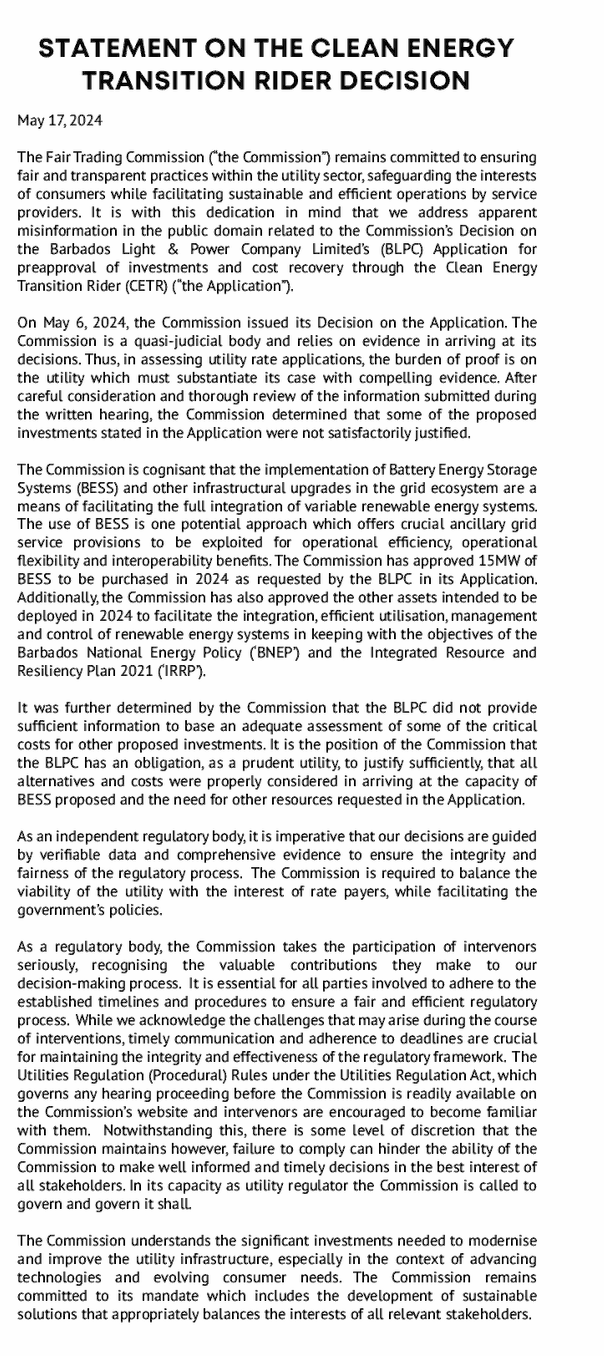
    On May 6, the Fair Trading Commission issued its decision on Barbados Light & Power Company Limited’s application for pre-approval of investments and cost recovery through the clean energy transition rider (CERT). Ricky Went, an intervenor in the process, shares his assessment of the FTC ruling and its implications for consumers.

    Regarding electricity interconnection infrastructure, do you support the proposed upgrades required on the network to facilitate renewable energy integration?

    As per our affidavit, BLPC states that ‘based on current interconnection requests from potential independent power producers, the Ronald Mapp Highway corridor stretching from the St Thomas to Trents and North substations have a high renewable energy interconnection demand. Our team supports this BLPC proposal. Only the cost related to this aspect should have been approved, possibly with a ten per cent contingency. BLPC should first have to demonstrate that it is cost effective to upgrade plant in other areas prior to approving the remainder.

    What is your view on the need for battery storage on the grid and the amount the FTC has approved?

    FTC’s approval of 15 MW of battery energy storage system (BESS) at this time is reasonable in order to maintain the integrity of the grid. However, as per our affidavit, instead of battery storage, the Government favours pumped storage as a long-term solution – a 50 year life-span – and is currently exploring funding for technology which offers high storage efficiency, stores large quantities of energy and is more cost-effective over the long term.

    Is there a need for more clarity in the way that cost savings from BESS are quantified and passed onto consumers?

    Cost savings are acknowledged and will be assessed after close monitoring. However, in our affidavit as intervenor in the CETR application, it was pointed out that as per the case with the existing 5MW BESS, BLPC will realise substantial savings which should be incorporated into its analysis to arrive at CERT’s tariffs. Indeed at page 79 of the report entitled “Appendix 1 Analysis of the Deployment of Battery Storage Systems for Barbados” it shows scenarios of savings arising from fuel cost reductions. Given the phenomenal revenue requirement, FTC must ask BLPC to quantify the savings to offset costs. Our team still maintains that an estimate should be included to reduce the burden on consumers upfront.

    You were strongly opposed to BL& P’s requested $131 266 265 revenue requirement for the proposed $684 904 562 Clean Energy Transition Plan (CETP) Project (CETP Project 1), deeming it excessive. What is your position on this following the FTC decision?

    While the CETR mechanism seeks to facilitate the expeditious deployment of renewable energy, the intention cannot be to simply approve an application that requires more from the consumer without no reference to the baseline/starting point. Indeed, as per its rate review application of 2021 and as expected in every request for an increase in customer rates, the baseline must be established, followed by the final impact after the additional revenue requirement. The Revenue Requirement of $46.5 million requested by the company in the substantive rate application must be adjusted downwards significantly after the findings identified by the FTC and intervenors. Yet, BLPC wanted an approval of $131 266 265 to be granted mostly on the premise that its request is necessary to comply with the Barbados National Energy Policy of 2019.

    Our team strongly disagrees with this position being taken by BLPC and stresses that the FTC must insist on getting the full picture. This is necessary to ensure that while a utility must be allowed to recover its investment, the regulator also has to be mindful of the impact on ratepayers.

    Our team maintains this position and feels the FTC should have been tougher on BLPC.

    What is your assessment of the final impact the average BL& P customer will face from the FTC decision on CETR recovery?

    In our data request filed on December 8th December 2023, our team sought to get a full appreciation of the impact of the CETP-Project 1 on the various customer classes. The information was not made available.However, in a recent data request from the FTC, BLPC provided CETR customer samples of bills on February 16, which were particularly helpful. Our team used the information to arrive at proxies for each customer class over the period 2024 to 2026. Our analysis showed that an average customer bill in each class will skyrocket between 20.7 per cent and 26.2 per cent.

    If the current customer bill does not reflect the interim rate, then the percentage increases would be higher. Further, if BLPC’s subsequent request to recover the cost of renting the 11 MW Aggreko diesel generator is approved then several customers will not be able to pay their bills.

    The impact on the customer bill ought to be further considered in light of two key international statistics. One is the cost of electricity in Barbados compared to other countries in the world. Electricity rates paid by Barbadian consumers and businesses are among the highest in the world. Secondly, the carbon dioxide emissions by Barbadians are amongst the lowest in the world at 0.00046 per cent. Against this background, customers do not have the appetite to take on the additional cost.

    Source: Nation


  3. New billing policy

    FTC to allow utility companies to use retroactive system

    The Fair Trading Commission (FTC) is planning to permit utility companies it regulates to charge customers for previously unbilled or incorrectly billed services.

    However, under the proposed retroactive billing policy, consumers will also be able to recover money when they are over-charged by the Barbados Light & Power Company Limited (BL& P), Barbados Water Authority (BWA), and Cable & Wireless (Barbados) Limited, which trades as Flow.

    For over-billed amounts of $100 or greater, customers would be entitled to receive a refund in the form of a cheque or bank transfer, while payments below $100 would be applied as credits to customer accounts.

    There would also be the option for customers to “indicate their preference for amounts in excess of $100 to be credited to their account in lieu of a cheque or bank transfer”.

    The FTC has issued a consultation paper on the matter and is inviting customers, utilities, other licensed operators, Government ministries, non-governmental organisations, consumer representatives, businesses and all other interested parties to submit written comments on what it is proposing. The deadline is June 26.

    Back-billing

    The regulator explained that retroactive billing, also known as back-billing, or catch-up billing, “is a method of billing employed by utilities, where a customer is billed for previously unbilled or incorrectly billed consumption periods”.

    Arrears on a customer’s account which arose from non-payment were excluded.

    The commission said that based on its experience with complaints dealing with retroactive billing, it believed that customers and utilities “may benefit from a policy that codifies the practical operation of the duties and responsibilities of utility service providers when billing customers”.

    “The establishment of a retroactive billing policy would ensure that utilities are recovering, and customers are charged the correct amounts for services rendered under set parameters,” it outlined in the 29-page consultation document.

    The FTC stated that “between January 2015 and September 2023, 34 of the 51 billing-related complaints received by the commission from customers of the BL& P related to retroactive billing, where the utility sought to recover a previously unbilled or under-billed amount”.

    “For this same period, of the 86 billing-related complaints received from the BWA, 29 were related to retroactive billing. Forty-three per cent of all BL& P complaints and 28 per cent of all BWA complaints received related to retroactive billing. There were 79 BL& P and 103 BWA (billing and service combined) complaints from customers,” it said.

    Complaints

    “Records show that during the above referenced period, retroactive billing issues represented the largest category of all complaints against these two utilities. There were two retroactive billing complaints related to the Cable & Wireless, not a significant amount,” the FTC added.

    The commission proposes to allow BL& P, BWA, and Flow to retroactively bill customers when ten different situations occurred, including when previously unbilled accounts exist; the customer has been utilising the utility service but has made no attempt to contact the utility to arrange payment; the customer has not co-operated with attempts to obtain meter readings or resolve queries requested by the utility; incorrect meter readings due to human or system/infrastructure errors; and failure of the customer to report a fault or issue, resulting in the gradual accumulation of debt on the customer’s account.

    This was in addition to an installation of the incorrect meter type; the account has not been registered, was not included in the meter database and was therefore never billed; the service was previously unbilled due to oversight; there was an error in account number; and the service was used and charged at a price lower than the published rate. The FTC is suggesting that where a utility is untimely with its billing but wants to claim retroactive payment it “should be restricted to billing the customer for a maximum of 24 months, where the referenced period exceeds two years”.

    In instances where the utility can prove the customer was at fault, retroactive billing will be permitted for up to six years, as is allowable for debt recovery under the Limitation of Actions Act.

    Utility companies will have to follow mandated procedures when using retroactive billing and will not be able to apply interest to the amounts they want to recover.

    “Where the retroactive billing results in the customer being indebted to the utility, the customer must be allowed payment options. The minimum period allowed for repayment should be at least equivalent to the time over which the debt accrued,” the FTC said.

    “In instances where the debt is considered excessive, that is when the amount is equivalent to or greater than the monthly income – salary, pension – of the customer, the customer should be given a lengthier period over which to repay the debt.”

    The commission also proposed that “if a customer is not in agreement with the decision of the utility, he/she has the right to submit a formal complaint to the commission. While the matter is under investigation, service should not be disconnected”.

    (SC)

    Source: Nation


  4. BL&P request

    Utility wants FTC to relook battery storage limit

    BARBADOS LIGHT & POWER COMPANY (BL& P) wants the Fair Trading Commission (FTC) to reconsider its decision to limit the amount of battery storage the utility can invest in and recover the cost of via its Clean Energy Transition Rider (CETR).

    Three months after the FTC approved 15 megawatts (MW) of the 90 MW BL& P applied to install as part of its Clean Energy Transition Plan (CETP) project, the company says a technical evaluation has concluded that even with the 15MW in battery energy storage systems (BESS), the electricity grid will be unable to accommodate additional distributed photovoltaic (DPV) systems.

    BL& P says it has written to the FTC since the issuance of its decision in May to request that “the quantum of BESS capacity, which was approved, be reconsidered, and highlighting the urgency of the requirement for synchronous condensers (SCOs) for additional grid stability”.

    The FTC had denied BL& P’s application for the additional 75 MW of BESS and did not approve the SCOs, citing uncertainty in relation to cost.

    The electricity company says it has made good progress in the procurement process for BESS, which are required to ensure stability on the public grid and accommodate additional intermittent renewable energy customers.

    BL& P said its technical evaluation concluded that the 15 MW of BESS “will help facilitate an acceptable level of grid stability up to a maximum of 99.9 MW of total installed DPV systems when implemented”.

    It reports that “given that the DPV systems on the grid were close to 100 MW on August 1, no more can be connected to the grid at this time until additional BESS capacity is installed.

    “The results of the evaluation also highlighted that apart from needing more BESS capacity to maintain grid stability, the installation of additional devices such as SCOs – previously recommended – were urgently required,” the company said.

    “The SCOs were also part of the CETP application to the FTC, but they were not approved by the regulator, which requested that a cost benefit analysis be first conducted on the possibility of converting retired generators to SCOs. This analysis is in progress. However, even if Light & Power converted all of the retired generators, additional new SCOs will be required.”

    It explained that SCOs “help to adjust voltage on the electric power transmission grid, as well as provide fault current to aid protection relay functionality, so they are now required since we are adding higher amounts of inverterbased solar PV systems that do not provide the same level of stability as traditional fossil fuel generators”.

    Updated pricing proposals

    BL& P said it shared the findings of the technical evaluation with the FTC and also requested updated pricing proposals from suppliers “because of the time that had elapsed between the original application to the FTC and receipt of approval from the regulator for the 15 MW of BESS in the middle of this year”.

    It stated that the updated pricing proposals revealed an average cost increase of about 30 per cent for 15 MW compared to 90 MW, due to the loss of economies of scale, among other factors.

    Given these developments, BL& P said it wrote the FTC requesting it to reconsider its decision in relation to the CETR – specifically the 15 MW limit and non-approval of SCOs.

    Under the CETR, the utility will recover the cost of its investments in the CETR, including BESS, from its customers.

    The FTC has approved cost recovery of 15 MW ($22.2 million) for 2024 and all of what BL& P applied for in relation to automatic generation control systems, distributed energy resources aggregation and control platform and independent power producers interconnection.

    Cost recovery for the remaining 75 MW of BESS (about $93 million) and SCOs ($6.9 million) was not denied. (SC)

    Source:Nation


  5. Here are yet ANOTHER set of imposed foreign albino centric owners (EMERA), seeking to further exploit Bajan BBs – simply because we are so gullible and willing to bend over and take it…

    But if this country is REALLY unable to find a set of COMPETENT LOCALS with the capability to manage our VERY BASIC energy needs, – after 80 years of free education – and after BL&P itself, was run with outstanding success BY LOCALS, – up until it was sold to the albino-centric EMERA by a set of political clowns, ….then we FULLY DESERVE to be screwed as they are currently doing…

    What a place
    What blindness
    What poor leaders


  6. @Bush Tea

    The BL&P before Emera was a public company? How could the government have orchestrated the company to be a local company? You agree then it should have been nationalized?


  7. Did you not own shares in BL&P before the sellout?
    Did our NIS not own a sizable block of shares?
    Did the NIS (government) not have a director on the Board?

    You playing dat you don’t know…
    The sellout started with ‘BL&P Holdings’, and ended when this company sold its block to EMERA ..and government decided to sell off theirs too…

    Now that the shit has hit the fan, we all will be paying the price, while EMERA rapes and ravishes our BB donkeys.

    What nationalize what??!!
    For some shiite ‘Senior Minister’ to come up with yet another Steal Project?

    It was PRIVATELY owned – and managed by persons who were selected on MERIT, and held continuously accountable for actual performance.


  8. Thanks for the refresher Bush Tea. The government was thirsty for foreign currency at the time.


  9. The government was thirsty for foreign currency at the time.
    ~~~~~~~~~~~~
    LOL @ David
    You reading too much Harry Russell stuff… with your fancy language…

    The damn idiots sold off our BIRTHRIGHTS – in the form of fundamental energy assets, for a can of shiite soup.

    Were the funds not specifically directed to pay off the Four Season Scam or some such shiite?


  10. Back to drawing board

    FTC wants to review decision on battery storage tariffs

    THERE ARE CONCERNS that similarities between two national programmes for providers of energy market battery storage could cause confusion among potential investors.

    This has prompted the Fair Trading Commission (FTC) to launch a January 13 to February 7 public consultation to review its June 2023 decision to use energy storage tariffs (EST) in a pilot programme to implement battery energy storage systems (BESS) projects.

    The conflict has emerged because, as currently proposed, the FTC’s EST framework and Government’s new framework for energy storage are both expected to apply to BESS in the one megawatt (MW) to ten MW capacity range.

    “That essentially presents two options to developers who wish to provide BESS services in the Barbados energy market. This is a situation that both the Commission and the Ministry of Energy and Business wish to avoid,” the FTC says in a Review And Variation Of The Decision On Energy Storage Framework And Tariffs consultation paper.

    “The overlap in terms of size category in this instance could create confusion among potential investors and this does not align with regulatory principles of clarity and predictability.”

    The regulator added that “owing to the importance of driving investment in the energy sector, it is important to send clear signals to the market”.

    It noted that “since the issuance of the decision in 2023, the Commission is aware of some interest by potential investors [but] due to the lack of an established BESS licensing component within the Ministry of Energy and Business renewable energy licensing framework, no applications could be processed”.

    The FTC reminded that BESS was needed because Barbados’ energy sector had predominantly seen the installation of variable renewable energy resources, mainly solar photovoltaics.

    “This and other intermittent resources are known to introduce stability and sustainability issues into the grid, leading to the need for mitigation measures. Indeed, the Government identified energy storage, particularly BESS, as a means of combatting the deleterious effects of these intermittent resources,” it said.

    The FTC’s 2023 EST framework for storage had proposed a four-year pilot project. The first two years of the pilot programme was expected to see the design, procurement, installation and connection of the BESS equipment.

    The remaining two years were to cover the operation of the projects and collection of the relevant data to assess the performance and viability of the projects.

    It was to focus on the use of BESS of four, three and two-hour durations, with a total allocated capacity of 50 MW.

    The FTC said the EST and associated framework “shall be reviewed every two years”, adding it “reserves the right to conduct reviews on a more frequent basis should market conditions deem it prudent”.

    The consultation paper observed that subsequent to the Commission’s determination on its pilot programme, “there have been significant developments which impacted the energy sector”.

    Among them was the fact that Government “has initiated the process of implementing a competitive procurement (or auction) framework for energy storage”.

    “With assistance from the Inter-American Development Bank, the Government undertook a consultancy to develop a competitive procurement process that facilitates the procurement of utility scale energy storage and is now close to launching its first round of procurement of 60 MW of BESS,” said the FTC.

    It explained that the auction process, being led by non-profit entity RELP, “is one of the main reasons for the Commission’s review of the decision at this stage, owing to the need to have the EST pilot and the auction clearly delineated such that investors can easily understand the regulatory environment and make decisions as warranted”. (SC)

    Source: Nation


  11. Who the Hell is RELP?

    What a place!


  12. Thanks Hants.
    The question was rhetorical.

    It HAD to be yet another of the usual suspects of albino-centric parasites, who are expert at spotting gullible and clueless government Judases, and leverage themselves into plantation-like relationships with the locals.

    RELP looks like EMERA on steroids….

    Our leaders are all sick in the mind.
    After 80 years of national investments in FREE education, we are unable to guide such national development projects?
    Are the people at BL&P (NOT EMERA) incompetent?, untrained? or just not interested?

    These UN linked people are all predators….
    How descendants of 400 years of slavery can be so quick to run to such obvious predators – and hand their intimate utility assets and its management and planning over to such strangers can ONLY be explained as a curse.

    Any bets that RELP have a black female face on staff – to allay any fears of persons like stinking Bushie??
    ..Just like they had with Covid 19, and with the Tuskegee Syphilis experiment…

    What a screwed up world….


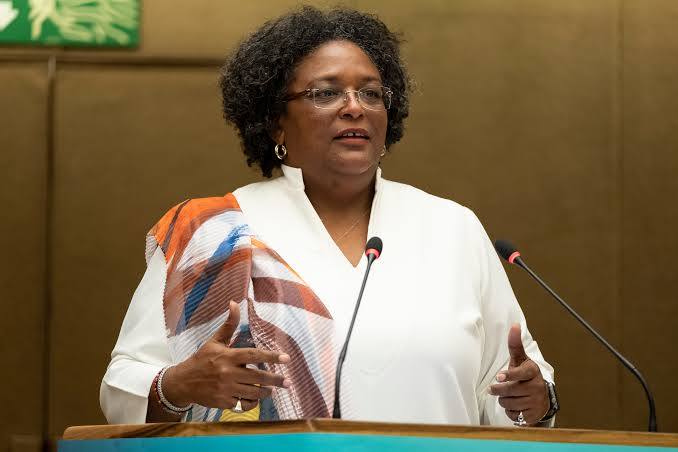
  13. PMMIA in the spotlight.

  14. NorthernObserver Avatar
    NorthernObserver

    she has a cadence, and fluidity, the envy of any public speaker.


  15. Too sweet; too sweet.

    She may have ditched her oversized scarves. But my or my! Does she not look regale in that black and white royale outfit.

    She truly is a don when it comes to public speaking. Too bad that she remains unfit to run a small island population with a predominantly homogeneous population of 280,000.

The blogmaster invites you to join the discussion.

    Trending

    Discover more from Barbados Underground

    Subscribe now to keep reading and get access to the full archive.

    Continue reading