← Back

Your message to the BLOGMASTER was sent

The Samoa Agreement and neo-colonialism in the Caribbean

Caribbean Organisation for Peoples Empowerment Caribbean

By A.T. Freeman

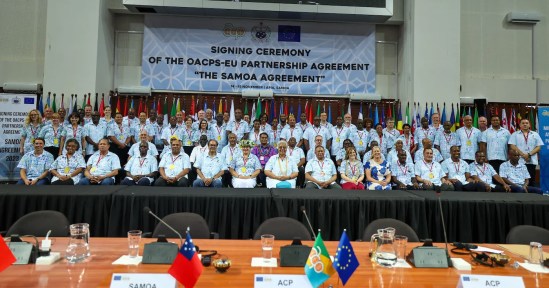
On 15 November 2023, the signing ceremony for the Partnership Agreement between the European Union (EU) and its Member States and the Members of the Organisation of the African, Caribbean and Pacific States (OACPS) took place in Apia, the capital of Samoa. The agreement, which is generally referred to as the Samoa Agreement, is a legally binding document between, on the one hand, the member states of the EU and the EU itself and, on the other, the member states of the OACPS. In essence, the document attempts to give legally binding force to the political demands of the EU on the OACPS member states which want to access loans from the European Investment Bank (EIB). 

Background to the Samoa Agreement

Although negotiations on the Samoa Agreement began in 2018, the process that produced it dates back to 1957. In that year, the Treaty of Rome was signed establishing the European Economic Community (EEC), the forerunner of the EU. In light of this unification, the newly formed EEC considered it necessary to make new arrangements with regard to their colonial territories. At that time, these were primarily French colonial territories in Africa. As the EEC expanded, eventually developing into the EU, this process also developed and produced the 2 Yaoundé Conventions, 4 Lomé Conventions and the Cotonou Convention which was signed in 2000 and expired in 2020.

The Samoa Agreement is the most recent document in this series and is intended to replace the Cotonou Agreement. Like its predecessors, it is driven primarily by the imperial interests of the EU which sets its political and economic direction.  For example, the OACPS excludes the North African countries of Algeria, Morocco, Tunisia, Libya and Egypt reflecting Europe’s longstanding racist division of Africa into so-called North Africa and “black Africa” or “sub-Saharan Africa”. Furthermore, the OACPS Secretariat is funded completely by the EU and is located not in Africa, the Caribbean or the Pacific, but in Brussels, the capital of Belgium.

Read full article Caribbean Empowerment blog.


Discover more from Barbados Underground

Subscribe to get the latest posts sent to your email.

11 responses to “Samoa Agreement, unpacked”


  1. The challenge is and always will be for the underdeveloped world to mobilize to decouple from the ‘establishment’.


  2. Christian right not free to impose their beliefs

    This article was submitted by Peter Laurie, a former head of the Barbados Foreign Service and author of several books. The Christian right is at it again.

    Their new target is the partnership agreement between the European Union (EU) and the Organisation of African, Caribbean and Pacific (OACP) countries officially signed on November 15, 2023, by the EU and its member states and OACP members in Samoa.

    This new Samoa Agreement (SA) serves as the legal framework for EU relations with 48 African, 16 Caribbean and 15 Pacific countries. The SA establishes a genuine partnership among equals whose aim is to go far beyond aid and trade. It sets out common principles and covers the following six priority areas: democracy and human rights, sustainable economic growth and development, climate change, human and social development, peace and security, and migration and mobility.

    So far, Barbados and six other CARICOM countries have signed the agreement.

    Now you would think such an international agreement, encompassing well-known principles of multilateral cooperation for sustainable development, would have been enthusiastically welcomed by everyone. In fact, practically all the goals and aspirations in the SA are also to be found in the United Nations (UN) Sustainable Development Goals endorsed by all UN members in 2015.

    What has changed in the last few years is the exponential growth of the Christian (mainly Evangelical) right in alliance with white nationalism in the United States that seeks to come to power via a second Trump presidency and to extend its subversive reach across the globe, including here in the Caribbean. Groups like Mums For Liberty, Alliance Defending Freedom and Family Watch International, have been organising well-financed, worldwide campaigns that target the LGBTQ community. They usually do so under the banner of “parental rights”, and “protecting our children”, goals that appear worthy of support.

    Criminal offence

    In Uganda, these groups threw their financial weight behind legislation that made homosexuality a criminal offence punishable, in certain circumstances, by death.

    Surprisingly, the most vigorous assault on the Samoa Agreement came from the Roman Catholic Archbishop of Port of Spain, who alleged in a video address that “. . . . Caribbean parties to the agreement . . . will have to impose abortion legislation, transgender, LBGTQ, comprehensive sex education, a whole range of values will be imposed . . . . The EU is imposing upon us an ideology that is not ours and a value system that is not ours. Whoever signs that document will then have to impose laws on their people that are not in keeping with the culture, values of us Caribbean people and it will be a colonial imposition one more time on small fragile states”.

    I say “surprisingly”, because the Roman Catholic Church has long opposed discrimination against the LGBTQ community and laws criminalising homosexuality. Pope Francis, while not condoning homosexual practices, has encouraged church leaders to act with “pastoral charity” and welcome all in the church.

    Baffling

    The baffling aspect of all this hullabaloo is that nowhere in the agreement is abortion, LGBTQ, transgender, sexual orientation, gender identity or same-sex marriage even mentioned. As for “comprehensive sexuality education” (CSE), the agreement simply says: “Parties shall stress the need for universal access to quality and affordable comprehensive sexual and reproductive health information and education.”

    So what exactly are these people objecting to in the SA?

    You have to understand that the Christian right sees a sinister “global sexual rights revolution” that seeks to undermine the nuclear family, unleash sexual predation on children, subvert religious values and sow “gender confusion”. They are highly suspicious of any mention of human rights. For example, they find the following paragraph in the SA offensive: “The parties shall commit to the promotion of universal respect for, and observance of, human rights and fundamental freedoms for all, without discrimination based on any ground including sex, ethnic or social origin, religion or belief, political or any other opinion, disability, age or other status.”

    These are provisions that exist not only in the 1948 Universal Declaration of Human Rights, but also in most constitutions across the world. But it’s the two words “other status” that is causing them issues. These might include sexual orientation, that nefarious road to hell and damnation.

    They also take particular exception to the mention of “gender equality”, even though wherever it is mentioned in the agreement, it specifically refers to women and girls. For example: “The parties acknowledge that gender inequality deprives women of their basic human rights and opportunities. They shall adopt and strengthen enforceable legislation, legal frameworks and sound policies . . . to ensure women’s and girls’ equal access to . . . and equal participation in, all spheres of life.”

    What is there possibly to disapprove of in these words? Let me tell you. It’s the word “gender”.

    They also object strenuously to the mention of women’s reproductive health because, to them, this means the legalisation of abortion. In the US they have supported virulent state laws that have endangered women’s reproductive lives and health, especially women of colour.

    For example, the following sentence from the agreement: “The parties shall support universal access to sexual and reproductive health commodities and health care services, including for family planning, information and education, and the integration of reproductive health into national strategies and programmes.”

    These health services have long existed in Barbados. Access to abortion has been legal since the Medical Termination of Pregnancy Act of 1983.

    To call the Samoa Agreement a colonial imposition by Europe on the Caribbean is being highly uninformed. You might as well argue that Christianity is a European colonial imposition.

    If anything, the external threat emanates from the American racist, authoritarian, Christian right famous for ecological irresponsibility and fundamentalist antagonism to science.

    Barbados is a secular democracy based on universal human rights, not a theocracy. People of all faiths are free to believe what they want, but they’re not free to impose their beliefs on others.

    Source: Nation


  3. Fully implement Samoa deal

    By Tony Best

    A leading Caribbean trade and investment expert, Errol Humphrey, a former top Barbados diplomat in Brussels, wants his birthplace to support and fully implement the new Samoa Agreement the European Union.

    “From my perspective it would be wise for Barbados to sign on” and fully implement it, said Humphrey, Barbados’ Ambassador in Belgium during the first decade of the 21st century. “I don’t see any reason why our country should not sign and implement it.

    “You have to put the Agreement into context,” insisted Humphrey. “The partnership between the EU and the CARIFORUM countries (Caricom and the Dominican Republic) has brought more development support to the Caribbean (Barbados included) than the US (has provided) for a long time and by a long way.

    “We talk a lot about the fact that the US is close by, but in terms of development over the years the European Union has provided a lot more financial (and other) support to the Caribbean region and our country over the years than the US. That is all part of the entire process,” he said.

    Comprehensive partnership

    Actually, added Humphrey “the partnership has progressed from a basic trade agreement 40 years ago to where it is today, a far more comprehensive partnership where we are not only getting grant funds from the EU but where we are getting” a variety of development assistance.

    “Don’t forget that these small island countries (Barbados included) have almost zero chance of getting anything changed globally,” insisted the Barbadian. “But if these small states can find common partnership with the EU, China, the US and the ‘big players’ it increases the chances of getting something that you want done. That’s why I look at the Samoa Agreement as an area where there is an opportunity to work with large and influential countries in areas where you have common interests. We are not going to agree on everything but there are areas where we can say ‘you go on we are not in that’ and in other areas where they will say to us ‘we can’t support that.’ But there will be occasions when we have common cause, and that’s when it is important to have someone in your corner like the EU.”

    Humphrey stated that there is never a chance everyone will agree on everything.

    For instance, the Europeans have “a long tradition of making provisions for islandcountries and the EU has been promoting climate change and so on for decades, long before most of the rest of the world was interested in it,” added Humphrey, “That’s an example of an area of common ground and it explains why we see Europe as one of our partners.”

    The Samoa Agreement signed last month by the EU and the Organisation of African, Caribbean and Pacific States will serve as an “overarching” legal framework for relations for the next 20 years, said the EU. It will succeed the Cotonou Agreement and covers such areas as sustainable development and growth, mobility, migration and security.

    Edmund Hinkson who represents Barbados on the Organisation of African, Caribbean and Pacific States and the EU joint parliamentary assembly, said the recent pact “protects Barbadians of all walks of life.”

    References to gender

    Kerrie Symmonds, Barbados Foreign Minister who affirmed Barbados’ signing of the Samoa deal, said among other things, while it was infused with references to gender, Barbados could steer its own way down the gender ship.

    As for questions about gender, the LGBTQI community and the faith-based organisations in Barbados and the rest of the Caribbean, Humphrey said it wasn’t a new issue, “It has been around for a long time,” and Barbados having signed on to a number of international human rights agreements would decide how it was going to deal with it, recognising it was (1) a “complex and controversial” matter and (2) “there was no way everyone in the country would agree to a single path.”

    Turning to global trade and other economic matters, Humphrey said “the big plus for us isn’t so much whether there was going to be increased trade with the EU, but whether Barbados as a country and the Caribbean as a region would become more internationally competitive.” In that case it could turn out to be a “plus,” for the Caribbean.

    “In reality if we are able to sell more things to the US, Canada, Trinidad and Tobago, Argentina and Chile while selling less and less to the EU we are going to be still better off,” said the expert, a former chief executive of the Barbados Investment and Development Corporation who became Consul-General in Toronto before moving to Brussels.


    Source: Nation

  4. whataboutery preached Avatar
    whataboutery preached

    Racism is now wrapped up in various dogma, such as gay rights issues.

    African and Caribbean (black) nations and individuals have been criticised in past for views against homosexuality, and are now being criticised for tolerating it.

    Christianity and other religions are responsible for regressive outdated social ‘laws’.

    The whataboutery preached to black nations is white noise to distract from white nations blatant hostile aggressive violent prejudiced past and insidious ongoing prejudice, crimes and breaches of human rights against blacks and issues of reparations due.


  5. These White supremacists getting ready for WW3.

    A war dey can’t win in a century of Sundays.

    Both it and these feckers should be preempted

    With wunna know what!

    Our man Putin must start pulling his weight ……. like a local sports commentator once opined about a matter far less prescient. LOL

    Of course, he was fired.


  6. BREAKING NEWS:

    According to #NewYorkTimes, President Nicolás Maduro says an oil-rich part of Guyana belongs to Venezuela. Voters agreed on Sunday…”

    COULD THIS BE THE 1ST MAJOR CONFLICT IN THE CARIBEEAN IN DECADES???

    #StayTuned

    https://www.nytimes.com/2023/12/03/world/americas/maduro-vote-essequibo-guyana.html


  7. The so called first world is quick to pump millions7billions into areas where their naked self interest is exposed. However, in our region it will be reluctant to do the same. It is how foreign policy of these developed countries is shaped.

    IDB launches ‘One Caribbean’ initiative

    DUBAI – The Inter-American Development Bank (IDB) has launched One Caribbean, a new regional initiative aimed at promoting the sustainable development of the Caribbean, “with a sharpened focus on high-impact initiatives”.

    “Caribbean countries are among the most vulnerable to the adverse impacts of climate change, such as rising sea levels, threats to agriculture and biodiversity, and more intense and frequent hurricanes and tropical storms,” said the IDB on the sidelines of the ongoing United Nations Climate Change Conference (COP 28).

    The Washington-based financial institution said that the One Caribbean programme includes four pillars, namely climate adaptation, disaster risk management and resilience; citizen and business security; sustainable development through private sector engagement; and food security.

    The IDB said institutional strengthening and digital transformation are “cross-cutting areas of work” and that the goal of One Caribbean is “to promote integration and resilience across the region through the support of projects and partnerships that can have a regional impact.

    “The programme proposes establishing a Project Preparation Facility (PPF), along with a strategy for partnerships and resource mobilisation, with financial innovation at its core,” the IDB said, adding that the programme seeks to generate investment scans that will lead to national digital and resilient investment plans.

    Barbados Prime Minister Mia Amor Mottley, Jamaica’s Minister of Finance, Dr Nigel Clarke, the president of the Barbados-based Caribbean Development Bank (CDB) Dr Gene Leon and the IDB president, Ilan Goldfajn, participated in a panel discussion at which the initiative was launched.

    “The IDB is fully committed to supporting the Caribbean,” Goldfajn said, adding “with One Caribbean, the IDB is putting forward a regional programme that aims to support the Caribbean in becoming a more resilient and competitive region that can overcome the challenges posed by climate change”.

    The IDB said it has also reinforced its collaboration with the CDB by signing an addendum to the 2020 Mutual Cooperation Agreement.

    “This new action plan strengthens activities aimed at addressing climate change resilient – physical and digital – infrastructure, project preparation and execution in priority areas, private sector productivity and development, and exposure exchange agreements and other financial products, among others,” the IDB said.

    It said the countries of Latin America and the Caribbean are “a critical part of the solution to global climate change challenges”.

    It added that its “Pavilion of the Americas” at COP28, is hosting more than 30 events with international leaders and experts “to showcase initiatives on climate action, from cutting-edge financial instruments to the conservation and sustainable use of natural resources, the Amazon, a just economic transition and more”. (CMC)


  8. @Tee White

    Barbados is going with the flow, the old fashion values practiced in days of yore are becoming less relevant to an emerging generation. Our politicians are many in NGO sector are spineless. We are at the mercy of the establishment north.


  9. PM Mottley wants pause in debt repayments by SIDS hit by natural disasters

    Article by Barbados Today
    Published on
    December 3, 2023

    Prime Minister Mia Mottley is advocating for an agreement that would enable Small Island Developing States (SIDS) to temporarily halt debt repayments in the aftermath of a disaster or crisis.

    The Prime Minister made these remarks during the inauguration of the Barbados Pavilion at the ongoing 28th edition of the Conference of the Parties (COP) in Dubai, United Arab Emirates (UAE).

    COP is an annual United Nations (UN) climate meeting where governments discuss strategies to mitigate and prepare for future climate change.

    In her address to the gathering, PM Mottley emphasised the urgency of the situation, stating, “We are already in the midst of a crisis,” and called for a global understanding to suspend debt repayments when crises hit SIDS.

    Barbados could potentially unlock around 20 per cent of its Gross Domestic Product (GDP) within two years through such an arrangement, according to Mottley.

    She asserted, “This is the most far-reaching instrument to give countries fiscal room,” highlighting the significance of the proposal.

    Acknowledging the World Bank’s support, PM Mottley commended its President, Ajay Banga, for recognising the needs of SIDS, stating that “the debt pause clauses would be used for existing financial instruments that the World Bank has provided, [giving] immediate relief to people.”

    Mottley further explained the concept of debt-for-nature swaps and debt-for-claim swaps, stressing the redirected benefits toward initiatives like the Barbados Marine Trust for environmental protection.

    The World Bank’s involvement has already released between US$50-60 million over 15 years, demonstrating the tangible impact of this approach.

    The Prime Minister announced plans for a debt-for-climate swap this year, involving collaborations with institutions such as the Inter-American Development Bank, the European Investment Bank, and the Green Climate Fund.

    This initiative, Mottley said, is aimed at repurchasing US$300 million of debt to fund a crucial sewage treatment plant for the people and businesses of Barbados, particularly on the South Coast.

    Addressing the increasing uninsurance and under-insurance in the Caribbean region due to high premiums and escalating climate-related incidents, Mottley pointed to the urgent need for fiscal resources to safeguard families and businesses from the adverse effects of the climate crisis.

    PM Mottley underscored the unique challenges faced by SIDS, such as high exposure to natural disasters, climate change, global economic shocks, and limited resources for resilient development.

    These challenges, she argued, hinder their growth prospects and necessitate global cooperation and support.

    (RT)


  10. Homosexuality is the last sign for Human Extinction….why r peoole so self destructive this days


  11. Addressing concerns on Samoa Agreement

    The following article was written and submitted by Sandra Husbands, Minister of State in the Ministry of Foreign Affairs and Foreign Trade and in Business Development.

    The Families-Faith-Freedom Barbados has responded with a Letter to the Editor of their continued concerns over the Samoa Agreement and its method of execution. Civic engagement is an important aspect of good nationbuilding and is to be valued.

    The matter of engaging stakeholders to inform the negotiations of the agreement would have been executed over a two-year period. The specific stakeholders directly impacted by varying sections of the agreement in a specific space would have been consulted, especially if a change was major or if there were inclusions and requests from these stakeholders to be negotiated. These took the form of meetings, distribution of relevant sections for consideration and feedback.

    For example – maritime issues would be the ministries and their stakeholders, tax issues to finance and business support organisations and associations. Private sector development, legal affairs, customs and police on crime, small arms, and so on were sent to specific entities involved in these matters.

    The issue of an expanded concept of what is gender and so on was not a position that our law allows or a mandate that negotiators were given to negotiate changes to the meaning of gender. Therefore, consultation with stakeholders outside of health on this matter was a non-issue. There has been no change to the Barbados position.

    Unwieldy

    The reference within the document to broad consultation with the general public (wider stakeholders) was in reference to implementation of the agreement rather than negotiation of the agreement. This is why it is included within the agreement. To engage in discussion, all Barbadians on all issues to develop the 400-page agreement, would be too lengthy and unwieldy.

    Hence, engagement is done with relevant ministries, agencies, business support organisations and associations, representing the public stakeholders, to shape the document.

    Best endeavour language is used in negotiations, to guard against committing to issues in which there will be variations in the broader public opinion. How far we go must emerge from the broader stakeholder discussions in the implementation stage, and we welcome your input on those matters.

    An excellent example is that of comprehensive sexual education which is governed by best endeavour language and which must be the subject of full public discussion with parents. What is contained in the health and family life is general, but it does not purport to help students to work through a wide range of sexual issues, considerations and conduct and would not meet the test of comprehensive sexual education. That has to be discussed with parents.

    What is currently referenced in schools is insufficient to change the understanding of those of our children who are sexually active from early, who are exposed without filter to a range of sexual experiences and information, of which some parents are not aware that they know or have experienced. Hence the continuing sexual dysfunction in how some Barbadians conduct their sexual lives, resulting in unwanted consequences.

    This deeply threatens our family stability and effectiveness, which is vital for producing active, productive and well-adjusted adults to operate within a society.

    Just to clarify on the issue of human rights for all persons, I don’t believe this brings a contest or dispute.

    All humans living within a community are entitled and should never be deprived of their human rights.

    There is no condition which puts an individual beyond the right to human rights. It does not matter if it is a pope, priest, pastor, drunkard, thief, or liar. That is protected by law and so, on a constitutional matter, any court would agree that discrimination against a person so entitled should be addressed.

    The issue is not who is asking but rather the fact that a condition exists which deprives a human being of his or her rights. If a human being, then they are entitled, that is the test. These rights are conferred by society and are constrained by what, where, when and how those rights are exercised. I have a right to sing, but not to disturb the peace. Literature states that “human rights are those set of rights and freedoms that belong to every human in the world, simply because they are born human beings.

    It sets out to establish basic standards of how to treat with respect and dignity all human beings, especially in emergencies. Human rights are universal and inalienable”.

    Should a murderer be deprived of the right to a fair trial because we are angry or fearful of what he or she has done? I don’t think there is a dispute here. Barbados will always stand for the rights of all citizens regardless to the variations which exist among them. We all can agree with this.

    The terms and meaning concerning gender, as existed at the time of negotiation, is what it means.

    It cannot be changed except by agreement. It cannot be changed on a whim, otherwise people can go in corners and make up terms and conditions and then come back and say, you have to abide by this rule I created for you, without your consent.

    The agreement is clear, that force or threats are not to be used in this agreement, and that if others are affected by it in a negative way, then it has to be adjusted.

    At all times this Government is consistent in honouring the concerns of Barbados. That has prompted this engagement to provide the clarity and assurances of what this agreement means. Barbados chose to treat its citizens as mature, reasonable adults who can engage in discussion on the specifics of this agreement rather than humouring citizens as if they are children to quieten their fears by making an unnecessary gesture, which does not change the underlying facts.

    These facts are that Barbados and OACP (Organisation of African Caribbean and Pacific) states have not agreed to an LBGTQI (Lesbian, Bisexual, Gay, Transgender, Queer and Intersex) agenda. That issue is for national discussion and a national decision.

    Building a strong Barbados requires we examine our social fabric and our values. Barbadians can advance our values by agreeing with what those values are and have them reflected in our constitutional reform and parliamentary reform.

    They must be further expressed in our social and economic initiatives.

    Unfortunately, too few citizens have taken the opportunity to engage these processes. These form the bedrock of our agreement as a country and as a republic. How can more Barbadians take the time to participate and make input? On achieving that agreement, we all must volunteer to work in ways to establish these as a part of how we do family, how we do community, how we do business, how we do govern and how we represent ourselves to the world.

    Concerns about changing moral conditions and conduct are real. As a society we are challenged on every hand by the conduct and slide of Barbadian values, as we perceive them. Its solution rests, not in laws or force, but rather in addressing the root problems afflicting families and individuals. Laws only tell us where we are, they do not produce integrity, productivity or provide peaceable living. Those come from the heart and mind, which requires education and training, to bring transformation.

    Culture and values

    Our concerns are well-served by reaching out into our communities bringing the message of transformation, and mentoring people as they journey. It is the only way to reach the mind and heart. This is why the media, music, peer influence, relations, friendships and associations etc are so powerful in shaping and spreading values and conduct, because it impacts the mind and then the heart. This is expressed outwardly in actions, habits, conduct and attitudes.

    Collectively it represents the Barbadian culture and values.

    The initiatives already on the table inviting the wide Barbadian public to get on board and work to achieve a better Barbados are the education transformation programme; youth advance programme; 1 000 families initiative; financial literacy training; The National Transformation Initiative; the Parliamentary Commissions providing opportunity to make an input to children’s rights and protection agenda; labour reform initiatives dealing with employment rights, health and safety, sexual harassment; the peace initiative; and health and wellness programmes.

    These are to change minds and hearts and further change our conduct.

    Upcoming are the elder policy, the National Quality Programme and then some. So many initiatives to rebuild Barbados into a socially viable, safe nation which provides people with an environment to promote the thriving of their families and communities.

    I thank Families-Faith-Freedom Barbados for their concern. To all of us in the public, I want to share that in my view, the main component now needed for success, is the greater presence of those who care and are committed to building this Barbados, to continue to come forward. Each of us needs to find that place of service, beyond the cares of our own lives.

    The invitation goes out to all, to get on board, bring your input and bring your energy and let us build that Barbados. We will not all agree or always agree, but we can find our best efforts and build.

    All humans living within a community are entitled and should never be deprived of their human rights.

    Sandra Husbands, Minister of State in the Ministry of Foreign Affairs and Foreign Trade and in Business Development. (FP)

    Source: Nation

The blogmaster invites you to join and add value to the discussion.

Trending

Discover more from Barbados Underground

Subscribe now to keep reading and get access to the full archive.

Continue reading