



“The best argument against democracy is a five-minute conversation with the average voter…” –Winston Churchill.
“Indeed it has been said that democracy is the worst form of Government except for all those other forms that have been tried from time to time…” –Winston Churchill
The story is that the deliberations of the US Constitutional Convention of 1787 were held in strict secrecy. Consequently, curious citizens gathered outside Independence Hall when the proceedings ended in order to learn what had been produced behind closed doors. Their answer was soon provided. A Mrs. Powel of Philadelphia asked Benjamin Franklin on his exit, “Well, Doctor, what have we got, a republic or a monarchy?” With no hesitation whatsoever, Franklin responded, “A republic, if you can keep it.”
As did most of my friends by their own admission, I spent last Wednesday morning in a funk of astonishment and disbelief at the events that had transpired in the US a few hours before. We were trying, as Maureen Dowd put it in her opinion piece in the New York Times last Wednesday, to “absorb the impossible”. Despite the geographical inexactitude and patent vagueness of his campaign slogan to “Make America Great Again”; despite his petulance and clear unease at articulating clearly any policy position; despite his clear contempt for those of a race or culture different from his own; despite his abandonment by the Republican establishment after flagrant displays of an offensive misogyny and mimicry of the disabled; and despite the unanimous certainty of the pre-election polls to the contrary, Donald J Trump had secured the mandate of the people (via the Electoral College) to become the next President of the United States of America.
And yet, on further reflection, it is not that difficult to explain this alarming event, although no single factor will suffice. For one, there is the vagary of democracy itself. Churchill’s dictum in the epigraph might seem uncharitable and perhaps even out of sync with our current constitutional ethos, but it may serve eloquently to explain in part some surprising results in recent democratic decisions such as the BREXIT referendum in the UK, the rejection of the peace accord in Colombia, the Trump victory and perhaps some others besides. And polls are mostly unable to predict these types of results because the actuality is that very few responders want to be perceived as being out of step with the prevailing view. I can count, on fewer than four fingers, the number of individuals who, to my knowledge, contemplated that Trump would have won this contest and even so, this was mostly because they hated Mrs. Hillary Clinton more.
This point as to the unthinking nature of voters should not be understated. In an interesting column published online in Foreign Policy, Jason Brennan first posits inarguably that “democracy is supposed to enact the will of the people” and then queries “but what if the people have no clue what they’re doing?” His thesis is that most voters are ignorant or misinformed because the costs to them of acquiring political information greatly exceed the potential benefits. He likens the democratic exercise to a professor telling her hypothetical class of 210 million that in their final exam no individual will receive his or her personal grade but that everyone will get the same grade. In that case, he argues, no one would bother to study and the common grade would be an “F”. He concludes therefore, “…voting is more like doing the wave at a sports game than it is like choosing policy.”
For some, it might have been precisely this Brennanesque stance of belittling the native intelligence of the ordinary voter that led ineluctably to the Trump triumph. One writer has argued persuasively that the choice made on Tuesday last might have been less of a instinctual default option and more of an “intelligent” choice. For him, anger and uncertainty at the inexorable march of globalization and technology had reached such a pitch that many voters were ready for disruption [of the status quo] at any cost.
“Enough of elites; enough of experts; enough of the status quo; enough of the politically correct; enough of the liberal intelligentsia and cultural overlords with their predominant place in the media; enough of the financial wizards who brought the 2008 meltdown and stagnant incomes and jobs disappearing offshore” is how Roger Cohen expresses their collective frustration in the New York Times, a worldview that could find some commonality in Trump’s sloganeering and would be antithetical rather to the Clinton campaign where the candidate herself was perceived as the epitome of this perverse state of affairs.
Indeed, more than a few commentators in recent days have focused their readership’s attention on the unsuitability of Mrs. Clinton as the worthiest Democratic opponent for Mr. Trump. Not-so- easily-dismissed suspicions about the moral authenticity of the process that brought her the nomination as the candidate of the Democratic Party; her coziness with “them” (the financial and social establishment) and a regrettable sense of entitlement that, perhaps unfairly, suggested that she should be free from popular and legal scrutiny –what Maureen Dowd calls a “miasma of financial and ethical cheesiness”; would scarcely have endeared Mrs. Clinton to the alienated rural voter in the counties and states of Middle America.
Nor should we discount lightly the bigotry that might have induced apoplexy should a female be allowed to follow a blackish individual into the White House and that would have felt itself threatened by the inexorable “browning” of a formerly whitish USA.
Today’s headline to this column poses a question for further debate. It is part of a broader inquiry as to what type of President is Trump likely to be. Given his flip-flopping with the truth during his campaign, it would be mere conjecture to base this conclusion purely on his utterances then. Will he be the candidate who claims that he knows more about ISIS than even the generals on the Joint Chiefs of Staff and thus be the individual defender of the “Free World” or will the demands and stresses of the office, so clearly evident in the frosting of the crowns of both Presidents Clinton and Obama during their respective tenures, humble him sufficiently to tone down his inflammatory exclusionist rhetoric?
The defining characteristic of the republican system of government as distinct from that of the monarchical that the US would have successfully rebelled against in 1776, is its checks and balances inherent in the constitutional construct of the separation of powers to ensure that no one branch impinges on the exclusive preserve of the other. Trump’s campaign discourse made a mockery of this principle with his frequent references as to what “I” would do. There was no correspondingly frequent mention of “my administration”.
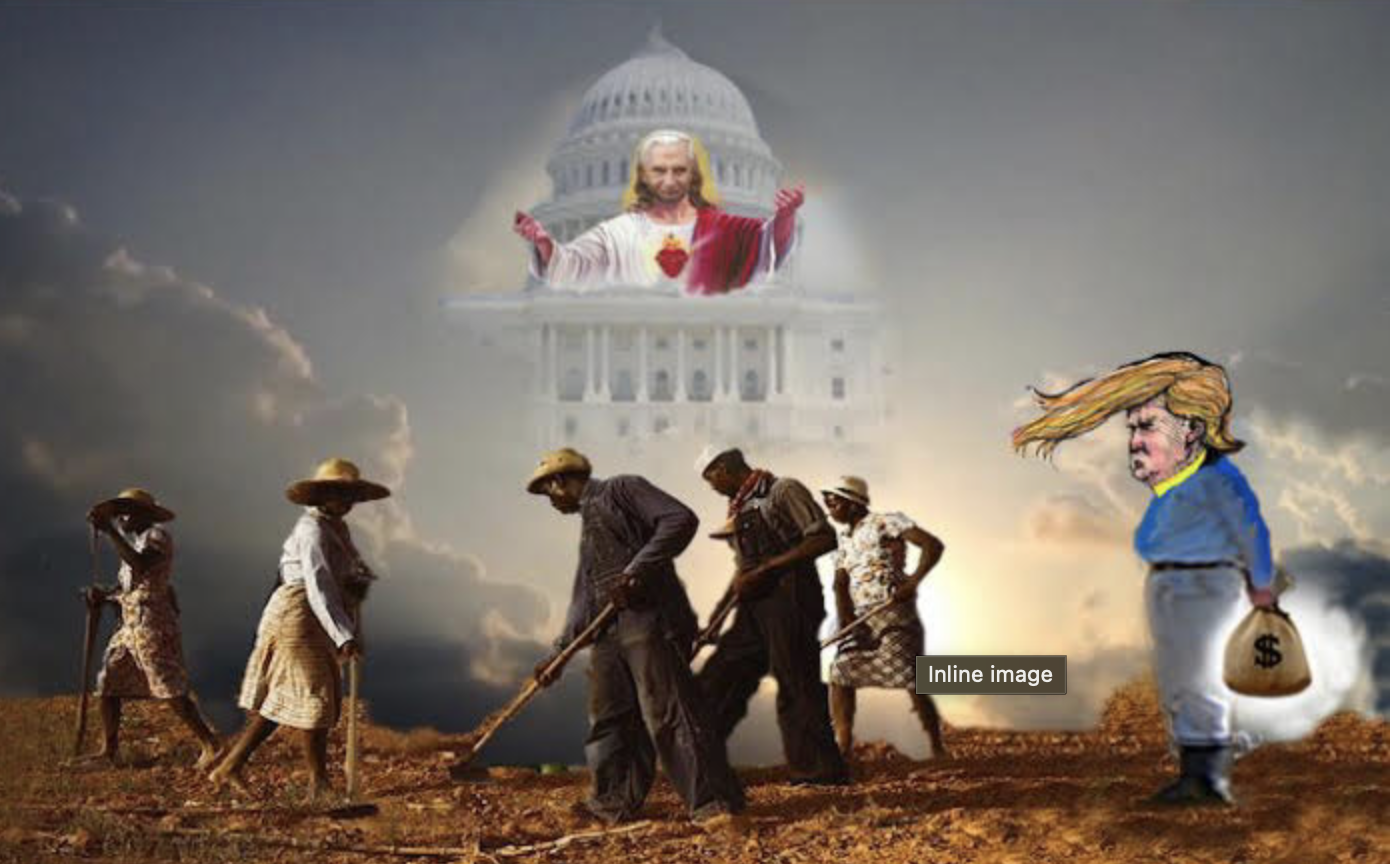
Now, with the Republicans controlling both the Senate and Congress, and with a President Trump, emboldened by his electoral mandate, entitled to reject the Republican establishment as a consequence of their earlier treatment causing him to do it “all by himself”, the circumstances are ideal for a return to a quasi-monarchical system of “Trumpism”.


The blogmaster invites you to join the discussion.