

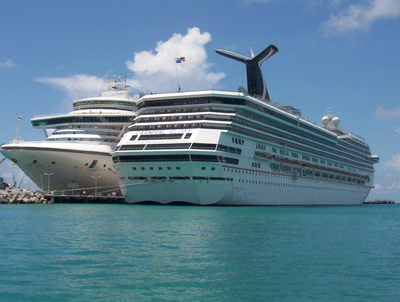


As a land based tourism entity, I clearly have strong opinions on this subject and any observations made, should bear this in mind in the interest of fairness and objectivity. Cruise tourism is a huge component of the overall global leisure industry and it is far better (in my opinion) to work with the sector and maximise the revenues and benefits. True home porting and the opportunities created by cruise and stay programmes offer the destination the best case economic scenario.
With the increase in airlift, especially from Sao Paulo and Dallas, plus planned new charter services from Northern England, it appears there is enormous further potential to build on the existing ships that use us as a turn around base. Cruise ship operators continue to have enormous advantages over their land based counterparts. These are almost too many to mention, but include substantially lower operating costs, in terms of labour, consumables and taxes. Ultimately if the going getting tough they can simply reposition and move their ‘investment’ to almost any other part of the world!
Conversely Governments have to invest massive amounts of money to accommodate these ships, and these costs will increase as the majority of newly built vessels dwarf their predecessors. While the state investment and passenger arrivals grow, does the amount each cruise passenger spends rise proportionally?
In a word NO!
According to CEO of Bridgetown Cruise Terminals Inc., Geoffrey Roach, who in a Business Barbados article dated 23rd December 2009 quoted a Florida Caribbean Cruise Association study which stated the average spend per cruise passenger in 2009 was US$69 ‘down from US$111 in 2006’. So even before you factor inflation into the equation, spending was down a massive 38 per cent during that four year period.
The shipping companies have naturally enough become evermore adept at extracting a higher proportion of their passenger’s disposable income onboard, so this could partially explain the reduction. And this certainly reflects in their annual fiscal results. Carnival Corporation alone, which boasts twelve of the major brands, declared for the full year ending 30th November 2010, a profit of US$2 billion on revenue of US$14.5 billion.
It’s therefore very difficult to understand the justification for the Barbados Tourism Authority in continuing to subsidise Carnival to the tune of a reported BDS$400,000 per year. Air travel purchased on Barbados now carries the highest rate of VAT (17.5 per cent) and departure tax in the region! The justification of the so called airport service fee is to ensure the wholly state owned Grantley Adams International Airport Inc, meets its operating costs.
Is this same criteria applied to port improvements and expansion?
What is the ‘embarkation fee’ paid by cruise passengers and why is VAT not payable on cruises?
Until all these anomalies are properly explained, there will always be resentment from sectors of the industry that do not share the overwhelming commercial advantages of the cruise industry. And that leaves many of us left to second guess whether or not cruise tourism is in fact ‘worth the investment’.






The blogmaster invites you to join the discussion.