



By William H Harriss
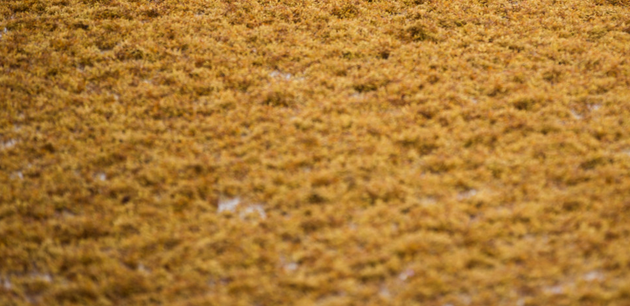
Sargasso Seaweed [Sargassum] has become the bane of every country affected by the Sargassum influx in their sea areas and beaches.
Sargassum originates from the Sargasso Sea in the North Atlantic and has spread across tropical and subtropical waters, forming the Great Atlantic Sargassum Belt.
Historical and Natural Origins
Sargassum is a genus of brown macroalgae that historically thrived in the Sargasso Sea, a region of the North Atlantic Ocean defined by swirling currents rather than land borders. This seaweed is unique because some species, such as ‘Sargassum natans’ and ‘Sargassum fluitans’, are holopelagic, meaning they live their entire life floating freely on the ocean surface without attaching to the seafloor. These species reproduce colonially through fragmentation, allowing mats to persist and expand over time.
The Sargasso Sea is approximately 1,100 kilometres (680 miles) wide and 3,200 kilometres (2,000 miles) long. It is bounded by the Gulf Stream to the west, the North Atlantic Current to the north, the Canary Current to the east, and the North Atlantic Equatorial Current to the south. This vast area is unique as it is the only sea without land boundaries and is characterized by its abundant Sargassum seaweed.
The earliest recorded encounters with Sargassum date back to Christopher Columbus, who noted vast floating masses that complicated navigation. For centuries, Sargassum was regulated by nature; the Sargasso Sea served as the primary domain of these floating algae, providing a vital habitat for fish, crabs, sea turtles, and other marine life.
For thousands of years, the growth of Sargassum was contained within the Sargasso Sea. But due to climate change, increased water temperatures, and also the change in water current directions and powers, is now breaking loose. A recent study has reported the first-ever reversal of the Deep Western Boundary Current (DWBC) in the Southern Ocean. This change is alarming as it could signal a potential collapse of the climate system, accelerate global warming and disrupt weather patterns. The Southern Ocean’s circulation is crucial for regulating heat and carbon in the atmosphere, and its alteration is leading to dramatic climate shifts globally. These changes are driving the Sargassum problem and will become a global problem which will be insurmountable.
Sargassum is polluting coastal waters and beaches in affected nations. The amounts of Sargassum are great and growing in quantities year on year due to climate change. It is forecast by the scientific community that the amounts of Sargassum will continue to increase for the next few thousand years. What that means is that unless a form of effective control is found, the future of sea fishing will be affected as Sargassum starves the sea of sunlight and oxygen. Short-term, currently, and over the next fifty or hundred years, tourism will be vastly affected by beach pollution, whereby deposits of Sargassum on beaches spoil them and remove them from holidaymakers’ use.
The damage to world trade and social tourism industries is massive and growing. As the seawater temperatures rise, and currents reverse and change course, Sargassum will spread to all seas and oceans.
The question is, what can be done about the problem right now? Sargassum can be collected and used to make Biogas and a lot of related products. There is so much of it that this will not cure the overload problem long-term, but it will slightly help the currently affected nations with their fishing and tourism products. The overall problem is a creeping problem that, unless scientists can find an answer to the problem, could gradually strangle nations, their fish and seafood industry will end, and the beaches will become so overloaded they will no longer exist as tourist beaches. This will also be the end of seaside tourist hotels as we know them today.
Farmers have started using the Sargassum as a fertiliser on their fields and crops. But it contains massive amounts of heavy metals that vegetables take up and store. Crops grown where Sargassum is used may be dangerous to human health. The heavy metals most commonly found in sargassum include:, Arsenic (As): Frequently cited as a primary contaminant, with levels influenced by natural processes and human pollution. Decomposing sargassum on beaches can specifically release arsenic into the surrounding environment.
Cadmium (Cd): Accumulated in significant amounts, particularly in polluted regions.
Lead (Pb): Found in varying concentrations depending on regional industrial pollution.
Mercury (Hg): Present in trace to significant amounts depending on the geographic location of the sargassum bloom.
Other Metals: Studies have also identified traces of Chromium (Cr), Nickel (Ni), Copper (Cu), Cobalt (Co), and Zinc (Zn).
All of us living today may be inconvenienced by Sargassum, but our descendants will perhaps be wiped out by it. So, we owe it to them to stem the problem as best we can at this moment, and to hope that the scientists will eventually find a way of controlling or eliminating Sargassum.






The blogmaster invites you to join the discussion.