← Back

Your message to the BLOGMASTER was sent

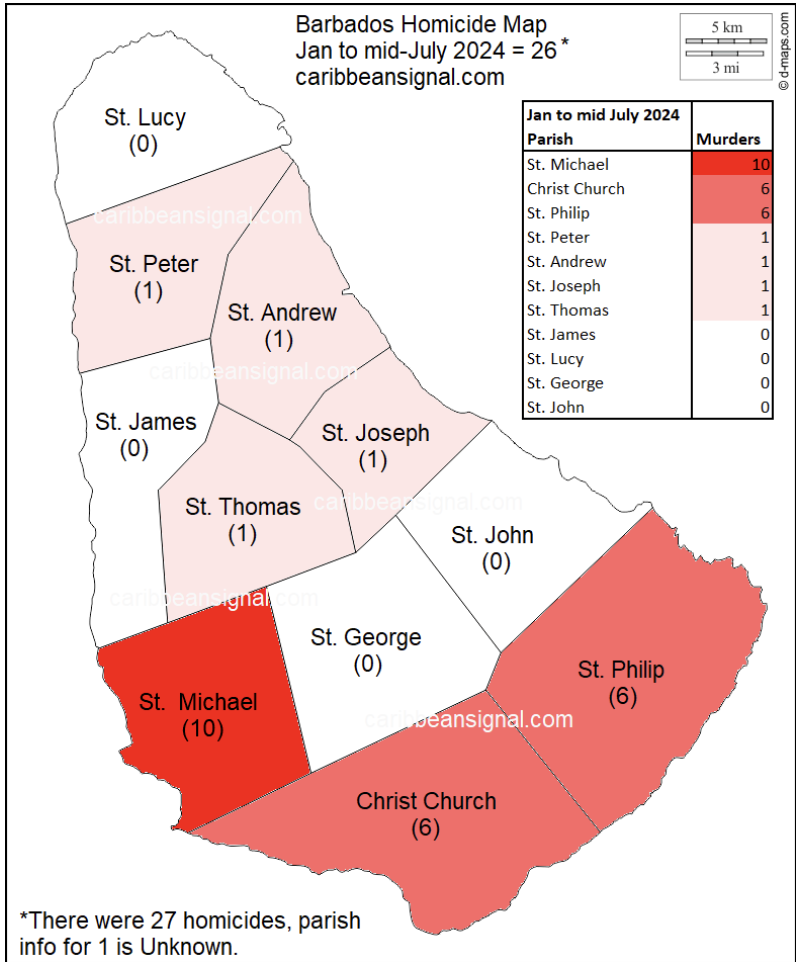
Amit at caribbeansignal.com has done a public service to provide some analysis of the number of murders committed for the year to date to give deep reflection.

A lot has been written and commented about the escalating crime situation, however, the blogmaster remains unconvinced leaders in government and non government are confident the tepid, knee jerk approaches being introduced will be effective.

The blogmaster repeats a call for Barbados to declare a state of emergency to fight crime. In a case of extreme circumstance, extreme measures must be taken. A state of emergency can have defined powers to give the Barbados Police Service (BPS) unrestricted right to frisk, search and inquire of citizens. Our small society is hurtling towards a precipice and the ‘business as usual approach‘ to addressing the problem will fail.

The fact that crime in the region is also on the increase does not bode well to stave off the contagion effect.

It was agreed that a joint CARICOM/UK consultation would focus on a framework for coordinated action for crime prevention and security, the challenges of the drug trade, improving interdiction, tackling the proliferation of illegal weapons and enhancing the Region’s capacity to tackle crime.

Caricom website

As far back as March 2004 the CARICOM Ministerial Sub-Committee for Resource Mobilisation for Crime and Security met with UK Prime Minister Tony Blair to discuss implementing a framework to tackle crime in the region. It is 2024, two decades later, we are hearing calls to declare crime a ‘public health issue’ and a ‘national disaster’. The evidence to date confirms we are failing to effectively arrest rising crime in Barbados and the region.

What is scary is that enforcement represents one component in a strategy to fight crime. Barbados has joined the world to define development of the country mainly in economic terms. In the nineties our leaders discussed development in the context of Human Development Index (HDI) which sought to capture richness of human life, rather than simply the richness of the economyUN HDI. Barbados was 38th in 2013 compared to 60th in the most recent global HDI ranking. There are few if any measures available to show that Barbados has significantly advanced as a society although politicians will disagree.

We are at a time in our history we have to dissolve partitions that polarize us and come together to make light work of our problems. If we do not, Barbados will become a failed society.


Discover more from Barbados Underground

Subscribe to get the latest posts sent to your email.

70 responses to “Barbados crime analysis – Jan to mid-July 2024”


  1. Call for cops to build greater trust

    By Ashada Joseph

    Gun violence is a multifaceted problem with the most commonly identified cause being socio-economic conditions.

    That is the view of Professor of Management and Organisational Behaviour in the Department of Management Studies at the University of the West Indies, Cave Hill Campus, Dwayne Devonish.

    “I’ve found that both males and females who have offended and were currently incarcerated came out of frustrated socioeconomic conditions. They came from an environment where they were exposed to violence, drugs or gang violence. They were also those who had limited opportunity for making a legitimate income and finding legitimate employment.”

    These frustrations, he said, were what pushed the younger men towards a life of crime where there was a perception that opportunities were limited.

    “Another factor that is associated with this issue is that people come out of households and communities where there was a lack of positive mentorship and role models,” he added.

    Devonish said there was no access to conflict resolution or anger management interventions in communities, schools or in homes which caused people to resort to violence as a matter of recourse. “This then creates a cocktail or a recipe for the kind of criminality we are seeing currently.”

    Unmonitored flow of firearms

    Devonish said not enough was being done to tackle the unmonitored flow of firearms coming into the country through legitimate ports.

    “We have an unregulated flow of illicit firearms coming into the country. With this unregulated flow of firearms coming into the country, we then have this unmonitored access of illicit firearms by young people from these same spaces,” he noted.

    Devonish is also concerned that gun violence places a greater risk on the livelihoods of those in the general public. “When people shoot in the open air anyone can be shot. Anyone can be at risk of being injured or killed by a stray bullet. The rivalling gangs and parties just shooting and killing each other and putting innocent people at risk.”

    He expressed concern that the young men and women who found fewer legitimate opportunities to make an income or have sufficient financial resources for themselves, were likely to direct their attention towards criminal activity.

    “From a victim perspective, a lot of these young men who are potential productive agents to society are losing their lives, leaving not just their families in significant grief or bereavement but also leaving their families in significant debt and costs associated with their victimhood,” he said.

    He called for a more vigilant society where people observe and report crimes anonymously and safely to the relevant authorities. “I know not everyone is going to observe a crime and report it. From my research there are two reasons why people observe crime and fail to report it. One, there is a lack of trust in the police services and two, there is a fear of reprisals, especially from those who are being reported to the police and relevant authorities.”

    Community policing network

    Devonish said there needed to be a stronger community policing network and relationships. “Police officers need to build greater trust from those they serve in the community. He, therefore, called for conflict resolution programming to be introduced to schools and communities. “We need to find ways to divert the young people from a life of crime by offering alternative programmes that are equally or more attractive. “We also need to look at rehabilitation in our prison system. We can’t just focus on the preventative at the expense of the curative or what I call the tertiary level intervention. A lot of young people go into prison, they come back out and go back into a life of crime. That suggests that several things are at play here.” He said there were questions about efficacy of rehabilitative programmes in places like prison, the Government Industrial Schools and juvenile facilities.

    “It also brings to question the efficacy of our reintegration because reintegration comes slightly after rehabilitation. Where you are looking at building networks with these young people who are going back into society. They have served their time and are going back to a society that is ready to welcome them,” he said.

    “There are a lot of issues with our reintegration programme. A lot of young men have complained about the stigma associated with their form of conviction. The stigma from employers when trying to apply for jobs.

    “They want to live above board but have significant difficulty in securing a job because of the stigma related to their conviction,” he said.


    Source: Nation


  2. Revisiting Bail Act way to go

    By Rennette M. Dimmott

    The recent surge in crime in Barbados is beginning to have a negative impact on the mood of Barbadians, and how they function.

    Government has recognised the implications of this scourge on the manner it continues to impact Barbadians, and on the loss of lives. Join me in commending the Government for exercising their governmental power to seriously revisit the Bail Act Cap 122.

    Examining the implications of granting bail to remanded individuals charged with murder, and other violent firearm offences, places a greater responsibility on the state.

    The question on Barbadian minds is, “What can the government do to decrease crime and revitalise communities?

    Revenge killing and personal vendettas in recent times seem to be reasons for the recent killings by gun violence. However, on further assessment, this is not the case with every killing encounter.

    The primary function of the legislative arm of Government is to make laws for peace, order and good governance. It is also vested with the power to enact new laws, amend existing laws, and place limits on negative behaviours in the society.

    This is important so that these behaviours do not interfere with how other law abiding citizens live and function. In this regard, public safety becomes paramount in protecting the well-being of individuals in communities across Barbados.

    Therefore, it is the responsibility of the ruling Government to manage with an iron fist in this situation. This is critical, especially if they assess that a small segment of the society has set out to create havoc by engaging in gun violence, and committing other criminal offences.

    The balancing of the public interest is also key, and therefore Government has the power through the tinkering of the Constitution to curtail the rights and freedoms of some in order to protect the rights and freedom of others and the public interest of citizens.

    Since the Constitution of Barbados does not afford any rights to bail, the legislature is armed with the notion of restricting bail in capital cases for safety reasons. However, the nature of the offence must be considered. It is to be noted that some constitutions all over the world have consistently upheld the right to deny bail in capital cases.

    Rennette M. Dimmott is an attorney, forensic psychologist and former candidate, Christ Church West Central.

    Source: Nation


  3. I watched Chi-Raq Spike Lee’s musical crime comedy drama film about gang violence in Chicago where children were killed in the crossfire and ricochet of warring gangs

    The story is based on Aristophanes’ Lysistrata, a classical Greek comedy play in which women withhold sex from their husbands to put an end to the Peloponnesian War.

    In the film the Lysistrata moves in with Miss Helen Worthy, a well-read non-violence advocate who suggests she research about Leymah Gbowee, who led a peace movement to stop the Second Liberian Civil War and threatened a sex strike.

    Inspired by Worthy and Gbowee, Lysistrata organizes a meeting between herself, the Spartans’ Gang’s lovers and the Trojans’ Gang’s lovers, where they agree to withhold sex until the men agree to lay down arms, hence their plea, “No Peace, No Pussy.”

    The strike rapidly spreads across the city, with women of many neighborhoods and occupations joining the boycott.


  4. Anti-gang laws ‘among options’

    THE DEMOCRATIC LABOUR PARTY (DLP) administration drafted anti-gang legislation when it was in office six years ago.

    This was revealed by Attorney General Dale Marshall yesterday in response to criticisms by Opposition Leader and DLP political leader Ralph Thorne, who suggested last week that Government should consider such laws as another solution to deal with the increasing gun crimes.

    Marshall said Government had looked at anti-gang legislation but it was also discussed by “the last administration” as he advised Thorne to find out why the DLP never brought it to fruition.

    “They went so far as to have a draft of anti-gang legislation. Why they did not pass it? I don’t know. I believe that the Opposition should speak to the last Attorney General and ask him for it,” he said, while stating that the Mia Amor Mottley administration had not ruled it out.

    “As I said, no options are off the table. It is something that I, as AG, am considering. It is something that I am, when I consider it, I will have a discussion with Cabinet and see if I can get Cabinet’s feel on it. But I will not say that the Government, at this time, has made a determination about anti-gang legislation. It’s something that we spoke about previously.”

    In reference to Jamaica and Trinidad which have such laws, Marshall pointed out that Jamaica only used it twice: “So anti-gang legislation will not be a panacea. We already have laws against killing. We already have laws against having firearms. We’ve increased the penalties. In other words, we can throw as many laws at this thing as exists. We will have more laws than we can, than we have pages to put them on. The problem is not in the laws . . . . Some of these things are very faddish and faddish,” he noted, adding that Bermuda had introduced such legislation earlier this year and he would wait to see what was its experience.

    Meanwhile, he gave the assurance that the new Bail Act will be taken to the House of Assembly shortly.

    “I expect that a new Bail Act will be before Parliament, not tomorrow (today), but by the following week. Bail and how it is dealt with in the courts is something that we recognise, and the Prime Minister announced it, something that we have to grapple with. We think that we have a solution for it, a more, if I use the word, robustly . . . but we think that the judicial system can operate on bail applications in a way that will have greater regard to the safety of Barbadians.

    “So I’m satisfied that the Government is doing, maybe we’re not doing all that we can, because there’s always something else that you can do. But in terms of our social programmes, in terms of our law enforcement, the Barbados Police Service has the largest budget ever in its history this year. Last year, they had the largest budget in history up to then. So we’re making sure that they’re not starved for resources. We’re doing all of these things to try to keep Barbadians safe.”

    The Attorney General also said police were using all of their resources to deal with the high number of violent crimes and had ramped up their efforts.

    “The last week has been quiet. I hope that we will have many, many, many more quiet weeks,” Marshall stated. (MB)

    Source: Nation


  5. Women flocking to become police officers, says AG

    A LARGE NUMBER of women are applying to join the Barbados Police Service and steps are being taken to accommodate them at the Regional Police Training Centre (RPTC).

    This was disclosed by Attorney General Dale Marshall yesterday during a signing agreement for the United States government to make a contribution of US$550 000 for the purpose of doing remedial work and renovations at the Seawell, Christ Church facility.

    He said Government will also be investing $6 million to build two new dormitories as well as undertaking remedial work on the building to make it more modernised.

    While recruitment has been a significant challenge in recent years, Marshall said it started to pick up with more than 60 recruits at the last graduating cohort compared to a low of only 18 a few years ago.

    “We’ve done a lot of advertising and marketing and so on to try to get people into policing and I think those efforts have begun to bear fruit. I would like to say, though, that our recent experience shows that more women, or let me be more accurate, a larger number of women than previously, are applying to join the police service,” he said.

    “We’ve had a difficulty accepting those increased numbers because the current dormitory accommodation is limited to just 22. We don’t have unisex dorms. If we did, we could probably accommodate many more people. So we can only accommodate 22. So every year we have to turn away a significant number of women simply because we can’t physically accommodate them. This investment by this assistance from the US is going to be to remediate the existing plant.”

    He explained that the new dormitories will accommodate 30 recruits from each sex, allowing the RPTC to add an extra 60 recruits to the 22 it can now accommodate.

    “I can say that no options are off the table at this time. But naturally we prefer to try to recruit our police officers from among Barbadians. We’ve not taken a decision to recruit officers from outside of Barbados. But you will all know that Barbadian police officers have been recruited in fewer numbers now but in the past they’ve been recruited to go to work in BVI (British Virgin Islands), Bahamas, Bermuda. In recent times they’ve even been recruited to work for the US Embassy, which speaks to the quality of officers that we produce . . . .

    Overseas recruitment

    “If our efforts at recruiting Barbadian officers don’t yield the fruit that we want, I believe the time will have come at that point to look to recruit officers from overseas. There are advantages to this but there are obviously some things that we’d have to figure out, housing and so on,” he said.

    He said efforts were still under way to boost the constabulary’s overall number to 1 500 as he revealed that at present, it stood at 1 251 with an additional 46 special constables.

    “Perhaps our first point of analysis is trying to determine what is our optimum number as opposed to what is the number that has been in existence for 40 or 50 years. I would like to see us achieve that number because I think it will take pressure off the officers and it will allow us to concentrate resources of a more specialised nature into various departments. But that is the number we have and that is the number we want to reach,” he said about getting the police service to 1 500-strong. (MB)

    Source: Nation


  6. Some articles in the newspaper are not meant top be funny, but when you read them they bring a smile to you. For decades, we have been hearing of a shortage of police and our inability to recruit and we have now come to learn that women are being turned away because of accommodation facilities.

    That bit of news is not reassuring as my wife sleeps in the same bedroom and uses the same bathroom as I do. What did I miss? A m I married to a man?
    Today, to calm my fears, I will sneak into a women’s bathroom and see what additional equipment is needed. A divorce lawyer is on standby.

    Solve the problem. Make the minor changes needed to accommodate the women and increase the size of your police force. But I guess there are no billions in putting “Women” on a bathroom door.

    Just like corrupt shit, silly shit disgusts me.

    From BarbadosToday
    AG ADMITS
    WOMEN DENIED ENTRY TO POLICE SERVICE. MARSHALL EXPLAINS WHY.
    A significant number of women are being turned away from joining The Barbados Police Service (TBPS) each year due to insufficient accommodation facilities, Attorney General Dale Marshall revealed on Monday.

    Speaking at a signing ceremony to launch the partial renovation of the Regional Police Training Centre, Marshall admitted: “Every year we have to turn away a significant number of women simply because we can’t physically accommodate them.”
    The attorney general highlighted ongoing challenges in police recruitment: “Recruitment of police officers is obviously a challenge. I’m happy to say we’ve done a little bit better in the last two cohorts than we had previously when I became AG.”
    Marshall noted a concerning trend in recent years: “I think in my second year as AG we saw the recruitment class drop as low as 18. That tells a story when you only have 18 young men and women interested in joining the police service at any given time.”
    But, he reported some improvement: “Our last graduating cohort, I think the number was just over 60.”
    The attorney general acknowledged that the police service has struggled to attract young people for many years and has failed to meet the required enrolment established four or five decades ago. Currently, there are 1 251 police officers and 46 special constables in service.
    In a move to address the accommodation shortage, Marshall announced a partnership with the United States to build two new dormitories at the Regional Police Training Centre. The project involves a $6 million investment from Barbados and $1.1 million from the US government.
    “In addition to the existing capacity, we will have the ability to add an extra 60 recruits if we could reach that capacity,” Marshall explained. Each new dormitory will house 30 recruits.
    US Ambassador to Barbados Roger Nyhus emphasised Washington’s commitment to improving regional security in the Caribbean.
    “Regional security is one of the most important issues we work on on a daily basis,” he said. “From the RSS [Regional Security System] to CARICOM IMPACS [Implementation Agency for Crime and Security] to so many other organisations that are really designed to do one thing —make it safer for the people of Barbados and those who visit that they people should not be fearing violent crime, they should not be fearing any sort of crime in an ideal world.”
    Ambassador Nyhus added: “I think having these enhanced facilities will make it easier for folks from throughout the region to come and get trained and it’s something that the US fully supports and hopefully we will continue to make investments in this area.”
    The signing ceremony took place at the Attorney General’s Office in Webster’s Business Park, Wildey.
    (SZB)

    **Note from The OG…
    A story like this should have mentioned the number of women in the force. A next swipe. A next six.


  7. I read the article above “Police probes at standstill” by Maria Agard and felt sick to my stomach.

    Miss/Mrs Agard would have had a better and more sensible article if she had decided to interview me. That officer was just spinning and the truth is “I love spin, but that bad, awful, ignorant and lying spin repulses me and leaves me disgusted..

    Miss Agard, for you next interview, please contact me. Icannot be any worse.

    After reading that, I have to bathe… Be right back.


  8. Two balls, two swipes and two sixes.
    Allow me to show you my spin bowling.

    I now solve the problem of accommodating women police officers and thereby IMMEDIATELY INCREASING THE SIZE of the police fore and
    LEADING TO A SHORTEN TIME TO police response without spending a penny.
    Let me repeat “WITHOUT SPENDING A CENT”.

    Hobble together ten of those steal houses, get a few unemployed workers to make some internal changes and you have a police dormitory with ten bathrooms.

    Do you see how some big problems can easily be solved.
    —x–
    You! Yes, you! Don’t come here saying that the government would still have to spend money. The cost of hobbling together these ten STEAL houses was already in that BDS $60M.
    You! Yes you! I did not mention Mia, so don’t come here talking about party and Mia. Enuff of that.

    It should be noted that The OG did not receive a national award.


  9. Why doesn’t Ms. Mockley do like Mexico and other coubries in the world and send the criminal element to America?

    https://insightcrime.org/news/venezuela-crime-rate-falling/


  10. A holistic approach on crime

    The call for a holistic approach to crime is coming from various corners of the society. It is an admission or realisation that we’ve been doing things in a compartmental, piecemeal and disjointed manner up to this point. If those calls are serious and we are to really address crime in a holistic manner, there are some hard truths which we will have to face. Looking at things holistically calls for us to look at realities we may normally avoid in places we may normally overlook and make connections between factors we would prefer to keep apart.

    A holistic approach to crime will make connections between our history and our contemporary situation. This entire region was founded on the crimes committed against the indigenous population and the enslaved and indentured people who were brought here. The fact that these were legal acts at the time gives us some perspective.

    What is lawful is not necessarily right nor just. Crime is a matter of perspective. A legal system itself can be perceived as criminal. Our society is rooted in, based on, and a branch of normalised crimes from history. To address crime holistically requires interrogating old perspectives and taking radically new ones.

    Many people take the perspective that religious organisations should play a major role in addressing the crime problem. In a holistic approach, we have to admit the criminal role religion has played throughout our history. The crime of the Islamic slave trade destabilised African societies, paving the way for Europe to take over.

    The crime of the European slave trade was seen as a duty for Christians who saw themselves as bringing God to the heathens. The caste system of India is wrapped in religious notions. Its colourism came to the Caribbean as the cultural baggage of indentured labourers. Even traditional African religions are implicated.

    For example, what was the role of the African spiritual systems like Ifa, which allowed its adherents to cooperate with European slavers? A serious holistic approach requires us to do some soul searching to make the connection between history, religion and crime and reassess our religious perspectives.

    It is hard though, to make a distinction between religious motivations and economic motivations. Historical crimes which were wrapped in religion, were often business decisions at their core. With members of the business community calling for holistic approaches to crime, it would be good to do a holistic reassessment of our business culture.

    Does an economic philosophy and approach, which is basically a tool of colonialism designed around the exploitation of the majority of the population and has profit as its primary and possibly sole value, have a role to play in the proliferation of crime?

    Does a business class which approaches society from the same or a similar perspective of the plantation provokes unrest and rebellion? A serious holistic approach requires us to do some soul searching to make the connection between our approach to economics, business and crime.

    Any holistic perspective and approach calls for some introspection and for collaboration between diverse entities. It calls for a re-education to develop an unaccustomed holistic way of thinking and new holistic perspectives. This is especially so in the context of Caribbean and African people with our history of miseducation.

    Naturally, government is best placed to oversee such a massive and complex operation. The question is, can a culture, with such a crime riddled root, with so many influential and powerful persons highly educated in deeply unholistic approaches, where the perspectives of party, profit and political expedience dominate, really look itself in the mirror and face the hard truths it has to face to take truly holistic approaches to crime? Call me crazy but I believe we can.

    Adrian Green is a communications specialist. Email adriangreen14@gmail.com

    Source: Nation


  11. Stemming the crime wave

    By Peter Laurie

    Over the last 25 years, Barbados has been experiencing an unusually high number of serious and violent crimes, with murder, armed robberies and reckless violence among the youth becoming quite alarming. This has been accompanied by excessive involvement in the drug culture, both in supporting transshipment operations and in the increasing use of illicit drugs across all sections of the society. This is a quote from the 2004 Report of the National Commission on Law and Order, chaired by the late Sir Roy Marshall.

    Plus ça change, plus c’est la même chose?

    My point is that the spate of gun violence is nothing new. And all this wringing of hands about instilling values in our children is beside the point. The gun violence itself is closely related to the trafficking in illegal drugs and firearms. The young men are mere pawns who slaughter each other while the kings and queens and knights and bishops reap the sweets of the trade.

    Operations

    Four things need to be done.

    Go after the traffickers with illegal drugs and guns. Now, I don’t know what is actually being done. But it should involve intelligence and sting operations onshore by specialised law enforcement units and vigorous interdiction by the Barbados Defence Force (BDF) Coast Guard and RSS offshore. Indeed, the BDF should play a leading role.

    Legalise marijuana/ cannabis for recreational use. Also have a careful study done on the pros and cons of decriminalising other specified drugs. Decriminalisation means the elimination of criminal penalties for drug use and possession of small quantities of drugs for personal use. In essence, we should start treating drug use as a health issue rather than a law enforcement problem.

    Just imagine if we banned alcoholic drinks or tobacco products. Illegal trafficking and gun violence would immediately follow.

    It is sociologically well established that crime and poverty are closely related. We are here talking about the pawns or foot-soldiers who are often tempted into the drug business as a way out of poverty. Poverty, in turn, is closely related to our educational system which celebrates the cream and largely ignores those at the bottom. I trust that the educational transformation taking place will address this problem. More remedial and extra-curricular support is needed for all our young people.

    Another solution that would help is the provision of a universal basic income for all citizens that would ensure that no one falls below the poverty line.

    Now, a universal unconditional annual income paid to every citizen, even set at $10 000 a year, would bankrupt the Barbadian economy.

    But remember: think big, start small.

    So, say we start by making it universal but not unconditional. For argument’s sake, Let’s set the universal basic income at $10 000 for every Barbadian citizen 18 years or over who is not in prison. We might also impose a condition that anyone between the ages of 18 and 30 would receive it only if they were enrolled in an educational institution, a training programme or apprenticeship, employed or self-employed, or an unpaid caregiver.

    Then, we might also impose a reduction rate on income earned above $10 000 so that you would gradually claw back the benefit to a point where anyone earning an income of, say $40 000 or over would not receive any of the BI. People with disabilities would be exempted from the clawback. In addition, if earned income above the universal basic income is taxed at low marginal rates, this would provide a strong incentive for recipients to work and earn more.

    Furthermore, to begin and continue receiving the universal basic income you would have to submit an income tax return. This might draw some of those working in the informal sector into the tax net.

    Go Kamala

    I have been temporarily shocked out of my cognitive decline by the announcement that Kamala Harris is now the Democratic candidate for the presidency of the United States.

    Have no fear, though, the campaign will now get extraordinarily brutal and nasty. She is the complete antithesis of everything that Donald Trump and the far-right MAGA movement stands for: heterosexual male dominance, white supremacy, misogyny, and Christian theocratic nationalism (that is, that government and laws should be based exclusively on Christian doctrine). Not to mention sucking up to the rich and powerful in the vain hope that some of their excessive wealth trickles down.

    The campaign now can be framed differently: the young up-andcoming versus the old has-been; the intelligent, articulate woman versus the orange-faced gibbering moron; the prosecutor versus the criminal.

    Kamala’s statement after meeting with Netanyahu was brilliant. That is a tricky issue which she handled expertly.

    The Democrats should now easily hold the Senate and take back the House. Indeed, I expect Kamala to win in a landslide (60 per cent of the popular vote and 300-plus of the 538 Electoral College votes).

    I suspect Trump, rather than go to prison, will flee to Orban’s Hungary or Putin’s Russia after losing the election and failing to incite another coup.

    As for her running mate, I would go with a bold in-your-face choice: Gretchen Whitmer, Governor of Michigan. She’s another badass woman. Go Kamala. Go Gretchen.

    Peter Laurie is a former head of the Barbados Foreign Service.

    Source: Nation

  12. Cuhdear Bajan Avatar

    “…the spate of gun violence is nothing new. And all this wringing of hands about instilling values in our children is beside the point. The gun violence itself is closely related to the trafficking in illegal drugs and firearms. The young men are mere pawns who slaughter each other while the kings and queens and knights and bishops reap the sweets of the trade.”

    Peter Laurie in today’s Sunday Sun, page 28.


  13. “… the spate of gun violence is nothing new …”

    I heard a story of a magistrate pulling a gun in someone. Have not seen any follow-up on that story. Do you know that is also gun violence? To the victim, as their life flash before their eyes, this act is worse than the intimidation or fear caused by a social media post of an idiot.

    But hypocrisy is nothing new to the island. It is going to kill all of you. Folks are quick to rush out and point fingers at some segments of the society but are dumb, deaf and blind when it comes to other segments.


  14. That story will come out. I am convinced it will not come out as a new story but as a short story when a person is recounting some of the ills of Barbados. One of those stories that is never fully documented but will be cited.


  15. The lull in murders illustrates one thing and it is not what you would rush and think.

    We wrung our hands and cried out in anguish when there was an outbreak in murderous violence and we are now silent and anxious in the lull. At some stage, a government official on seeing how the wind is now blowing will step to the microphone and take the credit.

    I should urge you to ask the minister what is the reason or what he did to slow the tide, but I will not. For I know that these doers of nothing probably have a fully prepared script to explain how their policies (or lack of policies) brought crime to a halt.

    What we are seeing is not a result of ministerial efforts, but it is the natural ebb and flow, the ‘spikes’ and the valleys and some of the randomness of these acts.

    I am begging you, please delay on passing out credit to minister and if you do, please be generous in sharing blame when it is due. Yes, the lull may just be ‘things taking their course’


  16. so how EXACTLY do YOU know that ministers are not working behind the scenes, and as a result, impacting the situation on the ground…?

    Is it that no minister has spoken to YOU?
    …or is it that no statement has been made on BU?

    Give it a rest TheO…. even if you are right.


  17. I will concede that you have a sound point though it was pulled out of thin air.

    I rely on the existing record to make my statements. It would be a stretch too far to believe that a record of outright failures and mismanagement could deliver a ‘miraculous’ and successful performance. I am fully aware that a ‘blind squirrel may occasionally find a nut’ but I doubt this motley bunch of squirrels can find themselves far less a nut.

    If this government or mismanagement, through its efforts, has managed to stem the tide of violence, then it must have received help from outside.

    This is very likely, as we cannot send forces to Haiti whilst our own island is in crisis. Yes, external forces may be providing our bunch of incompetents with support.

    I still believe that we are seeing the natural ebb and flow, the ‘spikes’ and the valleys and some of the randomness of these acts.

  18. Zdahuti Ankh Amun Hatap Avatar
    Zdahuti Ankh Amun Hatap

    I think that with today’s level of technology, crime can be contained if that was what is desired. In my humble opinion, crime is a billion dollar industry, so why would anyone want to hinder that which is financially beneficial across the board. a significant reduction in crime is proportionally equal to unemployment. Less work for lawyers, policemen, prison officers, security guards etc.


  19. :In my humble opinion, crime is a billion dollar industry, so why would anyone want to hinder that which is financially beneficial across the board.:

    America wants to stop other peoples crime so they can be #1
    the biggest richest gang in the whole world and other countries bow down to them

    So they implemented Anti-money laundering laws and started the drug wars
    but the CIA are the biggest drug smugglers warmongers and money launderers
    they call it ‘black’ ops which should more accurately be called ‘white’ ops

The blogmaster invites you to join the discussion.

Trending

Discover more from Barbados Underground

Subscribe now to keep reading and get access to the full archive.

Continue reading